Omkareshwar
ओंकारेश्वर
The Jyotirlinga where the island itself takes the shape of Om
Khandwa, Madhya Pradesh, India
OṁkāreśvaraAlso known as: Omkar Mandhata, Shri Omkar Mamleshwar Jyotirlinga, Pranavalingam, Omkareshwara Mahadeva, Mandhata Lingam
The Sacred Legend · पवित्र कथा
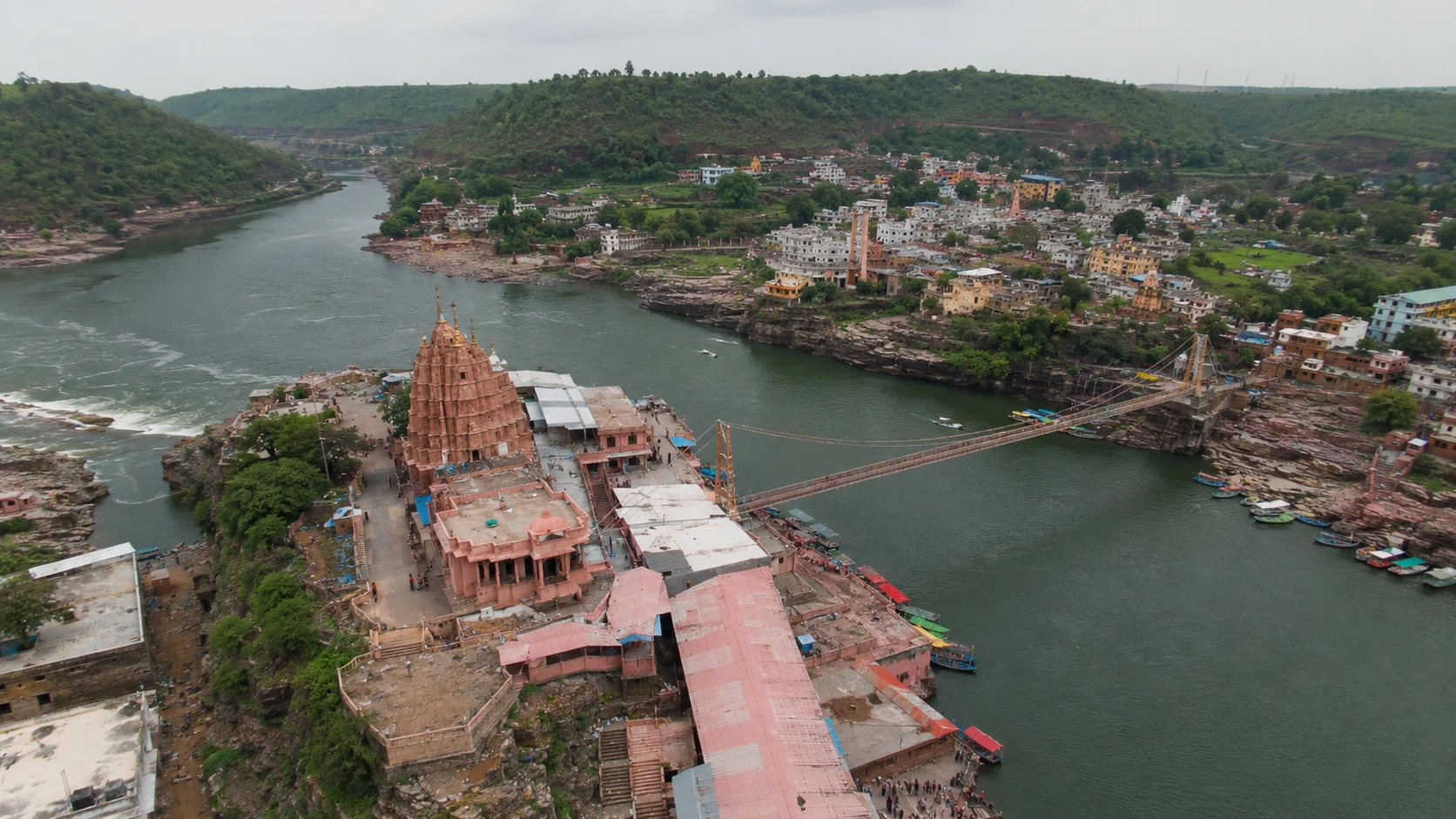
Omkareshwar is the Jyotirlinga of the Pranava, the primordial syllable Om made manifest in stone, on an island shaped like the very symbol that opens the Vedas. Set on Mandhata island in the Narmada river in the Malwa-Nimar region of Madhya Pradesh, the temple sits where the river divides and rejoins, tracing the contours of the sacred glyph. According to the Shiva Purana, when Vindhya mountain prayed to Shiva for liberation from inferiority before Meru, the Lord appeared as a single Jyotirlinga that split into two abodes, Omkareshwar on the island and Mamleshwar on the southern bank, and a tradition older than memory holds that both together constitute the fourth of the twelve Jyotirlingas. The temple is also the place where Adi Shankaracharya is said to have met his guru Govinda Bhagavatpada in a riverside cave and received initiation into sannyasa, an event commemorated in 2023 by the inauguration of a 108-foot bronze Statue of Oneness on the island. Pilgrims complete a seven-kilometre circumambulation of the entire island, the only Jyotirlinga where the parikrama traces the form of Om itself, bathe in the Narmada, and end the day at the famed Shayana Aarti, when Shiva and Parvati are believed to descend each night to play chausar on a board laid out in the sanctum.
Sacred Designationपवित्र पदनाम
4th of 12 Jyotirlingas
बारह ज्योतिर्लिंगों में 4th
Historyइतिहास
Omkareshwar's documented history reaches deep into the Indian past, with the site recognised as a major Narmada tirtha by the late epic period and as a fully developed Saiva centre by the early medieval era. The Mahabharata's Tirtha Yatra Parva includes the Narmada bend and its surroundings in its catalogue of holy places, and the Skanda Purana's Reva Khanda, composed in layers between approximately the 7th and 12th centuries, treats Omkareshwar as a tirtha of the highest order.
The site's prominence in the Saiva canon is anchored by the Dwadasha Jyotirlinga Stotram, where the line 'Omkare Mamaleshwaram' fixes the temple in the company of the twelve, an enumeration that became normative across north and central India by the early medieval period.
Inscriptional and architectural evidence places the construction of the principal surviving structures within the orbit of the Paramara dynasty of Malwa (c. 9th, 13th centuries), which patronised Saiva institutions across the upper Narmada and the Malwa plateau; Bhumija-style elements in the temple's tower and outer mandapas point to this lineage.
A foundational tradition, recorded by the Saiva mathas and recounted in many hagiographies of Adi Shankaracharya, holds that the boy Shankara journeyed to a riverside cave at Omkareshwar to meet his guru Govinda Bhagavatpada, a disciple of Gaudapada, and there received initiation into the sannyasa order.
The cave, identified locally as the Adi Shankara Gufa, remains a venerated site on Mandhata island, and the meeting is dated by traditional reckoning to the early 8th century, though academic scholarship places Shankaracharya's life across a wider band from the 6th to the 9th century.
The medieval period saw the region absorbed into the Delhi Sultanate's sphere following the conquests of the Khalji and Tughlaq dynasties, and the temple, like other Saiva shrines of central India, suffered episodes of disturbance and rebuilding.
Detailed contemporary chronicling for these centuries is sparser at Omkareshwar than at Somnath or Ujjain, and historians continue to debate the degree and dating of damage and restoration. The early modern period brought renewed and lavish patronage from the Holkars of Indore, particularly under Ahilyabai Holkar in the late 18th century, whose programme of Saiva temple restoration along the Narmada included the Omkareshwar mandir's repair, the building of ghats, and the consecration of a series of subsidiary shrines.
The Maratha-era additions are responsible for much of the visible fabric a modern pilgrim encounters, layered atop the older Paramara core. In the post-independence period, the construction of the Omkareshwar Dam (operational 2007) and the Indira Sagar reservoir upstream reshaped the lower Narmada landscape, raising water levels and altering several traditional ghats.
The most consequential recent development is the inauguration on 21 September 2023 of the 108-foot bronze Statue of Oneness (Ekatma Pratima), commemorating Adi Shankaracharya at the site of his sannyasa initiation, as the centrepiece of the Madhya Pradesh government's Ekatma Dham project, the largest commemorative installation for an Indian acharya anywhere in the world.
Historical Timelineऐतिहासिक कालक्रम
The dating of Adi Shankaracharya's life is one of the most debated questions in Indian intellectual history. Traditional Saiva math chronologies place him at 788, 820 CE; alternate scholarly proposals place his life as early as the 6th century or as late as the 9th. The historicity of the Omkareshwar meeting itself is, however, attested in all the major Shankara hagiographies and is not seriously contested in either traditional or modern accounts.
The historiography of medieval damage and rebuilding at Omkareshwar is less developed than for the more famously contested Jyotirlinga sites. Specific episodes, dates, and the extent of disturbance remain debated among regional historians. We present this period in summary rather than asserting unverified specifics.
What You'll Seeदर्शन में
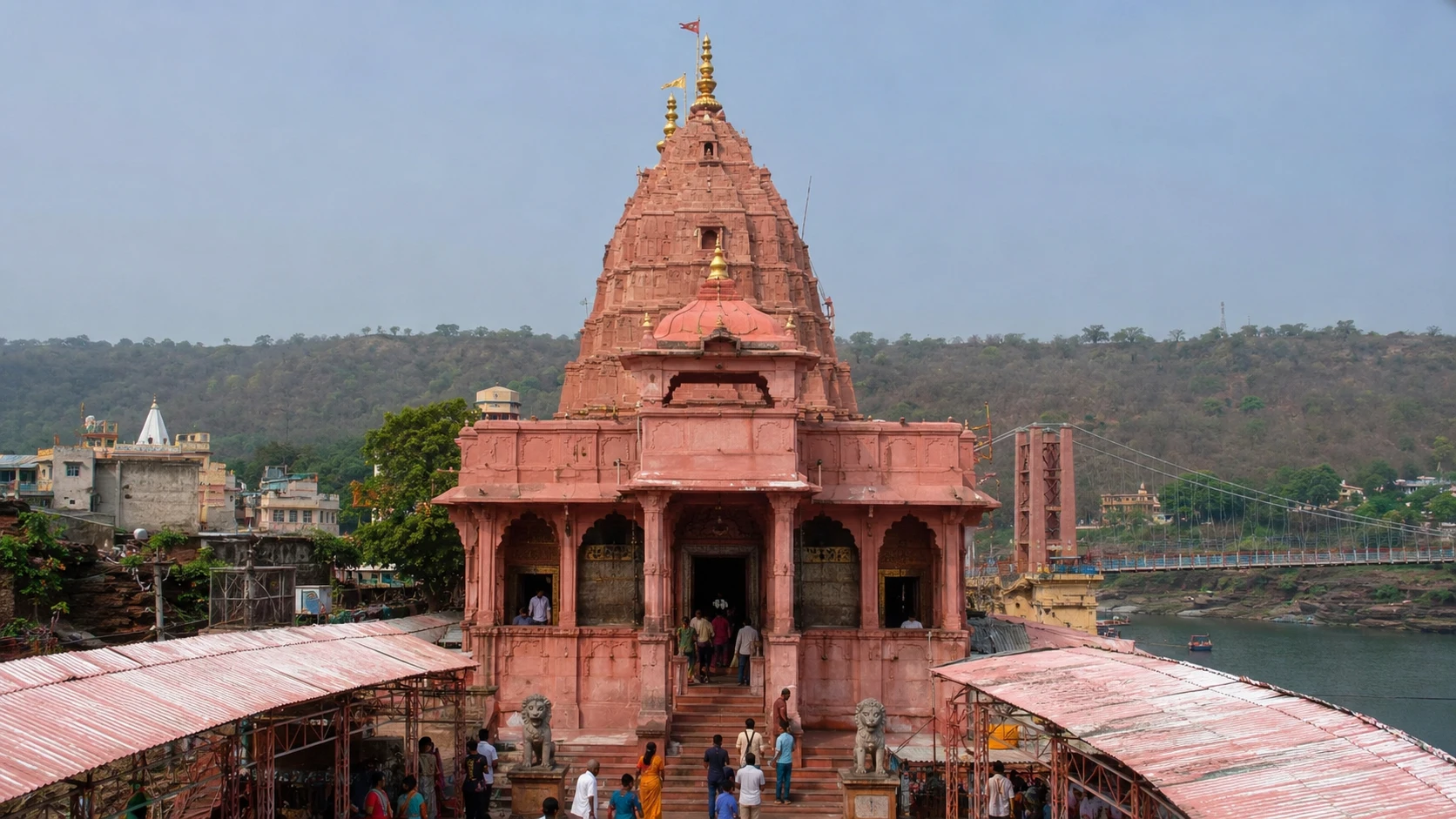
The Omkareshwar Jyotirlinga is enshrined in the lowest level of a multi-tier temple complex on Mandhata island, set within a sandstone garbhagriha approached through a low, columned entrance that requires devotees to bend in reverence on entry.
The lingam is svayambhu, naturally formed and not carved by human hands, and is one of the principal sites where the lingam is said to emerge directly from the bedrock of the island; it is therefore neither installed atop a yoni-pitha nor centred in the conventional manner of an architecturally consecrated lingam.
Strikingly, the Omkareshwar lingam is positioned slightly off-centre in the sanctum, an unusual placement that local priestly tradition explains as faithfulness to the natural emergence of the rock and never artificially adjusted. The lingam is bathed daily in Narmada water, garlanded with bilva leaves and seasonal flowers, and offered milk, ghee, and fruit.
Photography within the sanctum is strictly prohibited at all times, in accordance with rules administered by the Omkareshwar temple trust. The temple complex is structured in five superimposed levels, each housing a Shiva shrine, beginning with the principal Omkareshwar Jyotirlinga at the lowest level and rising through additional shrines (often identified as Mahakaleshwar, Siddhanath/Siddheshwar, Gupteshwar, and Dhwajadhari Mahadev, though local sources vary on the exact identification and order of the upper four), a vertical stacking of Saiva sanctums unique among major Indian temples.
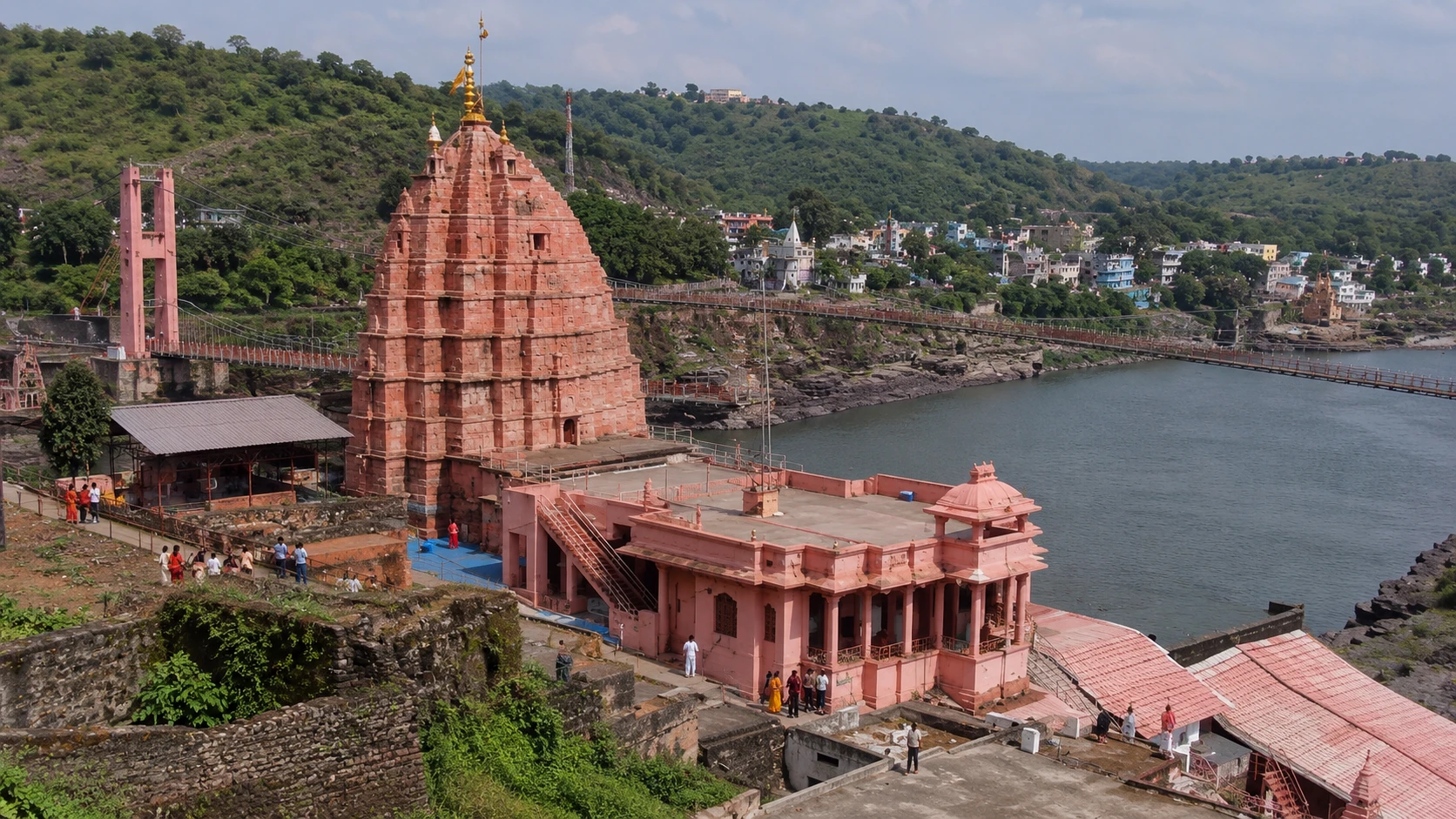
The principal shikhara is in the Bhumija sub-style of Nagara temple architecture, characterised by miniature shikhara replicas (urusringas) ascending the main tower in lines that radiate from the centre. Subsidiary shrines on Mandhata island and on the southern bank, including Mamleshwar, Siddhanath, Gauri-Somnath, the 24 Avatar shrines, and several smaller temples, together form a sacred landscape that pilgrims traverse during the seven-kilometre island parikrama.
The complex is administered by the Shri Omkar Mandhata Mandir Trust under the Madhya Pradesh Public Trust Act.
Distinctive Practicesविशिष्ट परंपराएँ
Island Parikrama (Mandhata Parikrama)
द्वीप परिक्रमा (माँधाता परिक्रमा)
The seven-kilometre circumambulation of the entire Mandhata island, undertaken in the clockwise direction by foot, beginning and ending at the temple. This is the only Jyotirlinga where the parikrama traces the form of the island itself, which corresponds to the shape of the Pranava (Om). The route passes the Adi Shankara cave, the 24 Avatar shrines, Siddhanath temple, Gauri-Somnath temple, several Narmada ghats, and viewpoints over the river. Pilgrims traditionally complete the parikrama silently or with japa of Om Namah Shivaya, and many do so barefoot. The route is partly stone-paved and partly earthen and includes some elevation gain.
Because the island itself is the natural diagram of Om, the Pranava that opens the Vedas and the seed-sound from which all manifestation is said to emerge, the parikrama is understood not merely as homage to the temple but as a meditation walked through the form of the primordial syllable. To complete it is to inscribe the Pranava in one's own body's movement, and the practice is regarded as conferring merit equivalent to multiple Jyotirlinga darshanas.
Shayana Aarti with Chausar (Shayan Aarti)
शयन आरती (चौसर आरती)
The bedtime aarti, performed nightly at approximately 9:00 PM, in which the Lord is ritually put to rest. A unique feature of this aarti at Omkareshwar is the laying of a chausar board, the ancient four-armed dice-board used in royal pastime, within the sanctum, on which dice are arranged in playing position. Local tradition holds that Shiva and Parvati descend each night to play chausar at this Jyotirlinga, and the board is therefore left set out for them; the next morning, the dice are observed to have moved during the night, an article of faith for generations of pilgrims and priests. After the aarti the sanctum is sealed for the night and reopens at the morning Mangala Aarti.
The Shayana Aarti dramatises the cosmic intimacy of Shiva and Shakti in their personal, householder dimension, the divine couple who are also playmates. The chausar tradition embodies the doctrine that the Lord, while transcendent, is also accessible in the most domestic image of married affection; the play of dice further evokes the Saiva metaphor of lila, divine play, through which the cosmos is sustained. Pilgrims attend the Shayana Aarti to witness this nightly closure of the divine day and seek the blessing of the Lord at his moment of rest.
Narmada Snan (bath in the Narmada before darshan)
नर्मदा स्नान (दर्शन से पूर्व नर्मदा में स्नान)
Pilgrims customarily bathe in the Narmada at one of the temple ghats, most commonly Kotitirth Ghat or Brahmapuri Ghat, before approaching the sanctum. The Narmada is regarded in the Saiva tradition as so holy that 'mere darshan' of her waters confers the merit of bathing in the Ganga, a status formalised in the Reva Khanda; ritual bathing here is therefore considered preparatory purification of the highest order. Pilgrims often carry a small quantity of Narmada water to offer at the lingam during darshan.
The Narmada, described in the Reva Khanda as having sprung from the perspiration of Shiva himself during his cosmic dance, is considered the most senior of the Saiva rivers and the only river whose every pebble is said to be a natural lingam (banalinga). To bathe in the Narmada at Omkareshwar before darshan is to enter the Lord's presence already touched by his own substance.
Mamleshwar Darshan (completing the Jyotirlinga)
ममलेश्वर दर्शन (ज्योतिर्लिंग की पूर्णता)
Pilgrims complete their Jyotirlinga visit by also taking darshan of Mamleshwar (also called Amareshwar/Amaleshwar) on the southern bank of the Narmada, a separate, older-feeling temple in a smaller and quieter setting. According to the Mamleshwar co-equal tradition embedded in the Shiva Purana, the fourth Jyotirlinga is the dual presence of Omkareshwar and Mamleshwar together, and a Jyotirlinga pilgrimage that visits only one of the two is regarded by traditional priestly families as incomplete. Many pilgrims dedicate the morning to Omkareshwar and the afternoon to Mamleshwar, crossing the bridge between the two banks. Mamleshwar's atmosphere, uncrowded, antique, with a strong Paramara-era architectural feel, is often described by long-time pilgrims as the more intimate of the two darshanas.
The Mamleshwar tradition preserves the doctrinally important reading that the Jyotirlinga is non-dual but presents itself in two faces: saguna (with form, on the island) and nirguna (without form, on the bank). Visiting both honours the integrity of this twin manifestation and is regarded as the practice that completes the merit of the fourth Jyotirlinga.
Did You Know?क्या आप जानते हैं?
The island shaped like Om, the only Jyotirlinga where the natural geography of the site spells the divine name. Mandhata island and the surrounding course of the Narmada, when seen from the air, naturally trace the contours of the Devanagari letter ॐ (Om). Aerial photographs released by the Madhya Pradesh tourism department since the 1990s have made this once-mystical claim visually evident; satellite imagery confirms the resemblance with striking precision. The island is therefore not just the location of the Jyotirlinga but, in the local theology, the body of the Pranava itself.
The off-centre Jyotirlinga, among the few major Indian temples where the principal lingam is not placed in the geometric centre of the sanctum. Local priestly tradition holds that the lingam emerged naturally at this exact spot from the bedrock of the island and that to move or re-centre it would violate the svayambhu principle; the architecture of the sanctum was therefore built around the lingam's actual position rather than dictating it. A pilgrim entering the garbhagriha sees the lingam slightly to the left of dead-centre, an asymmetry seasoned visitors notice as one of the temple's quiet marks of authenticity.
The five-tier vertical stack of Shiva sanctums, a structural feature unique among major Indian temples. The Omkareshwar complex consists of five superimposed levels, each containing a Shiva shrine; the Jyotirlinga is at the lowest level, with additional sanctums rising above. While the precise identification and order of the upper four shrines varies among local sources, the principle of a vertical Saiva pancha-loka, five worlds of Shiva stacked one above the other, is treated as deliberate sacred architecture, possibly representing the five faces of Sadashiva (Sadyojata, Vamadeva, Aghora, Tatpurusha, Ishana).
The Adi Shankara Cave on the island, the place of his sannyasa initiation. The cave, identified as the site where the boy Shankara met Govinda Bhagavatpada and received initiation into the dasanami sannyasa order, is preserved on Mandhata island near the temple. It is a small natural rock chamber with stone steps leading down to it, accessible to pilgrims and unroofed by any later construction. All four traditional Shankara mathas, Sringeri, Dwaraka, Puri, and Jyotir, recognise this as the foundational site of their lineage's transmission. The 2023 Statue of Oneness was placed in close conceptual relation to this cave.
The chausar dice that move overnight, a faith-tradition that has continued unbroken for centuries. After the Shayana Aarti each night, the chausar board is set out in playing position with dice arranged. The next morning, the priests opening the sanctum at the Mangala Aarti routinely report that the dice have shifted from where they were left. To pilgrims and to the priestly families, this is the nightly evidence that Shiva and Parvati did indeed descend to play. The practice is unique to Omkareshwar among the twelve Jyotirlingas.
The 108-foot Statue of Oneness, the largest commemorative installation for an Indian acharya anywhere in the world. The Ekatma Pratima, unveiled on Mandhata island on 21 September 2023, depicts Adi Shankaracharya as a 12-year-old boy at the moment of his arrival at Omkareshwar. At 108 feet (32.9 metres), it is the tallest statue of a sitting figure in the world. The monument was conceived to highlight Adi Shankaracharya's articulation of the philosophical unity of India and his integrative four-direction travels.
The Narmada Pradakshina pilgrimage tradition begins or ends at Omkareshwar. The Narmada Parikrama, the ancient pilgrimage in which devotees walk the entire length of the Narmada from source to sea and back along the opposite bank, a journey traditionally taking three years and three months, is conventionally begun and concluded at Omkareshwar, where the river's geometry around the island allows pilgrims to symbolically 'cross over' without ever crossing the river itself. Few major rivers in the world have an ambulatory pilgrimage of this kind, and Omkareshwar is its ritual hinge.
Festivalsत्योहार
Maha Shivratri
महाशिवरात्रि
Shravan (Sawan) Month
श्रावण (सावन) मास
Narmada Jayanti
नर्मदा जयंती
Kartik Purnima
कार्तिक पूर्णिमा
Vaikuntha Chaturdashi (Hari-Hara Milan)
वैकुंठ चतुर्दशी (हरि-हर मिलन)
Traditional Offeringsपारंपरिक अर्पण
Primary Offerings
Bilva (bel) leaves
बिल्व पत्र (बेल पत्र)
Narmada water
नर्मदा जल
Milk (dugdha)
दूध (दुग्ध)
Bhang or bhanga (preparations of cannabis leaves)
भांग
Datura flowers and fruits
धतूरा (पुष्प और फल)
Ghee, honey, curd, and sugar (panchamrita components)
घी, मधु, दही और शक्कर (पंचामृत के घटक)
Unique to This Temple
Chausar offering (symbolic)
चौसर अर्पण (प्रतीकात्मक)
Tulsi (rare among Saiva temples)
तुलसी (शैव मंदिरों में विरल)
All offerings should be sourced from trust-approved vendors at the temple complex or from reputed dharamshalas. Pilgrims are advised against accepting unsolicited offering kits from individuals at the parking area or bus stand, as adulteration and overpricing have been reported. The trust periodically issues notices clarifying which seva packages include which offerings.
How to Reachकैसे पहुँचें
Omkareshwar lies on Mandhata island in the Narmada river in Khandwa district, Madhya Pradesh, in the Malwa-Nimar region of west-central India. The nearest major railway station is Omkareshwar Road (formerly Mortakka), about 12 km from the temple complex; trains from Indore, Bhopal, Khandwa, and Ujjain stop here, with onward connections to Mumbai, Delhi, and the broader rail network.
The well-served Khandwa Junction is approximately 70 km away and offers more long-distance options. The nearest commercial airport is Devi Ahilyabai Holkar Airport in Indore (IDR), about 75, 80 km away by road, with daily flights from Delhi, Mumbai, Bengaluru, Hyderabad, Pune, and several other cities.
Buses and taxis ply regularly from Indore, Khandwa, Ujjain, and Maheshwar to Omkareshwar; the road journey from Indore takes approximately two hours via the Khandwa highway. From the Omkareshwar bus stand and parking area on the southern bank, pilgrims walk across one of two pedestrian bridges to reach the temple on the island; small electric vehicles assist those with mobility limitations.
The Statue of Oneness and Ekatma Dham complex is on the island a short walk from the temple, and Mamleshwar temple is on the southern bank within walking distance of the bridges. Accommodation options include the Madhya Pradesh Tourism Development Corporation's Narmada Resort, several mid-range hotels, dharamshalas operated by various charitable trusts, and modest guesthouses; Indore offers fuller hotel options for those preferring a base city.
The best season for visiting is October to March, with comfortable temperatures; April, June is hot (35, 42°C), and July, September is the monsoon, beautiful but with heavier crowds, occasional river-rise, and slippery ghats.
Plan Your Visitयात्रा की योजना
Sacred Soundsपवित्र ध्वनि
Did You Know? · क्या आप जानते हैं?
The same translation error that turned '33 Koti' into '33 crore' in Hinduism also happened in Buddhism. The Chinese translation of Buddhist texts rendered 'Sapta Koti Buddha' (7 Supreme Buddhas) as '7 Crore Buddhas.' The Tibetan translation got it right: 7 types, not 7 crore. One Sanskrit word, misread across two major world religions, generated two identical misconceptions independently.
Related Contentसंबंधित सामग्री
Related Scriptures
Community Reflections
🕉️
Be the first to share your reflection.