Rajagopalaswamy (Mannargudi)
राजगोपालस्वामी मन्नारगुडी
The Southern Dwarka — where the cowherd-king chose to stay in the Tamil country
Mannargudi, Tamil Nadu, India
Rājagopālasvāmī Mandira, MannārgudiAlso known as: Rajagopalaswamy Temple Mannargudi, Dakshina Dwarka, Mannarkudi Rajagopala Perumal Temple, Thirukoilur Mannargudi
Era
Ancient origins; Divya Desam celebrated in the Nalayira Divya Prabandham (c. 7th–9th century CE); major Chola-period construction and patronage; present temple structure evolved over many centuries of royal patronage
Architecture
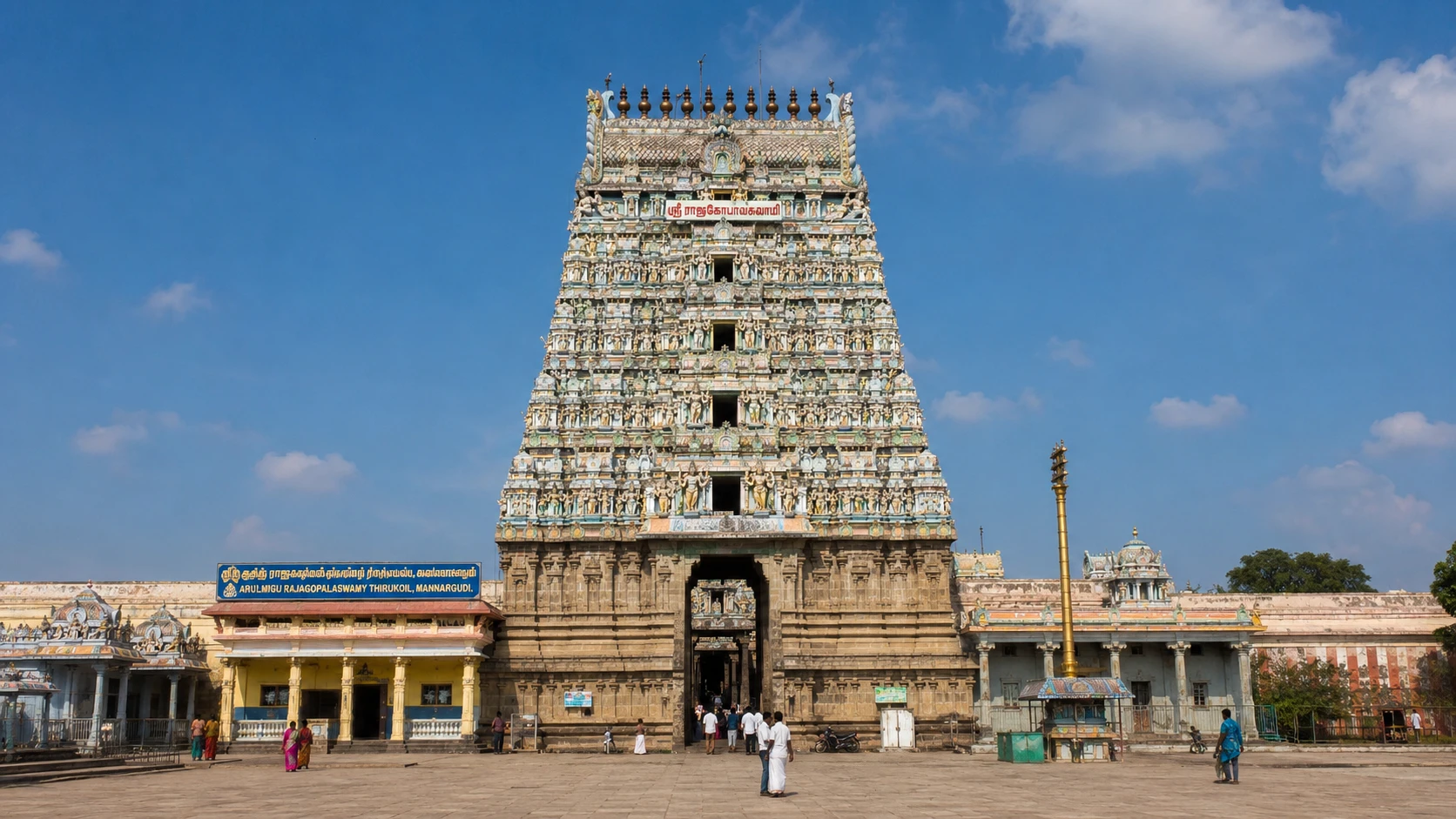
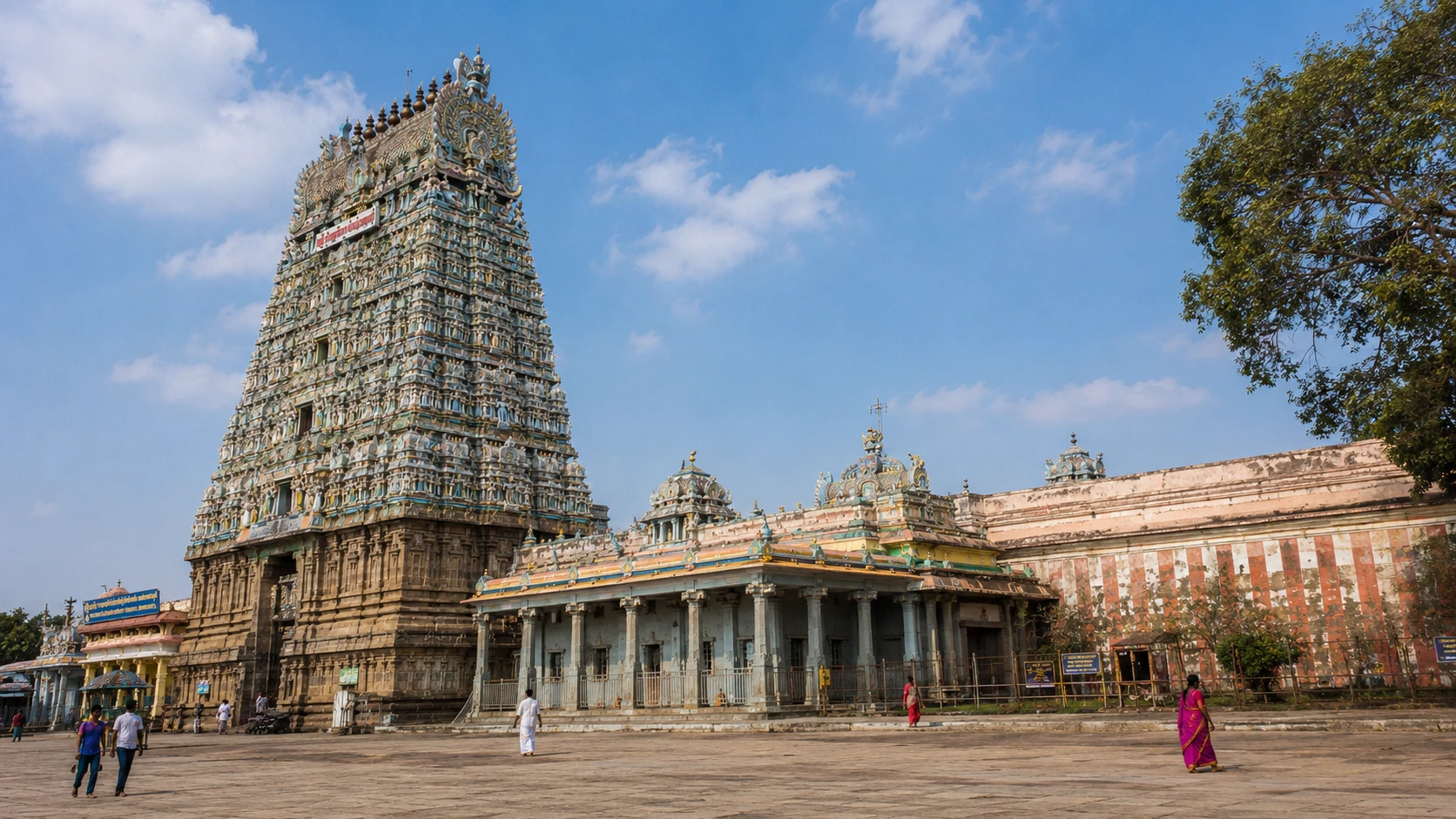
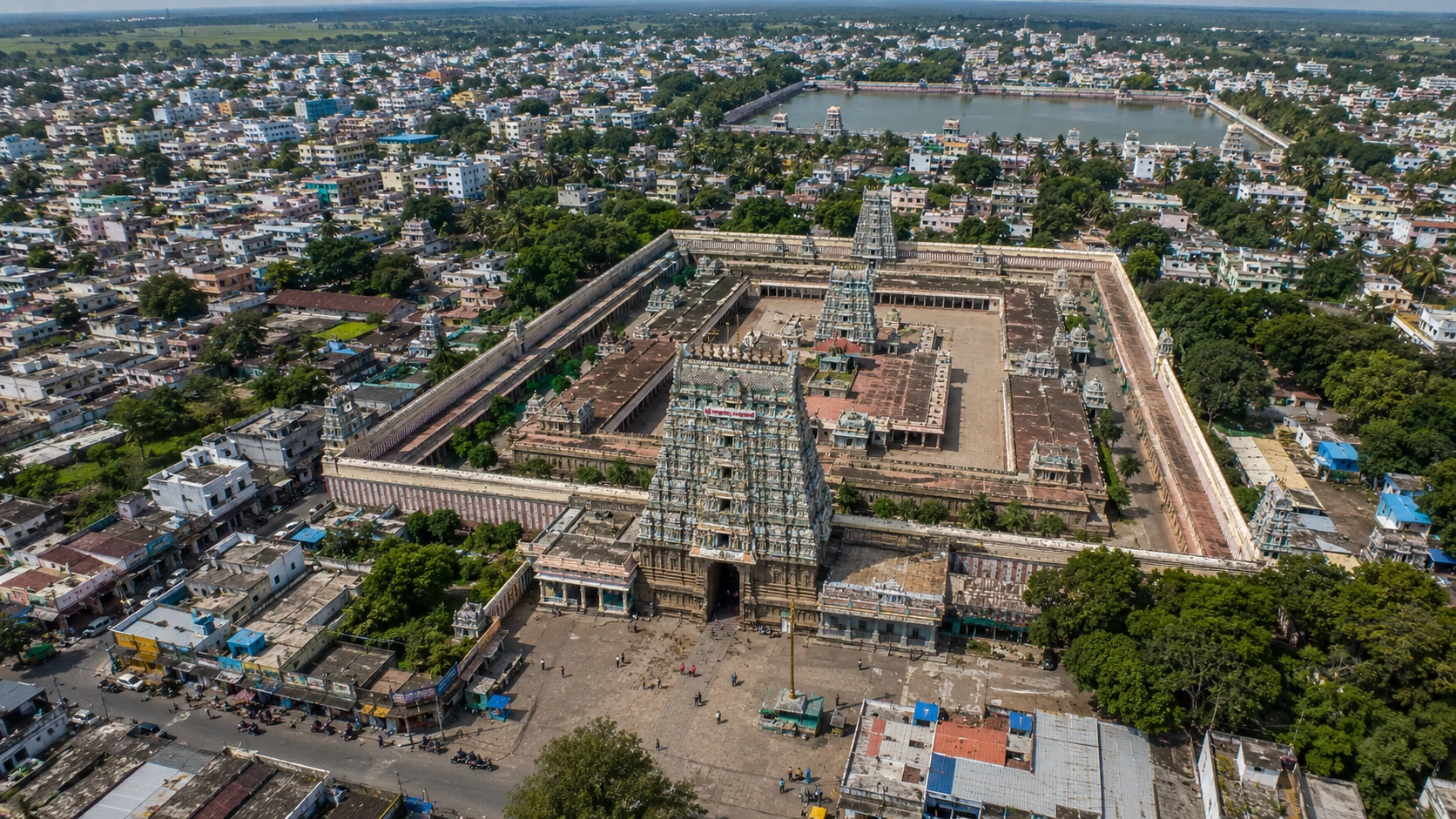
Dravidian temple architecture — tall multi-storey rajagopuram (main entrance tower); large walled enclosure with multiple prakarams (concentric courtyards); the Haridra nadhi (Saravana Poigai) temple tank is one of the largest in the Cauvery delta region
Open
07:00 – 21:00
Aarti
07:00 · 08:30 · 12:00 · 16:30 · 18:00 · 20:30
Special
Temple closes from approximately 12:30–4:30 PM for a midday interval (Uchikala Puja break). Divya Prabandham pasuram recitation is conducted during morning and evening sevas. During Brahmotsavam (annual festival period, typically 10 days), special darshan protocols and extended timings apply — verify with the temple office. All timings approximate and subject to seasonal and festival adjustment.
The Sacred Legend · पवित्र कथा
Mannargudi is called Dakshina Dwarka — the Southern Dwarka — because the same deity who ruled the golden city on the western sea chose, in this telling, to plant himself in the Tamil country too: not as the cosmic sovereign of Vaikuntham, but as a cowherd-king, Rajagopalaswamy, holding his flute in the fertile Cauvery delta. The Alvars sang here. The Nalayira Divya Prabandham carries their mangalasasanam (auspicious praise) for this kshetra — words composed in Tamil not to describe a deity seen from outside but to record a direct encounter. The proof of that encounter is still here: the enormous chariot (ther) that rolls through the streets of Mannargudi during the annual Brahmotsavam, one of the largest wooden temple chariots in south India, drawing millions to see Rajagopalaswamy come out from his inner precincts into the open air of the city that carries his name. Manna r gudi — the town of the Lord who plays (manna = jewel/Lord, r = of, gudi = temple/town). Every name in this place remembers who lives here.
Sacred Designationपवित्र पदनाम
Sacred Origin Storyपवित्र उत्पत्ति कथा
Source: Sri Vaishnava tradition; the Divya Desam is celebrated in the Nalayira Divya Prabandham composed by the Alvars (c. 7th–9th century CE); primary Puranic source is the Bhagavata Purana's Tenth Canto, contextualised through the Tamil Sthala Purana tradition
The name Mannargudi encodes the theology of the place: 'Mannar' (King, jewel-lord) + 'gudi' (temple town). The deity is Rajagopalaswamy — 'Raja' (king) + 'Gopala' (cowherd keeper of cows) + 'Swamy' (lord) — simultaneously the pastoral child-Krishna of Vrindavan and the sovereign king of Dwarka, both aspects united in the same standing figure holding his flute. The 'Dakshina Dwarka' epithet is not merely honorific: it is a theological statement that the same sovereign presence that established itself in the western sea has manifested in the Tamil country's eastern coast, planted in the fertile Cauvery delta as if to anchor both ends of the Indian subcontinent in the same devotional geography.
The sthala Purana tradition associates the manifestation of Rajagopalaswamy at Mannargudi with a sage-devotee's intense tapas on the banks of the Haridra nadhi (now the temple tank). The tradition holds that Vishnu appeared in the form of Rajagopala — the royal cowherd, holding his flute, consort Komalavalli beside him — and declared that he would remain at this kshetra for the benefit of all beings. The deity is described in the Divya Prabandham pasurams as standing in a posture of inviting openness, the flute lowered, available for the direct gaze of the devotee without any protective distance.
The consort is Komalavalli Thaayaar (also known as Kolavalli Nachiyar) — 'the tender-limbed Lakshmi' — whose own shrine within the temple complex is an integral part of the Rajagopalaswamy darshan. Tamil Vaishnavism insists that Lakshmi is the necessary mediator (purushakara) who presents the devotee to the Lord: one approaches Rajagopalaswamy through the compassion of Komalavalli, and her shrine precedes his in the devotional itinerary.
Sources cited:
- Nalayira Divya Prabandham — Alvar pasurams celebrating the Mannargudi kshetra (specific pasuram count and authorship to be verified with temple publications)
- Bhagavata Purana, Canto 10 — the primary theological source for the Gopala/Rajagopala form of Krishna
- Temple Sthala Purana (available in Tamil from the temple office) — the local tradition of Rajagopalaswamy's manifestation at Mannargudi
- S.K. Aiyangar, 'Krishnabhumi' and 'Studies in South Indian History' — contextual Tamil Vaishnava scholarship
Scholarly Context
The identification of Mannargudi as a Divya Desam is accepted within the Sri Vaishnava tradition; scholars of Tamil Vaishnavism (V. Raghavan, 'Studies in the Alvars', 1961; K.K.A. Venkatachari, 'The Manipravala Literature of the Srivaishnava Acharyas', 1978) treat the Divya Prabandham's celebration of the kshetra as evidence of the cult's antiquity and regional importance. The specific Alvars who sang at Mannargudi and the exact count of pasurams at this kshetra should be verified with the temple's own publications or the Divya Prabandham scholarly editions. The 'Dakshina Dwarka' epithet appears in medieval temple literature and is used in popular religious discourse; its earliest datable usage in inscriptions should be confirmed through the Archaeological Survey of India's Tamil Nadu temple records.
Historyइतिहास
The Rajagopalaswamy temple at Mannargudi is one of the most significant Vaishnavite kshetras in the Cauvery delta region of Tamil Nadu, carrying the epithet Dakshina Dwarka (Southern Dwarka) and celebrated as a Divya Desam in the Nalayira Divya Prabandham — the Tamil canon of 4,000 verses composed by the Alvars over the 7th to 9th centuries CE. The Alvar hymns at this kshetra confirm the cult's presence and importance before the great Chola-period temple construction campaigns that shaped most of Tamil Nadu's major temple complexes. The Chola dynasty (9th–13th centuries CE), whose heartland was the Cauvery delta, was among the principal donors and builders of the Mannargudi temple's structural elaboration — inscriptions from the Chola period record land grants and construction at the site. The Vijayanagara Empire (14th–17th centuries CE) and subsequent Nayaka rulers continued to patronise the temple, adding prakarams, gopurams, and mandapams in successive campaigns. The British-era administrative transition placed the temple under the Hindu Religious and Charitable Endowments (HR&CE) Department of Tamil Nadu, which manages it today. The Brahmotsavam — the annual festival culminating in the Rajarathosavam (chariot festival) — has been the defining public event of Mannargudi's religious calendar for centuries, drawing pilgrims from across Tamil Nadu, Andhra Pradesh, and the Tamil diaspora worldwide.
Historical Timelineऐतिहासिक कालक्रम
Alvar poet-saints compose pasurams (devotional hymns) celebrating the Mannargudi Rajagopalaswamy kshetra as part of the Nalayira Divya Prabandham. The Alvar mangalasasanam (auspicious praise) of this kshetra establishes its status as a Divya Desam and marks the Tamil country's absorption of the Gopala/Dwarka Krishna tradition into its own devotional canon.
The specific Alvars who composed pasurams at the Mannargudi kshetra and the exact count of verses should be confirmed from the Divya Prabandham critical editions (Srivaishnava Grantha Prasuram editions) or the temple's own publications. This entry defers precise figures to the temple authority.
The Chola dynasty — whose heartland was the Cauvery delta — undertakes major construction and donation campaigns at the Mannargudi Rajagopalaswamy temple. Inscriptions from the Chola period record royal land grants (devadana), construction of prakarams, and endowments for perpetual worship (nitya puja). The present stone temple's structural foundation dates substantially to this period.
Specific Chola inscriptions at Mannargudi should be confirmed from the Archaeological Survey of India's South Indian Inscriptions series. The general pattern of Chola royal patronage of Cauvery delta temples is extensively documented.
The Vijayanagara Empire and subsequent Nayaka rulers of Tamil Nadu continue patronage of the Mannargudi temple. Additional gopurams, mandapams, and tank renovations are undertaken. The Brahmotsavam and Rajarathosavam (chariot festival) traditions are consolidated and elaborated under Nayaka-period patronage.
The Rajagopalaswamy temple comes under the administration of the Hindu Religious and Charitable Endowments (HR&CE) Department of Tamil Nadu. The annual Brahmotsavam — culminating in the Rajarathosavam — continues to draw millions of pilgrims from across India and the global Tamil diaspora. The temple complex has undergone multiple restoration and infrastructure improvement campaigns under HR&CE management.
What You'll Seeदर्शन में
The Rajagopalaswamy murti is a standing form of Krishna-Vishnu in the Dravidian tradition — the iconic posture of the south Indian Gopala deity, tall and serene, in the samapada (balanced standing) or slight tribhanga (triple-bend) posture characteristic of Chola-period Vishnu sculpture. The complexion is the deep blue-black (shyama) of Vishnu in his most intimate, immediate aspect: the cowherd-king who has not yet put down his flute. He holds the venu (flute) in his hand — the musical attribute that distinguishes Rajagopalaswamy as specifically the Gopala-Krishna rather than the sovereign Chaturbhuja Mahavishnu. His crown (kiritam) is the tall, elaborate South Indian mukuta characteristic of Tamil Vaishnavite iconography; his ornaments (abhushana) follow the Pancharatra Agama prescriptions for the full adornment of a divya mangala vigraha (auspicious divine form).
The consort shrine houses Komalavalli Thaayaar — Lakshmi as the tender, compassionate mother-goddess of Mannargudi, whose name ('the one with tender limbs') evokes the approachable warmth that Tamil Vaishnavism locates in the goddess as purushakara (divine advocate) for the devotee. The Thaayaar's darshan typically precedes the main Rajagopalaswamy darshan in the devotional itinerary — approaching the Lord through the goddess's mediation. Photography inside the inner shrines is not permitted.
Distinctive Practicesविशिष्ट परंपराएँ
Rajarathosavam — the great chariot festival
राजरथोत्सवम् — महान रथ उत्सव
During Brahmotsavam (annual festival, typically 10 days; main chariot procession on the final day)
The Rajarathosavam is the annual chariot procession of Rajagopalaswamy — a festival of pan-Tamil significance in which the deity is placed on the enormous temple ther (chariot) and pulled through the streets of Mannargudi by thousands of devotees. The Mannargudi ther is one of the largest wooden temple chariots in south India, constructed from timber and decorated elaborately each year with silk, flowers, and sculptural adornments. On the day of the Rajarathosavam, the population of Mannargudi multiplies several times as pilgrims arrive from across Tamil Nadu, Andhra Pradesh, and the global Tamil diaspora. The chariot's passage through the four mada streets (the broad streets surrounding the temple) is the culmination of ten days of Brahmotsavam ceremonies that include smaller vehicle (vahana) processions and Divya Prabandham recitations.
The chariot procession in the Agamic and Alvar tradition is the moment when the deity leaves the inner precincts of the temple — normally accessible only through priestly mediation — and comes out into the street, visible to all, reachable by all. For the Tamil Vaishnava tradition, the ther procession is the Lord's act of radical accessibility: Rajagopalaswamy, the deity of the inner sanctum, coming into the public world, the boundary between sacred and secular dissolved for a day.
Divya Prabandham recitation — the Alvar hymns in daily seva
दिव्य प्रबन्धम् पाठ — दैनिक सेवा में आलवार स्तोत्र
During morning and evening seva (daily)
As a Divya Desam, the Rajagopalaswamy temple incorporates the recitation of Divya Prabandham pasurams — the Tamil hymns of the Alvars — as an integral part of the daily worship programme. The pasurams sung at Mannargudi specifically are recited by temple priests trained in the Araiyar seva tradition, the unique Tamil Vaishnava form of devotional recitation that incorporates stylised gesture (mudra) and movement alongside the sung verse. This tradition — maintained at Divya Desams — keeps the Alvars' personal encounter with the deity alive as a living liturgical form rather than as a closed text.
Haridra nadhi — the sacred tank and ritual bathing
हरिद्रा नंदी — पवित्र तालाब और अनुष्ठानिक स्नान
Daily, before entering the temple for darshan; particularly during festival periods
The temple tank at Mannargudi — known as the Haridra nadhi (sometimes Saravana Poigai or Chakra Tirtha) — is one of the largest temple tanks in the Cauvery delta region, its size consistent with the importance of the kshetra. Tamil Vaishnavite pilgrimage practice requires ritual bathing (snanam) in the temple tank before proceeding to the main shrine; this practice at Mannargudi connects the devotee to the Alvar tradition — Nammalvar's famous verse 'neer malai neer' and related hyms speak of the sacred waters of the Divya Desams as themselves purifying. During Brahmotsavam, the theerthavari (immersion in the tank waters sanctified by the deity's festival) is one of the most important acts of the entire festival cycle.
Did You Know?क्या आप जानते हैं?
'Dakshina Dwarka' — the Southern Dwarka — is an epithet claimed by only a small number of temples in India; Mannargudi's use of it connects the Tamil Vaishnava tradition directly to the pan-Indian Dwaraka theology of Krishna as the Lord of the sea-city. For Tamil pilgrims, Mannargudi is their Dwarka: the closest version of that western holy city to their own sacred geography.
Tamil Vaishnavite temple tradition; Divya Prabandham commentary literature
The Mannargudi Rajagopalaswamy temple is a Divya Desam — one of the 108 Vishnu temples in India, Nepal, and the celestial realm celebrated in the Nalayira Divya Prabandham, the sacred canon of 4,000 Tamil Vaishnava hymns composed by the twelve Alvars between the 7th and 9th centuries CE. Each of the 108 Divya Desams is associated with specific pasurams addressed directly to that kshetra's form of Vishnu.
Nalayira Divya Prabandham; Sri Vaishnava Divya Desam enumeration tradition
The Mannargudi Brahmotsavam chariot (ther) is one of the largest wooden temple chariots in use in south India — a multi-storey wooden structure requiring months of preparation, carpentry, and decoration by craftsmen who specialise in this ancient form. The ther is not merely a vehicle; it is itself a moving temple, carved with images of deities and narratives from the Bhagavata Purana, temporarily elevating the street to the status of sacred precinct.
Tamil Nadu Tourism Board documentation; temple management records
The Cauvery delta region of Tamil Nadu — the heartland of Chola civilisation — contains a remarkably high concentration of Divya Desams, reflecting the dense Vaishnavite sacred geography of this fertile, temple-rich zone. Mannargudi sits at the centre of this cluster; within approximately 100 km radius, pilgrims can visit Kumbakonam, Tiruvarur, Karaikal, and dozens of other major Vaishnavite and Shaivite temples, making the region one of the most devotionally saturated in the Indian subcontinent.
K.A. Nilakanta Sastri, 'A History of South India' (Oxford, 1955); Tamil Nadu Tourism documentation
Visitor Accessप्रवेश जानकारी
Entry to the Rajagopalaswamy temple is restricted to Hindus, in keeping with the traditional Agamic norms that govern Tamil Nadu's ancient temples. Non-Hindus are not permitted inside the temple complex. Traditional dress is required: men must wear a dhoti (veshti) inside the temple; wearing shirts inside the inner sanctum is traditionally not permitted for men. Women should wear a sari or salwar-kameez; heads need not be covered inside. Footwear must be removed at the temple entrance.
Spiritual Basis
The entry restriction at Tamil Nadu's major temples, including Divya Desams, derives from the Pancharatra Agama framework that prescribes the preparation and eligibility of those who may enter the sanctified space of the deity's presence. These norms are codified in the Agamas and are administered by the temple priests and the HR&CE Department.
Contemporary Context
The entry restriction for non-Hindus at Tamil Nadu temples is maintained under the Tamil Nadu Hindu Religious and Charitable Endowments Act (1959) and has been the subject of periodic legal and policy debate in India. The HR&CE Department enforces the restriction as a matter of traditional religious governance.
Practical Guidance
Dhoti rental is typically available near the temple entrance. Visitors should carry proof of Hindu faith if asked at the entrance. The temple management office can advise on current access protocols.
Festivalsत्योहार
Brahmotsavam — annual ten-day festival
ब्रह्मोत्सवम् — वार्षिक दस-दिवसीय उत्सव
Variable (typically Feb-Mar or as per the Tamil Panchangam; verify with the temple office for current year dates)
The annual Brahmotsavam at Mannargudi is the most important festival in the temple's calendar — ten days of elaborate ceremonies in which the utsava murti (processional form of Rajagopalaswamy) is taken out on different vahanas (divine vehicles) through the temple precincts each evening, culminating in the Rajarathosavam (chariot festival) on the final day. The festival draws millions of pilgrims from across Tamil Nadu and is considered one of the grandest Brahmotsavams in the Cauvery delta region.
Vaikunta Ekadasi
वैकुंठ एकादशी
Dec-Jan (Margashirsha Shukla Ekadasi)
Vaikunta Ekadasi — the day when Vishnu opens the gates of Vaikuntham — is observed at Mannargudi with the Paramapada Vasal (gateway to Vaikuntham) ceremony, in which devotees symbolically pass through a specially constructed gateway into the Lord's presence. The Vaikunta Ekadasi rituals at a Divya Desam carry special theological resonance, as the kshetra is itself understood as a fragment of Vaikuntham on earth.
Aadi Pooram — Komalavalli Thaayaar festival
आडि पूरम् — कोमलावल्ली थायार उत्सव
Jul-Aug (Aadi Pooram, Tamil calendar)
Aadi Pooram, the birth star festival of the Thaayaar (Goddess Lakshmi/Komalavalli), is celebrated with particular devotion at Mannargudi, where the consort shrine is an integral part of the devotional experience. Tamil Vaishnavism's emphasis on the goddess as purushakara (advocate) means her festival is not secondary to the Lord's — it is the complementary half of the kshetra's theological identity.
Krishnajayanti (Janmashtami)
कृष्ण जयंती (जन्माष्टमी)
Jul-Aug (Bhadra Krishna Ashtami)
The birth of Krishna is celebrated at Rajagopalaswamy temple with particular emotional intensity — because Rajagopalaswamy IS Krishna, the cowherd-king, the deity whose name means 'the royal Gopala'. Janmashtami here carries the specific resonance of celebrating the birth of the deity whose adult form is worshipped at the kshetra: it is the birthday of the Lord who stands here, holding his flute, waiting.
Traditional Offeringsपारंपरिक अर्पण
Primary Offerings
Tulsi (Holy Basil)
तुलसी
तुलसी
Tulsi is the foremost offering in all Vaishnava worship; in Tamil Vaishnavism, the Pancharatra Agama prescribes the offering of tulsi garlands (thulasi maalai) as the most essential element of Vishnu's daily worship. The Divya Prabandham contains many references to tulsi as the Lord's beloved plant — Perumal without tulsi is incomplete. At a Divya Desam like Mannargudi, tulsi has both ritual and liturgical significance: the garlands are part of the seva protocols recited in the pasurams themselves.
Lotus flowers (Padma) and Lotus garlands
कमल पुष्प और कमल माला
पद्म
Lotus flowers are Vishnu's primary flower — he holds one in his hand, Lakshmi sits upon one, and the image of Vishnu on the cosmic ocean with a lotus rising from his navel is one of Hinduism's foundational cosmological icons. In Tamil Vaishnavite worship, white and pink lotus flowers are offered to Rajagopalaswamy during special abishekams (ritual baths) and festival days. The Haridra nadhi (temple tank) at Mannargudi grows lotus in season, providing a natural offering source from the sacred waters themselves.
Neyy (Ghee) — for abhishekam and deepam
घी — अभिषेकम् और दीपम के लिए
घृत
Clarified butter (ghee/neyy) is used both for the ritual bathing (abhishekam) of the deity on festival occasions and for the lamps (deepam) that form the visual focus of all Tamil temple aartis. The flickering ghee lamp is the primary medium through which the devotee receives and gives light in the Tamil temple aarti (Deepa aradhana). Offering ghee to Rajagopalaswamy's deepam is an act of offering one's vision itself — the lamp that illuminates the Lord is made from one's own offering.
Panchamrit — five nectars for abhishekam
पंचामृत — अभिषेकम् के लिए पाँच अमृत
पञ्चामृत
Panchamrit (milk, curd, honey, ghee, sugar) is used for the ritual bathing of Rajagopalaswamy on auspicious occasions and during specific festival sevas. In Tamil Vaishnavite practice, the abhishekam follows Pancharatra Agama prescriptions; the receiving of thirtha (the consecrated bath water) after the abhishekam is among the most coveted acts of prasada reception.
Unique to This Temple
Kozhukattai (steamed rice cakes) — the traditional Janmashtami offering
कोज़ुकट्टई — पारंपरिक जन्माष्टमी अर्पण
Kozhukattai — steamed rice cakes filled with sweet coconut and jaggery — are the distinctive Tamil offering for Krishna during Janmashtami and other festivals. As the cowherd-child of Gokul, Krishna in Tamil tradition is offered the foods of a Tamil village household rather than North Indian makhan-mishri; kozhukattai represents the Tamilisation of the devotional food tradition. The preparation of kozhukattai at home and its offering to Rajagopalaswamy on Janmashtami is a widespread domestic practice throughout the Cauvery delta.
Offering materials (tulsi, lotus garlands, camphor for deepam, kozhukattai in season) are available from vendors surrounding the Mannargudi temple complex. Prasada from Rajagopalaswamy Temple (typically sweet pongal, vada, or payasam following the meal type of the day) is distributed through the temple's prasadam counter. Annadana (free meals) may be available on major festival days — verify with the temple office.
How to Reachकैसे पहुँचें
Mannargudi is located in Tiruvarur district, Tamil Nadu. By rail, Mannargudi has a railway station on the Mayiladuthurai–Mannargudi branch line; service frequency and current gauge status should be verified at the time of travel. The mainline railheads closest to Mannargudi are Tiruvarur Junction (15 km; connected to Chennai, Trichy, and Nagapattinam) and Kumbakonam (50 km; mainline connections to Chennai, Thanjavur, and Trichy). By road, Mannargudi is on Tamil Nadu state highways with bus connections from Kumbakonam, Tiruvarur, Thanjavur, and Nagapattinam. Tiruchirappalli International Airport (approximately 100 km) is the nearest practical airport; Chennai International Airport (approximately 350 km) has wider flight connectivity. SETC and private bus services connect Mannargudi to major Tamil Nadu cities.
Plan Your Visitयात्रा की योजना
🌤 Best Season
October to February (cool Tamil Nadu winters; avoid the very hot and humid summer months of April–June). The annual Brahmotsavam — dates vary year to year; check the temple website or HR&CE calendar — is the most spiritually and culturally significant time to visit. Vaikunta Ekadasi (December–January) is the most important single festival day.
👘 Dress Code
Traditional dress strictly required: men must wear a dhoti (veshti/lungi in proper temple style); shirts are not permitted inside the inner sanctum for men. Women: sari or salwar-kameez required. Footwear removed at the temple entrance. Dhoti rental is available near the temple entrance.
📱 Phones & Photography
Photography inside the inner shrines is not permitted. Photography in the outer prakarams and tank areas is generally permitted.
🏨 Accommodation
Mannargudi town has basic pilgrim guesthouses. Tiruvarur (15 km) and Kumbakonam (50 km) offer wider accommodation options. Kumbakonam in particular has a range of hotels and guesthouses that serve as a base for the Cauvery delta temple circuit. During Brahmotsavam, Mannargudi fills rapidly — advance accommodation booking several weeks ahead is advised for festival periods.
Book a Pujaपूजा बुक करें
Temple timings are verified periodically but are subject to festival and seasonal adjustment. During Brahmotsavam, special timings apply — verify dates and schedules through the HR&CE portal or the temple office well in advance. The HR&CE portal (hrce.tn.gov.in) is the official source for seva bookings; any unauthorised third-party site claiming to offer temple tickets or 'VIP darshan' for this temple should be treated with caution.
Managed by: Hindu Religious and Charitable Endowments (HR&CE) Department, Government of Tamil Nadu
Special Archana / Abhishekam (individual seva booking)
विशेष अर्चना / अभिषेकम् (व्यक्तिगत सेवा बुकिंग)
Brahmotsavam special darshan passes
ब्रह्मोत्सवम् विशेष दर्शन पास
Booking information verified: 2026-05-23
Sacred Soundsपवित्र ध्वनि
Nalayira Divya Prabandham pasurams at the Mannargudi kshetra — Alvar hymns addressed specifically to Rajagopalaswamy; recited daily during temple seva
stotram
Thiruvanandal — the morning invocation aarti at Rajagopalaswamy Temple, Mannargudi
aarti
Thirumangai Alvar pasurams — Tamil Vaishnavite devotional poetry associated with the Mannargudi kshetra in the Divya Prabandham tradition
stotram
108 Japa Practice
Om Namo Bhagavate Vasudevaya — the Ashtakshari mantra of Vishnu/Krishna
Chant 108 times in the spirit of this temple
Did You Know? · क्या आप जानते हैं?
The same translation error that turned '33 Koti' into '33 crore' in Hinduism also happened in Buddhism. The Chinese translation of Buddhist texts rendered 'Sapta Koti Buddha' (7 Supreme Buddhas) as '7 Crore Buddhas.' The Tibetan translation got it right: 7 types, not 7 crore. One Sanskrit word, misread across two major world religions, generated two identical misconceptions independently.
Related Contentसंबंधित सामग्री
Related Scriptures
Community Reflections
🕉️
Be the first to share your reflection.