Ram Janmabhoomi
राम जन्मभूमि
Janmasthan of Lord Rama, foremost of the seven Mokshapuri cities
Ayodhya, Uttar Pradesh, India
Rāma JanmabhūmiAlso known as: Ram Mandir Ayodhya, Shri Ram Janmabhoomi Mandir, Ram Janmasthan, Ramkot Mandir, Ayodhya Ram Mandir
Era
Hindu sacred geography pre-historic per Ramayana tradition (Treta Yuga); Buddhist-period Saketa from c. 5th century BCE; current Ram Mandir foundation laid 5 August 2020, garbhagriha consecrated 22 January 2024
Architecture
Nagara (North Indian), traditional style with Maru-Gurjara influences, designed by Chandrakant Sompura and Ashish Sompura
Open
06:30 – 21:30
Aarti
04:30 · 06:30 · 11:30 · 19:30 · 22:00
Special
VIP/Special darshan available via official online registration through Shri Ram Janmabhoomi Teerth Kshetra Trust portal. Aarti participation requires advance pass. Significant queue waits common during weekends, Ram Navami, and major festivals. Mobile phones, cameras, and bags not permitted inside the temple complex; cloakrooms available at entry.
The Sacred Legend · पवित्र कथा
Ram Janmabhoomi stands at the most foundational spot in Hindu sacred geography, the birthplace of Lord Rama, seventh avatar of Vishnu, and the city from which the entire Ramayana unfolds. Ayodhya is the first of the seven Mokshapuri cities listed in the canonical Mokshapuri Stotram, those rare places where, by tradition, residence itself confers liberation. On the banks of the Sarayu river, where the Valmiki Ramayana tells that Dasharatha's Putrakameshti Yajna brought forth four divine sons of whom the eldest was Rama, the new Ram Mandir was consecrated on 22 January 2024 in a Prana Pratishtha ceremony attended by India's prime minister as chief yajaman. The consecration closed a centuries-long civilizational journey of contestation, litigation, and devotion that the Supreme Court of India had brought to legal closure on 9 November 2019. The Janmabhoomi remains, as it has for millennia in Hindu memory, the still center around which the figure of Rama is organized.
Sacred Designationपवित्र पदनाम
One of the Seven Moksha Citiesसप्त पुरी
Sacred Origin Storyपवित्र उत्पत्ति कथा
Source: Valmiki Ramayana (Bala Kanda), Skanda Purana (Vaishnava Khanda, Ayodhya Mahatmya), Padma Purana (Patala Khanda), Ramcharitmanas of Tulsidas (Bala Kand), widely-attested across the Ramayana tradition
In the kingdom of Kosala, on the banks of the Sarayu river, stood the great city of Ayodhya, built, by tradition, by Manu Vaivasvata himself, ruled by the Ikshvaku dynasty, and described in the Valmiki Ramayana as 'a-yodhya,' the unconquerable.
The city's nine gates opened to broad streets paved with stone; its houses rose in tiers like clouds gathered after monsoon; its people lived in dharma; its king was Dasharatha, descendant of Raghu, ruler of the solar dynasty.
But Dasharatha had no son. Three queens, Kausalya, Sumitra, Kaikeyi, had borne him no heir, and the king grew old wondering who would inherit the Kosala throne. On the counsel of his preceptor Vasishtha, Dasharatha invited the great sage Rishyashringa to perform the Putrakameshti Yajna, the ritual prescribed in the Vedas to grant sons to those who lack them.
Sumantra was sent to bring Rishyashringa from his forest hermitage, and the kings of the surrounding lands were summoned to the great fire-altar.
The yajna burned for many nights. Mantras of the four Vedas rose with the smoke. From the sacred fire emerged a divine being, golden in complexion, holding a vessel of charu, sweet rice cooked with milk, sanctified by the gods themselves. 'Take this prasada,' the celestial figure said to Dasharatha, 'and divide it among your queens, and from their wombs shall be born sons of immeasurable strength, who shall be the destroyers of demons and the upholders of dharma.'
Dasharatha gave half of the charu to Kausalya, his eldest queen. Of the remaining half, he gave half to Sumitra. Of what remained, he divided again, half to Kaikeyi, half once more to Sumitra. So Kausalya received one full portion, Kaikeyi one, and Sumitra two.
In the month of Chaitra, on the navami tithi of the bright fortnight, under the constellation Punarvasu, when Jupiter stood in Cancer and the Sun in Aries, at the auspicious midday hour when five planets were in their exaltation, Kausalya gave birth to a child whose dark complexion held the blue of monsoon rainclouds, whose lotus-eyes held the compassion of the universe, and whose body bore the thirty-two marks (lakshana) of Vishnu himself.
This was Rama. Bharata was born to Kaikeyi. Lakshmana and Shatrughna were born to Sumitra, twins who would shadow Rama and Bharata through every step of the Ramayana that followed.
The Janmabhoomi, the place of birth, is the spot, by tradition, where Kausalya brought Rama into the world. The Sarayu carried the news to the four directions. The gods rained flowers from heaven. Ayodhya, the unconquerable, had its prince. The Ramayana had begun.
Sources cited:
- Valmiki Ramayana, Bala Kanda, Sargas 14, 18 (Putrakameshti Yajna and birth of Rama)
- Skanda Purana, Vaishnava Khanda, Ayodhya Mahatmya, Chapters 1, 10
- Ramcharitmanas of Tulsidas, Bala Kand, dohas 191, 200
- Padma Purana, Patala Khanda, Chapters describing Ayodhya as the eternal Vaikuntha on earth
Other Traditions · अन्य परंपराएँ
Buddhist canonical tradition, the city as Saketa
In the Pali canon and Buddhist literature, Ayodhya is known as Saketa and was one of the six great cities of the Buddha's time, alongside Champa, Rajagriha, Sravasti, Kosambi, and Varanasi. The Buddha visited Saketa multiple times and delivered discourses there, recorded across the Digha Nikaya, Majjhima Nikaya, and Anguttara Nikaya.
Saketa was a major center of Buddhist learning during the Mauryan and post-Mauryan periods (3rd century BCE through early common era), with monasteries (viharas) and stupas attested in archaeological surveys. The Anjanavana monastery near Saketa was a noted teaching site.
The city's identification with the Hindu Ayodhya of the Ramayana was reasserted with the resurgence of Vaishnava devotion in the early common era and the Gupta period; in the Buddhist period the two identifications coexisted, with the city understood as both Saketa and Ayodhya by different traditions.
Jain tradition, Vinita / Ayodhya as the birthplace of five Tirthankaras
In Jain tradition, Ayodhya is called Vinita (also Saketa or Ayodhya in later texts) and is regarded as the birthplace of five of the twenty-four Tirthankaras of this cosmic age (avasarpini). Most foundationally, it is the birthplace of Rishabhanatha (Adinatha), the first Tirthankara, regarded in Jain cosmology as the founder of human civilization itself, teacher of agriculture, the arts, kingship, and the householder's life before he renounced the world to attain kevala-jnana (omniscience).
Ayodhya is also the birthplace of Ajitanatha (the second Tirthankara), Abhinandananatha (fourth), Sumatinatha (fifth), and Anantanatha (fourteenth). Jain pilgrimage to Ayodhya is concentrated at sites associated with these Tirthankaras' birth, kalyanaka events, and renunciation.
The Jain Kalpasutra and Hemachandra's Trishashti-shalaka-purusha-charitra are the principal canonical sources.
Historyइतिहास
Ayodhya's sacred status in Hindu tradition is foundational, the Valmiki Ramayana opens with the city, and the Skanda Purana devotes an entire khanda to its mahatmya. Archaeological evidence from the Allahabad High Court-mandated Archaeological Survey of India excavations (2003) indicates a pre-existing structure with non-Islamic architectural features beneath the Babri Masjid, including pillar bases dated to the 11th, 12th centuries CE, with foundations possibly older.
The Buddhist period saw the city known as Saketa, with the Buddha visiting multiple times and the city serving as a major Buddhist learning center attested in the Pali Canon. The Gupta period (4th, 6th centuries CE) marked a Hindu cultural renewal centered on Ayodhya, and the composition of the Ramcharitmanas by Tulsidas (16th century, in Awadhi) entrenched the Janmabhoomi tradition in popular north Indian Hindu memory.
In 1528 a mosque attributed to Mir Baqi was constructed at the site under the Mughal emperor Babur. The 22, 23 December 1949 placement of Ram Lalla idols inside the structure precipitated decades of legal contestation under court-supervised arrangements. The 6 December 1992 demolition of the Babri Masjid by kar sevaks brought the dispute to its modern crisis.
The 30 September 2010 Allahabad High Court three-way partition order and the 9 November 2019 Supreme Court of India unanimous Constitution Bench verdict together established the legal framework under which the new Ram Mandir was constructed by the Shri Ram Janmabhoomi Teerth Kshetra Trust.
The Prana Pratishtha of Ram Lalla on 22 January 2024 marked the contemporary consecration of a temple-tradition continuous, in the Hindu reading, with Ayodhya's most ancient sanctity.
Historical Timelineऐतिहासिक कालक्रम
Construction of the Babri Masjid at the Ram Janmabhoomi site, attributed in Persian inscriptions to Mir Baqi, a commander acting under the Mughal emperor Babur. The structure stood until 6 December 1992. Allahabad High Court-ordered Archaeological Survey of India excavations conducted in 2003 indicated the mosque was built atop pre-existing structures with non-Islamic architectural features, including dressed pillar bases and decorated stonework dated provisionally to the 11th, 12th centuries CE.
The exact circumstances of the 1528 construction, whether it replaced a pre-existing temple, whether such a temple was demolished for the construction, and the authenticity of the Babri inscriptions, remain subjects of historical debate. The 2003 ASI report identified evidence of a pre-existing structure with non-Islamic architectural features beneath the mosque, including 50+ pillar bases and decorated elements. The Supreme Court's 2019 verdict accepted the ASI findings as evidence but ruled that the question of the mosque's pre-construction history did not, by itself, determine the legal title, which was instead awarded based on a wider preponderance of evidence regarding continuous Hindu worship at the site's outer courtyard.
On the night of 22, 23 December 1949, idols of Ram Lalla were placed inside the Babri Masjid structure. The state attached the property under Section 145 of the Code of Criminal Procedure on 29 December 1949, and the structure was effectively converted into a contested site under legal seizure with restricted access. Daily worship of the idols continued under court-supervised arrangements administered by a court-appointed receiver; Friday namaaz, which had continued at the site through 1948, ceased after the attachment. The 1949 events generated four civil suits whose consolidation and adjudication would consume the subsequent seventy years of litigation.
The events of 22, 23 December 1949 are factually well-documented in police FIRs and District Magistrate orders, but the question of whether the idols 'appeared miraculously' (the position taken by some Hindu devotees at the time) or were placed by individuals (the position recorded in the FIR and reflected in subsequent investigations) was central to the litigation that followed. The Supreme Court's 2019 verdict treated the 1949 placement as a temporal fact whose legal significance was the resulting attachment and the cessation of namaaz at the inner structure, rather than ruling on the metaphysical question of how the idols arrived at the site.
On 6 December 1992, an estimated 150,000 kar sevaks gathered at the disputed site for a rally organized by the Vishva Hindu Parishad and affiliated organizations. Over the course of approximately five hours beginning around 11:45 AM, the crowd breached security cordons and demolished the Babri Masjid structure, despite assurances given to the Supreme Court of India by the Uttar Pradesh state government that the structure would be protected. The demolition was followed by communal violence across multiple Indian cities including Bombay, Surat, and Bhopal, with documented casualties in the thousands. The Liberhan Ayodhya Commission of Inquiry, appointed by the Government of India on 16 December 1992, submitted its report on 30 June 2009 after seventeen years of proceedings, naming individuals it held responsible for the demolition.
The demolition itself is undisputed as a temporal event, extensively documented in photography, video, and contemporaneous press reports. The Supreme Court's 2019 verdict (paragraph 798) explicitly characterized the demolition as 'an egregious violation of the rule of law,' while separately ruling on the title question on independent grounds. The CBI Special Court's 2020 judgment acquitting the surviving accused was based on findings that conspiracy could not be proven beyond reasonable doubt under the legal standard applicable; this is distinct from the question of whether the demolition itself occurred, on which there is no dispute. Casualty figures from the post-demolition violence range across reputable sources and remain subject to historical re-examination.
On 9 November 2019, a five-judge Constitution Bench of the Supreme Court of India, Chief Justice Ranjan Gogoi and Justices Sharad Arvind Bobde, Dhananjaya Y Chandrachud, Ashok Bhushan, and S Abdul Nazeer, delivered a unanimous verdict in M Siddiq (D) Through Lrs vs Mahant Suresh Das & Others. The court awarded the disputed 2.77 acres to the deity Bhagwan Sri Ram Virajman (treated as a juristic person under Indian law), directed the Government of India to formulate a scheme establishing a trust to manage temple construction within three months, and ordered the allocation of a separate 5-acre plot at a prominent location in Ayodhya to the Sunni Central Waqf Board for the construction of a mosque. The judgment ran to 1045 pages and was preceded by 40 days of continuous hearings, among the longest in Supreme Court history. The Shri Ram Janmabhoomi Teerth Kshetra Trust was duly constituted by Government of India notification on 5 February 2020.
On 22 January 2024 (Paush Shukla Dwadashi, Vikram Samvat 2080), the Prana Pratishtha (consecration) ceremony of Ram Lalla was performed at the new Ram Mandir, marking the religious inauguration of the temple at the Janmabhoomi. The 51-inch idol of Ram Lalla in the form of a five-year-old child (bal-roopa), sculpted in black Krishna shila stone by Mysuru sculptor Arun Yogiraj, was installed in the garbhagriha. The principal Vedic ceremony was led by Pandit Lakshmikant Dixit of Varanasi, with Prime Minister Narendra Modi serving as the chief yajaman. Attendees included Sangh Parivar leadership, representatives of major Hindu denominations and akharas, and prominent figures from public and private life. The temple's first phase, including the ground-floor garbhagriha and the karma sthala, was completed for the consecration; subsequent construction phases for the upper levels and parikrama complex continue, with the Trust projecting completion of the full complex during 2025, 2026.
What You'll Seeदर्शन में
The garbhagriha of the Ram Mandir houses two enshrined forms of Ram Lalla. The newly consecrated principal idol, installed at the Prana Pratishtha on 22 January 2024, is a 51-inch (130 cm) standing figure of Ram in his bal-roopa, the form of a five-year-old child.
Sculpted in black Krishna shila stone sourced from Karnataka by Mysuru sculptor Arun Yogiraj, the idol depicts Ram with bow and arrow in the iconic Vaishnava sthanaka (standing) posture, the right hand raised in abhaya mudra.
Surrounding the idol is an elaborate prabhavali (halo) carved with the ten Vishnu avatars (Dashavatara), the auspicious swastika and conch, and floral motifs in the Maru-Gurjara tradition. The smaller original Ram Lalla Virajman idols from 1949, the named litigant deity who, by the Supreme Court's 2019 verdict, was held a juristic person and awarded title to the Janmabhoomi, are placed alongside the new consecrated idol in the same garbhagriha, preserving continuity with the worship that has been continuous at the site since the late 1940s.
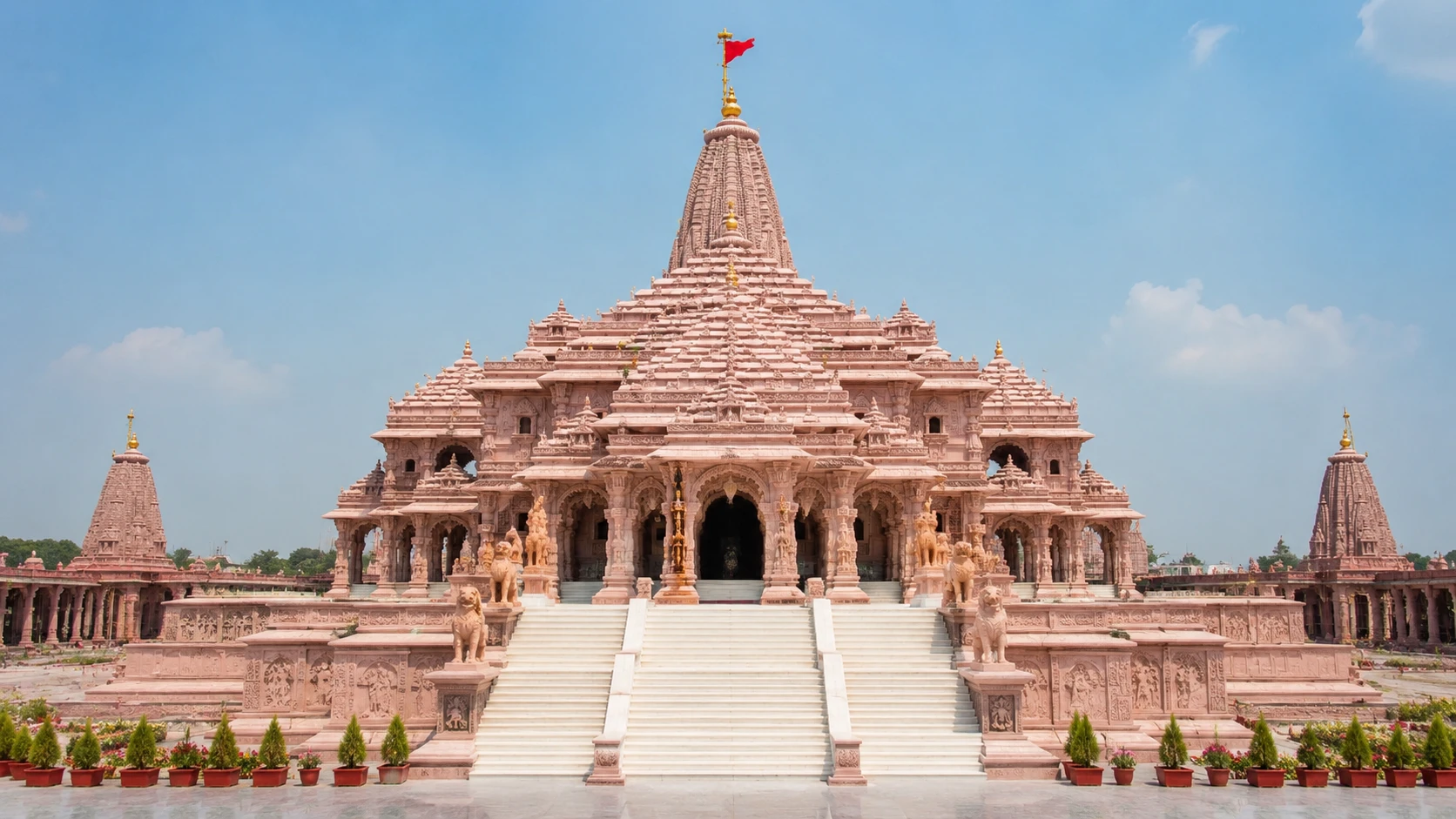
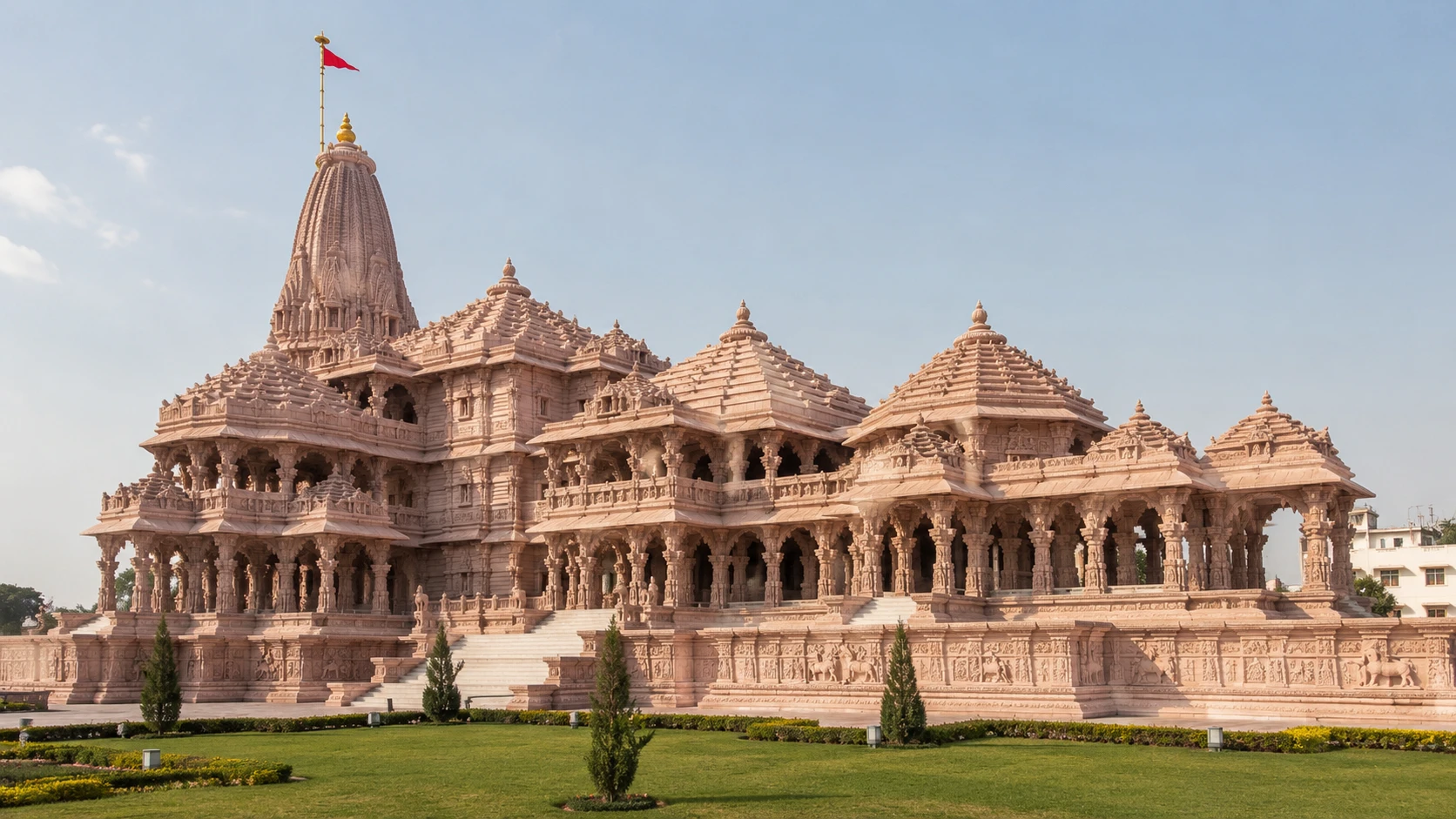
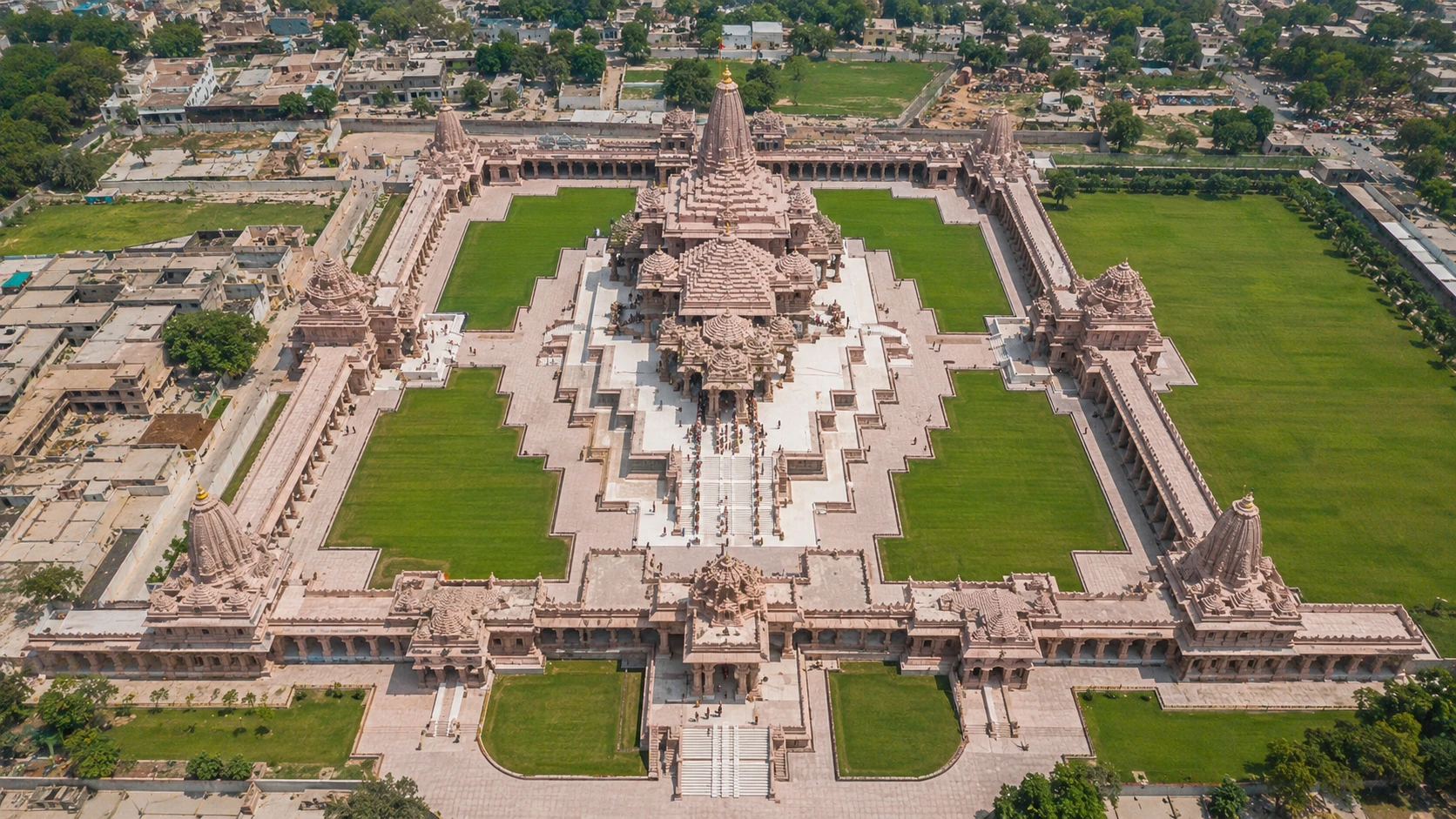
The temple architecture is Nagara, the classical North Indian temple style, designed by the Sompura family of Ahmedabad, Chandrakant Sompura and his son Ashish Sompura, drawing on traditional shilpa shastra principles refined across fifteen generations of temple architects.
The temple is built entirely without iron or steel; the structure rests on Bansi Paharpur sandstone (the pink-hued stone of Bharatpur, Rajasthan) and granite, joined with traditional locking techniques. The complete temple, when finished, will rise 161 feet across three floors with five shikharas (spires), 392 carved pillars, and 44 carved doors.
Five mandapas, Nritya, Rang, Sabha, Prarthana, and Kirtan, surround the garbhagriha. A distinctive engineered feature is the Surya Tilak: on every Ram Navami, at solar noon, sunlight is directed through a precisely calibrated system of mirrors and lenses to fall on Ram Lalla's forehead for approximately four minutes; the system was first demonstrated successfully on Ram Navami 17 April 2024 by the Indian Institute of Astrophysics and CBRI Roorkee.
The temple complex, when complete, will include shrines to Maharishi Valmiki, Vasishtha, Vishvamitra, Agastya, Nishadraj, Shabari, and Devi Ahilya around the parikrama path, locating the Janmabhoomi within the broader Ramayana ecology.
Distinctive Practicesविशिष्ट परंपराएँ
Surya Tilak on Ram Navami
राम नवमी सूर्य तिलक
Annual, Ram Navami day (Chaitra Shukla Navami, March, April), at solar noon for approximately 4 minutes
On every Ram Navami, at the precise moment of solar noon (approximately 12:00 noon local time depending on solar declination), sunlight is captured at the temple's third floor through an aperture and reflected through a system of four mirrors and two lenses, traveling vertically down a shaft into the garbhagriha to fall directly on the forehead of Ram Lalla as a 75-millimetre solar tilak. The phenomenon lasts approximately four minutes. The optical system was designed by the Indian Institute of Astrophysics, Bengaluru, in collaboration with the CSIR-Central Building Research Institute, Roorkee, and engineered to account for the variation in solar declination across years so that the tilak falls within tolerance every Ram Navami in perpetuity. The first successful demonstration occurred on Ram Navami, 17 April 2024.
The Surya Tilak fuses two ancient strands of Hindu thought: the solar genealogy of Lord Rama as Suryavamsha (descendant of the Sun-god Surya through Ikshvaku and Raghu), and the temple architecture tradition that aligns inner sanctums with cosmic events. By drawing the sun itself to anoint Rama's forehead at the moment of his birth-festival, the practice enacts in light what the genealogy holds in narrative, the Sun returning, each year, to honor the descendant who bore his lineage's dharma into human form. It also marks the first successful integration of contemporary precision optics with garbhagriha ritual at this scale, embedding modern science within the temple's traditional spiritual framework rather than displacing it.
Sarayu Snan and Ramkot Parikrama
सरयू स्नान और रामकोट परिक्रमा
Year-round; particularly on Kartik Purnima, Ram Navami, and Chaitra Purnima
Pilgrims traditionally begin their Ayodhya darshan with a ritual snan (bath) in the Sarayu river at one of the principal ghats, Naya Ghat, Lakshman Ghat, Ram Ki Paidi, or Guptar Ghat (the last being where, by tradition, Lord Rama entered the Sarayu at the close of his earthly avatara). After the snan, pilgrims undertake the Ramkot Parikrama, a circumambulation of the eight quarters of old Ayodhya covering the principal shrines including Hanuman Garhi, Kanak Bhawan, the Ram Janmabhoomi, the Sita Rasoi, the temple of Nageshwarnath, and Treta Ke Thakur. The full parikrama is observed across one or two days; the larger Chaurasi Kosi Parikrama, an 84-kosa (approximately 250 km) circuit covering the broader Ayodhya region, is performed annually by lakhs of pilgrims and takes around two weeks.
The Sarayu is described in the Rigveda and named throughout the Ramayana as the river that witnessed Rama's life from birth to ascension. Bathing in its waters is held to wash away the karmic residue accumulated in human life, restoring the pilgrim to a baseline ritual purity before the Janmabhoomi darshan. The Ramkot Parikrama walks the geography that the Ramayana itself maps, Hanuman Garhi marks the protector who guards Ayodhya in Rama's absence, Kanak Bhawan was given by Kaikeyi to Sita as a wedding gift, Sita Rasoi commemorates the queen's kitchen. Walking the perimeter of these sites is itself a recitation of the Ramayana through the body, the pilgrim physically tracing the city that the epic established as sacred geography.
Ram Navami Mahotsav
राम नवमी महोत्सव
Annual, Chaitra Shukla Navami (March, April); the principal festival begins on Chaitra Shukla Pratipada and concludes on Navami
The nine-day Ram Navami Mahotsav at the Janmabhoomi is the temple's marquee festival, marking Lord Rama's birth-tithi. The Trust observes special abhishekam, alankaram, and aarti sequences across the nine days, with daily Ramayana parayan (recitation) by appointed pandits and continuous chanting by visiting pilgrim parties. On Navami, the day of birth itself, the Surya Tilak occurs at solar noon. Special bhog offerings, including the traditional panjiri (a sweet flour preparation) made specifically for Ram Lalla, and milk-based prasad, are distributed. The festival draws several million pilgrims to Ayodhya, with the state government coordinating crowd flow, transport, and security with the Trust. Ram Navami 2024, the first after consecration, drew an estimated 2.5 million pilgrims to Ayodhya across the festival period.
Ram Navami is the only birthday in the Hindu calendar attributed to a fully manifest divine avatara whose biographical record is held in continuous textual transmission for over two millennia. Celebrating it at the Janmabhoomi, the tirtha of birth itself, is, in the tradition's reading, the most spatially exact form of the festival possible. The nine days replicate the spiritual structure of Navaratri (the nine nights of the Devi) but oriented to Vishnu's seventh avatara, and the festival's culmination at the Janmabhoomi sanctum represents the convergence of time (the tithi), place (the tirtha), and being (the deity) that the tradition holds as the maximally efficacious confluence for darshan.
Did You Know?क्या आप जानते हैं?
Bhagwan Sri Ram Virajman, the deity Ram Lalla, was treated as a juristic person and named litigant in the seventy-year title case, ultimately receiving the Supreme Court's 9 November 2019 award of the disputed 2.77 acres in his own name. Indian law's recognition of deities as legal persons capable of holding property is a doctrine settled across multiple landmark judgments, but the Janmabhoomi case is its most prominent contemporary application; the deity continues to be treated as the legal owner of the land, with the Shri Ram Janmabhoomi Teerth Kshetra Trust acting as manager rather than proprietor.
Supreme Court of India, M Siddiq (D) Thr Lrs vs Mahant Suresh Das & Ors. (2019), particularly paragraphs 235, 290 on juristic personality of deities; Pramatha Nath Mullick v Pradyumna Kumar Mullick (1925) 52 IA 245, foundational Privy Council precedent on Hindu idols as juristic persons
The Ram Mandir is constructed entirely without iron or steel, joined instead through traditional stone-on-stone interlocking techniques. The principal contractor Larsen & Toubro and project monitors Tata Consulting Engineers have publicly stated the temple is engineered for a structural lifespan of 1,000 years, designed to withstand earthquakes up to magnitude 8 on the Richter scale and floods, drawing on traditional Indian temple longevity precedents from sites such as the Brihadeeswara Temple at Thanjavur (over 1,000 years standing without iron).
Larsen & Toubro engineering disclosures and Tata Consulting Engineers project monitoring reports; Nripendra Misra, Chairman of the Construction Committee, public statements (2022, 2024)
Ayodhya's main railway station was renamed from Ayodhya Junction to Ayodhya Dham Junction in late 2023 ahead of the temple consecration. The Maharishi Valmiki International Airport, named after the author of the Valmiki Ramayana, was inaugurated by Prime Minister Narendra Modi on 30 December 2023, built specifically to handle the projected pilgrim influx, with Phase 1 capacity of 6 lakh passengers annually and design provision to scale to 60 lakh annually upon Phase 2 completion. The airport's terminal building draws Nagara temple-architecture motifs into its facade.
Indian Railways notification on Ayodhya Dham Junction renaming, December 2023; Airports Authority of India and Ministry of Civil Aviation announcements regarding Maharishi Valmiki International Airport, 30 December 2023; airport design briefs disclosed by AAI
Tulsidas composed the Ramcharitmanas in Awadhi between 1574 and approximately 1577, beginning the work, by tradition, in Ayodhya itself before relocating to Varanasi for completion. The Ramcharitmanas, not the Sanskrit Valmiki Ramayana, became the principal vehicle through which the Janmabhoomi tradition reached the rural and devotional Hindi-speaking heartland over the following four centuries. Ayodhya was therefore not only the site of the Ramayana's narrative but, in a meaningful sense, the site of one of its most influential retellings; Tulsidas Ghat on the Sarayu commemorates the connection.
Tulsidas, Ramcharitmanas, internal dating in Bala Kand and tradition recorded in Nabhadas's Bhaktamala (c. 1600); Philip Lutgendorf, The Life of a Text: Performing the Ramcaritmanas of Tulsidas (University of California Press, 1991)
The principal idol of Ram Lalla consecrated on 22 January 2024 was selected from three candidate idols sculpted by three different sculptors over a period of approximately seven months: Arun Yogiraj (Mysuru), Ganesh Bhatt (Karnataka), and Satyanarayan Pandey (Rajasthan). The selection process, conducted by the Trust with input from spiritual and artistic advisors, ultimately chose the Arun Yogiraj idol carved in black Krishna shila for the principal consecration. The other two idols are also enshrined within the broader temple complex, an unusual provision reflecting the Trust's decision to honor all three sculptors' work rather than discard the unselected idols.
Champat Rai, General Secretary, Shri Ram Janmabhoomi Teerth Kshetra Trust, public addresses and interviews 2023, 2024; Arun Yogiraj, public interviews including The Hindu (January 2024) and India Today (January 2024)
Visitor Accessप्रवेश जानकारी
Strict security screening at all temple entry gates. Mobile phones, cameras, large bags, footwear, leather goods, and electronic items are prohibited inside the temple complex; cloakrooms (jootha-ghar / saamaan-ghar) are available at the main entry free of charge. Aarti participation and special darshan windows require an advance pass via the Shri Ram Janmabhoomi Teerth Kshetra Trust online portal, passes are time-slotted and free, but quantity is limited per slot. Photography of the inner sanctum is strictly prohibited; the outer complex permits photography in designated zones. The temple is open to all Hindus and visitors of all denominations and there is no religious-affiliation-based restriction; the standard Hindu temple expectation of modest, covering attire applies. During major festivals (Ram Navami, Deepotsav, Vivaha Panchami) entry windows are reorganized for crowd flow and visitors should plan an extra-day buffer. Visitors with disabilities can request wheelchair assistance and accessible queues at the Trust's help desks.
Spiritual Basis
Restrictions at the Janmabhoomi are practical, security-oriented, and crowd-flow-related rather than rooted in caste, gender, or denominational exclusion. The temple's stated policy and the broader Hindu Ramayana-derived ethic of universal welcome (Rama himself accepted Shabari's berries, embraced Nishadraj as a brother) frame the Janmabhoomi as structurally inclusive. Photography prohibitions in the inner sanctum reflect the traditional understanding that the deity's intimate ritual moments (abhishekam, vastra changes, bhog offerings) are mediated experiences best preserved through direct darshan rather than recorded documentation, which can dilute the spiritual quality of the encounter for both the photographer and subsequent viewers.
Festivalsत्योहार
Ram Navami
राम नवमी
Deepotsav (Ayodhya Diwali)
दीपोत्सव (अयोध्या दीवाली)
Vivaha Panchami
विवाह पंचमी
Sawan Jhula Mela
सावन झूला मेला
Traditional Offeringsपारंपरिक अर्पण
Primary Offerings
Tulsi (Holy Basil leaves)
तुलसी
तुलसी
Tulsi is the most foundational offering for any Vishnu or Vishnu-avatara deity, and is doubly significant in the Rama tradition. The Skanda Purana describes Tulsi as a manifestation of Lakshmi, eternally devoted to Vishnu in his every avatara; the Padma Purana states that an offering of even a single Tulsi leaf to Vishnu surpasses elaborate yajnas. At Ram Mandir, Tulsi is offered fresh each morning as part of the abhishekam-alankaram cycle and forms the principal element of the deity's mala.
Yellow flowers (Marigold, Champa, Genda)
पीले पुष्प (गेंदा, चंपा)
पीतपुष्प
Yellow is the canonical color of Vishnu and his avataras, the peetambara that Krishna wears, the saffron-yellow associated with Rama's regal aspect. Marigold and champa flowers form the bulk of the daily floral offering at the Janmabhoomi. The Vishnu Sahasranama specifically associates yellow with the Vasudeva form of Vishnu, and the Padma Purana elaborates that yellow flowers offered to Rama transmit the offerer toward the gunas of Sattva, clarity, lightness, dharma.
Chandan (Sandalwood paste)
चंदन
चन्दन
Sandalwood paste is applied to Ram Lalla as the daily tilak and as part of the alankaram. The Skanda Purana states that chandan offered to Vishnu cools the heat of accumulated sin (papa-tapa) and brings the offerer toward the inner stillness that Rama himself embodied through fourteen years of forest exile. The fragrance of chandan is held to be among the few that please all forms of Vishnu equally.
Kheer and Panjiri (Sweet bhog)
खीर और पंजीरी
क्षीर / पञ्जीरी
Kheer (rice pudding cooked in milk) and panjiri (a sweet flour-and-ghee preparation) are the principal naivedya offerings to Ram Lalla. The bal-roopa (child-form) of the deity makes child-friendly sweet offerings particularly traditional, Ram Lalla is offered the bhog that a beloved five-year-old child of the household would receive. Charu (sweet rice) is also offered in commemoration of the divine charu of the Putrakameshti Yajna from which Rama himself was born.
Coconut and Banana (Phal)
नारियल और केला (फल)
नारिकेल
Coconut is the universal Hindu offering, regarded as the purest fruit because it is sealed in its own husk and cannot be defiled. Bananas are offered for their association with prosperity and continuity (the banana plant continually produces successor shoots). Together they form the standard phal-naivedya at Ram Mandir, supplementing the cooked kheer and panjiri offerings with raw fruit.
Camphor (Karpura)
कर्पूर
कर्पूर
Camphor is burned at the close of each aarti, the camphor flame waved before the deity in clockwise circles. The complete combustion of camphor, leaving no residue, symbolizes the dissolution of the ego in the presence of the divine, the offerer's own self consumed in the act of darshan. The fragrance of burning camphor is held in the Linga Purana to purify the immediate atmosphere around the deity.
Unique to This Temple
Ram Lalla Bal-Bhog
राम लला बाल-भोग
Because Ram Lalla is enshrined in his bal-roopa (five-year-old child form), the bhog cycle at the Janmabhoomi is structured around what a much-loved child would be offered through the day. The Trust prepares specific bal-bhog items rotated across days and seasons, kheer, makhana laddoo, peda, mathura ka peda, milk-based mithai, and seasonal fruits, and a portion of the consecrated bhog is distributed as prasad at designated counters within the complex. Pilgrims often note that the Janmabhoomi's bhog tradition is more child-themed than that of any other major Hindu temple they have visited.
Sarayu Theerth (Charanamrit from the Sarayu)
सरयू तीर्थ (सरयू से चरणामृत)
Devotees often bring water from the Sarayu, ritually drawn at one of the principal ghats (Naya Ghat, Lakshman Ghat, or Ram Ki Paidi), as their personal abhishekam offering for Ram Lalla. After the abhishekam, the same water, now sanctified by contact with the deity, is returned to the devotee as theerth (charanamrit), to be carried home or shared with family unable to make the pilgrimage. This practice, distinctive to Ayodhya, integrates the river itself into the temple's ritual economy and lets each pilgrim physically carry a fragment of the Sarayu-Janmabhoomi confluence back to their household shrine.
Devotees may bring offerings from outside (Tulsi, flowers, sweets) or purchase them from the Trust-authorized counters within the temple complex. The Trust does not charge for darshan or for receiving offerings, but maintains paid stalls for those wishing to purchase Trust-prepared offering bundles. Outside offerings are accepted within reasonable limits per the security protocol. No leather goods, alcohol, tobacco, or non-vegetarian items may be brought into the temple complex under any circumstances.
How to Reachकैसे पहुँचें
✈️By Air
Maharishi Valmiki International Airport Ayodhya (AYJ), opened 30 December 2023, is 15 km from the Janmabhoomi and the closest airport. Direct flights operate to Delhi, Mumbai, Bengaluru, Ahmedabad, and Kolkata via Indigo, Air India Express, SpiceJet, and Akasa Air.
Chaudhary Charan Singh International Airport Lucknow (LKO), 135 km away, offers wider international connectivity and is well connected to Ayodhya by NH-27 expressway (approximately 2.5 hours by road). Gorakhpur Airport (GOP), 140 km, and Varanasi Airport (VNS), 220 km, are alternatives.
🚆By Train
Ayodhya Dham Junction (formerly Ayodhya Junction, renamed in late 2023) is 1.5 km from the Janmabhoomi and is served by the Vande Bharat Express from Delhi (approximately 8 hours), the Saryu Yamuna Express, and numerous mail and express trains from across north and central India.
Ayodhya Cantt Railway Station, 4 km from the temple, and Faizabad Junction, 8 km, are alternative arrival points with broader train selection. Pre-paid auto-rickshaws, e-rickshaws, and taxi services are available outside the stations; the Trust's coordinated shuttle service connects Ayodhya Dham Junction to the temple complex during festivals.
🚌By Road
Ayodhya is well connected by national highways: NH-27 (Lucknow, Gorakhpur corridor) passes through Ayodhya and is the principal road artery; NH-227A connects Ayodhya to Faizabad and onward to Sultanpur and Allahabad/Prayagraj. Lucknow is approximately 135 km / 2.5 hours by road; Varanasi is 220 km / 4, 5 hours; Delhi is 690 km / 12, 13 hours via the Lucknow, Agra Expressway.
UPSRTC operates regular buses including Volvo and AC services from Lucknow, Delhi, and major UP cities. Self-drive routes use the Lucknow, Ayodhya stretch of NH-27 which is four-lane and well-maintained.
🛺Local Transport
E-rickshaws are the dominant local transport mode in Ayodhya, with fares in the ₹50, 150 range for most temple-area destinations. Auto-rickshaws and small taxis are available; pre-paid services operate from the airport, Ayodhya Dham Junction, and Ayodhya Cantt Railway Station.
The temple complex itself requires walking once parking is reached; from the parking and security checkpoint to the garbhagriha is approximately 1 km of paved walkway with shaded rest stops. Free shuttle service operates within the broader temple parikrama precinct during festivals.
Book a Pujaपूजा बुक करें
FRAUD WARNING, VERIFY OFFICIAL CHANNELS BEFORE PAYING ANYTHING. The Shri Ram Janmabhoomi Teerth Kshetra Trust does NOT charge any fee for darshan, aarti participation, VIP passes, or temple entry. All passes are FREE and issued only via the Trust's official portal at srjbtkshetra.org. Any website, individual, or third-party agent charging fees for Ram Mandir darshan booking, VIP passes, aarti slots, or 'priority access' is fraudulent and should be reported to the Trust and to local police. Numerous fraudulent darshan-booking sites have proliferated since the January 2024 consecration; some closely mimic the Trust's official site through similar domain names. Verify the official URL character-by-character before entering any personal information or making payments. Hotel and homestay bookings should be done only through established platforms (MakeMyTrip, Booking.com, Goibibo) or directly with verified properties, Ayodhya has been documented as a hotspot for fraudulent hotel listings since the consecration. Avoid unsolicited 'priest' or 'pandit' offers near temple entrances; the Trust appoints its own pandits and the Trust's panel pandits do not solicit pilgrims at the gates. Photography and videography of the inner sanctum (garbhagriha) and the consecrated Ram Lalla idol are strictly prohibited. Anyone offering 'special photography access' for a fee is fraudulent.
Managed by: Shri Ram Janmabhoomi Teerth Kshetra Trust
Aarti Pass (Mangla / Shringar / Bhog / Sandhya / Shayan)
आरती पास
Special Darshan Pass
विशेष दर्शन पास
Booking information verified: 2026-05-08
Sacred Soundsपवित्र ध्वनि
Did You Know? · क्या आप जानते हैं?
The same translation error that turned '33 Koti' into '33 crore' in Hinduism also happened in Buddhism. The Chinese translation of Buddhist texts rendered 'Sapta Koti Buddha' (7 Supreme Buddhas) as '7 Crore Buddhas.' The Tibetan translation got it right: 7 types, not 7 crore. One Sanskrit word, misread across two major world religions, generated two identical misconceptions independently.
Community Reflections
🕉️
Be the first to share your reflection.