Alangudi Apatsahayesvarar (Jupiter)
अलंगुडी
The Jupiter temple, where Shiva is the one who helps in the worst distress
Alangudi, Tamil Nadu, India
Ālaṅguḍi ĀpatsahāyeśvararAlso known as: Apatsahayesvarar Temple, Alangudi Guru Sthalam, Thiruvirinjhaipuram, Guru Bhagavan Temple
युग
A paadal petra sthalam praised in the Tevaram, of established antiquity as a Shaiva shrine; assigned Jupiter in the later Navagraha circuit and among its most visited stations
वास्तुकला
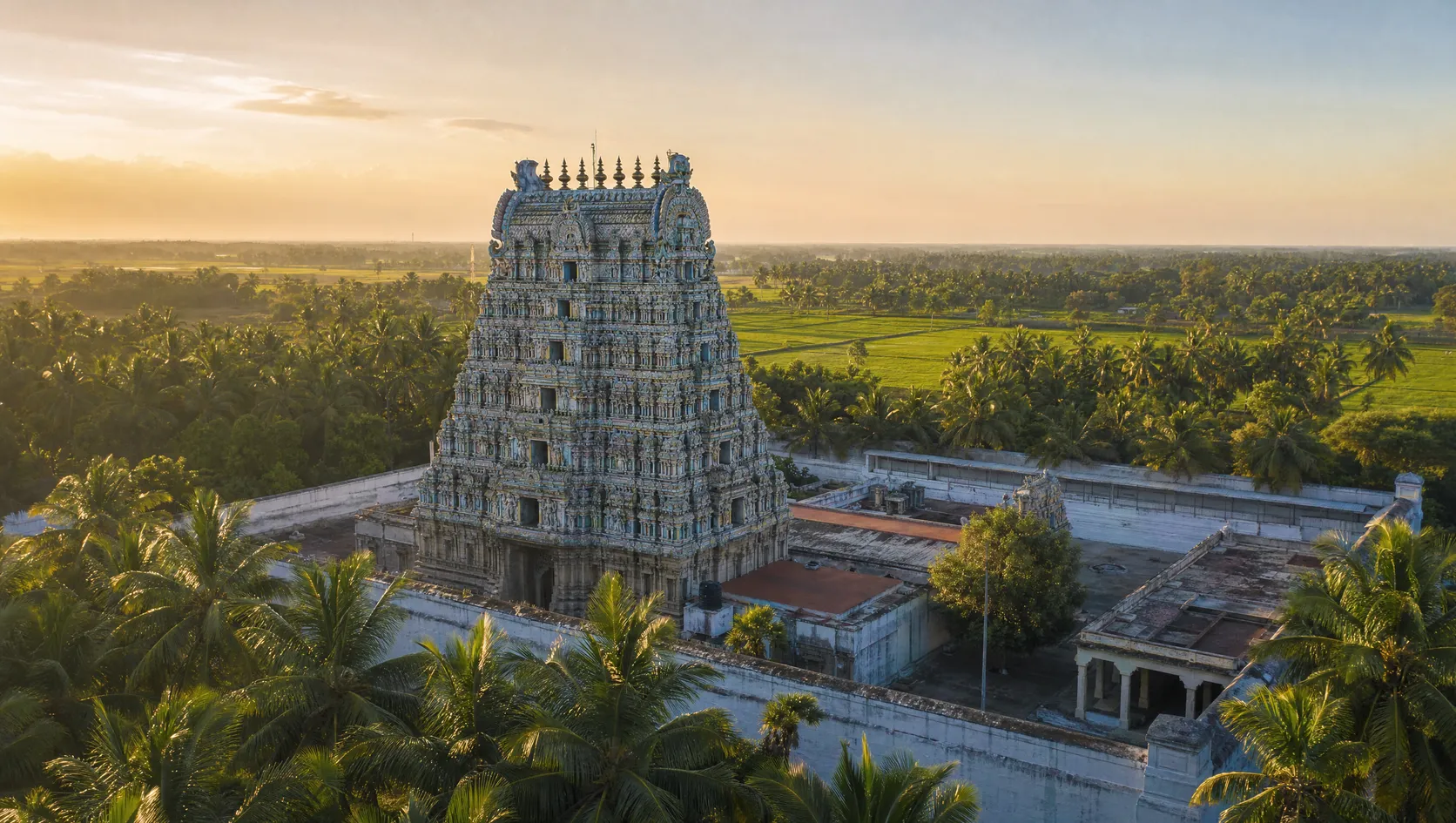
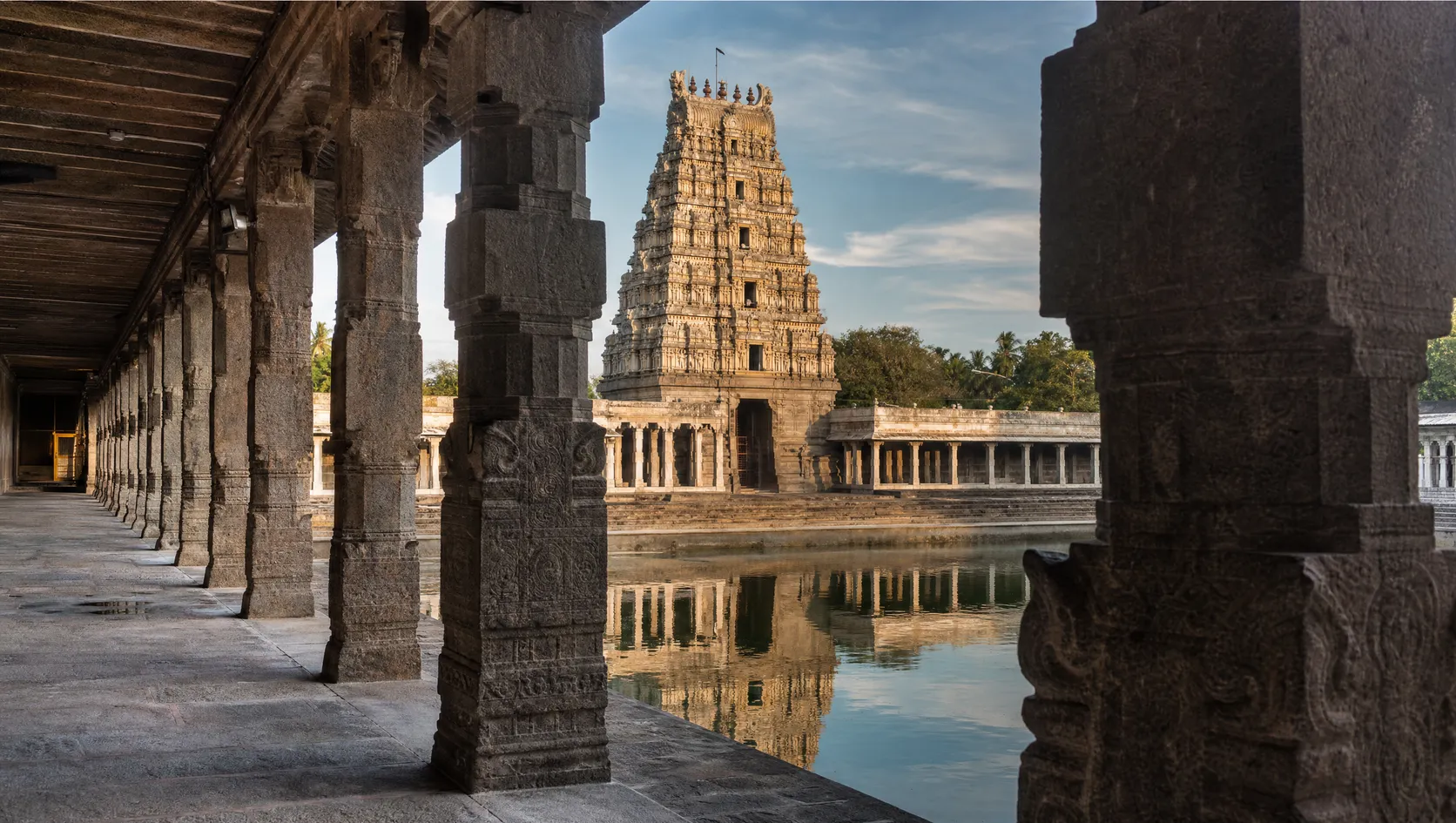
Dravidian, with a gopuram over the entrance and the Guru shrine among the subsidiary shrines of the main Shiva temple
विशेष
Pilgrims come principally for the Guru shrine, Jupiter being the most auspicious of the planets; the presiding deity is Shiva. Thursdays, the day of Jupiter, and Guru transit days draw very large gatherings.
पवित्र कथा · पवित्र कथा
Alangudi is the Jupiter temple of the Navagraha circuit, and Jupiter, Guru or Brihaspati, is the most auspicious of the planets: the teacher of the gods, the giver of wisdom, marriage and children, the one graha whose attention is almost always welcome. But the presiding deity here is Shiva as Apatsahayesvarar, a name that means the lord who helps in apat, in calamity, in the moment of gravest danger. And the story attached to that name is the darkest in the whole cycle of Shiva: this is held to be a place bound up with the churning of the ocean, when a poison rose that would have destroyed all creation, and Shiva drank it to save the world, holding it in his throat. So the most benefic planet is housed in a temple named for the deity who takes the poison meant for everyone. The pilgrim comes for good fortune and stands in the shrine of the one who intervenes when fortune has run out entirely.
Sacred Designationपवित्र पदनाम
Navagraha
ग्रह:
Sacred Origin Storyपवित्र उत्पत्ति कथा
Source: The Apatsahayesvarar account of the temple's sthala purana, associated with the churning of the ocean, together with the Guru association of the Navagraha circuit
The name Apatsahayesvarar, the lord who helps in calamity, is explained by the gravest calamity in the tradition's cosmology.
When the gods and asuras churned the ocean of milk to draw out the nectar of immortality, the first thing to rise was not nectar but its opposite: halahala, a poison so virulent that it began to destroy all creation as it appeared. There was no remedy and no appeal; the churning had produced something that would end the world. In that moment, when every other power had failed, Shiva took the poison into himself and drank it, holding it in his throat, which turned blue, and the destruction was arrested.
Alangudi is held in its tradition to be bound up with this act, and the name Apatsahayesvarar records it: the deity who acts precisely when there is no other help, when the situation is beyond ordinary remedy. That is the meaning of apat, not misfortune but calamity, the point past which nothing normal will serve.
Guru, Jupiter, has his shrine here, and it is one of the most visited on the circuit, for Jupiter is the giver of wisdom, of a good marriage, of children and of the expansion of a life. That the most hoped-for planet should sit in the temple of the deity who drank the world's poison places good fortune and catastrophe in the same enclosure, which is closer to how a life is actually lived than either alone.
उद्धृत स्रोत:
- Temple sthala purana (Apatsahayesvarar and the churning of the ocean)
- Navagraha circuit tradition (Guru sthalam account)
- Tevaram hymns referring to the site
विद्वत संदर्भ
Alangudi is a paadal petra sthalam, praised in the Tevaram, and was an established Shaiva shrine before its assignment as the Jupiter station of the Navagraha circuit. Its older name, Thiruvirinjhaipuram, and its association with Apatsahayesvarar belong to this earlier Shaiva identity. Among the circuit temples Alangudi is one of the most visited, and this reflects the nature of the graha it houses. Jupiter is the great benefic, and Guru transits, when Jupiter moves from one sign to the next roughly once a year, draw exceptional crowds seeking to align themselves with a favourable movement. This makes Alangudi busier than several of the other stations, which are visited chiefly to remedy affliction rather than to court good fortune. As with the rest of the circuit, the Jupiter assignment is a later layer over an older Shaiva shrine, and the connection between the benefic planet and the deity who drank the world's poison is not a prior association but a juxtaposition the circuit created.
Historyइतिहास
Alangudi is one of the paadal petra sthalams of the Cauvery delta, praised in the Tevaram, and its standing as a Shaiva shrine is old, held under the older name Thiruvirinjhaipuram before its identity as a Guru sthalam took hold. The presiding deity, Shiva as Apatsahayesvarar, the lord who helps in calamity, is associated with the drinking of the world-destroying poison at the churning of the ocean.
When the Navagraha circuit of nine planet temples was organised across the delta, Alangudi was assigned Jupiter, Guru, and the Guru shrine within the complex became one of the most visited on the whole circuit. Jupiter's standing as the great benefic, the giver of wisdom, marriage and children, means that pilgrims come here not only to remedy affliction but to court good fortune, which distinguishes Alangudi's traffic from that of the stations devoted to the more troubling planets.
The temple received Chola and later patronage as part of the delta's dense network of Shaiva shrines, and its complex took its present form across successive periods. Guru Peyarchi, the transit of Jupiter from one zodiacal sign to the next roughly once a year, became a major occasion here, drawing very large crowds seeking to begin the new transit auspiciously.
In the modern period the temple comes under the Tamil Nadu Hindu Religious and Charitable Endowments Department, and its visitor numbers, already high because of Jupiter's benefic standing, rose further as the Navagraha circuit became an organised pilgrimage.
Historical Timelineऐतिहासिक कालक्रम
The temple is praised in the Tevaram hymns of the Nayanar saints, establishing it as a paadal petra sthalam and fixing its antiquity as a Shaiva shrine centuries before the structures now standing.
The older name Thiruvirinjhaipuram belongs to this earlier Shaiva identity, before the Guru sthalam association.
The identity of the presiding deity as Apatsahayesvarar, the lord who helps in calamity, becomes established, associated with Shiva's drinking of the poison at the churning of the ocean.
The name records the deity as one who acts when no ordinary help remains, the meaning of apat as calamity rather than misfortune.
The temple receives Chola patronage as part of the dense network of Shaiva shrines endowed across the Cauvery delta, and much of the standing structure dates from this and later periods.
The gopuram, the pillared halls and the subsidiary shrines take their present form across successive campaigns of building and repair.
The Navagraha circuit of the Cauvery delta takes shape, and Alangudi is assigned Jupiter, its Guru shrine becoming one of the most visited on the circuit because of the planet's benefic standing.
Unlike the stations of the troubling planets, Alangudi is visited to court good fortune as much as to remedy affliction.
Guru Peyarchi, the transit of Jupiter from one zodiacal sign to the next roughly once a year, becomes a major occasion at the temple, drawing very large crowds to begin the new transit auspiciously.
Later patronage under the Thanjavur Nayakas and Marathas supports additions and repairs, as across the delta's temple landscape.
Colonial-era gazetteers record the temple within the delta's religious landscape, noting its place in the Navagraha circuit and its Guru association.
Administration passes to the Tamil Nadu Hindu Religious and Charitable Endowments Department, and periodic renovation and kumbhabhishekam are carried out.
As the Navagraha circuit grows into an organised pilgrimage and Guru Peyarchi draws exceptional crowds, Alangudi becomes one of the busiest stations of the circuit, visited for good fortune as much as for remedy.
What You'll Seeदर्शन में
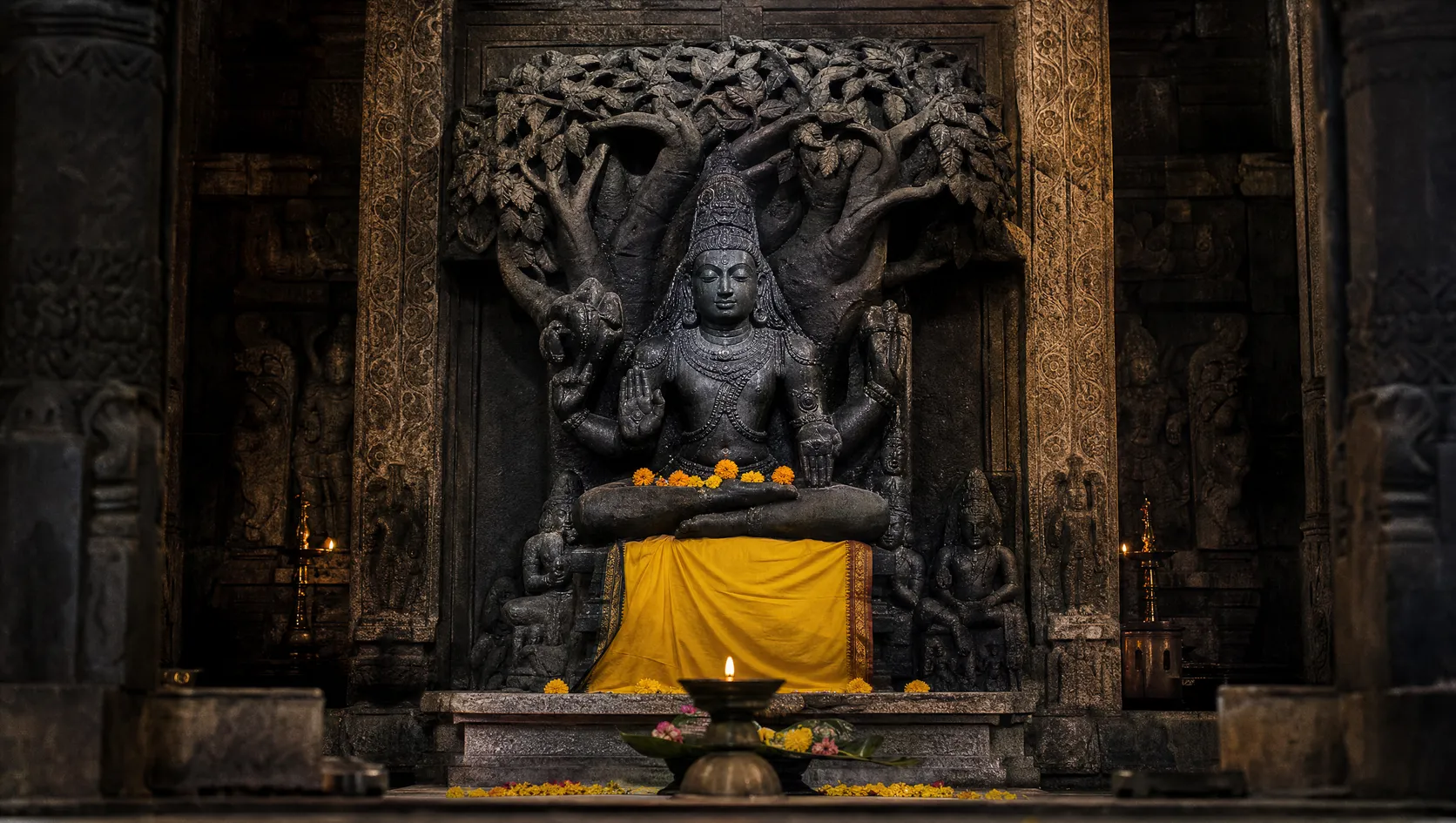
The presiding deity is Shiva as Apatsahayesvarar, worshipped as a linga in the main sanctum, with the goddess Elavarkuzhali in her own shrine. The building follows the Dravidian idiom of the delta, with a gopuram over the entrance and pillared halls within. A Dakshinamurthy, Shiva as the teacher facing south, is present and carries particular weight here, since the graha the temple houses is himself the teacher of the gods.
The Guru shrine, which brings the circuit pilgrim in large numbers, holds Jupiter in his graha form, yellow in complexion, seated, associated by the correspondences of graha worship with yellow, with Bengal gram, with topaz and with Thursday.
The pairing that defines the temple is between the two figures of the teacher and the two extremities of fortune. Guru, the benefic planet, is the teacher among the grahas; Dakshinamurthy is Shiva as teacher; and the presiding Apatsahayesvarar is the deity of the direst calamity. Good fortune, instruction and catastrophe are gathered in a single small temple, which is a fuller account of a life than a shrine of unmixed blessing would give.
Distinctive Practicesविशिष्ट परंपराएँ
Guru Peyarchi (Jupiter Transit)
गुरु पेयर्चि (बृहस्पति संक्रमण)
When Jupiter transits from one zodiacal sign to the next, roughly once a year
The transit of Jupiter from one sign to the next, occurring roughly once a year, is the temple's greatest occasion. Very large crowds come to Alangudi to begin the new transit auspiciously, since Jupiter's position governs an entire year's fortune in the graha system.
Jupiter moves slowly, spending about a year in each sign, so its transit resets the fortune of an entire year at once. To worship at the Guru sthalam at the moment of transit is to align the coming year with the benefic planet from its first day, which is why the occasion draws crowds unlike the ordinary rhythm of the circuit.
Thursday Worship for Jupiter
गुरु के लिए गुरुवार उपासना
Weekly on Thursdays
Thursday, the day of Jupiter, is the principal weekly day of worship, when the Guru shrine draws its largest regular crowds. Yellow offerings and Bengal gram are given according to the graha's correspondences, and Thursdays are favoured for prayers concerning marriage, children and learning.
Each graha governs a weekday, and Jupiter's is Thursday. Because Jupiter is the giver of marriage, children and wisdom, Thursday worship here is sought as much for these blessings as for the remedy of affliction, which sets it apart from the more anxious worship at the stations of the difficult planets.
Worship of Dakshinamurthy
दक्षिणामूर्ति की उपासना
Alongside the Guru worship, particularly by students
The Dakshinamurthy form, Shiva as the silent teacher facing south, is worshipped here alongside the Guru shrine, and students and seekers of knowledge address both, since both are teachers: Guru of the gods, Dakshinamurthy of the sages.
The temple gathers two teachers, the planet and the deity, and worship of both is fitting for a shrine whose graha is himself the instructor of the gods. For students the pairing is especially apt: instruction sought from the teacher among the planets and from the teacher among Shiva's forms in the same visit.
Yellow Offerings for Jupiter
बृहस्पति के लिए पीली भेंट
At the Guru shrine, particularly on Thursdays and at transit
Offerings for Jupiter follow the graha's colour and substance: yellow flowers, yellow cloth, Bengal gram and, where prescribed, topaz. The correspondences are specific to Guru and differ from those of the other eight planets.
The colour system makes each graha shrine legible by its offerings alone, and for Jupiter yellow carries the associations of gold, of ripeness and of auspicious expansion, the qualities of the great benefic. The offering is chosen to invite the growth that Jupiter is held to bring.
Did You Know?क्या आप जानते हैं?
The presiding deity is Shiva as Apatsahayesvarar, the lord who helps in calamity, associated with the drinking of the world-destroying poison at the churning of the ocean. So the most benefic planet is housed in the temple of the deity of the direst danger.
Temple sthala purana; Navagraha circuit tradition
Alangudi is among the most visited stations of the Navagraha circuit because Jupiter is the great benefic, so pilgrims come to court good fortune as much as to remedy affliction, unlike the stations of the troubling planets.
Navagraha circuit tradition
Guru Peyarchi, the transit of Jupiter from one sign to the next roughly once a year, is the temple's greatest occasion, since Jupiter's slow movement resets the fortune of an entire year at once.
Guru Peyarchi observance tradition
The temple gathers two teachers: Guru, the teacher of the gods among the planets, and Dakshinamurthy, Shiva as the silent teacher facing south, and students address both.
Temple tradition
The name Apatsahayesvarar records the deity as one who acts precisely when no ordinary help remains; apat means calamity, the point past which nothing normal will serve, not mere misfortune.
Standard etymology of Apatsahayesvarar
Jupiter governs wisdom, marriage, children and the expansion of a life in the graha system, so Thursday worship here is sought for these blessings, and Alangudi is a favoured temple for prayers concerning marriage and progeny.
Standard graha correspondences
The gathering of good fortune, instruction and catastrophe in a single small temple gives a fuller account of a life than a shrine of unmixed blessing would, which is part of the place's particular character.
Site tradition
Visitor Accessप्रवेश जानकारी
The temple is open to devotees without entry restriction. Traditional dress is customary, as at other temples in the Tamil delta, and footwear is removed at the entrance. Pilgrims come principally for the Guru shrine, Jupiter being the most auspicious planet, though the presiding deity is Shiva; many also worship Dakshinamurthy. Those on the circuit make the Jupiter offering at the Guru shrine, and students and those praying for marriage or children come specifically for its blessings. Thursdays and Guru Peyarchi are by far the busiest, when the temple can be very crowded. On ordinary days a visit is unhurried.
Avoid Guru Peyarchi and Thursdays if a quiet visit is wanted; on those days expect festival-scale crowds and long queues. On ordinary weekdays the temple is calm. Take darshan of the presiding Apatsahayesvarar and worship Dakshinamurthy before making the Jupiter offering at the Guru shrine; students in particular benefit from addressing both teachers. Bring or buy the yellow flowers and Bengal gram associated with the planet. Kumbakonam, about 20 km away, is the usual base, and hiring a vehicle for the circuit covers all nine temples comfortably.
Festivalsत्योहार
Guru Peyarchi (Jupiter Transit)
गुरु पेयर्चि
When Jupiter changes zodiacal sign, roughly once a year
The temple's greatest occasion, marking Jupiter's transit into a new sign. Very large crowds come to begin the new year-long transit auspiciously, and the day is treated across Tamil Nadu as a major astrological event.
Thursday Worship (Guru Vaaram)
गुरुवार उपासना
Weekly, throughout the year
Thursday, the day of Jupiter, is the temple's weekly high point, when the Guru shrine draws its largest regular crowds and prayers for marriage, children and learning are especially made.
Maha Shivaratri
महाशिवरात्रि
Feb-Mar (Phalgun Krishna Chaturdashi)
As the presiding deity is Shiva as Apatsahayesvarar, Maha Shivaratri is observed with night-long vigil and worship, a reminder that the temple is a Shiva shrine before it is the Jupiter station.
Brahmotsavam
ब्रह्मोत्सवम्
Varies by temple calendar
The annual festival of the presiding deity, with processions of the utsava murti and the associated ritual sequence over several days, drawing pilgrims beyond the regular Guru worship.
Traditional Offeringsपारंपरिक अर्पण
प्राथमिक अर्पण
Bel Patra (Bilva leaves)
बेल पत्र
बिल्व पत्र
The bilva leaf, the offering most closely associated with Shiva, is given to the presiding Apatsahayesvarar. At a temple whose deity drank the world's poison, the leaf held to be cooling and medicinal carries an added fitness before the god who took the burning halahala into his throat.
Yellow flowers and Bengal gram for Jupiter
बृहस्पति के लिए पीले पुष्प और चने की दाल
Yellow is the colour assigned to Jupiter and Bengal gram its grain. These are offered at the Guru shrine according to the graha's correspondences, and the grain is often donated afterwards as part of a prayer for Jupiter's blessings.
Yellow cloth and turmeric
पीला वस्त्र और हल्दी
Yellow cloth is offered at the Guru shrine, and turmeric, yellow and auspicious, is used in the worship of Jupiter and in prayers for marriage, which the planet governs. The colour draws the auspicious expansion Jupiter is held to bring.
Ghee lamp
घी का दीप
A lamp is lit at the Guru shrine, often the single most common element of Jupiter worship, and lamps are offered to the presiding Shiva. On Thursdays and at Guru Peyarchi the lighting of lamps is at its most abundant.
इस मंदिर की विशेषता
Prayers for Marriage and Children
विवाह और संतान की प्रार्थनाएँ
Because Jupiter governs marriage, children and the expansion of a life, Alangudi is a favoured temple for prayers concerning these, and the offerings made here are as often petitions for blessing as remedies for affliction. Turmeric, yellow cloth and the tying of vows are common. What is particular to Alangudi is that these hopeful prayers are offered in the temple of the deity who drank the world's poison. The setting does not undercut the hope; it frames it. To ask Jupiter for a marriage in the house of Apatsahayesvarar is to ask for good fortune while standing in the presence of the one who acts when fortune has failed, which the tradition treats as the more grounded way to ask.
Offering materials for both the Shiva worship and the Jupiter prayers are sold near the temple, and it is simplest to buy them there. If a specific remedy or vow has been prescribed, arrange the archana at the Guru shrine on arrival, and note that on Guru Peyarchi and Thursdays the queues are long. Many pilgrims take darshan of the presiding Apatsahayesvarar and worship Dakshinamurthy before making the Jupiter offering, following the temple's own order of worship. Eternal Raga presents these practices as devotional tradition and does not offer astrological advice.
How to Reachकैसे पहुँचें
Alangudi lies in the Cauvery delta near Kumbakonam and Needamangalam, and Kumbakonam is the usual base for the Navagraha circuit of which it is part.
By air: Tiruchirappalli International Airport is roughly 80 km away and is the nearest useful airport. Chennai is considerably further but far better connected.
By rail: Kumbakonam, roughly 20 km away, is the main railhead, well connected within Tamil Nadu. Tiruvarur is another junction nearby.
By road: The temple is reached by road from Kumbakonam or Needamangalam, and taxis are readily hired at Kumbakonam. The delta roads are flat and the driving is easy, though on Guru Peyarchi and Thursdays traffic to Alangudi is heavy.
Most pilgrims visit as one station of the Navagraha circuit, though Jupiter's benefic standing means many also come to Alangudi as a destination for prayers about marriage, children and learning. Hiring a vehicle for a day or two from Kumbakonam covers all nine temples comfortably.
Plan Your Visitयात्रा की योजना
🌤 सर्वोत्तम मौसम
November to February is the most comfortable period in the delta, with cooler air and manageable humidity, and it is when the multi-stop circuit is most pleasant to drive. March to June is hot, often severely so. The northeast monsoon, roughly October to December, brings rain that can affect road travel, though the delta roads recover quickly. Guru Peyarchi, whenever it falls, is by far the busiest day of the year, followed by Thursdays. For a quiet visit, choose an ordinary weekday morning in the cool season and avoid transit dates.
👘 पहनावे का नियम
Traditional dress is customary, as at Tamil temples generally. Men commonly wear a dhoti or trousers with a shirt; in the inner areas a dhoti without an upper garment may be expected. Women wear saree or salwar kameez. Yellow is favoured by many devotees on Thursdays, being the colour of Jupiter. Footwear is removed at the entrance, and the stone underfoot gets hot in the delta by mid-morning.
📱 फोन और फोटोग्राफी
Photography restrictions apply within the sanctum, as at Tamil temples generally; the outer areas are usually less restricted, but check locally rather than assuming. Phones should be silenced, and recording during a scheduled archana is inappropriate without the priest's agreement. On crowded transit days phones are best kept away entirely.
🏨 आवास
There is limited accommodation in Alangudi itself. Kumbakonam, about 20 km away and the usual circuit base, offers a full range of hotels and lodges and is well placed for the rest of the Navagraha temples as well as the great Chola temples of the delta. Most pilgrims stay at Kumbakonam and cover Alangudi as part of a day's circuit. On Guru Peyarchi accommodation across the region fills well in advance, and booking ahead is necessary.
Sacred Soundsपवित्र ध्वनि
क्या आप जानते हैं? · Did You Know?
वही अनुवाद त्रुटि जिसने हिन्दू धर्म में '33 कोटि' को '33 करोड़' बनाया, बौद्ध धर्म में भी हुई। बौद्ध ग्रन्थों के चीनी अनुवाद ने 'सप्त कोटि बुद्ध' (7 श्रेष्ठ बुद्ध) का अनुवाद '7 करोड़ बुद्ध' कर दिया। तिब्बती अनुवाद ने सही किया: 7 प्रकार, 7 करोड़ नहीं। एक संस्कृत शब्द, दो प्रमुख विश्व धर्मों में गलत पढ़ा गया, ने दो एकसमान भ्रम स्वतन्त्र रूप से उत्पन्न किए।
Related Contentसंबंधित सामग्री
Related Scriptures
Community Reflections
🕉️
Be the first to share your reflection.