Thirunallar Saneeswaran (Saturn)
तिरुनल्लार
Where Saturn releases rather than afflicts, and a king's seven and a half years ended
Thirunallar, Puducherry, India
Tirunaḷḷāṟu DarbhāraṇyeśvararAlso known as: Darbaranyeswarar Temple, Thirunallar Saniswaran Temple, Sani Sthalam
युग
A paadal petra sthalam praised in the Tevaram, of established antiquity as a Shaiva shrine; assigned Saturn in the Navagraha circuit and by far its most visited station
वास्तुकला
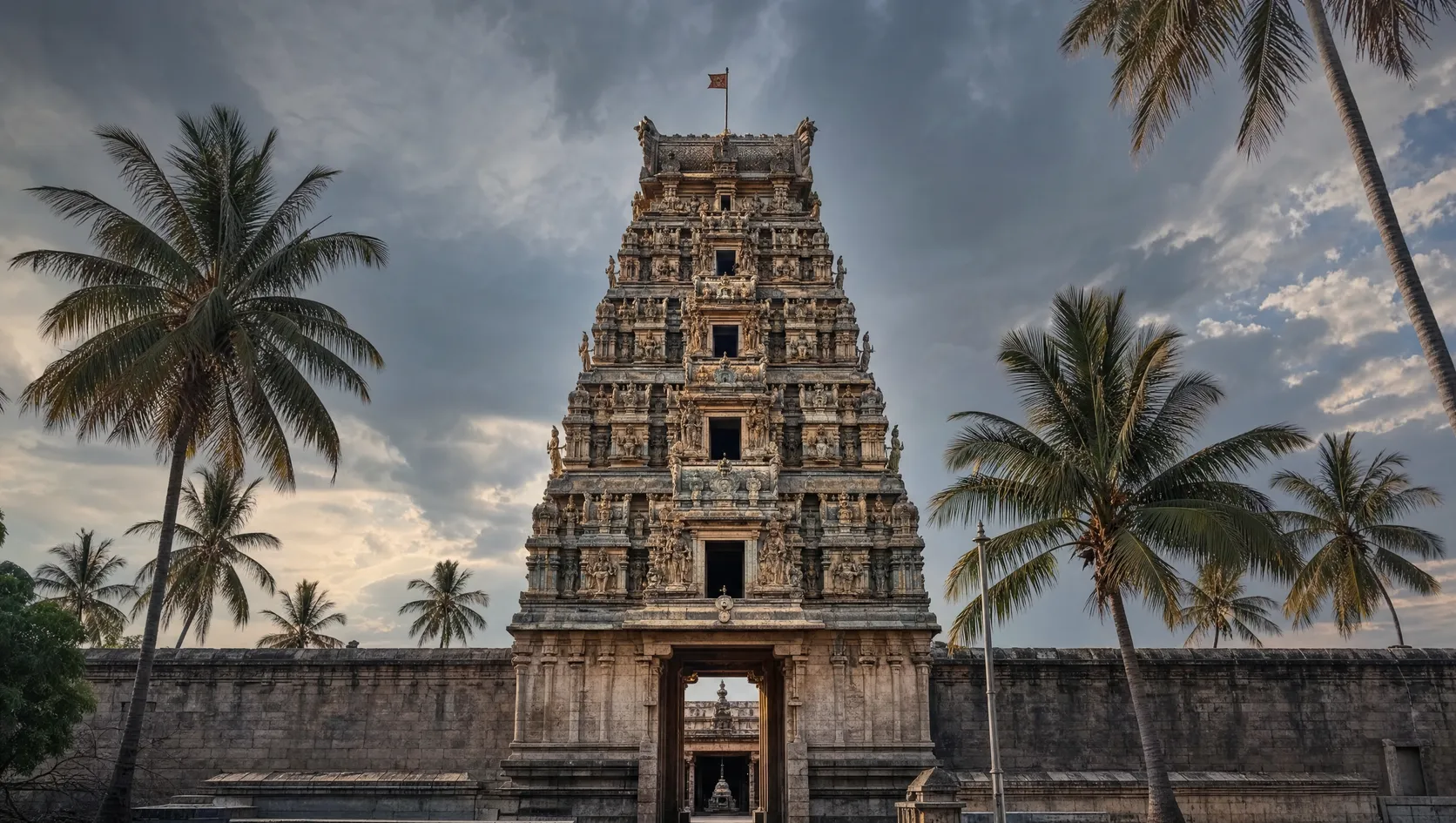
Dravidian, with gopurams, the Nala Theertham tank and the Saniswaran shrine, which draws the largest crowds of the circuit, within the complex
विशेष
Pilgrims come principally for the Saniswaran shrine, addressed for Saturn afflictions and sade sati; the presiding deity is Shiva. Saturdays draw very large crowds, and Shani Peyarchi, the transit of Saturn once in about two and a half years, draws crowds on a scale unmatched elsewhere on the circuit.
पवित्र कथा · पवित्र कथा
Thirunallar is the Saturn temple of the Navagraha circuit, and of the nine it is by far the most visited, because Saturn, Shani, is the most feared of the planets. His slow gaze over a life, the seven and a half years known as sade sati, is the affliction people dread most, and this is the one place where the tradition holds that Saturn does not only afflict but releases. The reason is a king. Nala, of the story of Nala and Damayanti, lost his kingdom, his wife and everything he had during the years Saturn's influence lay on him, and wandered in disguise and misery. It was at this place that the affliction lifted and his fortune turned, and the town is named for him: Thiru-Nala-aaru, the sacred place of Nala. So the pilgrim who comes carrying a dread of Saturn comes to the one temple where Saturn is remembered for letting a sufferer go. The name of the town is the name of a man Saturn finally released.
Sacred Designationपवित्र पदनाम
Navagraha
ग्रह:
Sacred Origin Storyपवित्र उत्पत्ति कथा
Source: The story of Nala and Damayanti, localised at Thirunallar, together with the Saturn account of the Navagraha circuit and the Darbaranyeswarar tradition of the temple's sthala purana
The story of Nala is told in the Mahabharata and retold across the tradition, and Thirunallar claims its turning point.
Nala was a righteous king, married to Damayanti, who had chosen him over the gods themselves. But Saturn had waited for an opening, and when Nala once performed his evening worship without properly washing his feet, the planet entered him. What followed was the full weight of Saturn's regard: Nala lost his kingdom at dice to his brother, went into exile, was separated from Damayanti in circumstances of terrible misjudgement, and wandered disfigured and unrecognised, reduced from a king to a charioteer in another man's service. The years of his suffering are read as sade sati, the seven and a half years of Saturn.
It was at this place, where Shiva is worshipped as Darbaranyeswarar, the lord of the forest of darbha grass, that the affliction ended. Nala bathed in the tank now called Nala Theertham, worshipped here, and Saturn's hold released him; his fortune turned, his kingdom and his wife were restored. The town took his name: Thiru-Nala-aaru.
What the story gives the tradition is a Saturn who lets go. Everywhere else Saturn is the planet of long affliction; here he is the planet who, having pressed a good man to the ground for seven and a half years, finally lifted the weight. That is why the most feared of the grahas has, at this one temple, the most visited shrine of the whole circuit.
उद्धृत स्रोत:
- Mahabharata (Nalopakhyana, the story of Nala and Damayanti)
- Temple sthala purana (Darbaranyeswarar and the release of Nala)
- Navagraha circuit tradition (Shani sthalam account)
विद्वत संदर्भ
Thirunallar is a paadal petra sthalam, praised in the Tevaram, and a Shaiva shrine of established antiquity dedicated to Shiva as Darbaranyeswarar. Its association with the Nala story gives it a standing among the Navagraha temples that the others do not have, and it is by a large margin the most visited of the nine. Administratively it is distinctive: it lies in the Karaikal region of the Puducherry union territory rather than in Tamil Nadu, so it comes under the Puducherry administration rather than the Tamil Nadu endowments department that governs the other circuit temples. The temple's importance is driven by Saturn's standing as the most feared planet and by the sade sati, the seven-and-a-half-year period of Saturn's influence, which is among the most dreaded features of a horoscope. Because Thirunallar is the place where Saturn is remembered as releasing rather than only afflicting, it functions as the principal remedial destination for Saturn in the south, and Shani Peyarchi, the transit of Saturn every two and a half years, draws crowds far exceeding those at any other circuit station.
Historyइतिहास
Thirunallar is one of the paadal petra sthalams of the Cauvery delta, praised in the Tevaram, and a Shaiva shrine of established antiquity dedicated to Shiva as Darbaranyeswarar, the lord of the forest of darbha grass. Its Shaiva identity is old and independent of the later Navagraha circuit, but it is the circuit that made it one of the most visited temples in South India.
The reason is the Nala story. Thirunallar claims to be the place where King Nala's affliction by Saturn ended, and where Saturn is therefore remembered not only as the planet of long suffering but as the one who released a sufferer. In a tradition that dreads the sade sati, the seven-and-a-half-year period of Saturn's influence, a temple where Saturn is known to have let go holds an importance out of proportion to its size.
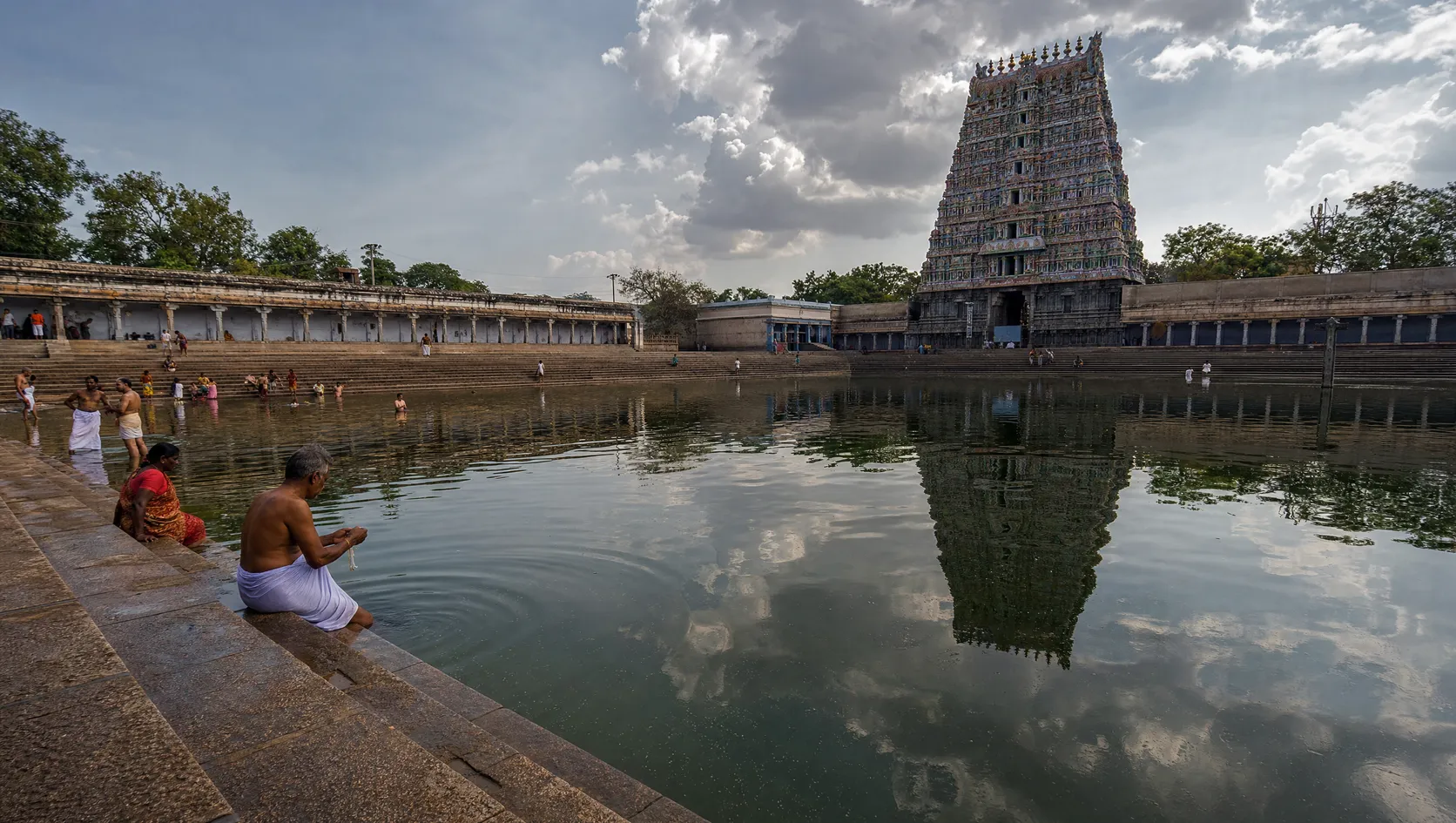
The temple lies in the Karaikal region of the Puducherry union territory, which sets it apart administratively from the other circuit temples in Tamil Nadu, and it comes under the Puducherry administration. Its Nala Theertham tank, in which Nala is said to have bathed when his fortune turned, is central to the remedy pilgrims come for.
Shani Peyarchi, the transit of Saturn from one zodiacal sign to the next once in about two and a half years, is the temple's greatest occasion, drawing crowds on a scale unmatched elsewhere on the circuit, when huge numbers come to mark the change in Saturn's position. The temple received patronage across the Chola and later periods, and in the modern era its Saturn association has made it a destination in its own right, visited by many who make no other part of the circuit.
Historical Timelineऐतिहासिक कालक्रम
The temple is praised in the Tevaram hymns of the Nayanar saints, establishing it as a paadal petra sthalam and fixing its antiquity as a Shaiva shrine centuries before the structures now standing.
The Shaiva identity as Darbaranyeswarar is older than the Saturn assignment.
The Nala story, told in the Mahabharata's Nalopakhyana, is localised at Thirunallar as the place where King Nala's affliction by Saturn ended and his fortune turned.
The localisation of the epic's turning point at this temple is the source of its unusual standing among the circuit stations.
The temple receives Chola patronage as part of the dense network of Shaiva shrines endowed across the Cauvery delta, and much of the standing structure dates from this and later periods.
The gopurams, the pillared halls, the Nala Theertham tank and the Saniswaran shrine take their present form across successive campaigns of building and repair.
The Navagraha circuit of the Cauvery delta takes shape, and Thirunallar is assigned Saturn, its Nala association making it the principal remedial destination for the most feared of the planets.
Thirunallar is by a wide margin the most visited of the nine stations, driven by the dread of Saturn's sade sati.
Shani Peyarchi, the transit of Saturn from one zodiacal sign to the next once in about two and a half years, becomes the temple's greatest occasion, drawing crowds on a scale unmatched elsewhere on the circuit.
Because Saturn moves slowly, its transit resets an influence lasting about two and a half years, which magnifies the occasion.
As part of the Karaikal region, Thirunallar came under French administration during the period of French India, which sets its modern administrative history apart from the Tamil Nadu circuit temples.
Karaikal was part of French India until the mid-twentieth century, and the region later became part of the Puducherry union territory.
With the transfer of the French territories, Karaikal becomes part of what is now the Puducherry union territory, and the temple comes under the Puducherry administration rather than the Tamil Nadu endowments department.
This administrative distinction sets Thirunallar apart from the other eight circuit temples.
The temple undergoes periodic renovation and kumbhabhishekam, and its Saturn association makes it a destination in its own right, visited by many who make no other part of the circuit.
Shani Peyarchi transits draw enormous crowds requiring large-scale management, and Thirunallar becomes among the most heavily attended temples in South India on those days, its Saturn remedy sought across the country.
What You'll Seeदर्शन में
The presiding deity is Shiva as Darbaranyeswarar, the lord of the forest of darbha grass, worshipped as a linga in the main sanctum, with the goddess Bogamartha Poonmulaiyal in her own shrine. The complex is large, with gopurams, the Nala Theertham tank and many subsidiary shrines.
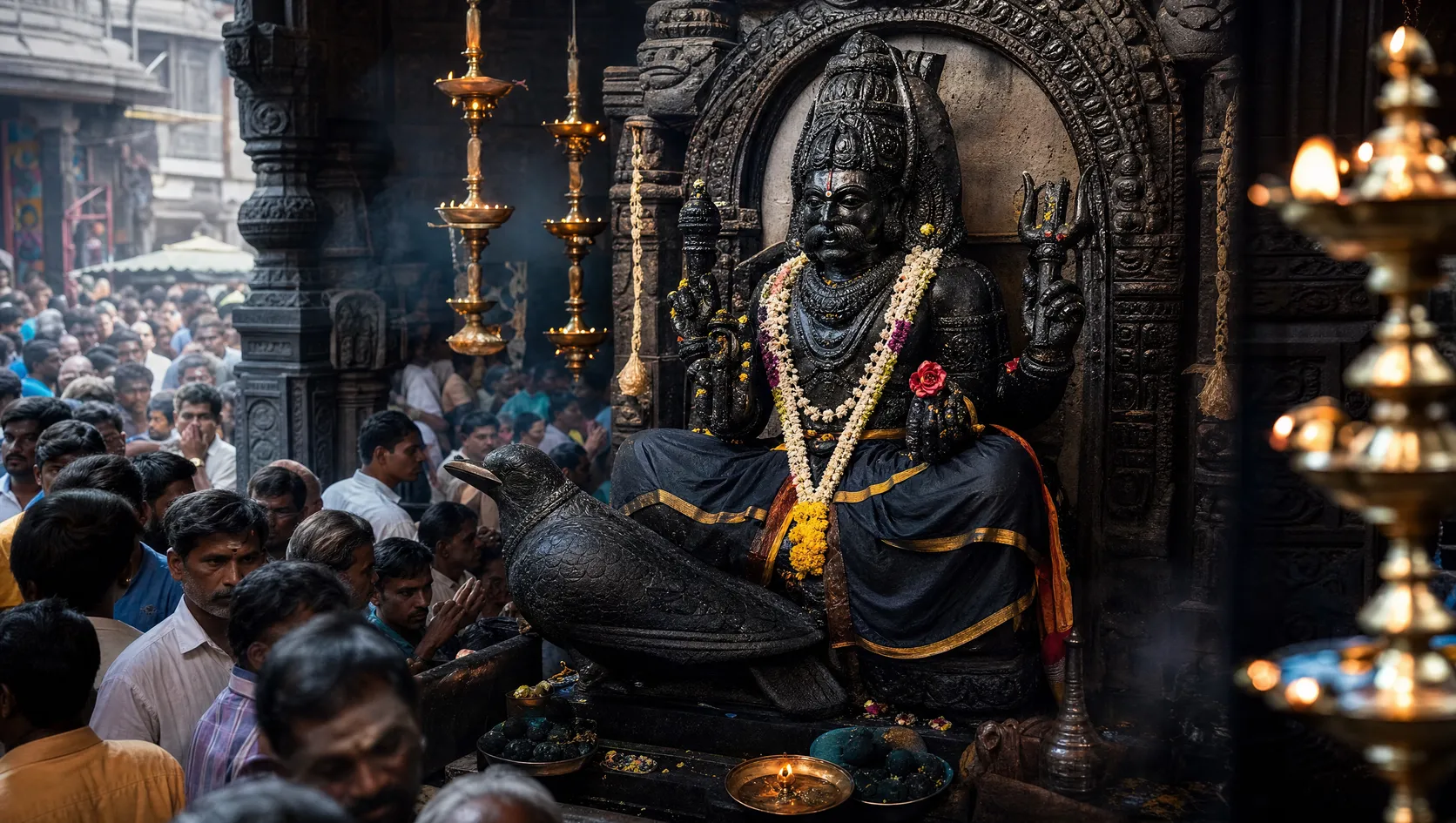
The Saniswaran shrine, which draws the largest crowds of the whole circuit, holds Saturn in his graha form. Shani is dark in complexion, slow-moving, mounted variously on a crow or a chariot, and associated by the correspondences of graha worship with blue and black, with sesame, with blue sapphire and with Saturday. His slowness is the point of him: where the swift planets pass, Saturn stays, and the long duration of his influence is what makes it feared.
But the image the temple is built around is the one that turns Saturn from affliction to release. This is where Nala's suffering ended, and the darshan of Saniswaran here is sought not to appease a tormentor at a distance but to ask the planet who let a king go to do the same again. The Nala Theertham tank, in which Nala is said to have bathed when his fortune turned, is as much the object of the pilgrimage as any image.
Distinctive Practicesविशिष्ट परंपराएँ
Bathing in the Nala Theertham
नल तीर्थम् में स्नान
Before darshan of Saniswaran
Pilgrims bathe in the Nala Theertham tank before taking darshan of Saniswaran, following King Nala, who is said to have bathed here when Saturn's hold on him released. The bath is central to the Saturn remedy sought at the temple.
The tank is where the affliction lifted in the story, so bathing in it is not preparation for worship but the first act of the remedy itself, a stepping into the water where Saturn once let a sufferer go. Many pilgrims regard the bath as the essential part of the visit, the darshan following from it.
Shani Peyarchi (Saturn Transit)
शनि पेयर्चि (शनि संक्रमण)
When Saturn transits to a new sign, once in about two and a half years
The transit of Saturn from one zodiacal sign to the next, occurring once in about two and a half years, is the temple's greatest occasion. Enormous crowds come to Thirunallar to mark the change in Saturn's position, and the day requires large-scale crowd management.
Saturn moves slowly, so its transit resets an influence lasting about two and a half years, a far longer span than the transits of the swift planets. To worship at the Saturn temple at the moment of transit is to face the new period of Saturn's regard from its beginning, at the place where Saturn is known to release, which is why the occasion draws crowds beyond anything else on the circuit.
Sade Sati Remedy
साढ़े साती निवारण
During the seven-and-a-half-year period of Saturn's influence
Pilgrims undergoing sade sati, the seven-and-a-half-year period when Saturn's influence lies heavily on a life, come to Thirunallar to seek relief, offering sesame, dark cloth and the substances associated with Saturn, particularly on Saturdays.
Sade sati is the most dreaded feature of a Saturn reading, a long stretch of hardship that cannot be hurried. The remedy sought here is not to escape it but to be released from it as Nala was, at the place where the tradition holds Saturn to have lifted his weight from a good man. The comfort the temple offers is precedent: it happened once, to a king.
Sesame and Dark Offerings for Saturn
शनि के लिए तिल और श्याम भेंट
At the Saniswaran shrine, particularly on Saturdays
Offerings for Saturn follow the graha's associations: sesame and sesame oil, dark or black cloth, black gram and, where prescribed, blue sapphire. These are offered at the Saniswaran shrine, and sesame-oil lamps are among the most common offerings, particularly on Saturdays.
Sesame and its oil, dark and slow-burning, match Saturn's nature as the dark, slow planet. The sesame-oil lamp in particular is the characteristic Saturn offering, its steady low flame suited to the planet whose regard is long rather than sudden. The offering meets the graha in its own quality.
Did You Know?क्या आप जानते हैं?
Thirunallar is by a wide margin the most visited of the nine Navagraha temples, because Saturn is the most feared of the planets and this is the one place where the tradition holds him to release rather than only afflict.
Navagraha circuit tradition
The town is named for King Nala of the Mahabharata, whose seven-and-a-half-year affliction by Saturn is said to have ended here: Thiru-Nala-aaru, the sacred place of Nala.
Mahabharata Nalopakhyana; temple sthala purana
Pilgrims bathe in the Nala Theertham tank, where Nala is said to have bathed when Saturn's hold released him, and the bath is central to the Saturn remedy the temple offers.
Temple tradition
Unlike the other circuit temples, which are in Tamil Nadu, Thirunallar lies in the Karaikal region of the Puducherry union territory and comes under the Puducherry administration, having been part of French India until the mid-twentieth century.
Administrative history of Karaikal and French India
Shani Peyarchi, the transit of Saturn once in about two and a half years, draws crowds on a scale unmatched elsewhere on the circuit, because Saturn's slowness makes each transit reset an influence lasting years.
Shani Peyarchi observance tradition
The sesame-oil lamp, dark and steady-burning, is the characteristic offering to Saturn, its low slow flame matching the planet whose regard is long rather than sudden.
Standard graha correspondences
Saturn governs discipline, labour, delay and the long consequences of action; the comfort Thirunallar offers those under his gaze is precedent, that a king once endured the full seven and a half years and was released.
Standard graha correspondences; site tradition
Visitor Accessप्रवेश जानकारी
The temple is open to devotees without entry restriction. Traditional dress is customary, as at Tamil temples generally, and footwear is removed at the entrance. Pilgrims come principally for the Saniswaran shrine, addressed for Saturn afflictions and sade sati, and most bathe in the Nala Theertham tank first, following King Nala. The presiding deity is Shiva, and many take his darshan as well. Saturdays are very busy, and Shani Peyarchi draws crowds on a scale that requires large-scale management, with waiting times extending greatly. On ordinary days the visit is calmer, though this remains the busiest of the nine stations.
Bathe in the Nala Theertham before darshan of Saniswaran; bring a change of clothes for this. Take darshan of the presiding Darbaranyeswarar as well as the graha. Avoid Shani Peyarchi and Saturdays if a calm visit is wanted; on Peyarchi days expect very large crowds and long waits, and check the Puducherry administration's arrangements in advance. Bring or buy sesame, sesame oil and dark cloth for the Saturn offering. The temple is near Nagapattinam and Karaikal; note that it is in Puducherry territory, not Tamil Nadu, though this makes no practical difference to a visit.
Festivalsत्योहार
Shani Peyarchi (Saturn Transit)
शनि पेयर्चि
When Saturn changes zodiacal sign, once in about two and a half years
The temple's greatest occasion, marking Saturn's transit into a new sign. Enormous crowds come to Thirunallar to face the new period of Saturn's influence from its beginning at the place where he is known to release, and the day requires large-scale management.
Saturday Worship (Sani Vaaram)
शनिवार उपासना
Weekly, throughout the year
Saturday, the day of Saturn, is the temple's weekly high point, when the Saniswaran shrine draws very large crowds and sesame-oil lamps and dark offerings are most made, particularly by those undergoing sade sati.
Maha Shivaratri
महाशिवरात्रि
Feb-Mar (Phalgun Krishna Chaturdashi)
As the presiding deity is Shiva as Darbaranyeswarar, Maha Shivaratri is observed with night-long vigil and worship, a reminder that the temple is a Shiva shrine before it is the Saturn station.
Brahmotsavam
ब्रह्मोत्सवम्
Varies by temple calendar
The annual festival of the presiding deity, with processions of the utsava murti and the associated ritual sequence over several days, drawing pilgrims beyond the regular Saturn traffic.
Traditional Offeringsपारंपरिक अर्पण
प्राथमिक अर्पण
Bel Patra (Bilva leaves)
बेल पत्र
बिल्व पत्र
The bilva leaf, the offering most closely associated with Shiva, is given to the presiding Darbaranyeswarar. At the temple most sought for Saturn, the standard Shiva offering is made to the presiding deity before or alongside the Saturn worship.
Sesame and sesame-oil lamp for Saturn
शनि के लिए तिल और तिल-तेल का दीप
Sesame and its oil are the substances most associated with Saturn, and the sesame-oil lamp, dark and steady-burning, is the characteristic offering at the Saniswaran shrine, particularly on Saturdays and during sade sati.
Dark cloth and black gram
श्याम वस्त्र और उड़द दाल
Black or dark blue cloth and black gram follow Saturn's colour and grain, offered at the Saniswaran shrine, with the grain often donated afterwards as part of a prescribed remedy for a Saturn affliction.
Nala Theertham water
नल तीर्थम् जल
The water of the Nala Theertham, where Nala was released, is itself central to the remedy: pilgrims bathe in it, and the bath is the first act of the Saturn remedy rather than a preliminary to it.
इस मंदिर की विशेषता
The Nala Theertham Bath and Release
नल तीर्थम् स्नान और मुक्ति
What is particular to Thirunallar is that its central offering is not a substance placed before an image but an act performed in a tank: the bath in the Nala Theertham, where King Nala is said to have bathed when Saturn released him. The remedy the pilgrim comes for is enacted, not merely requested. Some traditions hold that a garment worn during affliction is left behind after the bath, and new clothes worn onward, so that the old fortune is shed with the old cloth in the water. Whatever the local custom, the logic is one of release rather than appeasement: the pilgrim does not bribe Saturn to relent but steps into the water where he already, once, let a sufferer go.
Offering materials for both the Shiva worship and the Saturn remedy are sold near the temple, and it is simplest to buy them there. The Nala Theertham bath is central, so bring a change of clothes. If a specific Saturn remedy has been prescribed, arrange the archana at the Saniswaran shrine on arrival, and note that on Shani Peyarchi and Saturdays the queues are very long. Eternal Raga presents these practices as devotional tradition and does not offer astrological advice; a sade sati reading obtained elsewhere is the individual's own matter.
How to Reachकैसे पहुँचें
Thirunallar lies in the Karaikal region of the Puducherry union territory, in the Cauvery delta near Nagapattinam, and it is among the more accessible stations of the Navagraha circuit.
By air: Tiruchirappalli International Airport is roughly 130 km away and is the nearest useful airport. Chennai is considerably further but far better connected.
By rail: Nagapattinam, about 5 km away, and Karaikal, very close, are the nearest railheads, connected within Tamil Nadu and to Chennai.
By road: The temple is reached by road from Nagapattinam or Karaikal in a short drive, and taxis and buses serve the route. Kumbakonam, the usual base for the wider circuit, is somewhat further away than for the more clustered inland temples.
Many pilgrims visit Thirunallar on its own rather than as part of the full circuit, because Saturn's standing makes it a destination in itself. Those doing the whole circuit reach it from Kumbakonam or Nagapattinam. On Shani Peyarchi, transport and access are heavily affected by the crowds, and the Puducherry administration makes special arrangements.
Plan Your Visitयात्रा की योजना
🌤 सर्वोत्तम मौसम
November to February is the most comfortable period in the delta, with cooler air and manageable humidity. The coastal Karaikal region is humid, and March to June is hot. The northeast monsoon, roughly October to December, brings heavy rain to this coastal region and can affect road travel and the crowds. Saturdays are very busy, and Shani Peyarchi, whenever it falls, brings crowds on a scale unlike any ordinary day, with the town overwhelmed and access difficult. For a calm visit, choose an ordinary weekday morning in the cool season and avoid transit dates and Saturdays.
👘 पहनावे का नियम
Traditional dress is customary, as at Tamil temples generally. Men commonly wear a dhoti or trousers with a shirt; in the inner areas a dhoti without an upper garment may be expected. Women wear saree or salwar kameez. Black is worn by many devotees, being the colour of Saturn. Footwear is removed at the entrance, and those bathing in the Nala Theertham should bring a change of clothes.
📱 फोन और फोटोग्राफी
Photography restrictions apply within the sanctum, as at Tamil temples generally; the outer areas and the tank are usually less restricted, but check locally rather than assuming. Phones should be silenced. On Shani Peyarchi and busy Saturdays, phones are best kept away entirely because of the crush.
🏨 आवास
There is accommodation in Karaikal and Nagapattinam nearby, both offering a range of hotels and lodges, more than at the smaller inland circuit stations because Thirunallar draws pilgrims as a destination in its own right. On Shani Peyarchi accommodation across the region fills far in advance, and booking well ahead is necessary. Those doing the wider circuit may base themselves at Kumbakonam, though Thirunallar is somewhat apart from the inland cluster.
Sacred Soundsपवित्र ध्वनि
क्या आप जानते हैं? · Did You Know?
वही अनुवाद त्रुटि जिसने हिन्दू धर्म में '33 कोटि' को '33 करोड़' बनाया, बौद्ध धर्म में भी हुई। बौद्ध ग्रन्थों के चीनी अनुवाद ने 'सप्त कोटि बुद्ध' (7 श्रेष्ठ बुद्ध) का अनुवाद '7 करोड़ बुद्ध' कर दिया। तिब्बती अनुवाद ने सही किया: 7 प्रकार, 7 करोड़ नहीं। एक संस्कृत शब्द, दो प्रमुख विश्व धर्मों में गलत पढ़ा गया, ने दो एकसमान भ्रम स्वतन्त्र रूप से उत्पन्न किए।
Related Contentसंबंधित सामग्री
Related Scriptures
Community Reflections
🕉️
Be the first to share your reflection.