Thingalur Kailasanathar (Moon)
तिंगलूर कैलासनाथर
You came for the Moon, and find you are in a temple of Shiva
Thingalur, Tamil Nadu, India
Tiṅgaḷūr KailāsanātharAlso known as: Thingalur Chandran Temple, Kailasanathar Temple, Thingalur, Chandra Sthalam
युग
A Chola-period foundation of the Cauvery delta, praised in the Tevaram hymns of the Nayanars, which places its importance well before the medieval structures that stand today
वास्तुकला
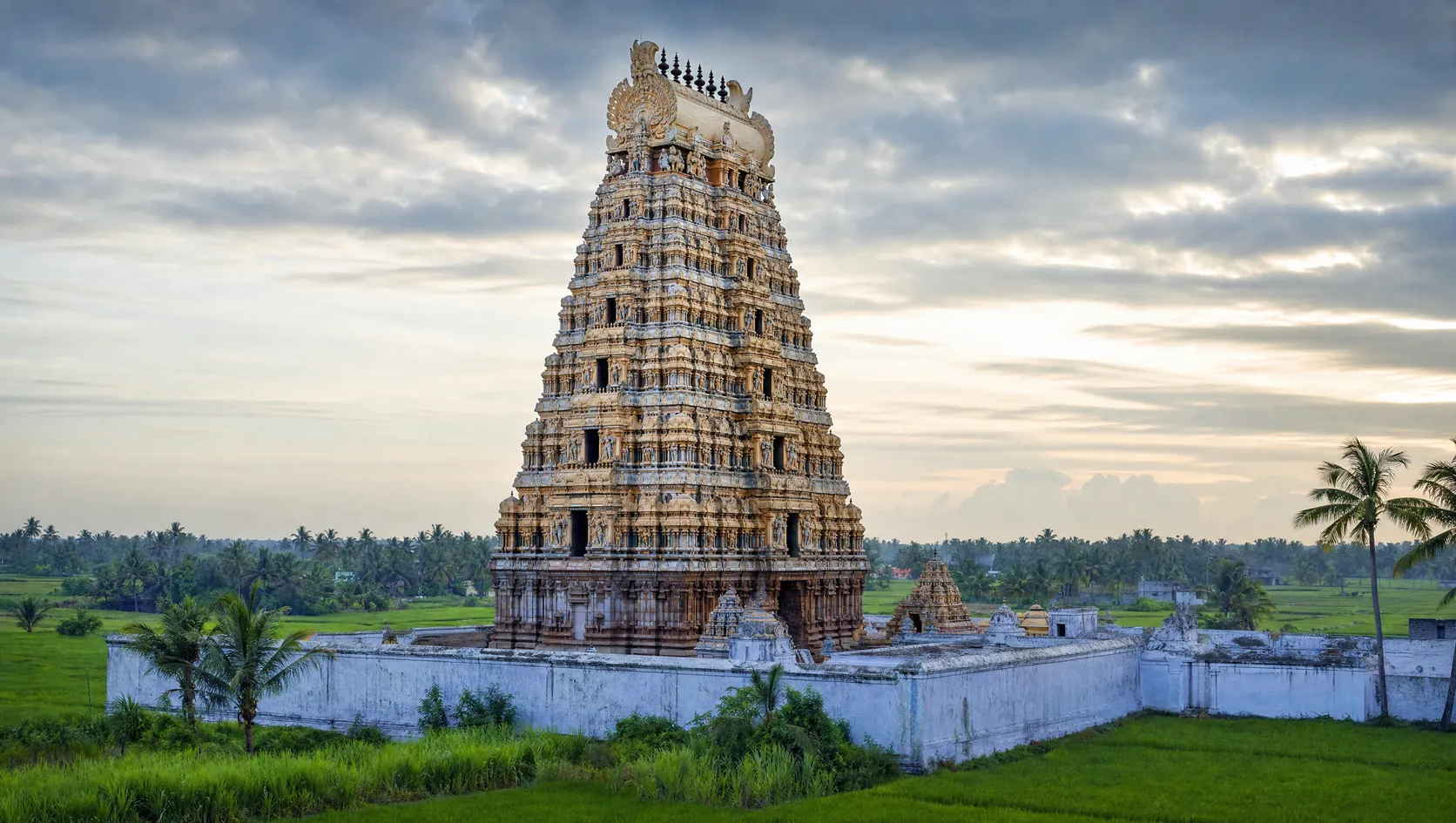
Dravidian, with a gopuram over the entrance and the Chandra shrine within the enclosure of the main Shiva temple
विशेष
Pilgrims of the Navagraha circuit come principally for the Chandra shrine, though the presiding deity is Shiva. Mondays, the Moon's day, and full-moon days draw the largest gatherings.
पवित्र कथा · पवित्र कथा
Thingalur is the Moon temple of the Navagraha circuit, and the first thing to understand about it is that the Moon does not preside here. The presiding deity is Shiva, as Kailasanathar. Chandra, the Moon, has a shrine, and it is his shrine that pilgrims come to address, but he stands inside a Shiva temple rather than at the centre of his own. This is the ordinary arrangement of the circuit, and Suryanar Kovil, where the Sun does preside, is the exception that proves it. Everywhere else you come for a planet and are received by Shiva. The theology is quiet but firm. The planet governs a portion of your life and can afflict it, but it is not the last authority. You address the Moon at Thingalur in the presence of the deity to whom, in the tradition's account, even the Moon once came for relief.
Sacred Designationपवित्र पदनाम
Navagraha
ग्रह:
Sacred Origin Storyपवित्र उत्पत्ति कथा
Source: The Chandra affliction account of the Navagraha circuit tradition, together with the Nayanar hagiography of Appudhi Adigal preserved in the Periya Puranam
Two stories meet at Thingalur, and the tradition keeps both.
The first is the Moon's. Chandra, cursed to wane by Daksha for neglecting his other wives, is said in the circuit tradition to have worshipped Shiva at this place to be relieved of the waning that threatened to consume him entirely. He was not restored to permanence but to a rhythm: the waning was made to alternate with waxing, so that he empties and fills rather than simply disappears. The relief he received was not the removal of the affliction but its conversion into a cycle he could survive.
The second story is human, and it is why Thingalur is loved beyond the circuit. Appudhi Adigal, a Brahmin of this village, was a devotee of the saint Thirunavukkarasar, whom he had never met. He revered him so completely that he named everything in his household after him: his wells, his sons, the vessels in his house. When Thirunavukkarasar, travelling, at last came to Thingalur and discovered a stranger who had built his whole life around a man he had never seen, he was undone by it.
The two accounts sit together without strain. One is about a god learning to survive by cycle rather than by permanence; the other about a man who gave his whole household to a devotion he expected nothing back from.
उद्धृत स्रोत:
- Navagraha circuit tradition (Chandra sthalam account)
- Periya Puranam (Appudhi Adigal Nayanar)
- Tevaram hymns referring to the site
विद्वत संदर्भ
Thingalur belongs to the paadal petra sthalam tradition, the temples praised in the Tevaram hymns of the Nayanar saints, which establishes its standing as a Shaiva site independent of and prior to its role in the Navagraha circuit. The circuit itself, in which nine delta temples are each assigned a planet, is a later organising scheme laid over an existing landscape of Shiva temples. This layering is characteristic of the whole circuit and is clearest here. Thingalur was a Shiva temple with its own hagiography before it became the Moon station, and the Chandra association is an addition to a site that already had a reason to exist. Scholars generally treat the Navagraha circuit as a medieval and later development that gathered older temples into a new devotional itinerary rather than as a set of temples built for planetary worship.
Historyइतिहास
Thingalur is a temple of the Cauvery delta of the kind the Tamil Shaiva tradition holds in particular affection: an ancient Shiva shrine praised in the Tevaram, the body of hymns composed by the Nayanar saints between roughly the sixth and eighth centuries. Inclusion in that corpus, as a paadal petra sthalam, is the highest antiquity a Tamil Shiva temple can claim, and it places Thingalur's importance long before the medieval structures now standing.
The village's own claim to fame within the Shaiva tradition is Appudhi Adigal, counted among the sixty-three Nayanars, whose story of devotion to Thirunavukkarasar is told in Sekkizhar's Periya Puranam. That the temple produced a canonised saint of its own gives it a standing in Tamil Shaivism that its modest scale would not otherwise suggest.
The Navagraha association came later. As the circuit of nine planet temples took shape across the delta, Thingalur was assigned the Moon, and the Chandra shrine within the temple became the focus for pilgrims addressing lunar afflictions in a horoscope. The temple thus carries two identities that developed in sequence: the older Shaiva shrine of the Tevaram and the saint, and the later Moon station of the Navagraha circuit.
Like the other temples of the delta it has been renovated and reconsecrated at intervals, and it now comes under the Tamil Nadu Hindu Religious and Charitable Endowments Department. Its visitor numbers rose considerably as the Navagraha circuit grew into an organised pilgrimage in the later twentieth century.
Historical Timelineऐतिहासिक कालक्रम
The temple is praised in the Tevaram hymns of the Nayanar saints, establishing it as a paadal petra sthalam and fixing its antiquity as a Shaiva shrine centuries before the structures now standing.
Inclusion in the Tevaram is the strongest available marker of antiquity for a Tamil Shiva temple.
Appudhi Adigal of Thingalur, a devotee of Thirunavukkarasar, is counted among the sixty-three Nayanars, giving the village a canonised saint of its own.
The temple receives Chola patronage as part of the dense network of Shaiva shrines endowed across the Cauvery delta, and much of the standing structure dates from this and later periods. The delta under the Cholas held one of the highest concentrations of stone temples anywhere, and Thingalur is one modest shrine within that landscape.
The density of Chola-era temple building in the delta is itself the context that made a nine-temple planetary circuit possible: the shrines were already there to be assigned.
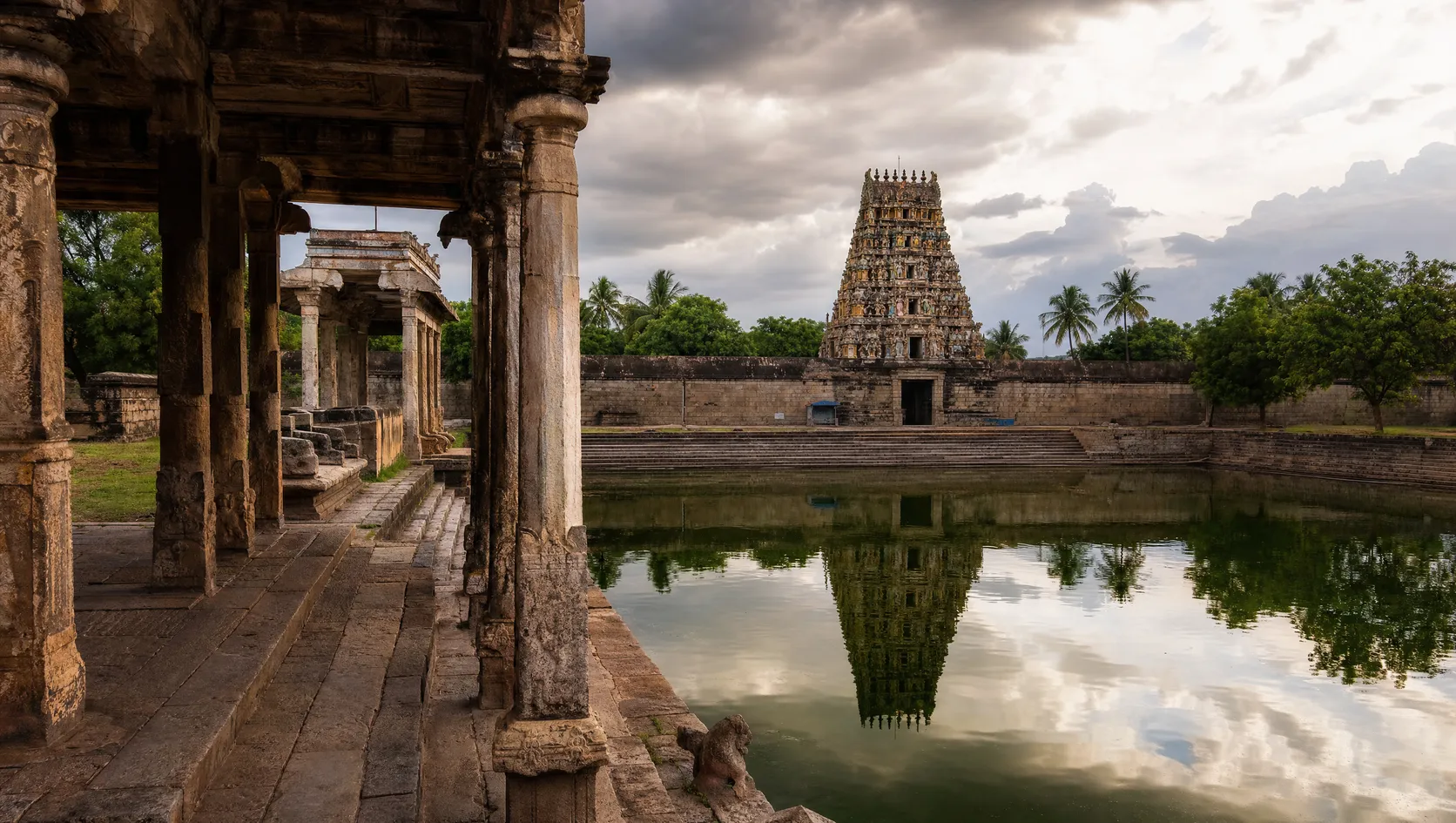
The goddess shrine, the pillared halls and the gopuram take their present form across successive campaigns of building and repair, following the standard evolution of a Tamil Shiva temple from a single sanctum into a walled complex.
The Navagraha circuit of the Cauvery delta takes shape, and Thingalur is assigned the Moon, its Chandra shrine becoming the focus for pilgrims of the circuit.
The circuit is a later scheme laid over older Tevaram temples rather than a set of purpose-built graha shrines.
Later patronage under the Thanjavur Nayakas and Marathas supports additions and repairs, as across the delta's temple landscape.
Colonial-era gazetteers record the temple within the delta's religious landscape, noting its place in the Navagraha circuit.
Administration passes to the Tamil Nadu Hindu Religious and Charitable Endowments Department, and periodic renovation and kumbhabhishekam are carried out.
As the Navagraha circuit grows into an organised form of religious travel served by tours from Kumbakonam, visitor numbers at Thingalur rise well beyond its earlier local draw.
What You'll Seeदर्शन में
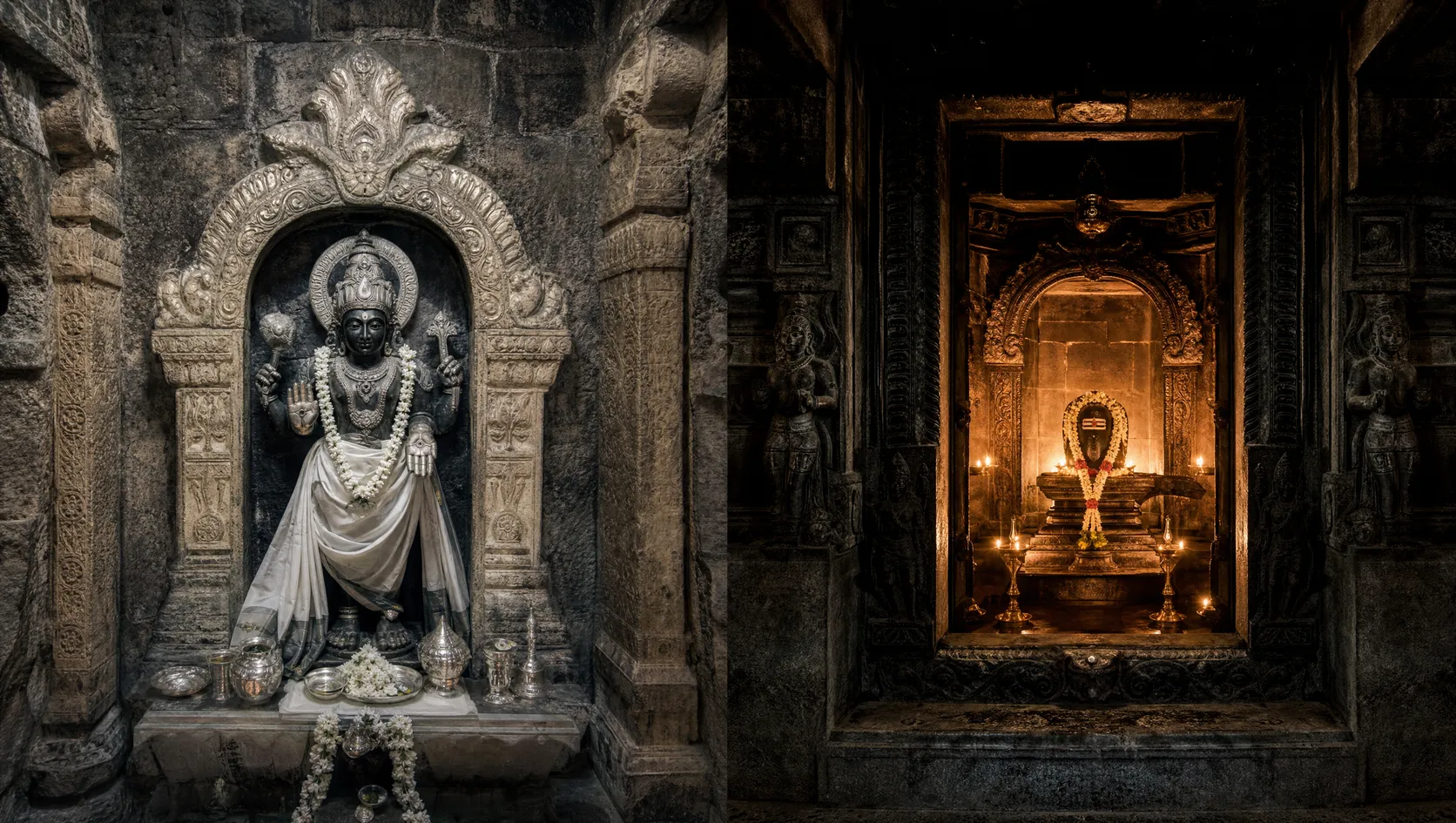
The presiding deity is Shiva as Kailasanathar, worshipped as a linga in the main sanctum, with the goddess in her own shrine as is usual in Tamil Shiva temples. The building follows the Dravidian idiom of the delta, of modest scale, with a gopuram over the entrance and pillared halls within.
The Chandra shrine, which is what brings the circuit pilgrim, holds the Moon in his graha form. Chandra is shown with the crescent, fair in complexion, and by the correspondences of graha worship he is associated with white, with rice, with pearl and with Monday. The shrine is approached with offerings following those associations.
What the arrangement makes visible is the hierarchy the circuit assumes. The graha has a shrine, not a sanctum; he is addressed within the temple of a deity greater than himself. A visitor who came only for the Moon and did not look up would take Chandra for the centre of the place, and would be wrong.
Distinctive Practicesविशिष्ट परंपराएँ
Addressing the Moon Within a Shiva Temple
शिव मंदिर के भीतर चंद्र को सम्बोधित करना
Every visit, particularly on Mondays
Circuit pilgrims come to the Chandra shrine to address lunar afflictions identified in a horoscope, but the worship is offered within the temple of Shiva, and many first take darshan of the presiding deity before turning to the graha.
The order enacts the theology of the circuit. The planet is real and its affliction is real, but it is not sovereign; it is addressed in the house of a deity to whom, in the tradition's own story, the Moon once came for relief. Worship here is not a petition to the last authority but to one under it.
Monday and Full-Moon Worship
सोमवार और पूर्णिमा उपासना
Weekly on Mondays, and on Pournami (full moon)
Monday, the day governed by the Moon, is the principal day of worship, and full-moon days draw additional pilgrims. White offerings and rice are given at the Chandra shrine according to the graha's correspondences.
Each graha governs a weekday, and worship on the planet's own day is held most effective. For the Moon, the full-moon day adds the point in the lunar cycle when the deity is at his fullest, the opposite of the waning the founding story addresses.
Remembrance of Appudhi Adigal
अप्पूदि अडिगळ का स्मरण
Observed in connection with the Nayanar tradition
The village's association with Appudhi Adigal, the Nayanar who built his household around devotion to a saint he had never met, is remembered at the temple, and the Tevaram connection is honoured alongside the Navagraha worship.
The saint's story is the human counterpart of the temple's theology. Appudhi Adigal expected nothing back from his devotion, which is the same posture the circuit asks of the pilgrim who addresses a planet: worship offered without a guaranteed return, in the presence of something greater than the object of the request.
White Offerings for the Moon
चंद्र के लिए श्वेत भेंट
At the Chandra shrine, particularly for lunar remedies
Offerings for the Moon follow the graha's colour and substance: white flowers, white cloth, rice and, where prescribed, pearl. The correspondences are specific to Chandra and differ from those of the other eight planets.
The colour system makes each graha shrine legible by its offerings alone, and for the Moon white carries the associations of coolness, calm and the mind, which the Moon governs. The offering is chosen to match the quality the devotee hopes to steady.
Did You Know?क्या आप जानते हैं?
The presiding deity of the Moon temple is not the Moon but Shiva, as Kailasanathar. This is the norm across the Navagraha circuit; Suryanar Kovil, where the Sun presides, is the single exception.
Navagraha circuit tradition
In the circuit tradition Chandra was relieved of his curse not by removal but by conversion into a cycle: the waning was made to alternate with waxing, so the Moon empties and fills rather than disappearing.
Navagraha circuit tradition (Chandra sthalam account)
Thingalur was the home of Appudhi Adigal, one of the sixty-three Nayanars, who revered the saint Thirunavukkarasar so completely that he named his wells, his sons and his household vessels after a man he had never met.
Periya Puranam of Sekkizhar
The temple is a paadal petra sthalam, praised in the Tevaram hymns, which makes it a Shaiva shrine of established antiquity long before it became the Moon station of the Navagraha circuit.
Tevaram corpus
The name Thingalur derives from thingal, the Tamil word for the moon, which is also the word for Monday, the day the Moon governs.
Tamil toponymic tradition
The Moon governs the mind in the graha system, so lunar remedies here are sought as much for mental unsteadiness, anxiety and emotional disturbance as for material misfortune.
Standard graha correspondences
Because it is one station of the nine-temple circuit, Thingalur is rarely visited alone; most pilgrims arrive as part of a one- or two-day journey covering all nine planets across the delta.
Navagraha circuit itinerary
Visitor Accessप्रवेश जानकारी
The temple is open to devotees without entry restriction. Traditional dress is customary, as at other temples in the Tamil delta, and footwear is removed at the entrance. Circuit pilgrims come principally for the Chandra shrine, though the presiding deity is Shiva; many take darshan of Shiva first. Those coming for a specific lunar remedy often arrange archana at the Chandra shrine on arrival. The temple is small and a visit does not take long unless a ritual has been arranged. It is almost always visited as one station of the Navagraha circuit rather than on its own.
Take darshan of Shiva as the presiding deity before turning to the Chandra shrine; it is both the traditional order and a way of seeing the temple as it understands itself rather than only as a circuit stop. If a specific lunar remedy is intended, arrange the archana on arrival and bring or buy the white offerings and rice associated with the Moon. The temple is small and a visit takes well under an hour without a scheduled ritual, so plan it as one stop among the nine, with a vehicle hired in Kumbakonam for the circuit.
Festivalsत्योहार
Pournami (Full Moon)
पूर्णिमा
Monthly, on the full moon
The full-moon day is the natural festival of a Moon temple, marking the point in the lunar cycle when Chandra is at his fullest. Worship at the Chandra shrine is at its most attended, and the day carries particular weight for those addressing lunar afflictions.
Maha Shivaratri
महाशिवरात्रि
Feb-Mar (Phalgun Krishna Chaturdashi)
As the presiding deity is Shiva, Maha Shivaratri is observed with night-long vigil and worship, a reminder that the temple is a Shiva shrine before it is a station of the Navagraha circuit.
Pradosham
प्रदोषम्
Twice monthly, on the thirteenth lunar day
The twilight worship of Shiva observed on the thirteenth day of each lunar fortnight is kept here as at Shiva temples generally, tying the temple's Shaiva identity to the lunar calendar its graha also inhabits.
Monday Worship
सोमवार उपासना
Weekly, throughout the year
Monday, the Moon's day, is the temple's weekly high point, and the day on which most circuit pilgrims time their visit to the Chandra shrine. For a Moon temple the recurring Monday matters more than most annual festivals do elsewhere.
Traditional Offeringsपारंपरिक अर्पण
प्राथमिक अर्पण
Bel Patra (Bilva leaves)
बेल पत्र
बिल्व पत्र
The three leaflets of the bilva are read as the three eyes of Shiva and the three prongs of his trident, and the leaf is the offering most closely associated with him. At Thingalur it is offered to the presiding deity, Kailasanathar, before the pilgrim turns to the graha shrine. That the Shiva offering comes first is the point in miniature: the leaf goes to the deity of the temple, not to the planet the visitor came for.
White flowers for the Moon
चंद्र के लिए श्वेत पुष्प
White is the colour assigned to Chandra, and white flowers, particularly jasmine, are offered at the Moon's shrine. The colour carries the Moon's associations of coolness and calm, and the mind, which the Moon governs. The white offering distinguishes the Chandra shrine at a glance from the shrines of the other grahas, each of which has its own colour.
Rice
चावल
Rice is the grain assigned to the Moon in graha worship, and it is offered at the Chandra shrine and often donated afterwards as part of a prescribed remedy. Each planet has its own grain; rice belongs to the Moon. As with the other grains of the circuit, the offering is not kept but given onward, so a lunar remedy commonly ends with rice leaving the temple and reaching someone who needs it.
Ghee lamp
घी का दीप
A lamp is lit at the Chandra shrine, often as the single most common element of a lunar remedy. Light offered at the shrine of the Moon has a natural fitness, the Moon being itself a giver of light, though a reflected and changing one. The number of lamps and the medium are sometimes prescribed according to the affliction, following the same logic that governs the offerings across the circuit.
इस मंदिर की विशेषता
The Chandra Remedy at Thingalur
तिंगलूर में चंद्र-निवारण
Pilgrims addressing a lunar affliction identified in a horoscope come specifically to the Chandra shrine here, offering white flowers, rice and a lamp, and where prescribed making a donation of rice or white cloth afterwards. What is particular to Thingalur is the setting of the remedy. It is offered not at a standalone Moon temple but within the shrine of Shiva, and the tradition treats the presence of the greater deity as part of what makes the remedy effective: the planet is being addressed in the house of the one to whom the planet itself once appealed.
Offering materials for the Moon are sold near the temple, and it is simplest to buy them there, since the correspondences of colour and grain are specific and the vendors know them. If a specific remedy has been prescribed, arrange the archana at the Chandra shrine on arrival. Many pilgrims first offer bilva and take darshan of the presiding Shiva before making the lunar offering, following the temple's own order of worship. Eternal Raga presents these practices as devotional tradition and does not offer astrological advice.
How to Reachकैसे पहुँचें
Thingalur lies in the Cauvery delta near Thiruvaiyaru, and Thanjavur or Kumbakonam is the practical base for the Navagraha circuit of which it is part.
By air: Tiruchirappalli International Airport is roughly 60 km away and is the nearest useful airport. Chennai is considerably further but far better connected.
By rail: Thanjavur is the main railhead at roughly 25 km, well connected within Tamil Nadu. Kumbakonam, the usual circuit base, is a little further.
By road: The temple is reached by road from Thiruvaiyaru or Thanjavur. Buses serve the route and taxis are readily hired at Thanjavur or Kumbakonam, which is how most pilgrims arrive. The delta roads are flat and the driving is easy.
Most people visit as one station of the Navagraha circuit rather than as a single destination. Hiring a vehicle for a day or two from Kumbakonam covers all nine temples comfortably, and dedicated circuit tours also run.
Plan Your Visitयात्रा की योजना
🌤 सर्वोत्तम मौसम
November to February is the most comfortable period in the delta, with cooler air and manageable humidity, and it is when the multi-stop circuit is most pleasant to drive. March to June is hot, often severely so. The northeast monsoon, roughly October to December, brings rain that can affect road travel across the circuit, though the delta roads recover quickly. Mondays and full-moon days are the busiest, being the Moon's day and the Moon's fullness respectively. For a quieter visit, an ordinary weekday morning in the cool season is best.
👘 पहनावे का नियम
Traditional dress is customary, as at Tamil temples generally. Men commonly wear a dhoti or trousers with a shirt; in the inner areas a dhoti without an upper garment may be expected. Women wear saree or salwar kameez. Footwear is removed at the entrance, and the stone underfoot gets hot in the delta by mid-morning, a practical argument for an early visit.
📱 फोन और फोटोग्राफी
Photography restrictions apply within the sanctum, as at Tamil temples generally; the outer areas are usually less restricted, but check locally rather than assuming. Phones should be silenced, and recording during a scheduled archana is inappropriate without the priest's agreement.
🏨 आवास
There is no significant accommodation at the temple itself. Thanjavur, roughly 25 km away, and Kumbakonam, the usual circuit base, both offer a full range of hotels and lodges and are well placed for the rest of the Navagraha temples as well as the great Chola temples of the delta. Most pilgrims stay at one of these and cover Thingalur as part of a day's circuit rather than lodging nearby.
Sacred Soundsपवित्र ध्वनि
क्या आप जानते हैं? · Did You Know?
वही अनुवाद त्रुटि जिसने हिन्दू धर्म में '33 कोटि' को '33 करोड़' बनाया, बौद्ध धर्म में भी हुई। बौद्ध ग्रन्थों के चीनी अनुवाद ने 'सप्त कोटि बुद्ध' (7 श्रेष्ठ बुद्ध) का अनुवाद '7 करोड़ बुद्ध' कर दिया। तिब्बती अनुवाद ने सही किया: 7 प्रकार, 7 करोड़ नहीं। एक संस्कृत शब्द, दो प्रमुख विश्व धर्मों में गलत पढ़ा गया, ने दो एकसमान भ्रम स्वतन्त्र रूप से उत्पन्न किए।
Related Contentसंबंधित सामग्री
Related Scriptures
Community Reflections
🕉️
Be the first to share your reflection.