Thirunageswaram Naganathaswamy (Rahu)
तिरुनागेश्वरम्
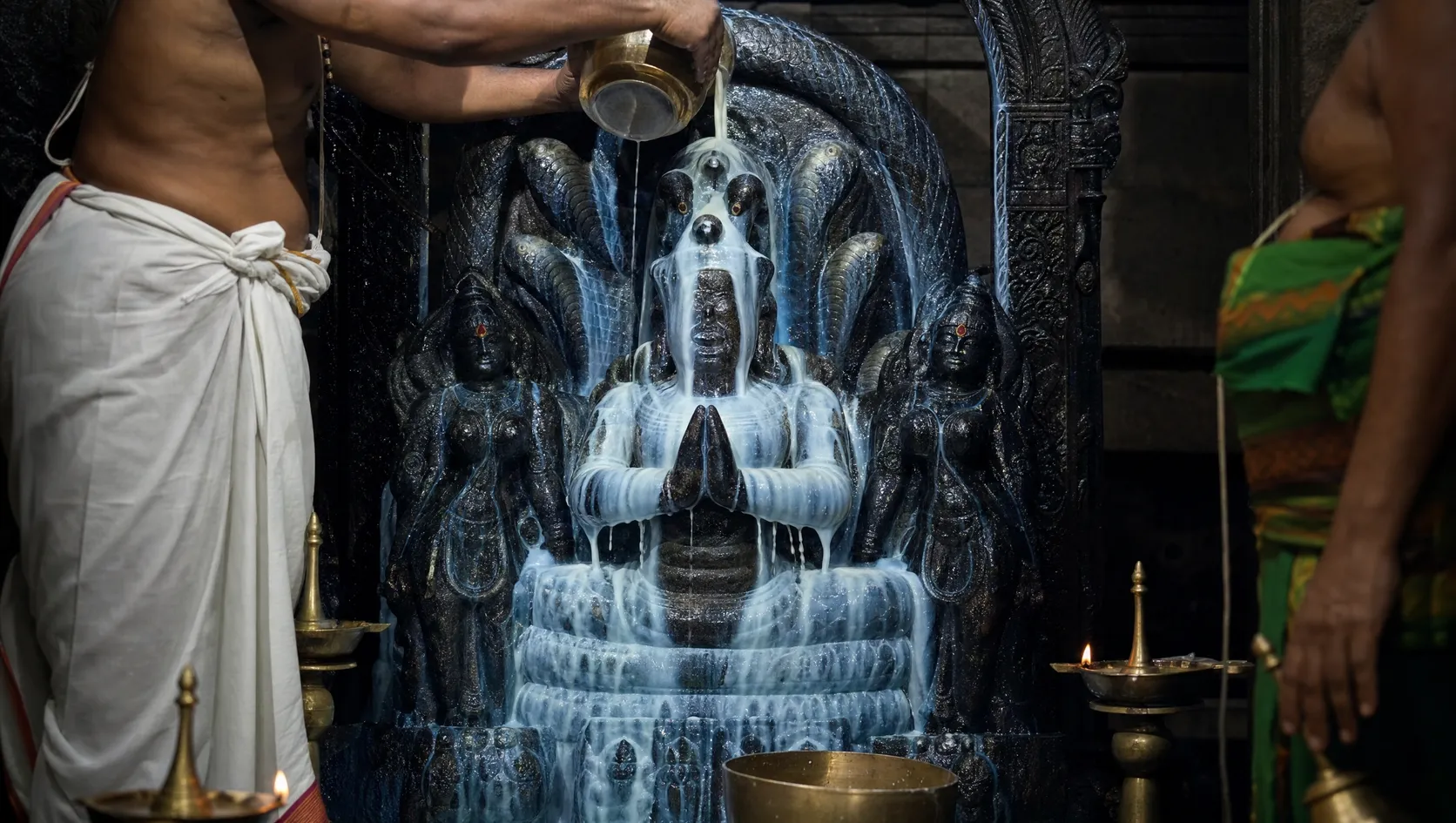
The Rahu temple, where milk poured on the shadow-planet turns blue
Thirunageswaram, Tamil Nadu, India
Tirunāgeśvaram NāganāthasvāmyAlso known as: Naganathaswamy Temple, Thirunageswaram Rahu Sthalam, Rahu Bhagavan Temple
युग
A paadal petra sthalam praised in the Tevaram, of established antiquity as a Shaiva shrine; assigned Rahu in the later Navagraha circuit and noted for the milk that changes colour on the Rahu image
वास्तुकला
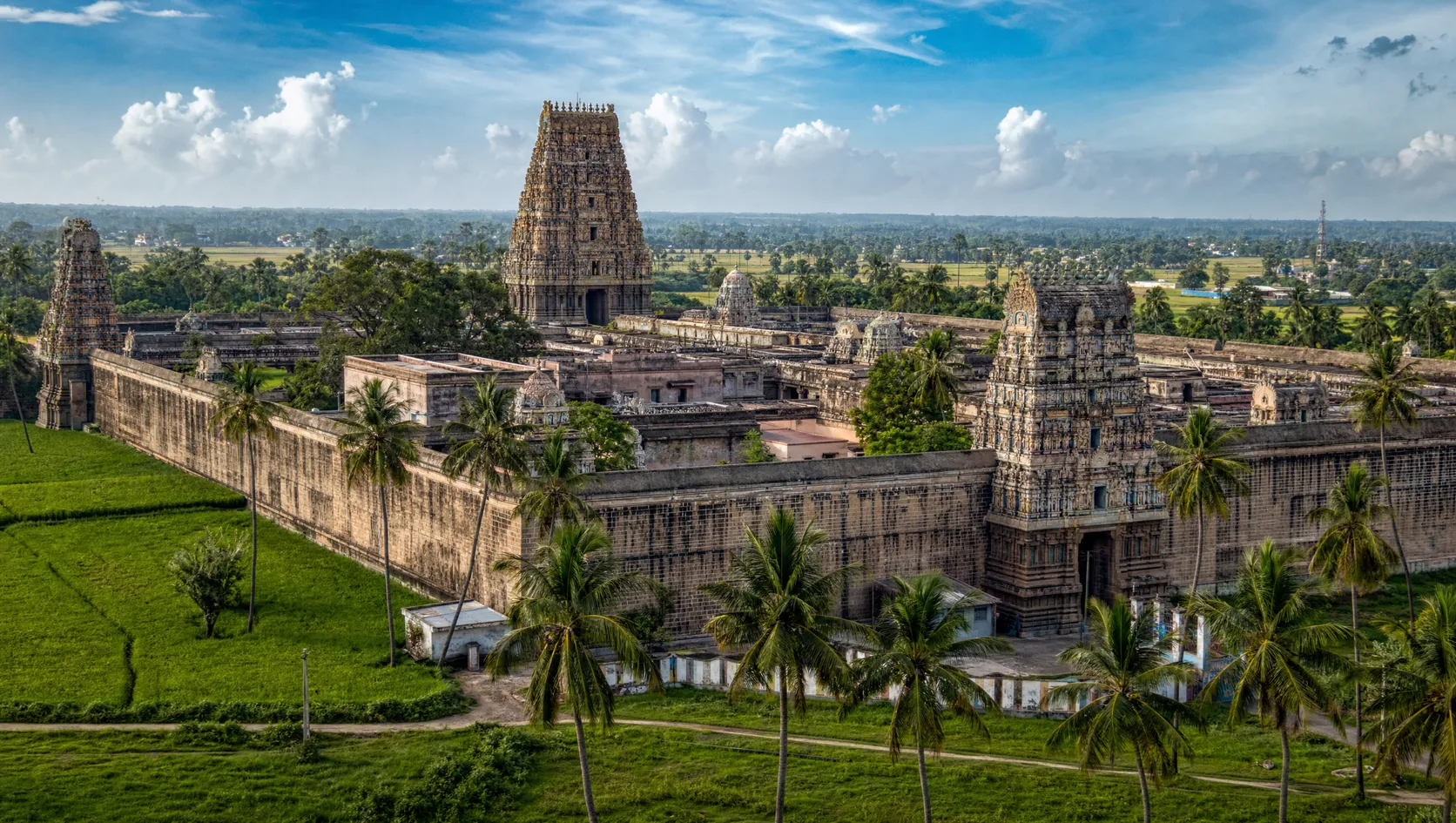
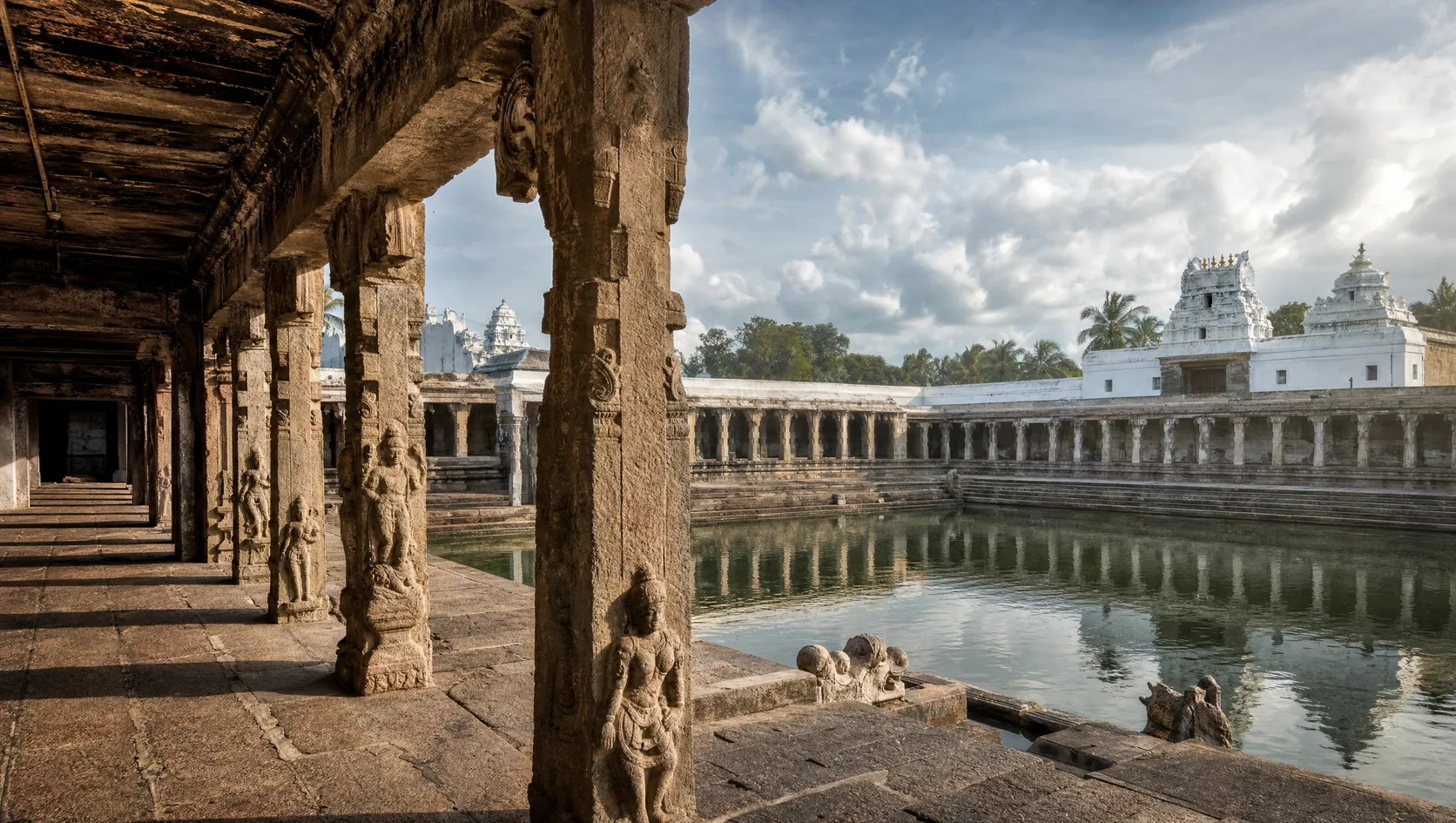
Dravidian, with a large complex, gopurams and the Rahu shrine, where Rahu is shown with consorts, among the subsidiary shrines
विशेष
Pilgrims come principally for the Rahu shrine and its milk abhishekam, addressed for serpent afflictions and Rahu doshas. The abhishekam during Rahu kalam draws the largest gatherings, when the milk is seen to change colour.
पवित्र कथा · पवित्र कथा
Thirunageswaram is the Rahu temple of the Navagraha circuit, and Rahu is not a planet in the ordinary sense. He is a shadow, a graha without a body: the severed head of the serpent Svarbhanu, who stole a mouthful of the nectar of immortality and was cut in two by Vishnu's discus a moment too late, so that the head lived on, immortal and headless of a body, and the body immortal and bodiless of a head. The head is Rahu; the tail is Ketu. They chase the sun and moon across the sky and swallow them, which is what an eclipse is. The presiding deity here is Shiva as Naganathaswamy, the lord of serpents, and the temple is best known for a single vivid phenomenon: when milk is poured over the Rahu image during the abhishekam, it is seen to take on a blue or violet tinge as it runs down. Pilgrims come to witness it, and it is treated as a sign of the shadow-planet's presence in the offering. So the pilgrim comes to address a planet that has no body, at a temple of the serpent lord, and sees the proof of the planet not in a form but in a change of colour in the milk.
Sacred Designationपवित्र पदनाम
Navagraha
ग्रह:
Sacred Origin Storyपवित्र उत्पत्ति कथा
Source: The Naganathaswamy tradition of serpent worship, together with the Rahu account of the Navagraha circuit and the story of Svarbhanu at the churning of the ocean
Rahu's origin is the churning of the ocean. When the gods and asuras drew out the nectar of immortality and Vishnu, disguised as the enchantress Mohini, distributed it to the gods alone, one asura, Svarbhanu, slipped among them in disguise and took a mouthful. The sun and moon saw him and cried out, and Vishnu's discus severed his neck, but the nectar had already passed his throat, so both halves lived. The head became Rahu, the tail Ketu, and the two of them pursue the sun and moon that betrayed them, swallowing them at eclipses.
Rahu is thus a graha without a body, a shadow that governs the hidden, the foreign, the sudden and the illusory, and in the reading of horoscopes he is bound up with serpents: sarpa dosha and kala sarpa dosha, the afflictions of the serpent, are addressed to him.
The presiding deity here is Shiva as Naganathaswamy, the lord of serpents, worshipped in a tradition of naga devotion older than the Rahu assignment. And the temple's celebrated sign is the milk of the abhishekam: poured white over the Rahu image, it is seen to run off with a blue or violet cast, which the tradition treats as the shadow-planet making its presence visible in the one way a body-less graha can, not in a form but in a transformation.
Unusually, Rahu here is shown with consorts, Nagavalli and Nagakanni, which softens the fearsome shadow into something closer to a householder, one of several ways the delta temples domesticate the most troubling of the grahas.
उद्धृत स्रोत:
- Temple sthala purana (Naganathaswamy and serpent worship)
- Navagraha circuit tradition (Rahu sthalam account)
- Puranic account of Svarbhanu at the churning of the ocean
विद्वत संदर्भ
Thirunageswaram is a paadal petra sthalam, praised in the Tevaram, and a substantial Shaiva shrine with a serpent-worship tradition that predates its assignment as the Rahu station of the Navagraha circuit. The dedication to Naganathaswamy, the serpent lord, made it a natural choice for Rahu, the graha bound up with serpents in astrological reading. The milk that appears to change colour on the Rahu image is the temple's best-known feature. It is described in devotional accounts as a miracle and by sceptical observers as an effect of the image's material and the light; the tradition does not require the distinction to be settled, treating the change as a sign regardless of its mechanism. Its role in the temple's popularity is not in doubt. Rahu and Ketu, the two shadow-planets, are the severed halves of one serpent, and their circuit temples, Thirunageswaram for Rahu and Keezhperumpallam for Ketu, are the two ends of a single mythological body distributed across the delta. As with the rest of the circuit, the graha assignment is a later layer over an older Shaiva shrine.
Historyइतिहास
Thirunageswaram is one of the paadal petra sthalams of the Cauvery delta, praised in the Tevaram, and a Shaiva shrine of established antiquity dedicated to Shiva as Naganathaswamy, the lord of serpents. Its tradition of serpent worship is old and independent of the later Navagraha circuit.
That dedication made it the obvious choice for Rahu when the circuit of nine planet temples was organised, since Rahu is the graha bound up with serpents in astrological reading, and the afflictions of the serpent, sarpa dosha and kala sarpa dosha, are addressed to him. The Rahu shrine within the complex, where the shadow-planet is shown unusually with consorts, became the focus for pilgrims of the circuit.
The temple's celebrated feature is the milk of the abhishekam, poured white over the Rahu image and seen to run off with a blue or violet cast. This phenomenon draws crowds to witness the abhishekam, particularly during Rahu kalam, the daily period governed by Rahu, and it is among the most widely known sights of the whole circuit.
The temple received Chola and later patronage as part of the delta's dense network of Shaiva shrines, and its large complex took its present form across successive periods. It lies very close to Kumbakonam, the usual circuit base, which makes it one of the most accessible stations. In the modern period it comes under the Tamil Nadu Hindu Religious and Charitable Endowments Department, and its visitor numbers rose considerably as the Navagraha circuit became an organised pilgrimage.
Historical Timelineऐतिहासिक कालक्रम
The temple is praised in the Tevaram hymns of the Nayanar saints, establishing it as a paadal petra sthalam and fixing its antiquity as a Shaiva shrine centuries before the structures now standing.
The serpent-worship dedication to Naganathaswamy is older than the Rahu assignment.
The dedication to Naganathaswamy, the lord of serpents, becomes established, in a tradition of naga devotion that would later make the temple a natural choice for Rahu.
The temple receives Chola patronage as part of the dense network of Shaiva shrines endowed across the Cauvery delta, and much of the standing structure dates from this and later periods.
The gopurams, the pillared halls and the numerous subsidiary shrines, including the Rahu shrine where the graha is shown with consorts, take their present form across successive campaigns of building.
Rahu shown with consorts is unusual and softens the fearsome shadow-planet into a more domestic figure.
The Navagraha circuit of the Cauvery delta takes shape, and Thirunageswaram is assigned Rahu, its serpent dedication fitting the graha bound up with serpents in astrological reading.
Rahu and Ketu, the severed halves of one serpent, are housed at two temples: Thirunageswaram and Keezhperumpallam.
The phenomenon of the milk changing colour on the Rahu image becomes the temple's celebrated sign, drawing crowds to witness the abhishekam, particularly during Rahu kalam.
Described as a miracle in devotional accounts and as a material-and-light effect by sceptics; the tradition treats it as a sign regardless.
Later patronage under the Thanjavur Nayakas and Marathas supports additions and repairs, as across the delta's temple landscape.
Colonial-era gazetteers record the temple within the delta's religious landscape, noting its place in the Navagraha circuit as the Rahu station and its proximity to Kumbakonam.
Administration passes to the Tamil Nadu Hindu Religious and Charitable Endowments Department, and periodic renovation and kumbhabhishekam are carried out.
As the Navagraha circuit grows into an organised pilgrimage and the milk phenomenon draws witnesses, Thirunageswaram becomes a heavily visited station, sought especially for serpent afflictions and Rahu doshas.
What You'll Seeदर्शन में
The presiding deity is Shiva as Naganathaswamy, the lord of serpents, worshipped as a linga in the main sanctum, with the goddess in her own shrine, and the complex is large, with gopurams and many subsidiary shrines.
The Rahu shrine, which brings the circuit pilgrim, holds the shadow-planet in a form that is itself distinctive. Rahu is usually shown as a severed head, or as a serpent, dark and fearsome; here he is shown with consorts, Nagavalli and Nagakanni, which softens the graha into a more settled, householder figure. Rahu is associated by the correspondences of graha worship with the smoky and the dark, with black gram, with hessonite garnet and with Rahu kalam, the inauspicious daily period rather than a weekday.
But the temple's true image is not a form at all. It is the milk of the abhishekam, poured white over the Rahu image and seen to change to a blue or violet cast as it runs off. For a graha that has no body, this transformation is the nearest thing to a visible presence, and it is what the tradition offers in place of a face.
Distinctive Practicesविशिष्ट परंपराएँ
The Milk Abhishekam at Rahu Kalam
राहु कालम् में दूध अभिषेक
During Rahu kalam, the daily period governed by Rahu
Milk is poured over the Rahu image during the abhishekam, particularly during Rahu kalam, and is seen to run off with a blue or violet cast. Pilgrims gather to witness the change, which is the temple's most famous sight.
Rahu has no body, so he cannot be seen as the other grahas can. The changing milk is the sign the tradition gives in place of a form: the shadow-planet declaring its presence not by appearing but by altering what is offered to it. To witness the change is to see, as nearly as a body-less graha permits, that the planet is there.
Sarpa Dosha and Kala Sarpa Dosha Remedy
सर्प दोष और काल सर्प दोष निवारण
According to horoscope, particularly during Rahu kalam
Pilgrims addressing serpent afflictions in a horoscope, sarpa dosha and the more severe kala sarpa dosha, come to the Rahu shrine, offering dark cloth, black gram and the substances associated with the graha. Because both Rahu and Ketu are serpents, the remedy often involves both their temples.
Kala sarpa dosha, the alignment in which all the planets fall between Rahu and Ketu, is among the most feared configurations, and its remedy is addressed to the two ends of the severed serpent. At a temple of the serpent lord that houses Rahu, the remedy has its natural home, and pilgrims often complete it at Keezhperumpallam, the Ketu station.
Worship of Naganathaswamy
नागनाथस्वामी की उपासना
Before or alongside the Rahu worship
Many pilgrims take darshan of the presiding Naganathaswamy, the serpent lord, before turning to the Rahu shrine, following the temple's order of worship and its older serpent-devotion identity.
The presiding deity is himself the lord of serpents, so the serpent affliction the pilgrim comes to remedy is addressed first to the god who governs serpents, and only then to Rahu, the serpent-graha within his house. The order keeps the shadow-planet subordinate to the deity even at the temple built around it.
Dark Offerings for Rahu
राहु के लिए श्याम भेंट
At the Rahu shrine, particularly during Rahu kalam
Offerings for Rahu follow the graha's associations: dark or smoky cloth, black gram and, where prescribed, hessonite garnet. These are offered at the Rahu shrine, and the timing is often keyed to Rahu kalam rather than to a weekday.
Rahu governs the hidden, the foreign and the sudden, and his associations are with the dark and the smoky, the qualities of a shadow. The offering matches the shadow it addresses, and the timing during Rahu kalam, the daily inauspicious period, is when the graha's influence is held to be strongest and its worship most effective.
Did You Know?क्या आप जानते हैं?
Rahu is a graha without a body, the severed head of the serpent Svarbhanu who stole a mouthful of the nectar of immortality; the tail became Ketu, and the two swallow the sun and moon at eclipses.
Puranic account of the churning of the ocean
Milk poured over the Rahu image during the abhishekam is seen to run off with a blue or violet cast, the temple's most famous sight and, for a body-less planet, the nearest thing to a visible presence.
Devotional accounts of the Thirunageswaram abhishekam
Rahu here is shown unusually with consorts, Nagavalli and Nagakanni, which softens the fearsome shadow-planet into a more settled, householder figure.
Temple iconographic tradition
The presiding deity is Naganathaswamy, the lord of serpents, and the temple's serpent-worship dedication is older than its assignment as the Rahu station of the circuit.
Temple tradition; Tevaram corpus
Rahu and Ketu, the severed halves of one serpent, are housed at two temples of the circuit, Thirunageswaram and Keezhperumpallam, the two ends of a single body distributed across the delta.
Navagraha circuit tradition
Rahu governs the hidden, the foreign, the sudden and the illusory, and in horoscopes he is addressed for sarpa dosha and kala sarpa dosha, the afflictions of the serpent.
Standard graha correspondences
Thirunageswaram lies only about six kilometres from Kumbakonam, the usual circuit base, which makes it one of the most accessible of the nine stations.
Navagraha circuit itinerary
Visitor Accessप्रवेश जानकारी
The temple is open to devotees without entry restriction. Traditional dress is customary, as at other temples in the Tamil delta, and footwear is removed at the entrance. Pilgrims come principally for the Rahu shrine and the milk abhishekam, addressed for serpent afflictions and Rahu doshas; many take darshan of the presiding Naganathaswamy first. The abhishekam during Rahu kalam draws the largest gatherings, and pilgrims often time their visit to witness the milk change colour. The complex is large, so a visit takes somewhat longer than at the smaller stations. It lies very close to Kumbakonam and is among the most accessible temples of the circuit.
Time your visit to Rahu kalam if you wish to witness the milk abhishekam, but expect crowds then; the daily period shifts, so check the day's timing locally. Take darshan of the presiding Naganathaswamy before the Rahu shrine. If addressing kala sarpa dosha, plan to visit Keezhperumpallam, the Ketu station, as well, since the remedy involves both ends of the serpent. Bring or buy the dark cloth and black gram associated with Rahu. Kumbakonam, only about 6 km away, is the base, and the temple's closeness makes it an easy inclusion in the circuit.
Festivalsत्योहार
Rahu Kalam Abhishekam
राहु कालम् अभिषेक
Daily, during the Rahu kalam period
The daily abhishekam during Rahu kalam, when the milk is seen to change colour on the Rahu image, is the temple's central and most attended observance, more important here than any annual festival.
Maha Shivaratri
महाशिवरात्रि
Feb-Mar (Phalgun Krishna Chaturdashi)
As the presiding deity is Shiva as Naganathaswamy, Maha Shivaratri is observed with night-long vigil and worship, a reminder that the temple is a Shiva shrine of the serpent lord before it is the Rahu station.
Nagar Chaturthi and Naga observances
नाग चतुर्थी और नाग अनुष्ठान
Observed on serpent-related days
As a temple of the serpent lord, Thirunageswaram keeps the observances associated with serpent worship, which draw those addressing serpent afflictions alongside the circuit pilgrims.
Brahmotsavam
ब्रह्मोत्सवम्
Varies by temple calendar
The annual festival of the presiding deity, with processions of the utsava murti and the associated ritual sequence over several days, drawing pilgrims beyond the regular circuit traffic.
Traditional Offeringsपारंपरिक अर्पण
प्राथमिक अर्पण
Bel Patra (Bilva leaves)
बेल पत्र
बिल्व पत्र
The bilva leaf, the offering most closely associated with Shiva, is given to the presiding Naganathaswamy, the serpent lord. At a temple of the deity who governs serpents, the standard Shiva offering is made before the pilgrim turns to Rahu, the serpent-graha within.
Milk for the Rahu abhishekam
राहु अभिषेक हेतु दूध
Milk poured over the Rahu image is the temple's central offering, and the change of colour it undergoes is the sign for which pilgrims come. It is offered particularly during Rahu kalam, and its transformation is treated as the shadow-planet declaring its presence.
Dark cloth and black gram for Rahu
राहु के लिए श्याम वस्त्र और उड़द दाल
Dark or smoky cloth and black gram follow Rahu's associations, offered at the Rahu shrine for serpent afflictions. The grain is often donated afterwards as part of a prescribed remedy.
Naga offerings
नाग भेंट
As a temple of the serpent lord, offerings associated with naga worship, including turmeric, milk and images of serpents, are made for the remedy of serpent afflictions, tying the graha worship to the older serpent devotion of the site.
इस मंदिर की विशेषता
The Colour-Changing Milk Abhishekam
रंग-बदलता दूध अभिषेक
What is unique to Thirunageswaram is the abhishekam of milk poured over the Rahu image, which is seen to run off with a blue or violet cast. Pilgrims come specifically to witness it, particularly during Rahu kalam, and the offering of milk is inseparable from the sign it produces. For a graha that has no body, the changing milk is the whole visible content of the worship. Where at other stations the pilgrim beholds a form, here the pilgrim beholds a transformation, the shadow-planet made momentarily visible not as a figure but as a colour that was not there before. The offering and the darshan are the same act.
Offering materials for both the Shiva worship and the Rahu remedy are sold near the temple, and it is simplest to buy them there. Milk for the abhishekam is arranged at the Rahu shrine, and its timing follows Rahu kalam, which shifts daily. If addressing kala sarpa dosha, plan the remedy to include Keezhperumpallam, the Ketu station, since it involves both ends of the serpent. Eternal Raga presents these practices as devotional tradition and does not offer astrological advice.
How to Reachकैसे पहुँचें
Thirunageswaram lies in the Cauvery delta only about six kilometres from Kumbakonam, which makes it one of the most accessible stations of the Navagraha circuit.
By air: Tiruchirappalli International Airport is roughly 90 km away and is the nearest useful airport. Chennai is considerably further but far better connected.
By rail: Kumbakonam, about 6 km away, is the nearest railhead, well connected within Tamil Nadu.
By road: The temple is reached by road from Kumbakonam in a few minutes, and taxis and autorickshaws are readily hired there. The delta roads are flat and the driving is easy, and Thirunageswaram's closeness to the circuit base makes it a simple inclusion.
Most pilgrims visit as one station of the Navagraha circuit, often pairing it with Keezhperumpallam, the Ketu station, when addressing serpent afflictions. Hiring a vehicle for a day or two from Kumbakonam covers all nine temples comfortably.
Plan Your Visitयात्रा की योजना
🌤 सर्वोत्तम मौसम
November to February is the most comfortable period in the delta, with cooler air and manageable humidity, and it is when the multi-stop circuit is most pleasant to drive. March to June is hot, often severely so. The northeast monsoon, roughly October to December, brings rain that can affect road travel, though the delta roads recover quickly. The daily Rahu kalam abhishekam is the busiest time on any day, and pilgrims addressing serpent afflictions often time their visit to it. For a quieter darshan of the presiding deity, come outside Rahu kalam.
👘 पहनावे का नियम
Traditional dress is customary, as at Tamil temples generally. Men commonly wear a dhoti or trousers with a shirt; in the inner areas a dhoti without an upper garment may be expected. Women wear saree or salwar kameez. Footwear is removed at the entrance, and the stone underfoot gets hot in the delta by mid-morning.
📱 फोन और फोटोग्राफी
Photography restrictions apply within the sanctum, as at Tamil temples generally, and photography of the Rahu abhishekam may be restricted; check locally. The outer areas are usually less restricted. Phones should be silenced, and recording during the abhishekam is inappropriate without permission.
🏨 आवास
There is no significant accommodation at Thirunageswaram itself, but Kumbakonam, only about 6 km away and the usual circuit base, offers a full range of hotels and lodges and is well placed for the rest of the Navagraha temples as well as the great Chola temples of the delta. Because the temple is so close to Kumbakonam, most pilgrims cover it from there without needing to stay nearer.
Sacred Soundsपवित्र ध्वनि
क्या आप जानते हैं? · Did You Know?
वही अनुवाद त्रुटि जिसने हिन्दू धर्म में '33 कोटि' को '33 करोड़' बनाया, बौद्ध धर्म में भी हुई। बौद्ध ग्रन्थों के चीनी अनुवाद ने 'सप्त कोटि बुद्ध' (7 श्रेष्ठ बुद्ध) का अनुवाद '7 करोड़ बुद्ध' कर दिया। तिब्बती अनुवाद ने सही किया: 7 प्रकार, 7 करोड़ नहीं। एक संस्कृत शब्द, दो प्रमुख विश्व धर्मों में गलत पढ़ा गया, ने दो एकसमान भ्रम स्वतन्त्र रूप से उत्पन्न किए।
Related Contentसंबंधित सामग्री
Related Scriptures
Community Reflections
🕉️
Be the first to share your reflection.