Keezhperumpallam Naganathar (Ketu)
कीळपेरुम्पल्लम
The Ketu temple, the serpent's tail to Rahu's head
Keezhperumpallam, Tamil Nadu, India
Kīḻpperumpaḷḷam NāganātharAlso known as: Naganathar Temple, Keezhperumpallam, Kilaperumpallam Ketu Sthalam, Ketu Bhagavan Temple
युग
A paadal petra sthalam praised in the Tevaram, of established antiquity as a Shaiva shrine; assigned Ketu in the later Navagraha circuit, the counterpart of the Rahu temple at Thirunageswaram
वास्तुकला
Dravidian, with a gopuram over the entrance and the Ketu shrine among the subsidiary shrines of the main Shiva temple
विशेष
Pilgrims come principally for the Ketu shrine, addressed for serpent afflictions and Ketu doshas, often as the completing station of a kala sarpa dosha remedy begun at the Rahu temple. Rahu kalam and Ketu-related days draw the largest gatherings.
पवित्र कथा · पवित्र कथा
Keezhperumpallam is the Ketu temple of the Navagraha circuit, and Ketu, like Rahu, is only half of a planet. When the asura Svarbhanu stole a mouthful of the nectar of immortality and Vishnu's discus severed his neck, the two halves both lived: the head became Rahu, the tail became Ketu. They are one serpent cut in two, and their two circuit temples, Thirunageswaram for the head and Keezhperumpallam for the tail, are the two ends of a single body laid across the delta. The presiding deity here is Shiva as Naganathar, the lord of serpents, the same serpent-lordship that governs the Rahu temple, so that both ends of the severed snake are kept in the houses of the same god under kindred names. Where Rahu is the head, all appetite and grasping and worldly hunger, Ketu is the tail, the severed end, and the tradition reads him as the graha of detachment, of loss, of what falls away, and, at the far end of that, of liberation. So the pilgrim who completes the circuit ends the serpent at the temple of letting go.
Sacred Designationपवित्र पदनाम
Navagraha
ग्रह:
Sacred Origin Storyपवित्र उत्पत्ति कथा
Source: The Naganathar tradition of serpent worship, together with the Ketu account of the Navagraha circuit and the story of Svarbhanu at the churning of the ocean
Ketu shares his origin with Rahu, because they were once one being. At the churning of the ocean, the asura Svarbhanu disguised himself among the gods to steal a mouthful of the nectar of immortality. The sun and moon exposed him, and Vishnu's discus cut through his neck; but the nectar had already reached his throat, so neither half could die. The head lived on as Rahu, the tail as Ketu, the two of them immortal and incomplete, each the missing half of the other.
The tradition reads the two halves as opposite temperaments of the same severed serpent. Rahu, the head, is appetite: grasping, worldly, hungry for what it cannot keep. Ketu, the tail, is the opposite end: the severed part, associated with loss, detachment, sudden endings, and what cannot be held on to. And at the far reach of detachment the tradition places liberation, so Ketu, the graha of what falls away, is also read as the graha of moksha, the letting go that is release.
The presiding deity here is Shiva as Naganathar, the lord of serpents, the same lordship under which Rahu is kept at Thirunageswaram. Serpent afflictions, sarpa dosha and the severe kala sarpa dosha, are addressed at both temples, and the remedy for the full serpent is understood to require both its ends: the head at one temple and the tail at the other.
उद्धृत स्रोत:
- Temple sthala purana (Naganathar and serpent worship)
- Navagraha circuit tradition (Ketu sthalam account)
- Puranic account of Svarbhanu at the churning of the ocean
विद्वत संदर्भ
Keezhperumpallam is a paadal petra sthalam, praised in the Tevaram, and a Shaiva shrine dedicated to Naganathar, the serpent lord, whose serpent-worship tradition predates its assignment as the Ketu station of the Navagraha circuit. Its dedication mirrors that of Thirunageswaram, the Rahu temple, so the two shadow-planets are housed under the same serpent-lordship at two ends of the delta. The pairing of the two temples for kala sarpa dosha, the configuration in which all planets fall between Rahu and Ketu, is a well-established feature of the circuit's practice. Because the affliction is that of the whole serpent, the remedy is held to require both its head and its tail, and pilgrims commonly visit Thirunageswaram and Keezhperumpallam together. Ketu's reading as the graha of both loss and liberation is characteristic of how the tradition treats the shadow-planets: not simply as bringers of misfortune but as forces whose severing action, at its extreme, coincides with the spiritual goal of release. As with the rest of the circuit, the graha assignment is a later layer over an older Shaiva shrine.
Historyइतिहास
Keezhperumpallam is one of the paadal petra sthalams of the Cauvery delta, praised in the Tevaram, and a Shaiva shrine of established antiquity dedicated to Shiva as Naganathar, the lord of serpents. Its serpent-worship tradition is old and independent of the later Navagraha circuit, and it mirrors the dedication of Thirunageswaram, the Rahu temple.
When the circuit of nine planet temples was organised across the delta, Keezhperumpallam was assigned Ketu, the tail of the severed serpent whose head is Rahu, so that the two shadow-planets came to be housed under the same serpent-lordship at two ends of the delta. The Ketu shrine within the complex became the focus for pilgrims addressing Ketu afflictions, and, together with Thirunageswaram, for the remedy of kala sarpa dosha, which requires both the head and the tail of the serpent.
The temple lies near the coast at Poompuhar, close to Sirkazhi, and received Chola and later patronage as part of the delta's dense network of Shaiva shrines. Its complex took its present form across successive periods. In the modern period it comes under the Tamil Nadu Hindu Religious and Charitable Endowments Department, and its visitor numbers rose considerably as the Navagraha circuit became an organised pilgrimage and kala sarpa dosha remedies grew into a substantial part of its traffic.
Historical Timelineऐतिहासिक कालक्रम
The temple is praised in the Tevaram hymns of the Nayanar saints, establishing it as a paadal petra sthalam and fixing its antiquity as a Shaiva shrine centuries before the structures now standing.
The serpent-worship dedication to Naganathar is older than the Ketu assignment and mirrors that of the Rahu temple.
The dedication to Naganathar, the lord of serpents, becomes established, mirroring the serpent-lordship of the Rahu temple at Thirunageswaram.
The temple receives Chola patronage as part of the dense network of Shaiva shrines endowed across the Cauvery delta, and much of the standing structure dates from this and later periods.
The gopuram, the pillared halls and the subsidiary shrines, including the Ketu shrine, take their present form across successive campaigns of building and repair.
The Navagraha circuit of the Cauvery delta takes shape, and Keezhperumpallam is assigned Ketu, the tail of the serpent whose head, Rahu, is housed at Thirunageswaram.
The two shadow-planets are the severed halves of one serpent, distributed across two temples of the circuit.
The pairing of Keezhperumpallam and Thirunageswaram for the remedy of kala sarpa dosha becomes established practice, since the affliction of the whole serpent requires both its ends.
Later patronage under the Thanjavur Nayakas and Marathas supports additions and repairs, as across the delta's temple landscape.
Colonial-era gazetteers record the temple within the delta's religious landscape, noting its coastal setting near Poompuhar and its place in the Navagraha circuit as the Ketu station.
Administration passes to the Tamil Nadu Hindu Religious and Charitable Endowments Department, and periodic renovation and kumbhabhishekam are carried out.
As the Navagraha circuit grows into an organised pilgrimage and kala sarpa dosha remedies become widely sought, Keezhperumpallam is visited heavily as the completing station of the serpent, paired with Thirunageswaram.
What You'll Seeदर्शन में
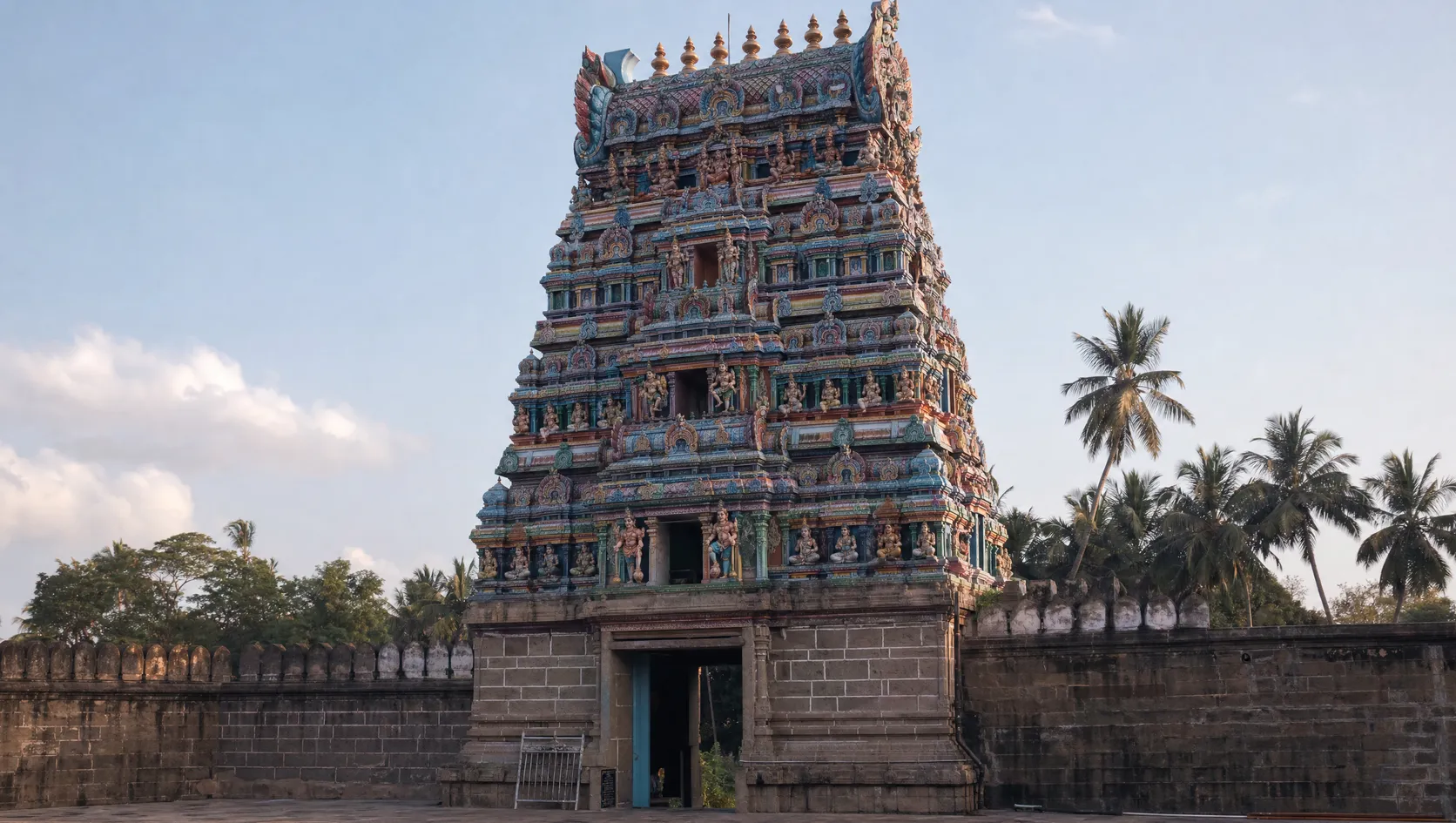
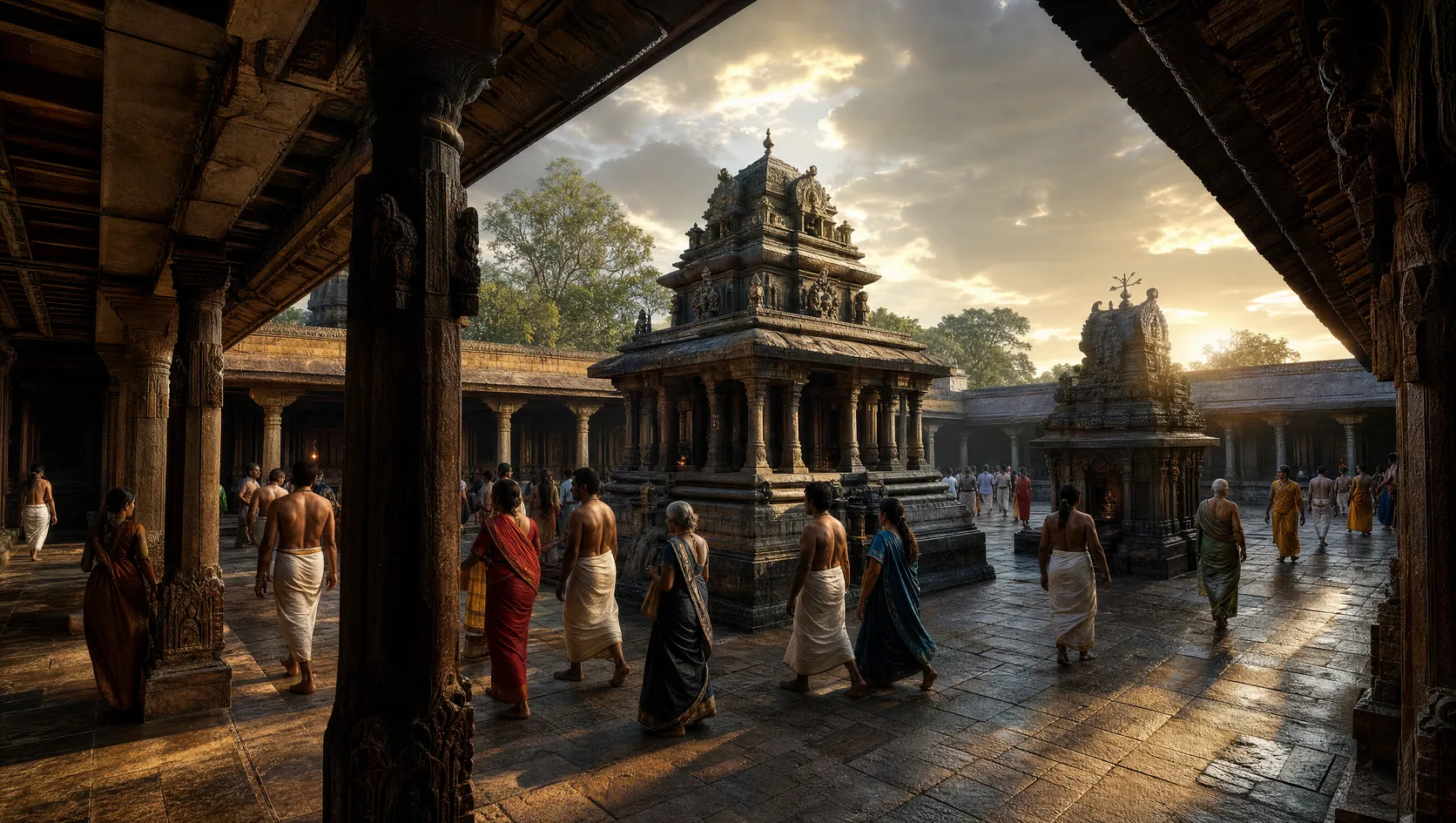
The presiding deity is Shiva as Naganathar, the lord of serpents, worshipped as a linga in the main sanctum, with the goddess in her own shrine. The building follows the Dravidian idiom of the delta, of modest scale, with a gopuram over the entrance.
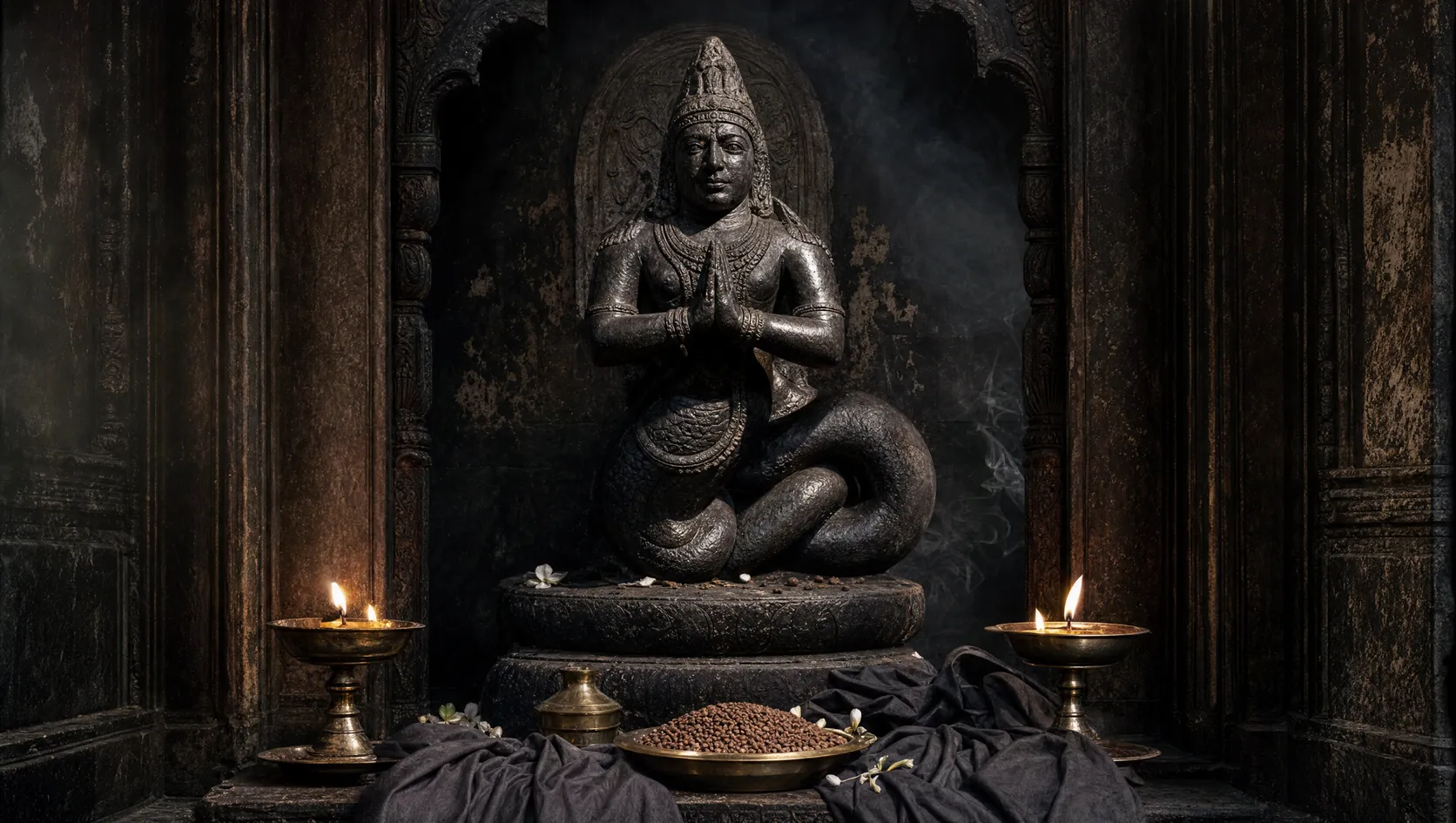
The Ketu shrine, which brings the circuit pilgrim, holds the shadow-planet in a form that reflects his nature as the tail of the serpent. Ketu is shown with a serpent's body and, often, the face turned in a way that marks him as the severed end, the counterpart of Rahu's severed head. He is associated by the correspondences of graha worship with the smoky and variegated, with horse gram, with cat's eye and with the daily period reckoned as Ketu's.
That the presiding deity is Naganathar, the same serpent-lordship as at the Rahu temple, is the iconographic point. The two shadow-planets, head and tail of one snake, are kept in the houses of the same god, so that a pilgrim completing the serpent's remedy moves between two temples of the serpent lord and finds the same deity presiding over both ends.
Distinctive Practicesविशिष्ट परंपराएँ
Completing the Serpent's Remedy
सर्प के उपाय को पूर्ण करना
As the completing station of a kala sarpa dosha remedy
Pilgrims addressing kala sarpa dosha, the configuration in which all the planets fall between Rahu and Ketu, commonly visit Keezhperumpallam as the completing station, having begun at Thirunageswaram, the Rahu temple. The remedy of the whole serpent requires both its head and its tail.
Because Rahu and Ketu are the two halves of one serpent, an affliction attributed to the whole snake cannot be remedied at one end alone. To address only Rahu is to leave the tail unattended, and only Ketu to leave the head. The paired visit completes the body, and the pilgrim who reaches Keezhperumpallam has, in the tradition's logic, made the serpent whole in order to be released from it.
Ketu Worship for Detachment and Release
वैराग्य और मुक्ति के लिए केतु उपासना
According to horoscope and Ketu-related days
Beyond the serpent remedy, Ketu is addressed for his own domains: the loosening of unhealthy attachments, relief from stagnation, and, at the far end, the spiritual detachment that the tradition reads as leading toward liberation.
Ketu is the severed end, the graha of what falls away, and the tradition treats his action as double-edged: the same force that brings loss and sudden endings, carried to its extreme, is the detachment that releases. To worship Ketu is not only to seek relief from his afflictions but to ask that what should fall away be let go of cleanly, which is why he is the graha most associated with moksha.
Worship of Naganathar
नागनाथर की उपासना
Before or alongside the Ketu worship
Many pilgrims take darshan of the presiding Naganathar, the serpent lord, before turning to the Ketu shrine, following the temple's order of worship and its older serpent-devotion identity, shared with the Rahu temple.
The presiding deity is the lord of serpents, so the serpent affliction is addressed first to the god who governs serpents and only then to Ketu, the serpent-graha within his house. That the same serpent-lordship presides at both the Rahu and Ketu temples binds the two ends of the snake under a single deity.
Offerings for Ketu
केतु के लिए भेंट
At the Ketu shrine, particularly on Ketu-related days
Offerings for Ketu follow the graha's associations: variegated or smoky cloth, horse gram and, where prescribed, cat's eye. These are offered at the Ketu shrine, often together with the serpent offerings shared with the naga worship of the site.
Ketu's associations with the variegated and the smoky reflect his nature as the incomplete, headless half, neither one thing nor another. The offering matches the graha, and horse gram, a hardy and austere grain, suits the planet of detachment and of what is stripped away.
Did You Know?क्या आप जानते हैं?
Ketu is the tail of the serpent Svarbhanu, whose head is Rahu; the two are one being cut in two by Vishnu's discus, and their circuit temples are the two ends of a single body across the delta.
Puranic account of the churning of the ocean
Ketu is read as the graha of both loss and liberation: the severed end that brings sudden endings and detachment, and at its extreme the letting go that the tradition associates with moksha.
Standard graha correspondences; site tradition
The remedy for kala sarpa dosha, the configuration in which all planets fall between Rahu and Ketu, requires both temples, since the affliction of the whole serpent needs both its head and its tail.
Navagraha circuit remedy tradition
The presiding deity is Naganathar, the lord of serpents, the same serpent-lordship as at the Rahu temple, so both ends of the severed snake are kept in the houses of the same god.
Temple tradition; Navagraha circuit structure
The temple lies near the coast at Poompuhar, the ancient Chola port also associated with Tamil literary tradition, giving the Ketu station a setting apart from the more inland circuit temples.
Regional history of the Poompuhar coast
Horse gram, a hardy and austere grain, is the offering assigned to Ketu, suiting the planet of detachment and of what is stripped away.
Standard graha correspondences
A pilgrim who completes the full Navagraha circuit commonly ends the serpent at Keezhperumpallam, the temple of the tail, which the tradition reads as the station of letting go.
Navagraha circuit tradition
Visitor Accessप्रवेश जानकारी
The temple is open to devotees without entry restriction. Traditional dress is customary, as at other temples in the Tamil delta, and footwear is removed at the entrance. Pilgrims come principally for the Ketu shrine, addressed for Ketu afflictions and, most commonly, as the completing station of a kala sarpa dosha remedy begun at the Rahu temple; many take darshan of the presiding Naganathar first. The temple is small and a visit does not take long. It lies near the coast at Poompuhar, somewhat apart from the more clustered inland circuit temples, so it is often taken together with Thirunageswaram and the nearby coastal stations.
If addressing kala sarpa dosha, plan the visit to include Thirunageswaram, the Rahu temple, since the remedy requires both ends of the serpent; many complete Rahu first and Ketu here. Take darshan of the presiding Naganathar before the Ketu shrine, and bring or buy the variegated cloth and horse gram associated with the planet. The temple lies near the coast at Poompuhar, a little apart from the inland cluster, so allow for the extra distance when planning the circuit. Kumbakonam is the usual base.
Festivalsत्योहार
Ketu-Related Observances
केतु-संबंधी अनुष्ठान
On days reckoned as Ketu's
Worship for Ketu is timed to the daily period and days reckoned as the graha's, when the Ketu shrine draws the largest gatherings, particularly from those addressing kala sarpa dosha and seeking detachment or release.
Maha Shivaratri
महाशिवरात्रि
Feb-Mar (Phalgun Krishna Chaturdashi)
As the presiding deity is Shiva as Naganathar, Maha Shivaratri is observed with night-long vigil and worship, a reminder that the temple is a Shiva shrine of the serpent lord before it is the Ketu station.
Naga observances
नाग अनुष्ठान
On serpent-related days
As a temple of the serpent lord, Keezhperumpallam keeps the observances associated with serpent worship, drawing those addressing serpent afflictions alongside the circuit pilgrims, and mirroring the naga worship of the Rahu temple.
Brahmotsavam
ब्रह्मोत्सवम्
Varies by temple calendar
The annual festival of the presiding deity, with processions of the utsava murti and the associated ritual sequence over several days, drawing pilgrims beyond the regular circuit traffic.
Traditional Offeringsपारंपरिक अर्पण
प्राथमिक अर्पण
Bel Patra (Bilva leaves)
बेल पत्र
बिल्व पत्र
The bilva leaf, the offering most closely associated with Shiva, is given to the presiding Naganathar, the serpent lord. At a temple of the deity who governs serpents, the standard Shiva offering is made before the pilgrim turns to Ketu, the serpent-graha within.
Variegated cloth and horse gram for Ketu
केतु के लिए विचित्र-वर्ण वस्त्र और कुल्थी
Variegated or smoky cloth and horse gram follow Ketu's associations, offered at the Ketu shrine for Ketu afflictions and the completion of the serpent remedy. The grain is often donated afterwards.
Naga offerings
नाग भेंट
As a temple of the serpent lord, offerings associated with naga worship, including turmeric, milk and serpent images, are made for the remedy of serpent afflictions, mirroring the naga worship of the Rahu temple.
Ghee lamp
घी का दीप
A lamp is lit at the Ketu shrine, often the single most common element of a Ketu remedy, and lamps are offered to the presiding Naganathar. For the graha of detachment, the lamp that consumes itself entirely in the giving is a fitting offering.
इस मंदिर की विशेषता
The Completing Half of the Serpent Remedy
सर्प-उपाय का पूर्ण करने वाला आधा
What is particular to Keezhperumpallam is its role as the completing half of the serpent remedy. A pilgrim addressing kala sarpa dosha worships Rahu at Thirunageswaram and Ketu here, and only with both is the remedy of the whole serpent held complete. The offering here is therefore not standalone but the closing of a movement begun at the other temple. To worship Ketu at Keezhperumpallam is to attend to the tail after the head, to make the severed serpent whole in order to be released from it. The tradition treats the paired offering as a single act distributed across two temples and two ends of one body.
Offering materials for both the Shiva worship and the Ketu remedy are sold near the temple, and it is simplest to buy them there. If addressing kala sarpa dosha, the remedy is completed together with Thirunageswaram, the Rahu temple; ask about the proper order. Many pilgrims take darshan of the presiding Naganathar before making the Ketu offering, following the temple's order of worship. Eternal Raga presents these practices as devotional tradition and does not offer astrological advice.
How to Reachकैसे पहुँचें
Keezhperumpallam lies in the Cauvery delta near Poompuhar and Sirkazhi, close to the coast, and Kumbakonam is the usual base for the Navagraha circuit of which it is part.
By air: Tiruchirappalli International Airport is roughly 100 km away and is the nearest useful airport. Chennai is considerably further but far better connected.
By rail: Sirkazhi, roughly 20 km away, is the nearest railhead, on the line between Chidambaram and Mayiladuthurai. Mayiladuthurai is the larger junction.
By road: The temple is reached by road from Sirkazhi, Mayiladuthurai or Poompuhar, and taxis are readily hired at Kumbakonam, the usual circuit base. The delta roads are flat and the driving is easy, though Keezhperumpallam's coastal position places it somewhat apart from the inland cluster, near Thiruvenkadu.
Most pilgrims visit as one station of the Navagraha circuit, very commonly pairing it with Thirunageswaram, the Rahu temple, when addressing serpent afflictions. Hiring a vehicle for a day or two from Kumbakonam covers all nine temples comfortably.
Plan Your Visitयात्रा की योजना
🌤 सर्वोत्तम मौसम
November to February is the most comfortable period in the delta, with cooler air and manageable humidity, and it is when the multi-stop circuit is most pleasant to drive. March to June is hot, often severely so, and the coastal position adds humidity. The northeast monsoon, roughly October to December, brings rain that can affect road travel, and the coastal location makes it somewhat more exposed than the inland circuit temples. Days reckoned as Ketu's, and periods when pilgrims complete kala sarpa dosha remedies, are the busiest. For a quieter visit, an ordinary weekday morning in the cool season is best.
👘 पहनावे का नियम
Traditional dress is customary, as at Tamil temples generally. Men commonly wear a dhoti or trousers with a shirt; in the inner areas a dhoti without an upper garment may be expected. Women wear saree or salwar kameez. Footwear is removed at the entrance, and the stone underfoot gets hot in the delta by mid-morning.
📱 फोन और फोटोग्राफी
Photography restrictions apply within the sanctum, as at Tamil temples generally; the outer areas are usually less restricted, but check locally rather than assuming. Phones should be silenced, and recording during a scheduled archana is inappropriate without the priest's agreement.
🏨 आवास
There is no significant accommodation at Keezhperumpallam itself. Sirkazhi and Mayiladuthurai nearby offer basic lodges, and Kumbakonam, the usual circuit base, has a fuller range of hotels and is well placed for the rest of the Navagraha temples. Because the temple lies near the coast and somewhat apart from the inland cluster, pilgrims often pair it with Thirunageswaram and the nearby coastal stations in the same stretch of the circuit rather than lodging near it.
Sacred Soundsपवित्र ध्वनि
क्या आप जानते हैं? · Did You Know?
वही अनुवाद त्रुटि जिसने हिन्दू धर्म में '33 कोटि' को '33 करोड़' बनाया, बौद्ध धर्म में भी हुई। बौद्ध ग्रन्थों के चीनी अनुवाद ने 'सप्त कोटि बुद्ध' (7 श्रेष्ठ बुद्ध) का अनुवाद '7 करोड़ बुद्ध' कर दिया। तिब्बती अनुवाद ने सही किया: 7 प्रकार, 7 करोड़ नहीं। एक संस्कृत शब्द, दो प्रमुख विश्व धर्मों में गलत पढ़ा गया, ने दो एकसमान भ्रम स्वतन्त्र रूप से उत्पन्न किए।
Related Contentसंबंधित सामग्री
Related Scriptures
Community Reflections
🕉️
Be the first to share your reflection.