Chintamani (Theur)
चिंतामणि थेऊर
The jewel that ends worry — Chintamani Vinayak at the Mula-Mutha confluence
Theur, Maharashtra, India
Cintāmaṇi VināyakaAlso known as: Chintamani Vinayak, Theur Ganpati, Shri Chintamani, Chintamani Ganesha, Theur Chintamani
युग
Puranic mythological origins (Mudgala Purana — Kapil-rishi narrative at Kadamba-kshetra); present stone sanctum core attributed to Dharanidhar Maharaj (great-grandson of Saint Morya Gosavi of Chinchwad) in the late 17th century; major Peshwa-era expansion and patronage under Peshwa Madhavrao I in the 1760s; the Madhavrao Wada within the temple complex marks the place of the Peshwa's death in 1772
वास्तुकला
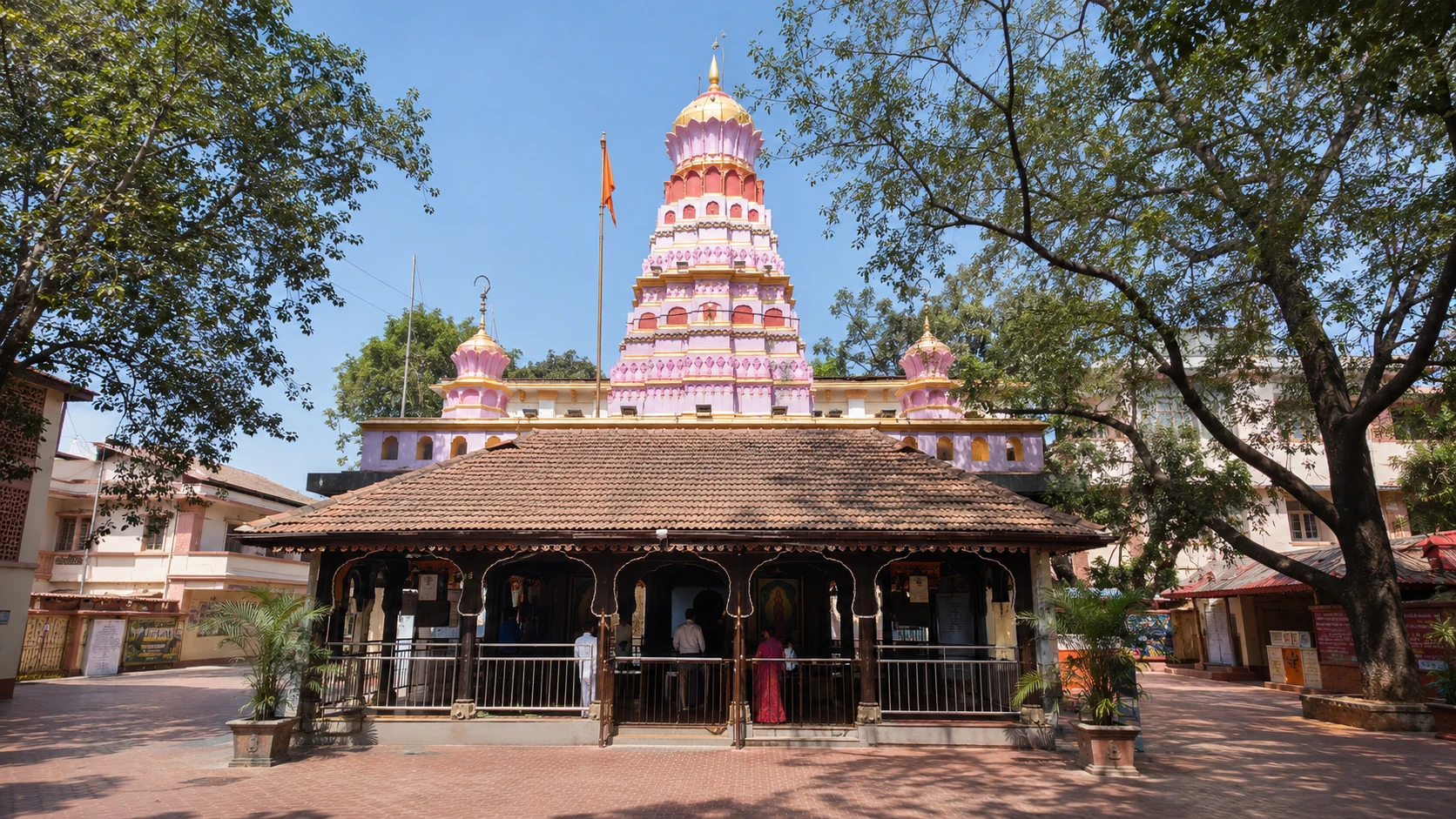
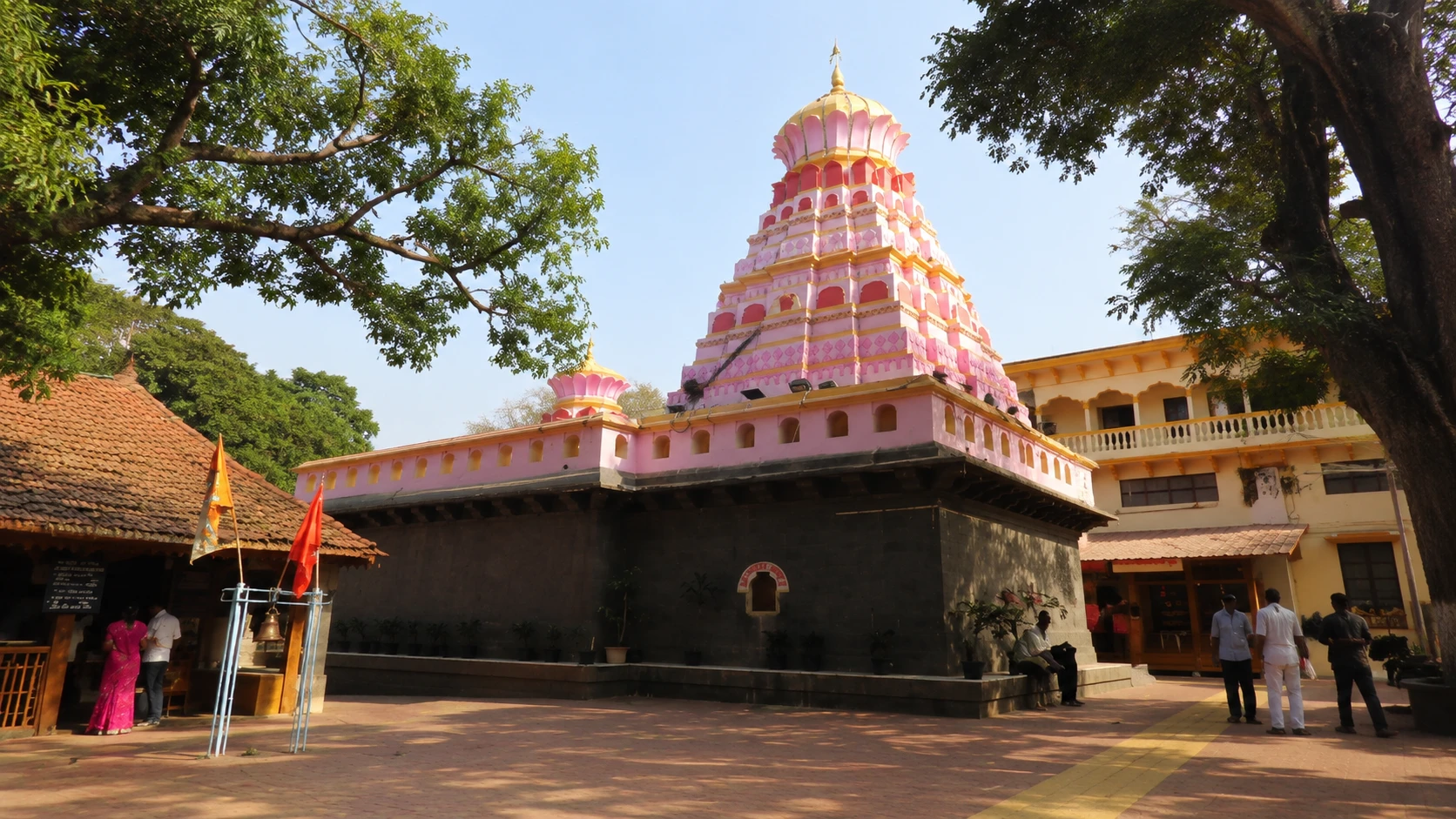
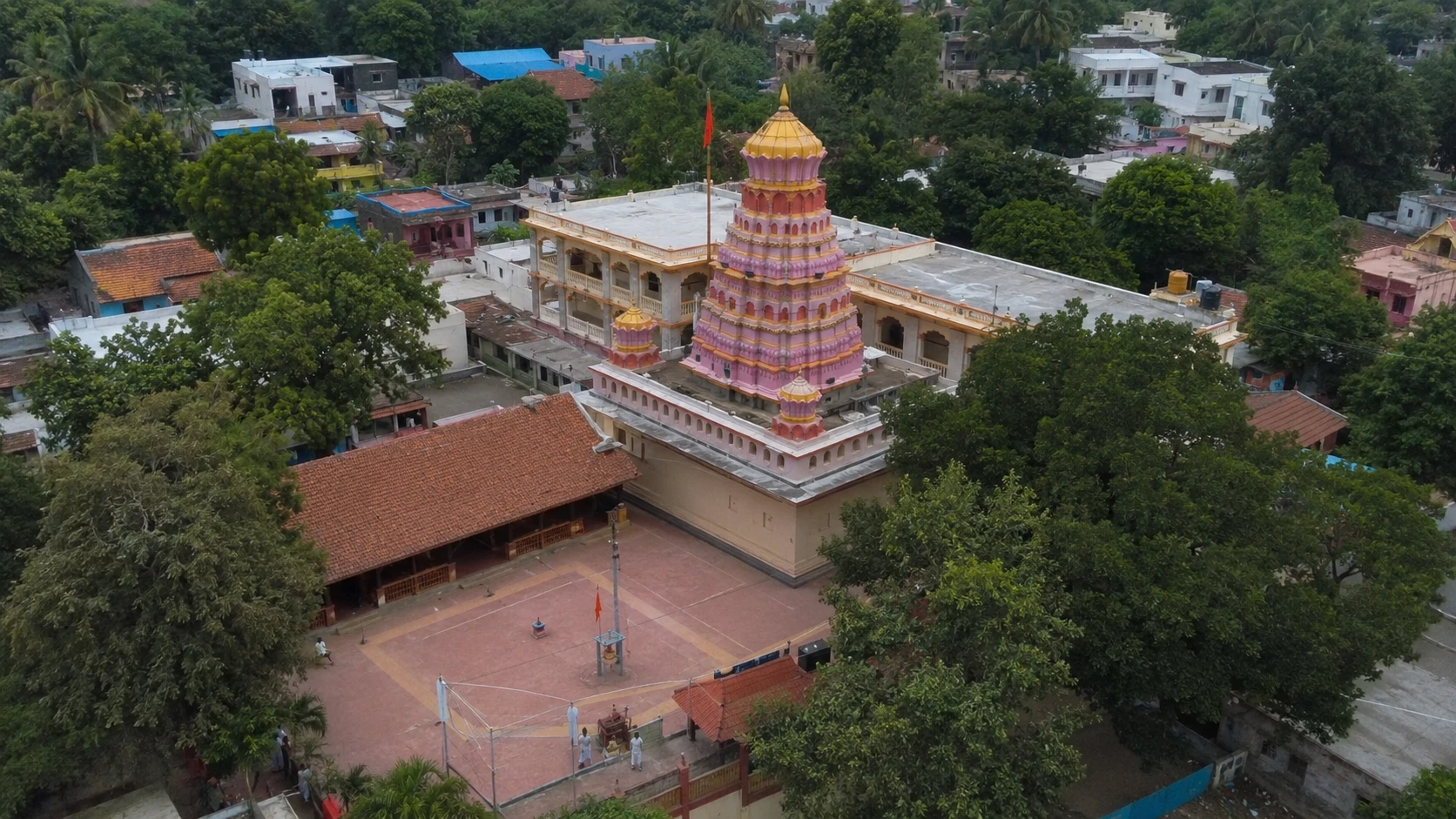
Mixed-period Maratha temple architecture combining a stone inner sanctum of late 17th-century Chinchwad-tradition construction with Peshwa-era wooden mandapas and outer pavilions; the surrounding compound is unusually large for an Ashtavinayak site, accommodating both the temple itself, the Madhavrao Wada (Peshwa residential pavilion), the Ramabai memorial shrine, and the broader pilgrim infrastructure. The temple is east-facing, set back from the riverbank by a short pathway down which pilgrims may walk to view the Mula-Mutha confluence
खुला
05:00 – 22:00
आरती
05:30 · 12:00 · 20:00
विशेष
The combined pilgrim circuit at Theur includes the main Chintamani Vinayak sanctum darshan, a visit to the Madhavrao Wada (the residential pavilion where Peshwa Madhavrao I spent his final illness and died in 1772), the Madhavrao and Ramabai memorial samadhi-shrines integrated into the temple compound, and a walk down to the Mula-Mutha confluence-point at the riverbank below the temple. Pilgrims typically take 60 to 90 minutes for the full Theur visit, longer than at most other Ashtavinayak sites due to the layered devotional-historical content of the compound. The temple stays open later than most other Ashtavinayak shrines (until 22:00 rather than 21:30) reflecting its higher evening pilgrim flow from Pune
पवित्र कथा · पवित्र कथा
Chintamani Vinayak at Theur is the fifth stop on the canonical Ashtavinayak circuit — the temple of the jewel-bearing Ganapati at the confluence of the Mula and Mutha rivers, twenty-five kilometres southeast of Pune. The deity here carries his unusual name from the legend of sage Kapil's stolen chintamani — the wish-fulfilling jewel — which the deity recovered and which Kapil then placed around Ganesha's neck, naming him 'the bearer of the chintamani-jewel, who ends worry'. Theur is also among the most historically dense of the Ashtavinayak sites in the Peshwa-era record: Peshwa Madhavrao I, the young administrator who steadied Maratha power in the years after the catastrophic Panipat defeat of 1761, was a lifelong devotee of Chintamani Vinayak and chose to spend his final illness in 1772 at the temple complex. He died at Theur, and his wife Ramabai performed sati on his pyre — a documented historical event of the late Peshwa period, now recorded with scholarly distance rather than devotional endorsement, but central to the site's eighteenth-century historical identity. The Madhavrao Wada (the residence-pavilion where the Peshwa died) stands in the temple compound, and memorial samadhi-shrines for Madhavrao and Ramabai are integrated into the temple's ritual geography. Architecturally the present temple combines a 17th-century stone sanctum (associated with Dharanidhar Maharaj, the great-grandson of Saint Morya Gosavi) with later Peshwa-era mandapas and wooden outer structures. The river-bank setting on the Mula-Mutha is considered canonically significant: the Mudgala Purana identifies the place as Kadamba-kshetra, the region where Ganapati granted Kapil the recovered jewel.
Sacred Designationपवित्र पदनाम
Sacred Origin Storyपवित्र उत्पत्ति कथा
Source: Mudgala Purana (Kapil-rishi prakarana) — widely-attested Ganapatya canonical narrative
In an age long before the present yuga, in the Kadamba forest beside the meeting-place of the Mula and Mutha rivers, the sage Kapil — among the most ancient of the rishis, ascribed in some textual traditions with the founding of the Samkhya darshana — had built a small hermitage. Kapil was no ordinary ascetic. Among his sadhana-possessions was the Chintamani, the wish-fulfilling jewel: a stone of such spiritual potency that whoever held it could call forth whatever they truly required, food and water and the means of devotional life. The Chintamani was a tool of the sage's spiritual independence — it meant Kapil could remain in deep tapas without ever leaving the forest to seek material support.
News of the jewel travelled. In the country of Konkana to the west, the king — variously named Gunna or Gunnarjun in different recensions of the Mudgala Purana — heard of the sage's possession. The king was an able administrator but a worldly man; the description of the Chintamani aroused his acquisitive desire. He sent emissaries to Kapil's hermitage requesting hospitality. Kapil, as the dharmic norm required, received the king's emissaries — and indeed the king himself when he later visited — with full sage's hospitality. The Chintamani provided the feast. The visitors were astonished.
The king resolved that the jewel was wasted in the keeping of an ascetic. It would serve better in his own treasury, where the wealth it generated could be put to royal use. He waited for the moment when Kapil was in deep meditation. Then his retainers, on his command, took the Chintamani from the sage's hermitage and rode away with it back to Konkana.
Kapil emerged from his meditation. The hermitage was empty. The jewel was gone. The sage, who could have called armies through his tapas-power and overwhelmed the thief by ordinary force, chose instead the route of bhakti. He turned to Ganapati — the deity worshipped at this very Kadamba-kshetra spot from a prior age — and asked the deity's intervention. 'Lord, my Chintamani has been stolen by a king who has used my hospitality to commit theft. I do not ask its return as my possession. I ask only that it be returned to its proper purpose — to support tapas, not to feed worldly greed.'
Ganapati heard. He moved against King Gunna with the force the situation required. The Mudgala Purana describes the encounter in different ways across recensions: in some, Ganapati and his ganas pursue the king in direct martial form; in others, the king is overcome by inward calamities — fever, ill omens, the loss of his counsellors' competence — that signal the divine displeasure he has incurred. What is consistent across the recensions is the outcome. Gunna's seizure of the Chintamani failed. The jewel returned to Kadamba-kshetra. It returned not to Kapil's hand but to Ganapati's keeping.
Kapil, when the jewel was restored to the hermitage, did something the legend marks as devotionally exceptional. He did not take the Chintamani back as his own property. Instead, he took the jewel — the very object that had made his life-as-ascetic possible — and placed it around Ganapati's neck. 'Lord,' he said, 'this jewel was always yours. I had only borrowed it. From this day, you wear it. Any worshipper who comes to this spot and asks for the ending of their worry — chinta — let them see this jewel on your neck and know that the chintamani is in safer keeping than my own.'
Ganapati accepted. He took the name Chintamani Vinayak — the bearer of the Chintamani jewel, the deity who ends worry. The Mula-Mutha confluence-place was named Kadamba-kshetra-Chintamani-sthana. The Mudgala Purana places this episode in pre-historical antiquity, but the worship of Chintamani Vinayak at Theur is held by local tradition to have been continuous from that time. Every pilgrim who comes to the temple and stands before the murti is approaching the deity who is held to wear the very jewel that ends worry — visible on his neck, materialized in the gem-inset ornament that the present murti carries, and theologically accessible to any devotee who frames their visit as a chinta-removal request.
उद्धृत स्रोत:
- Mudgala Purana — Kapil-rishi prakarana (Kadamba-kshetra-Chintamani narrative)
- Ganesha Purana — referencing the Chintamani-vadha episode in cross-text
- Sthala-purana of Theur (regional Marathi devotional tradition)
- Skanda Purana — variant references to Chintamani-recovery legends with location-attribution to multiple sites
विद्वत संदर्भ
Modern scholarship on the Chintamani Vinayak narrative (Paul Courtright, 'Ganesa: Lord of Obstacles, Lord of Beginnings', Oxford 1985; Anita Raina Thapan, 'Understanding Ganapati', Manohar 1997) treats the Theur legend as an unusually theologically rich Ganapatya site-narrative. The story functions on three layers simultaneously: a literal narrative of theft and recovery; a moral framework about hospitality, royal acquisitiveness, and the proper purposes of material power; and a devotional resource for any worshipper carrying chinta (worry, anxiety, mental disturbance). Courtright reads Kapil's renunciation of the recovered jewel — placing it on Ganapati's neck rather than reclaiming it — as the legend's theological climax: the chintamani is treated by the sage as having always belonged to the deity, with the sage's possession being only a borrowing. This reframing converts an object-recovery narrative into a renunciation narrative, with the Theur site marked as the place where the boundary between possession and offering is sacralized. The Mudgala Purana's location-attribution of the episode to the Mula-Mutha confluence is consistent across recensions; alternative recensions in the Skanda Purana attribute Chintamani-recovery legends to other sites, but the Theur tradition is preserved without significant internal contestation. The temple's centrality to late-Peshwa-era devotional life (Madhavrao I in particular) added a layer of eighteenth-century historical association that has shaped the site's modern identity alongside the Puranic narrative.
Historyइतिहास
The history of Chintamani Vinayak at Theur is unusually layered for an Ashtavinayak site, combining Puranic-mythological antiquity, late-medieval saint-tradition reconstruction, and one of the most historically dense Peshwa-era episodes in the broader Maratha-period record. The Mudgala Purana's Kapil-Chintamani narrative places the shrine's origins in pre-historical antiquity, and continuous Ganapatya worship at the Mula-Mutha confluence is suggested by regional Marathi devotional literature through the medieval period, but the present stone sanctum's documented history begins with the Chinchwad Sansthan tradition.
The lineage of Saint Morya Gosavi of Chinchwad — the seventeenth-century Ganapatya saint whose tradition shaped the formal Ashtavinayak circuit — passes through several generations of saints who undertook reconstruction and consolidation work at sites associated with the eight Ganapati shrines. At Theur, this work is most strongly associated with Dharanidhar Maharaj, the great-grandson of Morya Gosavi, who lived in the late seventeenth and early eighteenth centuries. The present stone sanctum is attributed to Dharanidhar's patronage, with the construction-and-consecration work undertaken in the period c. 1690–1720. The Chinchwad Sansthan continues to hold institutional and ceremonial authority over Theur to this day, and the temple's ritual calendar coordinates with the Sansthan's broader Ashtavinayak rhythms.
The transformation of Theur from a regional Ganapatya shrine into a major Peshwa-era heritage site occurred under Peshwa Madhavrao I (born 1745, ruled as Peshwa from 1761 to his death in 1772). Madhavrao came to the Peshwa office at sixteen in the aftermath of the catastrophic Maratha defeat at Panipat earlier that same year. The political situation he inherited was perilous: the older generation of Maratha leaders had been killed at Panipat, the army was depleted, and the empire's northern reach had collapsed. Madhavrao steadied the situation through eleven years of disciplined administration, military reorganization, and diplomatic management — a record that has earned him a place in modern Maratha historiography as the most effective of the Peshwas after Bajirao I.
His personal devotional life centred on Chintamani Vinayak at Theur. Contemporary correspondence preserved in the Peshwa Daftar documents his frequent visits, his sponsorship of temple expansion-works (including the Sabha-mandapa and outer pavilions in the present compound), and his commissioning of the Madhavrao Wada — a residential pavilion within the temple compound where he could stay during extended devotional retreats. The Peshwa's Wada is small by royal-residence standards, oriented around devotional practice rather than administrative function, and survives today within the temple compound as a heritage site.
In 1772, Madhavrao's tuberculosis (which had been progressing for some years) entered its terminal phase. Rather than remain at the Peshwa headquarters in Pune to die under court protocol, he chose to spend his final months at Theur, in the Wada beside the temple of his lifelong devotion. He died at Theur on 18 November 1772, aged twenty-seven. His wife Ramabai — a deeply devoted partner across his eleven-year Peshwa period — performed sati on his pyre, becoming one of the documented historical sati instances of the late Peshwa era. This episode is recorded here as historical fact, with appropriate scholarly framing: sati is now illegal in India under the Commission of Sati (Prevention) Act 1987 and was prohibited even earlier under colonial-era legislation from 1829; the practice is not endorsed by present-day devotional, scholarly, or legal traditions. Ramabai's act in 1772 is preserved in the historical record as one element of the complex emotional and political reality of the late Peshwa court, where Madhavrao's death precipitated a succession crisis that the Maratha state did not entirely recover from.
The temple compound today contains memorial samadhi-shrines for both Madhavrao I and Ramabai, integrated into the ritual geography alongside the main Chintamani Vinayak sanctum. Pilgrims customarily visit these memorials as part of the Theur darshan; for many, the Peshwa-historical layer of the site carries devotional weight comparable to the Puranic Kapil-Chintamani narrative.
After the broader fall of Peshwa rule in 1818, Theur continued under Chinchwad Sansthan administration. The 19th and early 20th centuries saw periodic maintenance without major intervention. The 2003-04 Ashtavinayak Vikas Yojana funded substantial conservation work, including the careful replacement of the murti's original inset gemstones with high-quality replicas to deter theft (the original gems are kept in secure storage under Devasthan custody), restoration of the Madhavrao Wada, conservation of the samadhi-shrines, and modernization of pilgrim infrastructure. Today Theur is among the most-visited Ashtavinayak shrines due to its accessibility from Pune (25 km), its layered Puranic-historical content, and its position as the geographical anchor of the Pune-district Ashtavinayak cluster.
Historical Timelineऐतिहासिक कालक्रम
Mythological-traditional foundation of the shrine in the Mudgala Purana's Kapil-Chintamani narrative, designating the Mula-Mutha confluence as Kadamba-kshetra. Continuous pilgrim awareness through the medieval period is suggested by regional Marathi devotional literature, but no archaeological evidence permits precise pre-1690 architectural dating.
The site's pre-1690 history is mythologically rich but architecturally undocumented. Event-bracket dating preserves the editorial honesty principle.
Construction of the present stone sanctum core under the patronage of Dharanidhar Maharaj, great-grandson of Saint Morya Gosavi of Chinchwad. Dharanidhar's work consolidated the regional Chintamani Vinayak shrine into the formal Ashtavinayak circuit framework that the Chinchwad Sansthan was institutionalizing across this period.
Peshwa Madhavrao I (born 1745, ruled 1761-1772) undertook major patronage and devotional engagement at Chintamani Vinayak Theur. His sponsored works included expansion of the Sabha-mandapa, construction of outer pavilions, and commissioning of the Madhavrao Wada — the residential pavilion within the temple compound where he stayed during extended devotional retreats. His personal devotional relationship to Chintamani Vinayak is documented in correspondence preserved in the Peshwa Daftar at the Bharat Itihas Samshodhan Mandal.
Death of Peshwa Madhavrao I at Theur on 18 November 1772, aged twenty-seven, from tuberculosis. Madhavrao chose to spend his final illness at the Madhavrao Wada within the Chintamani Vinayak temple compound rather than at the Peshwa court in Pune. His wife Ramabai performed sati on his pyre — a documented historical event of the late Peshwa period, recorded here with scholarly distance and explicit non-endorsement: sati is now illegal in India under the Commission of Sati (Prevention) Act 1987 and was prohibited from 1829 under colonial-era legislation; the practice is not endorsed by present-day devotional, scholarly, or legal traditions. Memorial samadhi-shrines for both Madhavrao and Ramabai stand within the temple compound today.
This entry is dual-natured: it records Madhavrao's death (a politically consequential event ending an effective Peshwa administration and precipitating the late-Peshwa succession crisis) and Ramabai's sati (a documented historical instance of a now-prohibited practice). The 'destruction' enum-tag captures the institutional rupture this dual event represented for the late Peshwa state. Both historical claims are well-documented in the Peshwa Daftar and corroborated by independent contemporary correspondence. For semi-annual operational review: this is a politically and socially sensitive historical record requiring continued careful framing in any user-facing presentation.
Fall of the broader Peshwa rule to British East India Company at the Battle of Khadki, ending major patronage flows to Ashtavinayak sites. Theur continued under Chinchwad Sansthan administration with the late-Peshwa institutional infrastructure (Madhavrao Wada, samadhi-shrines, expanded sanctum) intact but without active royal sponsorship.
Recorded as institutional rupture rather than physical destruction of the temple; the temple itself was not damaged.
Ashtavinayak Vikas Yojana renovation works at Theur included careful replacement of the murti's original inset gemstones with high-quality replicas (the originals kept in secure storage under Devasthan custody) to deter theft, restoration of the Madhavrao Wada, conservation of the Madhavrao and Ramabai samadhi-shrines, repair of the Sabha-mandapa, and modernization of pilgrim infrastructure including approach roads, parking, and rest-houses.
What You'll Seeदर्शन में
The Chintamani Vinayak murti is the iconographic centre of the Theur compound: a self-manifested seated form in dark basalt, approximately three feet tall, with the trunk turning to the left (vamavarti). The face is broad with slightly elongated features, the third eye visible vertically on the forehead. The most distinctive iconographic feature of this murti — and the one that materializes the temple's foundational legend — is the gemstone neck-ornament worn by the deity, depicting the Chintamani-jewel that Kapil placed around Ganesha's neck after the deity's recovery of it from King Gunna. The original ornament historically contained inset precious stones; during the 2003-04 Ashtavinayak Vikas Yojana renovation, the original gems were carefully removed and placed in secure storage under Devasthan custody, with high-quality replicas now inset in the murti's ornament. The original gems are produced for inspection on specific ceremonial occasions but are not worn by the murti in everyday darshan, reflecting modern conservation priorities and theft-prevention concerns at a high-volume pilgrim site.
The sanctum itself is a stone-walled Hemadpanthi-style inner chamber dating to Dharanidhar Maharaj's late-17th-century construction. The murti is mounted on a low stone platform, with Riddhi and Siddhi (the consorts) seated to either side as smaller secondary figures. A small Mooshaka (mouse vahana) is carved at the base of the platform. The sanctum is east-facing; morning sunlight enters through the eastern doorway and falls obliquely across the murti during the early hours, producing a softly-lit darshan window before the artificial sanctum lighting takes over for the rest of the day.
Outside the inner sanctum, the temple compound is among the largest of the Ashtavinayak sites — reflecting the Peshwa-era expansion under Madhavrao I. The Sabha-mandapa is a stone-pillared hall in Maratha temple style, with painted murals along the upper register depicting episodes from the Kapil-Chintamani narrative and from the broader Ashtavinayak cycle. Subsidiary shrines for Mahadev, Vishnu, and Hanuman stand at various points within the compound. The Madhavrao Wada — the residential pavilion where Peshwa Madhavrao I died in 1772 — stands within the compound as a heritage building; it is a modest two-story stone-and-wood structure with a small inner courtyard, conserved as part of the 2003-04 renovation. The samadhi-shrines for Madhavrao I and Ramabai are situated at the western edge of the compound, marked by small chhatris (canopied memorials) in Maratha funerary style. A short pathway leads from the temple compound down to the Mula-Mutha confluence-point, where pilgrims customarily offer water and durva before returning to the main darshan.
Distinctive Practicesविशिष्ट परंपराएँ
Combined Sanctum-Wada-Samadhi-Confluence Circuit
संयुक्त गर्भगृह-वाडा-समाधि-संगम परिक्रमा
Every darshan visit; the canonical full Theur darshan covers all four elements
Unique among the Ashtavinayak sites, the canonical full darshan at Theur involves a sequence of four distinct stops within the temple compound: (1) main Chintamani Vinayak sanctum darshan, (2) visit to the Madhavrao Wada — the residential pavilion where Peshwa Madhavrao I died in 1772, (3) the Madhavrao and Ramabai memorial samadhi-shrines at the western edge of the compound, and (4) the Mula-Mutha confluence-point at the riverbank below the temple. Pilgrims typically take 60 to 90 minutes for the full sequence — longer than at most other Ashtavinayak sites — reflecting the layered Puranic-historical content of the compound. The temple priests can guide first-time visitors through the sequence; experienced pilgrims undertake it in their preferred order, though the sanctum darshan is conventionally first.
The four-stop circuit preserves the layered devotional-historical reality of Theur as a site where Puranic legend (Kapil-Chintamani at the confluence) and Peshwa-era history (Madhavrao's death and the Ramabai memorial) coexist within a single compound. Pilgrims who walk the full sequence are integrating both the Puranic and the historical layers into their darshan, treating the place itself as a layered devotional resource rather than reducing it to the sanctum-only darshan pattern that suffices at other Ashtavinayak sites.
Chinta-Removal Sankalpa at the Murti
मूर्ति पर चिंता-हरण संकल्प
Personal sadhana commitment; informally undertaken at darshan rather than formally registered
A devotional pattern specific to Chintamani Vinayak — preserved in temple tradition and the local Devasthan's pilgrim guidance — is the conscious naming of a specific chinta (worry, anxiety, mental disturbance) at the sanctum during darshan and the framing of the visit as a request for that chinta's removal. The Kapil-Chintamani theology of this temple is that the deity wears the jewel that ends worry, and that any worshipper who approaches with a chinta-removal request is treated as bringing a legitimate devotional concern (rather than a worldly distraction from 'proper' devotion). The chinta-removal sankalpa is unstructured — no fixed mantra, no fixed format, no registry — but is a recognized devotional pattern at Theur, especially favoured by pilgrims experiencing acute anxiety about specific life circumstances.
The legend specifically frames the deity as the jewel-bearer who ends worry; the practice of naming one's chinta at the sanctum integrates the worshipper's actual mental concern into the devotional encounter, rather than substituting a generic devotional formula. The Theur theology rests on the conviction that the worry the devotee brings is the devotional content — that bringing one's actual chinta to the chintamani-bearing deity is the appropriate posture for this site.
Madhavrao Wada Heritage Pause
माधवराव वाडा धरोहर ठहराव
Part of the canonical four-stop Theur darshan; undertaken between the sanctum darshan and the samadhi-shrines
A devotional-historical practice specific to Theur: pilgrims customarily pause at the Madhavrao Wada (the residential pavilion where Peshwa Madhavrao I spent his final illness and died in 1772) as part of the four-stop darshan circuit. The pause is brief — pilgrims circumambulate the Wada's outer courtyard, mentally acknowledge the historical-devotional weight of the place where an effective Maratha ruler chose to die in the presence of his chosen deity rather than at the seat of his administrative power. The practice integrates Maratha-historical consciousness into the Ashtavinayak pilgrimage in a way unique to Theur; no other Ashtavinayak site combines the deity-darshan with a historically-specific death-place pause of comparable weight.
The Madhavrao Wada is a tangible historical artifact of a specific devotional choice: a young effective ruler chose to die at his deity's temple rather than at his court. The pilgrim's pause at the Wada acknowledges that the place itself carries devotional information — the visible architectural trace of a Peshwa-era life-and-death decision that integrated political power with personal devotional commitment. The practice resists the tendency to separate religious from political-historical layers of a site, and treats Theur's full content as part of the proper Ashtavinayak darshan.
Mula-Mutha Confluence Water Offering
मुला-मुठा संगम जल अर्पण
Part of the canonical four-stop Theur darshan; undertaken after sanctum darshan and Wada visit
Pilgrims customarily walk down from the temple compound to the Mula-Mutha confluence-point at the riverbank below the temple, where they offer water from the rivers back to the deity through a brief argha (water-libation) ritual and place durva tufts at the water's edge. The Mudgala Purana identifies this confluence as part of the Kadamba-kshetra where the Kapil-Chintamani encounter took place, so the water-offering integrates the riverine sacred geography into the temple darshan. The confluence is accessible by a short stone-paved pathway from the temple compound and the walk takes approximately ten minutes round-trip.
The Mula-Mutha confluence is the physical instantiation of the Kadamba-kshetra of the Puranic narrative. The water-offering ritual closes the loop between the legend's textual claim that the confluence is sacred and the pilgrim's embodied participation in the sacred geography. Pilgrims who undertake the confluence-walk often note that the silent riverine landscape carries a calmness distinct from the busy temple compound, deepening the chinta-removal devotional posture the site invites.
Did You Know?क्या आप जानते हैं?
The Chintamani Vinayak murti is distinctive in the Ashtavinayak iconographic tradition for the gemstone neck-ornament it wears — materializing the Mudgala Purana legend in which sage Kapil placed the recovered chintamani-jewel around Ganesha's neck. The original inset precious stones were carefully removed during the 2003-04 renovation and stored in secure Devasthan custody to prevent theft, with high-quality replicas now visible in everyday darshan; the originals are produced for inspection only on specific ceremonial occasions. This security measure is a modern conservation choice at a high-volume pilgrim site, not a change in the temple's ritual or iconographic tradition.
Maharashtra Department of Archaeology renovation records 2003-04; Mahad/Theur Devasthan documentation
Theur was the personal devotional anchor of Peshwa Madhavrao I (1745-1772), one of the most effective administrators in late-Maratha history. Madhavrao chose to spend his final illness from tuberculosis at the Madhavrao Wada — a residential pavilion within the temple compound that he himself had commissioned for devotional retreats. He died at Theur on 18 November 1772, aged twenty-seven. His wife Ramabai performed sati on his pyre, a documented historical instance now framed with scholarly distance and explicit non-endorsement, given that sati is illegal in India under the Commission of Sati (Prevention) Act 1987. The Madhavrao Wada survives today as a heritage building within the temple compound, and memorial samadhi-shrines for both Madhavrao and Ramabai are integrated into the temple's ritual geography.
Peshwa Daftar — Madhavrao I correspondence (Bharat Itihas Samshodhan Mandal, Pune); Stewart Gordon, 'The Marathas 1600–1818' (Cambridge 1993); G.S. Sardesai, 'New History of the Marathas' (1958)
The canonical full darshan at Theur covers four distinct stops within the temple compound — the Chintamani Vinayak sanctum, the Madhavrao Wada, the Madhavrao and Ramabai memorial samadhi-shrines, and the Mula-Mutha confluence-point — making this the most spatially-extended Ashtavinayak darshan in the circuit. Pilgrims typically take 60 to 90 minutes for the full sequence, longer than at most other Ashtavinayak sites. The four-stop circuit integrates the Puranic Kapil-Chintamani legend and the Peshwa-era Madhavrao history into a single layered devotional experience.
Chinchwad Sansthan pilgrim guidance documents; Mahad/Theur Devasthan visitor records
The Mudgala Purana names the Mula-Mutha confluence at Theur as Kadamba-kshetra — the region where sage Kapil performed his tapas and where the Chintamani jewel was recovered from King Gunna of Konkana. The legend pivots on Kapil's renunciation of the recovered jewel: rather than reclaiming it as his property, Kapil placed it around Ganesha's neck, treating the jewel as having always belonged to the deity. Modern scholarship (Paul Courtright, 1985) reads this renunciation as the legend's theological climax, converting an object-recovery narrative into a renunciation narrative.
Mudgala Purana — Kapil-rishi prakarana; Paul Courtright, 'Ganesa: Lord of Obstacles, Lord of Beginnings' (Oxford 1985)
The Madhavrao Wada — the residential pavilion where Peshwa Madhavrao I died in 1772 — is unusually modest by Maratha-royal-residence standards. The building was designed for devotional retreats rather than administrative function, with a small inner courtyard, basic residential rooms, and direct compound access to the temple sanctum. The choice of a small devotional residence rather than a larger royal pavilion reflects Madhavrao's documented preference for the religious-personal aspect of Theur over the political-display function. This is among the few surviving Peshwa-era residential buildings preserved within an active temple compound rather than as a standalone heritage site.
Maharashtra Department of Archaeology heritage building survey; Peshwa Daftar Madhavrao I residential records
The present stone sanctum core at Theur is attributed to Dharanidhar Maharaj, the great-grandson of Saint Morya Gosavi of Chinchwad, who undertook the construction-and-consecration work in the period c. 1690-1720. The Chinchwad Sansthan continues to hold institutional and ceremonial authority over Theur. This continuity-of-administration from the late-17th-century Chinchwad tradition to the present-day Devasthan trust is among the longest unbroken institutional chains across the Ashtavinayak circuit.
Chinchwad Sansthan archival records; Dharanidhar Maharaj hagiographic tradition
Theur is the geographical anchor of the Pune-district Ashtavinayak cluster — only 25 km from central Pune, with Lenyadri (98 km), Ozar (85 km), and Ranjangaon (50 km) all accessible from Pune in radial routes. Pilgrims doing the Pune-district segment of the circuit typically base in Pune and undertake Theur on its own day given its layered four-stop content, with the other three Pune-district shrines combined across the following one or two days. The high pilgrim volume at Theur — among the highest in the Ashtavinayak circuit — reflects both this geographical centrality and the historical-devotional density of the compound.
Maharashtra Tourism Development Corporation circuit-tour itineraries; Chinchwad Sansthan pilgrim flow records
Visitor Accessप्रवेश जानकारी
Chintamani Vinayak welcomes devotees of all backgrounds without restriction based on gender, age, caste, or origin. Photography is permitted in the Sabha-mandapa, the outer compound, around the Madhavrao Wada exterior, at the samadhi-shrines (respectfully), and along the Mula-Mutha confluence pathway, but is not allowed within the inner sanctum during darshan or abhishekam. The Madhavrao Wada interior is open for visit but photography inside the Wada is restricted to specific designated areas (the outer courtyard rather than the inner private rooms where the Peshwa actually lived and died). Footwear must be removed before entering the temple complex. Mobile phones should be silenced inside the sanctum and Wada interior areas. The compound has wheelchair access ramps to the outer mandapa and the samadhi-shrines; the inner sanctum requires a short step-up that may need assistance.
There is no formal VIP-darshan or priority-queue at Chintamani Vinayak; on weekdays the queue moves swiftly. Sundays, Sankashti Chaturthi evenings, the Bhadrapada Ganesh Chaturthi festival week, and the Magha Ganesh Jayanti week generate the heaviest crowds — pilgrims should plan weekday mid-morning arrivals or weekday late afternoon for the most unhurried four-stop darshan experience. The 60-90 minute full-circuit time means peak weekend crowds can extend the visit substantially; pilgrims with limited time may prioritize the sanctum darshan and Mula-Mutha confluence while skipping detailed Madhavrao Wada interior tour. Photo ID is not required. The Wada interior visit is included in standard temple entry — no separate ticket — but pilgrims interested in the heritage-historical detail benefit from a brief priest-guided introduction available at the temple office on request.
Festivalsत्योहार
Ganesh Chaturthi (Bhadrapada Shukla Chaturthi)
गणेश चतुर्थी (भाद्रपद शुक्ल चतुर्थी)
Aug-Sep (Bhadrapada Shukla Chaturthi)
The principal Ganapati festival of the lunar calendar, observed at Chintamani Vinayak with continuous abhishekam, twenty-one Atharvashirsha recitations, and extended four-stop darshan hours across the festival fortnight. Pilgrim flow during this period is among the heaviest in the Pune-district Ashtavinayak cluster, driven by Theur's accessibility from Pune city. The Madhavrao Wada and the samadhi-shrines remain open for visits across the festival period, with the broader temple compound illuminated through the night during the final five days of the fortnight. The Bhadrapada festival at Theur draws devotees specifically for the chinta-removal sankalpa work, treating the festival window as an especially auspicious moment for naming and committing to release a specific worry.
Magha Ganesh Jayanti (Magha Shukla Chaturthi)
माघ गणेश जयंती (माघ शुक्ल चतुर्थी)
Jan-Feb (Magha Shukla Chaturthi)
The birth-tithi observance of Ganesha. At Theur the day is marked by sustained abhishekam from pre-dawn through midnight, twenty-one Atharvashirsha avartans, and special recitations of the Kapil-Chintamani prakarana from the Mudgala Purana through the day. The more inwardly devotional atmosphere of the Magha festival (compared to the larger Bhadrapada festival) is particularly suited to the chinta-removal sankalpa work, and many serious sadhakas time their full Theur four-stop darshan to this day specifically. The Mula-Mutha confluence sees additional ritual offerings on Magha Chaturthi, with priests conducting brief riverbank pujas at sunrise and sunset.
Sankashti Chaturthi (monthly)
संकष्टी चतुर्थी (मासिक)
Every lunar month — Krishna Paksha Chaturthi
The monthly Sankashti at Chintamani Vinayak draws heavy evening crowds, with the temple operating extended hours to accommodate the moonrise darshan pattern. Theur's accessibility from Pune makes it a popular Sankashti destination for Pune-resident devotees undertaking the obstacle-removal observance. The Angarki Sankashti (falling on a Tuesday) draws the largest of the monthly crowd cycles. The chinta-removal sankalpa work that defines Theur's devotional pattern is particularly favoured by pilgrims undertaking sustained multi-month Sankashti commitments — returning to the temple across consecutive Sankashtis until the specific chinta is resolved.
Madhavrao Punyatithi (annual)
माधवराव पुण्यतिथि (वार्षिक)
Annual — 18 November observance commemorating Peshwa Madhavrao I's death in 1772
An annual heritage-devotional observance specific to Theur: the death-anniversary of Peshwa Madhavrao I, observed on 18 November each year at the Madhavrao Wada and at the Madhavrao samadhi-shrine. The observance is small-scale and culturally weighted rather than a major pilgrim festival — primarily attended by Maharashtra Maratha-history enthusiasts, Chinchwad Sansthan affiliates, and local Theur residents. Prayer-services are held at the samadhi-shrine alongside the regular temple aarti. The observance also marks the Ramabai sati anniversary with appropriate solemnity; the modern framing emphasizes scholarly historical commemoration of an event from the late-Peshwa period without endorsement of the practice itself.
Vijayadashami (Dussehra)
विजयादशमी (दशहरा)
Sep-Oct (Ashwin Shukla Dashami)
Observed at Chintamani Vinayak with the standard cosmic-victory framework — morning special abhishekam, evening procession of the utsav-murti around the temple compound, and a public reading of the Kapil-Chintamani recovery narrative as the framing legend of the day. The Theur emphasis on Dussehra connects Ganapati's recovery of the chintamani-jewel from King Gunna with the broader cosmic-victory framework, treating the Kapil-Chintamani narrative as the temple's foundational expression of dharmic recovery from worldly seizure. The Madhavrao Wada is included in the Vijayadashami procession route, integrating the Peshwa-historical layer into the day's observance.
Traditional Offeringsपारंपरिक अर्पण
प्राथमिक अर्पण
Modak
मोदक
मोदक
The canonical Ganesha naivedya — steamed or fried rice-flour dumplings filled with coconut and jaggery. At Chintamani Vinayak the modak offering is integrated into the four-stop circuit: pilgrims customarily offer modaks at the main sanctum, and may additionally place small offerings at the Madhavrao Wada threshold and at the Mula-Mutha confluence as part of the extended darshan. Twenty-one modaks (ekvis modak) is the formal full naivedya offering, often sponsored as part of a chinta-removal sankalpa.
Durva grass
दूर्वा घास
दूर्वा
Trifoliate durva grass sacred to Ganesha. At Theur durva is offered at all four stops of the canonical circuit — sanctum, Wada, samadhi-shrines, and the Mula-Mutha confluence — making the four-stop darshan a continuous progressive durva-offering ritual. Twenty-one tufts (ekvis durva) is the formal full offering.
Red Hibiscus (Jaaswand)
लाल जपा कुसुम
जपापुष्प
Red hibiscus flowers sacred to Ganesha. At Chintamani Vinayak the offering is part of the daily morning abhishekam at the sanctum, with garlands placed on the murti during the ritual sequence. The flower's red colour resonates with the gemstone neck-ornament's symbolism — both materialize the temple's chintamani-jewel theology in flowering form and stone form.
Coconut
नारियल
नारिकेल
The standard preliminary offering at Hindu temple thresholds. At Theur the coconut is broken at the entrance to the temple compound before pilgrims begin the four-stop circuit — a marking of the boundary between ordinary consciousness and the layered Puranic-historical darshan the compound carries.
Sindoor (Vermilion paste)
सिंदूर
सिन्दूर
Saffron-red vermilion paste applied to the murti during abhishekam and offered to devotees as prasad after darshan. At Theur the sindoor accumulation is moderate — present enough to colour the murti's visible surfaces but light enough that the gemstone neck-ornament remains clearly visible. Pilgrims receive sindoor-prasad after the sanctum darshan, with many extending the prasad to a brief tilak-application at the samadhi-shrines as an act of remembrance.
इस मंदिर की विशेषता
Mula-Mutha Confluence Argha
मुला-मुठा संगम अर्घ्य
A Theur-specific offering pattern: pilgrims walk down to the Mula-Mutha confluence-point at the riverbank below the temple, where they offer river water back to the deity through a brief argha (water-libation) ritual. The Mudgala Purana identifies this confluence as part of the Kadamba-kshetra of the Kapil-Chintamani narrative, so the water-offering integrates the riverine sacred geography of the legend into the pilgrim's darshan. Durva tufts are typically placed at the water's edge alongside the argha. This is the canonical concluding act of the four-stop Theur circuit and is unique among the Ashtavinayak shrines.
Pilgrims are welcome to bring offerings from outside the temple complex. A puja-sahitya counter near the temple entrance, operated under the local Devasthan, offers basic offering bundles (modaks, durva, sindoor packets, flowers). The four-stop circuit means offerings may be distributed across the route — pilgrims may carry small additional bundles for the Wada threshold and the confluence-walk. Synthetic plastic flowers are politely discouraged in favour of fresh natural materials. Pilgrims interested in sponsoring more elaborate puja-offerings tied to the chinta-removal sankalpa should consult the temple office directly on arrival.
How to Reachकैसे पहुँचें
Theur lies in Haveli taluka of Pune district, approximately 25 km southeast of central Pune, at the confluence of the Mula and Mutha rivers. The village's modern accessibility from Pune makes it the most-visited of the Pune-district Ashtavinayak shrines in absolute numbers and a natural starting point for pilgrims entering the Pune-district segment of the circuit.
By road from Pune, the standard route is via the Pune-Solapur Highway (NH-65) eastward to Loni Kalbhor, then a short southward turn to Theur — approximately 25 km total with a driving time of 45 minutes to 1 hour under normal conditions, longer in peak Pune traffic. An alternative route via Hadapsar and the Theur road is slightly longer but avoids highway congestion. From Mumbai, the route is via Mumbai-Pune Expressway to Pune and onward to Theur — approximately 175 km and 4 to 5 hours by private vehicle. Maharashtra State Road Transport Corporation (MSRTC) buses run from Pune Station bus stand directly to Theur with multiple daily departures; private taxis and ride-hailing services are widely available from Pune.
By rail, Pune Junction (25 km) is the principal regional rail hub with direct services from Mumbai, Delhi, Hyderabad, Bangalore, Chennai, and across India; shared taxis to Theur are readily available at the station. Hadapsar (15 km) is a secondary commuter-rail option but with limited shared-transport availability from the station. Loni Kalbhor (10 km) is the closest railway station but is a minor stop with limited services — most pilgrims arrive by rail use Pune Junction.
By air, Pune International Airport (PNQ, approximately 22 km via the Hadapsar route) is the principal access point for domestic and many international pilgrims; the route from the airport to Theur passes through eastern Pune suburbs and the journey takes 45 minutes to 1 hour. Mumbai's Chhatrapati Shivaji Maharaj International Airport (BOM, approximately 175 km) is the alternative for pilgrims arriving on long-haul international flights; the road journey adds 4 to 5 hours and most international pilgrims time their Theur visit after a Pune-based rest day.
Within the Ashtavinayak circuit, the canonical sequence after Theur proceeds northward to Girijatmaj Vinayak at Lenyadri (in Pune district, approximately 98 km north-northwest via the Pune-Narayangaon route). The four Pune-district Ashtavinayak shrines (Theur, Lenyadri, Ozar, Ranjangaon) are typically combined across two to three days of a Pune-based circuit pilgrimage, with Theur as the first day given its layered four-stop darshan content and the others handled in radial routes thereafter.
Plan Your Visitयात्रा की योजना
🌤 सर्वोत्तम मौसम
October to February is the most comfortable period for Theur — daytime temperatures range from 18-30°C with low humidity, the post-monsoon countryside is at its best, and the Mula-Mutha confluence walk is comfortable. The temple is open year-round. March to May is the hot dry season (35-42°C) — manageable but the four-stop circuit and the confluence-walk are physically demanding under direct sun; best limited to early morning or late afternoon in these months. The monsoon (June-September) brings rain to the central Maharashtra plateau; the Mula-Mutha runs high and the confluence-walk may be partially restricted due to riverbank flooding in the heaviest weeks. The most spiritually intense windows are Magha Ganesh Jayanti (January-February), Bhadrapada Ganesh Chaturthi (August-September), and the 18 November Madhavrao Punyatithi. The most operationally comfortable for ordinary darshan is November to early February.
👘 पहनावे का नियम
Modest traditional dress is expected and appreciated. For men, full-length trousers or dhotis with appropriate shirts are suitable; shorts and sleeveless tops are discouraged. For women, sarees, salwar suits, or long skirts with covered shoulders are appropriate. There is no requirement for a head covering at this temple. Pilgrims undertaking the four-stop circuit should wear comfortable closed walking shoes suitable for the short Mula-Mutha confluence pathway; the temple-interior areas require footwear removal at the standard threshold but the confluence-walk path is accessed across rough natural terrain in places.
📱 फोन और फोटोग्राफी
Mobile phones should be silenced before entering the inner sanctum or the Madhavrao Wada interior. Photography with phones is permitted in the Sabha-mandapa, the outer compound, around the Madhavrao Wada exterior, at the samadhi-shrines (with sensitive treatment), and along the Mula-Mutha confluence pathway. Photography is not permitted within the inner sanctum during darshan or abhishekam, and the inner private rooms of the Madhavrao Wada (where the Peshwa actually lived and died) are also off-limits to photography out of heritage-protection rather than ritual concerns. The samadhi-shrines themselves allow respectful photography of the exterior structures but not of any active prayer-services taking place there.
🏨 आवास
Theur village has limited dedicated accommodation infrastructure beyond a Devasthan-managed dharamshala adjacent to the temple compound. Most pilgrims stay in Pune (25 km), which offers the full range of accommodation from budget hotels in Hadapsar and Camp area to mid-range hotels near Pune Station and luxury hotels in Koregaon Park and the airport area. The standard pilgrim practice is a Pune-based stay with day-trips to the four Pune-district Ashtavinayak shrines. Loni Kalbhor (10 km from Theur) has a few mid-range hotels suited for pilgrims wanting to be closer to the temple than central Pune. Ashtavinayak package-tour operators routinely organize Pune-based accommodation for the Pune-district segment of the circuit.
Book a Pujaपूजा बुक करें
The Shri Chintamani Vinayak Devasthan at Theur does not currently operate a verified online puja booking portal. The Ashtavinayak circuit attracts a high volume of package-tour pilgrims, and Theur specifically draws among the highest volumes in the circuit given its accessibility from Pune (25 km) and its layered four-stop content. Third-party websites and intermediaries claiming to offer puja bookings, priority darshan passes, Madhavrao Wada interior tours, or accommodation packages should be approached with caution — many are unaffiliated with the Devasthan and the Chinchwad Sansthan. For puja bookings, including the chinta-removal sankalpa puja and the full four-stop sponsored darshan, contact the temple office directly upon arrival or coordinate through a reputable Ashtavinayak package-tour operator. We do not list a phone number or email here because no verified primary contact has been published by the Trust; this section will be updated when the Trust publishes one. Pilgrims walking down to the Mula-Mutha confluence should remain on the paved pathway and avoid the riverbank during monsoon high-water periods.
Managed by: Shri Chintamani Vinayak Devasthan, Theur (under the Chinchwad Sansthan administrative framework with formal authority extending from the Dharanidhar Maharaj reconstruction tradition)
Abhishekam (ritual bathing)
अभिषेकम
Chinta-Removal Sankalpa Puja
चिंता-हरण संकल्प पूजा
Ekvis Modak Naivedya (twenty-one modak offering)
एकवीस मोदक नैवेद्य
Atharvashirsha Avartan (twenty-one recitations)
अथर्वशीर्ष आवर्तन (एकवीस आवर्तने)
Full Four-Stop Sponsored Darshan (with priest-led narrative recitation at each stop)
पूर्ण चार-पड़ाव प्रायोजित दर्शन (प्रत्येक पड़ाव पर पुजारी-नेतृत्व आख्यानिका पाठ के साथ)
Booking information verified: 2026-05-19
Sacred Soundsपवित्र ध्वनि
क्या आप जानते हैं? · Did You Know?
वही अनुवाद त्रुटि जिसने हिन्दू धर्म में '33 कोटि' को '33 करोड़' बनाया, बौद्ध धर्म में भी हुई। बौद्ध ग्रन्थों के चीनी अनुवाद ने 'सप्त कोटि बुद्ध' (7 श्रेष्ठ बुद्ध) का अनुवाद '7 करोड़ बुद्ध' कर दिया। तिब्बती अनुवाद ने सही किया: 7 प्रकार, 7 करोड़ नहीं। एक संस्कृत शब्द, दो प्रमुख विश्व धर्मों में गलत पढ़ा गया, ने दो एकसमान भ्रम स्वतन्त्र रूप से उत्पन्न किए।
Related Contentसंबंधित सामग्री
Related Scriptures
Related Temples
Girijatmaj (Lenyadri)
गिरिजात्मज लेण्याद्री
Lenyadri, Maharashtra
Vighneshwar (Ozar)
विघ्नेश्वर ओझर
Ozar, Maharashtra
Mahaganapati (Ranjangaon)
महागणपति रांजणगाव
Ranjangaon, Maharashtra
Moreshwar Mayureshwar (Morgaon)
मोरेश्वर मयूरेश्वर
Morgaon, Maharashtra
Siddhivinayak (Siddhatek)
सिद्धिविनायक सिद्धटेक
Siddhatek, Maharashtra
Ballaleshwar (Pali)
बल्लालेश्वर
Pali, Maharashtra
Varadavinayak (Mahad)
वरदविनायक
Mahad, Maharashtra
Community Reflections
🕉️
Be the first to share your reflection.