Moreshwar Mayureshwar (Morgaon)
मोरेश्वर मयूरेश्वर
The peacock-riding Mayureshwara — first and last stop of the Ashtavinayak circuit
Morgaon, Maharashtra, India
Moreśvara MayūreśvaraAlso known as: Mayureshwara, Mayureshwar, Moreshwar Ganpati, Shri Moreshwar, Morgaon Ganpati, Bhuswananda Bhuvana
युग
Origin pre-historic per Puranic tradition (Ganesha Purana, Mudgala Purana); earliest documented stone construction layers attributed to the Yadava period (12th–13th century, Hemadpanthi style); present complex substantially shaped by Peshwa-era patronage in the 18th century
वास्तुकला
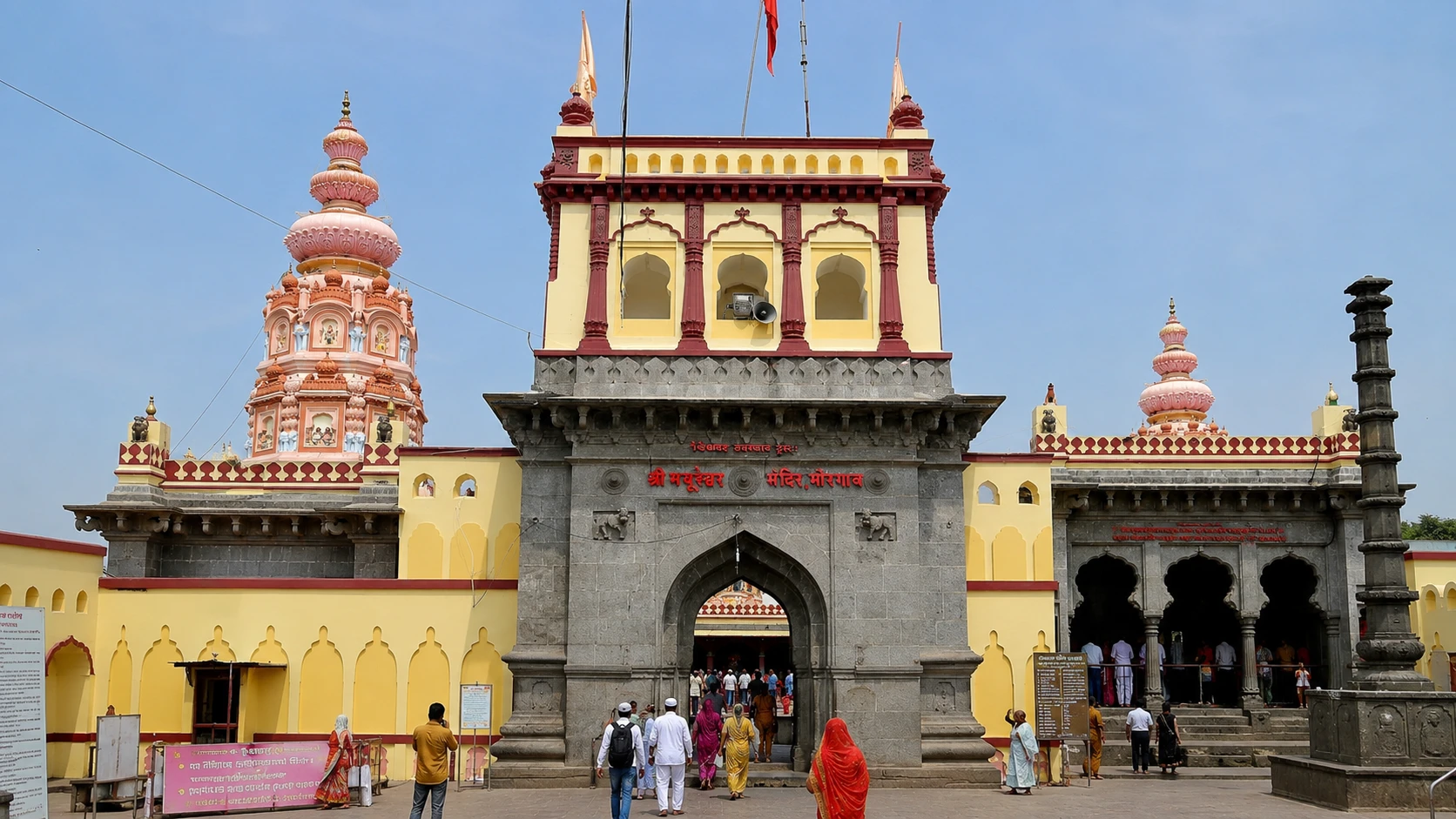
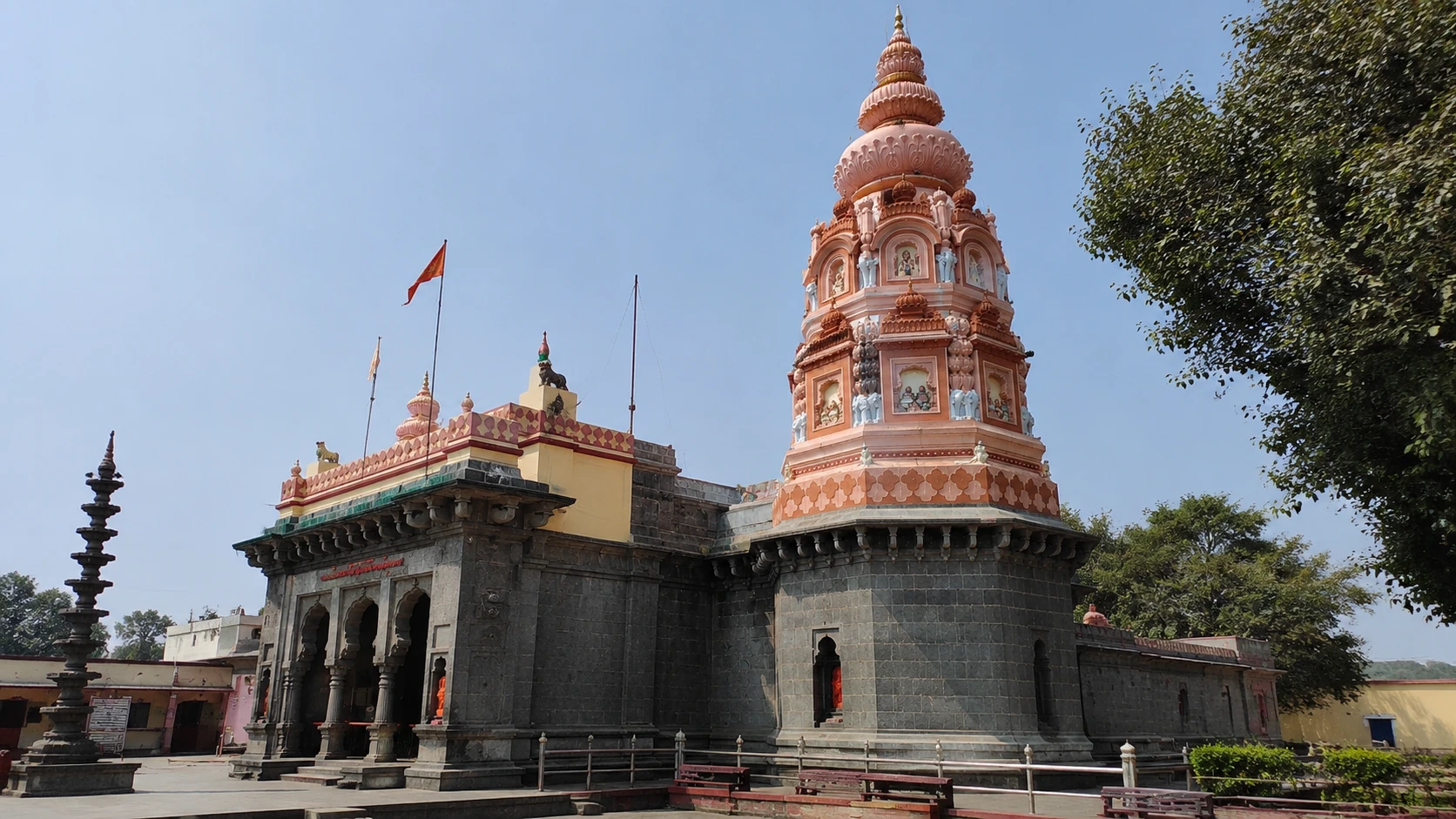
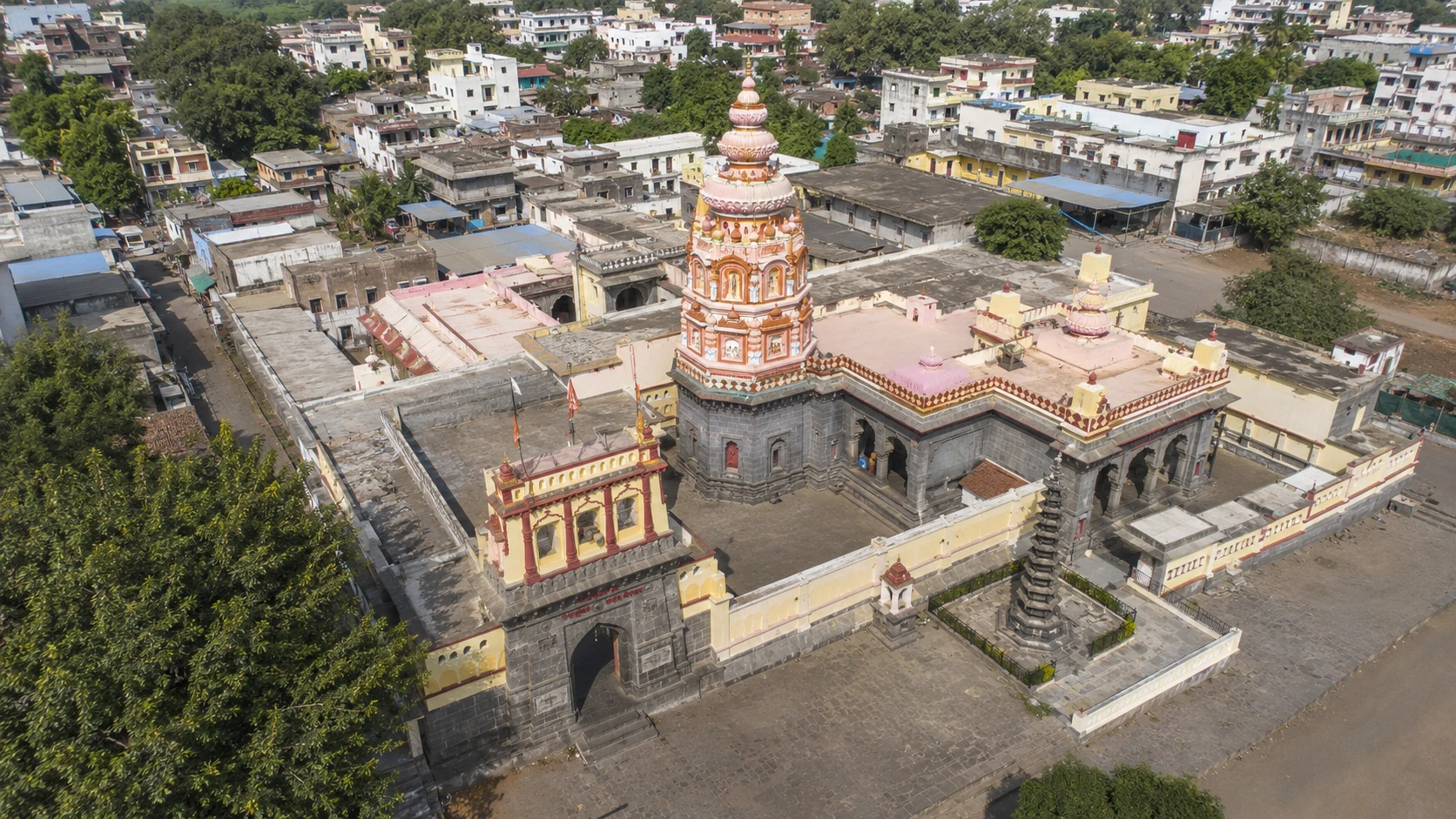
Hemadpanthi (dry-stone Yadava style) at the core, with Peshwa-era additions; the rectangular outer prakara wall is corner-anchored by four short minar-like towers — a syncretic post-Mughal architectural element distinctive among Ashtavinayak sites
खुला
05:00 – 22:00
आरती
07:00 · 12:00 · 20:00
विशेष
Sankashti Chaturthi (every lunar month) draws sustained queues from late afternoon through midnight; Magha Shuddha Chaturthi (Ganesh Jayanti) and Bhadrapada Shuddha Chaturthi (Ganesh Chaturthi) trigger multi-day festival darshan with extended timings — visitors are advised to confirm timings with the temple trust before travel
पवित्र कथा · पवित्र कथा
Moreshwar at Morgaon is the canonical first and last stop of the Ashtavinayak pilgrim circuit — the eight self-manifested Ganesha shrines of Maharashtra. Tradition holds that a pilgrimage is incomplete until the devotee returns to Morgaon and offers darshan a second time, closing the circuit where it began. The deity here is Mayureshwara — 'Lord of the Peacock' — named for the legend that Ganesha rode his peacock vahana to this riverside grove to slay the demon Sindhurasura. The swayambhu murti is seated, three-eyed, with a leftward-twisted trunk, and a cobra rising behind the head like a canopy. Of the eight Ashtavinayaka shrines, Morgaon is held to be the senior — the moolasthana, the root-seat — from which the entire Maharashtra Ganapatya circuit unfolds. The thirteenth-century saint Morya Gosavi traced his own devotional lineage to this temple, and the Peshwa-era patronage that built much of what stands today raised this small village on the Karha river into one of the most-visited Ganesha shrines in India.
Sacred Designationपवित्र पदनाम
Sacred Origin Storyपवित्र उत्पत्ति कथा
Source: Ganesha Purana (Upasana Khanda) and Mudgala Purana — widely-attested Ganapatya canonical accounts
In an age long before the present yuga, a demon named Sindhurasura was born. The sage Kashyapa had a son named Chakrapani, and Chakrapani's wife was so devout that she fasted and meditated for years asking for a child equal to the sun. The boon was granted, but the radiance she had asked for was too much — when her son was born, his blazing presence terrified the gods themselves. The infant grew rapidly in power. He defeated Indra, took dominion of the three worlds, and forced the gods into hiding. He was named Sindhu — and as he came of age, his cruelty consumed the earth.
The gods, scattered and humiliated, gathered in secret and went to Lord Vishnu. Vishnu directed them to a single answer: 'Worship Vinayaka. Only the elephant-faced one can put an end to this demon.' The gods together performed tapas — the deepest austerities — calling on Ganesha to descend in a form that could destroy Sindhurasura.
Ganesha responded. To enter the battlefield he chose an unusual vahana — not the mouse on which he is most often depicted, but the peacock, the swift and brilliant bird of the heavens. Mounted on his peacock, Ganesha came to a quiet grove on the banks of a small river — the place we now call Morgaon, the village of the peacock. From there he launched the war.
The battle with Sindhurasura was vast and terrible. The demon's armies fell in waves. Sindhurasura himself fought with cosmic weapons and ancient curses, but Ganesha cut through each in turn. At last, on this very ground, Ganesha killed the demon and freed the worlds. The gods came down from their hiding places to praise him. They begged him to remain at this spot, to stay forever at the place where he had ridden in on the peacock and ended the terror of Sindhu.
Ganesha agreed. The self-manifested form he left at this grove is what devotees come to see today — Mayureshwara, the Lord of the Peacock. The Ganesha Purana names this as one of the principal places where Ganesha takes incarnation across the yugas to defeat demons. The Mudgala Purana adds that of all the eight self-manifested Vinayakas of this region, Morgaon is the moolapeetha — the root-seat — because it was here that the divine confrontation took place that established Ganesha as the destroyer of all obstacles, including the obstacle of demonic adharma itself.
For this reason, pilgrims who undertake the Ashtavinayak yatra begin at Morgaon and conclude at Morgaon. The other seven shrines, however sacred, are darshans of the radiating presence; Morgaon is the source.
उद्धृत स्रोत:
- Ganesha Purana, Upasana Khanda, Chapters 60–73 (Sindhurasura-vadha narrative)
- Mudgala Purana, Khanda 1 (referencing the Mayureshwara avatara among the eight principal Ganesha forms)
- Sthala-purana of Morgaon (regional Marathi devotional tradition compiled across the 17th–18th centuries)
अन्य परंपराएँ · अन्य परंपराएँ
Mudgala Purana — cosmic-cycle variant emphasizing the Brahma creation framework
The Mudgala Purana presents a slightly different framing of the same Sindhurasura confrontation. In this version, Sindhurasura's birth is placed within a broader Brahma-creation cycle, and Ganesha's incarnation at Morgaon is named as the first of eight avataras taken across cosmic ages to defeat eight different demonic threats. The Mayureshwara form is specifically identified as the avatara that ended the demon of unchecked egoism — Sindhura representing the proud, sun-bright will that overreaches its place in the cosmic order. The Mudgala framing thus reads the Morgaon legend less as a single battle and more as a recurrent cosmological principle: Ganesha as Mayureshwara enters whenever ego grows beyond its boundary, and Morgaon is the place where that principle was first instantiated.
विद्वत संदर्भ
Modern scholarship on the Ashtavinayak tradition (Paul Courtright, 'Ganesa: Lord of Obstacles, Lord of Beginnings', Oxford 1985; Anita Raina Thapan, 'Understanding Ganapati: Insights into the Dynamics of a Cult', Manohar 1997; Bhalchandra Khandekar, 'Ashtavinayak Darshan', Marathi devotional-historical compilation 1978) places the formal codification of the eight-shrine circuit in the Peshwa period of the 18th century, when Maratha patronage rebuilt or substantially expanded all eight sites and the pilgrim convention of the canonical visiting order became fixed. The underlying shrines themselves are older — most carry stone-architectural layers from the Yadava period (12th–13th centuries), and the Sindhurasura legend at Morgaon is attested in Puranic compositions that predate the Peshwa formalization by several centuries. The 13th–14th century saint Morya Gosavi, whose own devotional movement (the Chinchwad Sansthan, near Pune) traces its origin to Morgaon, is considered the principal pre-Peshwa figure who established Morgaon's status as the seniormost Ganapatya pilgrimage site in Maharashtra.
Historyइतिहास
The documented history of the Morgaon temple is older than its present buildings. The site itself — a quiet bend of the Karha river in what is now Baramati taluka — has been a Ganesha shrine continuously for at least eight centuries, with archaeological signatures of an early stone temple datable to the Yadava period of the 12th–13th centuries. The Hemadpanthi style of the inner sanctum core — dry-jointed black basalt construction, characteristic of the Yadava religious architecture revived under the minister Hemadri — anchors the structure to this medieval phase. What stood at the site before stone is undocumented; tradition holds it had always been a sacred grove.
The figure who transformed Morgaon from a regional Ganesha shrine into a pan-Maharashtra devotional anchor was the saint Morya Gosavi, who lived in the 13th–14th centuries. Born into a devout Brahmin family near Pune, Morya is said to have undertaken intensive Ganapatya tapas at Morgaon and to have received direct darshan of Mayureshwara. He later established his own temple-residence at Chinchwad, just outside Pune, which became the Chinchwad Sansthan — a hereditary religious establishment continuing to this day. Morya Gosavi's lineage is held by his followers to receive seven generations of living gurus considered partial incarnations of Ganesha himself, and the Chinchwad Sansthan continues to recognize Morgaon as its tirtha-moolasthana, its source-pilgrimage.
The 17th and 18th centuries saw Morgaon enter the orbit of Maratha religious patronage. Chhatrapati Shivaji Maharaj is recorded in regional Bakhar chronicles as having visited the temple during his early consolidation of the Maval region. The far more substantial transformation, however, came with the Peshwa period of the 18th century. Successive Peshwas — Brahmin prime ministers of the Maratha confederacy who made Pune their political and religious capital — funded major works at Morgaon along with most of the other Ashtavinayak sites. The outer prakara wall with its four corner deepmala-towers (the small minar-like structures whose Indo-Islamic silhouettes give the temple its distinctive skyline), the assembly mandapas, the temple kitchens, and most of the visible secondary stonework date to this Peshwa-era patronage. Pilgrim accounts from the period describe the formalization of the eight-shrine circuit during these decades; the convention of beginning and ending the Ashtavinayak yatra at Morgaon is documented in Peshwa-era devotional Marathi literature.
After the fall of the Peshwa rule to the British in 1818, the Chinchwad Sansthan continued to administer Morgaon as a private religious establishment. Following the formation of the state of Maharashtra in 1960, the temple was eventually brought under the Ashtavinayak Devasthan trust framework administered in association with the Government of Maharashtra. In the early 2000s, a coordinated renovation initiative — the Ashtavinayak Vikas Yojana — restored the temple complexes of all eight sites, with Morgaon receiving particular attention as the circuit anchor. The Mayureshwar Devasthan Trust today handles day-to-day operations, while the Chinchwad Sansthan retains its traditional religious-ceremonial authority over the moolasthana.
Historical Timelineऐतिहासिक कालक्रम
Earliest archaeologically datable stone temple at Morgaon, constructed in the Hemadpanthi style characteristic of the Yadava dynasty period. The dry-jointed black basalt sanctum core of the present temple is attributed to this phase.
The Hemadpanthi attribution dates the stone-construction phase rather than the shrine itself; tradition holds the site to be far older as a sacred grove, but pre-stone material evidence is not available.
Lifetime of Saint Morya Gosavi, who established Morgaon's status as a pan-Maharashtra Ganapatya pilgrimage centre. Morya undertook prolonged tapas at Morgaon and went on to found the Chinchwad Sansthan near Pune, the hereditary religious lineage that continues to recognize Morgaon as its source-tirtha.
The exact birth and death dates of Morya Gosavi vary across hagiographic sources by several decades. The 1280–1375 range reflects the most commonly cited tradition; some lineage records place him slightly later. The Chinchwad Sansthan itself preserves a continuous line of named successors from Morya forward, which provides a relative chronology even where absolute dates are uncertain.
Recorded visits to Morgaon by Chhatrapati Shivaji Maharaj during his consolidation of the Maval region. Maratha-era patronage of the temple is documented from this period onward, including land grants and revenue arrangements for daily worship.
Peshwa-era patronage transformed the Morgaon complex into substantially its present form. Successive Peshwas — particularly during the reigns of Bajirao I, Balaji Bajirao (Nanasaheb), and Madhavrao I — funded the outer prakara wall with its four corner deepmala-towers, the sabha-mandapa expansions, the temple kitchens, and the institutional infrastructure for pilgrim hosting. The convention of beginning and ending the Ashtavinayak yatra at Morgaon was formalized in devotional Marathi literature of this period.
Specific donation records exist in the Peshwa Daftar tying named commanders and Peshwa ministers to particular structures, but the attribution of individual elements (which deepmala by whom, which mandapa under whose patronage) is fragmentary. The aggregate Peshwa-era patronage is well-established; element-level attribution requires further archival work.
Documented major renovation cycle of the temple complex during the late Peshwa period, traditionally attributed to the patronage of Sardar Haripant Phadke and other senior Peshwa-era commanders. This renovation cycle is preserved in Chinchwad Sansthan oral tradition as one of the most substantial in the temple's recorded history.
Coordinated renovation of all eight Ashtavinayak temple complexes undertaken under the Maharashtra Government's Ashtavinayak Vikas Yojana (Ashtavinayak Development Scheme). At Morgaon, the work included structural restoration of the deepmala-towers, reorganization of pilgrim flow, water management around the Karha river bank, and modernization of basic visitor infrastructure.
What You'll Seeदर्शन में
The murti of Mayureshwara sits within a small, dim sanctum at the heart of the Hemadpanthi inner shrine, set on a raised stone pedestal carved in lotus-petal pattern. The form is seated — knees bent, the left leg folded inward over the seat — with the elephant face turned slightly forward and the trunk curving toward the left (vamavarti). Three eyes are visible on the face, the third opening vertically on the forehead. A seven-hooded cobra rises behind the head and fans outward in a natural canopy — this serpent-canopy detail is among the most photographed iconographic signatures of Morgaon.
Flanking the murti, two smaller figures stand on either side: Siddhi (achievement) to one and Buddhi (intellect) to the other, the two consorts of Ganapati in Ganapatya theological tradition. A small Mooshaka (mouse, Ganesha's primary vahana) is carved at the base of the platform, but the peacock — the Mayura that gives the deity its name — is not depicted within the inner sanctum itself. The peacock figures instead in the iconography of the temple gateways and in painted murals around the outer mandapa.
The daily ritual at Morgaon involves heavy application of sindoor (saffron-red vermilion paste mixed with oil), which is layered over the murti continuously across the centuries. The accumulation is now so thick that the original carved features of the stone are visible only briefly during the morning abhishekam, when the sindoor is partially removed for ritual bathing. Devotees who wish to see the original swayambhu basalt form must arrive in the narrow window after the morning snan and before the fresh sindoor application — a circumstance the temple priests will indicate to interested pilgrims.
The surrounding sanctum walls bear smaller carved figures of Ganesha's retinue and of related Ganapatya iconography — Ekadanta (single-tusked) form, Vakratunda (curved-trunk) form, Lambodara (large-bellied) form, and the Mahaganapati composite. Outside the sanctum, the sabha-mandapa pillars carry Yadava-period geometric and floral carving, and beyond that the outer prakara wall is anchored at its four corners by the temple's distinctive deepmala-towers — short pillar-towers in Indo-Islamic silhouette that hold oil-lamp niches lit during major festivals. At the main entrance, two stone Nandi figures (bulls) face inward toward the sanctum, a configuration unusual for a Ganesha temple. The folk explanation, preserved in local tradition, holds that a Nandi being transported to a Shiva temple paused at Morgaon, found the company of Mayureshwara so pleasing that he refused to continue, and was permitted to remain in permanent darshan of Ganesha.
Distinctive Practicesविशिष्ट परंपराएँ
Ashtavinayak Yatra Anchor Darshan
अष्टविनायक यात्रा आरंभ-समापन दर्शन
Beginning and end of every canonical Ashtavinayak pilgrim circuit (typically a 2–3 day yatra)
The pilgrim convention codified during the Peshwa period requires that any complete Ashtavinayak yatra begin with darshan at Morgaon and conclude with a return darshan at the same shrine. Most package tour operators and traditional pilgrim groups arrive at Morgaon at dawn on the first day, perform the opening puja, travel onward through the canonical seven sites in order (Siddhatek, Pali, Mahad, Theur, Lenyadri, Ozar, Ranjangaon), and return to Morgaon on the final day to close the circuit. The closing darshan is treated as the moment of completion of the entire yatra — a single missed Morgaon return is held to leave the pilgrimage spiritually unfinished.
Morgaon is held to be the moolapeetha — the root-seat — of the eight Ashtavinayaka manifestations. The other seven shrines are darshans of the radiating presence; the source-seat is at Morgaon. To begin and end at the source is to circumambulate the principle of Ganesha itself, treating the entire yatra as one extended pradakshina (sacred circumambulation) of the moolasthana.
Sankashti Chaturthi Observance
संकष्टी चतुर्थी व्रत
Krishna Paksha Chaturthi of every lunar month (12-13 times a year); the most significant falls in the month of Magha (January-February)
On the fourth day of the waning moon each lunar month, devotees observe a day-long fast known as Sankashti Chaturthi (Chaturthi-of-troubles), breaking the fast only after moonrise darshan of Ganesha. At Morgaon the day draws sustained pilgrim crowds from afternoon through midnight, with continuous abhishekam, recitation of the Sankatnashan Ganesh Stotra, and special evening aarti. Devotees facing personal difficulties — financial, health, relational, or vocational — undertake the Sankashti vow as a request for the removal of obstacles, the function for which Ganesha is most widely invoked.
Ganesha is Vighnaharta — the remover of obstacles. The Sankashti observance is a structured monthly request for that intervention. The fast itself is held to amplify the devotional intensity; the moon-rise darshan ties the personal request to the cosmic timing of the lunar cycle.
Modak Naivedya Tradition
मोदक नैवेद्य परंपरा
Daily naivedya offering during the afternoon abhishekam window; substantially elaborated on Ganesh Chaturthi (Bhadrapada) and the four Tuesdays of Margashirsha month
Modak — a steamed or fried dumpling of rice-flour dough filled with grated coconut and jaggery — is the canonical naivedya (food offering) for Ganesha across the Marathi devotional tradition, and Morgaon is one of the temples where the offering carries explicit textual sanction. The Ganesha Purana names modaka among the foods Mayureshwara himself preferred. Hereditary modak-preparing families in Morgaon village supply offerings to the temple; pilgrims may also bring modaks from outside, though the temple's own kitchen-prepared offering is considered the most spiritually charged.
Modak is held to symbolize the sweet fruit of inner spiritual attainment — its outer dough plain and unremarkable, its inner sweetness revealed only when the offering is broken. Ganesha as Vighnaharta is said to relish modak because the form of the sweet matches the form of his teaching: the seeker who breaks through outer obstacle finds the inner sweetness of self-realization.
Ganapati Atharvashirsha Recitation
गणपति अथर्वशीर्ष पाठ
Daily during morning and evening aarti; with elevated significance on Ganesh Chaturthi and during the Bhadrapada Ganeshotsav month
The Ganapati Atharvashirsha, an Upanishadic-style hymn that opens with the foundational mantra 'Om Namaste Ganapataye', is recited by temple priests during the daily aarti at Morgaon. Devotees who wish to participate may join the recitation. Twenty-one consecutive recitations (ekvis avartane) of the Atharvashirsha is considered a particularly powerful devotional practice and is undertaken by many pilgrims at Morgaon either at the temple itself or in the surrounding pilgrim dharamshalas.
The Atharvashirsha is treated by the Ganapatya tradition as a complete statement of Ganesha's metaphysical identity — Ganesha as the underlying principle of the universe, beyond the elephant-headed iconographic form. Recitation is said to invoke that deeper metaphysical Ganesha rather than only the local deity, anchoring the temple visit in scriptural ground.
Did You Know?क्या आप जानते हैं?
Morgaon is the only Ashtavinayak shrine that the canonical pilgrim convention requires devotees to visit twice in a single circuit — once at the beginning, once at the end. The other seven shrines are visited once each in canonical order; Morgaon brackets the entire yatra as the moolasthana, the root-seat from which the eight-shrine tradition radiates and to which it returns.
Peshwa-era devotional Marathi literature; Chinchwad Sansthan pilgrim-tradition records
The temple's distinctive corner deepmala-towers — short minar-like pillars at the four corners of the outer prakara wall — are an Indo-Islamic architectural element absorbed into 18th-century Maratha temple-building. They give Morgaon a syncretic silhouette that is unique among the Ashtavinayak sites; none of the other seven shrines carry this specific feature in the same form, making the Morgaon outline immediately recognizable in old paintings and modern photographs alike.
Maharashtra State Department of Archaeology, Ashtavinayak architectural survey; Bhalchandra Khandekar, 'Ashtavinayak Darshan' (1978)
Two stone Nandi figures face the inner sanctum from the main entrance — a highly unusual configuration for a Ganesha temple, where one would normally expect Mooshaka (the mouse vahana of Ganesha) in that position. The folk explanation preserved in Morgaon's local tradition holds that a Nandi being transported to a Shiva temple paused at Morgaon, found the company of Mayureshwara so pleasing that he refused to continue, and was permitted by Ganesha to remain in permanent darshan at his shrine.
Local Morgaon oral tradition; Chinchwad Sansthan pilgrim guides
Saint Morya Gosavi, the 13th–14th century Ganapatya saint who established Morgaon's pan-Maharashtra prominence, founded the Chinchwad Sansthan near Pune — a religious establishment held by its followers to receive seven living gurus considered partial incarnations of Ganesha. The Sansthan still treats Morgaon as its source-tirtha to this day, and senior Chinchwad representatives are present at Morgaon during all major festivals.
Chinchwad Sansthan archival records and Morya Gosavi Charitra (traditional Marathi devotional biography)
The murti at Morgaon receives a continuous accumulation of sindoor (vermilion paste) applied daily over centuries — to the point where the original carved features of the black-basalt swayambhu form are visible only briefly each morning, in the narrow window after ritual snan and before the fresh sindoor application. Pilgrims who want to see the underlying stone form must time their darshan to that specific interval, which the temple priests can identify on request.
Mayureshwar Devasthan Trust pilgrim information; field observations by Marathi devotional travel writers
The temple stands on the south bank of the Karha river, in a village whose name — Morgaon — itself translates as 'village of the peacock', tying place-name and deity-name together through the Mayura legend. Morgaon village remains small to this day; the surrounding agricultural landscape of grape and sugarcane fields (the Baramati area is one of Maharashtra's principal grape-growing regions) supplies the local economy alongside temple pilgrim revenue.
Maharashtra State Gazetteer (Pune district) and Baramati Taluka administrative records
The Mudgala Purana describes the Mayureshwara form of Ganesha specifically as the avatara that destroys ahamkara — the obstacle of unchecked ego — represented in the Sindhurasura legend as a demon born of an excess of solar radiance the human will could not contain. Of the eight Ganesha avataras the Mudgala enumerates across the cosmic ages, Mayureshwara is named as the first, placing Morgaon's foundational legend at the philosophical and cosmological starting point of the entire Ganapatya avatara framework.
Mudgala Purana, Khanda 1 (Ekadanta-Mayureshwara avatara)
Visitor Accessप्रवेश जानकारी
Morgaon welcomes devotees of all backgrounds for darshan without restriction based on gender, age, caste, or origin. Photography is permitted in the outer halls, the prakara courtyard, and around the deepmala-towers, but is not allowed within the inner sanctum (garbhagriha), particularly during abhishekam. Footwear must be removed before entering the main temple complex. Mobile phones should be silenced inside the sanctum area. The temple is fully accessible to differently-abled pilgrims via a ramp at the southern entrance, though the sanctum step itself remains a small physical threshold.
There is no formal VIP-darshan or paid priority-queue at Morgaon; on ordinary days the queue moves swiftly and darshan is direct. Sankashti Chaturthi evenings, Ganesh Chaturthi week (Bhadrapada), and Magha Ganesh Jayanti can produce queues of several hours — pilgrims attending on these days should arrive by mid-morning at the latest. Pilgrim groups travelling the full Ashtavinayak circuit are typically accommodated under the package-tour management of the Maharashtra Tourism Development Corporation (MTDC) or private operators; independent pilgrims may also walk in directly without prior booking.
Festivalsत्योहार
Ganesh Chaturthi (Bhadrapada Shukla Chaturthi)
गणेश चतुर्थी (भाद्रपद शुक्ल चतुर्थी)
Aug-Sep (Bhadrapada Shukla Chaturthi)
The principal festival of Ganesha and the most significant date in the Morgaon ritual calendar. The Bhadrapada Ganesh Chaturthi marks the cosmic descent of Ganesha and is observed across Maharashtra as Ganeshotsav — a ten-day public festival made famous in its modern form by Lokmanya Tilak's late-19th-century revival in Pune. Morgaon, as the moolapeetha, receives multi-day pilgrim crowds across this period, with the central day drawing tens of thousands. Continuous abhishekam, twenty-one Atharvashirsha recitations by groups of priests, special evening aartis, and major naivedya offerings of modak define the observance. Many pilgrim groups undertake the Ashtavinayak yatra specifically during this fortnight, beginning and ending at Morgaon to coincide with the festival itself.
Magha Ganesh Jayanti (Magha Shuddha Chaturthi)
माघ गणेश जयंती (माघ शुद्ध चतुर्थी)
Jan-Feb (Magha Shuddha Chaturthi)
Held by the Ganapatya tradition to be the birth-tithi of Ganesha — distinct from the Bhadrapada festival, which celebrates the descent of the deity into Earth-darshan. The Magha Chaturthi is the more inwardly devotional of the two festivals, drawing smaller but more sustained pilgrim crowds. At Morgaon the day is marked by an extended Atharvashirsha-paath cycle, sustained abhishekam from pre-dawn through midnight, and a particular emphasis on the Mayureshwara avatara-narrative — readings from the Ganesha Purana and Mudgala Purana sections describing the Sindhurasura defeat are conducted publicly through the day.
Sankashti Chaturthi (monthly)
संकष्टी चतुर्थी (मासिक)
Every lunar month — Krishna Paksha Chaturthi (12-13 times annually)
The monthly cycle of obstacle-removal devotion that gives the Ganapatya devotional year its rhythm. Each Krishna Paksha Chaturthi sees Morgaon draw substantial evening crowds — pilgrims observing the day-long fast break it after moonrise darshan, and the temple operates extended hours through the night. The Angarki Sankashti — Sankashti Chaturthi falling on a Tuesday — is held to be particularly powerful, and produces the largest of the monthly crowd cycles. The temple maintains a calendar of all Sankashti dates each year, available at the office near the main entrance and online via the trust.
Vijayadashami (Dussehra)
विजयादशमी (दशहरा)
Sep-Oct (Ashwin Shukla Dashami)
Celebrated at Morgaon with particular significance because of the Sindhurasura-vadha narrative at the temple's foundational myth — Dussehra is the cosmic day of demon-slaying, and Mayureshwara is the demon-slaying Ganesha. The temple observes the day with a special evening aarti and a procession of the utsav-murti (ceremonial portable image) around the prakara walls. Several pilgrim groups choose to begin their Ashtavinayak circuits on this day specifically.
Rangapanchami (Phalgun Krishna Panchami)
रंगपंचमी (फाल्गुन कृष्ण पंचमी)
Mar (Phalgun Krishna Panchami — five days after Holi)
Rangapanchami is the principal Holi-cycle festival in the Maharashtra Ganapatya calendar, observed at Morgaon as a community festival rather than a strictly inward devotional day. Gulal (coloured powder) is offered to the murti as part of the morning ritual, and the village courtyards outside the temple complex host community Holi observance — distinct in spirit from the major North Indian Holi but rooted in the same lunar-month framework.
Traditional Offeringsपारंपरिक अर्पण
प्राथमिक अर्पण
Modak
मोदक
मोदक
The canonical naivedya for Ganesha across the Marathi devotional tradition — a steamed (ukadiche modak) or fried dumpling of rice-flour dough filled with grated coconut and jaggery. The Ganesha Purana names modaka among the foods Mayureshwara himself preferred. The modak symbolizes the sweet fruit of inner spiritual attainment: outer dough plain and unremarkable, inner sweetness revealed only when broken open. Twenty-one modaks (ekvis modak) offered together is considered the complete devotional naivedya.
Durva grass
दूर्वा घास
दूर्वा
The trifoliate Durva grass is held to be sacred to Ganesha in a way matched by no other plant. The Ganesha Purana describes how Ganesha once consumed the demon Analasura and suffered an inner burning that no remedy could ease — until the sages offered him fresh durva grass, which restored his coolness. Since then, durva is offered to Ganesha to cool the heat of accumulated obstacles. Twenty-one tufts of durva (ekvis durva) is the canonical full offering, mirroring the twenty-one modaks.
Red Hibiscus (Jaaswand)
लाल जपा कुसुम
जपापुष्प
Red hibiscus flowers — known as jaaswand in Marathi — are particularly sacred to Ganesha among floral offerings. The flower's deep red colour echoes the sindoor that perpetually adorns the murti; the five-petalled form is held to symbolize the five elements that Ganesha as Mahaganapati governs. Red hibiscus garlands are offered daily at Morgaon and feature prominently in the major festival decorations.
Sindoor (Vermilion paste)
सिंदूर
सिन्दूर
Saffron-red vermilion paste, applied directly to the murti over centuries to create the thick coating that now defines Mayureshwara's visible form. Devotees may bring sindoor as offering or receive sindoor-prasad from the temple after darshan — applied to one's own forehead as the deity's direct blessing. The accumulation of sindoor on the Morgaon murti is held by tradition to encode the prayers of every devotee who has ever offered it, layer upon layer, century upon century.
Coconut
नारियल
नारिकेल
The coconut is a standard offering across Hindu temple traditions, symbolizing the human ego that must be broken before the deity for spiritual progress. At Morgaon, coconut is part of every formal puja and is broken at the entrance to the prakara as a preliminary ritual before approaching the inner sanctum. The water inside the coconut is treated as a small offering of pure prana (life-force).
इस मंदिर की विशेषता
Morgaon Modak Naivedya
मोरगाव मोदक नैवेद्य
Hereditary modak-preparing families in Morgaon village have supplied the temple's daily naivedya for generations. The modak prepared in these traditional household kitchens, consecrated through the afternoon abhishekam, and distributed to devotees as prasad is treated as a Morgaon-specific offering — a tangible carry-home blessing that pilgrims often take back to their own household shrines. Pilgrims may also purchase modak prepared by these families directly from village shops adjoining the temple complex.
Pilgrims are welcome to bring offerings from outside the temple complex. The Mayureshwar Devasthan Trust maintains a small puja-sahitya counter near the main entrance where pre-arranged offering bundles, sindoor packets, durva-tufts, and modak are available. Synthetic plastic flowers are politely discouraged in favour of fresh natural materials. Pilgrims undertaking the full Ashtavinayak yatra are advised to carry a few sealed packets of durva and sindoor from Morgaon to use as offerings at the subsequent seven shrines — a practice rooted in the moolasthana convention.
How to Reachकैसे पहुँचें
Morgaon is located in Baramati taluka of Pune district, on the south bank of the Karha river, approximately 65 km southeast of Pune city. The temple is set in open agricultural countryside — the surrounding landscape is characteristic Baramati region, with grape vineyards, sugarcane fields, and scattered villages.
By road, the temple is most easily reached from Pune via the Pune–Saswad–Jejuri–Morgaon route (about 1.5 to 2 hours by private vehicle, depending on traffic through the Saswad ghat section). State transport buses operated by Maharashtra State Road Transport Corporation (MSRTC) run from Pune Swargate bus stand to Morgaon and to Baramati; private shared taxis and tour-package vehicles are the more common pilgrim transport modes. Most Ashtavinayak package operators include Morgaon as the first stop on a 2–3 day circuit, with overnight accommodation typically arranged in Pune or Baramati between segments.
By rail, the nearest railway stations in order of distance are Jejuri (16 km — a small station with limited connectivity, useful for pilgrims combining Morgaon with Jejuri's own Khandoba temple), Daund Junction (50 km — well-connected to Pune, Solapur, Mumbai and Hyderabad), and Pune Junction (65 km — the principal regional rail hub with services from across India). From Daund or Pune, taxis and shared transport to Morgaon are easily arranged.
By air, Pune International Airport (PNQ, approximately 80 km via Saswad) is the primary access point, with domestic flights from all major Indian cities and limited international connectivity. Mumbai's Chhatrapati Shivaji Maharaj International Airport (BOM, approximately 225 km, 5–6 hours by road) is the more practical option for international pilgrims; from Mumbai, the Pune Expressway via Lonavala and onward via Saswad is the conventional route.
For the canonical Ashtavinayak circuit, the route after Morgaon proceeds to Siddhatek (approximately 70 km northeast, in Ahmednagar district), then Pali (Raigad district, via Pune), Mahad, Theur, Lenyadri, Ozar, Ranjangaon, and concluding with the return to Morgaon. Most package tours cover the full circuit in 2–3 days; pilgrims travelling independently by private vehicle should plan for 3–4 days to allow unhurried darshan at each site.
Plan Your Visitयात्रा की योजना
🌤 सर्वोत्तम मौसम
October to February is the most comfortable period for Morgaon — daytime temperatures range from 18–28°C with low humidity, and the post-monsoon countryside is at its most beautiful. The temple is open year-round; March to May brings hot dry weather (35–42°C) which is the off-season for casual visits but does not affect ritual operation. The monsoon (June to September) brings substantial rain to the Baramati region; the Karha river runs high and the roads through the Saswad ghat can flood briefly. Ganesh Chaturthi falling in late August or early September often coincides with monsoon conditions — pilgrims should plan accordingly. The most spiritually charged windows are Magha Ganesh Jayanti (January–February) and Bhadrapada Ganesh Chaturthi (August–September); the most operationally comfortable is November to early February.
👘 पहनावे का नियम
Modest traditional dress is expected and appreciated. For men, full-length trousers or dhotis with shirts of any kind are appropriate; shorts and sleeveless tops are discouraged. For women, sarees, salwar suits, or long skirts with covered shoulders are appropriate; sleeveless or short-sleeved tops without an additional covering are discouraged at the sanctum threshold. The temple does not enforce a strict written dress code at the main entrance, but gestures of traditional modesty are visibly respected by other devotees and by the priests. There is no requirement for a head covering at this temple.
📱 फोन और फोटोग्राफी
Mobile phones should be silenced before entering the inner sanctum. Photography with phones is permitted in the outer halls, the prakara courtyard, the deepmala-tower exteriors, and the surrounding mandapa areas. Photography is not permitted in the inner sanctum itself, particularly during abhishekam and during the brief snan window when the underlying murti-form is visible. The temple does not formally collect or deposit phones at the entrance, but does enforce the sanctum-photography prohibition through priest intervention if necessary.
🏨 आवास
There is no major hotel infrastructure in Morgaon village itself — the village is small and surrounded by agricultural countryside. The Mayureshwar Devasthan Trust operates a basic pilgrim dharamshala adjacent to the temple complex with simple rooms suitable for an overnight stay, available on first-come-first-served basis. Pilgrim groups on the Ashtavinayak circuit typically arrange their overnight accommodation at one of two regional hubs: Pune city (65 km, full range of hotels from budget to luxury, the standard choice for organized package tours) or Baramati town (28 km, mid-range hotels suited to longer regional stays). The Maharashtra Tourism Development Corporation (MTDC) operates a holiday resort at Saswad on the Pune-Morgaon route, used by many circuit tours as an overnight stop between Morgaon and the next shrine.
Book a Pujaपूजा बुक करें
The Mayureshwar Devasthan Trust at Morgaon does not currently operate a verified online puja booking portal. The Ashtavinayak circuit attracts a high volume of package-tour pilgrims, and third-party websites and intermediaries claiming to offer puja bookings, priority darshan passes, or accommodation packages should be approached with caution — many are unaffiliated with the Devasthan and the Chinchwad Sansthan. For puja bookings, contact the temple office directly upon arrival or coordinate through a reputable Ashtavinayak package-tour operator. We do not list a phone number or email here because no verified primary contact has been published by the Trust; this section will be updated when the Trust publishes one.
Managed by: Shri Mayureshwar Devasthan Trust, Morgaon (with religious-ceremonial authority retained by the Chinchwad Sansthan)
Abhishekam (ritual bathing)
अभिषेकम
Ekvis Modak Naivedya (twenty-one modak offering)
एकवीस मोदक नैवेद्य
Atharvashirsha Avartan (twenty-one recitations)
अथर्वशीर्ष आवर्तन (एकवीस आवर्तने)
Sankashti Chaturthi sponsored aarti
संकष्टी चतुर्थी प्रायोजित आरती
Booking information verified: 2026-05-19
Sacred Soundsपवित्र ध्वनि
क्या आप जानते हैं? · Did You Know?
वही अनुवाद त्रुटि जिसने हिन्दू धर्म में '33 कोटि' को '33 करोड़' बनाया, बौद्ध धर्म में भी हुई। बौद्ध ग्रन्थों के चीनी अनुवाद ने 'सप्त कोटि बुद्ध' (7 श्रेष्ठ बुद्ध) का अनुवाद '7 करोड़ बुद्ध' कर दिया। तिब्बती अनुवाद ने सही किया: 7 प्रकार, 7 करोड़ नहीं। एक संस्कृत शब्द, दो प्रमुख विश्व धर्मों में गलत पढ़ा गया, ने दो एकसमान भ्रम स्वतन्त्र रूप से उत्पन्न किए।
Related Contentसंबंधित सामग्री
Related Scriptures
Related Temples
Siddhivinayak (Siddhatek)
सिद्धिविनायक सिद्धटेक
Siddhatek, Maharashtra
Ballaleshwar (Pali)
बल्लालेश्वर
Pali, Maharashtra
Varadavinayak (Mahad)
वरदविनायक
Mahad, Maharashtra
Chintamani (Theur)
चिंतामणि थेऊर
Theur, Maharashtra
Girijatmaj (Lenyadri)
गिरिजात्मज लेण्याद्री
Lenyadri, Maharashtra
Vighneshwar (Ozar)
विघ्नेश्वर ओझर
Ozar, Maharashtra
Mahaganapati (Ranjangaon)
महागणपति रांजणगाव
Ranjangaon, Maharashtra
Community Reflections
🕉️
Be the first to share your reflection.