Varadavinayak (Mahad)
वरदविनायक
The boon-granting Vinayak — where every devotee's varada is said to be heard
Mahad, Maharashtra, India
VaradavināyakaAlso known as: Varad Vinayak, Mahad Ganpati, Shri Varadavinayak, Mahad Vinayak, Varadeshwar
युग
Mythological origins per Puranic tradition (Mudgala Purana — Gritsamada-rishi narrative in the Bhadrak forest); swayambhu murti rediscovered in 1690 by the devotee Dhondu Paudkar in a nearby pond; present small dome temple structure built around 1725 under Peshwa-era patronage of Subhedar Ramji Mahadev Biwalkar; akhand jyot tradition documented from 1892
वास्तुकला
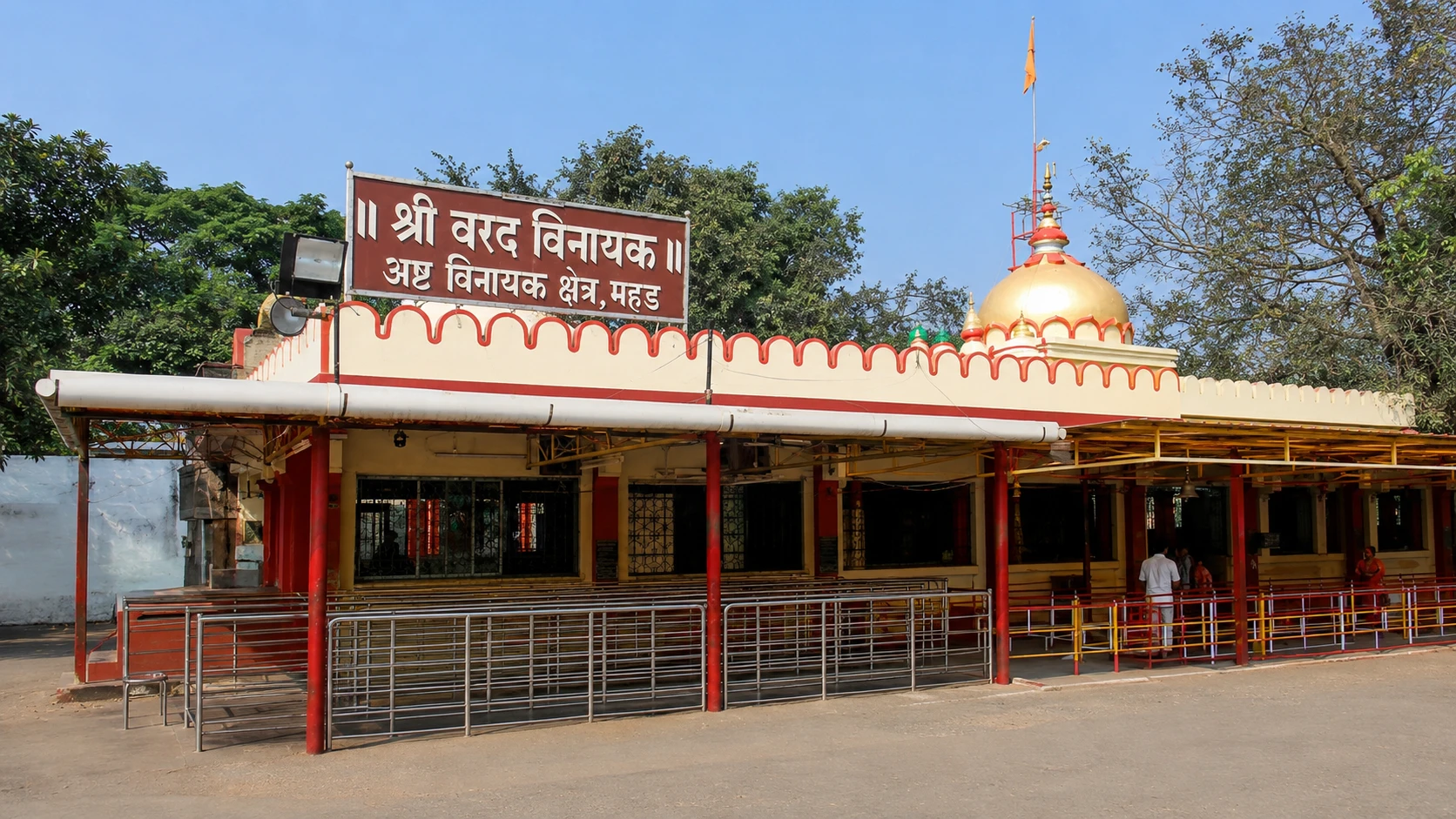
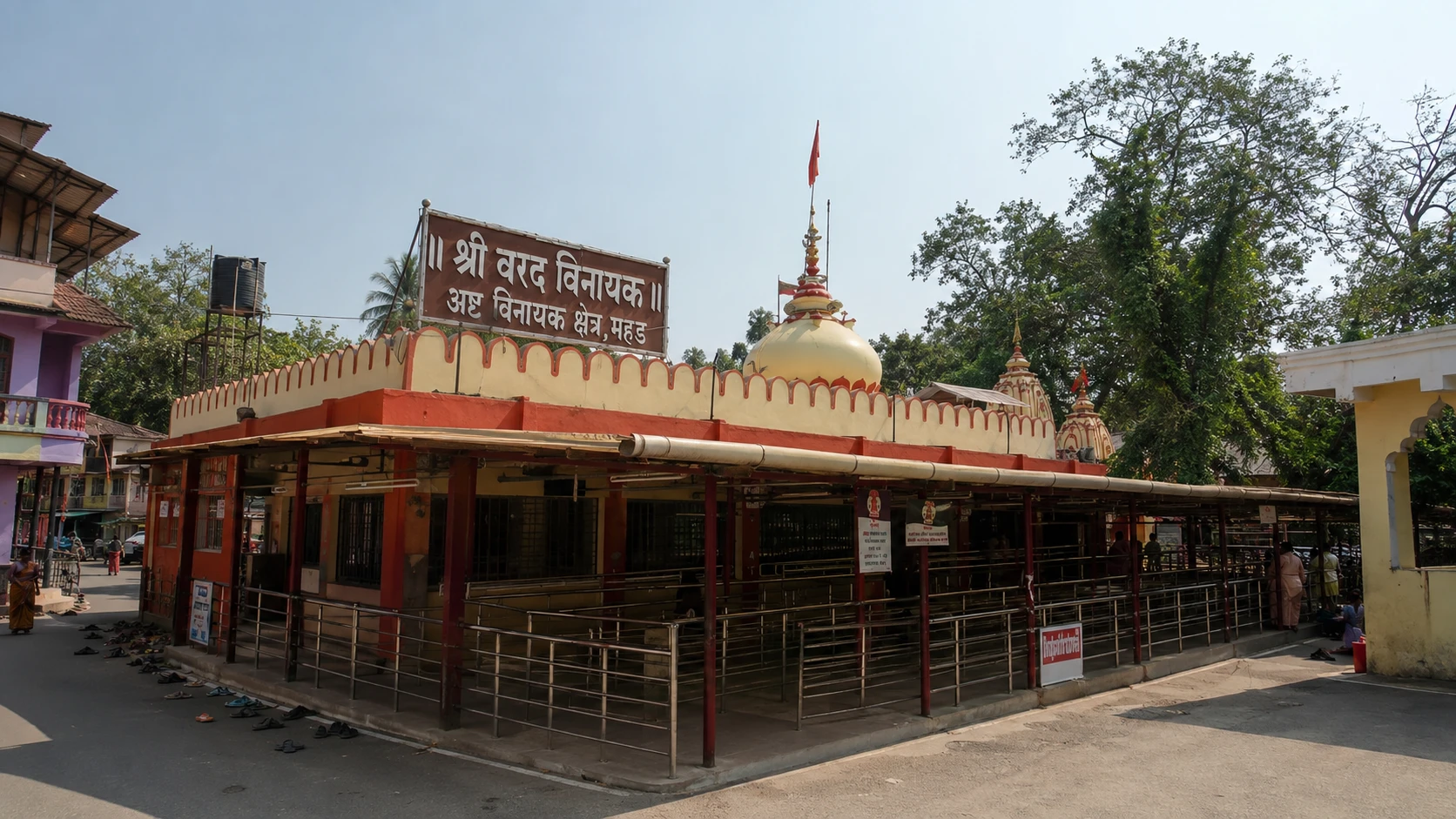
Compact single-dome Maratha-Peshwa temple architecture; the dome is topped with a copper-plated finial and four stone elephant figures stand at the corners of the dome's base — a distinctive iconographic-architectural element that marks Varadavinayak among the Ashtavinayak sites. The temple's footprint is small relative to the more elaborate Pali and Theur complexes; the interior is intimate, designed to permit the direct pilgrim-sanctum access that is one of the temple's signature features
खुला
05:00 – 21:30
आरती
05:30 · 12:00 · 20:00
विशेष
Pilgrims are permitted to enter the small sanctum directly and place their hands on the Varadavinayak murti during darshan — a level of physical access rare among major Hindu temples and unique within the Ashtavinayak circuit (Lenyadri's cave structure provides open access of a different kind, but at Varadavinayak the open access is by deliberate tradition rather than architectural artifact). The continuously-burning akhand jyot (eternal oil lamp) is visible in the sanctum next to the murti; tradition holds it has burned without interruption since 1892, tended by a hereditary lineage of lamp-keepers
पवित्र कथा · पवित्र कथा
Varadavinayak at Mahad is the fourth stop on the canonical Ashtavinayak circuit — the shrine of the boon-granting form of Ganesha, where tradition holds that no devotee's varada (boon-request) goes unanswered. The legend that anchors the temple involves the rishi Gritsamada, whose ambiguous parentage (his mother Mukunda was deceived by Indra) caused him such inner anguish that he undertook intense tapas to Ganesha in the surrounding Bhadrak forest, and received a boon that the place itself would become Varada-kshetra — the field where boons are granted. The site sits on the Konkan-Sahyadri side, in Mahad village of Khalapur taluka (a name shared with the larger southern Raigad town famous for Ambedkar's 1927 Chavdar Tale Satyagraha, but a distinct location). Two distinctive features set this shrine apart within the Ashtavinayak circuit: pilgrims are permitted to enter the small sanctum directly and place their hands on the murti during darshan — a level of physical access not granted at most major Hindu temples — and a continuously-burning oil lamp (the akhand jyot) is held by temple tradition to have been lit in 1892 and to have burned without interruption since. The present small single-dome temple, with four stone elephants at the dome's corners, was built by the Peshwa-era subhedar Ramji Mahadev Biwalkar around 1725, around a swayambhu murti rediscovered in a nearby pond by the devotee Dhondu Paudkar in 1690.
Sacred Designationपवित्र पदनाम
Sacred Origin Storyपवित्र उत्पत्ति कथा
Source: Mudgala Purana (Gritsamada-rishi prakarana) — widely-attested Ganapatya canonical account
In an age long before the present yuga, there lived a king named Vitragu and his queen Mukunda. They were a couple of dharma — devoted to each other, attentive to their duties, and reverent toward the gods. Among the gods, however, was Indra, the king of the devas, whose appetites were known to exceed his discipline. Indra observed Mukunda from his heaven and desired her. Knowing she would never receive him willingly, he took the form of her husband Vitragu, came to her in this disguise, and lay with her. Mukunda did not know the deception. She believed she had been with her own husband.
From that union, a child was conceived. As the pregnancy advanced, the truth came to Mukunda — Indra's deception was revealed, perhaps by the sages who saw what no human eye could see, perhaps through her own dawning recognition of the inconsistencies in her memory of the encounter. She told her husband Vitragu. The king's response was not the compassion the situation required; it was rage. He cursed his wife: 'For this betrayal, even though you did not know — for the failure of your discernment — the child in your womb shall be born of grass, not of a queen. Let the contamination leave my line.'
Mukunda, broken by the curse and by the discovery of Indra's deception, withdrew into a remote area of the Bhadrak forest. She gave birth not as a queen on a royal bed but alone, among grass and thorn-bushes. The child — a boy — emerged into the world from the grass-thicket where his mother had laboured. She named him Gritsamada, which means 'gathered from grass' or 'born of the grass-collection'. The name itself carried the curse: every utterance of it would remind the boy of the dishonour of his origin.
Gritsamada grew. He was an extraordinary child — intellectually precocious, spiritually intense — but the shadow of his birth never left him. He knew the story. He knew his mother had been deceived. He knew his royal father had cursed him in the womb. He knew his place in dharmic society was uncertain — was he the king's son? Indra's son? The grass's son? No answer settled the question. He carried the unresolved identity into his adolescence and beyond.
In time, Gritsamada left his mother's hermitage and went deeper into the Bhadrak forest seeking the only resolution he could imagine — to ask the deity himself. He came upon a clearing where a swayambhu Ganesha murti had revealed itself. The site was already known to local forest-dwelling tapasvis as a place of intense divine presence. Gritsamada settled there. He began his tapas.
The Mudgala Purana records the austerities he undertook as among the most prolonged offered by any human seeker. Years passed. He remained motionless before the murti, fasting, chanting Ganesha's names, refusing to leave the clearing. The forest itself learned his rhythm; deer slept near him without fear, birds nested in his hair. At last, after many years, Ganesha was pleased.
The deity manifested before Gritsamada. 'Speak,' Ganesha said. 'Whatever varada you ask, that shall I grant.'
Gritsamada had thought about this through his years of tapas, and his answer was not what one might expect. He did not ask for his own birth-circumstance to be undone — for the deception to be reversed, or for his mother's curse to be lifted retroactively. He understood that the past does not unwind. Instead, he asked for the place itself. 'Lord, you have answered my call here in this forest. Let this place forever be the place where calls are answered. Let any worshipper who comes here with a varada-request receive your hearing. Let none be turned away. Let Bhadrak become Varada-kshetra — the field of boons — so that no child born of unhappy circumstance, no devotee carrying an unresolved shadow, will have to wander as I wandered before reaching a deity who responds.'
Ganesha agreed. He named the place Varada-kshetra. He named himself, at this spot, Varadavinayak — the boon-granting Vinayak. The swayambhu murti before which Gritsamada had performed his tapas became the visible sign of the boon-granting promise: any devotee who comes to this place and offers a varada with sincerity is held to be heard, regardless of the worldly improbability or ritual elaboration of the request. Gritsamada himself, his own inner question now released into the larger principle of the boon-granting place, attained the inner stability his birth-curse had denied him. He became one of the great rishis of the Vedic tradition; the Mudgala Purana places several Vedic hymns under his composition.
For this reason, Varadavinayak at Mahad is held to be the temple where no varada goes unheard. The pilgrim's request need not be elaborately framed; it need not align with ritual hierarchy; it need not be of any particular sort. Tradition holds that any worshipper who comes to this place and asks Ganesha for a boon will receive Ganesha's hearing — the same hearing that came once to a boy born of grass.
उद्धृत स्रोत:
- Mudgala Purana — Gritsamada-rishi prakarana
- Ganesha Purana — referencing the Gritsamada episode and the Varada-kshetra designation
- Sthala-purana of Mahad (regional Marathi devotional tradition)
- Rigveda — Gritsamada is credited as the seer of several hymns in the second mandala
विद्वत संदर्भ
Modern scholarship on the Gritsamada figure (Paul Courtright, 'Ganesa: Lord of Obstacles, Lord of Beginnings', Oxford 1985; Anita Raina Thapan, 'Understanding Ganapati', Manohar 1997) treats the Mahad temple's foundational narrative as an unusually morally complex Ganapatya legend within the Mudgala Purana cycle. The story does not present its protagonist as a victorious demon-slayer (as the Sindhurasura-Morgaon narrative does) or as a passive recipient of grace (as the Ballal-Pali narrative does), but as a figure whose own ambiguous origin forces a particular kind of devotional question — what does one ask of the deity when the past cannot be undone? Gritsamada's resolution (asking for the place rather than the personal undoing) is read by Courtright as theologically sophisticated: it transforms a particular grievance into a universal devotional resource. The Rigvedic attribution of hymns to a Gritsamada — historically a different figure or a later legendary identification with the same name — adds a textual layer to the temple's identity, linking the Mahad Ganapatya tradition to the older Vedic seer tradition. The pilgrim-sanctum-access tradition is documented in pre-modern Marathi pilgrim travel-writing and is treated by scholars (Bhalchandra Khandekar, 'Ashtavinayak Darshan', 1978) as a distinctive devotional accommodation rather than a casual relaxation of standard temple protocol — the access reflects the boon-granting theology that no devotee should be held at a distance from the deity who is held to hear them.
Historyइतिहास
The documented history of the present Varadavinayak temple at Mahad begins relatively late among the Ashtavinayak sites — not because the place lacked Ganapatya significance in earlier periods, but because the visible temple structure dates to a clearly identifiable rediscovery-and-rebuilding event in the late seventeenth and early eighteenth centuries. The Bhadrak forest legend of Gritsamada places the shrine's mythological origins in pre-historical antiquity, and continuous pilgrim awareness of the site appears to have persisted through the medieval period, but the worshipped murti is recorded by temple tradition to have been lost from view at some point before its rediscovery in 1690 — submerged in a nearby pond, perhaps deliberately concealed during a period of regional disturbance, perhaps simply lost to local memory across generations.
The rediscovery itself is the temple's founding historical event in its present form. A devotee named Dhondu Paudkar (also spelled Pawdkar in some sources) is recorded in temple tradition as having been led by a recurring dream-vision to the pond near the present temple site, where he found the swayambhu murti and brought it ashore. The rediscovery is dated to 1690. The murti was installed in a modest shrine on the spot where it now stands, and worship resumed continuously from that date.
The transformation of this modest rediscovery-shrine into the present small but architecturally distinctive temple took place around 1725, under the patronage of Subhedar Ramji Mahadev Biwalkar, a Peshwa-era administrative officer whose region of responsibility included the Khalapur-Khopoli area. Biwalkar funded the construction of the present single-dome temple structure with its four corner-elephants — the architectural signature that distinguishes Varadavinayak visually from the other Ashtavinayak sites. The dome was originally stone-faced; the copper-plated finial that now caps it was a later addition.
The akhand jyot tradition — the continuously-burning oil lamp in the sanctum — is the temple's other major institutional signature. Temple tradition records the lamp as having been lit in 1892 by a specific devotional act (the precise circumstance varies across local accounts; some sources record it as a personal sankalpa fulfilled, some as a community-collective offering, some as a lineage-handover from an earlier lamp that had been periodically extinguished and re-lit before this date). What is consistent across accounts is that since 1892, the lamp has been tended by a hereditary lineage of lamp-keepers and has remained continuously lit, including across periods of social and political disruption. The Devasthan trust treats the maintenance of the akhand jyot as one of its primary institutional obligations.
After the fall of Peshwa rule in 1818, Varadavinayak continued under local Brahmin priestly administration loosely affiliated with the broader Ashtavinayak framework. The 20th century saw periodic local-trust upkeep without major architectural intervention. The 2003-04 Ashtavinayak Vikas Yojana renovation included structural repairs to the temple dome, conservation of the corner elephant-figures, restoration of the sanctum platform, and modernization of pilgrim infrastructure. The temple's proximity to the Mumbai-Pune Expressway via Khopoli — and its location only 27 km from Pali — has made Varadavinayak one of the most-visited Ashtavinayak sites by pilgrim volume, particularly because circuit-tour operators routinely combine Pali and Mahad as a single-day Raigad-district visit. The hereditary lamp-keeper tradition continues, and the akhand jyot remains the temple's most-photographed and most-narrated devotional artifact.
Historical Timelineऐतिहासिक कालक्रम
Mythological-traditional foundation of the shrine in the Gritsamada-rishi narrative of the Mudgala Purana, designating the Bhadrak forest site as Varada-kshetra. Continuous pilgrim awareness of the site as a Ganapatya shrine is suggested by regional Marathi devotional literature through the medieval period, but the worshipped murti was lost from active veneration at some point before its 1690 rediscovery; no archaeological evidence permits dating of any pre-1690 stone structure at the site.
The site's pre-1690 history is mythologically rich but archaeologically thin. We list this as an event-bracket rather than a specific year out of editorial honesty about the absence of physical-architectural evidence preceding the rediscovery event.
Rediscovery of the swayambhu Varadavinayak murti by the devotee Dhondu Paudkar (also spelled Pawdkar). Temple tradition records that Paudkar was led by a recurring dream-vision to a pond near the present temple site, where he found the murti submerged and brought it ashore. The murti was installed in a modest shrine on the spot of present worship, marking the beginning of the temple's continuous post-rediscovery institutional history.
The Paudkar rediscovery is consistently attested across temple tradition and Chinchwad Sansthan records but is not corroborated by external archival sources from 1690. The 1690 date is the temple's institutional date; the underlying murti is older.
Construction of the present small single-dome temple structure with its four corner stone-elephant figures, funded by Subhedar Ramji Mahadev Biwalkar — a Peshwa-era administrative officer whose region of responsibility included the Khalapur-Khopoli area. This is the temple's architectural foundation in its current form. Biwalkar's patronage extended to providing for daily worship and basic pilgrim infrastructure.
Fall of Peshwa rule to British East India Company at the Battle of Khadki, ending major patronage flows to Ashtavinayak sites. Varadavinayak entered a quieter institutional phase under continued local Brahmin priestly administration, with no further major architectural interventions until the 21st century.
Recorded here as the structural end of the patronage system rather than as physical destruction of the temple, which did not occur. The 'destruction' enum-tag captures the institutional sense.
Lighting of the akhand jyot (eternal oil lamp) in the temple sanctum. Temple tradition holds that the lamp has burned without interruption since this date, tended by a hereditary lineage of lamp-keepers. The specific founding circumstance varies across local accounts (some record it as a fulfilled personal sankalpa, some as a community-collective offering, some as a lineage-handover from an earlier intermittently-lit lamp).
The 1892 date is consistent across temple tradition but the precise circumstance of the lamp's lighting varies in local accounts. The continuous-burning claim is the institutional position of the Devasthan; external verification of the unbroken 130-plus-year continuity is not available, though the lamp has been documented as continuously lit in all pilgrim travel-writing from at least the early 20th century onward.
Ashtavinayak Vikas Yojana renovation works at Varadavinayak included structural repairs to the temple dome, conservation of the four corner elephant-figures, restoration of the sanctum platform, modernization of pilgrim infrastructure including approach roads, parking, and rest-houses, and protective work around the akhand jyot.
What You'll Seeदर्शन में
The Varadavinayak temple's sanctum is unusually accessible by major-Hindu-temple standards: small, intimate, with a low threshold and a sanctum platform low enough that pilgrims entering the inner space stand at the same level as the murti rather than looking up at a distant elevated deity. The murti itself is a self-manifested seated form in dark basalt, approximately two and a half feet tall, with the trunk turning to the left (vamavarti). The face is gentle, the third eye visible on the forehead, and the surface bears moderate sindoor accumulation — neither as heavily covered as Morgaon nor as light as Siddhatek, the original carved features remaining visible across most of the form. Riddhi and Siddhi (the consorts) stand to either side as smaller figures on the same platform. A small Mooshaka (mouse) is carved at the base.
The most-narrated visual feature of the sanctum is not the murti itself but the akhand jyot — the continuously-burning oil lamp that stands in a small fixed alcove beside the murti. The lamp is a brass standing-diya of traditional Maharashtra design, fed by ghee and oil topped up daily by the hereditary lamp-keeper. The flame is small but constant. Temple tradition holds it has burned without interruption since 1892. Pilgrims often note the lamp before they note the murti — its quiet steady flame is the temple's visual signature.
The sanctum's openness — pilgrims are permitted to enter directly and touch the murti — is the temple's other distinctive iconographic feature in the broader sense of how the deity is encountered. This access is by deliberate tradition, not by accidental looseness of protocol: the boon-granting theology of the Gritsamada-narrative is held to require that no devotee be held at a distance from the deity who hears them. Temple priests guide pilgrims through the access ritual — wash hands at the threshold basin, enter quietly, place a hand briefly on the murti at the location the priest indicates (typically the trunk or the base), offer the silent or whispered varada, withdraw and return to the outer hall. The interaction is intimate but structured, and pilgrim accounts frequently emphasize the affective weight of physical contact with a major Hindu temple murti as the single most-remembered element of the visit.
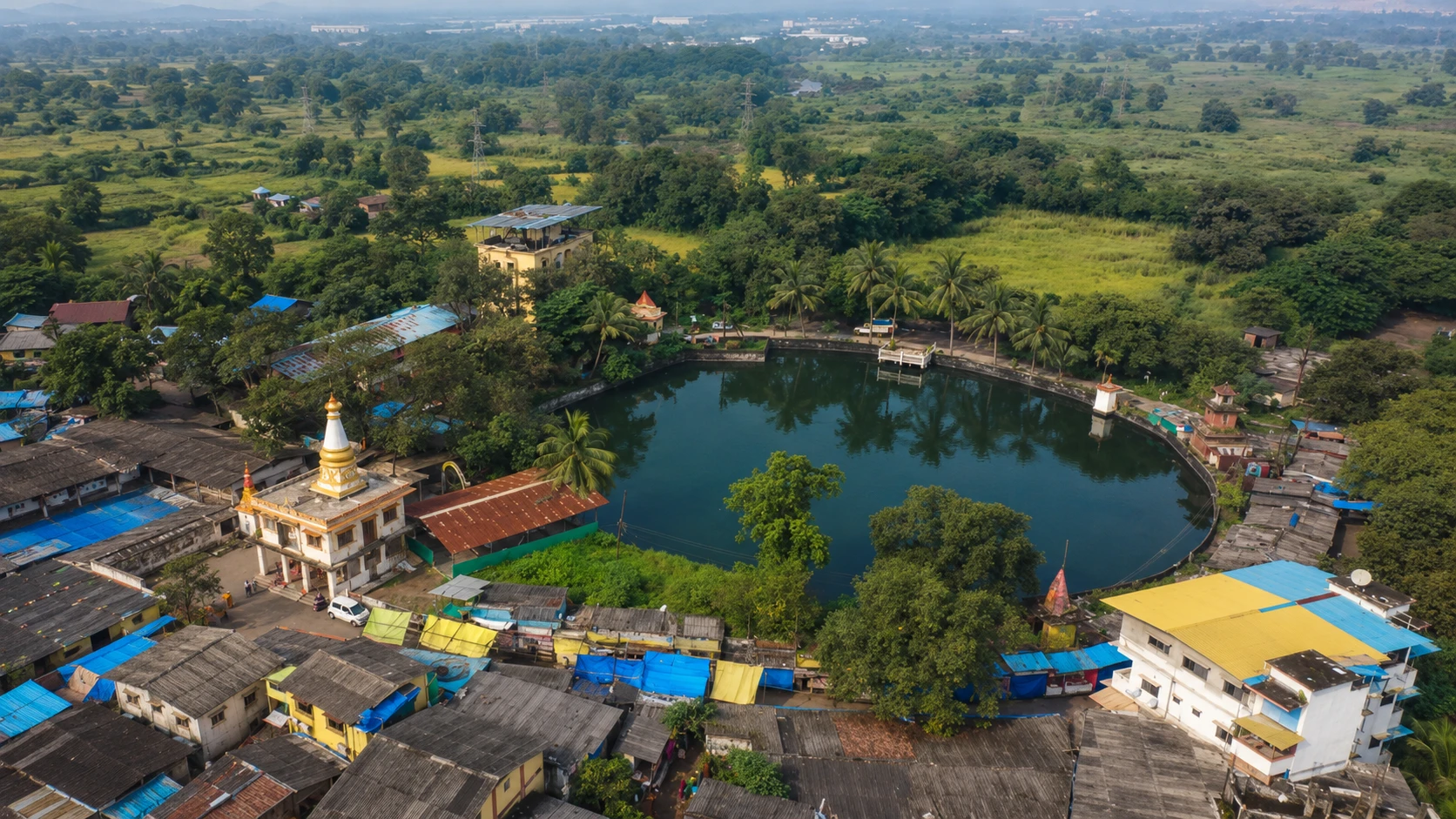
Outside the sanctum, the small temple structure itself is architecturally compact compared to Pali's octagonal mandapa or Theur's larger compound. The single dome is topped by a copper-plated finial and four stone elephant figures stand at the corners of the dome's base — the iconographic signature that marks Varadavinayak visually within the circuit. The surrounding compound is modest: a small mandapa, a few subsidiary shrines (including ones for Mahadev and Hanuman), the hereditary lamp-keeper's residence, and pilgrim facilities expanded during the 2003-04 renovation. The pond from which the murti was rediscovered in 1690 lies a short distance from the temple and is still visible to pilgrims who walk to it; the temple priests can identify the spot of the original recovery.
Distinctive Practicesविशिष्ट परंपराएँ
Direct Sanctum Access and Hand-Contact Darshan
सीधा गर्भगृह प्रवेश और हस्त-स्पर्श दर्शन
Every darshan visit; ordinary daily darshan and festival darshan alike
Unique among the Ashtavinayak shrines and rare among major Hindu temples generally, Varadavinayak permits pilgrims to enter the inner sanctum directly and place their hands briefly on the murti during darshan. The access is structured rather than informal: pilgrims wash their hands at a threshold basin, enter quietly, approach the murti, and place one hand on the location the temple priest indicates (typically the trunk or the base of the platform) while silently offering their varada. The contact is brief — moments rather than minutes — and the pilgrim then withdraws to the outer hall to allow the next worshipper. The practice is preserved across centuries by the local Devasthan as the temple's most distinctive devotional accommodation and is treated as theologically central rather than as a casual relaxation of standard protocol.
The Gritsamada-narrative establishes Varadavinayak's theology as the boon-granting place where no devotee is held at a distance from the deity who hears them. The direct sanctum access is the material expression of this theology: the worshipper's hand on the murti at the moment of speaking the varada removes the symbolic and physical separation that ritual protocol elsewhere maintains. The practice insists that the boon-granting relationship is not mediated through ritual hierarchy but is direct — devotee to deity, hand to stone, varada to ear.
Akhand Jyot Darshan
अखंड ज्योत दर्शन
Every darshan visit; the lamp is visible to every pilgrim entering the sanctum
The eternal oil lamp (akhand jyot) burning continuously in the sanctum since 1892 is one of the temple's two devotional signatures. Pilgrims customarily pause before the lamp during their sanctum visit, mentally acknowledging its continuity as a tangible link to the chain of devotees and lamp-keepers across the past century and more. Many pilgrims bring small ghee offerings to the lamp during their visit; these are added by the lamp-keeper to the lamp's daily fuel cycle. The akhand jyot is tended by a hereditary lineage of lamp-keepers; their family residence within the temple compound and their continuous attendance constitute a parallel institutional tradition alongside the main pujari tradition.
The continuously-burning lamp is held to be a physical instantiation of unbroken devotional intention. Each devotee who has tended the lamp across the past 130-plus years has contributed to its continuity; each devotee who pauses before it now becomes part of that lineage. The lamp's flame is small and unremarkable in isolation; its devotional weight comes entirely from the continuity it represents. Pilgrims often note the lamp's significance as a contemplative anchor — a focal point that integrates the moment of their own visit into a chain of moments stretching across generations.
Open Varada-Speech in the Sanctum
गर्भगृह में मुक्त वरद-कथन
Personal devotional commitment; not a fixed ritual but a recognized devotional pattern at this temple
A devotional pattern specific to Varadavinayak — preserved in temple tradition and Chinchwad Sansthan pilgrim guidance — is the speaking of one's varada (boon-request) aloud or whispered during the sanctum-access moment, rather than holding it as silent internal prayer. The Gritsamada theology of this place is that the deity hears any varada offered with sincerity, regardless of its worldly improbability or its alignment with conventional devotional categories. Pilgrims are encouraged by temple priests, when asked, to speak their actual varada rather than translating it into formal Sanskrit prayer or generic devotional language. The practice is unstructured — there is no fixed mantra to recite, no specific format the varada must take — but it is a recognized devotional encouragement at this site, distinct from the more formal sankalpa-register tradition at Siddhatek.
If the deity hears any varada offered with sincerity, then the devotional task is sincerity itself — and sincerity is more reliably expressed when the devotee speaks their actual concern in their own words rather than translating it into an aspirational ritual register. The temple's theology rests on the conviction that the relationship between deity and devotee is fundamentally direct; the practice of open varada-speech extends that conviction into the linguistic dimension of the encounter.
Did You Know?क्या आप जानते हैं?
Varadavinayak is one of the very few major Hindu temples in India where pilgrims are permitted to enter the inner sanctum directly and place their hands on the murti during darshan. This level of physical access is unique within the Ashtavinayak circuit — the access at Lenyadri is a different phenomenon, being a cave temple with structural openness rather than ritually-granted intimacy — and is rare among major Hindu temples generally. The access is by deliberate Devasthan tradition rooted in the Gritsamada-narrative's boon-granting theology, not an accidental relaxation of protocol.
Mahad Devasthan tradition; Bhalchandra Khandekar, 'Ashtavinayak Darshan' (1978); Chinchwad Sansthan pilgrim guidance documents
The akhand jyot — the continuously-burning oil lamp in the temple sanctum — has been lit since 1892 according to temple tradition, tended without interruption by a hereditary lineage of lamp-keepers. The lamp's flame has been documented as continuously lit in pilgrim travel-writing from the early 20th century onward, including across periods of social and political disruption that interrupted normal temple operations elsewhere. The eternal lamp tradition is the temple's second devotional signature alongside the open-sanctum access, and is treated by the Devasthan as one of its primary institutional obligations.
Mahad Devasthan oral tradition and trust records; early 20th-century Marathi pilgrim travel-writing
The temple's foundational legend in the Mudgala Purana involves the rishi Gritsamada, whose mother Mukunda was deceived by Indra (who took the form of her husband). Gritsamada was born from this deception under a paternal curse, struggled with his ambiguous identity, and resolved it not by asking the deity to undo his birth but by asking for the place itself to become Varada-kshetra — the field of boons — so that future devotees in difficult circumstances would not have to wander in search of an answering deity. The theological move is unusually mature within Puranic devotional literature: a personal grievance translated into a universal devotional resource.
Mudgala Purana — Gritsamada-rishi prakarana; Paul Courtright, 'Ganesa: Lord of Obstacles, Lord of Beginnings' (Oxford 1985)
The present small single-dome temple was built around 1725 under the patronage of Subhedar Ramji Mahadev Biwalkar, a Peshwa-era administrative officer. The four stone elephant figures at the corners of the dome's base are an iconographic-architectural signature distinctive among the Ashtavinayak sites; no other shrine in the circuit carries this specific four-elephant-dome composition. The copper-plated finial topping the dome was a later addition to the original stone-faced construction.
Peshwa Daftar — Biwalkar patronage records; Maharashtra Department of Archaeology survey
The current temple's institutional history begins with a documented rediscovery event in 1690: a devotee named Dhondu Paudkar (or Pawdkar) is recorded as having been led by a recurring dream-vision to a pond near the present temple site, where he found the swayambhu Varadavinayak murti submerged and brought it ashore. The murti is older than 1690 — the date marks its rediscovery, not its origin — but the temple's continuous institutional life dates to this rediscovery. The pond from which the murti was retrieved still exists a short distance from the temple and remains a stop for pilgrims who wish to walk the legendary recovery route.
Mahad Devasthan tradition; Chinchwad Sansthan associated records; Bhalchandra Khandekar (1978)
The Mahad of Varadavinayak — in Khalapur taluka of Raigad district — is distinct from the larger Mahad town in southern Raigad district which is famous for Dr. B. R. Ambedkar's 1927 Chavdar Tale Satyagraha and for the Raigad fort access point. The two Mahads share a name (the common Marathi place-name 'Mahad' derives from generic geographic vocabulary, not from any shared historical origin) and pilgrims occasionally arrive at the wrong destination. Travel routing for Varadavinayak should always specify Khalapur taluka or use the proximity to Khopoli (6 km) as the disambiguating reference.
Maharashtra State Gazetteer (Raigad district); local Devasthan visitor advisory
Together with Ballaleshwar at Pali (27 km south), Varadavinayak forms the Raigad-district pair of the Ashtavinayak circuit. Package-tour operators routinely combine both shrines into a single-day visit, which contributes to Varadavinayak's high pilgrim volume despite the temple's modest physical scale. Pilgrims doing the full Ashtavinayak yatra typically reach Mahad on the second day of a 3-day circuit, after morning darshan at Pali, and continue eastward to the Pune-district shrines on the following day.
Maharashtra Tourism Development Corporation circuit-tour itineraries; local Devasthan visitor records
Visitor Accessप्रवेश जानकारी
Varadavinayak welcomes devotees of all backgrounds without restriction based on gender, age, caste, or origin. The temple's distinctive feature is open sanctum access — pilgrims are permitted to enter the inner sanctum directly and place their hands on the murti during darshan, a privilege rare among major Hindu temples. The access is structured (a threshold hand-wash, priest guidance on the contact, brief contact duration to allow the queue to flow) but genuine: this is not formalized look-but-don't-touch darshan. Photography is permitted in the outer mandapa, the surrounding compound, and on the approach pathway, but is not allowed within the inner sanctum during darshan or near the akhand jyot. Footwear must be removed before entering the temple complex. Mobile phones should be silenced and ideally placed in pocket-storage before approaching the sanctum.
There is no formal VIP-darshan or priority-queue at Varadavinayak. On weekdays the queue moves swiftly and the open-sanctum access produces a steady but unhurried pilgrim flow. Sundays, Sankashti Chaturthi evenings, the Bhadrapada Ganesh Chaturthi festival week, and the Magha Ganesh Jayanti week generate longer queues — pilgrims should plan mid-morning weekday arrivals for unhurried open-sanctum darshan. The temple's small size means that during peak periods the access ritual is necessarily brief (a few seconds of hand-contact rather than minutes); pilgrims who want extended sanctum time should target the weekday morning or late evening windows. Photo ID is not required. Pilgrims unfamiliar with the open-access protocol will be guided by the temple priests on arrival; do not enter the sanctum without priest direction during peak periods.
Festivalsत्योहार
Ganesh Chaturthi (Bhadrapada Shukla Chaturthi)
गणेश चतुर्थी (भाद्रपद शुक्ल चतुर्थी)
Aug-Sep (Bhadrapada Shukla Chaturthi)
The principal Ganapati festival of the lunar calendar. At Varadavinayak the festival fortnight produces some of the heaviest pilgrim flows of the year, driven by the temple's accessibility from Mumbai and Pune and by the open-sanctum darshan tradition that adds a sought-after intimate-contact dimension to festival darshan. Continuous abhishekam, twenty-one Atharvashirsha recitations by groups of priests, and extended sanctum access hours define the festival week. The akhand jyot receives special offerings and is the focal point of evening aartis through the fortnight. Many pilgrims undertake the Ashtavinayak circuit specifically during the Bhadrapada festival period, with Pali and Mahad covered together on the second day.
Magha Ganesh Jayanti (Magha Shukla Chaturthi)
माघ गणेश जयंती (माघ शुक्ल चतुर्थी)
Jan-Feb (Magha Shukla Chaturthi)
Held by the Ganapatya tradition to be the birth-tithi of Ganesha. At Varadavinayak the day is observed with sustained abhishekam from pre-dawn through midnight, extended Atharvashirsha-paath cycles, and the speaking of Gritsamada-narrative readings from the Mudgala Purana through the day. The open-sanctum darshan operates throughout the day with priest guidance managing the heavier pilgrim flows. Pilgrims undertaking serious sankalpa work often choose Magha Chaturthi for their visit because the more inward devotional atmosphere of this festival (compared to the larger Bhadrapada festival) suits the boon-request work the temple's theology centres on.
Sankashti Chaturthi (monthly)
संकष्टी चतुर्थी (मासिक)
Every lunar month — Krishna Paksha Chaturthi
The monthly Sankashti at Varadavinayak draws heavy evening crowds, particularly because of the temple's accessibility from Mumbai. The open-sanctum access is maintained through the evening, with priest-guided pilgrim flow managing the queue. The temple operates extended hours to accommodate the moonrise darshan pattern characteristic of Sankashti observance. The Angarki Sankashti (Sankashti falling on a Tuesday) draws the largest of the monthly cycles. Many Mumbai-based devotees use the Sankashti-Sunday coincidence (when it occurs) to undertake a same-day round trip to Varadavinayak specifically for the sanctum-access ritual.
Akhand Jyot Anniversary (annual)
अखंड ज्योत वर्षगाँठ (वार्षिक)
Annual; date determined by the original lighting date in the temple calendar
An annual observance specific to Varadavinayak: the anniversary of the akhand jyot's lighting in 1892, marked by special prayer-services at the lamp itself, ritual replenishment of its fuel reserves, and a community-meal (mahaprasad) offered to pilgrims who attend. The hereditary lamp-keeper family leads the observance, and the broader Devasthan trust coordinates with regional devotional networks to bring pilgrims from across Maharashtra. The Anniversary is a smaller-scale festival than the major Ganapati festivals but is the temple's most distinctive institutional observance, tying the present moment to the unbroken century-and-more chain of devotion that the lamp embodies.
Vijayadashami (Dussehra)
विजयादशमी (दशहरा)
Sep-Oct (Ashwin Shukla Dashami)
Observed at Varadavinayak with morning special abhishekam, evening procession of the utsav-murti (ceremonial portable image) around the temple compound, and community offerings at the akhand jyot. The day's emphasis at Varadavinayak is on the boon-granting aspect of the deity rather than the demon-slaying narrative central to other Ganapatya sites — pilgrims at Vijayadashami often consciously frame the day as the auspicious moment to formalize varada-sankalpas for the year ahead, treating Dussehra not only as cosmic-victory anniversary but as the auspicious start-date for boon-request commitments.
Traditional Offeringsपारंपरिक अर्पण
प्राथमिक अर्पण
Modak
मोदक
मोदक
The canonical Ganesha naivedya — steamed or fried rice-flour dumplings filled with coconut and jaggery. At Varadavinayak the modak offering carries an additional Pali-resonant symbolism: the modak's plain exterior holding inner sweetness mirrors the temple's broader theology, where the unremarkable village shrine holds the deity who hears every devotee's boon-request. Modaks are offered both at the sanctum (handed to the priest for placement near the murti) and at the akhand jyot. Twenty-one modaks (ekvis modak) is the formal full naivedya offering.
Durva grass
दूर्वा घास
दूर्वा
Trifoliate durva grass sacred to Ganesha across all Ganapatya traditions. At Varadavinayak the durva offering is integrated into the sanctum-access ritual: pilgrims often place a few durva tufts on the murti during the hand-contact moment, leaving them with the deity as a sustained material trace of the visit. Twenty-one durva-tufts (ekvis durva) is the formal full offering.
Red Hibiscus (Jaaswand)
लाल जपा कुसुम
जपापुष्प
Red hibiscus flowers sacred to Ganesha among floral offerings. At Varadavinayak the offering is part of the daily morning abhishekam at the sanctum. Pilgrims often bring fresh hibiscus garlands for the murti; the temple priests place these on the deity during the morning ritual sequence.
Ghee for the Akhand Jyot
अखंड ज्योत के लिए घी
A Varadavinayak-specific offering pattern unique within the Ashtavinayak circuit: pilgrims may bring small sealed containers of pure ghee or oil as offerings specifically for the akhand jyot. The lamp-keeper adds these to the lamp's daily fuel cycle, integrating the pilgrim's offering into the continuously-burning flame that has been maintained since 1892. Pilgrims undertaking a serious sankalpa often choose to contribute ghee to the akhand jyot as a parallel offering to the murti-darshan — adding their own intention to the continuous chain of devotional intentions the lamp represents.
Coconut
नारियल
नारिकेल
The standard preliminary offering at Hindu temple thresholds, symbolizing the human ego that must be broken before the deity for spiritual progress. At Varadavinayak the coconut is broken at the entrance to the temple complex before pilgrims approach the sanctum-access ritual — a marking of the boundary between ordinary consciousness and the unusually intimate darshan the temple permits.
इस मंदिर की विशेषता
Akhand Jyot Ghee Offering
अखंड ज्योत घी अर्पण
Pure ghee or oil offered specifically as fuel for the continuously-burning eternal lamp. The lamp-keeper accepts the offering and integrates it into the lamp's daily replenishment cycle. This is a Varadavinayak-specific devotional pattern unique within the Ashtavinayak circuit — no other shrine maintains a comparable akhand jyot tradition with pilgrim-fuel integration. Pilgrims undertaking the sanctum-access varada ritual often pair it with an akhand jyot offering, treating the two practices as parallel material commitments to the deity.
Pilgrims are welcome to bring offerings from outside the temple complex. A small puja-sahitya counter near the temple entrance, operated under the local Devasthan, offers basic offering bundles (modaks, durva, sindoor packets, flowers, and pre-measured ghee containers for the akhand jyot). Synthetic plastic flowers are politely discouraged in favour of fresh natural materials. Pilgrims bringing ghee for the akhand jyot should select pure cow-ghee from a clean source; the lamp-keeper will accept it after a brief check of its quality and source.
How to Reachकैसे पहुँचें
Varadavinayak lies in Mahad village of Khalapur taluka, Raigad district — a small Konkan-side village approximately 18 km from Karjat, 6 km north of Khopoli, and roughly 27 km north of Pali (the previous Ashtavinayak stop). Critical disambiguation note: this is not the larger Mahad town in southern Raigad district which is famous for Babasaheb Ambedkar's 1927 Chavdar Tale Satyagraha and which lies further south near Raigad fort. Travel routing should always specify Khalapur taluka or use Khopoli proximity (6 km) as the disambiguating reference.
By road from Mumbai, the standard route is via the Mumbai-Pune Expressway to the Khopoli exit, then a short 6 km drive north to Mahad village — approximately 100 km total from central Mumbai with a driving time of 2 to 2.5 hours under normal traffic conditions. From Pune, the route is via the same NH-48 highway westward to Khopoli, then north to Mahad — approximately 100 km and 2 to 2.5 hours by private vehicle. The proximity of Varadavinayak to the Expressway makes it the most accessibility-favoured of all the Ashtavinayak sites for both Mumbai-based and Pune-based pilgrims, contributing to its high visitor volume despite its small physical scale.
By rail, Karjat Junction on the Mumbai-Pune central line is the most useful station, 18 km from Varadavinayak. Karjat has direct local-train services from Mumbai (CSMT, LTT, Thane, Kalyan) and Pune; shared taxis and auto-rickshaws to Mahad-Khalapur are readily available at the station. Khopoli Junction (6 km) is a much closer secondary option but with less rail traffic and limited shared-transport availability from the station — most pilgrims arriving by rail use Karjat. Lonavala (32 km) is further but has long-distance express train services that Karjat lacks.
By air, Mumbai's Chhatrapati Shivaji Maharaj International Airport (BOM, approximately 100 km via Mumbai-Pune Expressway) is the most practical access point for both domestic and international pilgrims given the temple's proximity to Mumbai. Pune International Airport (PNQ, approximately 100 km) is the alternative for pilgrims approaching from the east. Pre-paid taxis and ride-hailing services from either airport are readily available.
Within the Ashtavinayak circuit, the canonical sequence after Varadavinayak proceeds to Chintamani Vinayak at Theur (in Pune district, approximately 105 km east via Pune). The Pali-Mahad pair completes the Raigad-district segment of the circuit, and the journey eastward from Mahad to Theur signals the transition into the Pune-district stretch where the remaining four Ashtavinayak shrines are clustered (Theur, Lenyadri, Ozar, Ranjangaon) before the canonical concluding return to Morgaon.
Plan Your Visitयात्रा की योजना
🌤 सर्वोत्तम मौसम
October to February is the most comfortable period for Varadavinayak — daytime temperatures range from 22-30°C with moderate humidity, the post-monsoon Konkan-side countryside is at its lushest, and Expressway road conditions are at their best. The temple is open year-round. March to May is the hot humid season (35-40°C with Konkan-side humidity making it feel hotter) — manageable but uncomfortable for unhurried open-sanctum darshan, particularly because the inner sanctum becomes warm during peak afternoon hours. The monsoon (June-September) brings heavy rain to the Konkan side; the temple remains open but the Mumbai-Pune Expressway sees frequent monsoon delays and the local roads from Khopoli can have brief flooding. The most spiritually intense windows are Magha Ganesh Jayanti (January-February) and Bhadrapada Ganesh Chaturthi (August-September). The most operationally comfortable is November to early February.
👘 पहनावे का नियम
Modest traditional dress is expected and particularly important at Varadavinayak given the open-sanctum access — pilgrims entering the sanctum are in physical proximity to the deity, and traditional formality is treated by the temple priests as the appropriate posture for that intimacy. For men, full-length trousers or dhotis with appropriate shirts are suitable; shorts and sleeveless tops are discouraged and may delay sanctum-access permission. For women, sarees, salwar suits, or long skirts with covered shoulders are appropriate. There is no requirement for a head covering at this temple. The combination of accessibility-tourism dynamics (many pilgrims arrive in casual Mumbai weekend-day-trip mode) and the temple's traditional formality occasionally produces tension; pilgrims are advised to err on the side of traditional dress for the open-sanctum darshan experience.
📱 फोन और फोटोग्राफी
Mobile phones should be silenced and ideally placed in pocket-storage before approaching the inner sanctum. Photography with phones is permitted in the outer mandapa, the surrounding compound, around the four corner elephant-figures of the dome exterior, and on the approach pathway. Photography is not permitted within the inner sanctum during darshan, particularly near the akhand jyot — the lamp's protective alcove is a sensitive zone and photography is treated as a disturbance to the lamp-keeper's daily attendance. The temple does not formally collect phones at the entrance but enforces the sanctum-photography prohibition through priest intervention if necessary. Phones should not be used for hands-free recording while undertaking the sanctum-access ritual — the hand-contact moment is to be made with full attention rather than recorded.
🏨 आवास
Mahad village itself has minimal accommodation infrastructure — a basic Devasthan-managed pilgrim dharamshala adjacent to the temple offers simple rooms on first-come-first-served basis. Most pilgrims arrange overnight accommodation at one of three regional hubs: Khopoli (6 km, basic and mid-range hotels along the Mumbai-Pune Expressway corridor — the closest practical option for an overnight stay near Varadavinayak), Lonavala (32 km, mid-range and luxury hotels and resorts — the popular regional accommodation hub combining Ashtavinayak circuit pilgrimage with broader Lonavala-Khandala tourism), or Mumbai itself (100 km, the standard choice for pilgrims doing Pali-Mahad as a day-trip rather than as part of an extended circuit). Most Ashtavinayak package tour operators arrange overnight in Lonavala or Pune for the segment that includes the two Raigad-district shrines.
Book a Pujaपूजा बुक करें
The Shri Varadavinayak Devasthan at Mahad does not currently operate a verified online puja booking portal. The Ashtavinayak circuit attracts a high volume of package-tour pilgrims, and Varadavinayak specifically draws substantial Mumbai-based weekend day-trip traffic given its Expressway proximity. Third-party websites and intermediaries claiming to offer puja bookings, priority sanctum-access passes, or accommodation packages should be approached with caution — many are unaffiliated with the Devasthan and the Chinchwad Sansthan. For puja bookings, including the akhand jyot ghee-offering sankalpa and the open-sanctum darshan, contact the temple office directly upon arrival or coordinate through a reputable Ashtavinayak package-tour operator. We do not list a phone number or email here because no verified primary contact has been published by the Trust; this section will be updated when the Trust publishes one. Critical disambiguation: travel routing to Varadavinayak must specify Mahad in Khalapur taluka of Raigad district (near Khopoli), not the larger Mahad town in southern Raigad district which is famous for Ambedkar's 1927 Chavdar Tale Satyagraha — pilgrims occasionally arrive at the wrong Mahad due to the shared place-name.
Managed by: Shri Varadavinayak Devasthan, Mahad (Khalapur) (under the Ashtavinayak Devasthan framework with associated authority from the Chinchwad Sansthan; the hereditary akhand jyot lamp-keeper lineage operates as a parallel institutional tradition)
Abhishekam with open-sanctum hand-contact darshan
अभिषेकम और खुले-गर्भगृह हस्त-स्पर्श दर्शन
Ekvis Modak Naivedya (twenty-one modak offering)
एकवीस मोदक नैवेद्य
Atharvashirsha Avartan (twenty-one recitations)
अथर्वशीर्ष आवर्तन (एकवीस आवर्तने)
Akhand Jyot Ghee-Offering Sankalpa
अखंड ज्योत घी-अर्पण संकल्प
Booking information verified: 2026-05-19
Sacred Soundsपवित्र ध्वनि
क्या आप जानते हैं? · Did You Know?
वही अनुवाद त्रुटि जिसने हिन्दू धर्म में '33 कोटि' को '33 करोड़' बनाया, बौद्ध धर्म में भी हुई। बौद्ध ग्रन्थों के चीनी अनुवाद ने 'सप्त कोटि बुद्ध' (7 श्रेष्ठ बुद्ध) का अनुवाद '7 करोड़ बुद्ध' कर दिया। तिब्बती अनुवाद ने सही किया: 7 प्रकार, 7 करोड़ नहीं। एक संस्कृत शब्द, दो प्रमुख विश्व धर्मों में गलत पढ़ा गया, ने दो एकसमान भ्रम स्वतन्त्र रूप से उत्पन्न किए।
Related Contentसंबंधित सामग्री
Related Scriptures
Related Temples
Ballaleshwar (Pali)
बल्लालेश्वर
Pali, Maharashtra
Chintamani (Theur)
चिंतामणि थेऊर
Theur, Maharashtra
Moreshwar Mayureshwar (Morgaon)
मोरेश्वर मयूरेश्वर
Morgaon, Maharashtra
Siddhivinayak (Siddhatek)
सिद्धिविनायक सिद्धटेक
Siddhatek, Maharashtra
Girijatmaj (Lenyadri)
गिरिजात्मज लेण्याद्री
Lenyadri, Maharashtra
Vighneshwar (Ozar)
विघ्नेश्वर ओझर
Ozar, Maharashtra
Mahaganapati (Ranjangaon)
महागणपति रांजणगाव
Ranjangaon, Maharashtra
Community Reflections
🕉️
Be the first to share your reflection.