Mahaganapati (Ranjangaon)
महागणपति रांजणगाव
The most powerful form — Mahaganapati, the circuit-closer of the Ashtavinayak yatra
Ranjangaon, Maharashtra, India
MahāgaṇapatiAlso known as: Maha Ganapati, Mahaganapati Vinayak, Ranjangaon Ganpati, Shri Mahaganapati, Mahotkat Ganapati, Ranjangaon Vinayak
युग
Mythological origins per Mudgala Purana (Tripurasura-cosmic-battle narrative with Shiva's tapas at this site); present stone Hemadpanthi-style sanctum reflects Maratha-era construction with major eighteenth-century expansion under Peshwa Madhavrao I; the temple's east-facing solar-alignment architecture is the work of Maratha-era craftsmen integrating astronomical-architectural precision into the temple form
वास्तुकला
Maratha-Peshwa temple architecture in Hemadpanthi style, with a stone sanctum core and a larger outer mandapa added during the eighteenth-century Peshwa expansion. The most architecturally distinctive feature is the east-facing alignment of the sanctum that produces a twice-yearly solar event: at the spring equinox (around 21 March) and the autumn equinox (around 23 September), the rising sun's rays pass directly through the sanctum opening and illuminate the murti for a brief window at dawn. The compound includes outer mandapas, subsidiary shrines, and the standard Maratha-era pilgrim infrastructure
खुला
05:00 – 21:30
आरती
05:30 · 12:00 · 19:30
विशेष
The Ranjangaon visit conventionally includes the main Mahaganapati sanctum darshan and a tradition of pause-and-acknowledgement of the temple's circuit-closing position. Pilgrims completing the full Ashtavinayak yatra customarily perform a sankalpa at Ranjangaon recognizing the journey's completion before undertaking the traditional return darshan at Morgaon. The twice-yearly equinox-dawn solar darshan attracts pilgrims specifically planning to witness the sun's direct illumination of the murti; the brief solar-alignment window (typically lasting 10-15 minutes at dawn on the equinox days) is the temple's most-anticipated astronomical-devotional event. The Mahotkat-form temple tradition (the hidden underground original murti) is honoured through ritual reference during major festivals; the underground chamber is not opened for ordinary pilgrim access
पवित्र कथा · पवित्र कथा
Mahaganapati at Ranjangaon is the eighth and concluding stop of the canonical Ashtavinayak circuit — the 'Great Ganapati' form, the most powerful manifestation of the deity, whose foundational legend is among the most cosmically significant in Ganapatya narrative. According to the Mudgala Purana, Shiva himself worshipped Ganapati at this site before undertaking his cosmic battle against Tripurasura — the demon who had constructed three impregnable cities (one of gold, one of silver, one of iron) that Shiva could not defeat without first invoking Ganapati's blessing. Shiva performed tapas at Ranjangaon, received the deity's power, and went on to destroy the three fortresses in the cosmic episode that earned Shiva the name Tripurari (slayer of Tripura). The Ranjangaon deity is therefore not the obstacle-remover of everyday concerns but the cosmic-power-generator — the form that grants strength sufficient for the largest cosmic undertakings. Temple tradition holds that the original Mahaganapati murti at this site was an extraordinarily elaborate form known as Mahotkat — described variously across recensions as having ten trunks, twenty arms, and seated on a lotus — and that this original form is preserved hidden in an underground chamber beneath the present sanctum, with the publicly visible murti being a more conventional form for daily darshan. The architectural feature most often noted at Ranjangaon is the temple's east-facing alignment producing a twice-yearly solar event: around the spring and autumn equinoxes, the rising sun's rays pass directly through the sanctum opening and illuminate the murti — a deliberate alignment that integrates astronomical-architectural precision into the daily Hindu-temple form. Peshwa Madhavrao I expanded the temple during his eighteenth-century patronage. As the circuit-closer, Ranjangaon is conventionally followed in the full Ashtavinayak yatra by a return darshan at Morgaon (the first shrine) — the journey's formal completion.
Sacred Designationपवित्र पदनाम
Sacred Origin Storyपवित्र उत्पत्ति कथा
Source: Mudgala Purana (Tripurasura-vadha prakarana — Shiva-tapas-at-Ranjangaon narrative) — widely-attested Ganapatya canonical account
In an age before the present yuga, a demon named Tripurasura — the son of Tarakasura — undertook austerities of such extraordinary intensity that the celestial hierarchies were forced to grant him a boon. He asked for the construction of three impregnable cities: one of gold, one of silver, one of iron. The three cities were to be airborne — moving through the sky according to his command — and were to be vulnerable only to a single arrow shot when all three cities were aligned in a single moment, an alignment that occurred only once in countless cosmic ages. The boon was granted. Tripurasura built his three cities and began terrorizing the inhabited worlds from them, raiding wherever he pleased and returning to his airborne fortresses where no opposing force could reach him.
The assembled gods, distressed by the demon's actions and unable to address him through ordinary means given the boon's protective specifications, approached Shiva. Shiva was the appropriate cosmic figure: as the lord of dissolution, he was the one with the capacity to undertake destruction of such cosmically-protected fortifications. Shiva accepted the responsibility but recognized the practical difficulty. The single-moment alignment of the three cities was rare; the single-arrow constraint required the most precise possible shot. Even Shiva, with his full cosmic power, could not be certain of success at the moment when the alignment came.
Shiva consulted with the wise. The Mudgala Purana places this consultation specifically at Ranjangaon, where Ganapati was already established in worship at a Kadamba-grove site beside the present-day temple. The advice Shiva received was direct: before attempting the destruction of Tripurasura's cities, Shiva himself should worship Ganapati and ask for the deity's power. The lord of dissolution would need the lord of beginnings — the deity who clears obstructions at the start of any undertaking — to make possible the precise alignment-arrow-shot that the boon's terms required.
Shiva performed tapas at Ranjangaon. The Mudgala Purana describes the austerity as among the most concentrated of any divine-on-divine devotional acts in the Puranic record: Shiva, the cosmic ascetic in his own right, the deity to whom others performed tapas, himself undertook tapas before Ganapati. The image of Shiva-worshipping-Ganapati at Ranjangaon is the legend's theological pivot. The lord of dissolution did not approach the lord of beginnings as a colleague but as a devotee. Ganapati was pleased, the legend records, by Shiva's recognition that no cosmic undertaking — not even the destruction of three boon-protected fortresses — could succeed without first invoking the deity of beginnings and obstacles.
Ganapati granted Shiva the boon of cosmic-power-for-the-Tripura-destruction. The form in which the deity manifested was Mahaganapati — the Great Ganapati, the most powerful manifestation, an extraordinarily elaborate form with ten trunks, twenty arms, and seated on a lotus. The Mudgala Purana's description of this form is unusual in its scale and complexity, departing from the standard four-armed Ganapati iconography and presenting a form that has accumulated the iconographic weight of a deity equipped for cosmic-level work. This is the Mahotkat-form: 'the one of extraordinary expansion'. Temple tradition holds that the original murti at the Ranjangaon site was this Mahotkat form, hidden in an underground chamber beneath the present sanctum to preserve it from any disturbance, with the publicly worshipped daily-darshan murti being a conventional Ganapati form that the deity took for the ordinary devotional encounter.
With the Mahaganapati boon, Shiva proceeded to undertake the Tripura-destruction. The Mudgala Purana describes the subsequent cosmic episode at length: Shiva mounted his cosmic chariot, the wheels of which were the sun and the moon, the horses of which were the directions of space, the charioteer of whom was Brahma himself; the bow he carried was Mount Meru, the bowstring was Vasuki the cosmic serpent, the arrow was Vishnu in his agni-baan (fire-arrow) form. At the precise moment when Tripurasura's three cities aligned, Shiva shot. The three cities — gold, silver, and iron — fell together. Tripurasura was destroyed. Shiva earned the name Tripurari (slayer of Tripura), one of his most-cited epithets.
The Mudgala Purana records that the success of the Tripura-destruction was attributed not solely to Shiva's own cosmic power but to the prior Ganapati-worship at Ranjangaon. Shiva himself, the legend records, returned to Ranjangaon after the destruction to offer thanks to Mahaganapati for the boon that had made the cosmic victory possible. The temple at Ranjangaon is therefore not the shrine of a deity who responds to ordinary devotional concerns but the shrine of the deity whose blessing was necessary for the largest cosmic-scale undertaking the divine record contains. Pilgrims at Ranjangaon are approaching not the deity of small obstacle-removal but the deity whose great-power blessing was the precondition of cosmic dissolution-victory itself.
उद्धृत स्रोत:
- Mudgala Purana — Tripurasura-vadha prakarana (Shiva-tapas-at-Ranjangaon, Mahaganapati-mahatmya)
- Ganesha Purana — referencing the Tripura-vadha narrative with cross-attribution to Mahaganapati's role
- Skanda Purana — variant Tripura-destruction recensions with attribution of the Ganapati-blessing component
- Linga Purana — Tripura-destruction with focus on Shiva's cosmic preparations
- Sthala-purana of Ranjangaon (regional Marathi devotional tradition)
विद्वत संदर्भ
Modern scholarship on the Tripura-destruction cycle (Paul Courtright, 'Ganesa: Lord of Obstacles, Lord of Beginnings', Oxford 1985; Wendy Doniger, 'The Origins of Evil in Hindu Mythology', University of California 1976; Anita Raina Thapan, 'Understanding Ganapati', Manohar 1997) reads the Tripurasura-vadha narrative as one of the principal Puranic cosmic-victory cycles, with the Ranjangaon localization being a Ganapatya tradition that integrates the Tripura legend with Ganapati pre-eminence in any cosmic undertaking. Courtright reads the Shiva-worships-Ganapati framing at Ranjangaon as theologically significant: it establishes Ganapati's pre-eminence over even the most powerful cosmic deities by showing that Shiva himself recognized the dependence of any large undertaking on prior Ganapati-invocation. This is the strongest form of the Ganapati 'lord of beginnings' theological claim — that even cosmic dissolution itself depends on the obstacle-removing-and-power-granting deity. The Mahotkat-form description (ten trunks, twenty arms, lotus-seated) is treated by scholars as primarily an iconographic-theological construction expressing the deity's maximum-power form rather than necessarily corresponding to a physically-existing hidden murti; the underground-chamber temple tradition is preserved without scholarly endorsement of the literal physical existence of an underground statue, though the tradition itself is recorded as part of the temple's narrative identity. The temple's equinox-dawn solar alignment is independently documented by Maharashtra State Department of Archaeology surveys and represents one of the most architecturally-precise astronomical alignments among Maratha-era Hindu temples, comparable in design intent (though not in scale) to the better-known alignment work at sites like the Sun Temple of Konark.
Historyइतिहास
The documented history of the Mahaganapati temple at Ranjangaon begins with the standard pattern of mythologically-rich but archaeologically-thin pre-Maratha origins. The Mudgala Purana's Tripurasura-vadha narrative places the shrine's origins in pre-historical antiquity at the Kadamba-grove site where Shiva performed tapas before defeating Tripurasura, and continuous Ganapatya worship at the site is suggested by regional Marathi devotional literature through the medieval period. No archaeological evidence permits precise pre-Maratha-era architectural dating; the early temple is understood to have been a more modest structure that did not survive into the modern period.
The temple's institutional transformation into its present form began in the late seventeenth and early eighteenth centuries with the Chinchwad Sansthan's broader project of consolidating the Ashtavinayak circuit. Saint Morya Gosavi of Chinchwad and his successor-generation saints recognized Ranjangaon as the eighth Ashtavinayak shrine within the canonical eight and as the circuit-closing position, with the Sansthan extending ceremonial authority and ritual coordination to the site. The Chinchwad tradition continues to hold this institutional authority over Ranjangaon today.
The most significant historical patronage layer at Ranjangaon is associated with Peshwa Madhavrao I (1745-1772) — the same young Peshwa whose deeper devotional anchor was Chintamani Vinayak at Theur, and who chose to die at Theur in 1772. Madhavrao's expansion at Ranjangaon dates to the 1760s and produced the present Hemadpanthi-style stone sanctum, the outer mandapa, the compound walls, and the distinctive east-facing solar-alignment construction that produces the temple's twice-yearly equinox-dawn solar event. The solar-alignment work specifically represents the integration of astronomical calculation into the temple's architectural design — Maratha-era craftsmen working with the precise sun-angle requirements of the spring and autumn equinoxes to align the sanctum opening so that the rising sun's rays would pass directly through and illuminate the murti. This is a relatively advanced architectural-astronomical feature for the Maratha period and reflects the patronage standards Madhavrao maintained across the Ashtavinayak sites.
The Madhavrao-era construction is also the period that established the temple's present relationship to the Mahotkat-form tradition. Temple records and Chinchwad Sansthan documentation date the present underground-chamber concept to this period, with the Madhavrao construction explicitly designed to preserve and conceal an inner chamber beneath the visible sanctum. Whether this chamber contains a physical Mahotkat-form murti (as temple tradition maintains) or is a ritually-significant void preserving the Mahotkat-form theology (as some scholars interpret) is a matter of preserved tradition rather than externally-verifiable fact; the chamber is not opened for ordinary pilgrim access and the underground-form temple tradition is preserved through narrative reference and festival ritual rather than direct viewing.
After the fall of Peshwa rule in 1818, Vighneshwar... [correction: Mahaganapati] continued under Chinchwad Sansthan ceremonial authority with local priestly administration. The 19th and early 20th centuries saw periodic maintenance without major architectural intervention. The temple's east-facing solar-alignment integrity was preserved across this period, with the equinox-dawn solar event continuing to occur without disruption.
The 2003-04 Ashtavinayak Vikas Yojana renovation works at Ranjangaon included structural conservation of the stone sanctum and the outer mandapa, careful preservation of the east-facing solar-alignment geometry (no modifications were made that would have altered the alignment), restoration of the compound walls, and modernization of pilgrim infrastructure including approach roads, parking, and rest-houses. The underground chamber was not opened or modified during the renovation, in accordance with continued temple tradition.
Today Ranjangaon is among the most-visited of the Ashtavinayak sites in absolute numbers due to its accessibility from Pune (50 km) and its circuit-closing position. Pilgrims completing the full Ashtavinayak yatra customarily visit Ranjangaon as their final canonical-eight darshan before undertaking the traditional return to Morgaon. The twice-yearly equinox-dawn solar darshan (around 21 March and around 23 September) attracts dedicated pilgrim flows specifically for the solar alignment event.
Historical Timelineऐतिहासिक कालक्रम
Mythological-traditional foundation of the shrine in the Mudgala Purana's Tripurasura-vadha narrative at the Kadamba-grove site where Shiva performed tapas before defeating Tripurasura. Continuous medieval-period Ganapatya worship is suggested by regional Marathi devotional literature, but no archaeological evidence permits precise pre-eighteenth-century structural dating; the early temple was probably a modest structure that did not survive into the modern period.
Event-bracket dating preserves the editorial honesty principle. Mythologically rich, archaeologically undocumented.
Integration of the Ranjangaon shrine into the formal Ashtavinayak circuit institutionalized by Saint Morya Gosavi of Chinchwad and his successor-generation saints. Mahaganapati is established as the eighth and circuit-closing Ashtavinayak shrine within the canonical eight, with the Chinchwad Sansthan extending ceremonial authority and ritual coordination to the site.
Major expansion of the Ranjangaon temple under the patronage of Peshwa Madhavrao I (1745-1772). The Madhavrao construction produced the present Hemadpanthi-style stone sanctum, the outer mandapa, the compound walls, and the distinctive east-facing solar-alignment design that produces the temple's twice-yearly equinox-dawn solar event. The construction also established the present relationship to the Mahotkat-form temple tradition through the design of an inner chamber beneath the visible sanctum. Madhavrao's broader Ashtavinayak patronage was anchored at Theur (Chintamani Vinayak), but his Ranjangaon investment was substantial and architecturally distinctive.
Fall of Peshwa rule to British East India Company at the Battle of Khadki, ending major patronage flows to Ashtavinayak sites. Mahaganapati continued under Chinchwad Sansthan ceremonial authority with local priestly administration. The temple's east-facing solar-alignment integrity was preserved across this period without disruption.
Institutional rupture rather than physical destruction; the temple itself was not damaged.
Ashtavinayak Vikas Yojana renovation works at Ranjangaon included structural conservation of the stone sanctum and the outer mandapa, careful preservation of the east-facing solar-alignment geometry (no modifications were made that would have altered the alignment), restoration of the compound walls, and modernization of pilgrim infrastructure including approach roads, parking, and rest-houses. The underground chamber preserving the Mahotkat-form tradition was not opened or modified during the renovation.
What You'll Seeदर्शन में
The iconographic experience at Ranjangaon involves two distinct levels: the publicly-worshipped darshan-murti in the visible sanctum, and the Mahotkat-form temple tradition concerning a hidden underground chamber beneath the sanctum. The visible darshan-murti is a self-manifested seated form in dark basalt, approximately three feet tall, with the trunk turning to the left (vamavarti) and the third eye visible on the forehead. The carving style is medieval-Maratha, consistent with the temple's eighteenth-century construction period. Riddhi and Siddhi sit smaller to either side, and a small Mooshaka is carved at the base of the platform. The visible murti is what pilgrims see during ordinary darshan and what receives the equinox-dawn solar illumination twice yearly.
The Mahotkat-form tradition is preserved primarily through narrative reference and ritual practice rather than direct viewing. Temple tradition holds that the original Mahaganapati murti — described in the Mudgala Purana as having ten trunks, twenty arms, and seated on a lotus — exists in an underground chamber beneath the present sanctum, sealed for preservation against any disturbance. The chamber is not opened for ordinary pilgrim access, and the underground form is not part of daily darshan. Major festivals include ritual reference to the Mahotkat-form (priest recitations of the Mudgala Purana descriptions, sankalpa invocations naming the underground form), but pilgrims do not see the form directly. Modern scholarship treats the Mahotkat description as primarily iconographic-theological — expressing the deity's maximum-power form rather than necessarily corresponding to a physically-existing hidden statue — while temple tradition maintains the literal physical existence of the underground murti. The honest editorial position preserves both the temple tradition and the scholarly framing without resolving the question one way or the other.
The sanctum itself is a stone Hemadpanthi-style inner chamber dating to the Madhavrao I expansion in the 1760s. The most architecturally significant feature of the sanctum is its east-facing alignment: the sanctum opening is precisely positioned so that the rising sun's rays, at the spring and autumn equinoxes (around 21 March and 23 September), pass directly through the opening and illuminate the murti for a brief window at dawn. This solar-alignment is the work of Maratha-era craftsmen integrating astronomical-calculation into the temple design, and it has been preserved across subsequent renovations including the 2003-04 AVY work. The equinox-dawn solar event lasts approximately 10-15 minutes; pilgrims wishing to witness it must arrive well before sunrise and position themselves in the sanctum to see the alignment moment.
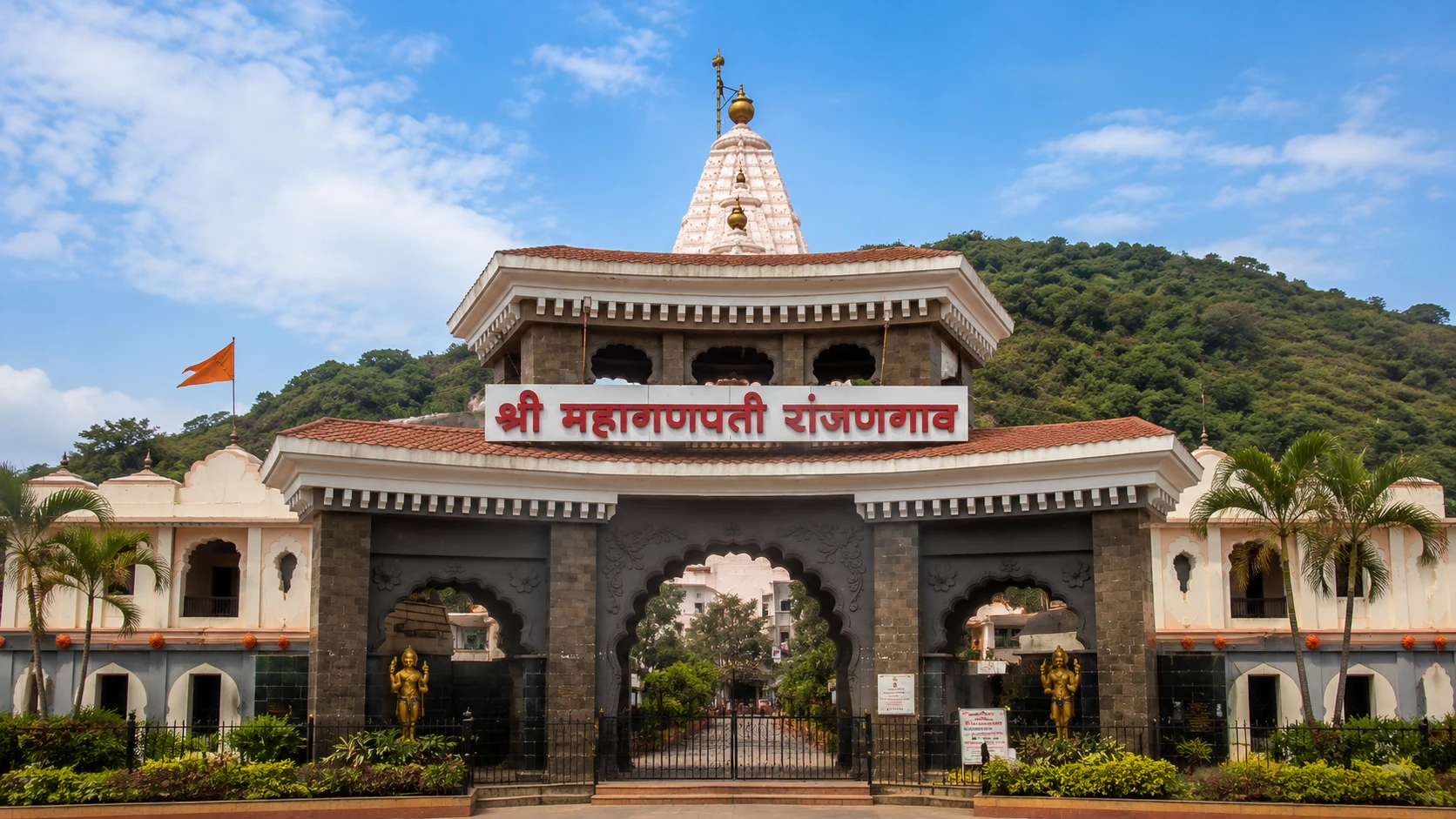
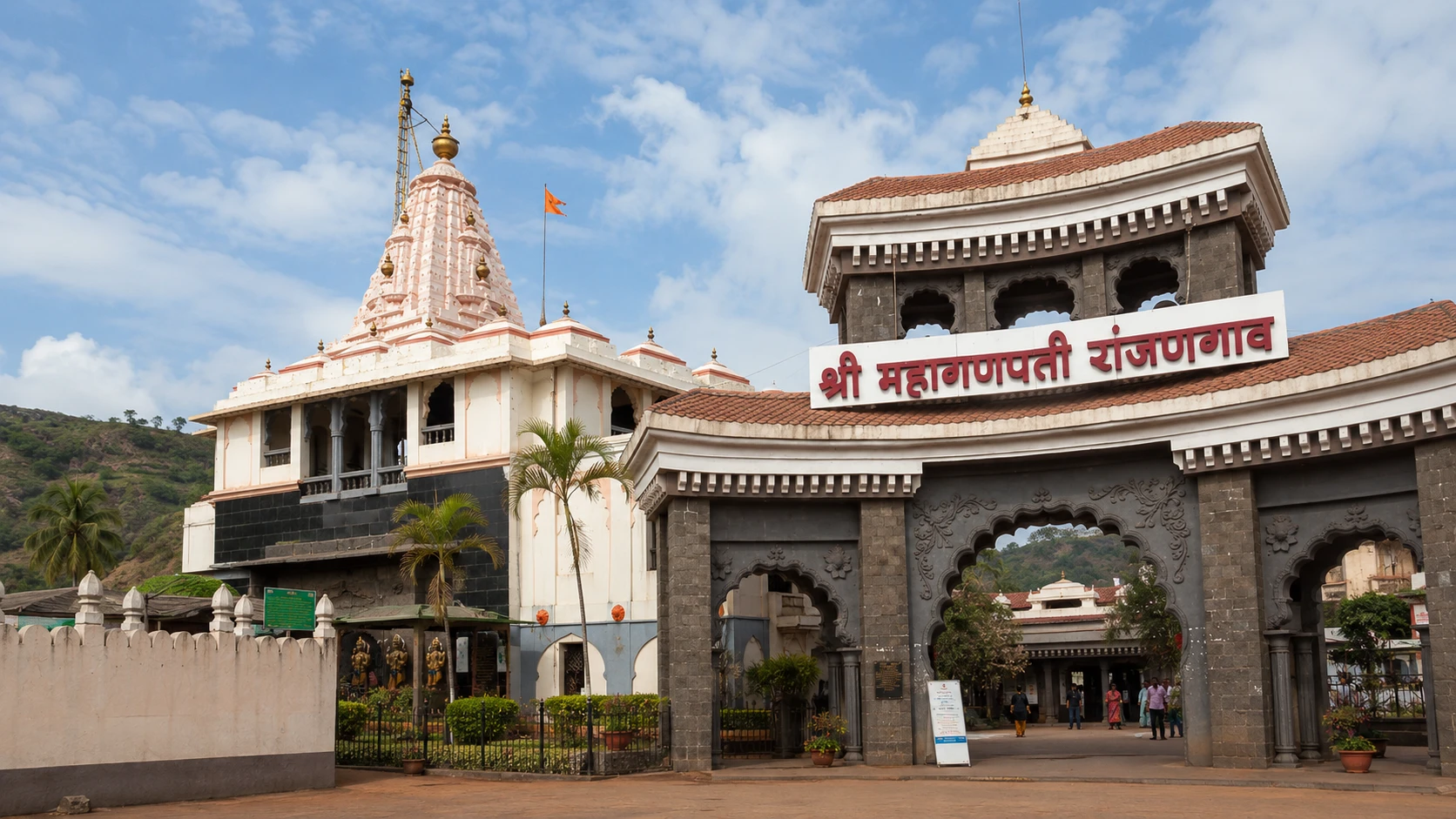
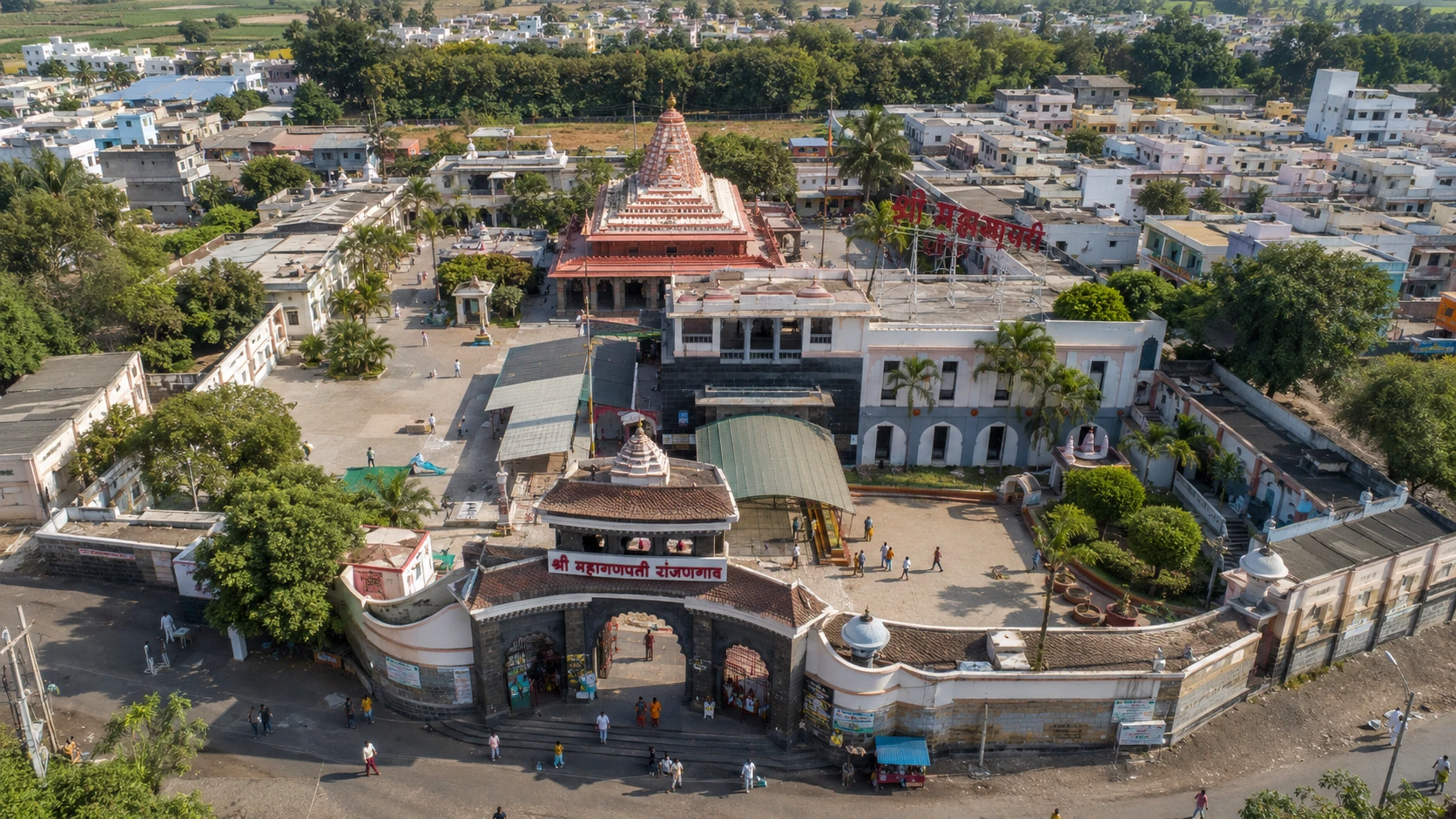
In front of the stone sanctum, the outer mandapa added during Madhavrao I's expansion provides the main pilgrim approach space. The mandapa is a substantial stone-pillared hall in Maratha temple style, accommodating significantly larger pilgrim flows than the modest mandapas at sites like Pali or Mahad. The compound walls enclose a substantial courtyard with subsidiary shrines, priest-residences along the inner wall, and standard pilgrim infrastructure. As a circuit-closing site with high pilgrim volume, Ranjangaon's compound is structurally designed for sustained pilgrim flow rather than intimate small-temple darshan.
The broader architectural setting reflects the Madhavrao patronage standard: substantial scale, careful ritual proportion, integration of astronomical-calculation features (the solar-alignment), and preservation of the temple's mythological-narrative identity through the underground-chamber Mahotkat-form tradition. Pilgrims walking the temple compound are engaging with both the visible Hemadpanthi-stone temple and the conceptual presence of the hidden Mahotkat-form whose narrative reference saturates the temple's identity even though the form itself is not seen.
Distinctive Practicesविशिष्ट परंपराएँ
Circuit-Closing Sankalpa
परिक्रमा-समापन संकल्प
Performed by pilgrims completing the full Ashtavinayak yatra; conventionally undertaken at the conclusion of the Ranjangaon darshan before departing for the traditional return to Morgaon
A devotional practice specific to Ranjangaon's circuit-closing position: pilgrims completing the full Ashtavinayak yatra customarily perform a sankalpa at the Ranjangaon sanctum recognizing the journey's completion. The sankalpa typically takes the form of a brief mental or whispered statement acknowledging the eight shrines visited (often with each named in sequence: Morgaon, Siddhatek, Pali, Mahad, Theur, Lenyadri, Ozar, Ranjangaon) and expressing the pilgrim's gratitude for the completion of the canonical eight-shrine circuit. Some pilgrims pair the circuit-closing sankalpa with a sponsored sankalpa-puja at the temple office, formalizing the completion through a priest-administered ritual. The practice precedes — but does not replace — the traditional return darshan at Morgaon that formally concludes the full Ashtavinayak yatra; the circuit-closing sankalpa at Ranjangaon is the in-sequence recognition, while the return-to-Morgaon visit is the formal closure of the yatra.
The full Ashtavinayak yatra is one of the most ritually-elaborate Hindu pilgrim circuits, requiring travel across two districts (Pune and Raigad) and visits to eight distinct shrines over typically three to five days. The completion of the canonical eight requires devotional recognition — the journey is not casual logistics but a structured devotional undertaking. The circuit-closing sankalpa at Ranjangaon formalizes the in-sequence completion before the formal yatra-closing return to Morgaon. The practice acknowledges that pilgrimage is itself a form of sadhana and that its completion carries devotional weight beyond the sum of the eight individual darshans.
Equinox-Dawn Solar Darshan
विषुव-प्रातः सौर दर्शन
Twice yearly — at the spring equinox (around 21 March) and the autumn equinox (around 23 September), in the brief window at sunrise
An architecturally-determined observance specific to Ranjangaon: the temple's east-facing alignment produces a twice-yearly solar event in which the rising sun's rays pass directly through the sanctum opening and illuminate the Mahaganapati murti at dawn on the equinox days. The window of solar alignment is brief — typically 10 to 15 minutes — and pilgrims wishing to witness it must arrive well before sunrise and position themselves in the sanctum to see the alignment moment. The equinox-dawn darshan attracts dedicated pilgrim flows specifically planning their visits for these two days of the year. The Maharashtra State Department of Archaeology has documented the alignment's astronomical precision; the practice combines astronomical-architectural appreciation with devotional darshan in a way unusual among Maratha-era Hindu temples.
The solar-alignment is read theologically as the cosmic-power deity receiving cosmic-source acknowledgement: the Mahaganapati form, whose foundational legend concerns the deity's cosmic-power blessing for Shiva's Tripura-destruction, is illuminated by the sun directly at the moment of the equinoxes — the cosmic-symmetry days when day and night are equal across the world. The architectural alignment is read as preserving the temple's cosmic-power theology in the very geometry of the building. Pilgrims who time their visits for the equinox-dawn solar darshan are accessing the temple's most distinctive astronomical-devotional moment.
Mahotkat-Form Ritual Reference (without direct viewing)
महोत्कट-रूप अनुष्ठानिक संदर्भ (बिना प्रत्यक्ष दर्शन के)
Performed during major festivals (Bhadrapada Ganesh Chaturthi, Magha Ganesh Jayanti) and on the equinox dates; not part of ordinary daily darshan
A devotional practice distinctive to Ranjangaon: during major festivals and on the equinox-dawn dates, the temple priests perform ritual recitations of the Mudgala Purana descriptions of the Mahotkat-form (the ten-trunked, twenty-armed underground original murti) and conduct sankalpa invocations naming the underground form. Pilgrims present in the temple during these recitations are participating in the Mahotkat-form devotional acknowledgement without seeing the form directly (the underground chamber remains closed and unopened for ordinary access). The practice preserves the temple's distinctive theological identity — the visible darshan-murti and the hidden Mahotkat-form together — through ritual reference and narrative invocation rather than through visual access. Pilgrims interested in engaging with the Mahotkat-form tradition should time their visits to coincide with major festivals or the equinox dates when the ritual reference is performed.
The Mahotkat-form represents the deity's maximum-power iconographic expression — the form invoked when the deity is approached for cosmic-scale work (as in the Tripurasura-vadha legend). The form's preservation in tradition rather than in daily darshan reflects the theological principle that maximum-power forms are not for ordinary devotional encounter; they are preserved for moments of specific cosmic-significance invocation. The festival-and-equinox ritual reference allows pilgrims to acknowledge the maximum-power form's presence at the site without trivializing it through ordinary daily viewing.
Did You Know?क्या आप जानते हैं?
Mahaganapati at Ranjangaon is the eighth and circuit-closing stop of the canonical Ashtavinayak circuit. Pilgrims completing the full eight-shrine yatra customarily perform a circuit-closing sankalpa at Ranjangaon before undertaking the traditional return darshan at Morgaon (the first shrine) that formally concludes the yatra. The circuit-closure protocol distinguishes the Ashtavinayak pilgrimage from less ritually-structured Hindu pilgrim circuits — the formal return to the starting shrine is the distinctive yatra-concluding act, and Ranjangaon's position is the in-sequence recognition before the formal closure.
Chinchwad Sansthan pilgrim guidance documents; Bhalchandra Khandekar, 'Ashtavinayak Darshan' (1978)
The Mudgala Purana foundational legend places Mahaganapati at Ranjangaon as the deity whose blessing was necessary for Shiva's cosmic destruction of Tripurasura's three boon-protected fortresses. Shiva himself, according to the Mudgala Purana account, performed tapas at Ranjangaon before undertaking the Tripura-vadha — establishing one of the strongest forms of the Ganapati 'lord of beginnings' theological claim: that even the lord of cosmic dissolution depends on the obstacle-removing-and-power-granting deity for any large undertaking. Modern scholarship (Paul Courtright, 1985; Wendy Doniger, 1976) reads this Shiva-worships-Ganapati framing as theologically significant.
Mudgala Purana — Tripurasura-vadha prakarana; Paul Courtright, 'Ganesa: Lord of Obstacles, Lord of Beginnings' (Oxford 1985); Wendy Doniger, 'The Origins of Evil in Hindu Mythology' (University of California 1976)
Temple tradition holds that the original Mahaganapati murti at Ranjangaon was an extraordinarily elaborate form known as Mahotkat — described in the Mudgala Purana as having ten trunks (dasa-shunda) and twenty arms (vimsati-bhuja), seated on a lotus. This original Mahotkat form is held by tradition to exist in an underground chamber beneath the present sanctum, sealed for preservation, with the publicly worshipped daily-darshan murti being a more conventional form. The underground chamber is not opened for ordinary pilgrim access. Modern scholarly opinion treats the Mahotkat description as primarily theological-iconographic (expressing the deity's maximum-power form) rather than necessarily corresponding to a physically-existing hidden statue; the editorial position preserves both the temple tradition and the scholarly framing.
Mudgala Purana — Mahaganapati-mahatmya; Chinchwad Sansthan archival records; Bhalchandra Khandekar, 'Ashtavinayak Darshan' (1978)
The Ranjangaon temple's most architecturally precise feature is its east-facing solar alignment: the sanctum opening is positioned so that the rising sun's rays pass directly through and illuminate the murti at dawn on the spring equinox (around 21 March) and the autumn equinox (around 23 September). The brief alignment window (approximately 10-15 minutes) is the temple's most-anticipated astronomical-devotional event each year. The alignment is the work of Maratha-era craftsmen integrating astronomical-calculation into the temple's eighteenth-century construction under Peshwa Madhavrao I; the Maharashtra State Department of Archaeology has documented its precision.
Maharashtra State Department of Archaeology — Ranjangaon solar-alignment documentation; Peshwa Daftar Madhavrao I patronage records
The Tripurasura-vadha narrative in which Mahaganapati's blessing enabled Shiva's cosmic-destruction work is referenced across multiple Puranic sources — Mudgala Purana, Ganesha Purana, Skanda Purana, Linga Purana — establishing it as one of the most cross-attested Puranic narratives within the Ganapatya corpus. The Ranjangaon localization of the Shiva-tapas episode is a Ganapatya tradition that integrates the broader cross-Puranic Tripura-destruction cycle into the specific Ashtavinayak geographical framework. This cross-textual attestation distinguishes the Ranjangaon legend from some other Ashtavinayak shrine-narratives that are documented primarily in the Mudgala Purana alone.
Mudgala Purana, Ganesha Purana, Skanda Purana, Linga Purana — cross-textual Tripura-vadha attestation; Wendy Doniger, 'The Origins of Evil in Hindu Mythology' (1976)
The temple was significantly expanded under Peshwa Madhavrao I (1745-1772), the same young Peshwa whose deeper personal devotional anchor was Chintamani Vinayak at Theur and who chose to die at Theur in 1772. Madhavrao's Ranjangaon investment in the 1760s produced the present Hemadpanthi-style stone sanctum, the outer mandapa, the compound walls, and the distinctive east-facing solar-alignment construction. The Madhavrao patronage at Ranjangaon was structurally substantial without the personal-residence intimacy of his Theur engagement; the two Pune-district Ashtavinayak shrines represent different facets of his Ashtavinayak relationship.
Peshwa Daftar — Madhavrao I patronage records (Bharat Itihas Samshodhan Mandal, Pune); G.S. Sardesai, 'New History of the Marathas' Volume II (1958)
Ranjangaon is approximately 50 km from central Pune on the Pune-Ahilyanagar Highway (NH-753F, formerly NH-50) — making it among the most accessible Ashtavinayak shrines from Pune and a natural same-day return-trip for circuit-closing pilgrims. The accessibility means Ranjangaon receives high pilgrim volumes from both organized Ashtavinayak yatra tours and day-trip pilgrims from Pune who visit Ranjangaon as a single-shrine darshan rather than as part of the full circuit.
Maharashtra Tourism Development Corporation circuit-tour itineraries; Chinchwad Sansthan pilgrim flow records
Visitor Accessप्रवेश जानकारी
Mahaganapati welcomes devotees of all backgrounds without restriction based on gender, age, caste, or origin. Photography is permitted in the outer mandapa, the compound, and on the approach pathway; photography is not permitted within the inner stone sanctum during darshan or abhishekam. The temple is at near-level access from the approach road — no significant climb or staircase required. The underground chamber that temple tradition associates with the Mahotkat-form is not accessible to ordinary pilgrims and is not opened during any festival or observance. Footwear must be removed before entering the temple complex. Mobile phones should be silenced inside the sanctum.
There is no formal VIP-darshan or priority-queue at Mahaganapati. On weekdays the queue moves swiftly. Sundays, Sankashti Chaturthi (especially Angarki Sankashti on Tuesday), the Ganesh Chaturthi and Magha Ganesh Jayanti festival weeks generate substantial crowds — particularly heavy because Ranjangaon receives both organized Ashtavinayak yatra-completing pilgrim flows and day-trip pilgrims from Pune. Pilgrims wishing for unhurried darshan should target weekday mid-morning arrivals. Pilgrims wishing to witness the equinox-dawn solar darshan must plan specifically for the two-day windows around 21 March and 23 September each year — arriving well before sunrise (typically by 5:00-5:30 AM) and positioning themselves in the sanctum for the 10-15 minute alignment window. Photo ID is not required. Pilgrims completing the full Ashtavinayak yatra should plan adequate time at Ranjangaon for the circuit-closing sankalpa before departing for the traditional return darshan at Morgaon — a 90-minute total visit window allows for unhurried sankalpa and sanctum darshan together.
Festivalsत्योहार
Ganesh Chaturthi (Bhadrapada Shukla Chaturthi)
गणेश चतुर्थी (भाद्रपद शुक्ल चतुर्थी)
Aug-Sep (Bhadrapada Shukla Chaturthi)
The principal Ganapati festival, observed at Mahaganapati with continuous abhishekam, twenty-one Atharvashirsha recitations, and major naivedya offerings across the festival fortnight. The Bhadrapada festival at Ranjangaon includes formal recitation of the Tripurasura-vadha prakarana from the Mudgala Purana and ritual reference to the Mahotkat-form during the principal worship sequences. Pilgrim flow during this period is heavy, intensified by the convergence of Ashtavinayak yatra-completing pilgrims (many time their full-circuit completion to coincide with the Bhadrapada festival) and day-trip pilgrims from Pune. The compound is illuminated through the night during the final five days of the fortnight, and the outer mandapa accommodates substantially larger gatherings than during ordinary darshan periods.
Magha Ganesh Jayanti (Magha Shukla Chaturthi)
माघ गणेश जयंती (माघ शुक्ल चतुर्थी)
Jan-Feb (Magha Shukla Chaturthi)
The birth-tithi observance of Ganesha. At Mahaganapati the day is marked by sustained abhishekam from pre-dawn through midnight, twenty-one Atharvashirsha avartans, and ritual recitation of the Mahaganapati-mahatmya from the Mudgala Purana. The cooler January-February climate is favourable for the Ranjangaon visit and the festival window often sees pilgrims completing their full Ashtavinayak yatra during the Magha period for the dual significance of the birth-tithi observance and the yatra-closure ritual. Special priest-led recitations of the Tripurasura-vadha prakarana are conducted at midday and evening.
Spring Equinox Solar Darshan
वसंत विषुव सौर दर्शन
Annual — around 21 March
An astronomically-determined observance specific to Ranjangaon: at the spring equinox each year (around 21 March), the rising sun's rays pass directly through the east-facing sanctum opening and illuminate the murti at dawn. The architectural alignment was engineered by Maratha-era craftsmen during the eighteenth-century Madhavrao expansion. The alignment window is brief — approximately 10-15 minutes — and pilgrims wishing to witness it must arrive well before sunrise. The spring equinox darshan attracts dedicated pilgrim flows specifically planning their visits for this event, and is often combined with the early morning sandhya-aarti. The temple authorities arrange extended pre-dawn opening hours on the equinox days to accommodate pilgrim arrivals.
Autumn Equinox Solar Darshan
शरद विषुव सौर दर्शन
Annual — around 23 September
The second of the two annual solar-alignment events at Mahaganapati. At the autumn equinox each year (around 23 September), the same architectural alignment that produces the spring equinox darshan also produces a corresponding sunrise illumination of the murti. The autumn equinox darshan typically falls within the Bhadrapada Ganesh Chaturthi festival fortnight (Ganesh Chaturthi being the new-moon-week observance preceding the autumn equinox), which causes the two observances to overlap in some years and produces some of the year's most concentrated pilgrim flows at Ranjangaon. Pilgrims who plan their full Ashtavinayak yatra completion to coincide with both the Bhadrapada festival and the autumn equinox solar darshan are accessing the temple's most layered devotional-architectural moment of the year.
Vijayadashami (Dussehra)
विजयादशमी (दशहरा)
Sep-Oct (Ashwin Shukla Dashami)
Observed at Mahaganapati with the cosmic-victory framework that fits the temple's Tripurasura-vadha foundational legend particularly resonantly — Dussehra commemorating cosmic-victory over disorder, with the Ranjangaon legend specifically describing one of the largest such victories (Shiva's destruction of the three Tripura fortresses, enabled by Mahaganapati's blessing). Morning special abhishekam, evening procession of the utsav-murti around the temple compound, and a sustained public reading of the Tripurasura-vadha prakarana define the day's observance. The day's significance at Mahaganapati is therefore not merely the general Dussehra framework but specifically the Ranjangaon-legend cosmic-victory it commemorates.
Traditional Offeringsपारंपरिक अर्पण
प्राथमिक अर्पण
Modak
मोदक
मोदक
The canonical Ganesha naivedya. At Mahaganapati the modak offering carries particular thematic resonance during the circuit-closing sankalpa: pilgrims completing the full Ashtavinayak yatra often offer twenty-one modaks (ekvis modak) as part of the yatra-completion ritual, treating the offering as a material acknowledgement of the eight-shrine pilgrimage now concluding. The modak's combination of plain exterior holding inner sweetness aligns thematically with the Ranjangaon legend's resolution: Shiva's cosmic-victory was made possible through prior Ganapati-blessing, the simple devotional act preceding the extraordinary cosmic outcome.
Durva grass
दूर्वा घास
दूर्वा
Trifoliate durva grass sacred to Ganesha. At Mahaganapati durva is offered during the sanctum darshan and additionally on the circuit-closing sankalpa. Twenty-one tufts (ekvis durva) is the formal full offering, often included in the yatra-completion ritual.
Red Hibiscus (Jaaswand)
लाल जपा कुसुम
जपापुष्प
Red hibiscus flowers sacred to Ganesha. At Mahaganapati the offering is part of the daily morning abhishekam at the sanctum, and during festival periods substantial floral garlands are offered for the elaborate temple-decoration sequences. The flowers' red colour resonates with the cosmic-power theology of the Mahaganapati form.
Coconut
नारियल
नारिकेल
The standard preliminary offering at Hindu temple thresholds. At Mahaganapati the coconut is broken at the entrance to the temple compound before pilgrims approach the sanctum darshan — a marking of the boundary between ordinary consciousness and the cosmic-power darshan the temple invites.
Sindoor (Vermilion paste)
सिंदूर
सिन्दूर
Saffron-red vermilion paste applied to the murti during abhishekam and offered to devotees as prasad after darshan. At Mahaganapati the sindoor accumulation on the murti is moderate, with the carved features remaining clearly visible across the sindoor cover during darshan hours. Pilgrims receive sindoor-prasad after the sanctum darshan as tilak, often pairing it with a brief circuit-closing sankalpa acknowledgement if completing the full Ashtavinayak yatra.
इस मंदिर की विशेषता
Circuit-Closing Yatra-Completion Sankalpa Offering
परिक्रमा-समापन यात्रा-पूर्णता संकल्प अर्पण
A Ranjangaon-specific offering pattern for pilgrims completing the full Ashtavinayak yatra: a formal sankalpa-puja sponsored at the temple office that includes recognition of the eight-shrine pilgrimage, recitation of the Ashtavinayak Stotram, and material offerings (typically twenty-one modaks, twenty-one durva tufts, and a coconut). The sankalpa-puja takes approximately 30-45 minutes and is conducted by the temple priest in coordination with the sponsored pilgrim. The offering acknowledges the yatra's completion in the canonical-eight sense, with the traditional return-darshan at Morgaon being the formal yatra-closure that follows. This circuit-closing offering pattern is unique among the Ashtavinayak shrines — only Ranjangaon's position as the eighth and concluding shrine makes the offering meaningful in this specific yatra-completion sense.
Pilgrims are welcome to bring offerings from outside the temple complex. A puja-sahitya counter near the temple entrance, operated under the local Devasthan, offers basic offering bundles (modaks, durva, sindoor packets, flowers). Pilgrims undertaking the canonical Ranjangaon visit should plan offerings appropriate to whether the visit is a standalone Mahaganapati darshan or the circuit-closing visit completing the full Ashtavinayak yatra — the latter benefits from the formal sankalpa-puja offering arrangement coordinated through the temple office. Synthetic plastic flowers are politely discouraged in favour of fresh natural materials.
How to Reachकैसे पहुँचें
Ranjangaon lies in Shirur taluka of Pune district, on the Pune-Ahilyanagar Highway (NH-753F, formerly NH-50), approximately 50 km northeast of central Pune. The temple's accessibility from Pune makes it the most-visited of the four Pune-district Ashtavinayak shrines in absolute daily pilgrim numbers and a natural same-day return-trip destination for both circuit-closing pilgrims and standalone Mahaganapati visitors.
By road from Pune, the standard route is via the Pune-Nagar Road / Pune-Ahilyanagar Highway directly to Ranjangaon — approximately 50 km with a driving time of 1.5 to 2 hours under normal conditions, longer during Pune-Ahilyanagar highway peak commercial traffic. The route is straightforward and well-signed, with Ranjangaon being a major recognized destination on this highway corridor. From Mumbai, the route is via the Mumbai-Pune Expressway to Pune and then via the Pune-Nagar Road to Ranjangaon, totalling approximately 200 km and 4.5 to 5 hours by private vehicle. Maharashtra State Road Transport Corporation (MSRTC) buses run from Pune Station bus stand directly to Ranjangaon with multiple daily departures. Private taxis and ride-hailing services from Pune to Ranjangaon can be arranged for the standard 1.5-hour transit.
By rail, Pune Junction (50 km) is the principal regional rail access with direct services from across India. Daund Junction (approximately 60 km southeast) is a secondary option for pilgrims connecting from south-central India, though most pilgrims arrive via Pune. Shared taxis and auto-rickshaws from either station to Ranjangaon are available. There is no significantly closer railway station — Ranjangaon is in a road-served area of central Pune district.
By air, Pune International Airport (PNQ, approximately 45 km via the Pune-Ahilyanagar Highway) is the principal access point for both domestic and international pilgrims; the airport-to-Ranjangaon route is direct via the same highway corridor, typically 1 to 1.25 hours. Mumbai's Chhatrapati Shivaji Maharaj International Airport (BOM, approximately 200 km) is the long-haul international option for pilgrims arriving on overseas flights.
Within the Ashtavinayak circuit, Ranjangaon is the eighth and circuit-closing shrine. After completing Ranjangaon, pilgrims traditionally undertake a return darshan at Morgaon (approximately 130 km southwest via Pune) to formally conclude the full Ashtavinayak yatra. This return-to-Morgaon journey is a substantial undertaking and is typically planned for a separate day after the Ranjangaon visit, rather than attempted as a same-day onward journey. The standard package-tour itinerary for the complete eight-plus-Morgaon circuit allocates three to five days total across the two-district geography (Raigad and Pune districts) and concludes with the formal return-darshan at Morgaon on the final day.
For pilgrims doing only the Pune-district segment (the Pune-based four shrines: Theur, Lenyadri, Ozar, Ranjangaon), Ranjangaon is typically the second day's destination after a Lenyadri-Ozar combined day, or the third day's destination if Theur is given its own full day (recommended given Theur's layered four-stop circuit content).
Plan Your Visitयात्रा की योजना
🌤 सर्वोत्तम मौसम
October to February is the most comfortable period for Mahaganapati — daytime temperatures range from 18-30°C with low humidity, the Pune-Ahilyanagar highway is at its best, and pilgrim flows are heavy but manageable. The temple is open year-round. March to May is the hot dry season (35-42°C) — manageable for the temple visit but the highway drive becomes uncomfortable in afternoon heat. The monsoon (June-September) brings rain to the central Maharashtra plateau; the temple remains fully accessible and the highway is monsoon-serviceable, though the autumn equinox solar darshan (around 23 September) may be affected by overcast weather in particularly rainy years. The two most spiritually significant single-day windows are the spring equinox (around 21 March) and the autumn equinox (around 23 September) for the solar-alignment darshan. The most spiritually intense extended windows are Magha Ganesh Jayanti (January-February) and Bhadrapada Ganesh Chaturthi (August-September, often overlapping the autumn equinox).
👘 पहनावे का नियम
Modest traditional dress is expected and appreciated. For men, full-length trousers or dhotis with appropriate shirts are suitable. For women, sarees, salwar suits, or long skirts with covered shoulders are appropriate. There is no requirement for a head covering at this temple. Pilgrims attending the equinox-dawn solar darshan should dress for the temperature variation (pre-dawn temperatures in late March or late September are significantly cooler than midday temperatures) and may benefit from a light shawl or wrap that can be removed once the sun rises. Pilgrims completing the full Ashtavinayak yatra at Ranjangaon often dress traditionally for the circuit-closing sankalpa as part of the ceremonial weight of the occasion.
📱 फोन और फोटोग्राफी
Mobile phones should be silenced before entering the inner sanctum. Photography with phones is permitted in the outer mandapa, the compound, and on the approach pathway. Photography is not permitted within the inner stone sanctum during darshan or abhishekam. Photography of the equinox-dawn solar alignment is permitted from positions inside the cave-mandapa (not the inner sanctum itself) and from the outer mandapa; the photography-prohibited zone is only the immediate inner-sanctum area around the murti during the alignment moment. The temple does not formally collect phones at the entrance, but enforces the inner-sanctum photography prohibition through priest intervention if necessary.
🏨 आवास
Ranjangaon village has limited accommodation infrastructure beyond a basic Devasthan-managed pilgrim shelter near the temple. Most pilgrims stay in Pune (50 km, full hotel range from budget to luxury). Pune-based stay is the standard choice for both Ashtavinayak yatra-completing pilgrims (who return to Pune accommodation between visits) and day-trip pilgrims who do Ranjangaon as a half-day excursion from Pune. Shirur town (15 km from Ranjangaon) has a few basic hotels suited to budget pilgrims wanting to be closer to the temple than Pune. Most Ashtavinayak package-tour operators arrange Pune-based accommodation for the full Pune-district segment and undertake Ranjangaon as the closing day's main visit before the journey back to Pune and onward to Morgaon for the formal yatra-closure.
Book a Pujaपूजा बुक करें
The Shri Mahaganapati Devasthan at Ranjangaon does not currently operate a verified online puja booking portal. The Ashtavinayak circuit attracts a high volume of package-tour pilgrims, and Ranjangaon specifically draws heavy volumes both as the circuit-closing shrine for yatra-completing pilgrims and as a standalone day-trip destination from Pune (50 km). Third-party websites and intermediaries claiming to offer puja bookings, priority darshan passes, equinox-dawn solar darshan priority access, or accommodation packages should be approached with caution — many are unaffiliated with the Devasthan and the Chinchwad Sansthan. For puja bookings, including the circuit-closing yatra-completion sankalpa puja and the equinox-dawn priority access, contact the temple office directly upon arrival or coordinate through a reputable Ashtavinayak package-tour operator. We do not list a phone number or email here because no verified primary contact has been published by the Trust; this section will be updated when the Trust publishes one. Pilgrims planning to witness the equinox-dawn solar darshan (around 21 March or around 23 September) should arrive well before sunrise (typically by 5:00-5:30 AM) and verify weather conditions on the specific dates — overcast weather can obscure the alignment event particularly during monsoon-period autumn equinoxes. Pilgrims undertaking the full Ashtavinayak yatra should plan the return-to-Morgaon journey for a separate day after the Ranjangaon visit rather than attempting same-day onward travel.
Managed by: Shri Mahaganapati Devasthan, Ranjangaon (under the Chinchwad Sansthan administrative framework with ceremonial authority extending from the Morya Gosavi tradition)
Abhishekam (ritual bathing)
अभिषेकम
Circuit-Closing Yatra-Completion Sankalpa Puja
परिक्रमा-समापन यात्रा-पूर्णता संकल्प पूजा
Ekvis Modak Naivedya (twenty-one modak offering)
एकवीस मोदक नैवेद्य
Atharvashirsha Avartan (twenty-one recitations)
अथर्वशीर्ष आवर्तन (एकवीस आवर्तने)
Equinox-Dawn Solar Darshan Priority Access
विषुव-प्रातः सौर दर्शन प्राथमिकता पहुँच
Booking information verified: 2026-05-19
Sacred Soundsपवित्र ध्वनि
क्या आप जानते हैं? · Did You Know?
वही अनुवाद त्रुटि जिसने हिन्दू धर्म में '33 कोटि' को '33 करोड़' बनाया, बौद्ध धर्म में भी हुई। बौद्ध ग्रन्थों के चीनी अनुवाद ने 'सप्त कोटि बुद्ध' (7 श्रेष्ठ बुद्ध) का अनुवाद '7 करोड़ बुद्ध' कर दिया। तिब्बती अनुवाद ने सही किया: 7 प्रकार, 7 करोड़ नहीं। एक संस्कृत शब्द, दो प्रमुख विश्व धर्मों में गलत पढ़ा गया, ने दो एकसमान भ्रम स्वतन्त्र रूप से उत्पन्न किए।
Related Contentसंबंधित सामग्री
Related Scriptures
Related Temples
Moreshwar Mayureshwar (Morgaon)
मोरेश्वर मयूरेश्वर
Morgaon, Maharashtra
Siddhivinayak (Siddhatek)
सिद्धिविनायक सिद्धटेक
Siddhatek, Maharashtra
Ballaleshwar (Pali)
बल्लालेश्वर
Pali, Maharashtra
Varadavinayak (Mahad)
वरदविनायक
Mahad, Maharashtra
Chintamani (Theur)
चिंतामणि थेऊर
Theur, Maharashtra
Girijatmaj (Lenyadri)
गिरिजात्मज लेण्याद्री
Lenyadri, Maharashtra
Vighneshwar (Ozar)
विघ्नेश्वर ओझर
Ozar, Maharashtra
Community Reflections
🕉️
Be the first to share your reflection.