Girijatmaj (Lenyadri)
गिरिजात्मज लेण्याद्री
The cave-temple of the mountain-mother's child — Ganesha as Girijatmaj, son of Parvati
Lenyadri, Maharashtra, India
GirijātmajaAlso known as: Girijatmaj Vinayak, Lenyadri Ganpati, Ganesh Lena, Shri Girijatmaj, Lenyadri Vinayak, Ganesa of the Caves
युग
Buddhist-era cave-architectural foundation in the first to third centuries CE (Hinayana Buddhist cave-complex of thirty caves, of which the present Ganapati shrine occupies Cave 7); repurposing as Ganapati shrine probably in the medieval period after Buddhism declined in this region; continuous Hindu worship at Cave 7 attested from the late medieval centuries onward with Maratha-era pilgrim infrastructure additions
वास्तुकला
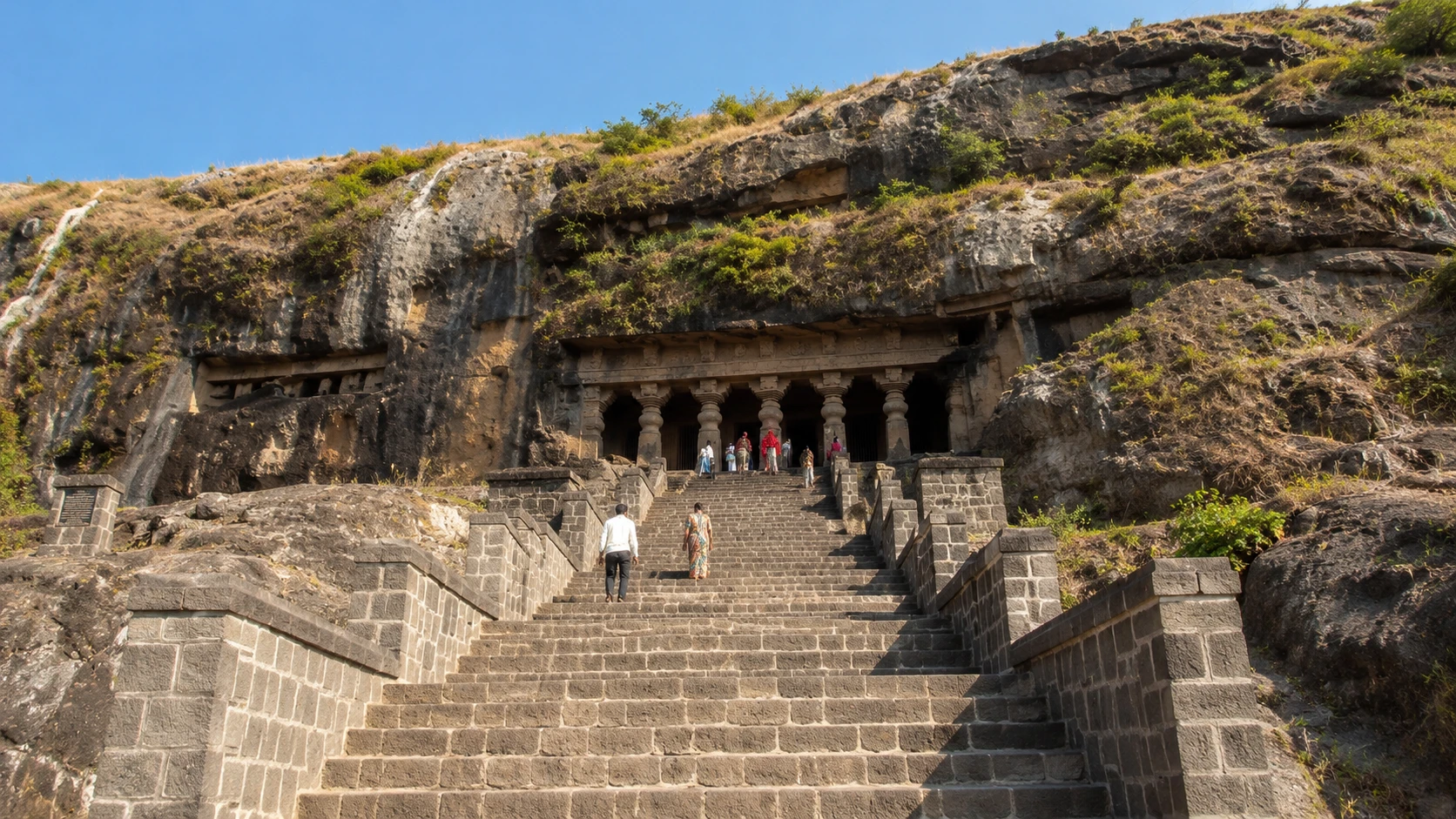
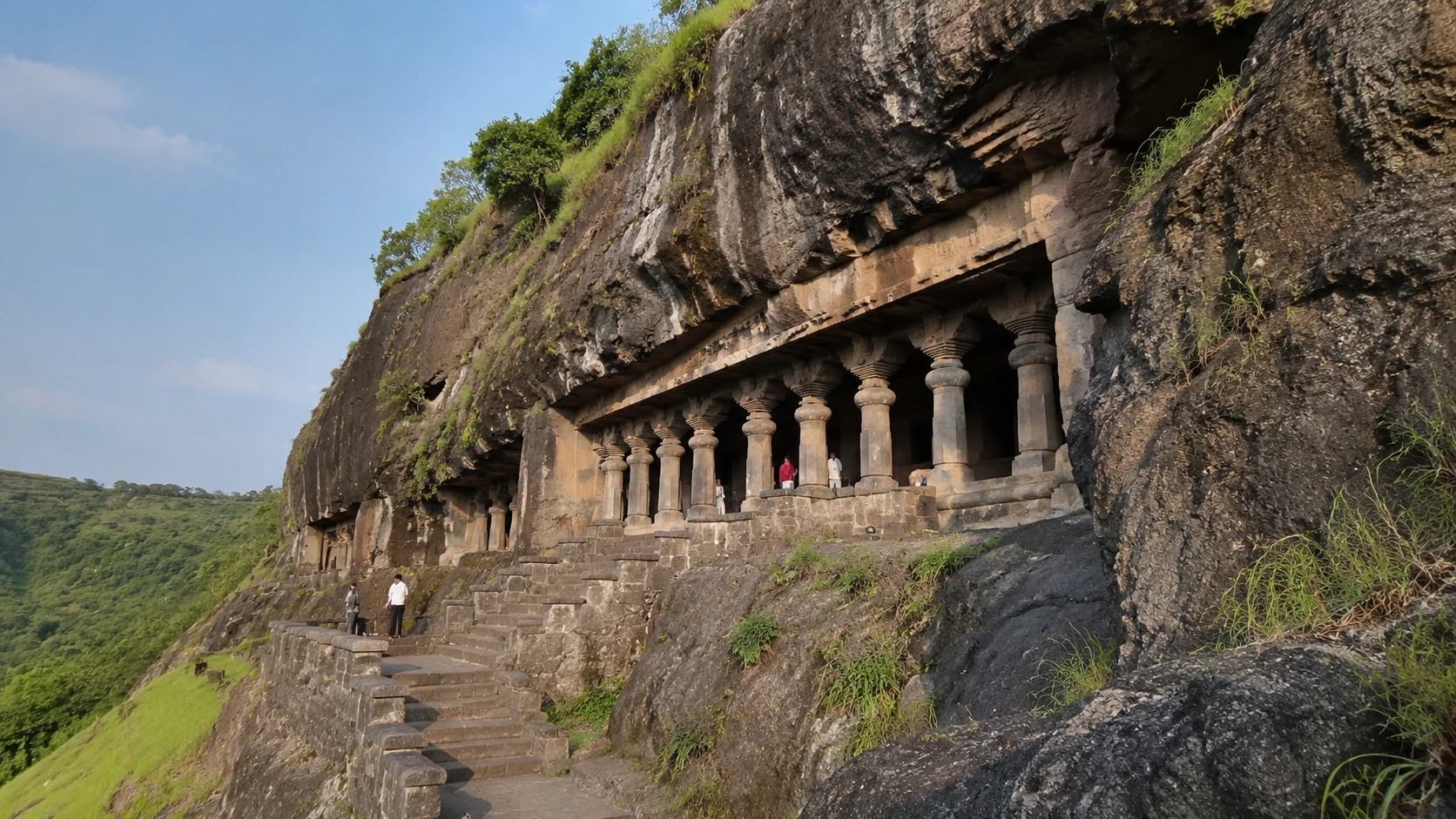
Pre-existing 1st-3rd century CE Hinayana Buddhist rock-cut cave architecture, repurposed for Hindu Ganapatya worship. The cave is a single-chamber excavated hall (vihara plan) with the Ganesha rock-cut image set into the rear wall as a bas-relief rather than a freestanding sculpture. The cave-mandapa is supported by pillars carved directly out of the rock during the Buddhist-era excavation; no Hindu-era structural additions have been made inside the cave itself (the cave is an Archaeological Survey of India Centrally Protected Monument and structural modifications are prohibited). Hindu-era additions are limited to the approach pathway, the 307-step staircase, and pilgrim infrastructure at the cave entrance and at the base of the hill
खुला
06:00 – 18:00
आरती
07:00 · 12:00 · 16:30
विशेष
The Lenyadri pilgrim experience is structurally different from the other Ashtavinayak shrines because it requires a 307-step climb on a hillside staircase and entry into a Buddhist-era rock-cut cave. The cave itself is the sanctum — there is no enclosed inner-shrine structure and no traditional priest-quarters within the cave (priests come up from Junnar daily). The rock-cut Ganesha image on the rear cave wall is visible to all pilgrims simultaneously rather than enclosed behind a barrier; the darshan experience is open-cave rather than barrier-bound. Aarti times reflect this open-cave reality: the cave is closed after sunset for safety reasons (no resident priest, hillside access, no artificial lighting inside the cave itself beyond what the priests bring during opening hours). Special darshan often combines a visit to the Lenyadri cave-temple with visits to nearby Shivneri Fort (the birthplace of Chhatrapati Shivaji Maharaj, approximately 5 km from Lenyadri) which is administratively distinct but conventionally combined in pilgrim itineraries
पवित्र कथा · पवित्र कथा
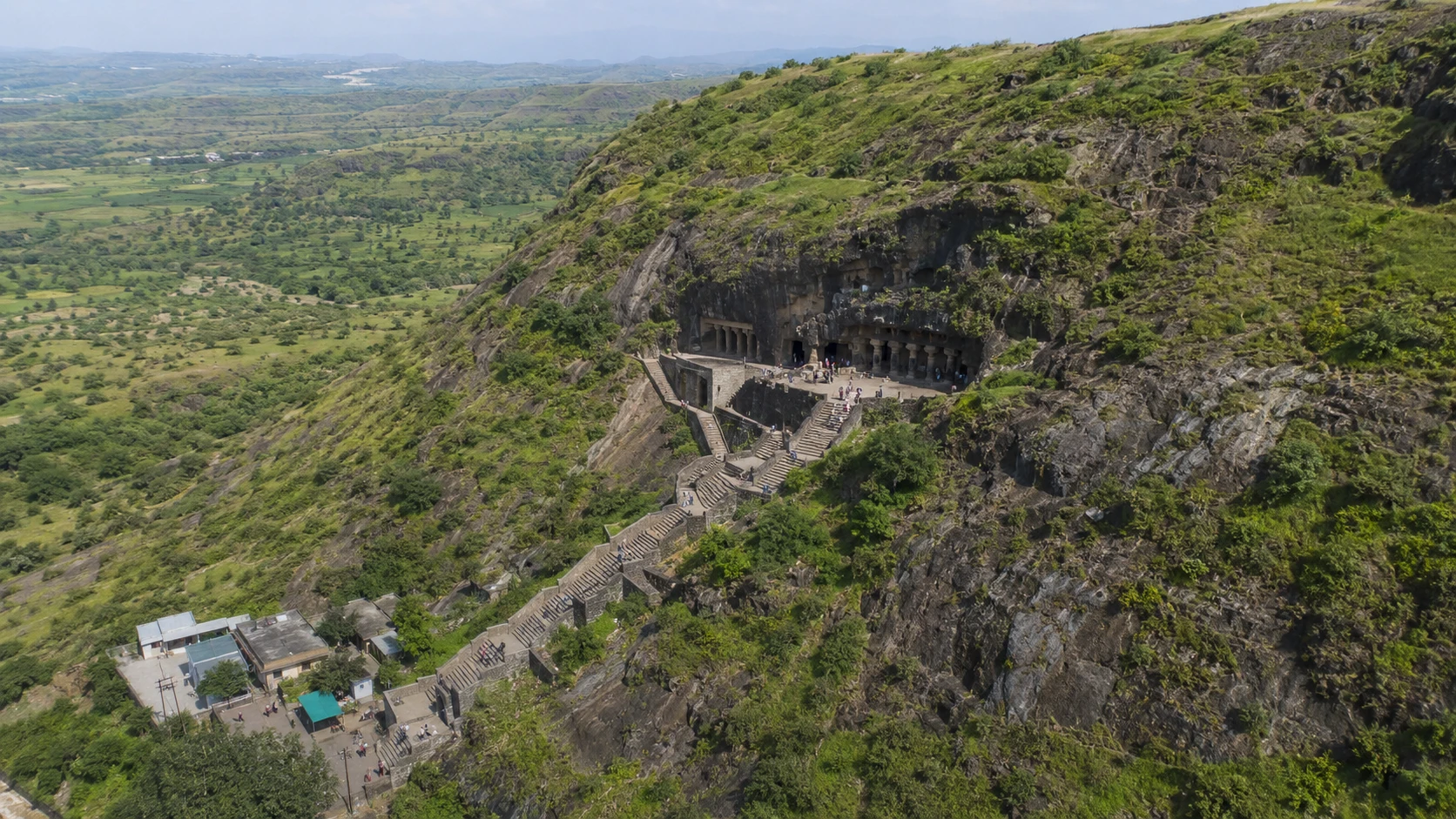
Girijatmaj at Lenyadri is the sixth stop on the canonical Ashtavinayak circuit, and the most architecturally singular of the eight: it is the only Ashtavinayak shrine inside a Buddhist-era cave, and the only one where the murti is carved directly into the natural rock face rather than installed as a freestanding sculpture. The cave-temple occupies Cave 7 in a complex of thirty Hinayana Buddhist caves on a hillside in Junnar taluka of Pune district, dated by Archaeological Survey of India scholarship to the first to third centuries of the Common Era. After Buddhism's decline in this region during the early medieval period, the cave was repurposed as a Ganapati shrine and the rock-cut Ganesha image — possibly an existing Buddhist sculptural form re-consecrated as Ganapati, possibly carved into the wall during the repurposing — became the focus of pilgrim worship. The name 'Girijatmaj' (girijā-ātmaja) means 'the son of Girija', Girija being one of the names of Parvati as the daughter of the mountain Himavan. The legend that anchors Lenyadri in the broader Mudgala Purana cycle is among the most theologically distinctive in Ashtavinayak narrative: Parvati performed twelve years of intense tapas at this cave wishing for a son, and Ganesha was born to her here. Lenyadri is therefore not the shrine of the deity-who-responds (the typical Ashtavinayak template) but the shrine of the divine-child-and-his-mother — Ganesha as Parvati's son, the mountain-mother's atmaja, in the cave where she raised him. The 307-step climb to reach the cave is itself part of the pilgrim experience, and the south-facing cave (rare among Hindu shrines, which conventionally face east) reflects the inherited Buddhist-era orientation rather than a deliberate Hindu architectural choice.
Sacred Designationपवित्र पदनाम
Sacred Origin Storyपवित्र उत्पत्ति कथा
Source: Mudgala Purana (Parvati-tapas prakarana, Girijatmaj-mahatmya) — widely-attested Ganapatya canonical narrative
In an age long before the present yuga, after Parvati had completed her own austerities and won Shiva as her husband, a question came to her that she had not anticipated. She wished for a son. Shiva, the great ascetic, was indifferent to procreation as a worldly concern; he had married Parvati for the unity of cosmic principles she represented but his own being remained turned toward dissolution rather than generation. Parvati found that her desire for a child was not one that her husband could simply grant by participating in ordinary domestic life. The desire would have to be earned through her own tapas, and the child she received would have to be a divine child born of her tapas rather than of conventional generation.
She asked Shiva for permission to undertake the tapas. He granted it. She then asked where she should go. He named for her several places of intense divine presence where the tapas of a divine mother seeking a son had concentrated power: the Himalayan caves, the Kailash retreats, the wider Sahyadri belt. Parvati considered. She did not want a Himalayan cave that would tie the child to her father's mountain-lineage too narrowly; she wanted a place of her own. She chose Lenyadri — the rocky cave-cluster on a hillside in the northern Sahyadri foothills, far from Kailash and Himalaya, in a region where the Devi's presence was strong but where no major prior cosmic event tied the geography to a specific divine relationship. She would go alone. She would do the tapas there.
For twelve years, Parvati remained in the cave at Lenyadri. The Mudgala Purana describes her austerities in considerable detail. She fasted; she chanted; she remained in meditation for long periods motionless. The cave around her became a place of palpable divine intensity. Local devas-in-waiting — minor mountain-spirits, forest-presences, the small powers of the Sahyadri hills — gathered at the cave-mouth to watch and to support. The animals that came to drink from the small spring near the cave became part of her sustaining environment. The cave itself, the legend says, was transformed by her continued presence; what had been an ordinary rocky shelter became saturated with the Devi's tapas-energy across the twelve years.
At the end of the twelfth year, the moment came. The Mudgala Purana describes it variously across recensions: in some, Parvati's body produced the child directly from her own substance, in a non-sexual divine generation that bypassed Shiva entirely; in others, Shiva descended at the conclusion of the tapas and granted the child to her in response to the completion of her austerity; in still others, the elements themselves — earth, fire, water, air, ether — combined under the Devi's command to produce a child whose body was made of the consecrated cave-environment Parvati had built up over twelve years. What is consistent across the recensions is the outcome. Parvati, alone in the cave at the conclusion of twelve years of tapas, received her son. He was Ganesha — the divine child, the deva-form she had earned.
He was named Girijatmaj — atmaja (son, child, offspring) of Girija (Parvati as daughter of the mountain Himavan). The name preserves the cave-and-mountain origin in the deity's own identity: this is the child of the mountain-mother, born in the rock, raised in the cave.
Parvati did not immediately leave Lenyadri after the birth. The Mudgala Purana records that she remained in the cave with the divine child for an extended period — variously given as fifteen years in some recensions, or as the broader 'childhood' of Ganesha before the legendary head-replacement event that occurred later at Kailash. During this Lenyadri period, Ganesha was raised by his mother in the cave, in the saturated devotional environment her tapas had built. Local Sahyadri devas and devis came to pay their respects to the divine child. The mountain-mother and her atmaja inhabited the cave together as a small divine family-unit, separate from the larger Shiva-household that would later become the formal divine residence.
For this reason, the Lenyadri cave-temple is not the site of a deity-encounter (the typical Ashtavinayak template — devotee approaches deity, makes request, receives response) but the site of a divine-childhood — the place where the Mother and her son lived together before the larger cosmic narratives that would later define Ganesha began. Pilgrims who come to Lenyadri are entering not the temple of a responding deity but the home of a divine child and his mother. The 307-step climb to reach the cave is treated by tradition as an approach not to a sanctum-deity but to a maternal-childhood shrine — a different devotional posture from the one demanded by most Ashtavinayak sites. The Mudgala Purana places this in pre-historical antiquity, but the cave's worship-continuity as the Girijatmaj shrine has been maintained from the medieval Ganapatya re-consecration of the Buddhist-era cave through to the present.
उद्धृत स्रोत:
- Mudgala Purana — Parvati-tapas prakarana (Girijatmaj-mahatmya)
- Ganesha Purana — referencing the Parvati-tapas-at-Lenyadri narrative
- Skanda Purana — variant references to Parvati's tapas for a divine son with location-attribution to multiple sites
- Sthala-purana of Lenyadri (regional Marathi devotional tradition)
विद्वत संदर्भ
Modern scholarship on the Lenyadri narrative (Paul Courtright, 'Ganesa: Lord of Obstacles, Lord of Beginnings', Oxford 1985; Anita Raina Thapan, 'Understanding Ganapati', Manohar 1997) treats the Mudgala Purana's Parvati-tapas-Lenyadri legend as one of the most theologically distinctive shrine-narratives in the Ashtavinayak corpus. The story is structurally a birth-and-childhood narrative rather than a deity-encounter narrative, which is rare across major Hindu pilgrimage temples generally — most Hindu temples are framed by the deity's actions in response to devotees rather than by the deity's own divine biography. Lenyadri's legend places Ganesha at the moment before he became the responding-deity figure: as the child of his mother, in the cave where he was raised, before the larger cosmic narratives of his adult divine career had begun. The cave-as-childhood-home framing also generates a different theological resource for devotees: pilgrims at Lenyadri are encouraged to approach the deity in maternal-bhakti rather than in petition-bhakti — relating to Ganesha as a divine child whose mother's tapas they honour, rather than as a problem-solving deity whose intervention they request. The archaeological history of the cave-complex is independently documented: Cave 7, occupying the present Ganapati shrine, is part of a thirty-cave Hinayana Buddhist excavation dated to the first to third centuries CE; the cave was re-consecrated as a Ganapati shrine probably in the medieval period after Buddhism's decline in the region, with the precise carving history of the present rock-cut image debated. The cave-complex as a whole is an ASI Centrally Protected Monument, and structural modifications to the cave interior are prohibited under the AMASR Act 1958; the Ganapati shrine functions within these archaeological-protection constraints, which is unusual for a major active Hindu pilgrim site.
Historyइतिहास
The documented history of Lenyadri begins with the Hinayana Buddhist cave-excavation tradition of the early Common Era, considerably earlier than any other Ashtavinayak site. The complex of thirty caves on the hillside above the small village of Lenyadri was excavated as a Buddhist vihara-and-chaitya complex between approximately the first and third centuries CE, during the period when the Sahyadri foothill region was an important node of Buddhist monastic life along the trade-routes that linked the Konkan coast with the Deccan interior. Junnar, the nearby town (5 km south), was a major commercial centre in this period, and the surrounding hills accommodated multiple Buddhist cave-complexes — Lenyadri being one of approximately a dozen excavated cave-clusters in the broader Junnar area. The Lenyadri caves served as monastic residences (viharas) and worship-halls (chaityas) for Buddhist communities for several centuries.
Buddhism declined in this region across the early-to-middle medieval period, as it did across most of central and western India. The exact date of the cave-complex's transition from active Buddhist monastic use to abandonment is not preserved; ASI scholarship generally places the decline across the fifth through ninth centuries CE. During the period of abandonment, the cave-complex appears to have functioned without specific religious community use, with the caves accessed primarily by local hill-dwelling communities and occasional pilgrims of various traditions.
The transition of Cave 7 specifically into a Hindu Ganapatya shrine is undocumented in inscriptional or external sources, but the temple tradition holds that the re-consecration occurred during the medieval period. The rock-cut Ganesha image visible today shows medieval rather than early Buddhist-era carving style, which suggests one of two possibilities: either the present image was carved during the medieval re-consecration into a previously-uncarved cave wall, or an existing Buddhist-era figure (which would have been an unidentified figure or possibly a Yaksha or Yakshi from the Buddhist iconographic repertoire) was substantially recarved into the Ganesha form. The precise carving history is debated by ASI scholars and would require detailed comparative analysis of the carving with the other Lenyadri caves to resolve.
What is clearer is that by the time the formal Ashtavinayak circuit was being institutionalized by the Chinchwad Sansthan in the late seventeenth century, Cave 7 at Lenyadri was already established as the Girijatmaj Vinayak shrine within the recognized Ashtavinayak grouping. Saint Morya Gosavi of Chinchwad and his successor-generation saints, in their work shaping the formal Ashtavinayak pilgrim circuit, included Lenyadri as the cave-shrine component of the eight, distinct in architecture from the other seven free-standing temple sites.
Maratha-era patronage at Lenyadri took a different form from the Peshwa-era stone-temple-construction work that characterized investment at Pali, Mahad, and Theur. The cave itself could not be structurally modified (it was an inherited Buddhist-era excavation, and Hindu religious-architectural conventions did not extend to modifying cave walls). Maratha-era investment at Lenyadri focused instead on the approach infrastructure: the 307-step staircase up the hillside, the pilgrim shelter at the cave entrance, and the maintenance of priest-residence arrangements in Junnar below. Peshwa-era correspondence in the Peshwa Daftar documents periodic land-grants and maintenance support for the Lenyadri pilgrim infrastructure across the eighteenth century.
The early twentieth century saw the formal designation of the Lenyadri cave-complex as a Centrally Protected Monument under the Archaeological Survey of India following the Ancient Monuments Preservation Act 1904 and its successor legislation (now governed by the Ancient Monuments and Archaeological Sites and Remains Act 1958 and its 2010 amendment). This designation established the legal framework under which the Ganapati shrine operates: active Hindu worship continues at Cave 7, but structural modifications to the cave interior are prohibited, and any infrastructure additions outside the cave must be approved by ASI. The coordination between the Devasthan trust and ASI is generally cooperative, with active worship treated as a continuous traditional use that the protection framework accommodates rather than restricts.
The 2003-04 Ashtavinayak Vikas Yojana renovation works at Lenyadri were structurally constrained by the ASI protection framework and focused on the approach infrastructure: replacement of the staircase steps, modernization of the pilgrim shelter at the cave entrance, improved approach roads from Junnar, and parking and rest-house facilities at the base of the hill. No work was undertaken inside the cave itself beyond routine cleaning and maintenance of the existing rock-cut image. The proximity to Shivneri Fort (the birthplace of Chhatrapati Shivaji Maharaj, 5 km away) means that Lenyadri pilgrim itineraries often combine the cave-temple visit with a Shivneri Fort visit, giving the site a layered religious-historical content within a small geographical radius.
Historical Timelineऐतिहासिक कालक्रम
Excavation of the Lenyadri cave-complex of thirty Hinayana Buddhist caves on the hillside above the village. The cave-complex served as Buddhist viharas (monastic residences) and chaityas (worship-halls) for several centuries, supporting a Buddhist monastic community that operated along the trade-routes between the Konkan coast and the Deccan interior, with the nearby town of Junnar as the regional commercial centre.
Gradual decline of Buddhist monastic use of the Lenyadri cave-complex, paralleling the broader decline of Buddhism in central and western India across this period. The exact transition date is not preserved in any single source; ASI scholarship places the decline across this multi-century window.
Recorded here as institutional rupture (the end of Buddhist monastic use) rather than as physical destruction of the cave-complex, which has remained intact. The 'destruction' enum-tag captures the institutional sense.
Re-consecration of Cave 7 specifically as a Hindu Ganapatya shrine — the Girijatmaj Vinayak temple. The precise date is not documented, and the carving history of the present rock-cut Ganesha image (whether carved fresh during the re-consecration, or recarved from an existing Buddhist-era figure) is debated by ASI scholars. The medieval style of the present carving establishes the medieval re-consecration period broadly, while the absence of inscriptional evidence prevents precise dating.
The carving history is genuinely contested. ASI analyses suggest medieval-style carving; whether the underlying rock-form was uncarved Buddhist-cave wall or an earlier Buddhist figure is not definitively resolved. Event-bracket dating preserves the honest editorial standard.
Integration of Cave 7 / Girijatmaj into the formal Ashtavinayak circuit institutionalized by Saint Morya Gosavi of Chinchwad and his successor-generation saints. Lenyadri is established as the cave-shrine component of the eight, distinct in architecture from the other seven free-standing temple sites.
Peshwa-era investment at Lenyadri focused on approach infrastructure rather than cave-interior modification: construction and maintenance of the 307-step staircase up the hillside, the pilgrim shelter at the cave entrance, and the priest-residence arrangements in Junnar below. Peshwa Daftar records document periodic land-grants and maintenance support across the eighteenth century.
Formal designation of the Lenyadri cave-complex as a Centrally Protected Monument under the Archaeological Survey of India, initially under the Ancient Monuments Preservation Act 1904 and subsequently governed by the Ancient Monuments and Archaeological Sites and Remains Act 1958 (and its 2010 amendment). This designation established the legal framework under which active Hindu worship at Cave 7 coexists with archaeological protection of the cave-complex as a whole.
Ashtavinayak Vikas Yojana renovation works at Lenyadri, structurally constrained by the ASI protection framework. Work focused on the approach infrastructure: replacement of staircase steps, modernization of the pilgrim shelter at the cave entrance, improved approach roads from Junnar, and parking and rest-house facilities at the base of the hill. No work was undertaken inside the cave itself beyond routine cleaning and maintenance of the existing rock-cut image.
What You'll Seeदर्शन में
The iconographic experience at Lenyadri is structurally different from the other seven Ashtavinayak shrines because the murti is inseparable from the architecture: a rock-cut bas-relief carved into the rear wall of Cave 7 rather than a freestanding sculptural object. The image depicts Ganesha seated in the customary Ganapati pose with the trunk turning to the left (vamavarti), the third eye visible on the forehead, and the carved features showing medieval rather than Buddhist-era stylistic vocabulary. The relief stands approximately three feet in height, set into the natural rock face at darshan eye-level for pilgrims standing in front of it. Riddhi and Siddhi are not separately represented in distinct adjacent sculptures (unlike at Morgaon, Theur, and the other freestanding-murti sites); the rock-cut composition is centred on the single Ganesha figure.
Sindoor application on the rock-cut image is deliberately light. Substantial sindoor application would penetrate the rock face and damage the underlying carving over time; the ASI-coordinated maintenance protocol limits sindoor application to a thin daily layer that can be cleanly removed during periodic conservation cleanings. As a result, the original carved features of the Lenyadri Ganesha image remain more visible than at any other Ashtavinayak shrine (where centuries of sindoor accumulation has substantially obscured the original sculptural detail). Pilgrims often note this visual difference: the Lenyadri murti shows its carved face directly, with the medieval-era stone treatment plainly visible.
The cave itself functions as the sanctum. There is no inner-shrine partition, no separate garbhagriha wall, no enclosure-screen between the deity and the pilgrim. The cave-mandapa is a single excavated chamber with rock-carved pillars (excavated during the original Buddhist-era construction) supporting the natural rock-ceiling. The space accommodates perhaps twenty to thirty pilgrims comfortably at one time; during peak festival days the cave becomes considerably more crowded and pilgrim management requires controlled entry and exit through the single cave-mouth opening. Natural light enters through the cave-mouth and provides the primary illumination during daytime hours; the cave is closed after sunset for safety reasons (no installed artificial lighting inside the cave itself, no resident priest, hillside access difficult after dark).
The cave is south-facing. This orientation is inherited from the original Buddhist-era excavation and is unusual for Hindu temples, which conventionally face east. The south-facing orientation produces light-entry patterns that are visibly different from the east-facing sanctums of the other Ashtavinayak shrines: morning light at Lenyadri enters obliquely from the eastern side of the cave-mouth rather than directly through a sanctum doorway, and the deepest light penetration into the cave occurs around midday rather than at sunrise. The cave's small size means that even oblique daylight illuminates the rock-cut Ganesha image clearly across most of the day.
Outside the cave, the approach pathway and the 307-step staircase are themselves part of the pilgrim experience. The hillside path passes the other twenty-nine Buddhist caves of the Lenyadri complex as it ascends — several of which contain Buddhist-era stupas, monastic cells, and sculptural fragments preserved in situ. Pilgrims undertaking the climb are walking past more than two thousand years of religious-architectural history, with the Ganapati shrine at Cave 7 being the active devotional endpoint of an otherwise-protected archaeological landscape. The pilgrim shelter at the cave entrance — a modern structure built outside the ASI protection boundary — provides rest, water, and basic prasad services. Below the hill, the priest-residence-and-administrative office in Junnar coordinates daily worship arrangements.
Distinctive Practicesविशिष्ट परंपराएँ
The 307-Step Pilgrim Climb
307-सीढ़ी तीर्थयात्री चढ़ाई
Every darshan visit; the climb is the only physical access to the cave-temple
Unique among the Ashtavinayak shrines and structurally inseparable from the Lenyadri pilgrim experience, the 307-step hillside staircase from the base parking area up to the cave entrance is itself part of the darshan. The climb takes approximately 20 to 30 minutes at moderate pace for an averagely-fit adult pilgrim, longer for older pilgrims, families with small children, or those with mobility limitations. The path passes the other twenty-nine Buddhist caves of the Lenyadri complex as it ascends, with viewing-pauses available at each major cave-cluster. Many pilgrims undertake the climb in a contemplative-ritual rather than touristic mode, treating the ascent itself as part of the maternal-bhakti approach to the Girijatmaj shrine — the climb being read as an enactment of the journey toward the divine-child-and-mother home that Parvati made when she chose Lenyadri for her tapas.
The cave is the place where Parvati raised Ganesha; the climb to the cave is the pilgrim's parallel approach to the maternal-childhood site. Unlike the conventional Ashtavinayak experience (where the deity-encounter is the singular focus and the journey to it is incidental), the Lenyadri climb is intrinsic to the visit. Pilgrims who walk the climb with attention to the cave-and-mother theology are participating in the foundational legend rather than merely arriving at it.
Open-Cave Darshan Without Barrier
बिना अवरोध खुले-गुहा दर्शन
Every darshan visit; the open-cave structure is the only available darshan format
Distinct from the freestanding-murti enclosed-sanctum darshan format of the other Ashtavinayak shrines, Lenyadri offers open-cave darshan: the rock-cut Ganesha image is visible to all pilgrims standing in the cave simultaneously, without a barrier-screen or queue-controlled approach. Pilgrims gather inside the cave-mandapa, stand or sit on the rock-floor, and may remain in front of the image for extended periods (subject to other pilgrims' need for access during peak periods). This open-cave format permits prolonged contemplative darshan that is structurally difficult in the queue-managed sanctums elsewhere — pilgrims may remain in front of the rock-cut image for ten or fifteen minutes if they wish, or longer at off-peak times. The temple priests, who come up from Junnar to perform the daily aartis, do not enforce a quick-turnover queue protocol at most times.
The cave is a maternal-childhood home, not an enclosed sanctum housing a remote deity. The open format invites a different devotional posture — sitting, lingering, contemplating, rather than the brief queue-bound darshan that defines other major Hindu temple experiences. Pilgrims undertaking serious maternal-bhakti sadhana often find the open-cave format the most suitable Ashtavinayak setting for sustained contemplation.
Maternal Bhakti Devotional Posture
मातृ-भक्ति भक्ति-मुद्रा
Personal devotional commitment at darshan; not a fixed ritual but a recognized devotional pattern at this temple
A devotional pattern specific to Lenyadri — preserved in temple tradition and the local Devasthan's pilgrim guidance — is the conscious adoption of maternal-bhakti rather than petition-bhakti during darshan. Pilgrims at Lenyadri are encouraged to approach the deity not as a remote responding-deity from whom intervention is requested (the standard Ashtavinayak posture) but as a divine child whose mother's twelve-year tapas at this place gave him birth, and as a son of the mountain-mother whose presence saturates the cave. The devotional act becomes one of honouring the deity's biography rather than asking for the deity's intervention. Many pilgrims pair Lenyadri darshan with visits to other Devi temples in the region (Saptashringi, in particular, the major Devi shrine of northern Maharashtra) treating Lenyadri as the Devi-and-her-child temple within the Ashtavinayak circuit.
The Lenyadri legend frames the temple as a maternal-childhood site rather than a deity-encounter site. The maternal-bhakti posture aligns the pilgrim's inner orientation with the temple's underlying theology. Petition-bhakti at Lenyadri is not refused — pilgrims are welcome to bring their concerns — but maternal-bhakti is treated as the posture that most fully accesses the temple's distinctive devotional resource. The shift in posture is internal rather than ritual; no specific external practice is required to undertake it.
Combined Lenyadri-Shivneri Heritage Visit
संयुक्त लेण्याद्री-शिवनेरी धरोहर भ्रमण
Optional supplementary practice; not part of the strict Ashtavinayak ritual sequence but conventionally undertaken by many pilgrims
An unusually common supplementary practice at Lenyadri — encouraged neither by the Devasthan as a religious requirement nor by formal Ashtavinayak circuit protocol — is the combination of the cave-temple darshan with a visit to Shivneri Fort, 5 km away, the birthplace of Chhatrapati Shivaji Maharaj. The two sites are administratively distinct (Shivneri is an ASI-protected Maratha-era fort and Lenyadri is the cave-temple) but geographical proximity makes the combined visit logistically natural. Many pilgrims undertaking the Pune-district segment of the Ashtavinayak circuit schedule Lenyadri and Shivneri for a single day, treating the combined visit as a layered cave-Hindu-Maratha heritage experience. The combination is also encouraged by package-tour operators serving the broader Pune-district circuit. Shivneri's own Shivai Devi temple within the fort — the temple after which Shivaji Maharaj was named — adds a second Devi-anchored site to the day, deepening the maternal-bhakti thematic content of the Lenyadri visit.
The geographical pairing of Lenyadri (cave-temple of Parvati and her atmaja) with Shivneri (fort housing the Shivai Devi temple after which Shivaji Maharaj was named, plus the birth-chamber of the Maratha founder) creates a small radial zone of Devi-anchored sites within Junnar taluka. Pilgrims who undertake both visits in a single day are exposed to Devi-bhakti across two distinct architectural-historical contexts — a cave-temple of pre-medieval origin and an early-modern fort — within a few kilometres of each other. The combination is recognized in regional devotional practice without being formalized into either site's official protocol.
Did You Know?क्या आप जानते हैं?
Lenyadri is the only Ashtavinayak shrine inside a Buddhist-era cave, and the only one where the Ganesha murti is carved directly into the natural rock face rather than installed as a freestanding sculpture. Cave 7 — the present Girijatmaj shrine — is part of a complex of thirty Hinayana Buddhist caves on the hillside, dated by ASI scholarship to the first to third centuries CE. The cave was repurposed as a Ganapati shrine probably during the medieval period after Buddhism's decline in this region. The murti and the cave wall are a single integrated stone unit; the image cannot be moved, replaced, or restored independently of the architecture.
Archaeological Survey of India — Junnar caves architectural survey; H.D. Sankalia, 'The Archaeology of Maharashtra' (1974)
Reaching the cave-temple requires a climb of 307 steps up the hillside from the base parking area. The staircase takes approximately 20 to 30 minutes to climb at moderate pace for an averagely-fit adult pilgrim, longer for older pilgrims or families with small children. The path passes the other twenty-nine Buddhist caves of the Lenyadri complex during the ascent, several of which contain Buddhist-era stupas, monastic cells, and sculptural fragments preserved in situ. Many pilgrims undertake the climb in a contemplative-ritual mode, treating it as part of the maternal-bhakti approach to the Girijatmaj shrine rather than as merely a means of access.
Maharashtra Tourism Development Corporation Ashtavinayak guide; ASI Lenyadri site survey
The Mudgala Purana places Lenyadri as the cave where Parvati performed twelve years of intense tapas wishing for a son, and where Ganesha was born to her. This makes Lenyadri unique among the Ashtavinayak sites: it is the only shrine framed by the deity's own birth-narrative rather than by an encounter between the deity and a devotee. The name 'Girijatmaj' (girijā-ātmaja) means 'son of Girija' — Girija being one of the names of Parvati as the daughter of the mountain Himavan. Pilgrims at Lenyadri are entering the divine-childhood-home of Ganesha rather than the temple of a responding deity.
Mudgala Purana — Parvati-tapas prakarana (Girijatmaj-mahatmya); Paul Courtright, 'Ganesa: Lord of Obstacles, Lord of Beginnings' (Oxford 1985)
The Lenyadri cave faces south, which is unusual for Hindu temples (which conventionally face east). The south-facing orientation is inherited from the original Buddhist-era excavation rather than reflecting a deliberate Hindu architectural choice. The orientation produces a distinctive light-entry pattern: morning sunlight enters obliquely from the eastern edge of the cave-mouth rather than directly through a sanctum doorway, with the deepest light penetration occurring around midday. The cave is naturally well-lit during daytime hours; it closes after sunset because no artificial lighting is installed inside the cave (an ASI protection requirement) and the hillside access is difficult after dark.
Archaeological Survey of India Lenyadri architectural survey; Maharashtra State Department of Archaeology
Lenyadri is approximately 5 kilometres from Shivneri Fort, the birthplace of Chhatrapati Shivaji Maharaj (born 19 February 1630). Many pilgrims combine the Lenyadri cave-temple visit with a Shivneri Fort visit on the same day, treating the geographical pairing as a layered cave-Hindu-Maratha heritage experience within Junnar taluka. Shivneri Fort's own Shivai Devi temple — the deity after whom Shivaji Maharaj was named — adds a second Devi-anchored site to the day, deepening the maternal-bhakti thematic content of the Lenyadri visit. Neither Devasthan formally requires this combined visit, but it is a recognized regional devotional-cultural pattern.
Maharashtra Tourism Development Corporation Pune-district guide; regional devotional travel-writing
Sindoor application on the rock-cut Ganesha image is deliberately light, since substantial application would penetrate the rock and damage the underlying carving over time. The ASI-coordinated maintenance protocol limits sindoor application to a thin daily layer that can be cleanly removed during periodic conservation cleanings. As a result, the original carved features of the Lenyadri Ganesha image remain more visible than at any other Ashtavinayak shrine — at Morgaon and several other sites, centuries of sindoor accumulation has substantially obscured the original sculptural detail. Lenyadri pilgrims see the murti's carved face directly, with medieval-era stone treatment plainly visible.
ASI Lenyadri conservation protocol documentation; Maharashtra State Department of Archaeology
The Lenyadri cave-complex is an Archaeological Survey of India Centrally Protected Monument under the Ancient Monuments and Archaeological Sites and Remains Act 1958 (and its 2010 amendment). This designation is unusual for a major active Hindu pilgrim site: most Ashtavinayak shrines and other major Hindu temples operate under religious-trust administration only. At Lenyadri, the Devasthan trust and the ASI coordinate through a cooperative framework — active worship at Cave 7 continues as a recognized traditional use, but structural modifications to the cave interior are prohibited and any external infrastructure additions require ASI approval. The 2003-04 Ashtavinayak Vikas Yojana renovation work at Lenyadri was structurally limited by this protection framework and focused exclusively on the approach infrastructure outside the cave.
Government of India Gazette notifications; ASI Lenyadri site documentation
Visitor Accessप्रवेश जानकारी
Lenyadri welcomes devotees of all backgrounds without restriction based on gender, age, caste, or origin. However, two structural access constraints distinguish this shrine from the other Ashtavinayak sites: (1) the 307-step climb is the only access to the cave-temple — there is no road access, vehicle access, or alternative route — making the temple physically inaccessible to pilgrims with significant mobility limitations; and (2) the cave is an ASI Centrally Protected Monument with specific prohibitions on certain activities inside the cave (no sindoor application beyond the priest's daily routine, no flame-offerings beyond the priest's daily aarti, no inscriptions or markings on the rock walls, no removal of any cave material). Photography is permitted at the cave entrance and across the cave-mandapa interior in normal-light conditions, but flash photography is restricted out of conservation concerns for the rock surfaces and the rock-cut image. The 307-step staircase has periodic rest landings; ascending pilgrims should pace the climb according to their fitness and may rest as needed.
समकालीन संदर्भ
The 307-step access requirement is the most significant practical access constraint among the Ashtavinayak sites and reflects the inherited Buddhist-era hillside cave excavation rather than any deliberate Hindu ritual choice. Pilgrims with mobility limitations who cannot undertake the climb sometimes hire local porters at the base of the hill for the ascent (the porter arrangement is informal and rates should be negotiated in advance). Pilgrim families travelling together often divide the visit, with stronger climbers undertaking the full ascent while others rest at the base; the pilgrim shelter at the cave entrance does not have facilities suitable for sustained waiting by non-climbing companions, so families should plan accordingly. The protected-monument status of the cave-complex is a legal-administrative constraint operating in parallel to but independently of any religious access principle; it applies equally to all visitors regardless of devotional intent.
व्यावहारिक मार्गदर्शन
There is no formal VIP-darshan or priority-queue at Lenyadri; the cave's open structure does not accommodate a queue system. Sundays, Sankashti Chaturthi (especially Angarki Sankashti on a Tuesday), and the Ganesh Chaturthi and Magha Ganesh Jayanti festival weeks generate substantial pilgrim flows that can produce delays both on the staircase climb and inside the cave. Pilgrims should plan a morning ascent (cooler weather, less crowded climb, more natural light in the cave) and allow 2 to 3 hours for the round-trip from the parking area at the base of the hill. Water and basic prasad are available at the cave entrance shelter; pilgrims should also carry water for the climb itself. Photo ID is not required. Pilgrims wishing to sponsor specific puja-offerings should make arrangements at the priest-administrative office in Junnar before ascending — same-day arrangements at the cave itself are difficult given the absence of a resident priest infrastructure within the cave.
Festivalsत्योहार
Ganesh Chaturthi (Bhadrapada Shukla Chaturthi)
गणेश चतुर्थी (भाद्रपद शुक्ल चतुर्थी)
Aug-Sep (Bhadrapada Shukla Chaturthi)
The principal Ganapati festival, observed at Lenyadri with substantial pilgrim flow despite the climb requirement. The cave-temple's small interior means that festival darshan operates on a controlled-entry basis during peak hours, with pilgrims queuing on the staircase rather than inside the cave. Continuous abhishekam (limited in scale due to the rock-cut image's protection requirements) and twenty-one Atharvashirsha recitations are performed by the priests across the festival fortnight. The Bhadrapada festival at Lenyadri draws devotees specifically attracted to the maternal-bhakti theology — pilgrims for whom the divine-childhood framing of the temple offers a devotional resource distinct from the deity-encounter framing of the other Ashtavinayak shrines. The climb in monsoon-period Bhadrapada weather can be slippery and challenging; pilgrims are advised to wear appropriate footwear and ascend during daylight hours only.
Magha Ganesh Jayanti (Magha Shukla Chaturthi)
माघ गणेश जयंती (माघ शुक्ल चतुर्थी)
Jan-Feb (Magha Shukla Chaturthi)
The birth-tithi observance carries particular resonance at Lenyadri given the temple's framing as the place of Ganesha's actual birth to Parvati. While the Ganesha Jayanti tithi is observed across all Ganapatya sites, at Lenyadri the day is treated as having unique mythological-locational fit — the birth-tithi commemorated at the birth-place. Special prayer-services include extended recitations of the Parvati-tapas narrative from the Mudgala Purana and sustained abhishekam-limited puja sequences accommodating the rock-cut image's conservation constraints. The cooler January-February climate makes the climb more comfortable than the Bhadrapada festival; pilgrim flows are substantial but more sustained-paced than the peak Bhadrapada surge.
Sankashti Chaturthi (monthly)
संकष्टी चतुर्थी (मासिक)
Every lunar month — Krishna Paksha Chaturthi
The monthly Sankashti at Lenyadri draws moderate evening crowds — smaller than the Theur Sankashti flows given the climb requirement and the temple's earlier closing time (no after-dark access). Pilgrims observing Sankashti who wish to take Lenyadri darshan typically arrange the climb during late afternoon, with the moonrise darshan completed at the cave-mouth or at the base shelter rather than inside the cave (the cave is closed by sunset). The Angarki Sankashti (Tuesday Sankashti) draws the largest of the monthly cycles, though Lenyadri's evening-access constraint limits the practical Sankashti darshan window.
Shivaji Maharaj Jayanti (annual)
शिवाजी महाराज जयंती (वार्षिक)
Annual — 19 February observance commemorating Chhatrapati Shivaji Maharaj's birth at Shivneri Fort in 1630
An unusual cross-site observance specific to the Lenyadri-Junnar geographical zone: Shivaji Maharaj Jayanti on 19 February draws substantial visitor flows to Shivneri Fort (5 km away), and many of those visitors include Lenyadri in the day's combined heritage-pilgrim itinerary. The Lenyadri Devasthan does not formally mark the Shivaji Maharaj Jayanti as a religious festival, but the temple absorbs increased pilgrim flow on this day from the Shivneri-Lenyadri combined-visit pattern. The day's significance at Lenyadri is therefore cultural-geographical rather than ritual.
Vijayadashami (Dussehra)
विजयादशमी (दशहरा)
Sep-Oct (Ashwin Shukla Dashami)
Observed at Lenyadri with morning special abhishekam (within the rock-cut image conservation constraints) and a devotional reading of the Parvati-tapas narrative. Vijayadashami at Lenyadri carries a thematic-resonance specific to the temple — the cosmic victory framework of Dussehra is read here as the Devi's tapas-victory, the moment when Parvati's twelve-year austerity culminated in the divine child being born to her. The day's emphasis is less on demon-slaying narratives (the more common Vijayadashami framing) and more on the Devi-tapas-fulfilment framing that is distinctive to Lenyadri's underlying theology.
Traditional Offeringsपारंपरिक अर्पण
प्राथमिक अर्पण
Modak
मोदक
मोदक
The canonical Ganesha naivedya — steamed or fried rice-flour dumplings filled with coconut and jaggery. At Lenyadri the modak offering is handed to the priest at the cave entrance and placed by him near the rock-cut image; pilgrims do not directly place offerings on the rock surface because of conservation concerns for the carving. The maternal-bhakti framing of the temple gives the modak offering an additional thematic resonance here: many pilgrims frame the offering as something a child receives from his mother — placing themselves in the position of the divine child momentarily, as they offer to the murti.
Durva grass
दूर्वा घास
दूर्वा
Trifoliate durva grass sacred to Ganesha. At Lenyadri the durva offering is handed to the priest rather than placed directly on the rock-cut image; the priest places small durva tufts in a tray near the murti. Twenty-one durva-tufts (ekvis durva) is the formal full offering. Pilgrims undertaking the climb often gather small offering-bundles at the base of the hill or at the cave-entrance shelter rather than carrying large quantities up the staircase.
Red Hibiscus (Jaaswand)
लाल जपा कुसुम
जपापुष्प
Red hibiscus flowers sacred to Ganesha. At Lenyadri flower offerings are placed in a tray near the rock-cut image by the priest rather than directly on the murti. Pilgrims may bring fresh hibiscus garlands; these are placed on a stand beside the image during the morning ritual sequence. The light-handed approach reflects the cave-temple's conservation priorities: substantial floral accumulation directly on the rock-cut image would create maintenance complications.
Coconut
नारियल
नारिकेल
The standard preliminary offering at Hindu temple thresholds. At Lenyadri the coconut is broken at the base of the hill before pilgrims begin the 307-step climb — making the coconut-breaking itself part of the ascent ritual rather than being performed at the cave entrance. Some pilgrims also break a second coconut at the cave-entrance shelter as a marker of arrival at the temple proper. The broken coconut symbolizes the breaking of ego before the climb that leads to the divine-childhood site.
Light Sindoor application (priest-administered only)
हल्का सिंदूर अनुप्रयोग (केवल पुजारी-प्रशासित)
सिन्दूर
At Lenyadri sindoor application on the rock-cut image is administered only by the temple priest and is kept deliberately light, since substantial application would penetrate the rock and damage the underlying carving over time. Pilgrims receive sindoor-prasad after darshan as a small portion in a paper packet, applied to the forehead as tilak rather than left on the murti. This is different from the other Ashtavinayak sites where pilgrims may apply sindoor more freely on or near the murti. The conservation-priority sindoor protocol is part of the ASI-coordinated maintenance framework at this site.
Pilgrims are welcome to bring offerings from outside, but should plan around the climb: large floral arrangements or heavy offering trays are impractical for the 307 steps and should be assembled at the base shelter or coordinated through the priest-administrative office in Junnar. A small puja-sahitya stand at the base of the hill (operated by local vendors rather than the Devasthan) offers basic bundles. Pilgrims should not attempt to apply sindoor, kumkum, or any substance directly onto the rock-cut image — this is prohibited under the ASI conservation protocol and enforced by the temple priest. Synthetic plastic flowers are politely discouraged. Water offerings, given the absence of a natural sanctum spring within the cave, are made symbolically through small libation-bowls placed by the priest near the murti rather than poured directly on the rock.
How to Reachकैसे पहुँचें
Lenyadri lies in Junnar taluka of Pune district, on a hillside approximately 5 km north of Junnar town. The route from central Pune passes through Narayangaon (a regional commercial centre approximately 70 km from Pune) and continues north to Junnar before turning toward Lenyadri. The total road distance from Pune is approximately 95 km, with a driving time of 2.5 to 3 hours under normal conditions. The 307-step climb to reach the cave-temple is the only access; vehicles can be parked at the base of the hill but cannot ascend further.
By road from Pune, the standard route is via the Pune-Nashik Highway (NH-60) to Narayangaon, then north to Junnar via state road, then 5 km north to the Lenyadri base parking area. From Mumbai, the route is more circuitous given Lenyadri's northern Pune district location — most pilgrims travel via the Mumbai-Pune Expressway to Pune and then via the standard Pune-Junnar route, totalling approximately 200 km and 5 hours by private vehicle. Maharashtra State Road Transport Corporation (MSRTC) buses run from Pune Station to Junnar with multiple daily departures; shared transport from Junnar to Lenyadri base (5 km) is readily available. Private taxis and ride-hailing from Pune to the Lenyadri base parking can be arranged.
By rail, Pune Junction (95 km) is the principal regional rail access with direct services from across India; shared taxis from Pune to Lenyadri are available. There is no significantly closer railway station — Lenyadri is in a non-rail area of northern Pune district. By air, Pune International Airport (PNQ, approximately 100 km via Narayangaon and Junnar) is the principal access point for both domestic and international pilgrims. Mumbai's Chhatrapati Shivaji Maharaj International Airport (BOM, approximately 180 km via Nashik-Sangamner-Junnar, or via Pune) is the long-haul international option.
Within the Ashtavinayak circuit, the canonical sequence after Lenyadri proceeds to Vighneshwar at Ozar (in Pune district, approximately 14 km from Lenyadri via Junnar). Lenyadri and Ozar are geographically close — the two Junnar-area Ashtavinayak shrines — and are routinely combined into a single-day visit by package-tour operators. Pilgrims doing the Pune-district segment of the circuit independently typically schedule Lenyadri and Ozar together on one day, treating the morning at Lenyadri (cooler climb, better natural light in the cave) and the afternoon at Ozar (the freestanding-temple darshan) as a natural pairing. The Shivneri Fort visit may be inserted between them or scheduled separately depending on time available.
Plan Your Visitयात्रा की योजना
🌤 सर्वोत्तम मौसम
October to February is the most comfortable period for Lenyadri — daytime temperatures range from 18-28°C with low humidity, the climb is comfortable, and the cave interior is naturally well-lit during daylight hours. The temple is open year-round but March to May (35-42°C) makes the 307-step climb physically demanding under direct sun — pilgrims should attempt this period climb only in early morning before 9 AM or evening after 4 PM. The monsoon (June-September) brings heavy rain to the Sahyadri foothills; the climb becomes slippery and the staircase can be treacherous in heavy rain. Lenyadri should be visited in monsoon only during clear-weather windows, and pilgrims should wear appropriate footwear. The most spiritually significant windows are Magha Ganesh Jayanti (January-February) — the temple's birth-narrative tithi — and Bhadrapada Ganesh Chaturthi (August-September). The most operationally comfortable for the climb is November to early February.
👘 पहनावे का नियम
Modest traditional dress is expected. For men, full-length trousers with appropriate shirts are suitable for the climb and the cave. For women, salwar suits or long skirts with covered shoulders are practical for the climb; sarees may be challenging on the 307 steps but are acceptable for those experienced with climbing in them. There is no requirement for a head covering. CRITICAL footwear note: closed walking shoes are strongly recommended for the climb — flat sandals, flip-flops, or open-toed sandals are inadequate for the staircase and especially treacherous in any moisture. Pilgrims must remove footwear before entering the cave-mouth threshold; a shoe-storage area is available at the cave entrance shelter. The combination of climb-appropriate footwear and traditional dress should be planned together: comfortable walking shoes with traditional clothing is the recommended balance.
📱 फोन और फोटोग्राफी
Mobile phones should be silenced before entering the cave. Photography with phones is permitted in normal-light conditions inside the cave (the cave's open structure means there is no separate enclosed inner-sanctum from which photography would be excluded), but flash photography is prohibited out of conservation concerns for the rock-cut image and the rock surfaces — repeated flash exposure can affect rock-pigment stability over time. The cave entrance, the staircase, and the surrounding hillside views are all open to photography. The temple does not formally collect phones at the entrance, but the no-flash rule inside the cave is enforced through priest intervention if necessary.
🏨 आवास
Lenyadri itself has no significant accommodation infrastructure. Most pilgrims stay in Junnar (5 km from Lenyadri base, basic hotels suited to a single overnight) or in Pune (95 km, full hotel range). Junnar is a convenient overnight option for pilgrims wanting an early-morning Lenyadri ascent and a combined Shivneri Fort visit the same day. Narayangaon (35 km from Lenyadri, a regional commercial centre) has a few mid-range hotels suited to package-tour pilgrims doing the Pune-district circuit. Most Ashtavinayak package-tour operators arrange Pune-based accommodation for the Pune-district segment and undertake Lenyadri-Ozar as a single-day excursion from Pune.
Book a Pujaपूजा बुक करें
Critical access notice for Lenyadri: the temple is accessible only via a 307-step climb on a hillside staircase from the base parking area; there is no road or vehicle access to the cave-temple, and no alternative route. Pilgrims with significant mobility limitations may find the climb impractical or impossible. Climb safety: appropriate closed footwear is essential; the staircase becomes slippery during and after rain (June-September monsoon period and occasional unseasonal weather). The cave is closed after sunset for safety reasons (no artificial lighting installed inside the cave, no resident priest, difficult hillside access in darkness). The Shri Girijatmaj Devasthan does not operate a verified online puja booking portal; pujas are arranged at the priest-administrative office in Junnar town (5 km from the Lenyadri base) before the climb rather than at the cave itself. Conservation protocol restrictions: the Lenyadri cave-complex is an ASI Centrally Protected Monument; pilgrims must not apply sindoor, kumkum, or any substance directly onto the rock-cut Ganesha image (the priest administers a thin daily layer under ASI-coordinated protocol); flash photography is prohibited inside the cave; structural modifications and inscriptions on cave surfaces are prohibited. Third-party websites claiming to offer Ashtavinayak puja booking are not endorsed by the Chinchwad Sansthan and should be approached with caution.
Managed by: Shri Girijatmaj Devasthan, Lenyadri (operating with Chinchwad Sansthan ceremonial authority and within the ASI Centrally Protected Monument framework for the cave-complex; the priest-administrative office is located in Junnar town rather than at the cave-site itself)
Abhishekam (conservation-limited; performed by priest using vessels rather than direct rock contact)
अभिषेकम (संरक्षण-सीमित; पाषाण के सीधे संपर्क के बजाय पात्रों का उपयोग करते पुजारी द्वारा किया गया)
Atharvashirsha Avartan (twenty-one recitations)
अथर्वशीर्ष आवर्तन (एकवीस आवर्तने)
Ekvis Modak Naivedya (twenty-one modak offering)
एकवीस मोदक नैवेद्य
Climb-Completion Sankalpa Puja (recognition of the maternal-bhakti pilgrimage)
चढ़ाई-पूर्ण संकल्प पूजा (मातृ-भक्ति तीर्थयात्रा का मान्यता)
Booking information verified: 2026-05-19
Sacred Soundsपवित्र ध्वनि
क्या आप जानते हैं? · Did You Know?
वही अनुवाद त्रुटि जिसने हिन्दू धर्म में '33 कोटि' को '33 करोड़' बनाया, बौद्ध धर्म में भी हुई। बौद्ध ग्रन्थों के चीनी अनुवाद ने 'सप्त कोटि बुद्ध' (7 श्रेष्ठ बुद्ध) का अनुवाद '7 करोड़ बुद्ध' कर दिया। तिब्बती अनुवाद ने सही किया: 7 प्रकार, 7 करोड़ नहीं। एक संस्कृत शब्द, दो प्रमुख विश्व धर्मों में गलत पढ़ा गया, ने दो एकसमान भ्रम स्वतन्त्र रूप से उत्पन्न किए।
Related Contentसंबंधित सामग्री
Related Scriptures
Related Temples
Vighneshwar (Ozar)
विघ्नेश्वर ओझर
Ozar, Maharashtra
Mahaganapati (Ranjangaon)
महागणपति रांजणगाव
Ranjangaon, Maharashtra
Chintamani (Theur)
चिंतामणि थेऊर
Theur, Maharashtra
Moreshwar Mayureshwar (Morgaon)
मोरेश्वर मयूरेश्वर
Morgaon, Maharashtra
Siddhivinayak (Siddhatek)
सिद्धिविनायक सिद्धटेक
Siddhatek, Maharashtra
Ballaleshwar (Pali)
बल्लालेश्वर
Pali, Maharashtra
Varadavinayak (Mahad)
वरदविनायक
Mahad, Maharashtra
Community Reflections
🕉️
Be the first to share your reflection.