Thiruvenkadu Swetharanyeswarar (Mercury)
तिरुवेंकाडु
The white forest, where Mercury is worshipped and Shiva presides as Aghora
Thiruvenkadu, Tamil Nadu, India
Tiruveṇkāḍu ŚvetāraṇyeśvararAlso known as: Swetaranyeswarar Temple, Thiruvenkadu Budhan Temple, Swetharanyam, Adi Chidambaram
युग
A paadal petra sthalam praised in the Tevaram, held in tradition to be of great antiquity and called Adi Chidambaram; assigned Mercury in the later Navagraha circuit
वास्तुकला
Dravidian, with a large complex, three tanks (Agni, Surya and Chandra theerthams) and the Budha shrine among the subsidiary shrines
विशेष
Pilgrims come both for the Aghora Murti of Shiva and for the Budha shrine of the Navagraha circuit. Wednesdays, the day of Mercury, draw the largest gatherings of circuit pilgrims.
पवित्र कथा · पवित्र कथा
Thiruvenkadu means the white forest, and Swetaranya, its Sanskrit name, means the same. The place is named for a colour, and the colour belongs to the graha it houses: Budha, Mercury, whose complexion in the graha system is green, close to the pale green of new leaves, and whose station this is on the Navagraha circuit. But the presiding deity is not Mercury. It is Shiva, worshipped here as Swetaranyeswarar, and the temple is best known not for the planet but for its Aghora Murti, one of the most powerful representations in South India of Shiva's fierce aspect, the face turned toward destruction and toward the dissolution of fear. So the pilgrim comes for the mildest of the planets, Mercury, the graha of intellect and speech, and finds it kept in a temple presided over by the fiercest of Shiva's faces. The arrangement is the circuit's ordinary inversion made vivid: you address the planet in the house of something far larger and far less gentle.
Sacred Designationपवित्र पदनाम
Navagraha
ग्रह:
Sacred Origin Storyपवित्र उत्पत्ति कथा
Source: The Swetaranya account of the temple's sthala purana, together with the Budha association of the Navagraha circuit and the Aghora Murti tradition
The white forest of the name is explained by an old story. A white elephant, Sweta, is said to have worshipped Shiva here, and the forest of the elephant's devotion gave the place its name; the elephant is remembered in the temple's account of itself. Around this older Shaiva sanctity gathered the temple's several tanks and its reputation as a place of great power, so much so that it is called Adi Chidambaram, a first or original Chidambaram, tying it to the great temple of the dancing Shiva nearby.
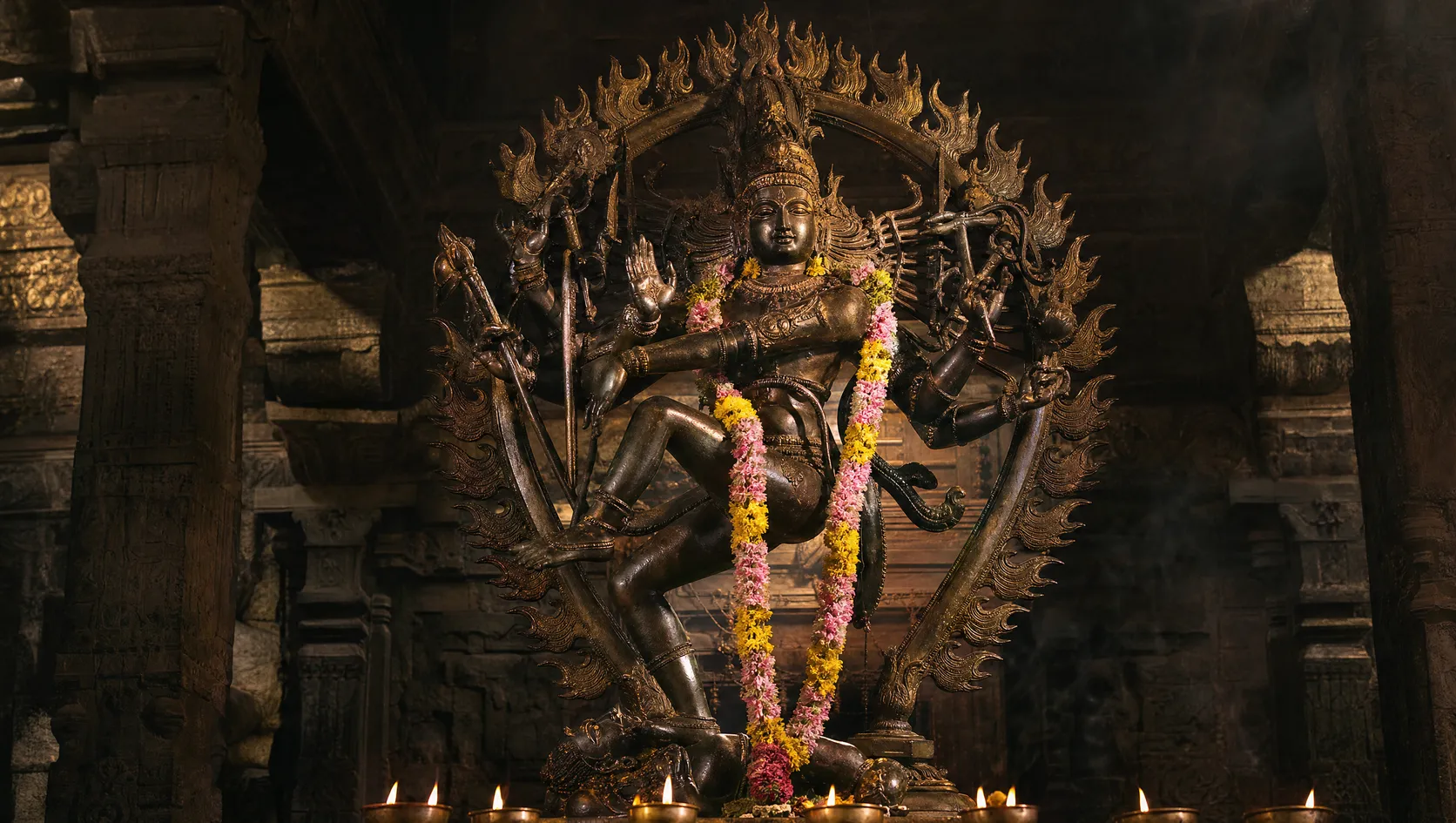
The temple's most striking image is the Aghora Murti, Shiva in his fierce, destructive aspect, worshipped here as a bronze of exceptional force. Aghora is the face of Shiva turned toward dissolution, and the tradition holds that worship of this form dissolves fear and the accumulated weight of wrong. That the fiercest face of Shiva should preside over the shrine of Mercury, the gentlest and most adaptable of the planets, is a juxtaposition the tradition does not explain and does not need to: the point of the circuit is that the planet is always the smaller presence.
Budha, Mercury, has his shrine here, and pilgrims addressing afflictions of intellect, speech, commerce and nervous unsteadiness, the domains Mercury governs, come to it on the circuit.
उद्धृत स्रोत:
- Temple sthala purana (Swetaranya and the elephant Sweta)
- Navagraha circuit tradition (Budha sthalam account)
- Aghora Murti tradition of Thiruvenkadu
विद्वत संदर्भ
Thiruvenkadu is a paadal petra sthalam of considerable standing, praised in the Tevaram, and its epithet Adi Chidambaram signals a claim to great antiquity and to association with the Nataraja tradition of nearby Chidambaram. It was an important Shaiva centre long before its assignment as the Mercury station of the Navagraha circuit. The temple is particularly noted among art historians for its bronzes, including the Aghora Murti, which are studied as examples of Chola metalwork of the highest order. The concentration of fine bronze at the site is one of the reasons it is treated as a major temple rather than a minor circuit stop. As with the other circuit temples, the Budha assignment is a later layer over an existing Shaiva shrine. The fit between Mercury, the planet of intellect and speech, and this particular temple is less pointed than the healer-Mars fit at Vaitheeswaran Koil; here the assignment appears to follow the circuit's need for a Mercury station more than any prior Mercury association.
Historyइतिहास
Thiruvenkadu is one of the more important paadal petra sthalams of the Cauvery delta, praised in the Tevaram and holding the epithet Adi Chidambaram, which claims for it an antiquity and a standing associated with the great Nataraja temple nearby. Its origins as a Shaiva shrine are held to be very old, and the white forest of its name is explained by the story of the elephant Sweta whose devotion gave the place its identity.
The temple is celebrated for its bronzes. The Aghora Murti, a representation of Shiva's fierce aspect, is among the most powerful bronze images in South India, and the site's metalwork is studied as an example of Chola casting at its height. This concentration of fine sculpture marks Thiruvenkadu as a major temple in its own right, not merely a station on a circuit.
The temple received Chola and later patronage, and its complex, with three named tanks and numerous subsidiary shrines, took shape across successive periods. When the Navagraha circuit was organised across the delta, Thiruvenkadu was assigned Mercury, Budha, and the Budha shrine within the complex became the focus for pilgrims addressing afflictions of the intellect, speech and commerce that Mercury governs.
In the modern period the temple comes under the Tamil Nadu Hindu Religious and Charitable Endowments Department, and its visitor numbers rose considerably as the Navagraha circuit became an organised pilgrimage, though it retains a standing among Shaiva devotees and art historians independent of the circuit.
Historical Timelineऐतिहासिक कालक्रम
The temple is praised in the Tevaram hymns of the Nayanar saints, establishing it as a paadal petra sthalam and fixing its antiquity as a Shaiva shrine centuries before the structures now standing.
The epithet Adi Chidambaram signals a claimed antiquity beyond even the Tevaram attestation.
The Swetaranya identity becomes established, the white forest named for the elephant Sweta whose devotion to Shiva is remembered at the site.
The temple receives substantial Chola patronage, and its celebrated bronzes, including the Aghora Murti, are cast in this period as examples of Chola metalwork at its height.
The Thiruvenkadu bronzes are among the most studied examples of Chola casting.
The three tanks, the pillared halls, the gopuram and the numerous subsidiary shrines take their present form across successive campaigns of building and repair.
The Navagraha circuit of the Cauvery delta takes shape, and Thiruvenkadu is assigned Mercury, its Budha shrine becoming the focus for pilgrims of the circuit.
The Mercury assignment is a later layer over an already major Shaiva shrine.
Later patronage under the Thanjavur Nayakas and Marathas supports additions and repairs, as across the delta's temple landscape.
Several of the temple's finest bronzes enter museum collections and scholarly literature, bringing the site to the attention of art historians beyond the devotional world.
Colonial-era gazetteers record the temple within the delta's religious landscape, noting its place in the Navagraha circuit and its coastal setting near Sirkazhi.
Administration passes to the Tamil Nadu Hindu Religious and Charitable Endowments Department, and periodic renovation and kumbhabhishekam are carried out.
As the Navagraha circuit grows into an organised pilgrimage, visitor numbers at Thiruvenkadu rise well beyond its earlier draw, arriving both for the Aghora Murti and for Mercury remedies.
What You'll Seeदर्शन में
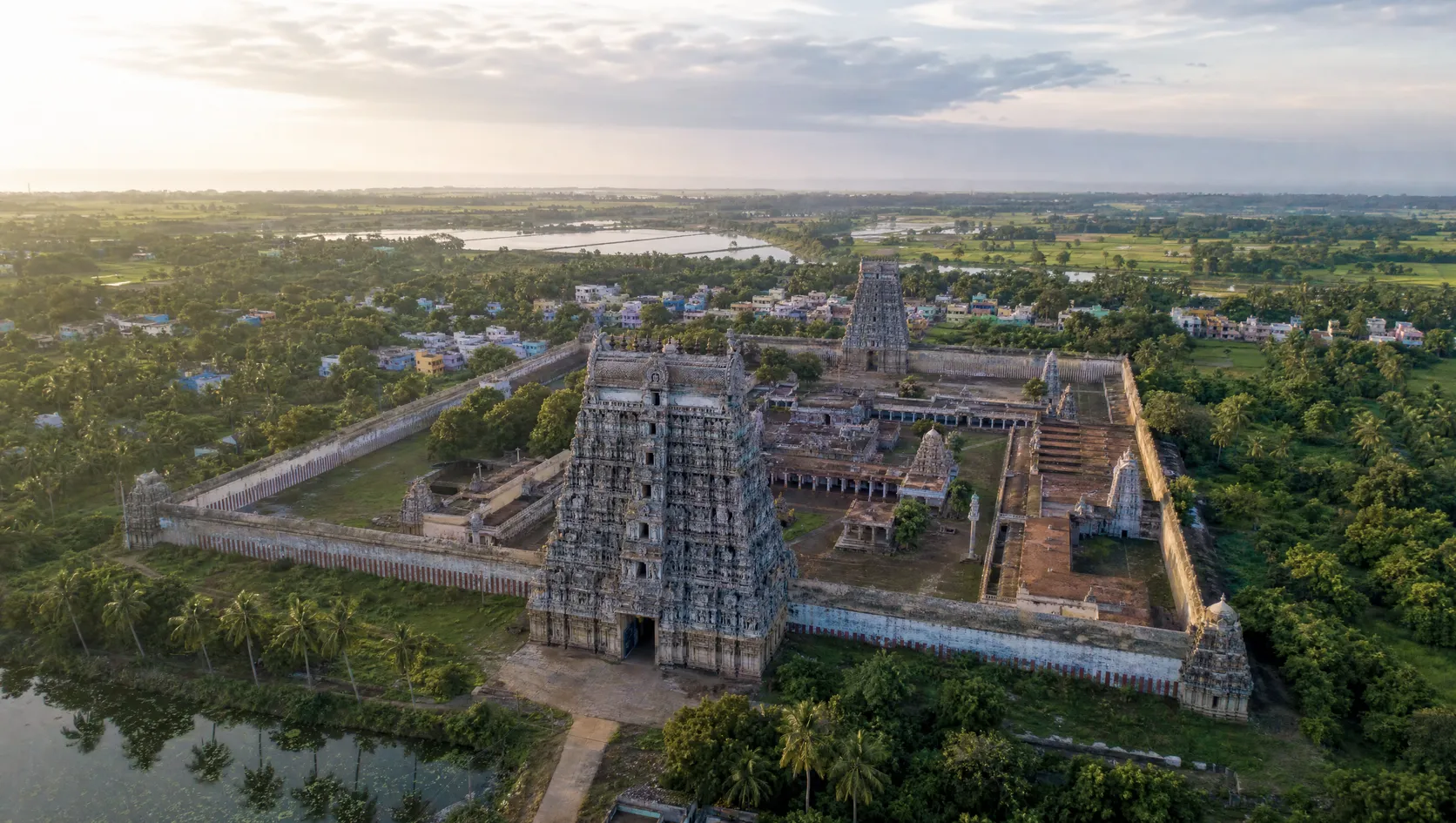
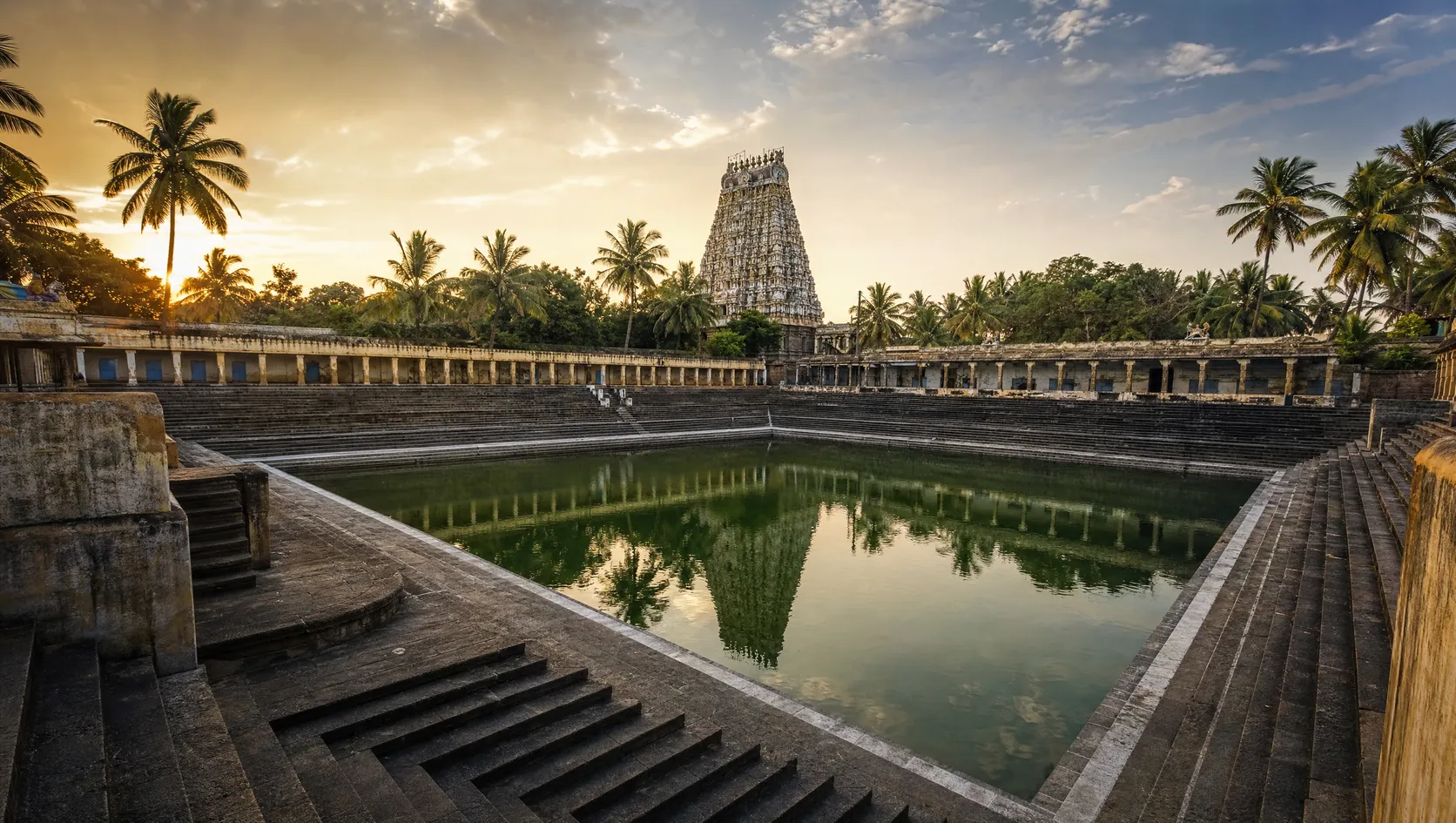
The presiding deity is Shiva as Swetaranyeswarar, worshipped as a linga in the main sanctum, with the goddess in her own shrine. The complex is large by the standards of the circuit, with three named tanks, the Agni, Surya and Chandra theerthams, and numerous subsidiary shrines.
The image for which the temple is most celebrated is the Aghora Murti, a bronze of Shiva's fierce aspect of exceptional power, studied as a masterwork of Chola casting. Aghora is the destructive face, and its worship is held to dissolve fear and the weight of accumulated wrong; the image is approached with a seriousness the gentler forms do not demand.
The Budha shrine, which brings the circuit pilgrim, holds Mercury in his graha form, green in complexion, associated by the correspondences of graha worship with green, with green gram, with emerald and with Wednesday. Mercury governs intellect, speech, commerce and the nervous system, and the shrine is approached for afflictions in those domains.
The juxtaposition is the temple's signature: the mildest planet housed under the fiercest face of Shiva, the graha of quick wit and adaptability kept in the presence of the god of dissolution.
Distinctive Practicesविशिष्ट परंपराएँ
Worship of the Aghora Murti
अघोर मूर्ति की उपासना
Central to the temple's worship, particularly at prescribed times
The Aghora Murti, the fierce bronze form of Shiva, is central to worship at Thiruvenkadu, and its darshan is sought for the dissolution of fear and of the accumulated weight of wrong. The image is treated with a gravity distinct from the gentler forms.
Aghora is the face of Shiva turned toward destruction, and the tradition holds that what it destroys, approached rightly, is fear itself and the residue of past wrong. The fierce form is not to be placated but to be received; its power is the instrument of its mercy.
Bathing in the Three Tanks
तीन सरोवरों में स्नान
Before darshan, particularly on auspicious days
The temple has three named tanks, the Agni, Surya and Chandra theerthams, and pilgrims bathe in them before darshan, each associated with its own quality. The multiplicity of tanks is itself a mark of the temple's standing.
Three tanks named for fire, sun and moon gather the elements around the shrine, and bathing in them is understood as a preparation of the body and mind before approaching the fierce form of Shiva within. The greater the deity, the more the tradition surrounds the approach with preparation.
Mercury Remedy at the Budha Shrine
बुध मंदिर में बुध-निवारण
Wednesdays and according to horoscope
Pilgrims addressing a Mercury affliction come to the Budha shrine, offering green flowers, green cloth and green gram according to the graha's correspondences, particularly on Wednesdays, the day of Mercury.
Mercury governs intellect, speech, commerce and the nerves, and its afflictions are read into difficulties in study, in communication, in business and in mental steadiness. Remedies here are sought especially by students and by those whose work depends on the mind and the tongue.
Green Offerings for Mercury
बुध के लिए हरी भेंट
At the Budha shrine, particularly for Mercury remedies
Offerings for Mercury follow the graha's colour and substance: green flowers, green cloth, green gram and, where prescribed, emerald. The correspondences are specific to Budha and differ from those of the other eight planets.
The colour system makes each graha shrine legible by its offerings alone, and for Mercury green carries the associations of freshness, quickness and growth, the qualities of a mind that adapts. The offering is chosen to match the faculty the devotee hopes to steady or sharpen.
Did You Know?क्या आप जानते हैं?
Thiruvenkadu means the white forest, and its Sanskrit name Swetaranya means the same; the colour points to Mercury, whose complexion in the graha system is green, and whose station this is.
Tamil and Sanskrit toponymic tradition
The temple's Aghora Murti, a bronze of Shiva's fierce aspect, is among the most powerful in South India and is studied as a masterwork of Chola casting, so the Mercury station is presided over by the fiercest of Shiva's faces.
Art-historical study of the Thiruvenkadu bronzes
The temple is called Adi Chidambaram, a first or original Chidambaram, tying it to the great Nataraja temple nearby and claiming for it an antiquity beyond even its Tevaram attestation.
Temple tradition; Tevaram corpus
The white forest of the name is explained by the story of a white elephant, Sweta, whose devotion to Shiva at this place gave it its identity, and who is remembered in the temple's account of itself.
Temple sthala purana
The temple has three named tanks, the Agni, Surya and Chandra theerthams, gathering fire, sun and moon around the shrine, a multiplicity unusual among the circuit temples.
Temple tradition
Mercury governs intellect, speech and commerce in the graha system, so remedies here are sought especially by students and by those whose livelihood depends on the mind and the spoken word.
Standard graha correspondences
That the gentlest and most adaptable of the planets should be housed under the fiercest face of Shiva is the temple's characteristic juxtaposition, and one the tradition leaves unexplained.
Site tradition; Navagraha circuit structure
Visitor Accessप्रवेश जानकारी
The temple is open to devotees without entry restriction. Traditional dress is customary, as at other temples in the Tamil delta, and footwear is removed at the entrance. Pilgrims come both for the Aghora Murti and for the Budha shrine of the Navagraha circuit; many take darshan of the presiding Swetaranyeswarar and the Aghora Murti before turning to the graha. Those on the circuit make the Mercury offering at the Budha shrine. The complex is larger than most circuit temples, so a visit takes somewhat longer, and the bronzes reward unhurried attention. Wednesdays, the day of Mercury, are the busiest for circuit pilgrims.
Give the temple more time than a circuit stop; take darshan of the presiding Swetaranyeswarar and the Aghora Murti, which are the heart of the place, before making the Mercury offering at the Budha shrine. If a specific Mercury remedy is intended, arrange the archana on arrival and bring or buy the green flowers and green gram associated with the planet. Wednesdays are busiest. The complex and its bronzes reward unhurried attention, so it is worth not treating this temple purely as one of nine.
Festivalsत्योहार
Wednesday Worship (Budhan Vaaram)
बुधवार उपासना
Weekly, throughout the year
Wednesday, the day of Mercury, is the temple's weekly high point for circuit pilgrims, when the Budha shrine draws the largest gatherings and Mercury remedies are most sought.
Maha Shivaratri
महाशिवरात्रि
Feb-Mar (Phalgun Krishna Chaturdashi)
As the presiding deity is Shiva, and the Aghora Murti is central to the temple, Maha Shivaratri is observed with night-long vigil and worship of particular intensity here.
Brahmotsavam
ब्रह्मोत्सवम्
Varies by temple calendar
The annual festival of the presiding deity, with processions of the utsava murti and the celebrated bronzes taken out in procession, drawing pilgrims beyond the regular circuit traffic.
Pradosham
प्रदोषम्
Twice monthly, on the thirteenth lunar day
The twilight worship of Shiva observed on the thirteenth day of each lunar fortnight is kept here as at Shiva temples generally, and carries added weight at a temple famed for its fierce form of the deity.
Traditional Offeringsपारंपरिक अर्पण
प्राथमिक अर्पण
Bel Patra (Bilva leaves)
बेल पत्र
बिल्व पत्र
The bilva leaf, the offering most closely associated with Shiva, is given to the presiding Swetaranyeswarar and before the Aghora Murti. At a temple whose central image is the fierce form of Shiva, the standard Shiva offering comes first, before the pilgrim turns to the graha.
Green flowers and green gram for Mercury
बुध के लिए हरे पुष्प और हरे चने
Green is the colour assigned to Mercury and green gram its grain. These are offered at the Budha shrine according to the graha's correspondences, and the grain is often donated afterwards as part of a prescribed remedy.
Vibhuti (sacred ash)
विभूति (भस्म)
विभूति
Sacred ash is applied and offered in Shaiva worship, and at a temple centred on the fierce Aghora form it carries the association of what remains when everything else has been consumed, the residue Shiva's destructive aspect leaves and blesses.
Ghee lamp
घी का दीप
A lamp is lit at the Budha shrine, often the single most common element of a Mercury remedy, and lamps are offered before the Aghora Murti as light set against the deity's darkness of dissolution.
इस मंदिर की विशेषता
Offering Before the Aghora Murti
अघोर मूर्ति के समक्ष भेंट
What is distinctive to Thiruvenkadu is worship offered before the Aghora Murti, the fierce bronze form of Shiva, sought for the dissolution of fear and of the accumulated weight of wrong. Lamps, ash and dark-toned offerings are made before it with a gravity the gentler shrines do not carry. The pilgrim who came for Mercury, the mildest planet, makes this offering to the fiercest face of the deity on the way, and the tradition treats the encounter as the more important of the two. The graha remedy addresses a portion of a life; the Aghora Murti addresses the fear that underlies the wish for remedy at all.
Offering materials for both the Shiva worship and the Mercury remedy are sold near the temple, and it is simplest to buy them there, since the graha correspondences are specific. If a specific Mercury remedy has been prescribed, arrange the archana at the Budha shrine on arrival. Many pilgrims take darshan of the Aghora Murti and the presiding Swetaranyeswarar before making the graha offering, following the temple's own order of worship. Eternal Raga presents these practices as devotional tradition and does not offer astrological advice.
How to Reachकैसे पहुँचें
Thiruvenkadu lies in the Cauvery delta near Sirkazhi, close to the coast, and Kumbakonam is the usual base for the Navagraha circuit of which it is part.
By air: Tiruchirappalli International Airport is roughly 100 km away and is the nearest useful airport. Chennai is considerably further but far better connected.
By rail: Sirkazhi, roughly 20 km away, is the nearest railhead, on the line between Chidambaram and Mayiladuthurai. Mayiladuthurai is the larger junction.
By road: The temple is reached by road from Sirkazhi or Mayiladuthurai, and taxis are readily hired at Kumbakonam, the usual circuit base. The delta roads are flat and the driving is easy, though Thiruvenkadu's coastal position places it somewhat apart from the more clustered circuit temples.
Most pilgrims visit as one station of the Navagraha circuit. Because Thiruvenkadu is a major temple in its own right, some come for the Aghora Murti alone. Hiring a vehicle for a day or two from Kumbakonam covers all nine temples comfortably.
Plan Your Visitयात्रा की योजना
🌤 सर्वोत्तम मौसम
November to February is the most comfortable period in the delta, with cooler air and manageable humidity, and it is when the multi-stop circuit is most pleasant to drive. March to June is hot, often severely so, and Thiruvenkadu's coastal position adds humidity. The northeast monsoon, roughly October to December, brings rain that can affect road travel, and the coastal location makes it somewhat more exposed than the inland circuit temples. Wednesdays are the busiest for circuit pilgrims, and Maha Shivaratri draws the largest gatherings of the year. For a quieter visit that also does justice to the bronzes, an ordinary weekday morning in the cool season is best.
👘 पहनावे का नियम
Traditional dress is customary, as at Tamil temples generally. Men commonly wear a dhoti or trousers with a shirt; in the inner areas a dhoti without an upper garment may be expected. Women wear saree or salwar kameez. Footwear is removed at the entrance, and those intending to bathe in the temple tanks should bring a change of clothes.
📱 फोन और फोटोग्राफी
Photography restrictions apply within the sanctum, as at Tamil temples generally, and the temple's celebrated bronzes are generally not to be photographed. The outer areas and tanks are usually less restricted, but check locally rather than assuming. Phones should be silenced.
🏨 आवास
There is limited accommodation in Thiruvenkadu itself. Sirkazhi and Mayiladuthurai nearby offer basic lodges, and Kumbakonam, the usual circuit base, has a fuller range of hotels and is well placed for the rest of the Navagraha temples. Most pilgrims base themselves at Kumbakonam and cover Thiruvenkadu as part of a day's circuit, though those wishing to give the temple and its bronzes proper time may prefer to stay nearer.
Sacred Soundsपवित्र ध्वनि
क्या आप जानते हैं? · Did You Know?
वही अनुवाद त्रुटि जिसने हिन्दू धर्म में '33 कोटि' को '33 करोड़' बनाया, बौद्ध धर्म में भी हुई। बौद्ध ग्रन्थों के चीनी अनुवाद ने 'सप्त कोटि बुद्ध' (7 श्रेष्ठ बुद्ध) का अनुवाद '7 करोड़ बुद्ध' कर दिया। तिब्बती अनुवाद ने सही किया: 7 प्रकार, 7 करोड़ नहीं। एक संस्कृत शब्द, दो प्रमुख विश्व धर्मों में गलत पढ़ा गया, ने दो एकसमान भ्रम स्वतन्त्र रूप से उत्पन्न किए।
Related Contentसंबंधित सामग्री
Related Scriptures
Community Reflections
🕉️
Be the first to share your reflection.