Ahobilam Narasimha
अहोबिलम् नरसिंह
The fiercest form of Vishnu, and the forest tribe that calls him family
Ahobilam, Andhra Pradesh, India
Ahobilaṃ NarasiṃhaAlso known as: Ahobalam, Singavel Kundram, Nava Narasimha Kshetram, Ahobila Narasimha
Era
Sung by Thirumangai Alvar as Singavel Kundram, placing it among the 108 Divya Desams; substantial temple building and endowment under the Vijayanagara period, with the Ahobila Matha established in the late fourteenth century
Architecture
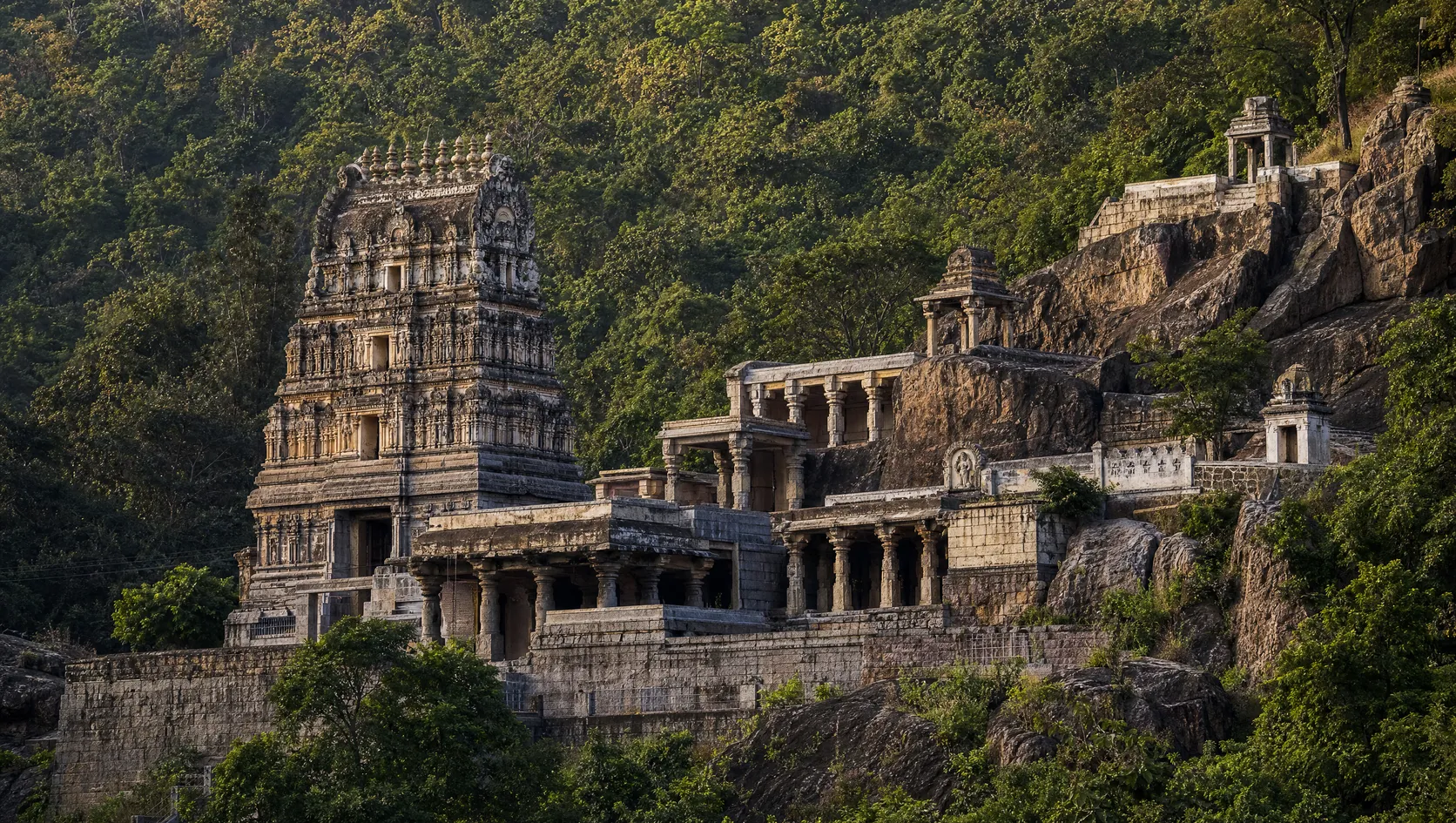
Dravidian, with Vijayanagara-period pillared mandapas and sculpture, set into natural rock and forest terrain
Special
The nine Narasimha shrines are dispersed across the hills rather than gathered in one complex. Some are reached by road, others only on foot through forest terrain, and access to the more remote shrines depends on season, daylight and forest department conditions.
The Sacred Legend · पवित्र कथा
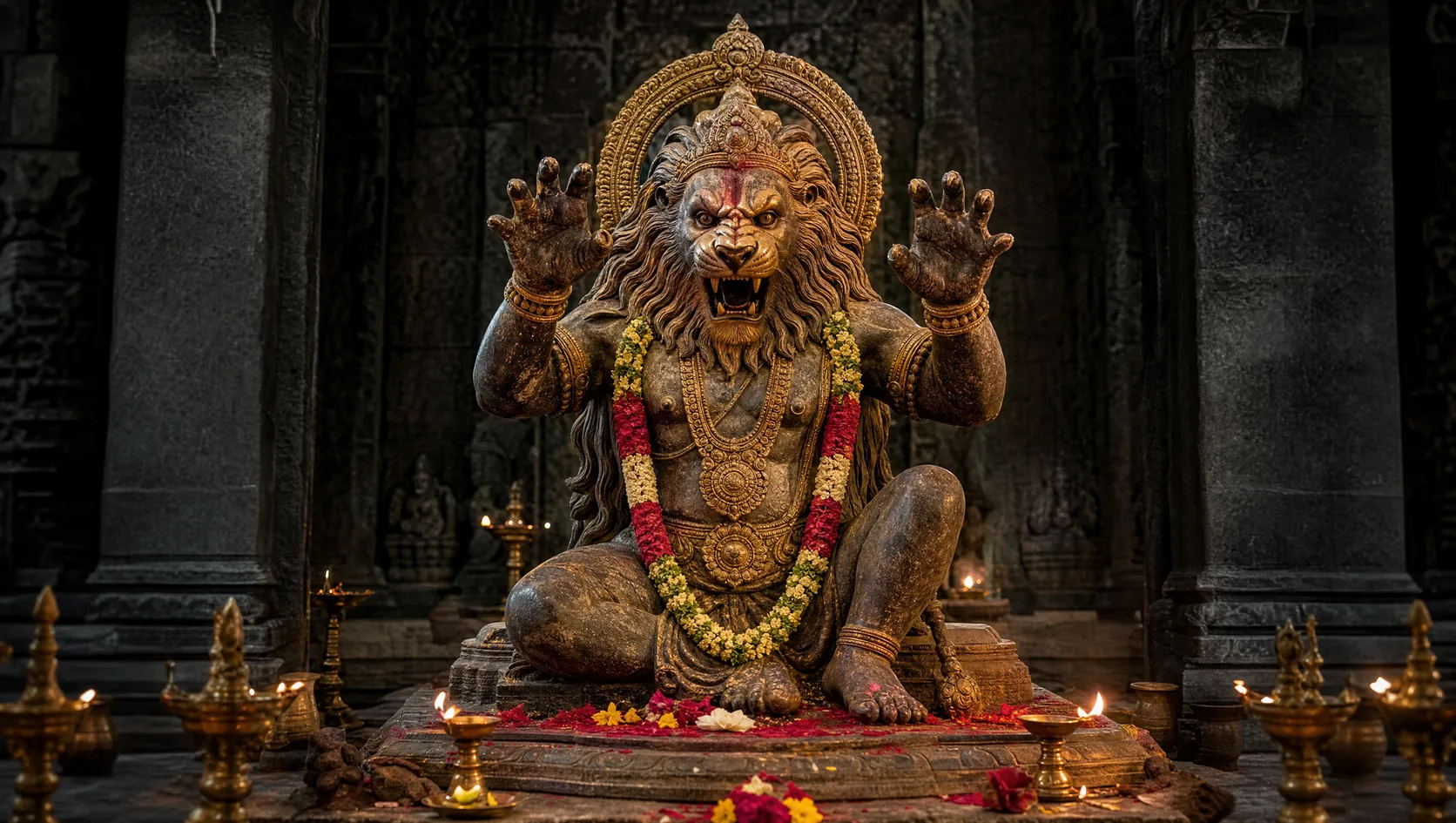
Narasimha is the avatar the tradition reaches for when it wants to describe rage. He is the one who could not be contained by any of the conditions of Hiranyakashipu's boon, who came out of a pillar at dusk, neither man nor beast, and tore a king apart on a threshold. And at Ahobilam, the tradition marries him to a Chenchu woman. The Chenchus are a forest people of the Nallamala hills, and their account is not that a god visited them. It is that he married into them. They call him brother-in-law. In the older telling he courts her in the forest, is refused, persists, and is accepted on her terms. Some of the temple's ritual acknowledges Chenchu precedence at particular shrines. So the most terrifying form in the Vaishnava canon is also the one with in-laws — and they are not kings or sages, but hunters who consider him kin.
Sacred Designationपवित्र पदनाम
Sacred Origin Storyपवित्र उत्पत्ति कथा
Source: The Narasimha avatara of the Bhagavata Purana and Vishnu Purana, localised at Ahobilam through the site's own sthala purana
Hiranyakashipu had secured a boon of extraordinary precision. He could not be killed by man or beast, by day or night, indoors or outdoors, on earth or in the air, by any weapon, by deva, asura or animal. Every avenue of death had been closed by careful drafting, and he had read the document himself.
His son Prahlada worshipped Vishnu. The father tried argument, then punishment, then attempts on the boy's life, and none of it worked, because the boy would not stop saying that Vishnu was everywhere.
Everywhere, said the king at last. Is he in this pillar?
The pillar split.
What came out was neither man nor beast: a lion's head on a human body, which the boon had not anticipated because it had listed categories rather than combinations. He took the king to a threshold, which is neither indoors nor outdoors. He did it at dusk, which is neither day nor night. He laid him across his lap, which is neither earth nor air. And he used his claws, which are grown rather than made and therefore not weapons.
Every clause was honoured. The king still died.
The devas, watching, are said to have cried out at that great strength, aho balam, and the hills took the name. Nine forms are venerated across the site, marking where the tradition holds he appeared, where he pursued, where he rested, and where he was finally pacified.
Sources cited:
- Bhagavata Purana, Canto 7 (Prahlada and the Narasimha avatara)
- Vishnu Purana, sections on the avataras
- Ahobilam sthala purana
- Nalayira Divya Prabandham (Thirumangai Alvar)
Scholarly Context
The Narasimha narrative itself is pan-Indian and securely attested in the major Puranas. What is specific to Ahobilam is its localisation: the identification of these particular hills as the site of the appearance, and the distribution of nine forms across the landscape. The Chenchu Lakshmi tradition is of particular interest to scholars of tribal-Brahmanical interaction. Rather than a forest community being absorbed into a temple's orbit as devotees, the Chenchus appear in the tradition as affinal kin, with corresponding claims. Comparable patterns exist elsewhere in the Deccan, but the Ahobilam case is among the more explicit, and it is reflected in ritual practice rather than only in narrative. The Ahobila Matha's peripatetic character is likewise unusual and is documented in the lineage's own records from the late fourteenth century onward.
Historyइतिहास
Ahobilam's standing in the Sri Vaishnava tradition rests first on the Alvars. Thirumangai Alvar sings of it as Singavel Kundram, which places it among the 108 Divya Desams and attests to its importance well before the medieval temple-building that gave the site its present shape.
The decisive institutional development came in the late fourteenth century with the founding of the Ahobila Matha, a Sri Vaishnava monastic lineage whose head bears the title Jeeyar. The Matha is unusual among Indian monastic institutions in that it has historically been peripatetic: the Jeeyar travels with the processional deity Malola Narasimha rather than remaining fixed at a single seat. This mobility carried Ahobilam's influence across South India and gave the shrine a reach disproportionate to its remote location, with the Matha acquiring followers and establishments far from the Nallamala.
Vijayanagara patronage in the fifteenth and sixteenth centuries funded much of the visible construction, including pillared mandapas and sculptural programmes characteristic of the period. Inscriptions record endowments from that era, and the empire's interest in the site fits its wider pattern of supporting shrines along the Deccan's forested frontier.
After Vijayanagara's decline the site received less sustained patronage, and its remoteness became the dominant fact of its history. That remoteness preserved the shrines from the disruptions that affected more accessible temples, but it also kept Ahobilam outside the ordinary pilgrimage circuits for long stretches, sustained more by the Matha's network than by passing traffic.
In the modern period the surrounding Nallamala forest has been brought under protection, and the area's status as protected forest and tiger habitat now governs how the site can be accessed and developed. Road access to Upper Ahobilam has improved, but several of the nine shrines remain reachable only on foot.
Historical Timelineऐतिहासिक कालक्रम
Thirumangai Alvar sings of the site as Singavel Kundram, establishing it among the 108 Divya Desams and providing the earliest secure evidence of its standing.
The Alvar attestation predates the surviving built fabric by several centuries.
Regional patronage supports worship at the site, with the shrines developing across the hills rather than as a single walled complex.
Documentation for this period is thinner than for the Vijayanagara era that follows.
The Ahobila Matha is founded, establishing a Sri Vaishnava monastic lineage headed by a Jeeyar. Tradition dates the founding to 1398 under Adi Van Satakopa Jeeyar.
The 1398 date comes from the Matha's own tradition; the institution's continuous existence from the late fourteenth century is not in dispute.
The Matha's peripatetic character is established, with the Jeeyar travelling with the processional deity Malola Narasimha rather than presiding from a fixed seat.
Vijayanagara patronage funds substantial construction, including pillared mandapas and sculptural work in the idiom of the period.
Endowments from the Vijayanagara court are recorded, fitting the empire's wider practice of supporting shrines along the forested Deccan frontier.
After Vijayanagara's decline, sustained state patronage falls away and the site is supported principally by the Matha's own network.
The site's remoteness becomes the dominant fact of its history, preserving the shrines from disruptions affecting more accessible temples while keeping them outside the ordinary pilgrimage circuits.
Colonial-era surveys and gazetteers record the shrines and note the difficulty of access, providing some of the earliest external descriptions of the nine-shrine arrangement.
The surrounding Nallamala forest is brought under protection, and the area's conservation status begins to govern how the site can be accessed and developed.
Road access to Upper Ahobilam improves, bringing the principal shrine within reach of vehicle traffic while the outlying shrines remain accessible only on foot.
The Nallamala's status as protected forest and tiger habitat continues to shape visiting conditions, with movement to the remoter shrines dependent on daylight, season and forest department arrangements.
What You'll Seeदर्शन में
Ahobilam is not one image but nine, and they differ from each other in mood as much as in form. Together they are known as the Nava Narasimha.
Ahobila, or Ugra, Narasimha is the principal form at the upper site, the fierce aspect from which the place takes its name. Malola Narasimha is Narasimha with Lakshmi, the gentlest of the nine and the form the Jeeyar of the Ahobila Matha carries in procession; the name is read as the one dear to Lakshmi, and its presence in the set is what keeps the group from being uniformly terrifying. Jwala Narasimha is the flaming form, associated with the moment of the killing itself. Kroda Narasimha combines boar and lion features, joining two avataras in a single image. Karanja Narasimha is associated with a tree of that name; Bhargava Narasimha with Parashurama; Yogananda Narasimha is seated in meditative posture; Chatravata Narasimha stands beneath a banyan; Pavana Narasimha lies furthest out, on the Pavana river, and is the hardest of the nine to reach.
The range across the nine is the point. A single site holds the avatar at his most violent and at his most composed, a few hills apart, and a pilgrim who completes the circuit encounters both.
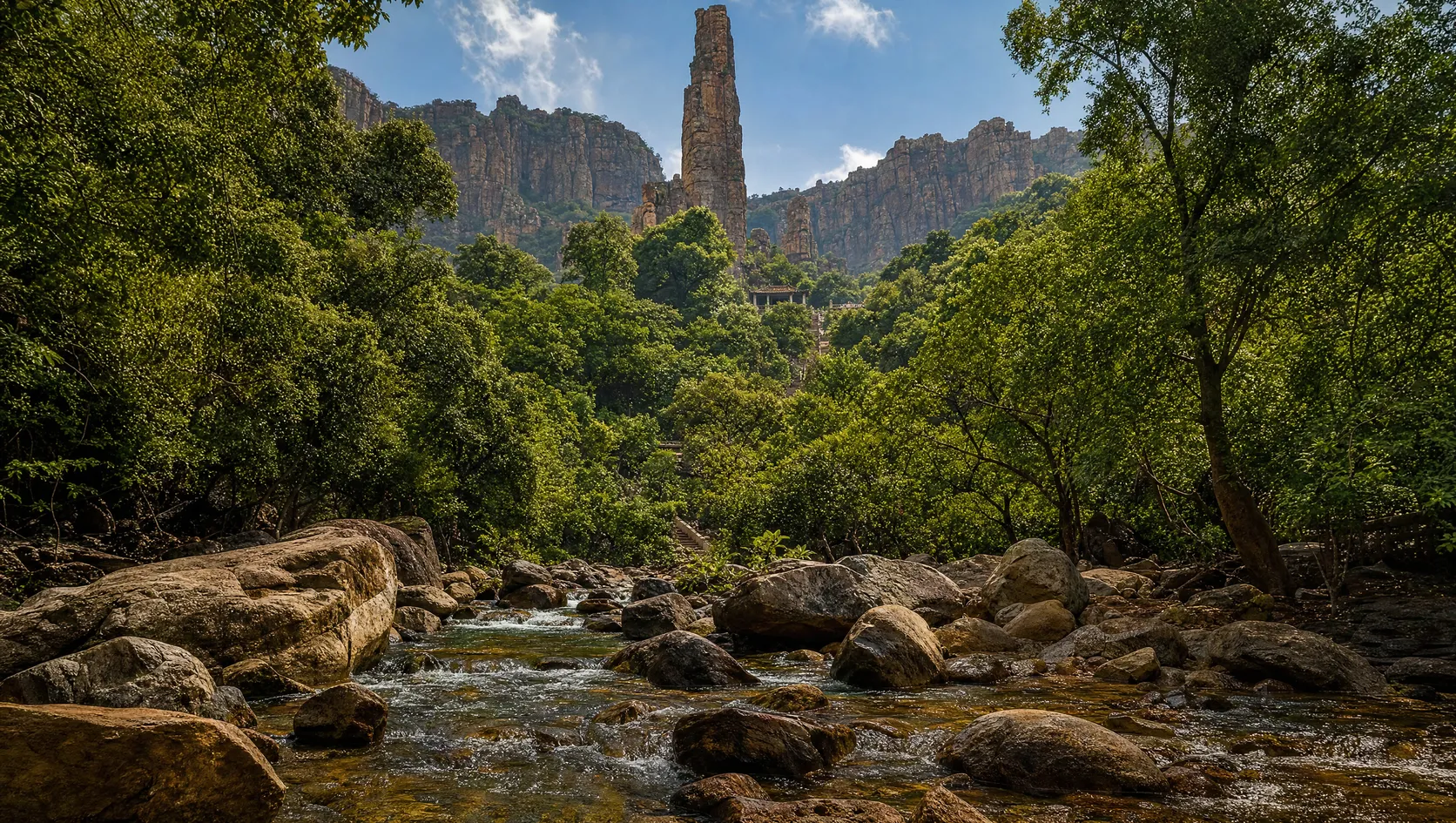
The Ugra Stambha, a rock formation on the upper hill, is venerated as the pillar from which he emerged. Lower Ahobilam holds the larger temple complex with its Vijayanagara-period mandapas and sculpture; Upper Ahobilam, some 8 km into the hills, holds the principal shrine.
Distinctive Practicesविशिष्ट परंपराएँ
The Nine-Shrine Circuit
नव-मंदिर परिक्रमा
Undertaken over one or more days
Pilgrimage here means visiting the Nava Narasimha shrines dispersed across the hills rather than a single sanctum. Some are reached by road, others by walking through forest, and completing all nine takes planning and physical effort. Pavana Narasimha, the furthest, is often left uncompleted.
The dispersal turns darshan into a journey through a landscape rather than an arrival at a building. Each shrine holds a different temper of the same deity, so the pilgrim encounters the avatar's full range rather than one fixed aspect, and the physical difficulty of the walk is treated as part of the offering rather than an obstacle to it.
The Travelling Jeeyar and Malola
भ्रमणशील जीयर और मलोल
Continuing tradition of the Ahobila Matha
The head of the Ahobila Matha travels with Malola Narasimha, the processional deity, rather than presiding from a fixed seat. The lineage has maintained this peripatetic character since the late fourteenth century, and the Jeeyar's tours cover establishments and followers across South India.
A monastery that moves takes the deity to devotees rather than requiring them to reach a remote forest. It is an unusual inversion of how a seat of authority normally works, and it is how a shrine in the Nallamala hills came to have influence across the south despite being difficult to visit.
Chenchu Association
चेंचू संबंध
Long-standing, reflected in ritual and in local observance
The Chenchu people of the Nallamala forest hold Narasimha as kin by marriage through Chenchu Lakshmi, and their relationship to the site is one of family rather than patronage. Chenchu precedence is acknowledged in connection with particular shrines and observances.
Most temple traditions record kings as patrons. This one records a forest community as relatives, which places the deity inside a kinship network rather than above a social hierarchy. The claim runs in the Chenchus' favour: a brother-in-law has standing that a devotee does not.
Cooling Offerings to the Fierce Forms
उग्र रूपों को शीतल भेंट
Throughout the year, particularly in summer
Offerings at the fierce shrines are predominantly cooling: panakam of jaggery and water, buttermilk, sandal paste and similar preparations, rather than the heating substances used in some other traditions.
The offering is understood as pacification rather than nourishment. Narasimha in his ugra form is held to remain heated after the killing, and the ritual intention is to cool him, which places the devotee in the position of someone calming a relative rather than petitioning a power.
Did You Know?क्या आप जानते हैं?
Ahobilam venerates nine distinct forms of the same avatar across dispersed hill shrines. Few Indian sites present one deity in so wide a range of temperaments, from Jwala Narasimha at the moment of killing to Yogananda Narasimha seated in meditation.
Site tradition and standard accounts of the Nava Narasimha shrines
The Ahobila Matha's head, the Jeeyar, travels with the deity Malola Narasimha rather than presiding from a fixed monastery. This peripatetic character has been maintained since the late fourteenth century and is unusual among Indian monastic institutions.
Ahobila Matha tradition; standard accounts of Sri Vaishnava monastic lineages
The Chenchu people of the Nallamala forest regard Narasimha as kin by marriage rather than as a deity they worship from outside, and refer to him as brother-in-law. Chenchu precedence is acknowledged at particular shrines.
Chenchu Lakshmi tradition; studies of tribal-Brahmanical interaction in the Deccan
The name is traditionally derived from the exclamation of the devas at the moment of Narasimha's appearance, aho balam, meaning what great strength, which is read into both Ahobalam and Ahobilam.
Sthala purana tradition of the site
The boon Hiranyakashipu obtained listed categories rather than combinations, which is precisely where it failed. A lion's head on a human body was not covered because the drafting had not anticipated a hybrid.
Bhagavata Purana, Canto 7
Kroda Narasimha combines the features of the boar and the lion, joining two of Vishnu's avataras in a single image, which is uncommon in Indian iconography.
Descriptions of the Nava Narasimha shrines
The shrines lie within the Nallamala forest belt, which is protected land and tiger habitat. Access to the more remote shrines is therefore governed by forest conditions and daylight as much as by temple timings.
Nallamala forest protected-area status
Visitor Accessप्रवेश जानकारी
Ahobilam is a forest site, and access is the main practical consideration. Lower Ahobilam is reached by road; Upper Ahobilam lies roughly 8 km further into the hills. Several of the nine shrines require walking on rough terrain, and the more remote among them involve genuine trekking. Because the shrines sit within protected forest, movement is affected by daylight, weather and forest department conditions. Travel in the hills after dark is generally not advisable. Local guides are commonly engaged for the outlying shrines. Facilities are limited compared with major pilgrimage towns. Plan for water, footwear suited to rock and forest paths, and a realistic assessment of fitness before attempting the full circuit.
Spiritual Basis
The difficulty is not incidental to the pilgrimage; it is close to being its content. Where a temple gathers everything into one enclosure, the devotee arrives and receives. Here the nine forms are separated by hills, and the pilgrim must decide how much of the deity they intend to meet. The tradition treats the walk between shrines as darshan rather than as travel toward darshan, which is why completing the circuit carries more weight than visiting the principal shrine alone.
Contemporary Context
Ahobilam receives far fewer visitors than the major Andhra pilgrimage centres, and infrastructure reflects that. Accommodation and food options are basic and concentrated at Lower Ahobilam. Mobile coverage is patchy in the hills. The forest's conservation status means access arrangements can change, and the outlying shrines are not always open to unaccompanied visitors. Anyone intending the full nine-shrine circuit should confirm current conditions locally on arrival rather than relying on published accounts, which date quickly.
Practical Guidance
Start early. The outlying shrines take longer than the distances suggest, and returning through forest after dark should be avoided. Carry more water than seems necessary and wear footwear with grip; the paths are rock rather than steps in places. Leeches are a genuine nuisance in the monsoon. Engage a local guide for Pavana and the further shrines rather than attempting them unaccompanied. Base yourself at Lower Ahobilam or Nandyal. Plan two days if the full circuit is intended; one day covers the main shrines comfortably.
Festivalsत्योहार
Narasimha Jayanti
नरसिंह जयंती
Apr-May (Vaishakha Shukla Chaturdashi)
The appearance day of Narasimha, observed at dusk in keeping with the hour at which the avatar is said to have emerged, neither day nor night. It is the most significant observance of the year at Ahobilam, and the timing is exact rather than approximate: the ritual is set to the junction of light and dark.
Brahmotsavam
ब्रह्मोत्सवम्
Feb-Mar (Phalguna)
The annual festival at the principal shrines, with processions of the utsava murti and the associated ritual sequence over several days. Crowds are substantial by Ahobilam's standards, though modest compared with the major Andhra centres.
Phalguna Utsavam and the Chenchu Lakshmi Kalyanam
फाल्गुन उत्सवम् और चेंचू लक्ष्मी कल्याणम्
Feb-Mar (Phalguna)
The ritual marriage of Narasimha and Chenchu Lakshmi is enacted, with Chenchu participation acknowledged in the observance. It is the point in the calendar where the tradition's claim of kinship with the forest community is performed rather than merely recounted.
Vaikunta Ekadasi
वैकुंठ एकादशी
Dec-Jan (Dhanurmasa)
Observed as at Vaishnava temples generally, with special worship and darshan arrangements at the principal shrine. The cooler season makes it one of the more comfortable times to attempt the wider circuit as well.
Traditional Offeringsपारंपरिक अर्पण
Primary Offerings
Tulsi leaves
तुलसी
तुलसी
Tulsi is the offering most closely associated with Vishnu in all his avataras, and worship is not considered complete without it. The plant is treated as a devotee in her own right rather than as material. At the fierce shrines tulsi is offered alongside cooling substances rather than alone, the two together forming the standard combination of devotion and pacification.
Panakam
पानकम्
Jaggery dissolved in water, often with cardamom, dry ginger and a little pepper, offered cool. It is the characteristic offering to Narasimha in his fierce aspects and is distributed afterwards to devotees. The intention is explicitly pacification. Narasimha is held to remain heated after the killing, and the offering is understood as cooling him rather than feeding him, which places the devotee in the position of calming a relative.
Buttermilk and cooling preparations
छाछ और शीतल पदार्थ
Buttermilk, curd-based preparations and sandal paste are offered particularly in the summer months, when the heat of the Nallamala is at its most severe and the ritual logic of cooling the deity coincides with the physical experience of the pilgrim. The same preparations are distributed to those who have walked to the shrines, so the offering and the relief are the same substance.
Lamps at the shrines
मंदिरों पर दीप
Oil lamps are lit at each of the shrines visited, and pilgrims completing the circuit commonly light one at every stage rather than only at the principal sanctum. The practice gives the dispersed circuit a thread: a single pilgrimage recorded in nine small fires across a landscape, each marking that the walk between them was made.
Unique to This Temple
Offerings at the Ugra Stambha
उग्र स्तंभ पर भेंट
The Ugra Stambha, the rock formation on the upper hill venerated as the pillar from which Narasimha emerged, receives its own offerings from pilgrims who make the climb to it. What is offered there is offered not to an image but to a place, and to the moment the place records. The pillar is the only element of the Hiranyakashipu narrative that survives as a physical object in the landscape, and the offering acknowledges the split rather than the deity who came through it.
Offerings are arranged at the shrines themselves. Because the nine are dispersed and staffing varies, what can be offered where is not uniform, and the outlying shrines may have minimal arrangements. Pilgrims intending offerings across the full circuit commonly carry basic materials with them rather than expecting to buy at each stage, and check at Lower Ahobilam before setting out.
How to Reachकैसे पहुँचें
Ahobilam is remote, and reaching it takes more planning than most Divya Desams.
By rail: Nandyal is the usual railhead, roughly 65 km away, with connections into the Andhra Pradesh network. Cuddapah and Kurnool are alternatives.
By air: Kurnool (Orvakal) Airport is the nearest, with limited connections. Hyderabad offers far more flights but is a long road journey away, in the region of five to six hours.
By road: Ahobilam is reached by road from Nandyal or Allagadda. Buses and taxis serve Lower Ahobilam, though services are not frequent and thin out considerably in the evening. The stretch from Lower to Upper Ahobilam is about 8 km of hill road, and vehicles are commonly hired locally for it.
On foot: the outlying shrines among the Nava Narasimha require walking, some of it steep and over rough ground through forest. Start early, carry water, and allow considerably more time than the distances suggest. Local guidance is worth arranging for the remoter shrines, and is sometimes required rather than optional.
Plan Your Visitयात्रा की योजना
🌤 Best Season
October to February is the practical window. The Nallamala summer is severe, with temperatures that make the walking sections genuinely punishing and water a real constraint rather than a convenience. The monsoon brings slippery rock, leeches and streams that can rise quickly across forest paths, and some of the outlying shrines become effectively unreachable. Narasimha Jayanti (Apr-May) is the most charged observance but falls in the hottest part of the year, so plan around heat if visiting then and confine ambitions to the main shrines. Winter mornings are the best conditions for attempting the outlying shrines.
👘 Dress Code
Traditional dress is customary at the shrines, as at Andhra temples generally, and footwear is removed at temple entrances. There is no dress code as strict as those at Kerala temples. For the walking sections, practical clothing matters more than formality: covered legs help against thorns and leeches, and footwear with grip is important on rock. Many pilgrims carry a change of clothes for the shrines and walk in something more suited to the terrain.
📱 Phones & Photography
Photography restrictions apply within the sanctums, as at Indian temples generally; check locally at each shrine, since practice is not uniform across the nine. More practically, mobile coverage in the hills is patchy and cannot be relied on. Anyone walking to the outlying shrines should not assume a phone will work, and should tell someone at base where they are going and when they expect to return.
🏨 Accommodation
Accommodation is basic and concentrated at Lower Ahobilam, where the Matha and the temple administration maintain rest houses, along with a small number of private lodges. Options are limited and fill during Brahmotsavam and Narasimha Jayanti. Many visitors prefer to base themselves at Nandyal, which has a fuller range of hotels, and travel to Ahobilam for the day. That works well for the main shrines but leaves little margin for the outlying ones, which need an early start from close by.
Sacred Soundsपवित्र ध्वनि
Did You Know? · क्या आप जानते हैं?
The same translation error that turned '33 Koti' into '33 crore' in Hinduism also happened in Buddhism. The Chinese translation of Buddhist texts rendered 'Sapta Koti Buddha' (7 Supreme Buddhas) as '7 Crore Buddhas.' The Tibetan translation got it right: 7 types, not 7 crore. One Sanskrit word, misread across two major world religions, generated two identical misconceptions independently.
Related Contentसंबंधित सामग्री
Related Scriptures
Community Reflections
🕉️
Be the first to share your reflection.