Padmanabhaswamy Temple
पद्मनाभस्वामी मंदिर
The king who gave away his kingdom and stayed on as its servant
Thiruvananthapuram, Kerala, India
Śrī PadmanābhasvāmīAlso known as: Ananthapadmanabhan, Padmanabha, Ananthasayanam Perumal, Thiruvananthapurathappan

Era
Attested in Tamil Sangam-era literature and sung by the Alvars as one of the 108 Divya Desams; the present structure is substantially the result of eighteenth-century rebuilding under Marthanda Varma, on a far older site
Architecture
A blend of Kerala and Dravidian idioms, with a seven-tier gopuram over the eastern entrance
Special
Darshan of the reclining deity is taken through three separate doors, each framing a different portion of the form. Timings run in discrete morning and evening windows with closures between; exact windows are set by the temple administration and change on festival days.
The Sacred Legend · पवित्र कथा
In 1750, Marthanda Varma of Travancore did something no other Indian ruler did. He formally surrendered his kingdom to Padmanabhaswamy, laid his sword before the deity, and declared that from that day the state belonged to the god and that he and his successors would rule only as Padmanabha Dasa, servant of Padmanabha. This was not a gesture. It was a legal instrument, the Thrippadidanam, and it restructured the constitutional basis of Travancore. Every subsequent ruler signed as the deity's servant. Land and revenue were held in the god's name. The city itself carries the same logic. Thiruvananthapuram means the city of Anantha, the serpent on whom the deity reclines. The capital is named after the snake, the snake belongs to the god, and the kingdom was signed over to him.
Sacred Designationपवित्र पदनाम
Sacred Origin Storyपवित्र उत्पत्ति कथा
Source: Ananthasayanam accounts preserved in regional Kerala tradition and the temple's own sthala purana, alongside the Divya Desam corpus
The account most commonly told concerns the sage Divakara Muni, a devotee of Vishnu.
The deity appeared to him as a small child, mischievous and unaccountable, and the sage grew attached to the boy. He agreed to let him stay on one condition: that the child should never be disrespected, and that if he ever was, he would leave.
One day the child picked up the saligrama the sage was worshipping and put it in his mouth. In the moment the sage forgot himself. He struck out in anger.
The child fled. As he went he called back that if the sage wanted to see him again, he would have to look for him in Ananthankadu, the forest of Anantha.
The sage searched a long time. When he found the place at last he saw the child vanishing into an illupa tree, and the tree fell, and where it lay there was Vishnu reclining on the serpent Anantha.
But the form was vast, stretching for miles across the forest, and no human eye could hold it. The sage begged him to contract to a size a person could take in. The deity reduced himself to roughly eighteen feet.
Even so it was too much for one view, which is why he is seen through three doors, and why the darshan is a sequence rather than a glance.
Sources cited:
- Temple sthala purana (Divakara Muni and Ananthankadu)
- Nalayira Divya Prabandham
- Regional Kerala Vaishnava tradition
Scholarly Context
The site's antiquity is securely established by its presence in the Divya Desam corpus and by early inscriptional evidence of patronage in the region, including under the Ay dynasty. The Divakara Muni narrative belongs to the temple's own sthala purana tradition and is regional rather than pan-Indian, which is characteristic of Kerala Vaishnava sites. Scholars generally distinguish three layers here: an old shrine of established Divya Desam standing; a major eighteenth-century rebuilding that produced most of what stands today; and the constitutional innovation of the Thrippadidanam, which is documented in state records rather than in devotional literature and is therefore unusually well evidenced for a temple tradition.
Historyइतिहास
The site is old, and the layers are visible in the sources. Padmanabhaswamy appears in Tamil Sangam-era literature and is sung by the Alvars, which places it among the 108 Divya Desams and establishes it as a significant Vaishnava centre well before the medieval period. Inscriptional evidence records patronage in the region from the Ay dynasty onward.
Its modern character, however, is inseparable from Travancore. Marthanda Varma, who consolidated the kingdom in the eighteenth century, rebuilt the temple substantially and then, in 1750, performed the Thrippadidanam: the formal surrender of the kingdom to the deity. Travancore was thereafter administered in Padmanabhaswamy's name, and its rulers styled themselves Padmanabha Dasa. This was constitutionally serious, shaping how land, revenue and royal authority were conceived for two centuries. Successive rulers signed state documents in that capacity, and the arrangement was recognised in the state's dealings with the colonial administration.
The same period saw the institution of the temple's great cyclical observances, including the Murajapam, a prolonged cycle of Vedic recitation held once in six years, concluding in the Laksha Deepam, the lighting of a hundred thousand lamps.
After Indian independence and the accession of Travancore in 1949, administration of the temple continued under an arrangement involving the erstwhile royal family, preserved by covenant. In 2011 the Supreme Court of India ordered an inventory of the temple's vaults, which revealed holdings of gold, jewellery and coin on a scale that drew international attention and prolonged litigation over control and custodianship. One vault, generally referred to as Vault B, was not opened during that process, and the question of opening it has been the subject of both legal argument and popular speculation, with the temple's own tradition holding that it should remain closed.
In 2020 the Supreme Court upheld the royal family's role in the temple's administration, subject to oversight arrangements.
Historical Timelineऐतिहासिक कालक्रम
The temple appears in early Tamil literature and is sung by the Alvars, establishing it among the 108 Divya Desams and as a major Vaishnava centre of the region.
The Divya Desam listing provides the earliest secure evidence of the site's standing, independent of the temple's own sthala purana.
Patronage in the region under the Ay dynasty is recorded, placing the shrine within an established network of royal support well before the Travancore period.
The Ottakkal Mandapam is installed before the sanctum, cut from a single large slab of granite and transported to the site to be set in place as one piece.
Fire damages parts of the temple complex, prompting repair work that precedes the far larger eighteenth-century rebuilding.
Marthanda Varma consolidates Travancore and undertakes substantial rebuilding of the temple, giving it much of its present form including the gopuram and the surrounding corridors.
The Thrippadidanam: Marthanda Varma formally surrenders the kingdom of Travancore to Padmanabhaswamy and rules thereafter as Padmanabha Dasa, servant of the deity. Successive rulers retain the title and sign state documents in that capacity.
Unusually for a temple tradition, this event is documented in administrative and legal records rather than devotional literature, and its constitutional effects are traceable in later state practice.
The Murajapam, a prolonged cycle of Vedic recitation held once in six years, is instituted, concluding in the Laksha Deepam, the lighting of a hundred thousand lamps.
Travancore's dealings with the colonial administration proceed on the basis that the state is held in the deity's name, and the Padmanabha Dasa formulation is recognised in official correspondence.
Travancore accedes to the Indian Union. Administration of the temple continues under an arrangement involving the erstwhile royal family, preserved by covenant.
The death of the last ruler to have reigned before accession raises the question of who inherits the administrative role defined by the covenant, a question that later becomes the substance of litigation.
The Supreme Court of India orders an inventory of the temple vaults. The recorded holdings of gold, jewellery and coin draw worldwide attention and prolonged litigation over custodianship. Vault B is not opened during the process.
Temple tradition holds that Vault B should remain closed. The court did not order its opening, and reporting on its contents remains speculative.
The Supreme Court upholds the erstwhile royal family's role in the temple's administration, subject to oversight arrangements.
What You'll Seeदर्शन में
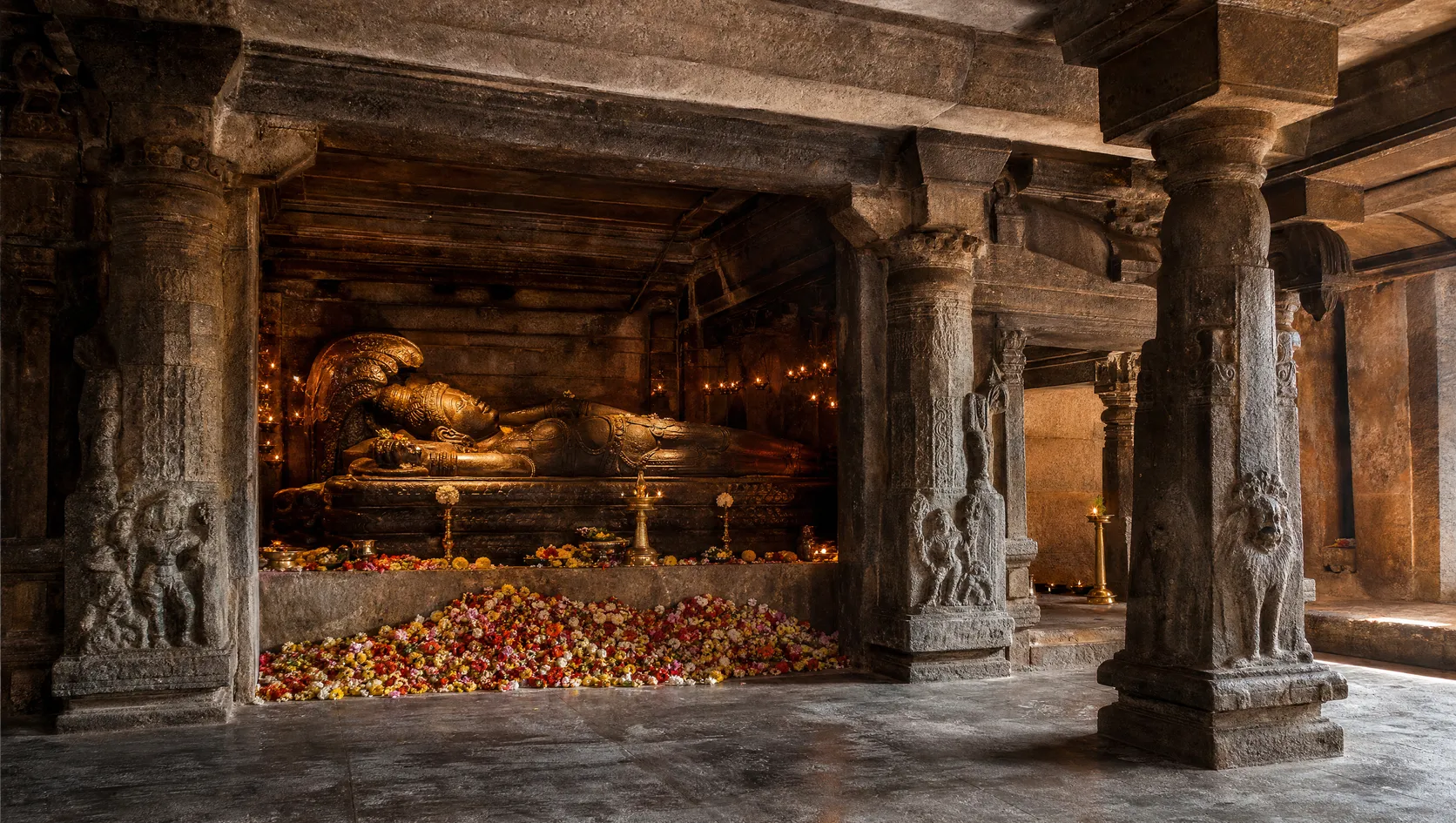
The deity reclines on Anantha, the many-hooded serpent, in the posture called Anantha Shayanam. The form is roughly eighteen feet long, and it cannot be taken in through a single opening. Three doors are set along the sanctum wall, and the devotee moves between them.
Through the first door, the face and chest are visible, with a hand extended over a Shiva lingam, an unusual detail in which Vishnu is shown in the act of honouring Shiva rather than being ranked above him. Through the second, Brahma is seen seated on a lotus rising from the navel, along with the royal insignia and attendant figures. Through the third, the feet, before which devotees offer their salutations.
The image is not carved from stone in the ordinary way. It is made by the katusarkara yogam method, a compacted ayurvedic material incorporating a very large number of saligramas said to have been brought from the Gandaki river in Nepal. Because of this composition, abhishekam with water and oil is not performed on the deity in the usual manner; the ritual vocabulary of the temple is adapted to the material, and the surface is maintained by specialists using preparations suited to it.
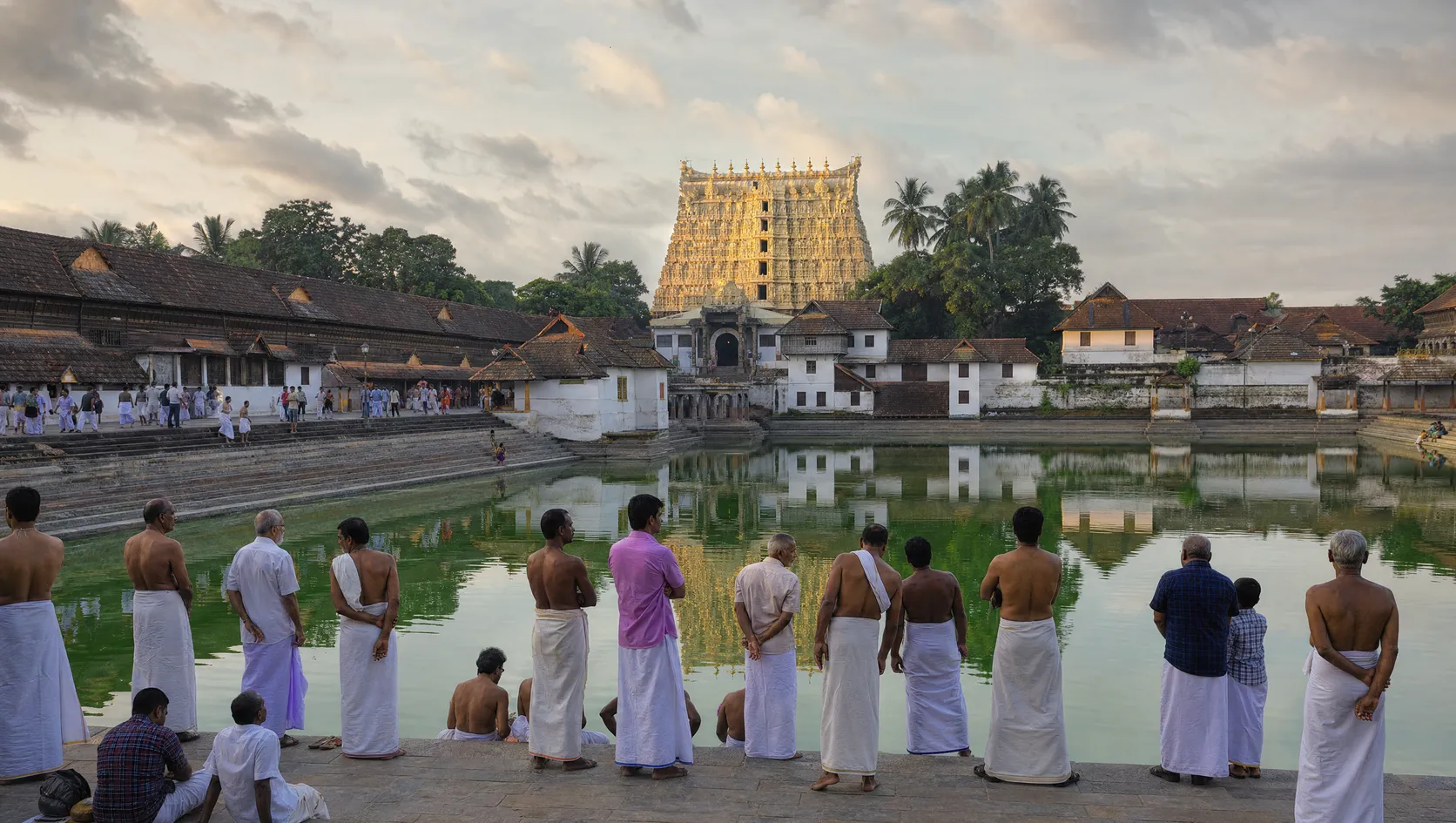
Before the sanctum stands the Ottakkal Mandapam, cut from a single slab of granite. The seven-tier gopuram over the eastern entrance rises above the Padma Theertham tank, and the surrounding corridors carry dense granite pillar work from the eighteenth-century rebuilding.
Distinctive Practicesविशिष्ट परंपराएँ
Darshan Through Three Doors
तीन द्वारों से दर्शन
Every darshan
The reclining form is too long to be seen at once, so the devotee views it in three parts through three separate doors: the face and chest with the hand over the Shiva lingam, then Brahma on the lotus from the navel, then the feet.
The arrangement makes darshan a sequence rather than a single glance. The devotee cannot possess the whole form at once and must move, look, and move again, which the tradition treats as fitting for a deity whose true extent was said to stretch for miles before he contracted himself.
Padmanabha Dasa
पद्मनाभ दास
Since 1750, in continuing use
Following the Thrippadidanam, the rulers of Travancore styled themselves servants of Padmanabha rather than sovereigns in their own right, and the kingdom was administered in the deity's name. The title continued to be used in state documents until accession and is retained ceremonially.
The surrender inverts the ordinary relationship between temple and state. Rather than the ruler patronising the deity, the deity owns the realm and the ruler holds office under him, which recasts political authority as a form of service rather than of possession.
Strict Traditional Dress
कठोर पारंपरिक वेशभूषा
For all entry
The temple maintains one of the stricter dress codes among major Indian temples. Men traditionally wear a mundu without an upper garment, and women a saree or equivalent traditional dress. Garments are commonly available for hire near the entrance.
The code is understood as levelling: everyone approaches in the same simple form of dress, without the markers of profession or status that ordinary clothing carries. In a temple whose defining act was a king declaring himself a servant, the erasure of rank at the door is consistent.
Arattu Procession to the Sea
समुद्र तक आरट्टु शोभायात्रा
Concluding Painkuni and Alpashy Utsavam
At the close of each of the two great festivals, the processional deities are taken from the temple to Shankhumugham beach for the ritual bath in the sea, historically accompanied on foot by the ruler in his capacity as Padmanabha Dasa.
The deity leaves the sanctum and crosses the city on foot to reach the water, and the sovereign walks behind rather than ahead. The procession makes the constitutional arrangement visible once a season: the servant escorting his master through the streets of the capital.
Did You Know?क्या आप जानते हैं?
The city's name records the temple's central image. Thiruvananthapuram means the city of Anantha, the serpent on whom the deity reclines, so the capital of Kerala is named after the snake beneath a god.
Standard toponymic accounts of Thiruvananthapuram
The deity is not carved stone but katusarkara yogam, a compacted ayurvedic composition incorporating a very large number of saligramas. Because of the material, the temple's abhishekam practice differs from that of ordinary stone images.
Temple tradition and published descriptions of the murti's composition
In 1750 a reigning king signed his kingdom over to the temple deity and ruled thereafter as his servant. The arrangement was a legal instrument, not a devotional gesture, and it governed Travancore's constitutional basis for two centuries.
Travancore state records of the Thrippadidanam
Vishnu is shown with a hand extended over a Shiva lingam, an unusual iconographic choice in which one deity is depicted honouring the other rather than being ranked above him.
Descriptions of the sanctum iconography
The Ottakkal Mandapam before the sanctum is cut from a single large slab of granite, which was transported to the site and set in place as one piece.
Architectural descriptions of the temple complex
The 2011 court-ordered inventory of the temple vaults recorded holdings on a scale that drew worldwide attention. One vault, generally called Vault B, was not opened, and temple tradition holds that it should remain closed.
Supreme Court of India proceedings, 2011 onward
The Laksha Deepam, the lighting of a hundred thousand lamps, is held only once in six years at the conclusion of the Murajapam recitation cycle, making it among the rarest observances at any Indian temple.
Travancore temple ritual records
Visitor Accessप्रवेश जानकारी
Entry to the sanctum area is traditionally restricted to Hindus, and this restriction is enforced. A strict traditional dress code applies: mundu for men, typically without an upper garment, and saree or equivalent for women, with garments usually available for hire nearby. Photography and mobile phones are not permitted inside, and cloakroom and security arrangements operate at the entrance. Darshan runs in discrete morning and evening windows with closures in between rather than continuously through the day. Entry rules, timings and dress requirements are set by the temple administration and should be confirmed before travelling.
Spiritual Basis
The dress code follows from the temple's founding logic. Where a king removed his own rank at this threshold and declared himself a servant, the removal of ordinary markers of status by everyone else is treated as the same act repeated. The mundu without an upper garment leaves nothing to signal profession, wealth or office. The restriction of sanctum entry to Hindus is a long-standing convention at this and several other Kerala temples, maintained on the basis that the sanctum is a ritual space governed by initiation and observance rather than a site of general access.
Contemporary Context
The dress requirement is enforced in practice and is a common source of difficulty for visitors who arrive unprepared, particularly those travelling from outside Kerala. Hire arrangements near the entrance handle most cases, but they add time. The restriction on non-Hindu entry has been discussed publicly and occasionally challenged, and the temple has maintained it. Visitors who cannot enter the sanctum can still see the gopuram, the tank and the outer complex, and the surrounding area of East Fort is itself of considerable historical interest. Since the 2011 inventory the temple has attracted attention as a site of wealth rather than only of worship, and visitors should be aware that reporting on the vaults is frequently speculative.
Practical Guidance
Carry or plan to hire the correct dress before arriving, and allow time for it. Leave phones and cameras behind or expect to deposit them. Darshan runs in windows rather than continuously, so check the current schedule before setting out; arriving between windows means a long wait. The three-door sequence means the queue moves in stages, which takes longer than a single-sanctum temple of comparable size. East Fort is walkable from much of the old city, and combining the visit with the Napier Museum, the palace complex or Shankhumugham beach makes a coherent day.
Festivalsत्योहार
Painkuni Utsavam
पैंकुनि उत्सवम्
Mar-Apr (Meenam)
One of the two principal ten-day festivals of the temple, marked by the raising of the festival flag and a sequence of daily rituals, concluding with the Arattu procession in which the deities are taken to Shankhumugham beach for the ritual bath. The ruler, as Padmanabha Dasa, historically accompanied the procession on foot, sword in hand, walking behind the deity rather than ahead of him.
Alpashy Utsavam
अल्पशी उत्सवम्
Oct-Nov (Thulam)
The second of the temple's two great ten-day festivals, following a similar sequence to Painkuni and likewise concluding in the Arattu procession to the sea. The two festivals divide the year, one in spring and one in autumn.
Laksha Deepam
लक्ष दीपम्
Observed once in six years
The lighting of a hundred thousand lamps, held once every six years at the conclusion of the Murajapam, a prolonged cycle of Vedic recitation carried out over weeks. It is among the rarest and most anticipated observances at any Indian temple, and draws crowds far beyond the ordinary festival scale.
Navaratri
नवरात्रि
Sep-Oct (Ashwin)
Observed in Thiruvananthapuram with a distinctive musical character, historically associated with the Travancore court's patronage of Carnatic music, and marked in the wider temple precinct as well as at the associated Navaratri Mandapam.
Traditional Offeringsपारंपरिक अर्पण
Primary Offerings
Tulsi leaves
तुलसी
तुलसी
Tulsi is the offering most closely associated with Vishnu, and worship of him is not considered complete without it. The plant is treated as a devotee in her own right rather than as material: tradition holds that Tulsi was a woman whose devotion earned her a permanent place at Vishnu's feet. Tulsi garlands are used in the daily ritual sequence here, and tulsi that has been offered is commonly taken home rather than discarded.
Payasam
पायसम्
Sweet preparations offered and returned as prasadam are central to the temple's offering practice, following Kerala's own culinary and ritual idiom. Payasam in its several varieties is prepared in temple kitchens and distributed after the ritual. The offering of cooked food rather than raw material reflects a household logic: the deity is fed as a member of the house is fed, at set hours, with dishes of the region.
Neyy Vilakku (ghee lamps)
घी के दीप
Lamps fed with ghee are lit and offered by devotees, a practice common across Kerala temples and central to the temple's own great observance, the Laksha Deepam, in which a hundred thousand lamps are lit once in six years. The lamp is among the few offerings that consumes itself entirely in the giving, which the tradition reads as the model of an offering made without expectation of return.
Flowers of the region
क्षेत्र के पुष्प
Garlands are made from flowers grown in and around Thiruvananthapuram, including tulsi, jasmine and the varieties used in Kerala temple practice. Fresh flowers rather than dried or synthetic material are the norm. Using local flowers ties the daily ritual to the season and the soil: what is offered changes through the year according to what is in bloom, so the sanctum registers the passage of the agricultural calendar.
Unique to This Temple
Thulabharam
तुलाभारम्
In the thulabharam a devotee is weighed on a large balance against an offering of equivalent weight, commonly sugar, jaggery, grain, banana or coins, which is then given to the temple. The practice is well established at Kerala temples and is undertaken here in fulfilment of vows. The logic is bodily rather than monetary. The measure is not a sum chosen by the giver but the giver's own weight, so the offering is fixed by the body itself, and a wealthy devotee and a poor one are measured on the same scale.
Offering arrangements, known as vazhipadu, are made at counters within the temple rather than brought in from outside in most cases. Devotees intending a specific offering, particularly thulabharam, should enquire in advance, as such rituals are scheduled rather than performed on arrival. Because the murti is made of katusarkara yogam rather than stone, abhishekam practice differs from that at ordinary Vishnu temples, and the offerings accepted for direct application to the deity are correspondingly restricted.
How to Reachकैसे पहुँचें
The temple stands in East Fort, in the old quarter of Thiruvananthapuram, and is easy to reach from anywhere in the city.
By air: Thiruvananthapuram International Airport is roughly 6 km away, with domestic connections across India and international links to the Gulf and Southeast Asia. It is one of the closest major airports to a temple of this significance.
By rail: Thiruvananthapuram Central is about 1.5 km from the temple, and is a major terminus on the Kerala coastal line with services throughout South India and beyond.
By road: East Fort is a principal city bus hub, served by frequent KSRTC and city services, and autorickshaws and taxis are readily available. The temple is walkable from much of the old city, and the approach through the fort area is itself worth taking on foot.
Because the dress code is enforced and garments are usually hired at the entrance, allow extra time before a darshan window rather than arriving as it opens.
Plan Your Visitयात्रा की योजना
🌤 Best Season
September to March is the most comfortable period, with lower humidity and less rain. Kerala's southwest monsoon runs roughly June to September and is heavy; the northeast monsoon follows in October and November. The temple remains open throughout, but travel and the seaside Arattu processions are affected. Painkuni (Mar-Apr) and Alpashy (Oct-Nov) are the most vivid times to visit and also the busiest, particularly on the Arattu day when the procession crosses the city. Laksha Deepam, once in six years, draws exceptional crowds and needs planning well in advance. Thiruvananthapuram is humid year-round; even in the cooler months, morning darshan is more comfortable than afternoon.
👘 Dress Code
The dress code is strict and enforced. Men wear a mundu or dhoti, traditionally without an upper garment; a shirt or vest is generally not permitted in the sanctum area. Women wear a saree, or a set-mundu, or a long skirt and blouse; salwar kameez is accepted at some temples in Kerala but should not be assumed here. Garments are available for hire close to the entrance, which is how most visitors from outside Kerala manage. Trousers, shorts and Western dress are not permitted.
📱 Phones & Photography
Mobile phones, cameras and electronic devices are not permitted inside the temple and must be deposited before entry. Photography of the sanctum and the deity is prohibited entirely. Given that garments must often be hired and devices deposited, it is worth arriving with as little as possible and allowing time at the entrance.
🏨 Accommodation
The temple does not operate large-scale pilgrim accommodation of the kind found at Tirumala or Sabarimala; Thiruvananthapuram is a state capital with a full range of hotels and guest houses, and most visitors stay in the city rather than in temple lodging. East Fort and the surrounding old quarter offer the closest options, within walking distance. During Laksha Deepam and the Arattu days demand rises sharply across the city, and booking ahead is advisable.
Sacred Soundsपवित्र ध्वनि
Did You Know? · क्या आप जानते हैं?
The same translation error that turned '33 Koti' into '33 crore' in Hinduism also happened in Buddhism. The Chinese translation of Buddhist texts rendered 'Sapta Koti Buddha' (7 Supreme Buddhas) as '7 Crore Buddhas.' The Tibetan translation got it right: 7 types, not 7 crore. One Sanskrit word, misread across two major world religions, generated two identical misconceptions independently.
Related Contentसंबंधित सामग्री
Related Scriptures
Community Reflections
🕉️
Be the first to share your reflection.