Angkor Wat
अंगकोर वाट
The largest religious monument in the world — Suryavarman II's twelfth-century Khmer temple to Vishnu, a stone model of Mount Meru that became a Buddhist sanctuary and the supreme national symbol of Cambodia
Siem Reap, Siem Reap Province, Cambodia
Aṅgkor VāṭAlso known as: Angkor, Paramavishnuloka, Angkor Wat Temple
Era
Built in the early 12th century, c. 1113 to 1150, under the Khmer emperor Suryavarman II; a UNESCO World Heritage monument within the Angkor Archaeological Park
Architecture
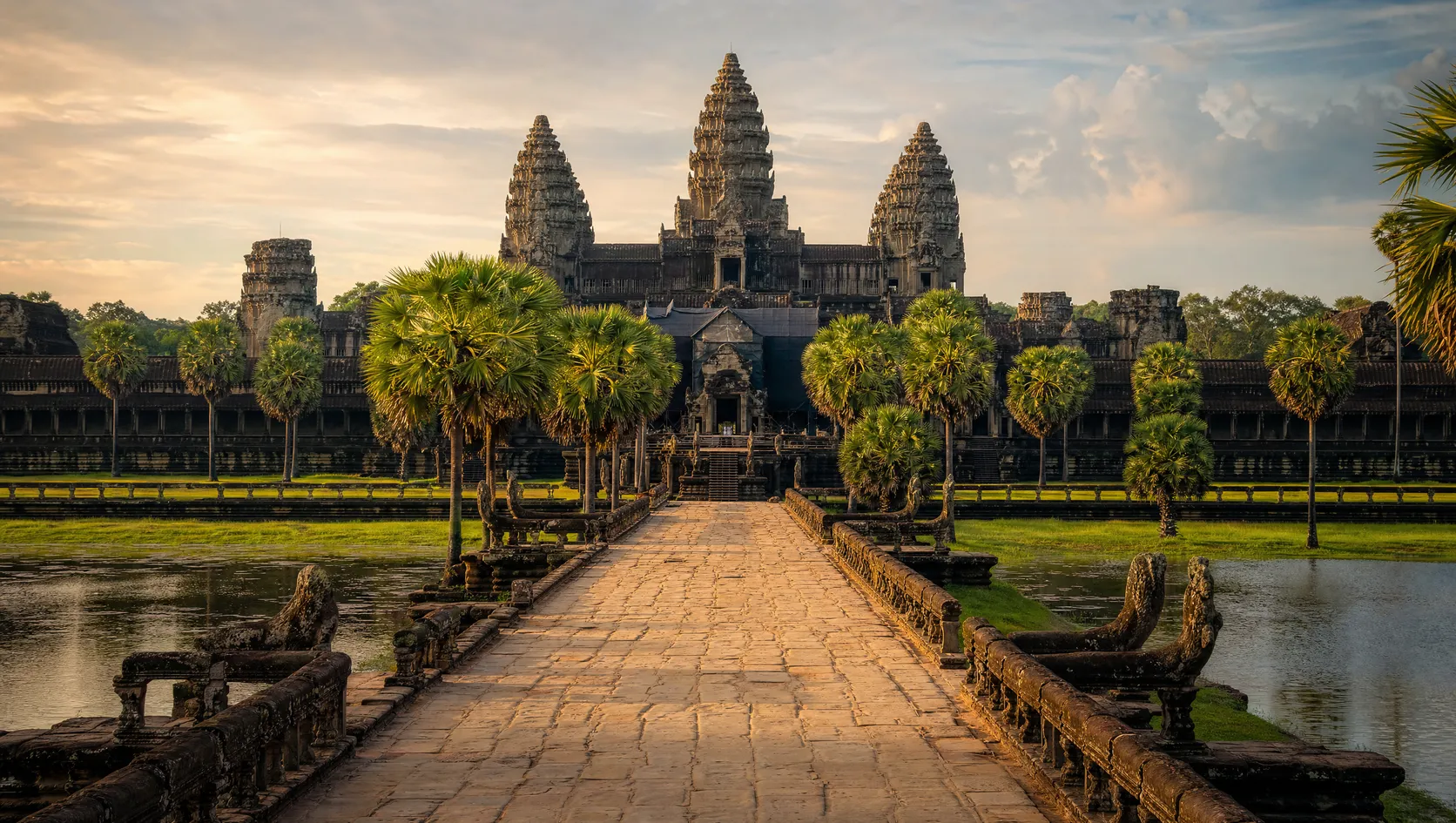
Classical Khmer architecture (the Angkor Wat style), a sandstone and laterite temple-mountain modelled on Mount Meru, with a quincunx of five towers, concentric galleries and a vast surrounding moat
Open
05:00 – 17:30
Special
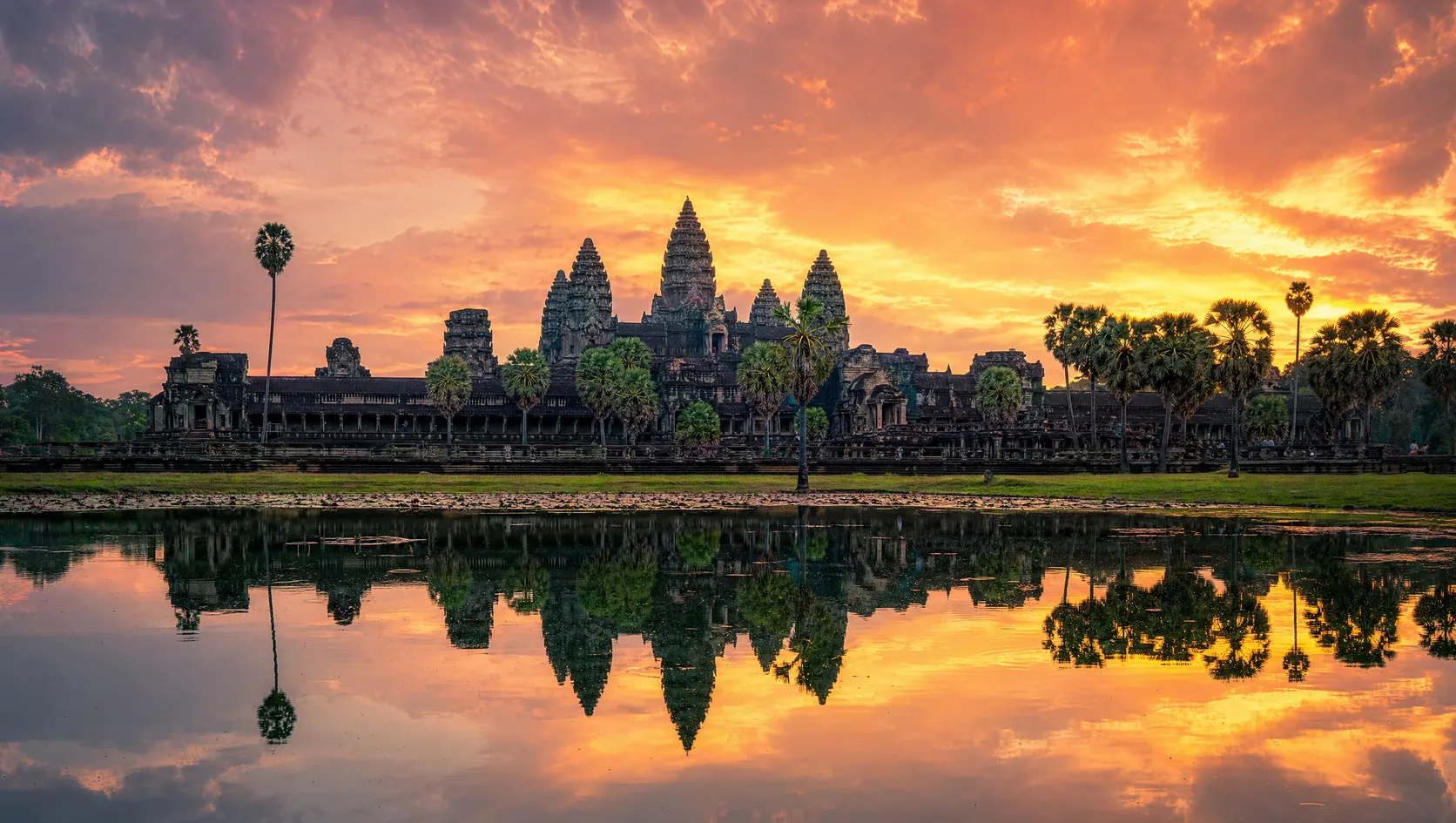
Angkor Wat is a ticketed heritage monument rather than a living Hindu temple with a daily puja schedule. The celebrated experience is the sunrise over the five towers, viewed across the reflecting pools of the western causeway, and access is by the Angkor Pass. Buddhist worship continues at the monument today, and its upper level (the Bakan) has restricted access.
The Sacred Legend · पवित्र कथा
Angkor Wat is not only a temple — it is the largest religious monument on earth, and the greatest single work of Khmer civilization. Raised in the first half of the twelfth century by the emperor Suryavarman II and dedicated to Vishnu, it was built as a model of the cosmos in stone: five towers rising as the peaks of Mount Meru, the mountain at the centre of the world, enclosed by galleries that stand for the ranges at the edge of the earth and ringed by a vast moat that is the cosmic ocean itself. Alone among the great state temples of Angkor, it was consecrated to Vishnu rather than Shiva, and alone among them it faces west, the direction of Vishnu and of the setting sun, a choice long linked to Vishnu's own realm and to funerary symbolism. Suryavarman II was honoured after death as Paramavishnuloka, he who has gone to the supreme world of Vishnu. Across the following centuries the Khmer turned to Buddhism, and Angkor Wat — never abandoned — became, and remains, a Buddhist temple, with Buddha images set among its Vaishnava reliefs. Today it is above all the supreme national monument of Cambodia, the one building in the world to appear on a national flag, and a UNESCO World Heritage Site within the Angkor Archaeological Park.
Sacred Designationपवित्र पदनाम
Sacred Origin Storyपवित्र उत्पत्ति कथा
Source: Khmer Vaishnava tradition of the Angkor empire, drawing on the Puranic cosmology of Mount Meru and the myth of the Churning of the Ocean of Milk (Samudra Manthana)
Angkor Wat was raised as an image of the universe. In the cosmology the Khmer had received from India, the world is centred on Mount Meru, a golden mountain about which the sun, moon and stars revolve, its summit the dwelling of the gods, ringed by mountain ranges and by the great outer ocean. To build a temple was to build Meru on earth, so that the god might be present at the axis of the world; and Angkor Wat is the fullest such image ever made. Its five towers are the five peaks of Meru, the tallest at the centre the very summit; its galleries are the ranges that enclose the world; and its immense moat, more than a kilometre and a half on each side, is the cosmic ocean that surrounds all.
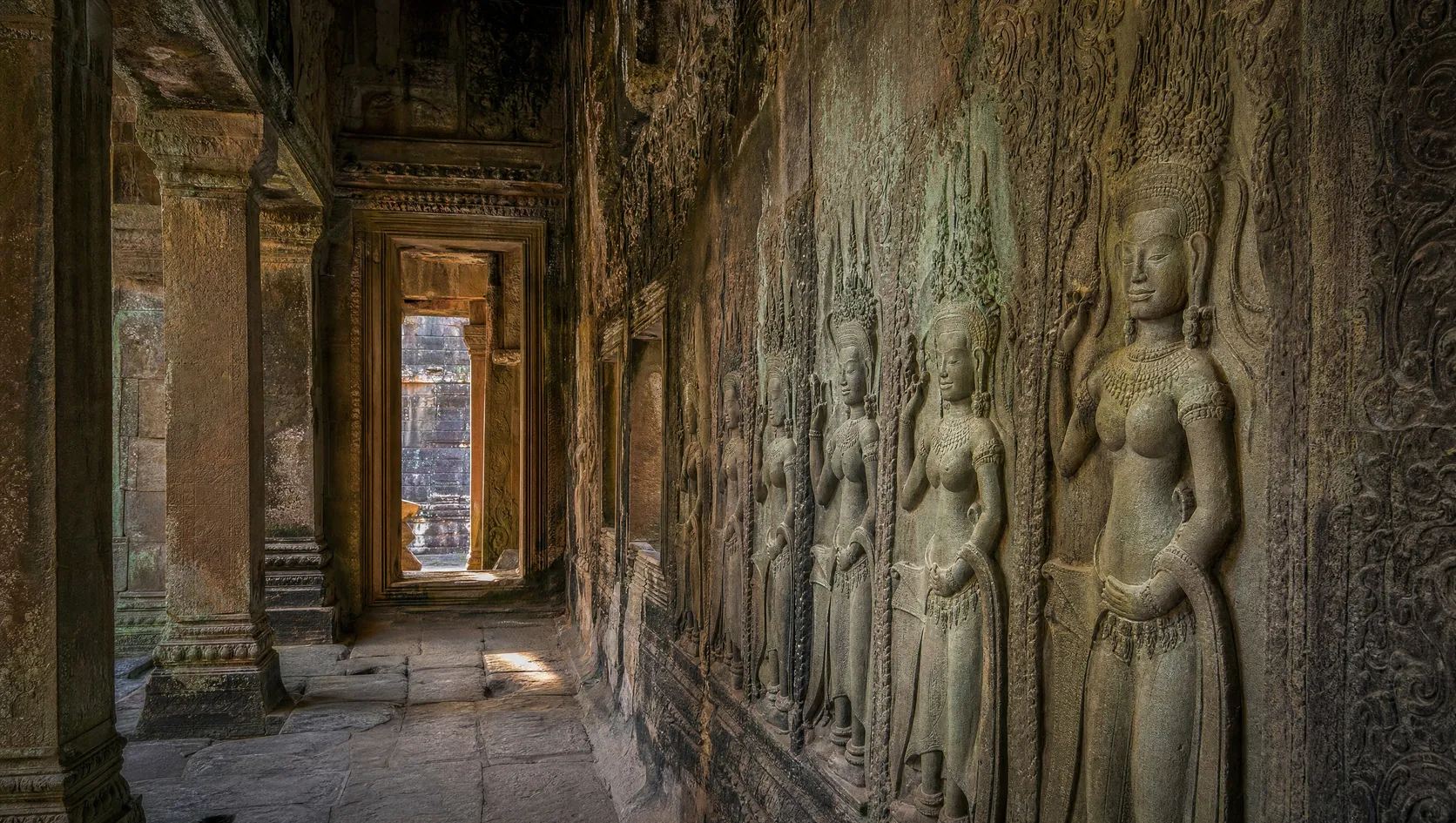
Suryavarman II built it for Vishnu, the preserver, who reclines upon the serpent Ananta on the ocean of milk between the ages of the world and from whose navel the lotus of creation springs. Along its galleries the Khmer sculptors carved the great Vaishnava and epic stories in a band of relief that runs for hundreds of metres. Chief among them is the Churning of the Ocean of Milk, the Samudra Manthana: the gods and the demons, taking the serpent Vasuki for a rope and Mount Mandara for a churning-stick, turn the sea of milk to draw from it the nectar of immortality, while Vishnu, at the centre, both steadies the mountain as the tortoise Kurma beneath it and presides above as the lord of the churning. Nearby run the battle of Kurukshetra from the Mahabharata and the battle of Lanka from the Ramayana, where Rama and the monkey host storm the fortress of Ravana; and along the walls, in their hundreds, stand the devatas and apsaras, the celestial women of Meru, each carved with her own face and adornment.
Angkor Wat faces west, unlike the other great temples of Angkor, and its reliefs are read from the left, against the usual direction. The west is the quarter of Vishnu and of the setting sun, and also the direction of death, and from this many have held that the temple served not only as the state shrine of Vishnu but as the funerary temple of its founder, who was honoured after death as Paramavishnuloka, he who has entered the supreme world of Vishnu.
Sources cited:
- Khmer Vaishnava tradition of the Angkor empire
- Puranic cosmology of Mount Meru
- The bas-relief galleries of Angkor Wat (Samudra Manthana, Ramayana, Mahabharata)
- Inscriptions of Suryavarman II's reign
Other Traditions · अन्य परंपराएँ
The debate over the west orientation and the temple's purpose
Scholarly Context
Angkor Wat is the supreme monument of the Khmer empire, built in the reign of Suryavarman II (c. 1113 to c. 1150) as a state temple dedicated to Vishnu, and it is the largest religious structure ever raised. Its plan is a deliberate cosmogram: the concentric enclosures and the quincunx of five towers render Mount Meru and the ranges of the world, and the moat renders the cosmic ocean, so that the whole is a model of the universe with the god at its centre, a conception the Khmer inherited and developed from Indian temple thought. Scholars note that the great bas-relief galleries carry the Vaishnava and epic repertoire — the Churning of the Ocean of Milk, scenes from the Ramayana and the Mahabharata, and a historical panel showing Suryavarman II and his army — carved in a distinctive Khmer idiom. The temple's west orientation, unusual among Angkorian state temples, and the counter-clockwise reading of its reliefs have generated a long discussion of whether it also functioned as a funerary temple for its founder, honoured after death as Paramavishnuloka. From the later thirteenth and fourteenth centuries the Khmer turned increasingly to Theravada Buddhism, and Angkor Wat was gradually converted to Buddhist use without ever being abandoned; it has remained a place of worship continuously to the present. Rediscovered by European travellers in the sixteenth and nineteenth centuries and made famous in the West by Henri Mouhot's account of 1860, it was studied and partially restored by the French from the early twentieth century, and inscribed as a UNESCO World Heritage Site, within the larger Angkor property, in 1992. Eternal Raga presents the securely attested history and the temple's Vaishnava origins, distinguishing them from the matters that remain under scholarly discussion.
Historyइतिहास
Angkor Wat was built in the first half of the twelfth century, in the reign of the Khmer emperor Suryavarman II (c. 1113 to c. 1150), as the great state temple of his capital at Angkor and as a shrine dedicated to Vishnu. Its construction, employing vast quantities of sandstone quarried from the Kulen hills and floated to the site, and a workforce and treasury on an imperial scale, produced the largest religious monument in the world, a cosmogram of Mount Meru enclosed by galleries and a moat more than a kilometre and a half across.
The temple was consecrated to Vishnu, an unusual choice among the largely Shaiva state temples of Angkor, and Suryavarman II was honoured after his death by the posthumous name Paramavishnuloka. Its galleries were carved with the Churning of the Ocean of Milk, the battles of the Ramayana and the Mahabharata, and a panel of the emperor's own army, together forming one of the greatest programmes of narrative relief anywhere in the world.
In 1177 the Cham sacked the Khmer capital, and under Jayavarman VII, who followed, the seat of power moved to the new walled city of Angkor Thom and the state religion turned toward Mahayana Buddhism. From the later thirteenth and fourteenth centuries the Khmer embraced Theravada Buddhism, and Angkor Wat was gradually converted to Buddhist use, its sanctuaries receiving Buddha images while its Vaishnava reliefs remained. Crucially, unlike many Angkorian monuments it was never abandoned: it continued as a living place of worship, tended by Buddhist monks, even after the capital was moved south in the fifteenth century and the surrounding city fell into decline.
European visitors described the temple from the sixteenth century, and it became widely known in the West after the naturalist Henri Mouhot published his account in 1860. Under the French protectorate the temple was studied, cleared and partially restored, above all by the École française d'Extrême-Orient, using the technique of anastylosis to re-erect fallen stonework. Angkor Wat became the emblem of Cambodia, appearing on its flags from the nineteenth century onward, and it is the only building in the world depicted on a national flag. Conservation was interrupted by the country's civil war and the Khmer Rouge years, but resumed thereafter, and in 1992 Angkor Wat was inscribed as a UNESCO World Heritage Site within the Angkor Archaeological Park. Today it is at once a Buddhist temple, the supreme national monument of Cambodia, and one of the most visited heritage sites on earth.
Historical Timelineऐतिहासिक कालक्रम
Angkor Wat is built in the reign of the Khmer emperor Suryavarman II as the great state temple of Angkor and a shrine dedicated to Vishnu, the largest religious monument in the world.
The exact dates of construction are inferred from the reign of Suryavarman II and the style of the monument; the temple was probably still being finished at or after his death.
The bas-relief galleries are carved, including the Churning of the Ocean of Milk, the battles of the Ramayana and the Mahabharata, and a historical panel of Suryavarman II and his army.
The reliefs run for hundreds of metres around the third enclosure and form one of the greatest programmes of narrative sculpture in the world.
Suryavarman II dies and is honoured with the posthumous name Paramavishnuloka, he who has entered the supreme world of Vishnu, associating the founder with the god of his temple.
The posthumous name is one of the reasons the temple has been discussed as a possible funerary shrine as well as a temple of Vishnu.
The Cham sack the Khmer capital at Angkor. The kingdom recovers under Jayavarman VII, who builds a new walled capital at Angkor Thom and turns the state religion toward Mahayana Buddhism.
The shift of the capital and the religious change belong to the wider history of Angkor; Angkor Wat itself continued in use through this period.
The Chinese envoy Zhou Daguan visits Angkor and later writes A Record of Cambodia, a rare eyewitness description of the Khmer capital and its temples at the height of the empire.
Zhou Daguan's account is among the most important contemporary sources for daily life at Angkor.
As the Khmer embrace Theravada Buddhism, Angkor Wat is gradually converted to Buddhist worship, receiving Buddha images among its Vaishnava reliefs; unlike many Angkorian temples it is never abandoned.
The continuity of worship is a defining feature of Angkor Wat and helps explain its remarkable state of preservation.
The Khmer capital is moved south from the Angkor region, and the surrounding city declines, but Angkor Wat remains an active Buddhist temple and place of pilgrimage tended by monks.
The Portuguese friar Antonio da Madalena becomes one of the first Europeans to describe Angkor Wat, marvelling at a structure he judged unlike any building known to him.
European travellers described Angkor from the sixteenth century; the temple was never truly lost to local knowledge.
The French naturalist Henri Mouhot visits Angkor and his posthumously published account brings the monument to wide attention in Europe, spurring the study and conservation that followed.
Mouhot did not discover Angkor, which was known locally and to earlier travellers, but his vivid account made it famous in the West.
Under the French protectorate the École française d'Extrême-Orient clears, studies and partially restores Angkor Wat, using anastylosis to re-erect fallen stonework and stabilise the monument.
Anastylosis, re-erecting original elements with minimal new material, became a defining method of Angkorian conservation.
Angkor, including Angkor Wat, is inscribed as a UNESCO World Heritage Site; it is placed on the List of World Heritage in Danger and, after major international conservation, removed from that list in 2004.
Conservation today is coordinated by the APSARA National Authority together with international teams.
Angkor Wat remains a Buddhist temple and the supreme national monument of Cambodia, appearing on the national flag and drawing very large numbers of visitors as a ticketed heritage site.
What You'll Seeदर्शन में
Angkor Wat is itself an image, and its iconography is written across the whole monument rather than gathered in a single sanctum. The five towers rise in a quincunx as the peaks of Mount Meru, the tall central tower crowning the innermost and highest level, the Bakan, where the principal image of the temple once stood; the concentric galleries and enclosures render the ranges of the world, and the great moat the cosmic ocean, so that the god is enshrined at the axis of a stone universe.
The temple was built for Vishnu, and its central sanctuary is held to have housed a standing image of the god. A colossal eight-armed standing Vishnu carved from a single block, known locally as Ta Reach, now stands in the southern tower of the western entrance gopura, draped in saffron cloth and honoured with incense; long revered, it is venerated today within the Buddhist life of the monument as much as for its Vaishnava origin. Along the third-enclosure galleries runs the celebrated band of bas-relief: the Churning of the Ocean of Milk with Vishnu at its centre, the battle of Lanka from the Ramayana, the battle of Kurukshetra from the Mahabharata, the procession of Suryavarman II, and scenes of the heavens and hells.
Across the walls, pillars and towers stand the devatas and apsaras, the celestial women of Meru, carved in their hundreds, each with her own face, headdress and ornament, among the most admired figural sculpture of Angkor. To these Vaishnava and cosmic images later ages added Buddha figures, set in the galleries and sanctuaries as the temple became Buddhist, so that the iconography of Angkor Wat holds together the Vishnu for whom it was built and the Buddha whom its worshippers came to honour.
Distinctive Practicesविशिष्ट परंपराएँ
Reverence at the Standing Vishnu of Ta Reach
ता रीच के खड़े विष्णु की श्रद्धा
Daily, at the western entrance of the monument
In the southern tower of the western gopura stands the great eight-armed image of Vishnu known as Ta Reach, draped in saffron cloth and honoured with incense, flowers and folded-hand reverence by visitors and local worshippers alike. It is the living focus of devotion at the monument, honoured within the Buddhist life of the temple.
Angkor Wat was built for Vishnu, and the standing image carries that dedication into the present. That the same figure is revered by Buddhist visitors and by those who honour it as Vishnu reflects the temple's long passage from a Vaishnava state shrine to a Buddhist sanctuary, in which the older god was not cast out but kept and clothed. To bow before Ta Reach is to meet the deity the monument was raised to house, still receiving reverence at the threshold of the cosmic mountain of stone.
Buddhist Worship at the Monument
स्मारक पर बौद्ध उपासना
Daily, and on Buddhist holy days
Angkor Wat is today a working Buddhist temple. Saffron-robed monks are present at the site, Buddha images set in the galleries and sanctuaries receive offerings of incense and flowers, and worshippers make merit, light incense and receive blessings, above all on the Buddhist observance days that follow the lunar calendar.
The continuity of worship is what sets Angkor Wat apart from many ruined monuments: it has never ceased to be a place of the sacred. As the Khmer turned from the worship of Vishnu to the Buddha, the monument turned with them, and its Buddhist life is not a museum re-enactment but a living tradition centuries deep. To worship here is to stand in that unbroken line, honouring the Buddha in a temple first raised to a Hindu god, where the two devotions rest together in the same stone.
The Sunrise Gathering and the Reading of the Galleries
सूर्योदय का समागम और गैलरियों का पठन
At dawn, and through the visiting day
Before first light visitors gather along the western causeway and the reflecting pools to watch the sun rise behind the five towers, one of the most famous sights of the monument. Through the day, walking the third-enclosure galleries in turn, they read the great bands of bas-relief, above all the Churning of the Ocean of Milk, tracing the Vaishnava and epic stories carved along hundreds of metres of wall.
Angkor Wat was designed to be read as much as to be entered, its galleries a cosmos laid out in stone and its alignment tuned to the sun; at the spring equinox the sun rises directly over the central tower. To watch the dawn behind the towers and to walk the reliefs in order is to receive the monument as its builders intended, as a model of the universe with Vishnu at its heart, whether one comes as a pilgrim, a Buddhist worshipper, or a traveller drawn to the greatest work of a vanished empire.
Did You Know?क्या आप जानते हैं?
Angkor Wat is the largest religious monument in the world, its outer enclosure covering more than 160 hectares, built in the early twelfth century by the Khmer emperor Suryavarman II.
UNESCO World Heritage listing; studies of the Angkor Archaeological Park
It is the only building in the world depicted on a national flag; a stylised image of Angkor Wat has featured on Cambodia's flags since the nineteenth century.
History of the Cambodian national flag
Unlike the largely Shaiva state temples of Angkor, Angkor Wat was dedicated to Vishnu, and its founder Suryavarman II was honoured after death as Paramavishnuloka, he who has entered the supreme world of Vishnu.
Khmer inscriptions and royal tradition
The whole temple is a model of Mount Meru: the five towers are the peaks of the cosmic mountain, the galleries the ranges of the world, and the vast moat, more than a kilometre and a half on each side, the surrounding cosmic ocean.
Studies of Khmer temple cosmology
Angkor Wat faces west, unlike the other great temples of Angkor which face east; the west is the direction of Vishnu and of the setting sun, and this orientation has fed a long debate over whether the temple also served a funerary purpose.
Scholarship on Angkor Wat's orientation
Its most famous bas-relief, the Churning of the Ocean of Milk, stretches for nearly fifty metres, showing rows of gods and demons pulling the serpent Vasuki to churn the sea, with Vishnu at the centre as the axis of the churning.
The bas-relief galleries of Angkor Wat
The walls and towers carry some eighteen hundred carved devatas and apsaras, the celestial women of Meru, each with her own face, headdress and ornament, among the most admired sculpture of the Khmer.
Surveys of Angkor Wat's figural sculpture
Unlike many Angkorian monuments, Angkor Wat was never abandoned; it passed from Vaishnava to Buddhist worship and has remained a living temple to the present day, which helps explain its remarkable preservation.
History of Angkor Wat's continuous worship
The Chinese envoy Zhou Daguan, who visited Angkor in 1296, left in A Record of Cambodia one of the rare eyewitness descriptions of the Khmer capital at the height of the empire.
Zhou Daguan, A Record of Cambodia
Angkor Wat is a UNESCO World Heritage Site within the Angkor Archaeological Park, listed in 1992; it was on the List of World Heritage in Danger until major international conservation allowed its removal in 2004.
UNESCO World Heritage Centre records
Visitor Accessप्रवेश जानकारी
Angkor Wat is a ticketed heritage monument within the Angkor Archaeological Park, not a free-entry temple. Visitors must hold an Angkor Pass, sold by Angkor Enterprise as a one-day, three-day or seven-day ticket that covers the whole park; the pass carries the visitor's photograph and is checked at entry. Children under twelve generally enter free. A dress code applies as at a working religious site: shoulders and knees must be covered, and this is enforced for the upper level. Footwear, hats and umbrellas may need to be removed or set aside on the sacred upper terrace. Access to the highest level, the Bakan or central tower, is limited: numbers are controlled, a minimum age applies, appropriate dress is required, and the upper level is closed on Buddhist holy days. The most celebrated experience is the sunrise, for which visitors arrive well before dawn.
Spiritual Basis
Angkor Wat was raised as a temple of Vishnu and a model of Mount Meru, the mountain at the centre of the world, and it remains a place of the sacred: a working Buddhist temple with monks, Buddha images and the venerated Vishnu of Ta Reach. The restrictions on the monument follow from this double character, as both a living religious site and an irreplaceable heritage monument. The covering of shoulders and knees, the removal of footwear on the upper terrace, and the closing of the highest level on Buddhist holy days are marks of respect owed to a sacred place, while the controlled numbers and the ticketed access protect a fragile eight-hundred-year-old structure from the wear of very large crowds. To observe them is to honour both the god for whom the temple was built and the Buddha whom its worshippers revere today.
Contemporary Context
Today Angkor Wat is at once a Buddhist temple, the supreme national monument of Cambodia and one of the most visited heritage sites in the world. It is the emblem of the nation, appearing on the flag and on its currency, and a central source of national pride and of the tourism on which the Siem Reap region depends. The monument is managed within the Angkor Archaeological Park by the APSARA National Authority, with conservation carried out together with international teams, and access is organised through the Angkor Pass. The very numbers that visit bring both the resources for conservation and the pressures of wear, and management balances open access against the protection of the fabric, above all on the fragile upper level.
Practical Guidance
Buy the Angkor Pass from an official Angkor Enterprise ticket centre, where your photograph is taken and printed on the pass; keep it with you, as it is checked at Angkor Wat and across the park. Arrive well before dawn if you want to see the famous sunrise over the towers from the reflecting pools. Dress modestly with shoulders and knees covered, which is required to climb to the upper Bakan level; that level admits limited numbers, sets a minimum age, and is closed on Buddhist holy days, so plan the climb early in the day. Respect the monks and the areas of active worship, keep to the marked routes to protect the reliefs, and confirm the current ticket prices, opening hours and any restrictions locally before your visit.
Festivalsत्योहार
Khmer New Year (Choul Chnam Thmey) and Angkor Sankranta
ख्मेर नववर्ष (चोल चनम थ्मेय) और आंगकोर संक्रांत
Apr (mid-April)
The Khmer New Year, in mid-April, is the great national festival of Cambodia, and in recent years the Angkor Sankranta celebration has filled the grounds of Angkor Wat and Siem Reap with traditional games, music, dance and food. The monument becomes the heart of a national gathering, joining the country's foremost celebration to its foremost symbol.
Visak Bochea (Vesak)
विसाक बोचेया (वेसाक)
May (Vaisakha full moon)
Visak Bochea, the Buddhist observance of the birth, enlightenment and passing of the Buddha, is kept at Angkor Wat as at Buddhist temples across Cambodia, with offerings, merit-making and the presence of monks. As a living Buddhist temple, the monument shares fully in the greatest of the Theravada holy days.
Meak Bochea (Magha Puja)
मीक बोचेया (माघ पूजा)
Feb-Mar (Magha full moon)
Meak Bochea, the Buddhist full-moon day recalling the great assembly of the Buddha's disciples, is observed at Angkor Wat with offerings and candlelit circumambulation by the faithful. It is one of the principal Buddhist observances now held at the monument, marking its continuing life as a place of worship.
Spring Equinox Sunrise Alignment
वसंत विषुव सूर्योदय संरेखण
Mar (around 21 March)
Angkor Wat was built with a precise solar alignment, and around the spring equinox the sun rises directly over the central tower, drawing crowds to the western causeway to witness it. This solar event belongs to the temple's original Vaishnava and cosmological design as a model of Mount Meru; the Khmer built Vishnu's temple to hold time as well as space, and the equinox sunrise makes that intention visible each year.
Traditional Offeringsपारंपरिक अर्पण
Primary Offerings
Tulasi (holy basil) leaves
तुलसी के पत्ते
तुलसी
Tulasi, the holy basil, is the offering dearest to Vishnu, and no Vaishnava worship is complete without it; a garland or a single leaf laid at the feet of the god is held the highest of gifts. As a temple built for Vishnu, Angkor Wat was raised to receive exactly such devotion, the leaf that the tradition holds Vishnu loves above gold.
Lotus and flower garlands
कमल और पुष्प मालाएँ
कमल
The lotus is the flower of Vishnu and of Lakshmi, rising from the god's own navel as the seat of creation, and garlands of flowers are the natural offering of Vaishnava worship. The devotion the temple embodies is expressed in the offering of the lotus, the bloom that opens to the sun as the soul opens to the divine.
Lamps and incense (deepa and dhupa)
दीप और धूप
दीप-धूप
Lamps and incense are offered before the god as light and fragrance, the deepa carrying the flame of devotion and the dhupa rising like the prayer of the worshipper. At Angkor Wat this offering continues at the venerated Vishnu of Ta Reach and at the Buddha images of the monument, the same lamps and incense honouring the sacred as they have for centuries.
Naivedya (food offering / bhoga)
नैवेद्य (भोग)
नैवेद्य
Cooked food and fruit offered to the god as naivedya, and shared afterward as prasad, are central to Vaishnava worship, in which the deity is served and fed as an honoured guest and lord. The temple was built to house a god who would be so served, and the sharing of the god's grace in the returned offering is the heart of Vaishnava devotion.
Recitation of the names of Vishnu
विष्णु के नामों का पाठ
विष्णु सहस्रनाम
The recitation of Vishnu's thousand names, the Vishnu Sahasranama, and of hymns such as the Narayana Suktam, is held among the highest offerings in the Vaishnava tradition, the god worshipped in sung and spoken praise as much as in flower and food. The devotion for which Angkor Wat was raised is voiced in these names, by which the preserver of the worlds is called and honoured.
Sandalwood paste (chandana)
चंदन
चन्दन
Fragrant sandalwood paste is applied to the image of the god as a mark of honour and coolness, and worn by devotees as the sign of their devotion; in the Vaishnava tradition the vertical marks of the tilaka are drawn with sandalwood and sacred clay. It is among the offerings the temple's worship was built to receive, cooling and adorning the god who preserves the worlds.
Unique to This Temple
Incense and cloth at the standing Vishnu of Ta Reach
ता रीच के खड़े विष्णु पर धूप और वस्त्र
What is particular to Angkor Wat is that its living offering is made not to a small icon but to a colossal eight-armed standing Vishnu, the image known as Ta Reach, carved from a single block and set in the western entrance. Draped in saffron cloth and honoured with incense, flowers and folded hands by visitors and local worshippers, it receives the devotion the whole monument was raised to hold. Here the Vaishnava origin and the Buddhist present meet in a single figure: some come to it as Vishnu, the god of the temple, and some within the Buddhist life of the site, but all bring the same incense and reverence. The offering at Ta Reach is the continuation, unbroken, of the worship for which Suryavarman II built the greatest temple in the world, kept alive at the threshold of the cosmic mountain of stone.
These offerings describe the Vaishnava devotion for which Angkor Wat was built and the living reverence that continues at the monument today, above all at the standing Vishnu of Ta Reach and among its Buddha images. Angkor Wat is a heritage monument and a Buddhist temple rather than a booking-based Hindu shrine, and it keeps no Indian-style daily puja schedule; Eternal Raga presents these practices as the devotional tradition the temple embodies. Specific arrangements should be confirmed at the site.
How to Reachकैसे पहुँचें
Angkor Wat lies in the Angkor Archaeological Park in north-western Cambodia, about 5 to 6 km north of the town of Siem Reap, which is the base for visiting the whole park.
By air: the Siem Reap–Angkor International Airport, about 40 km east of the town, is the main gateway, with flights from regional hubs such as Bangkok, Singapore, Ho Chi Minh City and other cities; from the airport, taxis and cars reach Siem Reap and the park.
By road: Siem Reap is connected by road to the Cambodian capital Phnom Penh (about 315 km) and, across the border, to Thailand; long-distance buses and private cars serve these routes. From Siem Reap town, most visitors reach Angkor Wat by tuk-tuk, hired car or bicycle, a short journey of a few kilometres north.
A valid Angkor Pass, bought from an official Angkor Enterprise ticket centre, is required to enter Angkor Wat and the surrounding monuments, and is checked at the entrance. Many visitors combine Angkor Wat with the other great monuments of the park, above all Angkor Thom with the Bayon, and Ta Prohm, over one or more days.
Plan Your Visitयात्रा की योजना
🌤 Best Season
November to February is the most comfortable time to visit, with cooler, drier weather in the dry season, and it is also the busiest. March to May is very hot, with temperatures often above 35°C, though the spring equinox in March brings the celebrated sunrise alignment over the central tower. The monsoon, roughly June to October, brings heavy rain and humidity, but also greener surroundings, fuller moats and reflecting pools, and thinner crowds; showers are often short, and the light after rain can be superb. At any season, dawn is the classic time: visitors arrive before first light for the sunrise over the towers, and the early and late hours are cooler and softer than the harsh light of midday.
👘 Dress Code
As at a working religious site, modest dress is expected and is enforced for the upper level of Angkor Wat: shoulders and knees must be covered. Light, breathable clothing suits the heat, but sleeveless tops and short skirts or shorts above the knee will bar entry to the highest terrace, the Bakan. Comfortable shoes are advisable for the uneven stone and the steep steps, and a hat, sunscreen and water are useful in the strong sun; footwear and hats may need to be removed on the sacred upper level.
📱 Phones & Photography
Photography is generally permitted across the monument, and Angkor Wat at sunrise is among the most photographed sites in the world, but visitors are asked to be respectful around monks and areas of active worship and not to disturb ceremonies. Tripods and professional or commercial photography may need permission, and the flying of drones over the monument is restricted; confirm the current rules locally.
🏨 Accommodation
The town of Siem Reap, a short distance south of the park, offers a very wide range of accommodation, from budget guesthouses and hostels to mid-range hotels and internationally known luxury resorts, together with restaurants, markets and services geared to visitors from around the world. Because almost everyone who visits Angkor Wat stays in Siem Reap, there is choice at every price, but demand and prices rise in the cool dry season from November to February and around the Khmer New Year; booking ahead is advisable at those times. Staying in the town places the visitor within a short tuk-tuk or car ride of the monument for the pre-dawn start.
Sacred Soundsपवित्र ध्वनि
Did You Know? · क्या आप जानते हैं?
The same translation error that turned '33 Koti' into '33 crore' in Hinduism also happened in Buddhism. The Chinese translation of Buddhist texts rendered 'Sapta Koti Buddha' (7 Supreme Buddhas) as '7 Crore Buddhas.' The Tibetan translation got it right: 7 types, not 7 crore. One Sanskrit word, misread across two major world religions, generated two identical misconceptions independently.
Related Contentसंबंधित सामग्री
Related Scriptures
Community Reflections
🕉️
Be the first to share your reflection.