Krishna Balaji (Birla Mandir Hyderabad)
बिड़ला मंदिर हैदराबाद
Tirupati's Lord in white marble — on a hill above Hussain Sagar, open to all
Hyderabad, Telangana, India
Śrī Venkaṭeśvara Mandira (Bralā Mandira), HyderābādaAlso known as: Birla Mandir Hyderabad, Sri Venkateswara Temple Hyderabad, Naubat Pahad Temple, Birla Balaji Temple Hyderabad
Era
Constructed 1966–1976 CE; inaugurated August 12, 1976 CE; built by the B.M. Birla Foundation
Architecture
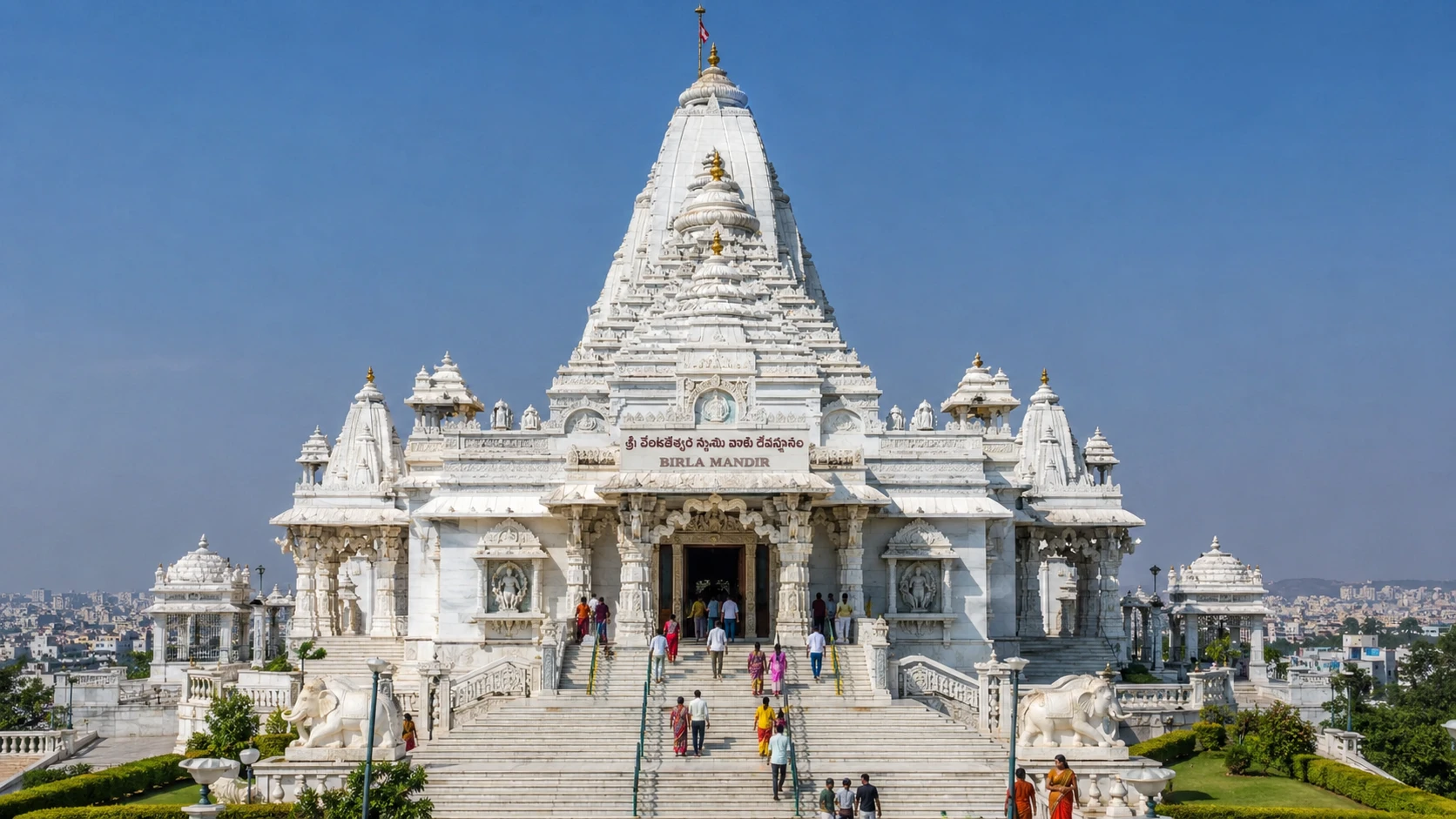
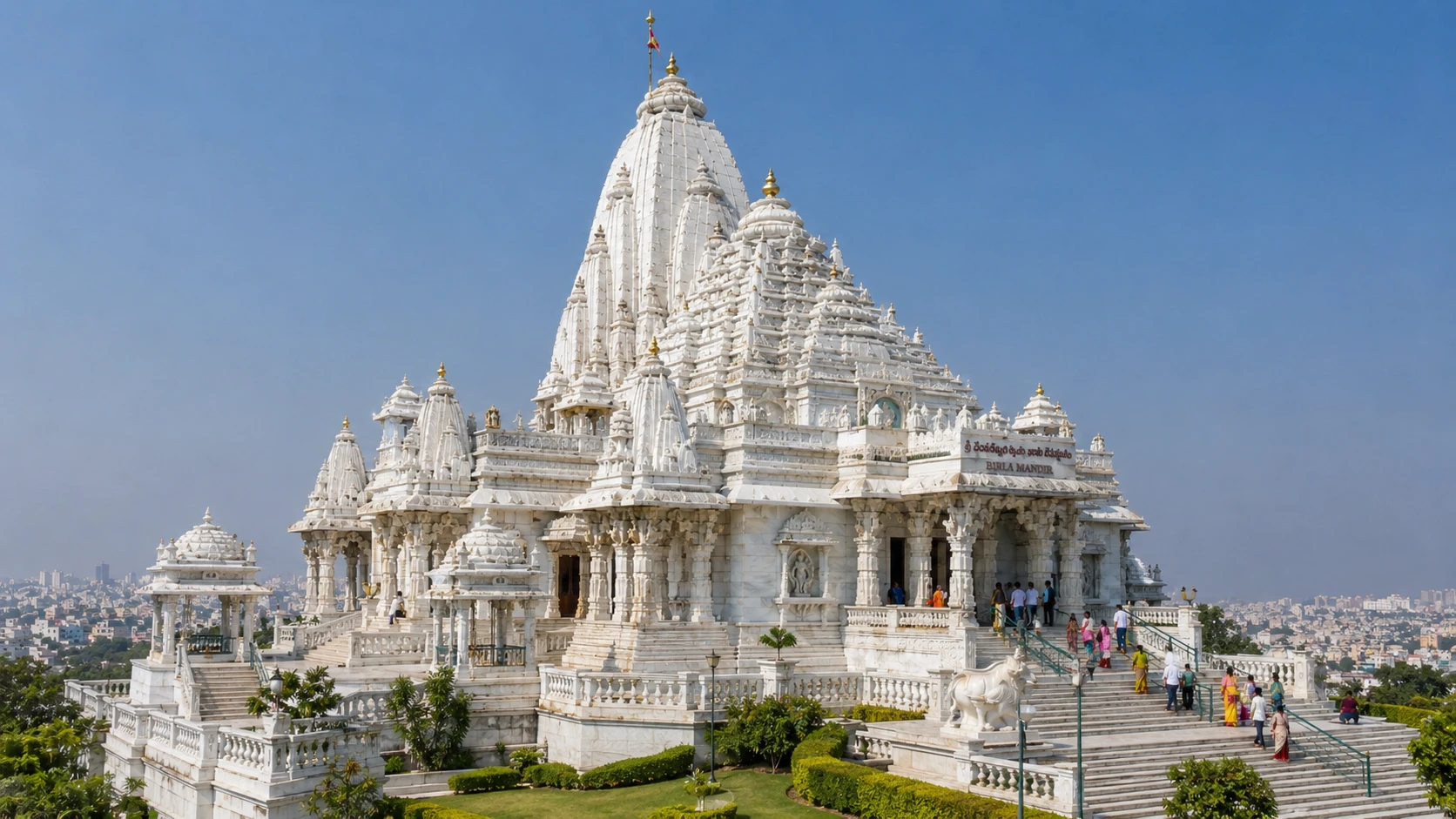
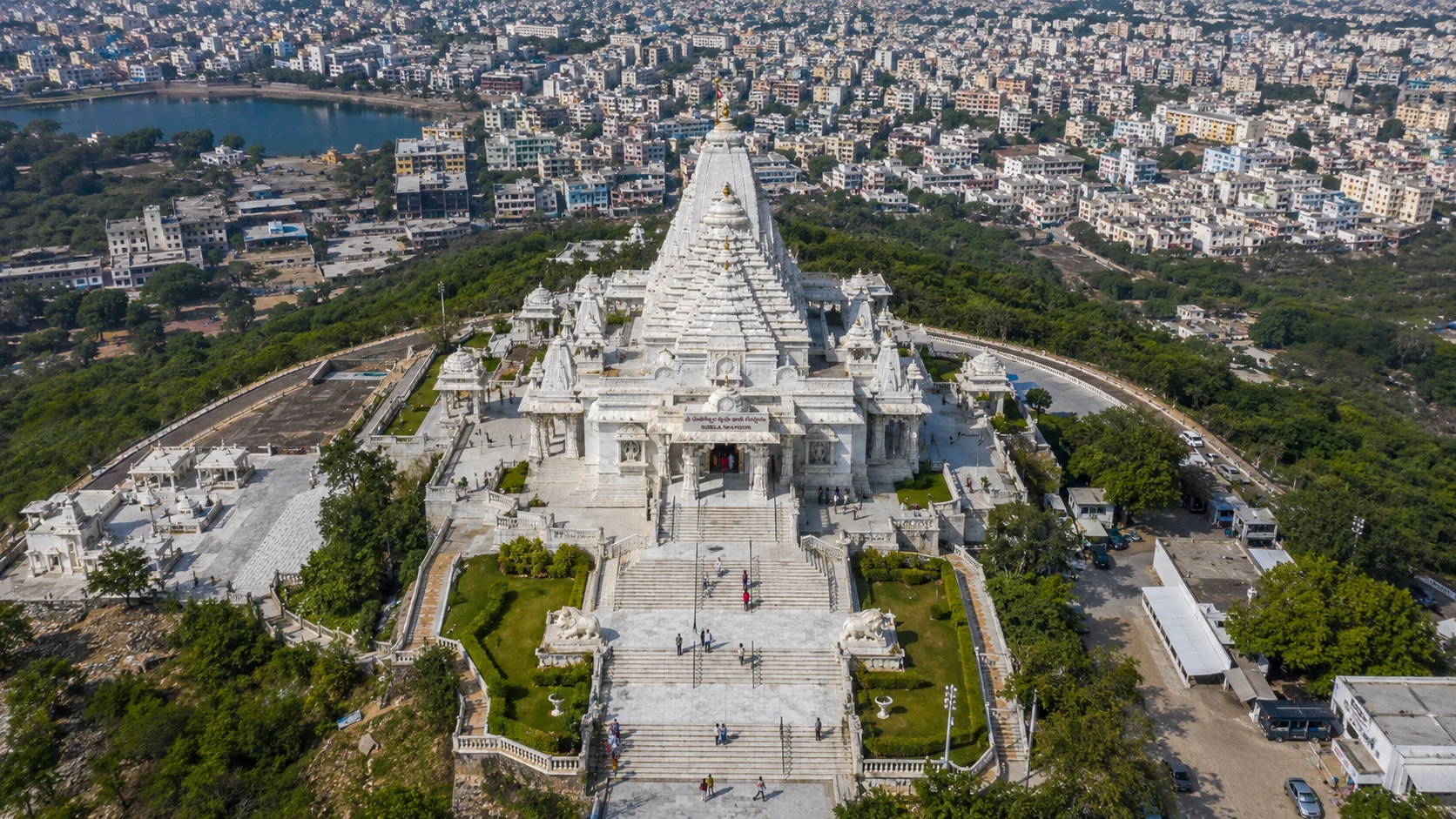
Contemporary temple architecture in white Rajasthani marble (Makrana); blends South Indian Dravidian elements (gopuram-influenced shikhara) with North Indian nagara motifs; set on a rocky hillTop 280 feet above city level
Open
07:00 – 21:00
Aarti
07:00 · 08:30 · 12:00 · 18:00 · 19:30
Special
The temple closes from approximately 12:30–3:00 PM for a midday break; verify current timings with temple management on arrival. Morning darshan is less crowded than evenings and weekends.
The Sacred Legend · पवित्र कथा
In 1976, on a bare rocky hill called Naubat Pahad that overlooks Hussain Sagar — the artificial lake at the heart of Hyderabad — two thousand tonnes of white Rajasthani marble were assembled into a gleaming temple to Lord Venkateswara. The same deity worshipped at Tirumala, an hour's drive away, had been brought to the city on this hill: accessible without the mountain climb, without the weeks of waiting, without the dawn queues. The Birla Foundation built the temple in that spirit — not to compete with Tirupati but to bring the Lord to the people of Hyderabad on their own terms, in a temple built open to all, regardless of community or background, as clear and inclusive as the white marble from which it is made. Seen from across Hussain Sagar at dusk, the white temple glows against the Hyderabad skyline — the Lord above the water, the city spread below.
Sacred Origin Storyपवित्र उत्पत्ति कथा
Source: Sri Vaishnava / Venkateswara devotional tradition; the primary scriptural sources are the Venkatachala Mahatmya in the Skanda Purana (Vaishnava Khanda) and the Varaha Purana
Lord Venkateswara — known also as Balaji, Sri Srinivasa, and Tirumala Tirupati Devasthanam's presiding deity — is understood in Vaishnava theology as Vishnu himself, having chosen to reside at the Tirumala hill in the Kali Yuga to be accessible to all beings. The Venkatachala Mahatmya in the Skanda Purana gives the full account: after the sage Brighu kicked Vishnu in anger (to test whether Vishnu or Shiva was truly the greatest deity) and Lakshmi departed from Vaikuntham in distress, Vishnu descended to earth to seek her. He came to the Tirumala hills of the Deccan, married Padmavati (an earthly princess, an incarnation of Lakshmi), and chose to remain on the hill as Venkateswara — 'the Lord who destroys the sins of Venkata (the hill).' He remains on earth to this day because he borrowed money from Kubera (the treasurer of the gods) to fund his wedding and has not yet repaid the debt. Devotees who make offerings at Venkateswara temples are, in this theology, contributing to the Lord's debt repayment — participating in a transaction between humanity and heaven that will last until the end of the Kali Yuga.
The Birla Mandir at Hyderabad is dedicated to this same Venkateswara — the Lord of the hills, the creditor of all devotees — here translated into white Rajasthani marble on a different hill, above a different lake, in a city that now has its own resident Balaji.
Sources cited:
- Skanda Purana, Vaishnava Khanda — Venkatachala Mahatmya (primary source for the Venkateswara tradition)
- Varaha Purana — Bhumi Devi-Vishnu narrative contextualizing the Venkateswara tradition
- T.K.T. Viraraghavacharya, 'History of Tirupati' (Tirupati: Tirumala Tirupati Devasthanams, 1953–1977) — scholarly documentation of the tradition
- Birla Mandir Hyderabad official documentation
Scholarly Context
The Venkateswara cult's historical development at Tirumala-Tirupati is well-documented in scholarly literature (T.K.T. Viraraghavacharya's multi-volume study; Rao's 'History of Sri Venkatesvara'; more recently, P.B. Wagoner's work on the Vijayanagara-era transformation of the Tirupati tradition). Scholars generally agree that the site's emergence as the wealthiest temple in India represents a confluence of royal patronage (Vijayanagara, Hoysala, later the Nayakas), Sri Vaishnava theological elaboration, and pan-Indian devotional appeal. The Birla Mandir Hyderabad represents a 20th-century chapter of this tradition — the extension of the Venkateswara cult's reach into a new urban context through a philanthropic temple-building programme.
Historyइतिहास
The Birla Mandir at Hyderabad was constructed by the B.M. Birla Foundation — the philanthropic wing of the Birla industrial group — as part of a programme of building major Hindu temples in Indian cities that began in 1939 with the inauguration of the Delhi Lakshmi Narayan Temple (opened by Mahatma Gandhi with the explicit condition that it be open to all castes and communities). The Hyderabad temple, dedicated to Lord Venkateswara, was begun in 1966 on Naubat Pahad — a rocky hill near Hussain Sagar — and constructed over approximately ten years using white marble transported from Makrana, Rajasthan. Approximately 2,000 tonnes of marble were used. The temple was inaugurated on August 12, 1976. The complex includes the main Venkateswara shrine, a shrine for Padmavati (the consort deity), a shrine for Anjaneya (Hanuman), and an art gallery housing sculptures that trace Hindu iconographic traditions across multiple periods. The temple is managed by the B.M. Birla Public Charitable Trust and maintains the foundation's founding commitment to non-discriminatory access.
Historical Timelineऐतिहासिक कालक्रम
The B.M. Birla Foundation opens the Lakshmi Narayan Temple (Birla Mandir) in New Delhi, inaugurated by Mahatma Gandhi on the explicit condition that the temple be open to all castes and communities. This founding act establishes the Birla temple programme's commitment to non-discriminatory access — a position that all subsequent Birla temples, including Hyderabad, maintain.
Gandhi's participation in the 1939 Delhi Birla Mandir inauguration, and his insistence on open access, is well-documented in Gandhi's own writings and contemporary newspaper accounts. It is often cited as a pivotal moment in the modern reform of caste exclusions in Hindu temple practice.
Construction of the Birla Mandir Hyderabad begins on Naubat Pahad (near Hussain Sagar) under the B.M. Birla Foundation. White marble from Makrana, Rajasthan is selected as the primary building material; approximately 2,000 tonnes will be transported to Hyderabad over the course of construction.
The Sri Venkateswara Temple (Birla Mandir) is inaugurated on August 12, 1976. The completed complex houses the main Venkateswara shrine, shrines for Padmavati and Anjaneya, and an art gallery. The temple formally opens to all communities.
What You'll Seeदर्शन में
The primary murti at the Birla Mandir Hyderabad is Lord Venkateswara in the standing four-armed form — the same iconographic programme as Tirumala, rendered here in white marble rather than the dark stone of the Tirupati hill shrine. The Lord stands in a majestic posture: the upper right arm holds the Sudarshana chakra (discus), the upper left holds the Panchajanya conch (shankha), the lower right arm is in abhaya mudra (palm forward, offering protection), and the lower left arm is in varada mudra (palm down, bestowing boons). The dark complexion of the original Tirupati Venkateswara is approximated here through dark ornamental paint on the white marble base, giving the murti the dual visual quality of a deity seen simultaneously in light and shadow. He is flanked by Sridevi (Lakshmi) on his right and Bhudevi (the earth goddess) on his left — the full Pancharatra threesome of Vishnu's two consorts and the Lord himself. Padmavati (Alamelu Manga), the earthly consort, has a separate shrine within the complex. Photography inside the main shrine is not permitted.
Did You Know?क्या आप जानते हैं?
The Birla Mandir Hyderabad is built entirely of white marble transported from Makrana (Rajasthan) — approximately 2,000 tonnes of marble used in construction. Makrana marble is the same stone used in the Taj Mahal; its distinctive white lustre and slight translucency give the Birla Mandir its otherworldly appearance when seen from across Hussain Sagar at dusk.
B.M. Birla Foundation official documentation; Hyderabad Tourism Board
The Birla Foundation's temple-building programme explicitly follows the non-discriminatory access principle established at the 1939 Delhi inauguration — all Birla temples are open to all Hindus regardless of caste, and in practice the Hyderabad temple is visited by people of all communities. This makes the Birla Mandir Hyderabad one of the few major temples in south India where non-Hindus are also permitted entry, in contrast to many traditional temples of the region.
B.M. Birla Foundation documentation; Gandhi writings on the 1939 inauguration
The temple complex includes an art gallery housing Hindu devotional sculptures from various periods, offering visitors a compressed introduction to the iconographic history of Vishnu, Shiva, Shakti, and their avatars. The gallery is one of the few places in Hyderabad where classical temple sculpture can be seen in an educational context adjacent to active worship.
Birla Mandir Hyderabad official documentation
From the top of Naubat Pahad — the hill on which the Birla Mandir stands — there is a panoramic view of Hussain Sagar lake, including the 18-metre tall Buddha statue that stands on a small island at the lake's centre. The juxtaposition of the white marble Vaikunta Venkateswara above and the stone Buddha below, across the water, is one of the more visually distinctive religious geographies of any Indian city.
Hyderabad Tourism documentation; Hussain Sagar Development Authority records
Visitor Accessप्रवेश जानकारी
The Birla Mandir Hyderabad is open to all visitors regardless of religion, caste, or nationality — in keeping with the Birla Foundation's foundational commitment to non-discriminatory access established at the 1939 Delhi inauguration. Modest dress is required; footwear must be removed before ascending the hill path to the temple (shoe storage is available at the hill's base).
Footwear must be removed at the bottom of the hill path before climbing to the temple. The ascent is approximately 180 steps; a ramp or lift may be available for differently-abled visitors — verify with the temple management on arrival. Shoe storage is available at the base.
Festivalsत्योहार
Vaikunta Ekadasi
वैकुंठ एकादशी
Dec-Jan (Margashirsha Shukla Ekadasi)
Vaikunta Ekadasi — the day on which Vishnu is said to open the gates of Vaikuntham — is the most important festival at the Birla Mandir Hyderabad, drawing particularly large crowds. The temple is illuminated and extended darshan is offered throughout the night.
Brahmotsavam (annual festival of Lord Venkateswara)
ब्रह्मोत्सवम्
Sep-Oct (Purattasi / Ashvin)
Brahmotsavam — the nine-day annual festival of Lord Venkateswara, elaborated most fully at Tirupati — is observed at the Birla Mandir with special sevas, vahana (vehicle) processions of the temple's utsava murti, and extended darshan. The Purattasi season is considered particularly auspicious for Venkateswara worship.
Janmashtami
जन्माष्टमी
Jul-Aug
While primarily a Venkateswara temple, the Birla Mandir celebrates Krishna Janmashtami with special decorations and midnight aarti, acknowledging the theological connection between Venkateswara and Krishna as Vishnu's forms.
Traditional Offeringsपारंपरिक अर्पण
Primary Offerings
Tulsi (Holy Basil)
तुलसी
तुलसी
Tulsi is the primary Vaishnava offering at all Vishnu and Venkateswara temples. The Venkatachala Mahatmya prescribes tulsi as the most beloved plant of Vishnu: 'tuulasyaa maadhavo raati' — Vishnu is pleased by tulsi above all. At the Birla Mandir Hyderabad, tulsi garlands are offered at the morning and evening aartis.
Lotus flowers (Padma) and Tulsi garlands
कमल पुष्प और तुलसी माला
पद्म
Lotus flowers (padma) are Vishnu's signature flower — he holds one in his hand, Lakshmi sits upon one, the Bhagavata Purana's creation narrative describes Brahma born from the lotus of Vishnu's navel. Offering lotus to Venkateswara recapitulates the theology of the entire Vaishnavism cosmos in a single flower. Hussain Sagar lake, below the Birla Mandir, provides fresh lotus in season.
Panchamrit abhishekam — milk, curd, honey, ghee, sugar
पंचामृत अभिषेकम्
पञ्चामृत
Panchamrit abhishekam is performed at the Birla Mandir on festival days and special seva occasions. The Venkateswara tradition's abhishekam follows Pancharatra Agama protocols — the bathing of the Lord with five sacred substances is an act of service that mirrors the cosmic bathing of Vishnu by the celestials at the beginning of creation.
Laddoo — the Venkateswara prasad
लड्डू — वेंकटेश्वर प्रसाद
The sweet laddoo (a spherical sweet of chickpea flour, sugar, and ghee) is the iconic prasad of Venkateswara devotion — associated most famously with the Tirupati laddoo, which has a Geographical Indication (GI) status. The Birla Mandir Hyderabad distributes laddoo prasad following the Venkateswara tradition. To receive and eat a Venkateswara laddoo is to receive the Lord's personal blessing in edible form.
Offering materials (tulsi, flowers, camphor for aarti) are available from vendors near the hill base. Laddoo prasad is available at the prasad counter inside the complex. Entry to the art gallery is included with temple entry.
How to Reachकैसे पहुँचें
The Birla Mandir is situated on Naubat Pahad, approximately 3 km from Nampally (Hyderabad Deccan) Railway Station and accessible by auto-rickshaw, taxi, or Hyderabad Metro from anywhere in the city. The nearest Metro station is Assembly (Blue Line), approximately 1.5 km walk. By road, the temple is near Hussain Sagar lake — the main road approach is via Tank Bund Road. From Rajiv Gandhi International Airport (35 km), taxis take approximately 45–60 minutes to Naubat Pahad depending on traffic.
Plan Your Visitयात्रा की योजना
🌤 Best Season
October to February (pleasant Hyderabad winters; less heat for climbing the hill steps). Weekday mornings are less crowded. Avoid weekend evenings during festival periods — queues can be very long. The view from the hilltop is best at sunset, when both the Hussain Sagar lake and the Buddha statue are lit.
👘 Dress Code
Modest dress required. Men and women should cover shoulders and knees. Footwear must be removed at the base of the hill — shoe storage is available. The hill climb is approximately 180 steps; comfortable footwear for the ascent is advisable.
📱 Phones & Photography
Photography inside the main shrine is not permitted. Photography of the temple exterior and the panoramic views from the hill is generally allowed.
🏨 Accommodation
Hyderabad has extensive accommodation at all price points. The Naubat Pahad area is centrally located — Nampally and Abids areas (2–4 km) have budget to mid-range hotels; Banjara Hills and Jubilee Hills (5–8 km) have luxury options.
Sacred Soundsपवित्र ध्वनि
Sri Venkateswara Suprabhatam — the dawn invocation to Lord Venkateswara; composed by Prativadi Bhayankara Annangaracharya (15th century); the most universally sung Vaishnava morning prayer in south India
stotram
Sri Venkateswara Ashtottara Shatanamavali — 108 names of Lord Venkateswara
stotram
Sri Venkateswara Temple Aarti — daily evening aarti at Birla Mandir Hyderabad
aarti
108 Japa Practice
Om Namo Bhagavate Vasudevaya — the Venkateswara tradition also uses 'Om Namo Venkatesaya' as a specific mantra
Chant 108 times in the spirit of this temple
Did You Know? · क्या आप जानते हैं?
The same translation error that turned '33 Koti' into '33 crore' in Hinduism also happened in Buddhism. The Chinese translation of Buddhist texts rendered 'Sapta Koti Buddha' (7 Supreme Buddhas) as '7 Crore Buddhas.' The Tibetan translation got it right: 7 types, not 7 crore. One Sanskrit word, misread across two major world religions, generated two identical misconceptions independently.
Related Contentसंबंधित सामग्री
Related Scriptures
Community Reflections
🕉️
Be the first to share your reflection.