ISKCON Mayapur
इस्कॉन मायापुर
Where Chaitanya was born — and where his chant came home from 120 countries
Mayapur, West Bengal, India
Śrī Māyāpura Candrodaya MandiraAlso known as: Sri Mayapur Chandrodaya Mandir, ISKCON Mayapur, Sri Dham Mayapur, Temple of Vedic Planetarium (TOVP), Mayapur Dham
Era
Sacred site: birthplace of Sri Chaitanya Mahaprabhu, 1486 CE; ISKCON institution: founded 1966 CE; ISKCON Mayapur project inaugurated 1972 CE; Temple of Vedic Planetarium (TOVP) — under construction/advanced completion stage as of 2025; verify current status at mayapur.com
Architecture
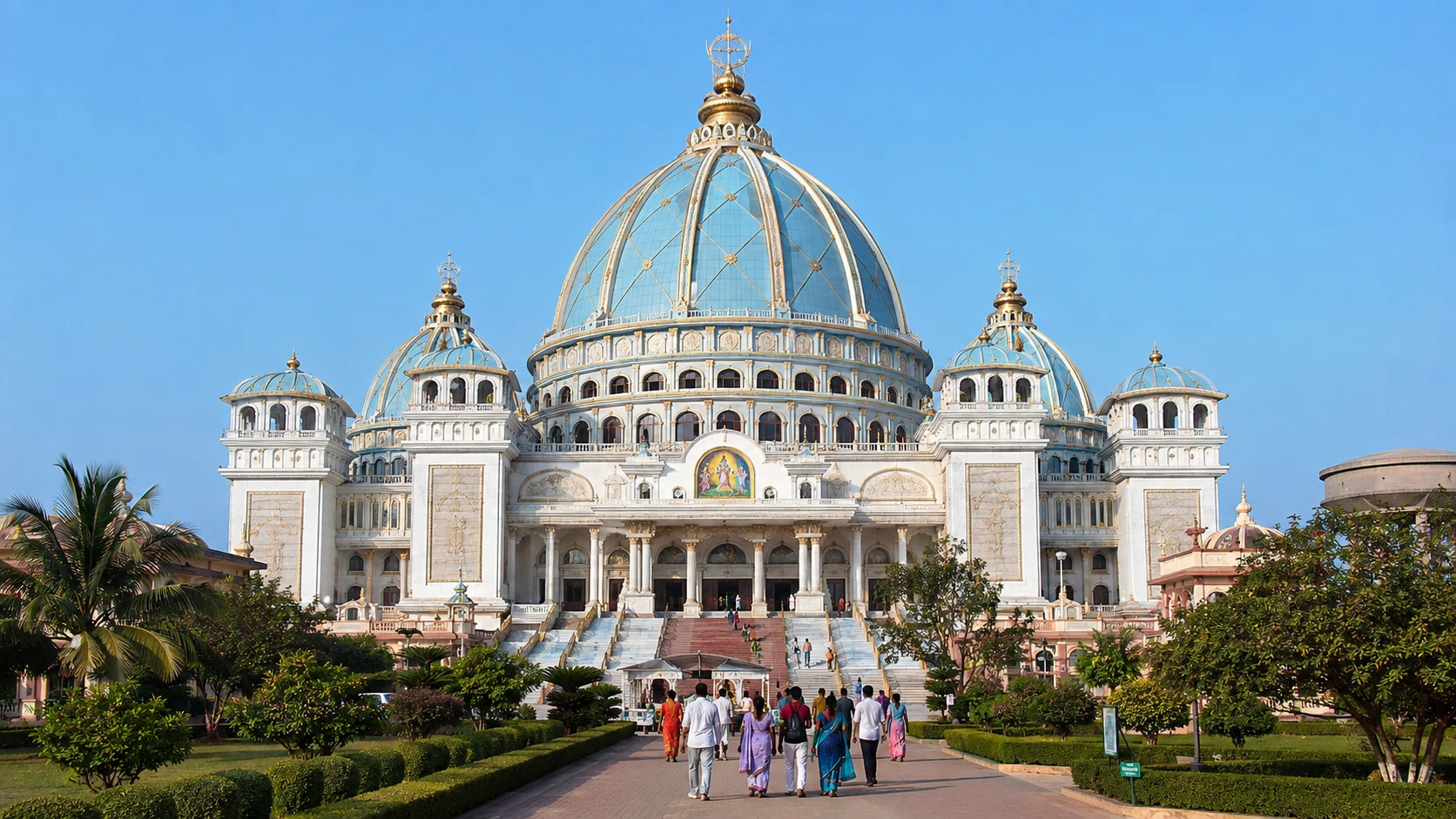
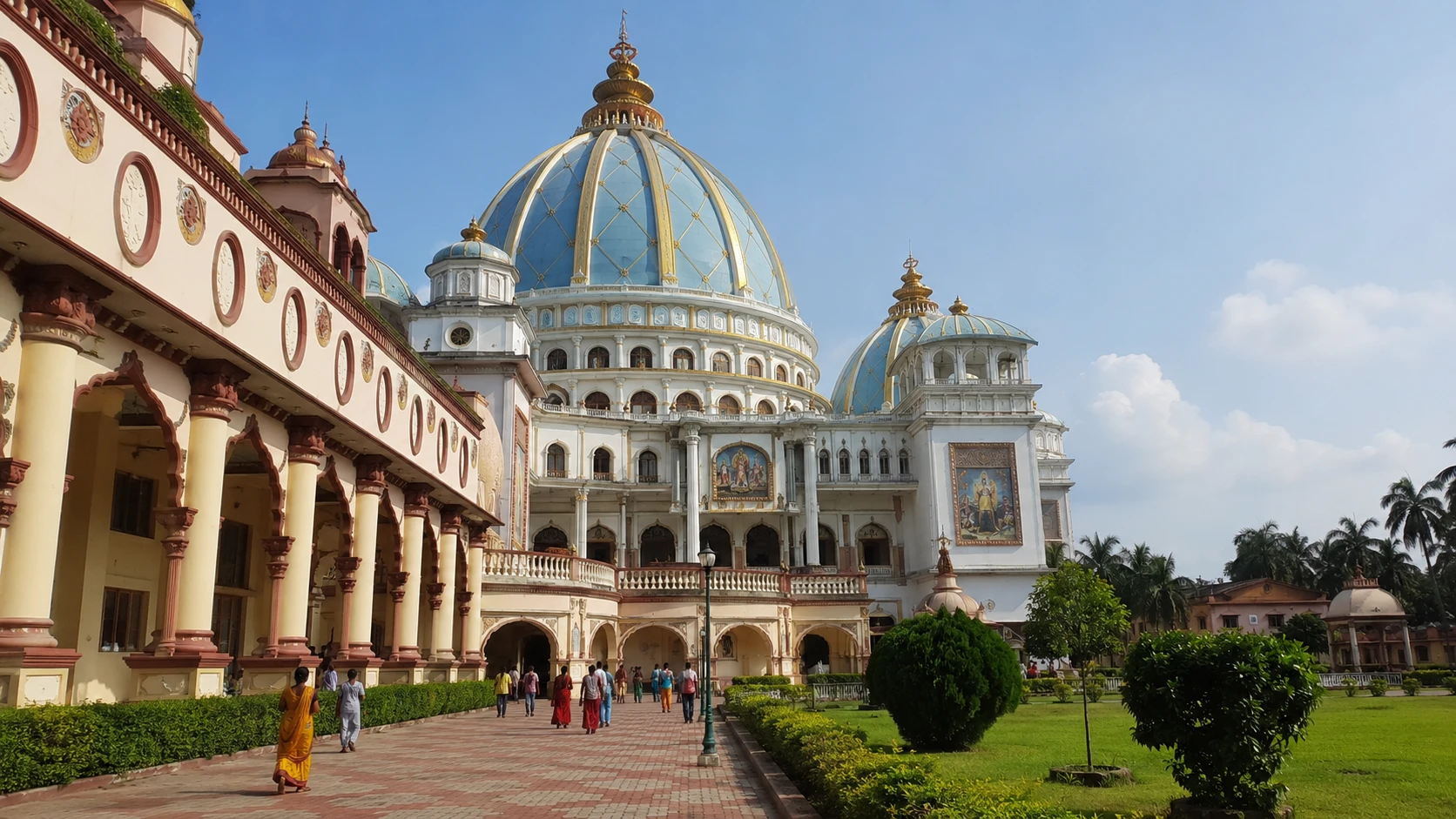
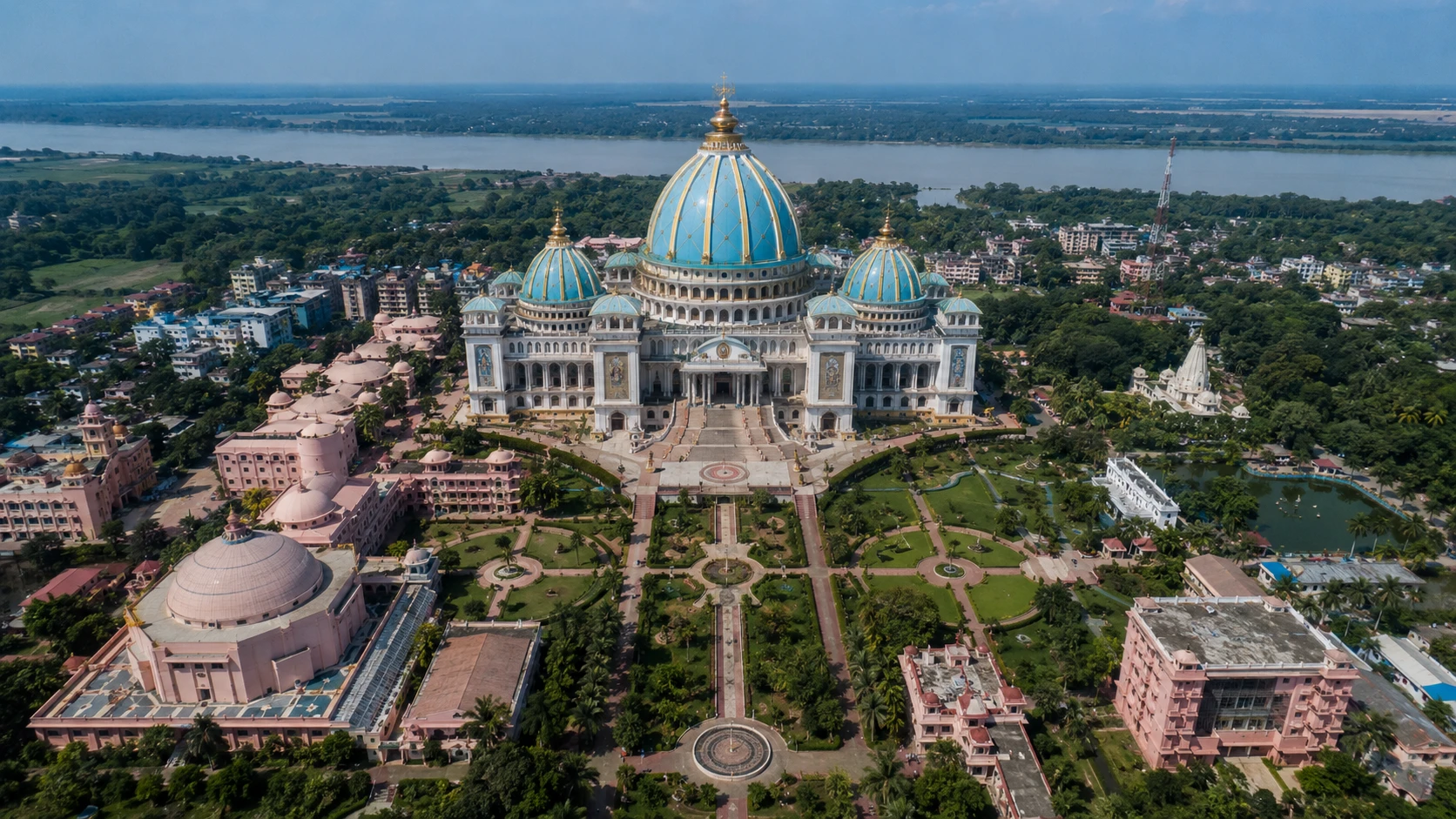
ISKCON Chandrodaya Mandir: contemporary Gaudiya Vaishnava devotional architecture. Temple of Vedic Planetarium (TOVP): Indo-Western hybrid with a massive central dome intended to exceed the diameter of St. Peter's Basilica in Rome
Open
04:30 – 21:00
Aarti
04:30 · 07:15 · 07:30 · 13:00 · 19:00 · 20:30
Special
Mangala Aarti at 4:30 AM is ISKCON Mayapur's defining daily practice — open to all. Gaura Purnima (March) draws pilgrims from around the world; the main festival period runs for approximately one week. Timings are subject to variation on festival days — verify at mayapur.com.
The Sacred Legend · पवित्र कथा
In 1486 CE, on a moonlit evening when a lunar eclipse had sent the whole town of Navadvip into the streets chanting Krishna's name, a child was born to a poor Brahmin and his wife. He was unusually fair-complexioned — golden — in a land of dark-skinned people. They named him Nimai after the neem tree outside the house. When he grew into a young man and initiated the sankirtan movement — public, mass chanting of the divine names, without ritual, without hierarchy, anyone welcome — the streets of Navadvip rang with 'Hare Krishna' before that phrase had ever crossed the sea. Five centuries later, the streets of the same town ring with the same chant, but the voices now belong to pilgrims from 120 countries, wearing white and saffron, arriving by boat across the Ganga to the town where the golden saint was born. A.C. Bhaktivedanta Swami Prabhupada planted ISKCON's world headquarters here because this geography is not heritage — it is a living presence, and every Gaudiya Vaishnava knows you come to Mayapur not to remember Chaitanya but to find him still there.
Sacred Origin Storyपवित्र उत्पत्ति कथा
Source: Gaudiya Vaishnava; following the theological lineage of Sri Chaitanya Mahaprabhu (1486–1534 CE), as documented in the Chaitanya-caritamrta and Chaitanya-bhagavata, and transmitted through the Bhaktivinoda-Bhaktisiddhanta-Prabhupada lineage to ISKCON
Sri Chaitanya Mahaprabhu — known in devotional literature as Gaura (the Golden One), Gauranga, Nimai, and Vishvambhara — was born at Navadvip (present-day Mayapur) on the evening of Gaura Purnima in 1486 CE to Jagannath Mishra, a learned Brahmin, and Sachi Devi. The Chaitanya-caritamrta records the circumstances of the birth as spiritually charged: a lunar eclipse was underway, and the people of Navadvip had spontaneously gathered in the streets to chant Hari's name — a traditional practice during eclipses — so that the child entered the world to the sound of the divine name.
Chaitanya showed early signs of extraordinary spiritual intensity. He was educated in Sanskrit grammar and eventually became a highly respected pandita at Navadvip. At approximately age 22, he underwent a transformative spiritual experience at Gaya (where he had gone to perform his father's obsequies) and returned to Navadvip a changed man — not a scholar but a bhakta, someone consumed by love of Krishna. He initiated the sankirtan movement: public processions of kirtan (collective chanting and singing) through the streets of Navadvip and later Puri, Vrindavan, and South India. He wore the mark of a Vaishnava sanyasi, carried a wooden staff, and danced in ecstasy at the name of Krishna.
The theological significance of Chaitanya Mahaprabhu for the Gaudiya tradition is immense: he is understood by his followers not merely as a saint or reformer but as the combined avatara of Radha and Krishna in one golden form — the divine appearing in the mood of the devotee, tasting the sweetness of devotion from the inside. His emotional approach to bhakti — tears of ecstasy, trembling, fainting, the full range of bhava — established the 'achintya bhedabheda' (inconceivable simultaneous difference and non-difference) philosophical framework through his disciples, particularly the Six Goswamis of Vrindavan.
Sources cited:
- Krishnadasa Kaviraja, 'Chaitanya-caritamrta' (16th century, Bengali/Sanskrit) — primary biography of Chaitanya Mahaprabhu
- Vrindavana Dasa Thakura, 'Chaitanya-bhagavata' (16th century, Bengali) — early biographical account
- A.C. Bhaktivedanta Swami Prabhupada, 'Teachings of Lord Chaitanya' (1968) — ISKCON's foundational theological work on the tradition
- S.K. De, 'Early History of the Vaishnava Faith and Movement in Bengal' (Calcutta, 1961)
Scholarly Context
The identification of the precise birthplace of Chaitanya Mahaprabhu at Mayapur (as distinct from other sites in the Navadvip area) was undertaken by Bhaktivinoda Thakura (1838–1914 CE) in the 19th century based on textual and geographical research, and is accepted by the Gaudiya Math and ISKCON lineages. Some other Gaudiya institutions locate the birthsite slightly differently within the Navadvip complex. Modern historians of Bengal's religious traditions (Ramakanta Chakravarti, 'Vaishnavism in Bengal', 1985; S.K. De, 1961) treat Chaitanya Mahaprabhu as a historical figure of the early 16th century whose birthdate of 1486 CE is plausible, while noting that the primary sources (Chaitanya-caritamrta, Chaitanya-bhagavata) are devotional rather than secular biographies. ISKCON's institutional development at Mayapur from 1972 onwards represents a 20th-century chapter in the site's long sacred history.
Historyइतिहास
The sacred geography of Mayapur extends across at least five centuries of documented history. Sri Chaitanya Mahaprabhu was born here in 1486 CE; spent his early life in Navadvip as a Sanskrit scholar and later as the initiator of the sankirtan movement; left for Puri around 1510 CE; and spent the rest of his life between Puri, Vrindavan, and South India. In the 19th century, Bhaktivinoda Thakura (1838–1914 CE) — a senior officer in the British colonial administration and a Gaudiya Vaishnava theologian — conducted textual and geographical research to identify Mayapur as Chaitanya's precise birthsite, publishing his findings and establishing a small Yogapith (birthplace shrine) there. His son Bhaktisiddhanta Sarasvati Thakura (1874–1937 CE) expanded the presence, founding the Gaudiya Math at Mayapur and establishing it as a major institutional centre for Gaudiya Vaishnavism. A.C. Bhaktivedanta Swami Prabhupada (1896–1977 CE), a disciple of Bhaktisiddhanta, took the tradition to the West — founding ISKCON in New York in 1966 — and returned to establish ISKCON's world headquarters at Mayapur, inaugurating the Mayapur project on Gaura Purnima, 1972. ISKCON has since developed Mayapur into a major international pilgrimage centre with guesthouses, educational institutions, farms, and the Temple of Vedic Planetarium (TOVP) — a massive domed structure intended to be one of the world's largest religious buildings. The TOVP was in advanced completion stages as of 2025; verify current status at mayapur.com.
Historical Timelineऐतिहासिक कालक्रम
Sri Chaitanya Mahaprabhu is born at Navadvip (Mayapur) on the evening of Gaura Purnima to Jagannath Mishra and Sachi Devi. The birth occurs during a lunar eclipse, when the townspeople have spontaneously gathered to chant Hari's name. The Chaitanya-caritamrta identifies this as Mayapur, on the bank of the Ganga.
The birthdate of 1486 CE (equivalent to Shakabda 1407, Phalguna Purnima) is accepted by scholars of Bengal's religious traditions as historically plausible. The precise location within Navadvip-Mayapur was historically identified by Bhaktivinoda Thakura in the 19th century; the identification is accepted by ISKCON and the Gaudiya Math lineages.
Bhaktivinoda Thakura (Kedarnath Datta, 1838–1914 CE) — Gaudiya Vaishnava theologian and colonial-era district magistrate — publishes research identifying Mayapur as the precise birthplace of Chaitanya Mahaprabhu. He establishes the Yogapith (birthplace shrine) and begins transforming Mayapur into a pilgrimage site accessible to devotees across Bengal.
Bhaktivinoda Thakura's identification of the Mayapur birthsite is not universally accepted among all Gaudiya lineages — some traditions locate the birthsite differently within the Navadvip complex. The ISKCON/Gaudiya Math identification with the current Yogapith is the dominant institutional position.
A.C. Bhaktivedanta Swami Prabhupada (1896–1977 CE), a disciple of Bhaktisiddhanta Sarasvati Thakura, founds the International Society for Krishna Consciousness (ISKCON) in New York City. The society rapidly expands globally through the Hare Krishna movement, establishing temples on every continent and making the Gaudiya Vaishnava tradition accessible to non-Indians for the first time at scale.
A.C. Bhaktivedanta Swami Prabhupada inaugurates the ISKCON Mayapur project on Gaura Purnima (March 28, 1972). He acquires land at Mayapur and lays the foundation for ISKCON's world headquarters at Chaitanya Mahaprabhu's birthplace. Prabhupada envisions a major spiritual community, international guesthouses, and eventually the Temple of Vedic Planetarium (TOVP). Prabhupada passes away in 1977; construction continues under the Governing Body Commission.
What You'll Seeदर्शन में
The ISKCON Mayapur complex houses two principal deity installations. The first and primary is Sri Sri Radha Madhava — Radha and Krishna together — accompanied by eight Sakhis (the eight principal gopis of Vrindavan). The Radha Madhava murti is installed in the main Chandrodaya Mandir, elaborately adorned in seasonal dress following the Gaudiya Vaishnava ashtayama (eight-period daily schedule). The second and equally significant installation is Sri Sri Pancha Tattva — the five sacred forms representing Chaitanya Mahaprabhu and his four principal associates: Nityananda Prabhu, Advaita Acharya, Gadadhara Pandit, and Srinivasa Thakura. The Pancha Tattva group stands in the main temple in the characteristic pose of the sankirtan movement — Chaitanya Mahaprabhu with his arms raised in the ecstatic gesture of kirtan. The image of Chaitanya as the golden lord (gaura-varna) — fair-complexioned, arms raised, in a posture of divine intoxication — is the central icon of ISKCON Mayapur and of the Gaudiya Vaishnava tradition's devotion to Navadvip. The Yogapith (birthplace shrine) — a separate structure at the site traditionally identified as Chaitanya Mahaprabhu's actual birthplace — is within the ISKCON compound.
Distinctive Practicesविशिष्ट परंपराएँ
Mangala Aarti at 4:30 AM — the predawn ISKCON practice
प्रातः 4:30 बजे मंगला आरती — इस्कॉन की भोर से पहले की प्रथा
Daily, 4:30 AM, year-round
ISKCON Mayapur's Mangala Aarti — the predawn waking of the deities, conducted at 4:30 AM every day of the year — is one of the defining features of ISKCON devotional life worldwide. Devotees from the ashram and visiting pilgrims fill the main temple before dawn, singing the Mangala Aarti prayers in the darkened hall lit only by ghee lamps and lamps before the deities. The experience is considered particularly auspicious at Mayapur because Chaitanya Mahaprabhu himself rose before dawn for morning prayers. The Mangala Aarti is open to all, regardless of religion or background.
Gaura Purnima — the world's largest Gaudiya Vaishnava gathering
गौर पूर्णिमा — विश्व का सबसे बड़ा गौड़ीय वैष्णव समागम
Phalguna Purnima (February–March); festival season runs approximately one week
Gaura Purnima — the full moon of Phalgun, the anniversary of Chaitanya Mahaprabhu's birth — is ISKCON Mayapur's most important festival and the occasion that draws the largest international gathering of Gaudiya Vaishnavas in the world. Tens of thousands of devotees from over 120 countries arrive at Mayapur in the days preceding the festival, filling the ashram and the surrounding guesthouses. The festival includes the Navadvip Mandal Parikrama — a multi-day walking circumambulation of the nine sacred islands of Navadvip — mass kirtan in the main temple, the Gaura Purnima Abhishek (ritual bathing of the Pancha Tattva deities), and the Jagannath Mishra Festival (a night procession celebrating Chaitanya's birth eve). The atmosphere of Gaura Purnima — thousands of people from dozens of languages and cultures singing the same kirtan in the town where the chant began — is described by pilgrims as unlike any other religious gathering in the world.
Temple of Vedic Planetarium (TOVP) — architectural landmark
वैदिक तारामंडल का मंदिर (TOVP) — वास्तुकला का मील का पत्थर
Under construction / completing (verify current status at mayapur.com)
The Temple of Vedic Planetarium — envisioned by Prabhupada, designed and constructed over decades by ISKCON Mayapur — is intended to be one of the largest religious buildings in the world by dome height, incorporating a Vedic cosmological model within an architectural complex of unprecedented scale for a modern Hindu temple. The central dome was designed to exceed the diameter of St. Peter's Basilica in Rome. The TOVP includes a Vedic Planetarium exhibition hall, multiple deity shrines, and extensive visitor facilities. Construction has been ongoing since the early 21st century and was in advanced completion stages as of 2025; verify current status and visiting access at mayapur.com.
Did You Know?क्या आप जानते हैं?
ISKCON Mayapur serves free prasada (sanctified vegetarian food) to all pilgrims and visitors from the temple's langar-style kitchen daily — one of the world's largest free vegetarian meal programmes associated with a single religious site. During Gaura Purnima, tens of thousands of meals are served daily.
ISKCON Mayapur official documentation; ISKCON Food for Life programme records
Bhaktivinoda Thakura — the 19th-century scholar who rediscovered Mayapur as Chaitanya's birthplace — was simultaneously a devout Vaishnava and a senior officer in the British colonial administration (he served as a district magistrate). His ability to combine rigorous Western scholarly methods with devotional practice in identifying the Mayapur birthsite represents one of the more unusual intellectual biographies in Bengal's religious history.
Shukavak N. Dasa, 'Hindu Encounter with Modernity: Kedarnath Datta Bhaktivinoda, Vaishnava Theologian' (1999)
Chaitanya Mahaprabhu never wrote a systematic philosophical treatise himself — his entire theology was transmitted through the compositions of his disciples (the Six Goswamis of Vrindavan and others). The Chaitanya-caritamrta, the primary biography, was composed by Krishnadasa Kaviraja approximately 80 years after Chaitanya's death. This makes Mayapur's significance depend almost entirely on the tradition's oral and textual memory rather than on surviving physical structures from Chaitanya's own time.
S.K. De, 'Early History of the Vaishnava Faith and Movement in Bengal' (1961); Krishnadasa Kaviraja, 'Chaitanya-caritamrta'
ISKCON Mayapur welcomes devotees and visitors of all religions and nationalities — there is no entry restriction based on religion, caste, or nationality. This openness is a theological position of ISKCON, rooted in Chaitanya Mahaprabhu's own universalism: he is recorded in the Chaitanya-caritamrta as saying that the divine name should be spread to every town and village in the world.
ISKCON official position; Krishnadasa Kaviraja, 'Chaitanya-caritamrta', Adi-lila
Visitor Accessप्रवेश जानकारी
ISKCON Mayapur is open to all, regardless of religion, caste, nationality, or background. This is an explicit policy of ISKCON, rooted in Chaitanya Mahaprabhu's universalist teaching. Modest dress is required inside the temple; women are requested to cover their heads with a dupatta or scarf inside the main shrine. Photography is permitted in most areas of the complex; flash photography inside the main shrine may be restricted.
Dhoti/sari sets are available for loan at the temple entrance for visitors not in traditional attire. Photography restrictions inside the main shrine should be checked with temple staff on arrival.
Festivalsत्योहार
Gaura Purnima
गौर पूर्णिमा
Feb-Mar (Phalguna Purnima)
The anniversary of Chaitanya Mahaprabhu's birth — ISKCON Mayapur's most important festival and the world's largest annual gathering of Gaudiya Vaishnavas. Tens of thousands from over 120 countries arrive for approximately one week of celebrations including the Navadvip Mandal Parikrama (walking circumambulation of Navadvip's nine islands), Gaura Purnima Abhishek, and the Jagannath Mishra Festival.
Navadvip Mandal Parikrama
नवद्वीप मंडल परिक्रमा
Feb-Mar (during Gaura Purnima season; approximately 4 days)
A walking pilgrimage circumambulating the nine sacred islands (mandal) of Navadvip — each island associated with a specific spiritual quality or episode from Chaitanya's life. Thousands walk over four days, covering approximately 90 km, singing kirtan throughout. The parikrama culminates in the Gaura Purnima festival at Mayapur.
Janmashtami
जन्माष्टमी
Jul-Aug
ISKCON worldwide celebrates Janmashtami with extended kirtan, midnight abhishekam of the Radha Madhava deities, and readings from the Bhagavata Purana's Tenth Canto. At Mayapur, the celebration draws large crowds and has the particular resonance of being observed at the world headquarters of the tradition that took the Hare Krishna chant globally.
Nityananda Trayodashi
नित्यानंद त्रयोदशी
Jan-Feb (Magha Shukla Trayodashi)
The birth anniversary of Nityananda Prabhu — Chaitanya Mahaprabhu's closest associate and the Lord's aspect of unconditional compassion — observed as a major festival at Mayapur with special kirtan and elaborate Pancha Tattva darshan. Nityananda's role in spreading the sankirtan movement throughout Bengal is celebrated specifically at Mayapur.
Traditional Offeringsपारंपरिक अर्पण
Primary Offerings
Tulsi (Holy Basil)
तुलसी
तुलसी
Tulsi is the supreme Vaishnava offering, and at ISKCON Mayapur the offering follows the Gaudiya Vaishnava protocols of the Haribhaktivilasa — tulsi leaves placed on every bhog offering to Radha Madhava. ISKCON's own literature frequently cites the instruction that tulsi is dearer to Vishnu than any other plant; the tradition of maintaining tulsi plants in every ISKCON temple worldwide originates from this devotional practice.
Maha-prasadam — the blessed remnants of food offered to the deity
महाप्रसादम् — देव को चढ़ाए गए भोजन के आशीर्वाद-युक्त अवशेष
महाप्रसाद
In ISKCON theology (following Chaitanya Mahaprabhu's emphasis on prasada distribution as a form of devotional service), maha-prasadam — the food offered to Radha Madhava and then distributed to devotees and visitors — is itself considered a form of Krishna's mercy. ISKCON Mayapur's daily free prasada distribution, serving hundreds of thousands during Gaura Purnima, is one of the world's largest acts of religious hospitality.
Panchamrit and floral offerings
पंचामृत और पुष्प अर्पण
पञ्चामृत
Panchamrit abhishekam is performed at ISKCON Mayapur on major festival occasions following the standard Gaudiya Vaishnava protocols. Fresh flower garlands — changed at each of the daily deity programs — are a continuous feature of the worship.
Offering materials (tulsi, flowers, incense) are available near the temple entrance. The ISKCON Mayapur temple offers free prasada daily; the main prasada hall serves hundreds of devotees per day and thousands during festival periods. Donations to the temple or ISKCON's charitable programmes can be made at donation counters or through mayapur.com.
How to Reachकैसे पहुँचें
Mayapur is most conveniently reached via Krishnanagar City Junction (35 km), served by regular trains from Kolkata's Sealdah station on the Sealdah–Krishnanagar line (approximately 1.5–2 hours). From Krishnanagar, ISKCON Mayapur operates shuttle services; local buses and taxis also make the 45-minute journey. Alternatively, from Kolkata one can reach Navadwip Station (on the Katwa line), cross the Ganga by ferry (approximately 10 minutes), and continue to Mayapur by rickshaw or walk (approximately 3 km). By air, Kolkata's Netaji Subhash Chandra Bose International Airport (130 km) is the nearest; car or train service from Kolkata to Mayapur takes approximately 3–4 hours. ISKCON Mayapur operates its own guesthouse booking and pilgrimage services through mayapur.com.
Plan Your Visitयात्रा की योजना
🌤 Best Season
October to March (pleasant Bengal winters). Gaura Purnima (February–March) is the most spiritually significant period, but expect very large crowds and full accommodation — book months in advance through mayapur.com. The complex has guesthouses accommodating thousands, but they fill quickly for Gaura Purnima.
👘 Dress Code
Modest dress required inside the temple. Men: kurta-dhoti or equivalent; Western dress tolerated but traditional preferred. Women: sari or salwar-kameez; head covered with dupatta inside the main shrine. Dhoti/sari sets available at the entrance.
📱 Phones & Photography
Photography generally permitted throughout the complex. Flash photography inside the main shrine may be restricted — check with temple staff on arrival.
🏨 Accommodation
ISKCON Mayapur operates a large complex of guesthouses (from dormitory to private rooms) bookable through mayapur.com. The complex can accommodate thousands of pilgrims. Outside the ISKCON complex, limited private accommodation exists in Mayapur and Navadvip towns.
Book a Pujaपूजा बुक करें
The Temple of Vedic Planetarium (TOVP) construction status should be verified at mayapur.com before planning a visit specifically to see the TOVP. Temple timings and programs vary during festival periods; always check the current schedule at mayapur.com. The mayapur.com website is the official and legitimate source for all bookings and donations.
Managed by: ISKCON Mayapur (International Society for Krishna Consciousness, Mayapur)
Guesthouse accommodation (dormitory to private rooms)
गेस्ट हाउस आवास (डॉर्मेटरी से निजी कमरे)
Gaura Purnima festival packages
गौर पूर्णिमा उत्सव पैकेज
Booking information verified: 2026-05-23
Sacred Soundsपवित्र ध्वनि
Hare Krishna Mahamantra — 'Hare Krishna Hare Krishna Krishna Krishna Hare Hare / Hare Rama Hare Rama Rama Rama Hare Hare'; the central chant of the ISKCON tradition
bhajan
Mayapur Mangala Aarti — predawn aarti prayers; sung daily at 4:30 AM
aarti
Gaura Aarti — evening aarti to Chaitanya Mahaprabhu; one of the most sung ISKCON prayers worldwide
aarti
108 Japa Practice
Hare Krishna Hare Krishna Krishna Krishna Hare Hare / Hare Rama Hare Rama Rama Rama Hare Hare
Chant 108 times in the spirit of this temple
Did You Know? · क्या आप जानते हैं?
The same translation error that turned '33 Koti' into '33 crore' in Hinduism also happened in Buddhism. The Chinese translation of Buddhist texts rendered 'Sapta Koti Buddha' (7 Supreme Buddhas) as '7 Crore Buddhas.' The Tibetan translation got it right: 7 types, not 7 crore. One Sanskrit word, misread across two major world religions, generated two identical misconceptions independently.
Related Contentसंबंधित सामग्री
Related Scriptures
Community Reflections
🕉️
Be the first to share your reflection.