Erumeli Sastha
एरुमेली शास्ता
Where pilgrims dance wildly before entering the sacred forest
Erumeli, Kerala, India
Erumeḷi ŚāstāAlso known as: Erumeli Putthan Sastha, Erumeli Dharmasastha Temple, Kottayam Erumeli Sastha
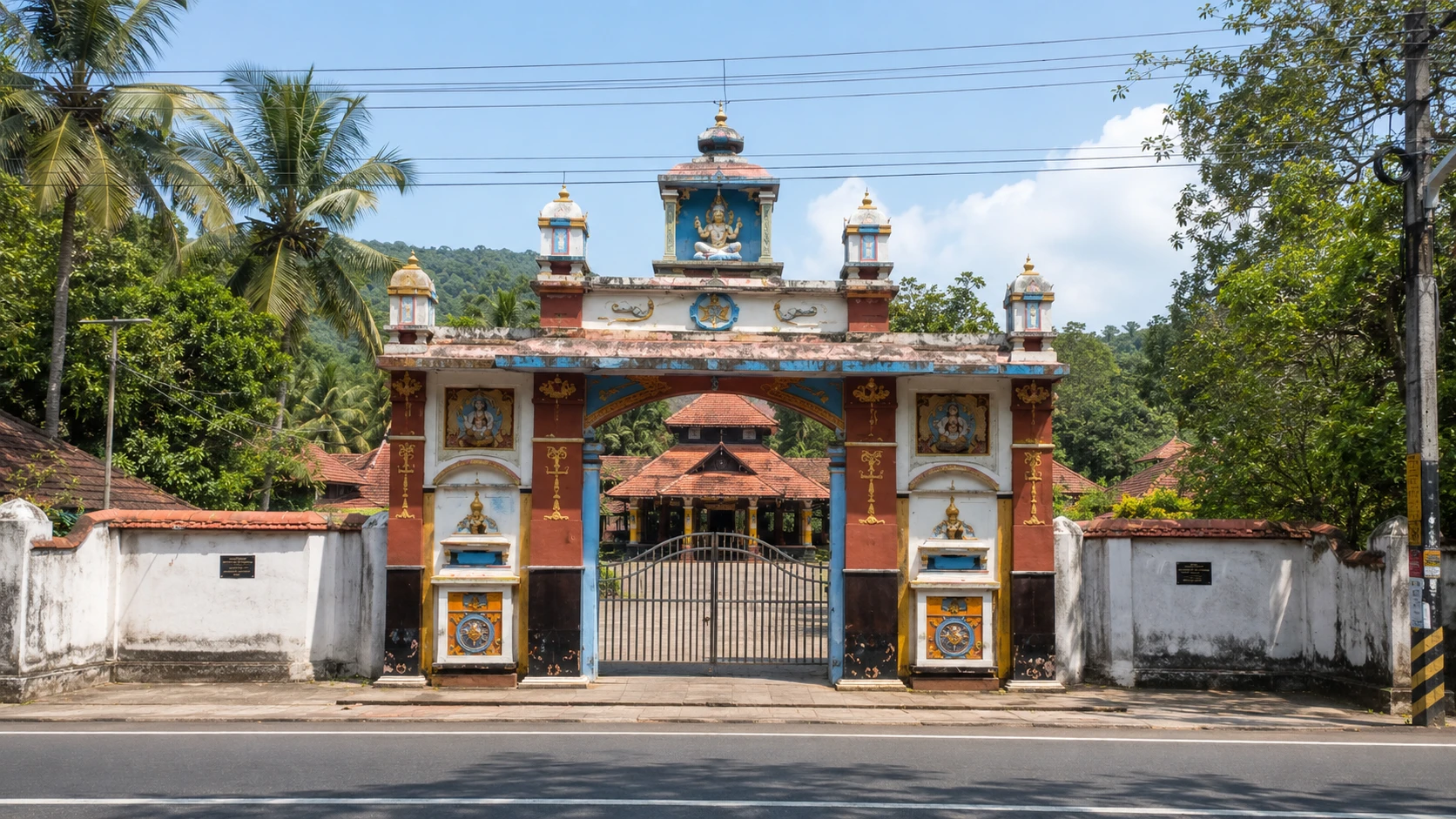
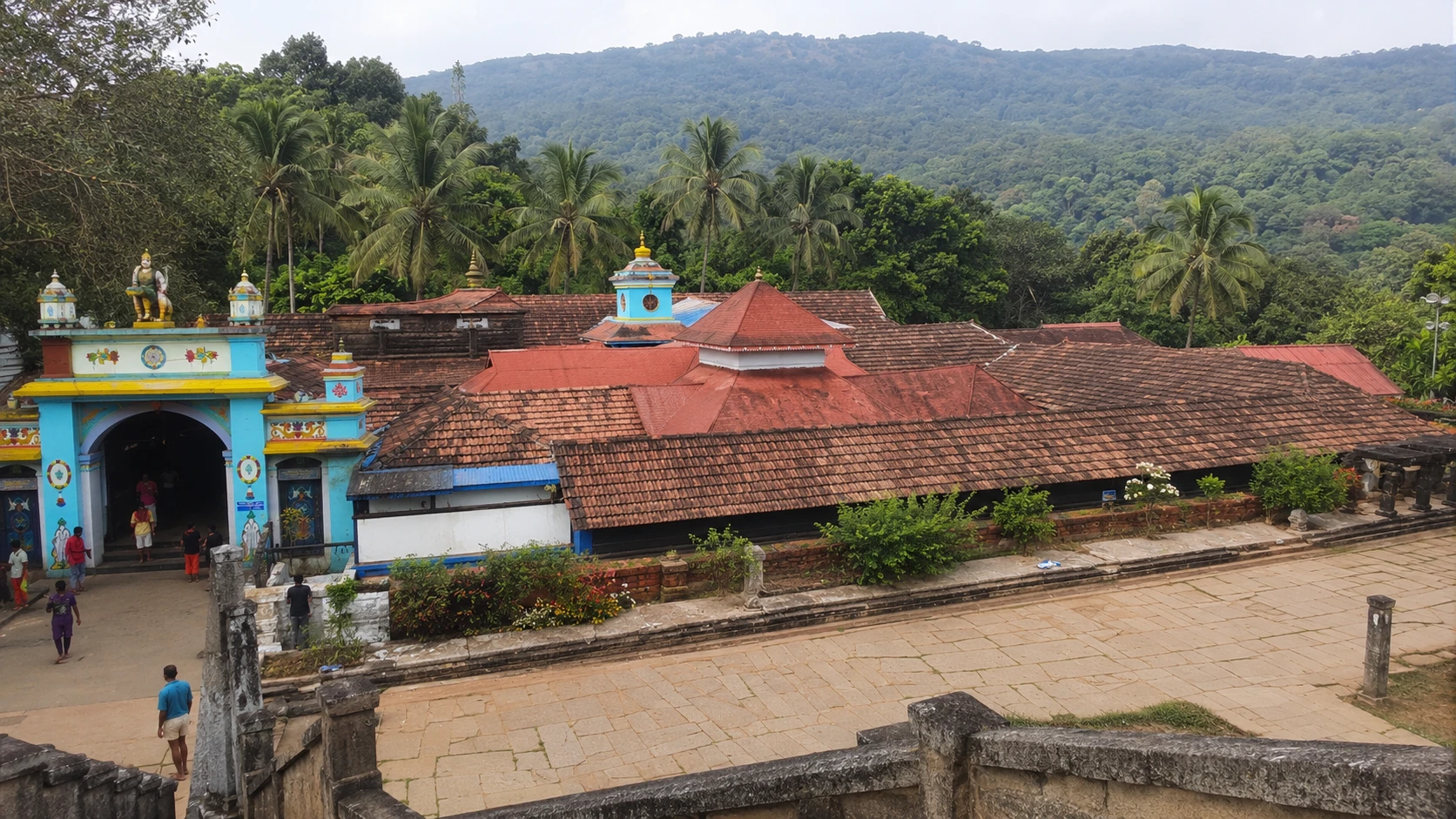
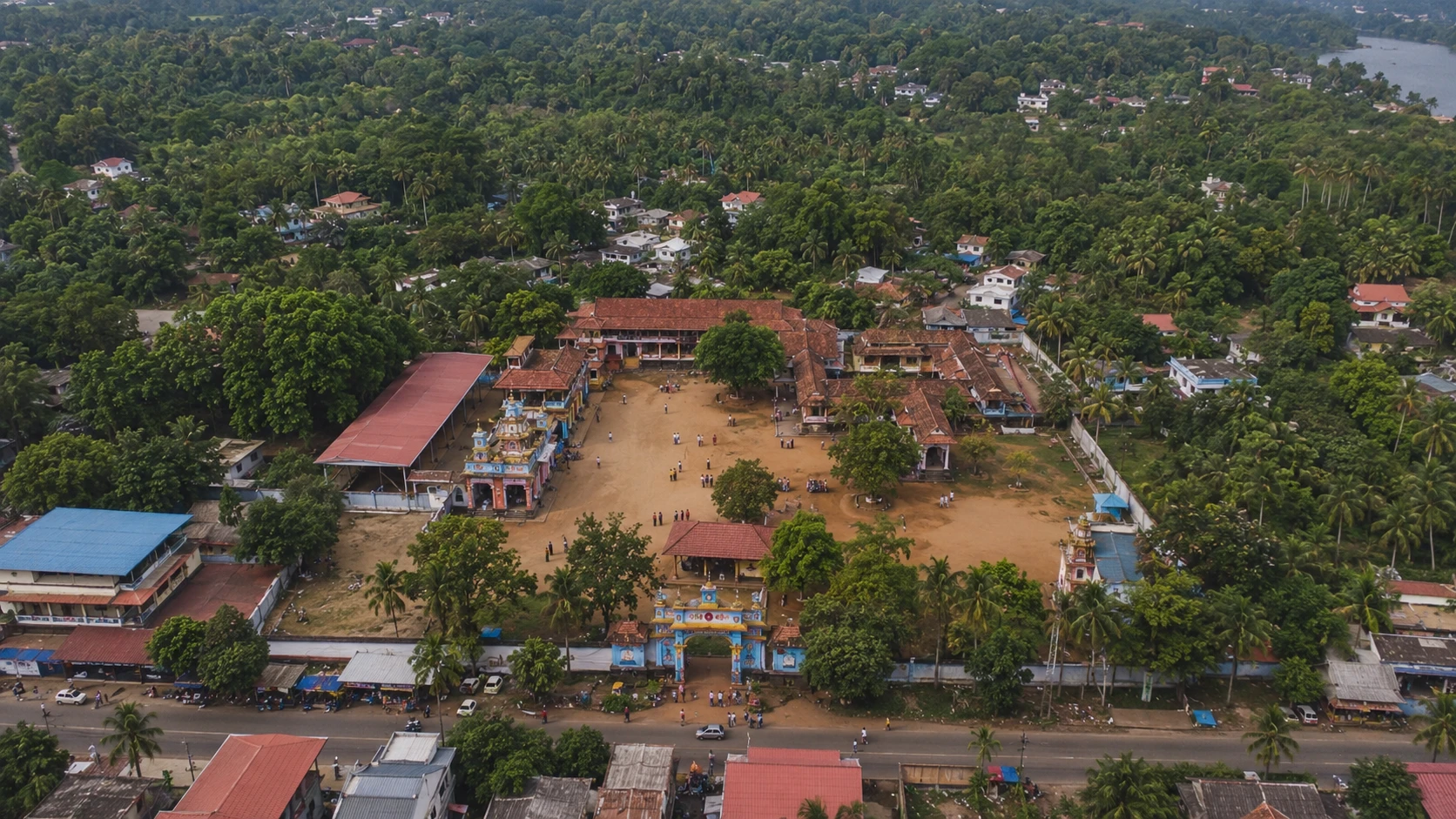
Era
Pre-modern (traditional pilgrimage route reference; current structure 20th century)
Architecture
Kerala Nāḷu-kettu tradition
Open
05:00 – 20:30
Aarti
05:30 · 10:30 · 18:00 · 20:00
Special
Petta Thullal procession: performed by Sabarimala pilgrims on their arrival in Erumeli during Mandala and Makaravilakku seasons. The procession passes through the Erumeli bazaar and culminates at the Sastha temple.
The Sacred Legend · पवित्र कथा
Erumeli is where the Sabarimala pilgrimage truly begins — and it begins with an act of controlled wildness. Before climbing the sacred forest path to the hilltop shrine, traditional pada yatra (foot pilgrimage) devotees stop at this small Kottayam-district town and perform the Petta Thullal: a frenzied, ash-smeared, drum-driven procession-dance through the Erumeli bazaar that re-enacts the cosmic battle in which Ayyappa slew the demoness Mahishi. The austerity of forty-one days gives way, for a few hours, to ecstatic tumult — and then, purged of the last residues of ego, the pilgrim turns towards the forest. Adjacent to the Sastha temple stands the Vavar Mosque, honoring Ayyappa's Muslim companion Vavar, and Sabarimala pilgrims traditionally bow at both before the trek begins. Erumeli is the place where warrior and ascetic, Hindu and Muslim, order and ecstasy meet at the threshold of the sacred.
Sacred Designationपवित्र पदनाम
Sacred Origin Storyपवित्र उत्पत्ति कथा
Source: Shaiva-Vaishnava composite (Hariharaputra tradition); Erumeli Sthala Purana
Erumeli is identified in the Ayyappa tradition as the site where Ayyappa — returning after slaying the demoness Mahishi in the forest — first crossed paths with Vavar, a Muslim warrior of the coastal regions. The two met in combat: Ayyappa defeated Vavar, but rather than destroying him, recognised in him a pure-hearted devotee. Vavar surrendered and became Ayyappa's constant companion and the protector of his pilgrims. Before ascending to establish his eternal seat at Sabarimala, Ayyappa decreed that all who would come to him must first pass through Erumeli, seek the blessing of the Sastha in his warrior form, and offer respect to Vavar — acknowledging that devotion has no single form and that Ayyappa's protection extends through all who surrender to dharma.
The Petta Thullal is understood in the tradition as the re-enactment of the divine armies' jubilant victory procession after Mahishi's defeat. Ayyappa's forces — representing dharma — and Mahishi's forces — representing adharma — faced each other in the cosmic battle that ended in Erumeli's fields. Pilgrims who perform the Thullal embody both sides simultaneously: the chaos of the demonic and the victory of the divine, burning through both in the fire of devotion before approaching the ascetic stillness of the hilltop.
Sources cited:
- Erumeli Sastha Sthala Purana (Malayalam oral tradition)
- Bhuta Purana (regional Kerala Purana — primary narrative for Vavar-Ayyappa encounter)
- Travancore Devaswom Board documentation on Sabarimala pilgrimage traditions
- M.S.S. Pandian, 'Sabarimala and Its Contexts', EPW (2000) — documents Vavar tradition and Petta Thullal
Historyइतिहास
Erumeli's documented history is inseparable from its role as the primary staging point of the traditional Sabarimala pada yatra (foot pilgrimage). While the temple's founding date is not inscriptionally established, the Erumeli Sastha shrine has been a recognised stop on the Sabarimala pilgrimage route for centuries — referenced in accounts of the pilgrimage tradition that predate the modern era. The town sits at the base of the Western Ghats where the forest paths toward Sabarimala begin, and its geography made it the natural threshold between the human settlement and the sacred wilderness. The Vavar Mosque adjacent to the Sastha temple is a well-attested feature of the pilgrimage townscape; the relationship between the mosque and the temple has been maintained by both communities across generations and continues to be observed by pilgrims undertaking the traditional foot route. The Petta Thullal — the ecstatic procession-dance performed by pilgrims on their passage through Erumeli — is among the most distinctive living ritual practices in Kerala's pilgrimage culture, practised with uninterrupted continuity through the expansion of the Sabarimala pilgrimage to its modern scale.
Historical Timelineऐतिहासिक कालक्रम
Erumeli established as the traditional gateway of the Sabarimala pada yatra: the Erumeli Sastha shrine and the adjacent Vavar site are referenced in accounts of the Sabarimala pilgrimage tradition that predate the earliest modern documentation, establishing Erumeli as the mandatory threshold stop for foot pilgrims heading to the hilltop shrine.
Founding date is traditional, not inscriptionally confirmed. The reference to Erumeli in pilgrimage accounts predating the 20th-century expansion establishes continuity of the tradition.
The Vavar Mosque at Erumeli documented as an established feature of the pilgrimage landscape: Travancore-era accounts of the Sabarimala pilgrimage consistently reference both the Sastha temple and the adjacent mosque as stops for pilgrims on the traditional foot route, indicating the Vavar co-veneration tradition was formalised by at least this period.
With the massive expansion of the Sabarimala pilgrimage following independence and the TDB's administration of Sabarimala, Erumeli's role as the gateway of the traditional pada yatra was formally recognised in pilgrimage literature and guides. The Petta Thullal became more widely documented as a distinctive feature of the Erumeli stop, drawing academic and journalistic attention.
What You'll Seeदर्शन में
The Erumeli Sastha is enshrined in the standing warrior posture — a form markedly distinct from the meditative yoga-pattam posture of the Sabarimala Ayyappa. The deity holds a bow (villu) and arrow (ambu), embodying Ayyappa as the divine warrior who descended into the mortal world to slay Mahishi. This is the Veerasastha or 'fierce Sastha' form: active, armed, and in the world rather than withdrawn from it. The deity is also referred to as Putthan Sastha — the 'young Sastha' — reflecting the dynamic youthful energy of this warrior manifestation as contrasted with the ancient, still, meditative Sabarimala form. Photography inside the inner sanctum is not permitted.
Distinctive Practicesविशिष्ट परंपराएँ
Petta Thullal — The Wild Procession Dance
पेट्टा थुल्लल — उन्मत्त जुलूस-नृत्य
Performed by Sabarimala pilgrims on the traditional pada yatra, upon arrival at Erumeli during the Mandala and Makaravilakku pilgrimage seasons
The Petta Thullal is among the most remarkable ritual performances in living Hindu pilgrimage practice. Pilgrims arriving at Erumeli on the traditional foot-pilgrimage route — already dressed in their forty-one-day black vow-clothing — smear themselves with ash and turmeric, take up drums (chenda and idakka), and form two rival procession groups that move through the Erumeli bazaar in a frenzy of dance, chanting, shouting, and leaping. The two groups traditionally represent the armies of the Devas and the armies of the Asuras — re-enacting the cosmic battle in which Ayyappa's forces triumphed. Participants dance with abandon, their bodies moving with an energy that is the opposite of the composed austerity of the forty-one-day vow. The procession passes through the bazaar, pauses at the Vavar Mosque, and culminates at the Erumeli Sastha temple, after which the pilgrims resume the composed, barefoot forest trek toward Sabarimala.
The Petta Thullal occupies a precise theological position in the Sabarimala pilgrimage structure: it is the liminal fire between the world and the sacred. Forty-one days of strict discipline purify the body and the gross mind; but the ego's deeper residues — pride in the discipline itself, the accumulated identity of 'the pilgrim' — require a different technique. The Thullal burns these through inversion: the devotee who has been composed and restrained for forty-one days now dances without reserve, plays the Asura as well as the Deva, inhabits chaos as well as order. The theological principle draws on the Tantric understanding that completion comes not by avoiding the lower energies but by moving through them and beyond. Emerging from the Thullal, the pilgrim is stripped of the last layer of performance — and enters the forest as pure intention.
Vavar Nerccha — Paying Respects at the Vavar Mosque
वावर नेर्च्च — वावर मस्जिद में श्रद्धांजलि
Performed by pilgrims on the traditional pada yatra, immediately before or after the Petta Thullal
Immediately adjacent to the Erumeli Sastha temple stands the Vavar Mosque (Vavar Palli) — the shrine honoring Vavar, Ayyappa's Muslim companion. Sabarimala pilgrims on the traditional foot-pilgrimage route stop at the mosque, bow their heads (namaskaram) toward the structure, and offer a brief prayer of respect to Vavar before continuing to the Sastha temple. This is not a crossing of religious lines — pilgrims do not pray as Muslims, and the mosque community has always maintained the distinction clearly. It is a practice of parallel co-veneration: Ayyappa's own decree, enshrined in the Bhuta Purana, that Vavar must be honoured on the way to Sabarimala. The Vavar Mosque community at Erumeli has maintained this relationship with the Ayyappa pilgrimage tradition across generations.
The Vavar practice enacts one of the Ayyappa tradition's most theologically distinctive principles: that Ayyappa's grace is not confined to a single community or form of surrender. Vavar, having surrendered to Ayyappa in combat, became his protector and companion. The pilgrim who bows at the mosque before approaching the Sastha temple enacts the same surrender — acknowledging that dharma has no single face, and that Ayyappa's blessing flows through all who have genuinely yielded to him, regardless of the name they use. The practice is presented in the tradition without ambiguity: it is not syncretism but a recognition of a specific historical-devotional relationship that the deity himself sanctified.
Did You Know?क्या आप जानते हैं?
The Petta Thullal is one of the few pilgrimage rituals in India where the devotee deliberately embodies the demonic — the Asura army — as part of the worship. Participants in the two-group procession take on the roles of both Ayyappa's forces and Mahishi's forces, performing both roles with equal abandon. The theological logic is that the divine victory is only meaningful in the context of the full cosmic battle, and the pilgrim must experience both before approaching the ascetic stillness of the Sabarimala summit.
M.S.S. Pandian, 'Sabarimala and Its Contexts', EPW (2000); Travancore Devaswom Board documentation; ethnographic studies of Sabarimala pilgrimage
Erumeli is one of the most documented examples of sustained Hindu-Muslim parallel co-veneration at a single pilgrimage site in India. The adjacent Vavar Mosque and Sastha temple have coexisted as stops on the same pilgrimage for at least several centuries. Sociologist M.S.S. Pandian described the Erumeli arrangement as a 'zone of cooperation' — not integration or syncretism, but a long-maintained parallel recognition of a shared sacred geography by two distinct communities.
M.S.S. Pandian, 'Sabarimala and Its Contexts', EPW (2000)
Unlike the other four temples in the Pancha Sabari Sastha circuit, Erumeli Sastha is depicted with weapons — a bow and arrow. This warrior iconography distinguishes the Erumeli form theologically: where Sabarimala Ayyappa is the eternal meditator, Kulathupuzha is the forest guardian, and Aryankavu/Achankovil are the householder forms, Erumeli represents the moment of Ayyappa's active, world-engaged agency — the divine warrior descending into history to restore order.
Erumeli Sastha Sthala Purana; Ayyappa iconographic tradition documented in Travancore Devaswom Board publications
The traditional full pada yatra (foot pilgrimage) to Sabarimala via Erumeli covers approximately 60–65 km of forest and hill terrain from Erumeli to the Sabarimala summit. This route, which passes through jungle, river crossings, and multiple Sastha shrines along the way, takes approximately three to four days to complete on foot and is considered spiritually superior to the shorter motor-route approach via Pampa. The number of pilgrims completing the full pada yatra has declined with the motor road to Pampa, but it remains the traditional ideal.
Travancore Devaswom Board pilgrimage route documentation; Kerala Forest Department maps
Festivalsत्योहार
Mandala Vilakku
मण्डल विलक्कू
Nov–Dec (coinciding with Sabarimala Mandala season)
During the forty-one-day Mandala season, the Erumeli temple observes its own Mandala Vilakku — a series of lamps lit daily throughout the season that mirror the Mandala observances at Sabarimala. The season is the peak period for the Petta Thullal, as the bulk of pada yatra pilgrims pass through Erumeli on their way to Sabarimala during these weeks. The atmosphere at Erumeli during Mandala is one of continuous pilgrimage energy — processions arriving, resting, performing the Thullal, and departing for the forest.
Makaravilakku Utsavam
मकरविलक्कू उत्सवम्
January (Makara Sankranti, ~January 14/15)
Erumeli observes Makaravilakku in tandem with Sabarimala — pilgrims rushing for the Makaravilakku darshan at the hilltop pass through Erumeli in large numbers in the days preceding January 14/15, and the Petta Thullal reaches its annual peak during these days. The Erumeli temple itself conducts special pujas aligned with the Sabarimala festival.
Ashtami Rohini
अष्टमी रोहिणी
Aug–Sep (Rohini nakshatra on Ashtami tithi in Chingam/Bhadra month)
Ashtami Rohini is celebrated at Erumeli as the birth anniversary of Ayyappa (Dharmasastha). The festival involves special abhishekam, the singing of Ayyappa compositions, and the distribution of prasad. Unlike the Mandala-season events, Ashtami Rohini draws a more local Kerala devotional attendance and is characterised by the quieter devotional register of the non-pilgrimage season.
Traditional Offeringsपारंपरिक अर्पण
Primary Offerings
Neyyabhishekam Coconut (Ghee-filled coconut)
नेय्याभिषेकम् नारियल (घी भरा नारियल)
The ghee-filled coconut carried in the irumudi — central to the Sabarimala offering — is also offered at Erumeli's Sastha shrine as pilgrims pause on the pada yatra. The coconut and its ghee are the pilgrim's own ego offered in surrender before the warrior deity.
Vibhuti and Turmeric (Manjal)
विभूति और हल्दी (मंजल)
Ash and turmeric are the dual substances of the Petta Thullal — pilgrims smear themselves with both before the procession. Ash (vibhuti) represents the Shaiva principle of impermanence and surrender; turmeric (manjal) is auspicious and protective in the Kerala tradition. Their combination on the body of the dancing pilgrim makes the Thullal participant simultaneously a Shaiva ascetic and a figure of fierce, protective divine energy.
Camphor (Karpooram)
कपूर (कर्पूरम्)
Camphor is burned in the Erumeli Sastha aarti and offered by pilgrims at the shrine. Its complete combustion — leaving no residue — mirrors the complete self-offering that the Thullal and the forty-one-day vow together represent.
Offerings at Erumeli are primarily carried in the irumudi kettu by pilgrims on the traditional pada yatra route. Pilgrims not on the foot-pilgrimage route may offer flowers, coconuts, and incense at the outer shrine. The Petta Thullal itself — the ash-and-turmeric-smeared procession — is the most distinctive 'offering' associated with Erumeli, understood as an offering of the whole body and the ego rather than an object.
How to Reachकैसे पहुँचें
Erumeli is located in Kottayam district, approximately 80 km from Kottayam town. The most convenient approach is by road: from Kottayam town, NH183 and state highways connect to Erumeli in approximately 2–2.5 hours. KSRTC buses run between Kottayam and Erumeli. From Kochi, the journey is approximately 130 km and takes 3–4 hours by road.
The nearest railway station is Changanacherry (~65 km) on the Ernakulam–Thiruvananthapuram line. Shared jeeps and private taxis connect Changanacherry to Erumeli. Kottayam Junction (80 km) is the major rail hub with better connectivity.
During the Mandala and Makaravilakku pilgrimage seasons, Erumeli town sees extremely high traffic; roads from Kottayam become congested with pilgrimage buses. Early morning arrival or off-peak approaches are advisable. Erumeli is also the starting point for the traditional 60 km pada yatra route to Sabarimala — pilgrims intending the full foot-route should allow 3–4 days for this segment.
Book a Pujaपूजा बुक करें
Booking links and phone numbers are verified periodically but may change without notice. Erumeli Sastha Devaswom does not currently maintain a public online booking portal; sevas are walk-in. Verify current operational details directly with the temple before travel.
Managed by: Erumeli Sastha Devaswom (local devaswom administered temple)
Abhishekam seva (walk-in)
अभिषेकम् सेवा (वॉक-इन)
Booking information verified: 2026-05-23
Sacred Soundsपवित्र ध्वनि
Did You Know? · क्या आप जानते हैं?
The same translation error that turned '33 Koti' into '33 crore' in Hinduism also happened in Buddhism. The Chinese translation of Buddhist texts rendered 'Sapta Koti Buddha' (7 Supreme Buddhas) as '7 Crore Buddhas.' The Tibetan translation got it right: 7 types, not 7 crore. One Sanskrit word, misread across two major world religions, generated two identical misconceptions independently.
Related Contentसंबंधित सामग्री
Related Scriptures
Community Reflections
🕉️
Be the first to share your reflection.