Jyotirmath (Joshimath)
ज्योतिर्मठ
The northern seat of Shankara's four, guardian of the words 'This Self is Brahman'
Joshimath, Uttarakhand, India
Jyotirmaṭha (Jośīmaṭha)Also known as: Jyotir Math, Joshimath, Uttaramnaya Matha, Jyotirpeetham, Jyotish Peeth
Era
Founded by Adi Shankaracharya as the northern (Uttaramnaya) matha of his four cardinal seats; the institution's continuous succession dates from that founding, with a long vacancy in later centuries and a modern revival
Architecture
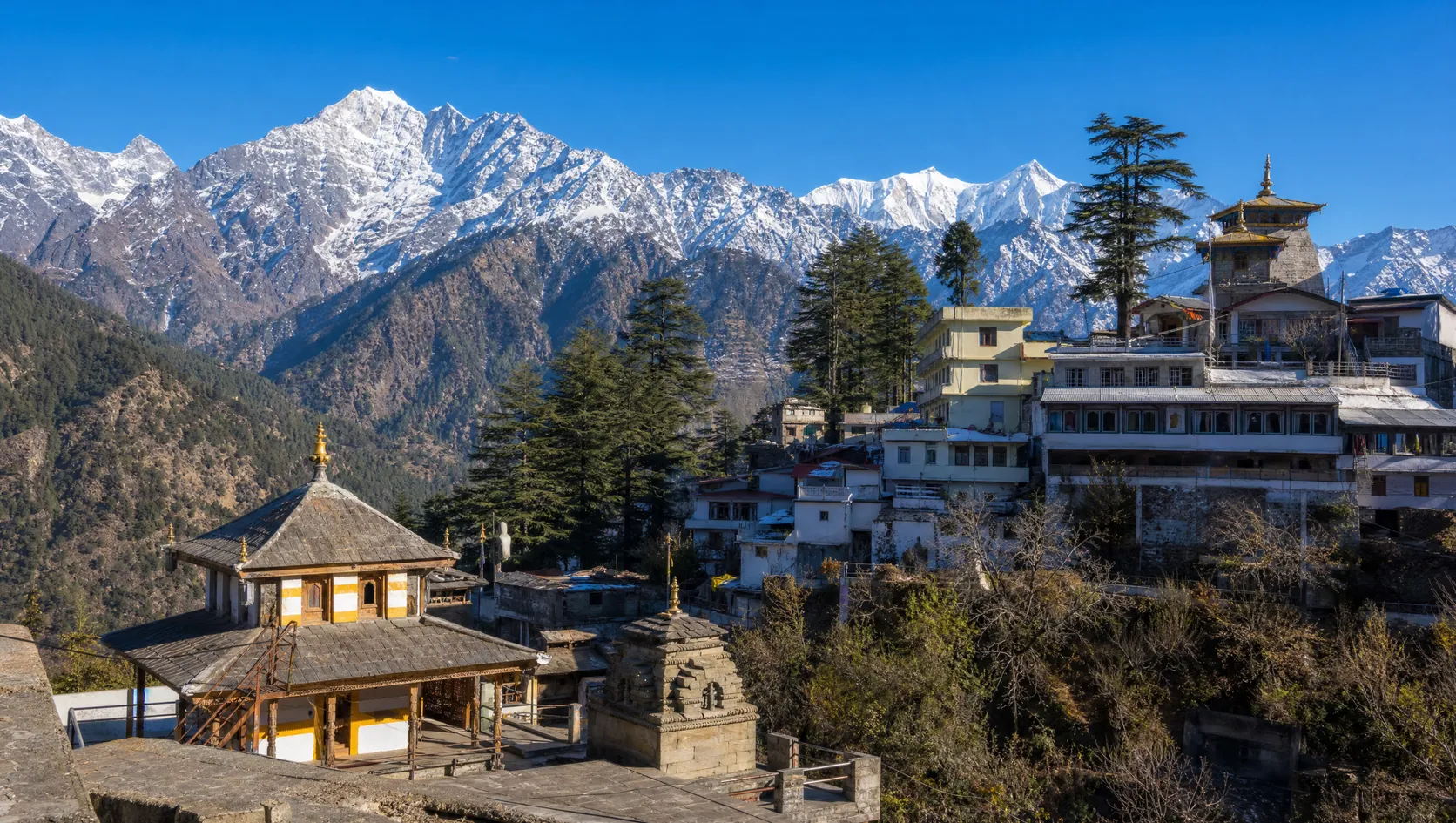
A Himalayan matha complex at Joshimath, associated with the ancient Narasimha temple and the Kalpavriksha, in the hill idiom of the upper Alaknanda valley
Special
The matha maintains a daily ritual schedule alongside its shrines, and the Shankaracharya's public audience is observed at set times. In winter, when Badrinath closes, the observances of the region shift down to Joshimath. Timings are set by the matha and vary with the ritual and seasonal calendar.
The Sacred Legend · पवित्र कथा
When Adi Shankaracharya set out to bind the subcontinent into a single field of Advaita Vedanta, he established four mathas at its cardinal points, and to each he entrusted one Veda and one mahavakya, one of the great sentences in which the Upanishads state the identity of the self and the absolute. Jyotirmath is the northern seat, the Uttaramnaya, high in the Himalaya above the town of Joshimath, and the sentence it guards is Ayamatma Brahma: This Self is Brahman. Three words from the Mandukya Upanishad, and they turn the teaching inward. Not that thou art, spoken by a teacher to a pupil, but this very Self, the awareness reading these words, is the absolute. Where the other seats hold sentences of instruction and declaration, the northern seat holds the sentence of recognition: the truth pointed not outward to the cosmos but back to the one who seeks it. So Jyotirmath is not only a place of pilgrimage on the road to Badrinath. It is the point at which Shankara set the northern corner of his philosophy, in the mountains where the tradition says he himself attained realisation, and assigned it the sentence in which the seeker finds the absolute in his own awareness.
Sacred Designationपवित्र पदनाम
Sacred Origin Storyपवित्र उत्पत्ति कथा
Source: The Shankara Digvijaya biographical tradition and the matha's own institutional records, set in the sacred landscape of the upper Alaknanda on the road to Badrinath
The mountains here were sacred long before the matha. Joshimath sits on the pilgrim road to Badrinath, the abode of Vishnu as Badrinarayan in the high Himalaya, and the whole valley of the upper Alaknanda is thick with the sanctity of that pilgrimage. To establish a seat of Advaita here was to place the philosophy of non-duality at the threshold of the highest of the Vaishnava mountain shrines.
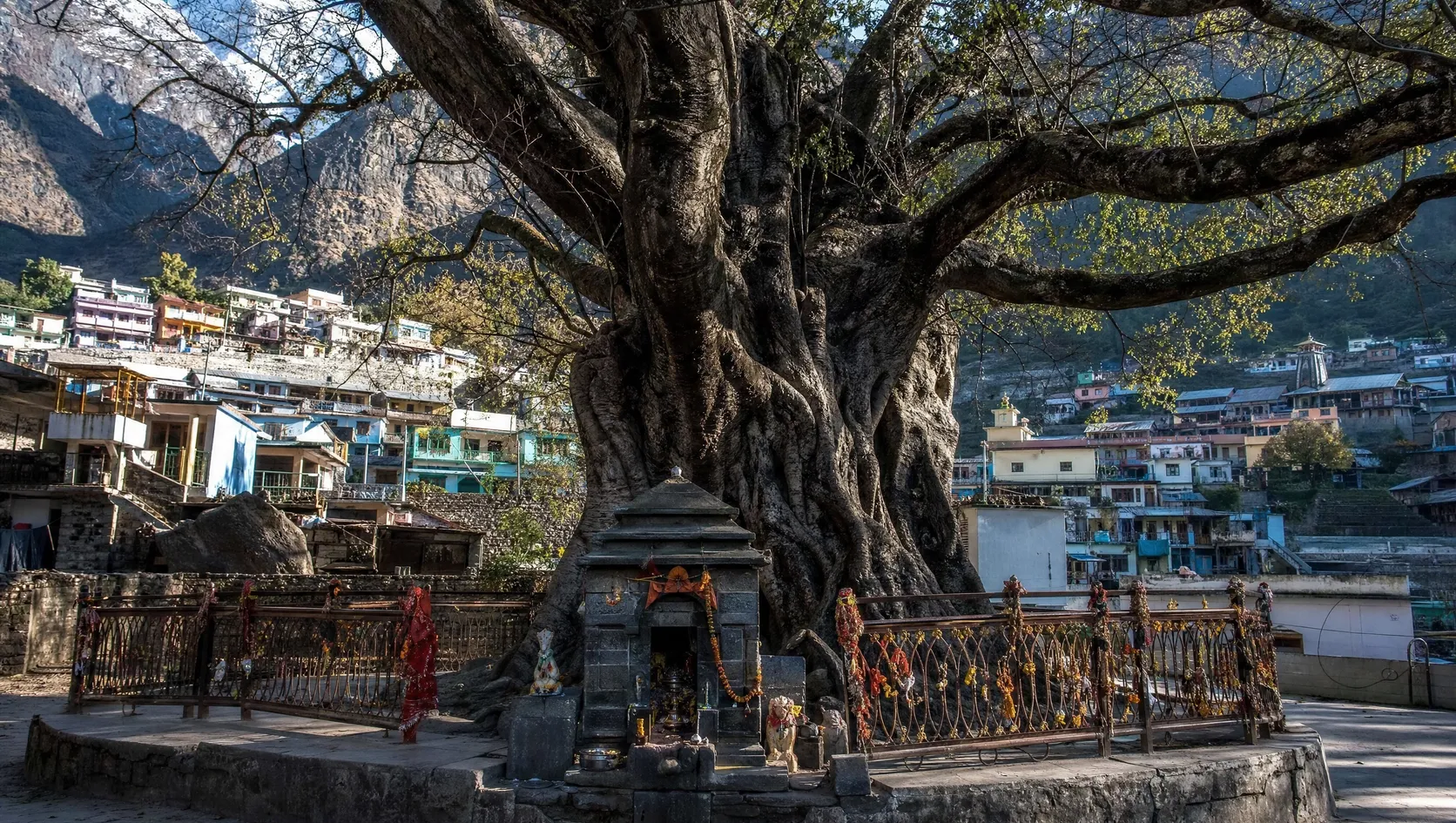
The tradition tells that Shankara himself came to this place and attained realisation, or composed his great commentaries, seated beneath a mulberry tree, the Kalpavriksha, which is still shown at Joshimath and held to be immensely old. It was here, in the account of his life, that he received the illumination for which the seat is named: Jyotirmath, the matha of light.
To the northern seat Shankara assigned the Atharvaveda, and the mahavakya Ayamatma Brahma, drawn from the Mandukya Upanishad, the shortest of the principal Upanishads and the one that analyses the states of waking, dream and deep sleep to point to the Self beyond them. He appointed his disciple Totakacharya as the first acharya. Totaka is remembered as the disciple of pure devotion rather than quick intellect, who served his master faithfully and was rewarded with sudden illumination, bursting into a hymn of praise in a difficult metre that gave him his name. To make him the first keeper of the sentence This Self is Brahman is the tradition's way of saying that the recognition of the Self is given to devotion as surely as to learning.
Sources cited:
- Shankara Digvijaya biographical tradition
- Jyotirmath institutional records and guru parampara
- Mandukya Upanishad (the mahavakya Ayamatma Brahma)
Scholarly Context
The traditional dating of Adi Shankaracharya, and therefore of the four mathas, is debated. The mathas' own reckoning places Shankara considerably earlier than the eighth-century date most modern scholars accept, and the two chronologies coexist without resolution, as they do at the other seats. What is not disputed is the antiquity and the standing of the four-matha system as the organising framework of the Advaita tradition. Jyotirmath's institutional history is unusual among the four in having a long documented interruption: the seat is generally said to have fallen vacant for a considerable period in later centuries, and to have been revived in the twentieth century, after which its succession has at times been contested. Scholars treat this as a real feature of the northern seat's history, distinct from the more continuous claims of some of the other mathas, without disturbing its recognition as one of the four. The assignment of one Veda and one mahavakya to each seat is the framework's distinctive feature. Jyotirmath holds the Atharvaveda and Ayamatma Brahma; Dwaraka the Samaveda and Tattvamasi; the other seats their own. The northern sentence, from the Mandukya Upanishad, is the one that turns the identity inward to the analysis of consciousness, which suits the seat set highest in the mountains, at the threshold of Badrinath.
Historyइतिहास
The Jyotirmath is the northern of the four cardinal mathas established by Adi Shankaracharya, set high in the Himalaya above the town of Joshimath on the road to Badrinath. To it Shankara assigned the Atharvaveda and the mahavakya Ayamatma Brahma, This Self is Brahman, and he appointed his disciple Totakacharya as its first acharya, from whom the lineage of Shankaracharyas of the northern seat is traced.
The tradition connects the site closely with Shankara himself, holding that he attained realisation or composed his commentaries here, seated beneath the mulberry tree called the Kalpavriksha, still shown at Joshimath. The seat's name, the matha of light, is read as a memory of the illumination the tradition places here.
Among the four seats, Jyotirmath's institutional history is the most interrupted. It is generally held that the seat fell vacant for a long period in later centuries, its line unfilled, and that it was revived in the twentieth century, with a Shankaracharya installed again. The revived seat has at times seen its succession contested between rival claimants, a dispute that has continued into the present and is a real part of the northern matha's modern story.
Joshimath's wider sanctity is inseparable from Badrinath. In winter, when the high shrine of Badrinath closes under snow, the presiding worship of the region shifts down to Joshimath, and the town's ancient Narasimha temple becomes the focus; the matha stands within this seasonal rhythm of the upper Alaknanda. In recent years Joshimath has also come to wider attention for land subsidence in the town, a serious concern for its buildings and residents that bears on any visit.
As an Advaita institution the matha's work is the transmission of the tradition through its lineage of acharyas, the study and teaching of the Vedanta, and the authority of the Shankaracharya of the northern seat in matters of Advaita doctrine, held within one of the most demanding and sacred landscapes of the tradition.
Historical Timelineऐतिहासिक कालक्रम
Adi Shankaracharya establishes the northern matha at Jyotirmath as one of his four cardinal seats, assigning it the Atharvaveda and the mahavakya Ayamatma Brahma, and appointing his disciple Totakacharya as its first acharya.
The matha's own chronology places Shankara considerably earlier than the eighth-century dating most modern scholars accept; the two reckonings coexist without resolution.
The tradition holds that Shankara attained realisation or composed his commentaries at Joshimath beneath the mulberry tree called the Kalpavriksha, and the seat takes its name, the matha of light, from that illumination.
The Kalpavriksha, an ancient mulberry, is still shown at Joshimath and venerated as the tree associated with Shankara's stay.
Totakacharya, remembered as the disciple of pure devotion rewarded with sudden illumination, becomes the first acharya, establishing the lineage of Shankaracharyas of the northern seat.
Totaka's hymn in the demanding totaka metre is traditionally cited as the sign of the illumination that made a devoted servant a knower of the Self.
The four-matha scheme distributes the four Vedas and four mahavakyas across the cardinal seats, with Jyotirmath holding the Atharvaveda and Ayamatma Brahma, the sentence that turns the identity inward to the Self.
Ayamatma Brahma is drawn from the Mandukya Upanishad, which analyses waking, dream and deep sleep to point to the Self beyond the three states.
Joshimath develops as the winter seat of Badrinath: when the high shrine closes under snow, the presiding worship of Badrinarayan and of the region shifts down to the town, centred on its ancient Narasimha temple.
The seasonal transfer of Badrinath's worship to Joshimath ties the matha's setting to the rhythm of the high Himalayan pilgrimage.
The northern seat is generally held to have fallen vacant for a long period, its line of acharyas unfilled, an interruption that distinguishes Jyotirmath's institutional history from the more continuous claims of the other seats.
The length and dating of the vacancy are variously reported; that the northern seat lapsed and was later revived is the common account.
The Jyotirmath is revived and a Shankaracharya installed on the northern seat again, restoring the lineage after its long interruption and returning the matha to active institutional life.
The revival returned an active Shankaracharya to the northern seat after its documented lapse.
The succession to the northern seat is at times contested between rival claimants, a dispute over the office of Shankaracharya that has continued into the present and is a distinctive feature of Jyotirmath's modern history.
Eternal Raga notes the existence of the dispute without adjudicating between claimants; the matter has at times been before the courts.
Joshimath draws national attention when significant land subsidence opens cracks in houses, roads and temples across the town, prompting evacuations, building restrictions and studies of the hillside's stability, a crisis that bears directly on the town and its shrines.
The subsidence has been linked to the town's geology, drainage and construction pressures; it is a live concern affecting travel and residence at Joshimath.
The matha remains one of the four principal seats of Advaita authority, and pilgrims on the Badrinath road commonly halt at Joshimath, visiting the matha, the Narasimha temple and the Kalpavriksha, joining the northern Advaita seat to the great mountain pilgrimage.
What You'll Seeदर्शन में
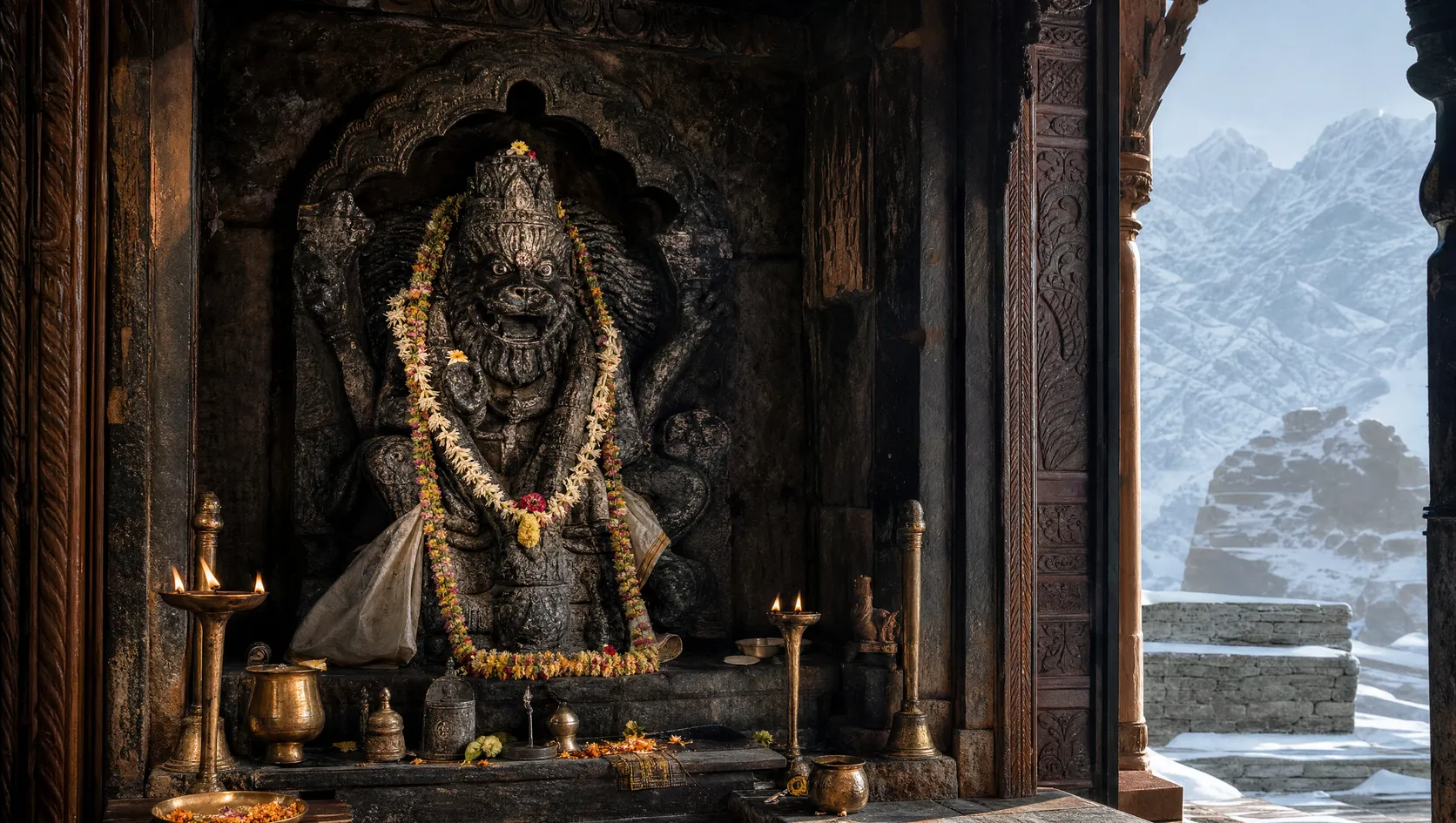
As a matha rather than a single temple, Jyotirmath's sanctity is carried less in one presiding image than in the institution, the sacred landscape, and the shrines gathered at Joshimath. The peetham venerates the goddess of learning, as at the other Shankara seats, and the seat is bound to the ancient Narasimha temple of the town, where Vishnu as the man-lion is worshipped and where, in winter, the presiding worship of Badrinath comes to rest.
The Narasimha image at Joshimath carries a famous prophecy of the mountains: its left arm is said to be slowly thinning, and it is held that when the arm at last falls away, the mountains Jaya and Vijaya near Badrinath will close the route, and the god will thereafter be worshipped at Bhavishya Badri, the future Badri lower down. The image thus holds, in its slow wasting, a whole eschatology of the pilgrimage.
The controlling image of the matha itself, in the Advaita sense, is not a figure but the mahavakya: Ayamatma Brahma, the sentence assigned to the northern seat, which the acharyas hold and transmit. And beside all of it stands the Kalpavriksha, the ancient mulberry under which the tradition places Shankara's illumination, a living thing venerated as witness to the founding. The site holds the personal god of the Narasimha temple, the philosophy of the Self in the matha, and the tree of the founder's enlightenment, all within one small mountain town.
Distinctive Practicesविशिष्ट परंपराएँ
The Guardianship of Ayamatma Brahma
अयम् आत्मा ब्रह्म की रक्षा
Continuous, in the teaching of the matha
As the northern seat, Jyotirmath is the keeper of the mahavakya Ayamatma Brahma, This Self is Brahman, and of the Atharvaveda. The transmission and exposition of this sentence and its Veda through the lineage of acharyas is the matha's defining work.
The mahavakyas are the compressed essence of the Upanishadic teaching, and to assign one to each seat is to make each matha the custodian of a portion of the whole. Ayamatma Brahma is the sentence of recognition, drawn from the Mandukya's analysis of the states of consciousness: it turns the seeker's attention not outward to the cosmos but back to the awareness that is reading and seeking, and finds the absolute there. The northern matha's work of teaching it is the work of turning attention home.
Worship at the Narasimha Temple and the Wasting Arm
नरसिंह मंदिर में उपासना और क्षीण होती भुजा
Year-round, and centrally in winter when Badrinath closes
The ancient Narasimha temple of Joshimath, tied to the seat, is the focus of the town's worship, and its image is watched for the slow thinning of its left arm, held to foretell the eventual closing of the Badrinath route and the shift of worship to Bhavishya Badri.
The wasting arm makes the image a clock of the ages. The tradition does not treat the mountains as fixed but as passing through cosmic time, and the slow decay of the arm marks the approach of an era when the high pilgrimage will end and its god descend to a lower shrine. To worship before that arm is to worship within a sense of time far longer than a life, in which even the sacred geography of the Himalaya is provisional.
The Winter Seat of Badrinath
बद्रीनाथ का शीतकालीन पीठ
Winter, when the Badrinath shrine is closed
When Badrinath closes under snow for the winter, the presiding worship of the region descends to Joshimath, and the town becomes the seat of the pilgrimage until the high shrine reopens in spring. The matha stands within this seasonal movement of worship down and up the mountain.
The high Himalayan shrines cannot be kept through the winter, and the tradition answers not by suspending worship but by moving it: the god comes down to where his people can reach him, and returns to the heights when the passes open. The rhythm treats the pilgrimage as a living thing that migrates with the season, and it gives Joshimath its half-year as the centre of a worship usually far above it.
Reverence of the Kalpavriksha
कल्पवृक्ष की श्रद्धा
Year-round, for pilgrims to Joshimath
The ancient mulberry tree called the Kalpavriksha, under which the tradition places Shankara's illumination, stands at Joshimath and is venerated by pilgrims as a living witness to the founding of the seat.
To venerate a tree as the witness of a founder's enlightenment is old in the tradition, as the Bodhi tree is to the Buddha. The Kalpavriksha roots the abstract event of realisation in a particular, living place: not an idea of illumination but the very spot, still growing, where the tradition says it happened. Pilgrims touch and circle the tree to stand where the founder stood.
Did You Know?क्या आप जानते हैं?
Jyotirmath is the northern of Adi Shankaracharya's four cardinal mathas, guardian of the Atharvaveda and the mahavakya Ayamatma Brahma, This Self is Brahman, drawn from the Mandukya Upanishad.
Advaita tradition on the four amnaya mathas
The seat is named the matha of light because the tradition holds that Shankara attained realisation here, beneath the mulberry tree called the Kalpavriksha, which is still shown at Joshimath.
Shankara Digvijaya tradition; local tradition of Joshimath
Its first acharya was Totakacharya, remembered less for quick intellect than for pure devotion, rewarded with sudden illumination that burst out in a hymn in the difficult totaka metre.
Jyotirmath guru parampara records
Joshimath is the winter seat of Badrinath: when the high shrine closes under snow, the god's worship descends to the town's ancient Narasimha temple until spring.
Regional tradition of the Badrinath pilgrimage
The Narasimha image at Joshimath is said to have a slowly thinning left arm, and it is held that when the arm falls, the Badrinath route will close and the god will be worshipped at Bhavishya Badri, the future Badri.
Local tradition of the Narasimha temple
Among the four seats Jyotirmath has the most interrupted history: the northern seat is generally held to have lain vacant for a long period before being revived in the twentieth century.
Institutional histories of the Advaita mathas
The northern seat holds the Atharvaveda and Ayamatma Brahma, the one mahavakya that turns the identity inward, pointing not to the cosmos but to the awareness of the seeker.
Mandukya Upanishad; Advaita tradition
In 2023 Joshimath came to national attention for land subsidence that cracked houses, roads and temples across the town, a serious concern for the hillside settlement and its shrines.
Government and scientific reports on Joshimath subsidence
Visitor Accessप्रवेश जानकारी
The matha and the associated shrines at Joshimath are open to devotees, and traditional dress is expected as at a working religious institution. Footwear is removed at the shrines. Most visitors reach Joshimath on the pilgrim road to Badrinath and visit the matha, the Narasimha temple and the Kalpavriksha as part of that journey. The Shankaracharya's audience is held at set times and is not continuous through the day. Joshimath is a high mountain town at about 1,875 m, reached only by a long road journey, and its access is shaped by weather, road conditions and the seasonal rhythm of the Badrinath pilgrimage. In recent years the town's land subsidence has added restrictions in affected areas. Timings, road status and local conditions should all be confirmed before travelling.
Plan Joshimath as part of a Badrinath trip, allowing time to acclimatise to the altitude; the town sits at about 1,875 m and the road up is long and winding. Visit the matha, the Narasimha temple and the Kalpavriksha together, as they lie close within the town. Check road conditions and the Badrinath yatra calendar before travelling: the high shrine is open roughly from late April or May to October or November, and the route is subject to landslides and closures, especially during and after the monsoon. Be aware of the areas affected by subsidence and follow any local restrictions. Dress traditionally, remove footwear at the shrines, and carry warm clothing, as the town is cold outside the summer months.
Festivalsत्योहार
Shankara Jayanti
शंकर जयंती
Apr-May (Vaishakha Shukla Panchami)
The appearance day of Adi Shankaracharya, the founder of the matha, observed with particular solemnity, with worship and discourses on Advaita. For a Shankara seat this is the day on which the lineage's origin is at the centre, and at Jyotirmath it is bound to the tradition of Shankara's own realisation here.
Guru Purnima
गुरु पूर्णिमा
Jun-Jul (Ashadha Purnima)
The day dedicated to the guru is of particular importance at a matha whose authority rests on the guru-lineage, observed with worship of the Shankaracharya and of the tradition of teachers reaching back to Shankara.
Badrinath Opening and Closing (Kapat)
बद्रीनाथ कपाट उद्घाटन और समापन
Apr-May and Oct-Nov
The opening of the Badrinath shrine in spring and its closing in autumn are the great markers of the year at Joshimath, since the god's worship descends to the town for the winter. The processions and rituals of the transfer tie the matha's town to the rhythm of the high pilgrimage.
Narasimha Jayanti
नृसिंह जयंती
Apr-May (Vaishakha Shukla Chaturdashi)
The appearance day of Narasimha, the man-lion form of Vishnu, is observed at the ancient Narasimha temple of Joshimath, the shrine bound to the seat and central to the town's worship, especially through the winter months.
Traditional Offeringsपारंपरिक अर्पण
Primary Offerings
Study offered to the goddess of learning
विद्या की देवी को अर्पित अध्ययन
As at the other Shankara seats, the goddess venerated is the goddess of learning, and the offering most proper to her is study itself. Students and scholars seek her blessing on their learning, and the tools of study are placed before her.
Worship at the Narasimha temple
नरसिंह मंदिर में उपासना
The ancient Narasimha temple bound to the seat receives the daily worship of the town, and pilgrims offer their reverence to the man-lion form of Vishnu there, especially through the winter months when it holds the descended worship of Badrinath.
Reverence at the Kalpavriksha
कल्पवृक्ष पर श्रद्धा
Pilgrims offer their reverence at the ancient mulberry, the Kalpavriksha, under which the tradition places Shankara's illumination, touching and circling the tree as a living witness to the founding of the seat.
Lamps and incense
दीप और धूप
Lamps and incense are offered in the matha's daily worship, as at any shrine, marking the ritual rhythm of an institution whose life is one of study and observance carried on continuously. The daily worship is not incidental to the teaching but its frame: the study of the Vedanta is set within an ordered round of ritual, so that the intellectual and the devotional are kept together rather than separated.
Unique to This Temple
The Offering of Learning at a Shankara Seat
शंकर पीठ पर विद्या की भेंट
What is particular to a matha, as against a temple, is that its highest offering is not a substance but the study and transmission of the teaching. At Jyotirmath, the northern seat charged with the Atharvaveda and the mahavakya Ayamatma Brahma, the proper offering is attention to that teaching: the recitation of the Veda, the exposition of the sentence, and above all the turning of attention inward to the Self that the northern mahavakya names. A pilgrim brings flowers and lamps as at any shrine, but the tradition holds that what the matha most receives, and most gives, is the teaching itself, handed from acharya to acharya since Totakacharya. The offering and the blessing are the same thing: the recognition, This Self is Brahman, passed on.
As a matha, Jyotirmath's worship centres on its shrines, the associated Narasimha temple and Kalpavriksha, and the study and transmission of the teaching rather than on elaborate individual offering rituals. Pilgrims may offer flowers, lamps and their reverence at the shrines, and seek the Shankaracharya's blessing at the appointed times. Most visitors come as part of the Badrinath pilgrimage and take in the seat, the Narasimha temple and the Kalpavriksha together. Eternal Raga presents the matha's practices as a devotional and philosophical tradition.
How to Reachकैसे पहुँचें
The matha stands at Joshimath in Chamoli district of Uttarakhand, high in the Himalaya on the pilgrim road to Badrinath, and is reached only by a long mountain journey.
By air: Dehradun's Jolly Grant Airport is the nearest, roughly 270 km away, from which the whole distance to Joshimath is by mountain road, a full day's drive.
By rail: the nearest usable railheads are at Rishikesh, roughly 250 km, and Haridwar a little further, both in the foothills; from there the journey continues entirely by road.
By road: Joshimath lies on the national highway to Badrinath, connected by bus and shared and private taxi from Rishikesh, Haridwar and Dehradun via Devprayag, Rudraprayag, Karnaprayag and Chamoli. The road is long, winding and mountainous, subject to landslides and closures during and after the monsoon, and journey times vary greatly with conditions.
Most travellers reach Joshimath as part of the Badrinath pilgrimage, halting here on the way up or down, and many also take the ropeway toward Auli above the town. Weather and road status should be checked before setting out.
Plan Your Visitयात्रा की योजना
🌤 Best Season
The best time to visit Joshimath is broadly the Badrinath pilgrimage season, from late April or May to October or November, when the road is open and the high shrine is receiving pilgrims. Within this, the pre-monsoon and post-monsoon weeks are the most settled. The monsoon, roughly July to September, brings the greatest risk of landslides and road closures on the mountain route and is best avoided for travel. Winter, from November to March, is cold with snow at these altitudes; it is the season when Badrinath's worship rests at Joshimath, which has its own atmosphere but demands preparation for the cold and for uncertain roads. Whatever the season, road and weather conditions on the Badrinath route should be checked before travelling, as they change quickly in the mountains.
👘 Dress Code
Traditional and modest dress is expected at the matha and the shrines, as at a working religious institution. Men commonly wear a dhoti or trousers with a shirt; women a saree or salwar kameez. Footwear is removed at the shrines. Because Joshimath is high and cold outside the summer months, warm layered clothing is needed for much of the year, worn under or alongside traditional dress at the shrines.
📱 Phones & Photography
Photography is restricted within the shrines, and phones should be silenced across the matha premises and the Narasimha temple. The Shankaracharya's audience is not a photo opportunity, and recording during it should not be attempted without explicit permission. The mountain setting invites photography of the landscape, but the interiors of the shrines are to be respected.
🏨 Accommodation
Joshimath has a range of accommodation serving the Badrinath pilgrimage, from dharamshalas and ashram guest houses to hotels and lodges, much of it geared to pilgrims halting on the way to and from the high shrine. Standards and availability vary with the season. Demand rises sharply through the yatra season and around the opening and closing of Badrinath. Since the 2023 subsidence, the availability and condition of some buildings in affected parts of the town have changed, so accommodation should be arranged with current information. Nearby Auli, reached by ropeway, also offers stays, particularly for those combining the pilgrimage with the mountains.
Sacred Soundsपवित्र ध्वनि
Did You Know? · क्या आप जानते हैं?
The same translation error that turned '33 Koti' into '33 crore' in Hinduism also happened in Buddhism. The Chinese translation of Buddhist texts rendered 'Sapta Koti Buddha' (7 Supreme Buddhas) as '7 Crore Buddhas.' The Tibetan translation got it right: 7 types, not 7 crore. One Sanskrit word, misread across two major world religions, generated two identical misconceptions independently.
Related Contentसंबंधित सामग्री
Related Scriptures
Community Reflections
🕉️
Be the first to share your reflection.