Kanjanur Agneeswarar (Venus)
कांजनूर
The Venus temple where the planet has no separate shrine, and is worshipped in Shiva himself
Kanjanur, Tamil Nadu, India
Kañjanūr AgnīśvararAlso known as: Agneeswarar Temple, Kanjanur Sukran Sthalam, Palasavanam
Era
A paadal petra sthalam praised in the Tevaram, of established antiquity as a Shaiva shrine; assigned Venus in the later Navagraha circuit, notable for having no separate graha shrine
Architecture
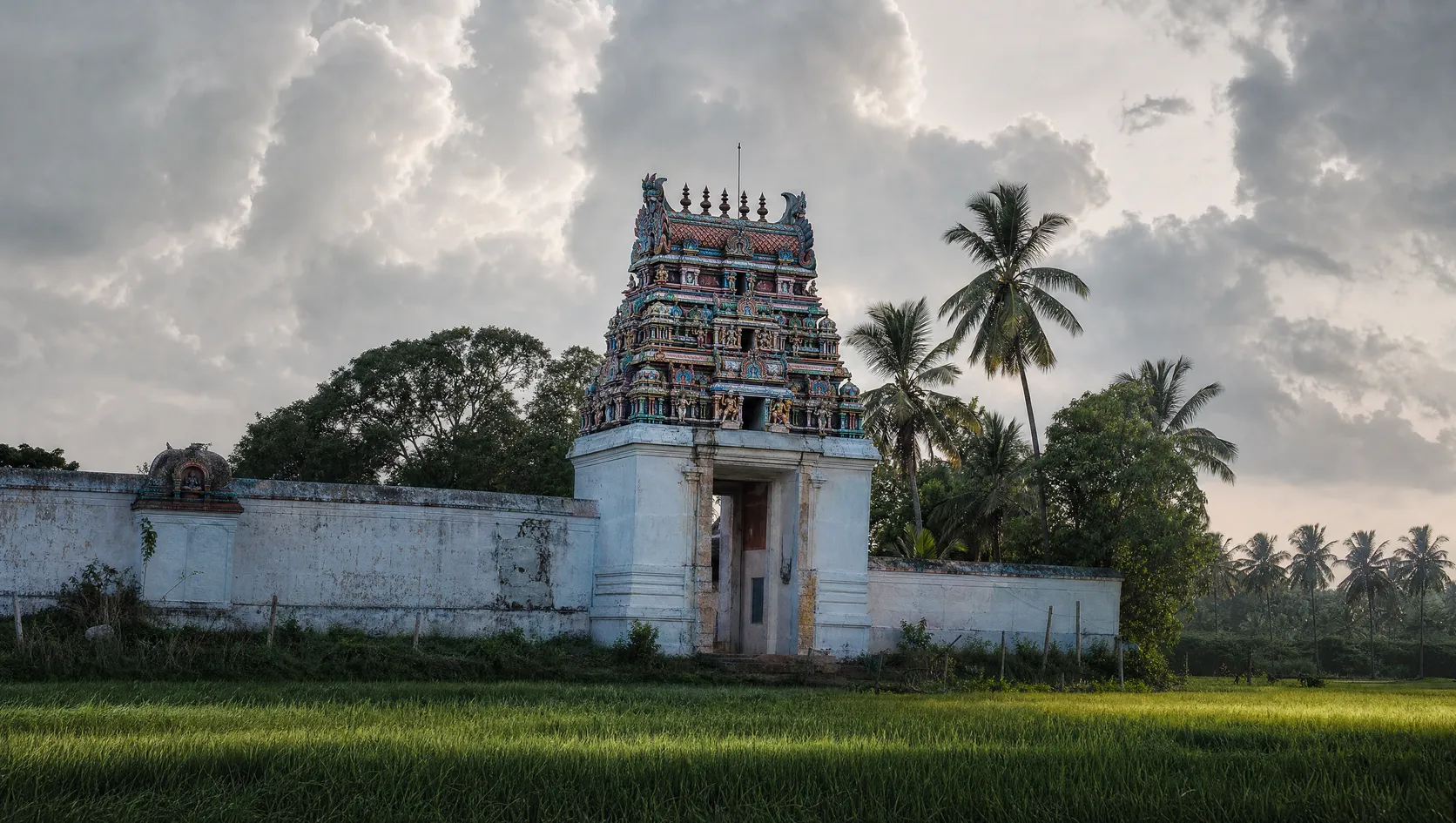
Dravidian, with a gopuram over the entrance; the Venus association is held in the main sanctum itself rather than in a subsidiary shrine
Special
Because Venus has no separate shrine, worship for Shukra is offered to the presiding deity Agneeswarar in the main sanctum. Fridays, the day of Venus, draw the largest gatherings of circuit pilgrims.
The Sacred Legend · पवित्र कथा
Kanjanur is the Venus temple of the Navagraha circuit, and it is unlike every other station in one decisive way: Venus, Shukra, has no separate shrine here. There is no graha image in a side chapel to be addressed. The tradition holds that Shukra resides within the presiding deity himself, Shiva as Agneeswarar, the lord of fire, so that worship of the main sanctum is worship of the planet. Everywhere else on the circuit the arrangement makes the hierarchy visible: the graha in his own shrine, smaller, within the temple of a greater deity. Here the hierarchy is total. The planet is not merely housed by Shiva; it is absorbed into him, with no independent form of its own. So the pilgrim who comes to address Venus finds nothing to address but the presiding god, and the tradition treats this not as an absence but as the most complete version of the circuit's teaching: the planet at its most benefic is the one that has disappeared into the deity entirely.
Sacred Designationपवित्र पदनाम
Navagraha
Planet:
Sacred Origin Storyपवित्र उत्पत्ति कथा
Source: The Agneeswarar tradition of the temple's sthala purana, together with the Shukra association of the Navagraha circuit and the account of Venus residing within the deity
The presiding deity is Shiva as Agneeswarar, the lord of fire, and the temple's older name, Palasavanam, points to the forest of palasa trees in which the shrine was set. The tradition of the site is Shaiva and old, praised in the Tevaram, and the fire in the deity's name is explained in accounts of Agni, the fire god, having worshipped Shiva here.
The temple's distinctive claim concerns Shukra, Venus. Shukra is the guru of the asuras, the teacher of the demons, and the keeper of the sanjivani vidya, the knowledge that revives the dead. He is the most benefic of the planets after Jupiter, governing marriage, love, beauty, the arts and material comfort. And at Kanjanur, alone among the nine stations, he has no image and no shrine of his own. The tradition holds that Shukra is present within the presiding Agneeswarar, so that to worship the main deity is to worship Venus.
Why Venus in particular should be the planet absorbed into the deity is not explained by the tradition and need not be. What the arrangement produces is a place where the usual structure of the circuit, the small graha in the great temple, is dissolved into unity, and the planet the pilgrim came for turns out to have no separate existence to address.
Sources cited:
- Temple sthala purana (Agneeswarar and Palasavanam)
- Navagraha circuit tradition (Shukra sthalam account)
- Tevaram hymns referring to the site
Scholarly Context
Kanjanur is a paadal petra sthalam, praised in the Tevaram, and an established Shaiva shrine long before its assignment as the Venus station of the Navagraha circuit. Its older name Palasavanam belongs to this Shaiva identity. The absence of a separate Shukra shrine is the temple's defining peculiarity within the circuit, and scholars note it as the clearest instance of the circuit's logic taken to its limit. Where the other stations keep the graha in a subsidiary shrine, marking its subordination, Kanjanur dispenses with the graha image altogether and folds the planet into the presiding deity. Whether this reflects an older arrangement that the circuit accommodated, or a deliberate theological statement, is not settled, but the effect is distinctive: it is the one circuit temple where the graha cannot be seen at all.
Historyइतिहास
Kanjanur is one of the paadal petra sthalams of the Cauvery delta, praised in the Tevaram, and its origins as a Shaiva shrine are old, held under the name Palasavanam, the forest of palasa trees. The presiding deity is Shiva as Agneeswarar, the lord of fire, a name explained by accounts of the fire god having worshipped here.
When the Navagraha circuit was organised across the delta, Kanjanur was assigned Venus, Shukra, but in a form found nowhere else on the circuit: without a separate graha shrine. The tradition holds that Venus resides within the presiding Agneeswarar, so that worship of the main sanctum serves as worship of the planet. This makes Kanjanur the one station where the pilgrim addresses the graha through the presiding deity directly, with no intervening image.
The temple received Chola and later patronage as part of the delta's dense network of Shaiva shrines, and its complex took its present form across successive periods. It lies close to Suryanar Kovil, the Sun temple, so the two are commonly visited in sequence on the circuit.
In the modern period the temple comes under the Tamil Nadu Hindu Religious and Charitable Endowments Department, and its visitor numbers rose as the Navagraha circuit became an organised pilgrimage, though its peculiarity, the missing graha shrine, keeps it a point of particular interest among those who make the full circuit.
Historical Timelineऐतिहासिक कालक्रम
The temple is praised in the Tevaram hymns of the Nayanar saints, establishing it as a paadal petra sthalam and fixing its antiquity as a Shaiva shrine centuries before the structures now standing.
The older name Palasavanam, the forest of palasa trees, belongs to this earlier Shaiva identity.
The presiding deity's identity as Agneeswarar, the lord of fire, becomes established, associated with the fire god Agni having worshipped Shiva at this place.
The temple receives Chola patronage as part of the dense network of Shaiva shrines endowed across the Cauvery delta, and much of the standing structure dates from this and later periods.
The gopuram, the pillared halls and the subsidiary shrines take their present form across successive campaigns of building and repair, though no separate Shukra shrine is built, in keeping with the temple's distinctive arrangement.
The absence of a graha shrine is the temple's defining peculiarity within the circuit.
The Navagraha circuit of the Cauvery delta takes shape, and Kanjanur is assigned Venus, uniquely with the planet held to reside within the presiding deity rather than in a shrine of its own.
This is the clearest instance of the circuit's logic taken to its limit: the graha absorbed into the deity.
Its proximity to Suryanar Kovil, the Sun temple a short distance away, establishes the customary sequence in which the two are visited together on the circuit.
Later patronage under the Thanjavur Nayakas and Marathas supports additions and repairs, as across the delta's temple landscape.
Colonial-era gazetteers record the temple within the delta's religious landscape, noting its place in the Navagraha circuit as the Venus station.
Administration passes to the Tamil Nadu Hindu Religious and Charitable Endowments Department, and periodic renovation and kumbhabhishekam are carried out.
As the Navagraha circuit grows into an organised pilgrimage, Kanjanur is visited by circuit pilgrims for Venus, its peculiarity of the absent graha shrine remaining a point of particular note.
What You'll Seeदर्शन में
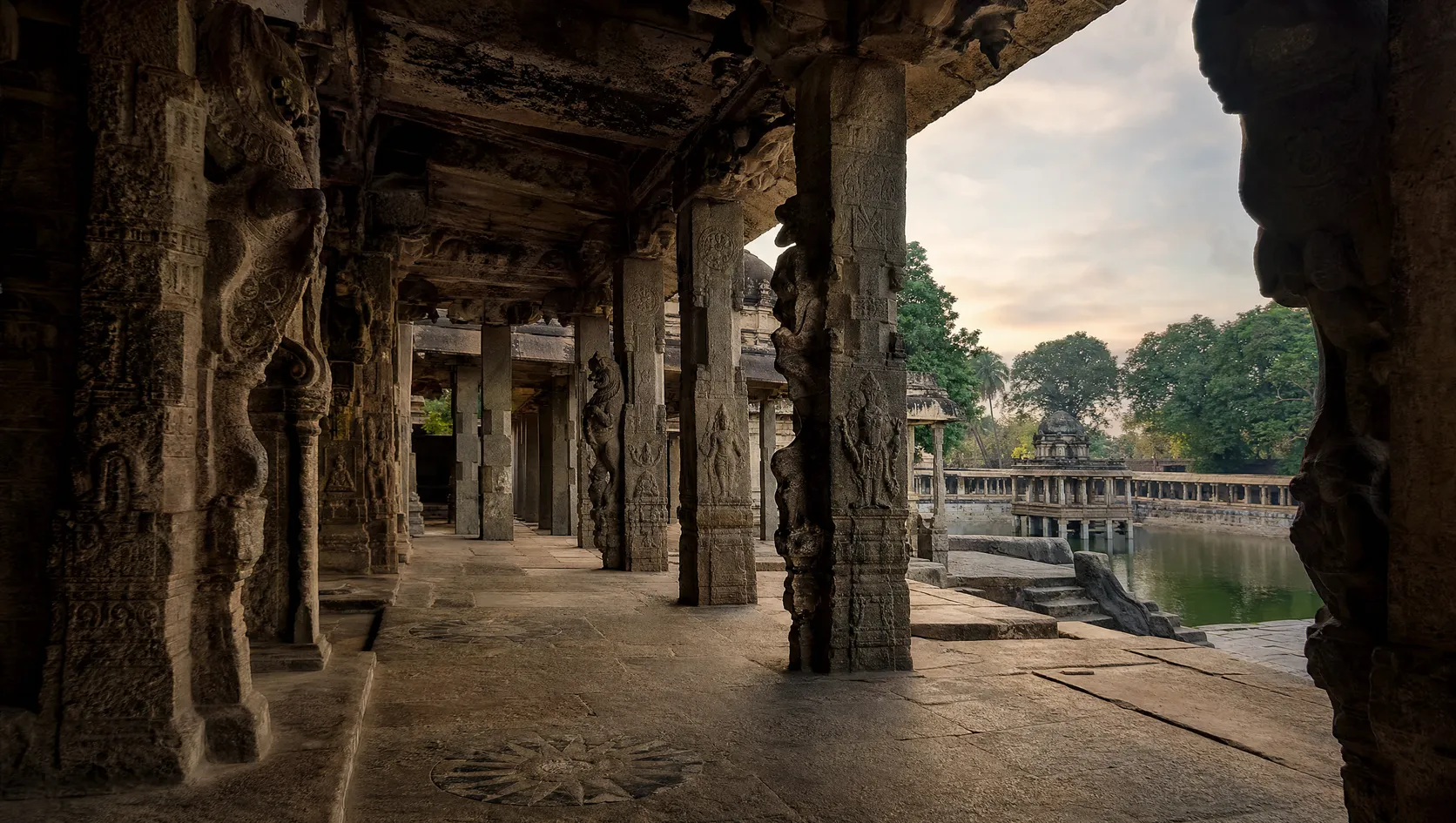
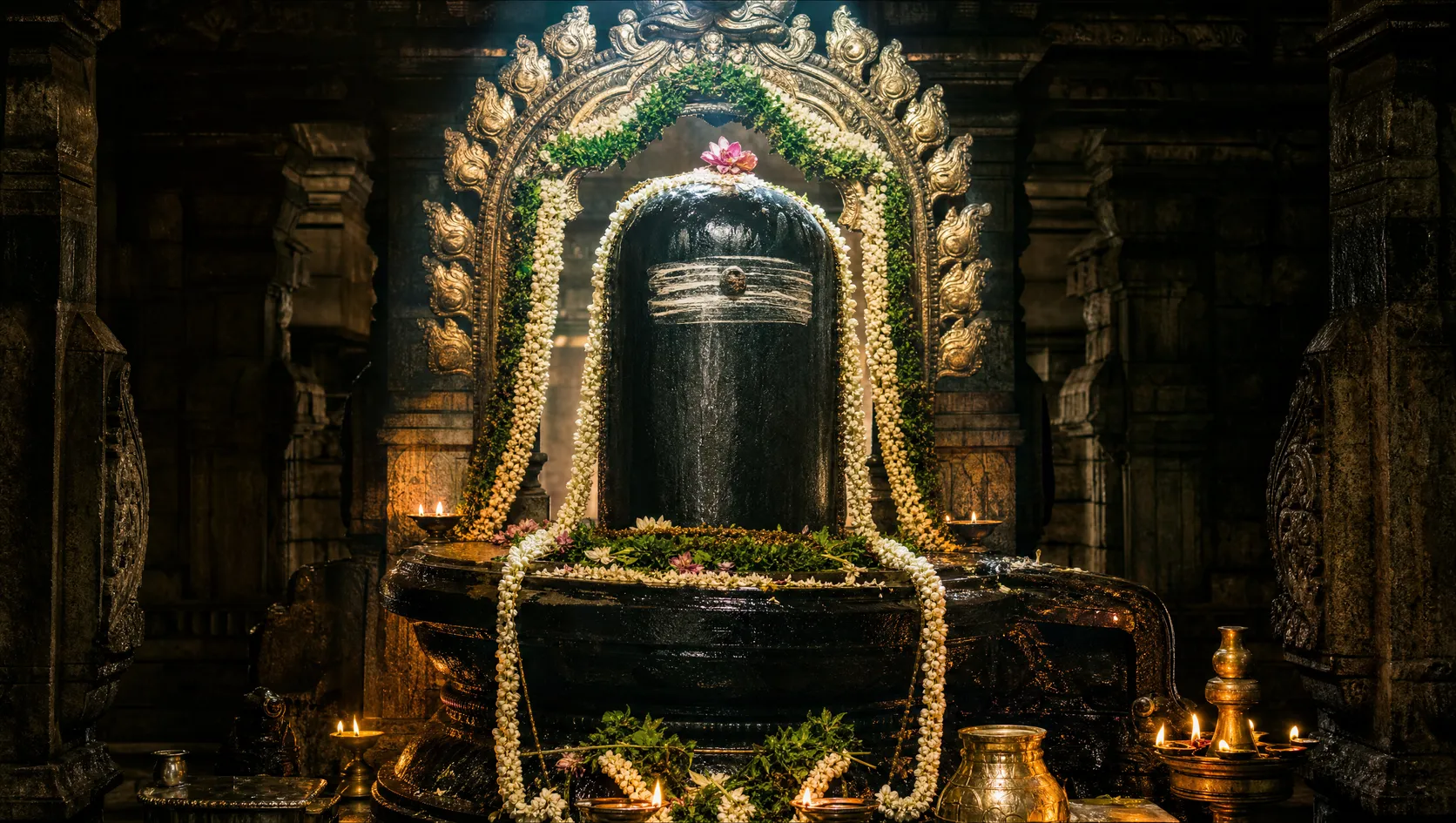
The presiding deity is Shiva as Agneeswarar, worshipped as a linga in the main sanctum, with the goddess in her own shrine. The building follows the Dravidian idiom of the delta, of modest scale, with a gopuram over the entrance and pillared halls within.
What is not present is the thing a circuit pilgrim expects: a shrine for the graha. There is no image of Shukra to be addressed. The tradition holds that Venus resides within the presiding Agneeswarar, and worship for the planet is therefore offered to the main deity in the sanctum. The absence is the temple's most striking feature, and it is deliberate rather than a loss.
Shukra in the graha system is white or bright in complexion, mounted on a horse, associated with white, with white beans, with diamond and with Friday. But at Kanjanur these correspondences are carried in the worship rather than in a visible image; the offerings for Venus are made, but there is no separate figure to receive them, only the presiding god in whom the planet is held to dwell.
Distinctive Practicesविशिष्ट परंपराएँ
Worshipping Venus in the Presiding Deity
अधिष्ठाता देवता में शुक्र की उपासना
Every visit for Venus, particularly on Fridays
With no separate Shukra shrine, pilgrims addressing a Venus matter offer their worship to the presiding Agneeswarar in the main sanctum, in whom the tradition holds Venus to reside. The offerings for the planet are made, but to the presiding deity rather than to a graha image.
The arrangement carries the circuit's teaching to its conclusion. Elsewhere the graha is smaller than the temple's deity; here it has dissolved into him entirely, so that to seek the planet is to find only the god. For the most benefic of planets after Jupiter, the tradition treats this disappearance into the deity as the highest form the planet can take.
Friday Worship for Venus
शुक्र के लिए शुक्रवार उपासना
Weekly on Fridays
Friday, the day of Venus, is the principal day of worship for circuit pilgrims here, when the largest gatherings come and Venus offerings, following the graha's white correspondences, are most made. Friday is also favoured for prayers concerning marriage, love and prosperity, the domains Venus governs.
Each graha governs a weekday, and Venus's is Friday. Venus governs marriage, beauty, the arts and material comfort, so Friday worship here is sought for these as much as for the remedy of a Venus affliction, and the offering is made to the deity in whom the planet dwells.
Ghee Abhishekam to Agneeswarar
अग्नीश्वरर को घृत अभिषेक
Prescribed for the presiding deity
The presiding deity being the lord of fire, ghee abhishekam, the bathing of the linga with clarified butter, carries particular significance here, ghee being both an offering to fire and a cooling of it. It is among the worship offered to the deity in whom Venus resides.
Ghee has a double relation to fire: it feeds the flame and, poured over the fiery deity, tempers him. At a temple of the lord of fire in whom the benefic Venus is held to dwell, the offering that both nourishes and cools is fitting, and it is directed to the presiding deity as the whole of the worship, graha included.
White Offerings for Venus
शुक्र के लिए श्वेत भेंट
For Venus worship, particularly on Fridays
Offerings for Venus follow the graha's colour and substance: white flowers, white cloth, white beans and, where prescribed, diamond. These are offered to the presiding deity, since there is no separate Shukra shrine, but they follow the correspondences specific to Venus.
The colour system holds even where the graha has no shrine: white carries Venus's associations of beauty, refinement and pleasure. That the white offering is made to the presiding deity rather than to a planet image is the whole peculiarity of Kanjanur in a single act.
Did You Know?क्या आप जानते हैं?
Kanjanur is the only Navagraha temple where the graha has no separate shrine. Venus is held to reside within the presiding deity, Shiva as Agneeswarar, so worship of the main sanctum is worship of the planet.
Navagraha circuit tradition; temple's own arrangement
The presiding deity is Agneeswarar, the lord of fire, and the ghee abhishekam offered to him is significant both as a feeding of fire and a cooling of it.
Temple tradition
Shukra, Venus, is the guru of the asuras and the keeper of the sanjivani vidya, the knowledge that revives the dead, as well as the planet of marriage, beauty and the arts.
Puranic tradition on Shukracharya
The temple's older name is Palasavanam, the forest of palasa trees, reflecting its Shaiva identity long before it became the Venus station of the circuit.
Temple tradition; Tevaram corpus
Kanjanur lies close to Suryanar Kovil, the Sun temple, and the two are commonly visited in sequence, the station where the graha presides and the station where the graha has vanished into the deity.
Navagraha circuit itinerary
Venus governs marriage, love, beauty, the arts and material comfort in the graha system, so worship here is sought for these, offered to the deity in whom the planet dwells.
Standard graha correspondences
That the graha at Kanjanur cannot be seen at all makes it the clearest instance of the circuit's underlying teaching, that the planet is never the centre and, at its most benefic, is not a separate presence at all.
Site tradition; Navagraha circuit structure
Visitor Accessप्रवेश जानकारी
The temple is open to devotees without entry restriction. Traditional dress is customary, as at other temples in the Tamil delta, and footwear is removed at the entrance. Because Venus has no separate shrine, worship for the planet is offered to the presiding Agneeswarar in the main sanctum; a pilgrim looking for a graha shrine will not find one, and priests direct the worship to the presiding deity. Those on the circuit make the Venus offering accordingly. The temple is small and a visit does not take long. It is almost always visited as one station of the circuit, commonly together with the nearby Suryanar Kovil. Fridays, the day of Venus, are the busiest.
Do not look for a Shukra shrine; there is none. Offer worship for Venus to the presiding Agneeswarar in the main sanctum, where the priests will direct you, with the white flowers and white beans associated with the planet. The temple is small and a visit is short, so it is best paired with the nearby Suryanar Kovil, which lies a short distance away. Fridays are busiest. Kumbakonam, about 18 km away, is the usual circuit base, and hiring a vehicle covers all nine temples comfortably.
Festivalsत्योहार
Friday Worship (Velli Vaaram)
शुक्रवार उपासना
Weekly, throughout the year
Friday, the day of Venus, is the temple's weekly high point for circuit pilgrims, when worship for Shukra, offered to the presiding deity, draws the largest gatherings, and prayers concerning marriage and prosperity are especially made.
Maha Shivaratri
महाशिवरात्रि
Feb-Mar (Phalgun Krishna Chaturdashi)
As the presiding deity is Shiva as Agneeswarar, Maha Shivaratri is observed with night-long vigil and worship, a reminder that the temple is a Shiva shrine in which the planet is held to dwell.
Shukra Peyarchi (Venus Transit)
शुक्र पेयर्चि (शुक्र संक्रमण)
When Venus changes zodiacal sign
The transit of Venus into a new sign is marked here, drawing pilgrims to align the coming period with the benefic planet. As Venus is worshipped in the presiding deity, the transit observance too is directed to Agneeswarar.
Brahmotsavam
ब्रह्मोत्सवम्
Varies by temple calendar
The annual festival of the presiding deity, with processions of the utsava murti and the associated ritual sequence over several days, drawing pilgrims beyond the regular circuit traffic.
Traditional Offeringsपारंपरिक अर्पण
Primary Offerings
Bel Patra (Bilva leaves)
बेल पत्र
बिल्व पत्र
The bilva leaf, the offering most closely associated with Shiva, is given to the presiding Agneeswarar, in whom Venus is held to reside. At Kanjanur the standard Shiva offering is also, in effect, the offering to the graha, since the two worship the same deity.
White flowers and white beans for Venus
शुक्र के लिए श्वेत पुष्प और श्वेत सेम
White is the colour assigned to Venus and white beans its grain. These are offered to the presiding deity, since there is no separate Shukra shrine, following the correspondences specific to Venus, and the grain is often donated afterwards.
Ghee for abhishekam
अभिषेक हेतु घी
Ghee abhishekam is offered to Agneeswarar, the lord of fire, ghee being both a feeding of fire and a cooling of it. It is among the most significant offerings at this temple of the fire deity in whom the benefic Venus dwells.
Ghee lamp
घी का दीप
A lamp is lit before the presiding deity, and lamps are offered as part of Venus worship, since here the worship of the planet and of the deity are one. Fridays see the most abundant lighting of lamps.
Unique to This Temple
Worship Without a Graha Image
ग्रह-प्रतिमा के बिना उपासना
What is unique to Kanjanur is that the graha offering is made with no graha image to receive it. Elsewhere on the circuit the pilgrim stands before a figure of the planet; here the white flowers, white beans and lamp for Venus are offered to the presiding Agneeswarar in the main sanctum. The practice makes the pilgrim enact the temple's theology directly. To worship Venus at Kanjanur is to accept that the planet has no separate existence to petition, only the deity in whom it dwells. The offering that would elsewhere go to a graha here goes to the god, and the tradition treats this not as a lesser worship but as the planet worshipped in its truest form.
Offering materials for Venus worship are sold near the temple, and it is simplest to buy them there. All offerings are made to the presiding Agneeswarar, since there is no separate Shukra shrine; the priests will direct the worship accordingly. If a specific Venus remedy has been prescribed, arrange the archana at the main sanctum on arrival. Eternal Raga presents these practices as devotional tradition and does not offer astrological advice.
How to Reachकैसे पहुँचें
Kanjanur lies in the Cauvery delta near Aduthurai and close to Suryanar Kovil, and Kumbakonam is the usual base for the Navagraha circuit of which it is part.
By air: Tiruchirappalli International Airport is roughly 85 km away and is the nearest useful airport. Chennai is considerably further but far better connected.
By rail: Kumbakonam, roughly 18 km away, is the main railhead, well connected within Tamil Nadu. Aduthurai is nearer to the temple.
By road: The temple is reached by road from Kumbakonam or Aduthurai, and taxis are readily hired at Kumbakonam. The delta roads are flat and the driving is easy. Because Kanjanur and Suryanar Kovil are close together, they are almost always visited in the same stretch of the circuit.
Most pilgrims visit as one station of the Navagraha circuit. Hiring a vehicle for a day or two from Kumbakonam covers all nine temples comfortably.
Plan Your Visitयात्रा की योजना
🌤 Best Season
November to February is the most comfortable period in the delta, with cooler air and manageable humidity, and it is when the multi-stop circuit is most pleasant to drive. March to June is hot, often severely so. The northeast monsoon, roughly October to December, brings rain that can affect road travel, though the delta roads recover quickly. Fridays are the busiest for circuit pilgrims, and Shukra Peyarchi draws additional crowds. For a quieter visit, an ordinary weekday morning in the cool season is best.
👘 Dress Code
Traditional dress is customary, as at Tamil temples generally. Men commonly wear a dhoti or trousers with a shirt; in the inner areas a dhoti without an upper garment may be expected. Women wear saree or salwar kameez. Footwear is removed at the entrance, and the stone underfoot gets hot in the delta by mid-morning.
📱 Phones & Photography
Photography restrictions apply within the sanctum, as at Tamil temples generally; the outer areas are usually less restricted, but check locally rather than assuming. Phones should be silenced, and recording during a scheduled archana is inappropriate without the priest's agreement.
🏨 Accommodation
There is no significant accommodation at Kanjanur itself. Kumbakonam, about 18 km away and the usual circuit base, offers a full range of hotels and lodges and is well placed for the rest of the Navagraha temples as well as the great Chola temples of the delta. Most pilgrims stay at Kumbakonam and cover Kanjanur, usually together with Suryanar Kovil, as part of a day's circuit.
Sacred Soundsपवित्र ध्वनि
Did You Know? · क्या आप जानते हैं?
The same translation error that turned '33 Koti' into '33 crore' in Hinduism also happened in Buddhism. The Chinese translation of Buddhist texts rendered 'Sapta Koti Buddha' (7 Supreme Buddhas) as '7 Crore Buddhas.' The Tibetan translation got it right: 7 types, not 7 crore. One Sanskrit word, misread across two major world religions, generated two identical misconceptions independently.
Related Contentसंबंधित सामग्री
Related Scriptures
Community Reflections
🕉️
Be the first to share your reflection.