Muktinath (Saligramam)
मुक्तिनाथ
The 106th Divya Desam and the only one beyond India — the Himalayan shrine of Mukti Narayana, where the saligrama stones are born in the Kali Gandaki, a hundred and eight waters pour for liberation, and an eternal flame burns over water
Muktinath, Mustang, Nepal
Muktinātha (Śrī Mukti Kṣetra)Also known as: Mukti Kshetra, Thiru Saligramam, Mukti Narayana, Chumig Gyatsa
Era
An ancient Himalayan shrine of Vishnu, counted as the 106th of the 108 Divya Desams and sung by the Alvars; also revered by Buddhists as Chumig Gyatsa. The present temple is a pagoda-style structure rebuilt across periods on a site of great antiquity
Architecture
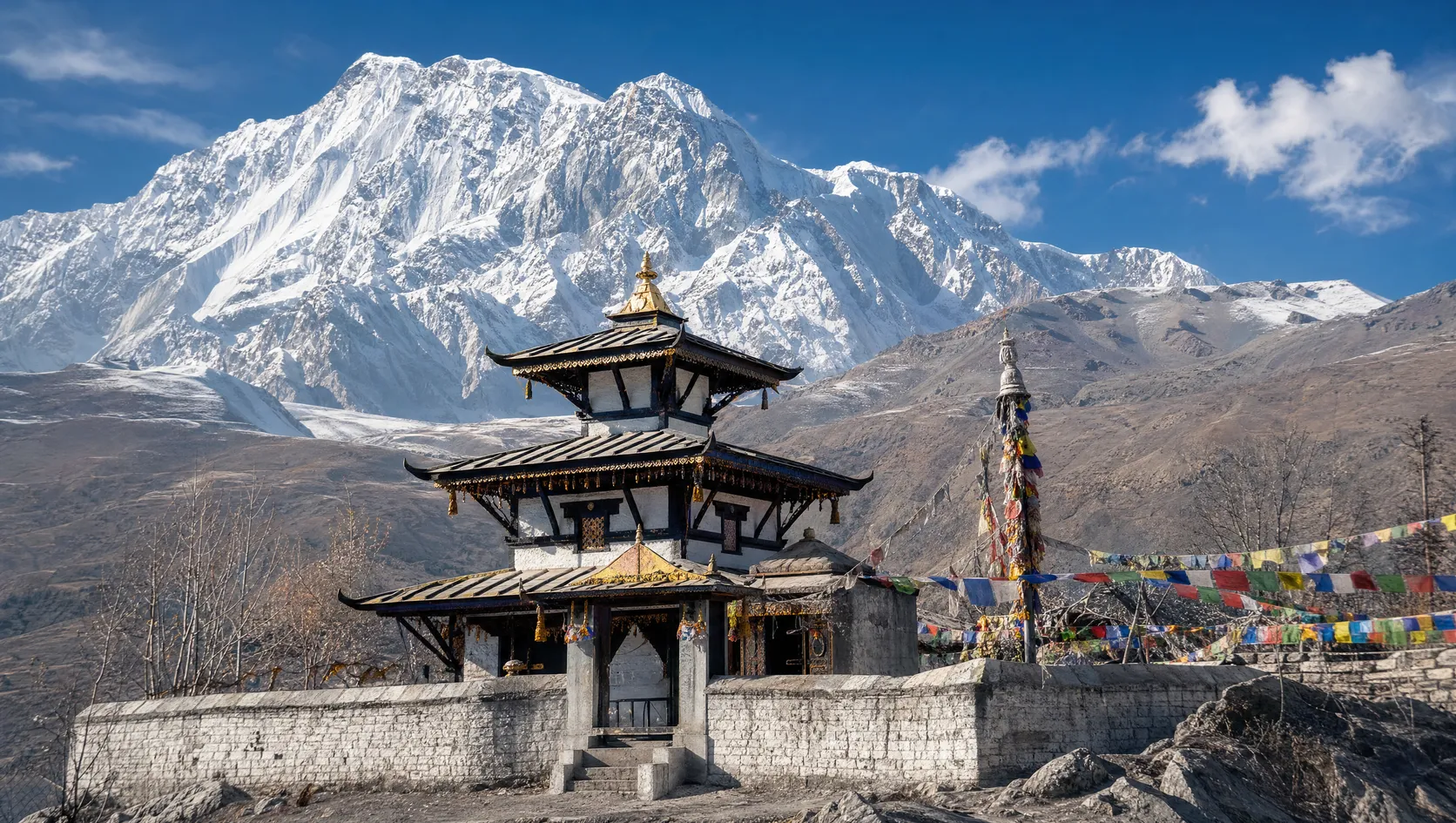
A small pagoda-style Himalayan temple of Vishnu at Mukti Kshetra, with the arc of the hundred and eight water-spouts behind it and the shrine of the Jwala Mai flames nearby
Special
The temple keeps the daily worship of Mukti Narayana, and pilgrims bathe under the hundred and eight Mukti Dhara spouts and in the sacred kunds before darshan, then take the darshan of the Jwala Mai flames nearby. Timings are set by the temple and by the high-altitude conditions, and vary with the season; they should be confirmed locally, and the shrine is hard to reach in deep winter.
The Sacred Legend · पवित्र कथा
High in the Nepal Himalaya, at about 3,800 metres in the Mustang district near the Thorong La pass, above the deep gorge of the Kali Gandaki, stands Muktinath, the Mukti Kshetra, the Place of Liberation. It is one of the very few shrines held sacred, whole and undivided, by both Hindus and Buddhists, and among Sri Vaishnavas it is the 106th of the 108 Divya Desams, the abodes of Vishnu sung by the Alvars, and the only one of the 108 that lies outside India. Here Vishnu is worshipped as Sri Murti, Mukti Narayana, the Lord who gives release. The place gathers into one spot the three things that the tradition holds most purifying: earth, water and fire. The earth gives up the saligrama, the sacred black ammonite-stone of Vishnu, found in the world only in the bed of the Kali Gandaki that runs below. The water pours from a hundred and eight spouts, the Mukti Dhara, set in an arc behind the temple, under which pilgrims bathe in the freezing snowmelt for the washing away of sin. And the fire burns of itself, the Jwala Mai, natural flames of earth-gas that play over rock and water nearby, so that at Muktinath water and fire are seen to live together. To the Buddhists the same site is Chumig Gyatsa, the Hundred Waters, a place of the dakinis linked with Guru Rinpoche, Padmasambhava, and it is tended by Buddhist nuns. Hindu and Buddhist worship the shrine side by side, and the pilgrim who climbs to Muktinath comes to a seat of liberation revered across two of the great traditions of the Himalaya.
Sacred Designationपवित्र पदनाम
Divya Desam
#106 of 108
Sacred Origin Storyपवित्र उत्पत्ति कथा
Source: Vaishnava tradition of the Divya Desams and the origin of the saligrama, drawing on the Puranic account of Tulasi (Vrinda) and the Devi Bhagavata and Vishnu tradition
The heart of Muktinath is the saligrama, the sacred black stone that is worshipped across the Vaishnava world as an aniconic, self-manifest form of Vishnu, needing no consecration by human hands. The tradition holds that these stones are found nowhere on earth but in the bed of the Kali Gandaki that runs below Muktinath, and the story of why the Lord dwells in the stone is told in the Puranas.
There was a demon named Jalandhara, or in another telling the demon Shankhachuda, whose wife Vrinda, also called Tulasi, was so faithful and so devoted to Vishnu that while her chastity held, her husband could not be slain. To end the demon's tyranny, Vishnu took the form of her husband and so broke the power of her devotion. When Vrinda learned that she had been deceived by the Lord himself, she cursed him: that he too should become a stone, cold and dark. Vishnu accepted the curse, for the protection of the world had required the deed, and he honoured her greatly in return: her ashes became the tulasi plant, dearest of all plants to him, never to be parted from his worship, and he himself took his abode in the saligrama stone. Where the tulasi is, there Vishnu is; and where the saligrama is, there Vishnu is present without any other rite. The Kali Gandaki, which the tradition also calls the Saligrami, became the one river that yields these stones, so that the mountain above it is a place of the Lord's own presence in the earth.
Muktinath is Mukti Kshetra, the field of liberation, where Vishnu is Sri Murti, Mukti Narayana, the giver of release. Here the earth gives the saligrama, the hundred and eight waters wash away sin, and the eternal flame burns over water, so that the pilgrim who comes to this seat, the Alvars and the tradition hold, is set on the road to moksha, the release from the round of birth and death.
Sources cited:
- Vaishnava tradition of the Divya Desams and the Nalayira Divya Prabandham of the Alvars
- Puranic account of the saligrama and the tulasi (Vrinda / Jalandhara narrative)
- Devi Bhagavata and Vishnu tradition on the origin of the saligrama stone
- Local tradition of the Mukti Kshetra at Muktinath
Other Traditions · अन्य परंपराएँ
The Buddhist tradition of Chumig Gyatsa
Scholarly Context
Muktinath holds a singular place in the sacred geography of India and the Himalaya. In the Sri Vaishnava tradition the 108 Divya Desams are the abodes of Vishnu praised in the Nalayira Divya Prabandham, the collected Tamil hymns of the twelve Alvars; of these 107 lie within the Indian subcontinent's traditional bounds and one, Thiru Saligramam, lies far to the north in the Nepal Himalaya, making Muktinath the only Divya Desam outside India. Scholars note the remarkable reach of the Alvar corpus in naming a Himalayan shrine among the southern-centred abodes of the Lord. The site is defined by three natural phenomena that the tradition reads as sacred: the saligrama ammonite fossils of the Kali Gandaki, which geologists identify as the shells of cephalopods from the ancient Tethys Sea, uplifted with the Himalaya and eroded out along this one river; the hundred and eight water-spouts fed by the mountain streams; and the natural gas seeps that burn as the Jwala Mai flames. The convergence of earth, water and fire at one high place has made Muktinath a shrine of unusual power in the eyes of pilgrims. Muktinath is also among the clearest examples of a genuinely shared sacred site, revered by Hindus as Mukti Kshetra and by Buddhists as Chumig Gyatsa, with Buddhist nuns tending a Vaishnava-Vishnu shrine and pilgrims of both traditions worshipping side by side. Eternal Raga presents the Vaishnava tradition as primary, records the Buddhist tradition with respect, and treats Muktinath as a Himalayan seat of the Lord whose sanctity crosses the bounds of a single faith.
Historyइतिहास
Muktinath, the Mukti Kshetra, is an ancient Himalayan shrine of Vishnu in the Mustang district of Nepal, high above the Kali Gandaki gorge near the Thorong La pass. In the Sri Vaishnava tradition it is Thiru Saligramam, the 106th of the 108 Divya Desams sung by the Alvars, and the only one of those abodes of Vishnu that lies outside India, where the Lord is worshipped as Sri Murti, Mukti Narayana.
The sanctity of the site is bound up with the Kali Gandaki below it, the one river in the world from which the saligrama, the aniconic stone form of Vishnu, is gathered. For this reason the mountain has drawn Vaishnava pilgrims from across India since early times, and the saligramas of the Gandaki have been carried to homes and temples throughout the subcontinent, so that this remote Himalayan valley is joined to the daily worship of Vishnu everywhere. The Alvar hymns' inclusion of Thiru Saligramam among the Divya Desams marks the antiquity and the reach of its fame.
The site has been holy to Buddhists as long as it has been holy to Hindus. As Chumig Gyatsa, the Hundred Waters, it is a place of the dakinis and is linked with Guru Rinpoche, Padmasambhava, and the natural flames of the Jwala Mai are revered in both traditions. The present pagoda-style temple, with the arc of the hundred and eight water-spouts behind it and the shrine of the eternal flame nearby, has been rebuilt and maintained across the centuries, and the precincts are tended by Buddhist nuns even as the Vishnu worship continues.
Today Muktinath remains a living shrine and one of the great high-altitude pilgrimages of the Himalaya, reached by flying or driving to Jomsom and then by jeep or on foot, and drawing Hindu and Buddhist pilgrims together to a seat of liberation where earth, water and fire are held sacred at one place. Its remoteness and its height have kept its character, and the road to it, hard and cold, is itself part of the pilgrimage.
Historical Timelineऐतिहासिक कालक्रम
The Kali Gandaki gorge below Muktinath becomes known as the one source of the saligrama, the aniconic stone form of Vishnu, drawing Vaishnava reverence to the site from early times.
The saligramas are ammonite fossils of the ancient Tethys Sea, uplifted with the Himalaya and eroded out along the Kali Gandaki, which the tradition also calls the Saligrami.
In the tradition of the saligrama, Vishnu accepts the curse of Vrinda (Tulasi) and takes his abode in the black stone of the Gandaki, and the tulasi plant becomes dearest of all to him.
The demon whose wife is cursed is given as Jalandhara in some tellings and Shankhachuda in others; the accounts vary in detail.
Thiru Saligramam is counted among the 108 Divya Desams in the tradition of the Alvars' Nalayira Divya Prabandham, the only one of the abodes of Vishnu placed outside India.
The inclusion of a Himalayan shrine among the largely southern Divya Desams is a striking feature of the Alvar corpus, associated in tradition with Tirumangai Alvar.
Muktinath develops as a high-altitude Vaishnava pilgrimage, its fame carried across India with the saligramas gathered from the Kali Gandaki and worshipped in homes and temples far to the south.
In the Buddhist tradition the site, known as Chumig Gyatsa, is hallowed by Guru Rinpoche, Padmasambhava, and honoured as a place of the dakinis on the way to Tibet.
The site is counted among the sacred power-places of the Himalaya in the Buddhist tradition and is tended by Buddhist nuns.
The present pagoda-style temple of Mukti Narayana takes shape and is maintained across the periods, with the arc of the hundred and eight water-spouts and the shrine of the Jwala Mai flames.
Hindu and Buddhist worship at the site continue side by side, the natural flames over water revered in both traditions and the shrine shared by pilgrims of the two faiths.
The pilgrimage to Muktinath is recorded by travellers and scholars, who note the saligrama-bearing Kali Gandaki, the hundred and eight spouts, and the burning flames as marvels of the shrine.
The identification of Muktinath as Thiru Saligramam, the 106th Divya Desam, is carried in the modern Sri Vaishnava pilgrimage, drawing devotees from the south to the Himalayan seat of the Lord.
Improved access, with the Jomsom airstrip and a motorable jeep road up the Kali Gandaki valley, opens Muktinath to far larger numbers of pilgrims and trekkers, though the high altitude keeps the journey demanding.
Muktinath remains a living shrine of Mukti Narayana and of Chumig Gyatsa, drawing Hindu and Buddhist pilgrims together, the temple tended by Buddhist nuns and the daily Vishnu worship kept, with the great numbers coming in the milder months.
Pilgrims bathe under the hundred and eight Mukti Dhara spouts and in the sacred kunds and take darshan of the eternal flame, joining the pilgrimage to Muktinath with the wider Annapurna and Thorong La routes of the Himalaya.
What You'll Seeदर्शन में
The presiding deity of Muktinath is Vishnu as Sri Murti, Mukti Narayana, the Lord who gives release, enshrined in the small pagoda-style temple as a standing image of the Lord, with Sri Devi, Lakshmi, honoured beside him in the tradition of the Divya Desams. But the deepest object of worship at Muktinath is not the enshrined image alone; it is the whole place, where the Lord is held present in the earth, the water and the flame.
The saligrama governs the iconography of the site. The black, spiral-marked ammonite-stone of the Kali Gandaki is worshipped across the Vaishnava world as an aniconic, self-manifest form of Vishnu, needing no consecration, and Muktinath is the source from which it comes. To come here is to come to the mountain of the saligrama, and the reverence brought to the enshrined Narayana is inseparable from the reverence brought to the stone form of the Lord that this valley alone yields.
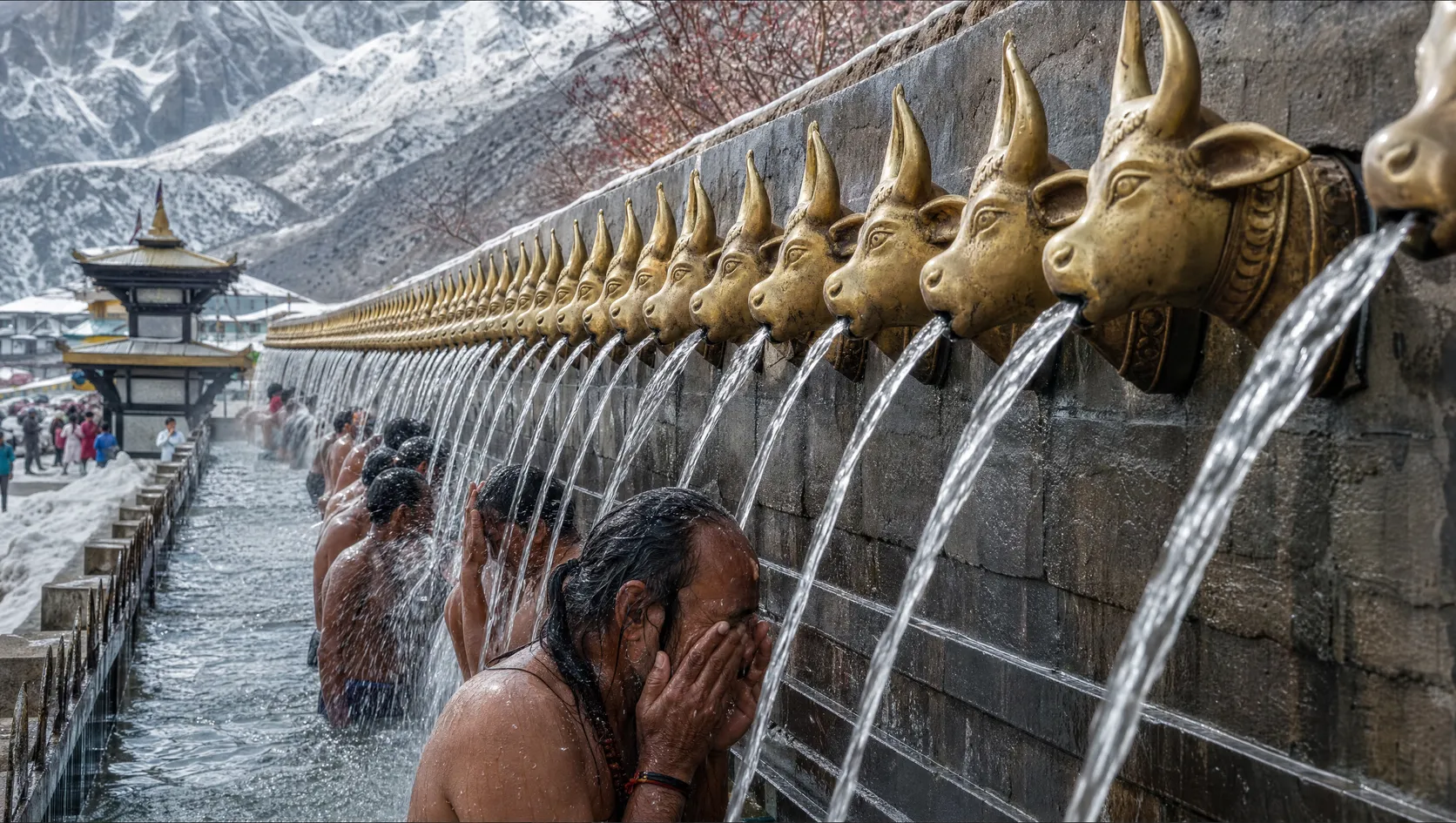
Behind the temple runs the arc of the hundred and eight water-spouts, the Mukti Dhara, each in the shape of a cow's or a makara's head, pouring the freezing snowmelt in an unbroken line; before them lie the sacred kunds. Nearby is the shrine of the Jwala Mai, where natural flames burn over rock and water. In the Buddhist understanding the same shrine holds a form of Avalokiteshvara, and the flames are revered as a manifestation of the deity. The controlling image of Muktinath is thus not a single figure but a convergence: Narayana enshrined, the saligrama in the earth below, the hundred and eight waters, and the fire that burns on water, all held together as the presence of the Lord at the field of liberation.
Distinctive Practicesविशिष्ट परंपराएँ
Bathing under the 108 Mukti Dhara
एक सौ आठ मुक्ति धारा के नीचे स्नान
Before darshan, in the daylight hours
The central practice of Muktinath is the bath under the hundred and eight water-spouts, the Mukti Dhara, that run in an arc behind the temple. Pilgrims pass under each spout in turn, letting the freezing snowmelt fall over the head, and then bathe in the sacred kunds, before taking the darshan of Mukti Narayana. Many complete the whole line of a hundred and eight spouts despite the cold and the thin high-altitude air.
The name Mukti Kshetra, the field of liberation, is understood in the water: to bathe under the hundred and eight spouts is held to wash away the accumulated sins of the pilgrim and to set the soul on the road to moksha. The number one hundred and eight, sacred throughout the tradition, gathers the sacred waters into a single complete rite, and the very hardship of the cold and the height is offered as part of the austerity of the pilgrimage. The bath is not an act before worship but a form of worship, the body given to the sacred water at the seat of the Lord who gives release.
Darshan of the Jwala Mai eternal flame
ज्वाला माई की अनंत ज्वाला का दर्शन
At the flame-shrine near the temple
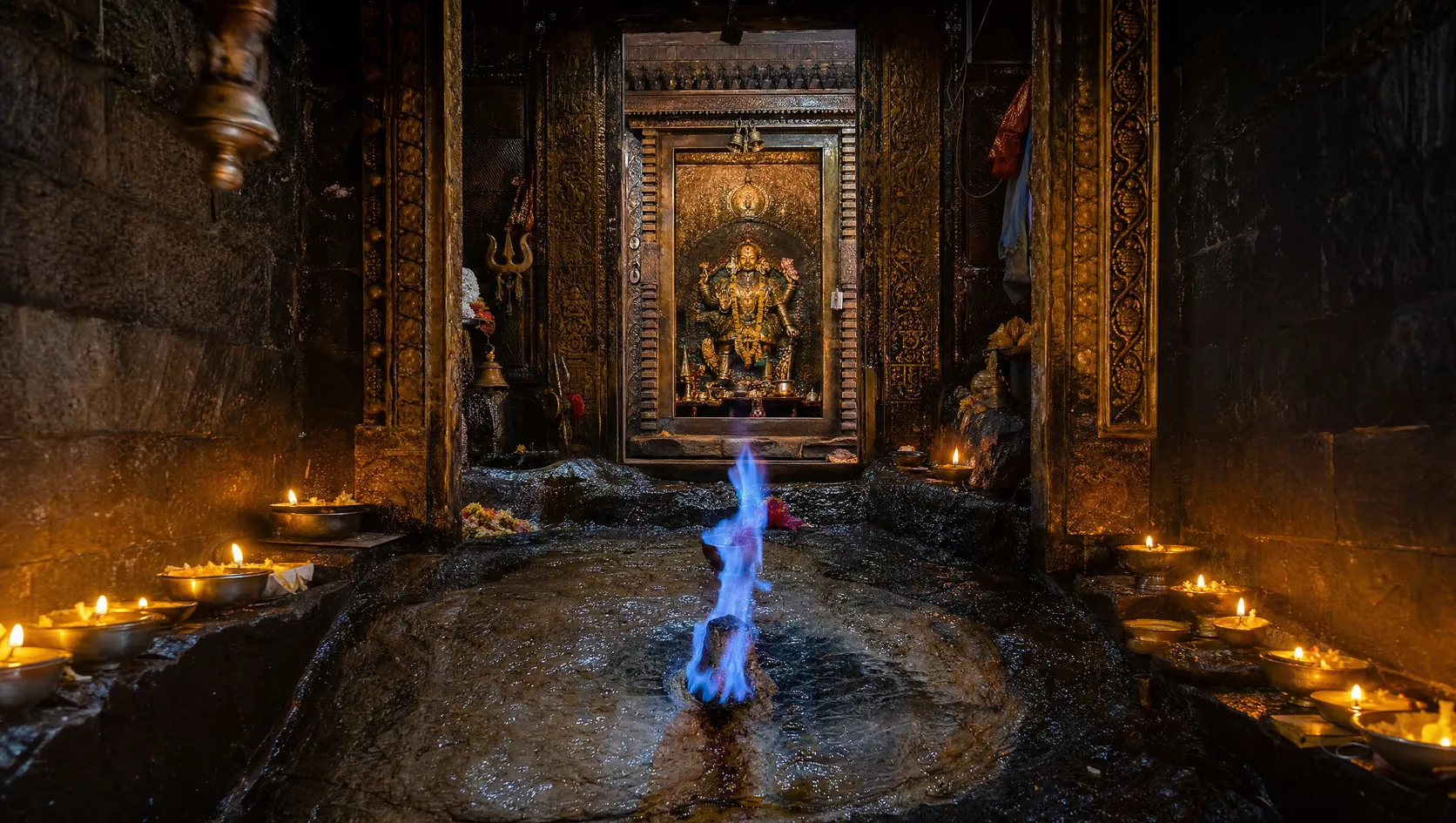
Near the temple stands the shrine of the Jwala Mai, where natural flames of earth-gas burn of themselves over rock and, most wonderfully, over water, so that water and fire are seen together in one place. Pilgrims take the darshan of the eternal flame as one of the marvels of Muktinath, a manifestation held sacred by Hindus and Buddhists alike.
At Muktinath the tradition sees the meeting of the elements as a sign of the fullness of the sacred: earth in the saligrama, water in the hundred and eight spouts, and fire in the flame that burns on water. That fire should live upon water, the two elements that ordinarily undo each other, is read as a mark of the presence of the divine at this place, a natural wonder taken as a revelation. To take the darshan of the flame is to worship the Lord in the element of fire, as the pilgrim has worshipped him in the water and will worship him in the stone.
Reverence and worship of the saligrama
शालग्राम की श्रद्धा और उपासना
At the shrine and along the Kali Gandaki
The saligrama, the black ammonite-stone of the Kali Gandaki, is revered as the aniconic form of Vishnu, and Muktinath is its source. Pilgrims honour the saligrama at the shrine and along the river below, and some carry a stone home for worship, where it is treated as a living form of the Lord, bathed, offered tulasi, and never bought or sold but received with reverence.
The saligrama needs no rite of consecration, for the tradition holds that Vishnu is already present within it by his own accepting of the curse of Vrinda; the stone is his self-manifest form, not an image made by hands. Muktinath, as the one source of the saligrama, is therefore not merely a shrine of Vishnu but the very ground from which his stone form comes into the world, and to reverence the saligrama here is to touch the presence of the Lord at its source, the mountain that gives to the whole tradition the stone in which the Lord is worshipped everywhere.
Shared Hindu and Buddhist worship
साझा हिन्दू और बौद्ध उपासना
Throughout the year, at the same shrine
Muktinath is worshipped by Hindus as Mukti Kshetra and by Buddhists as Chumig Gyatsa, and the two traditions honour the same temple, the same hundred and eight spouts, and the same eternal flame. The precincts are tended by Buddhist nuns, and pilgrims of both faiths bathe and worship side by side, so that the pilgrimage itself is an act shared across the two great traditions of the Himalaya.
That a Vishnu shrine of the Vaishnava Divya Desams should be tended by Buddhist nuns, and that Hindu and Buddhist should worship the same flame and the same waters, is not felt as a contradiction at Muktinath but as a fullness. The place is understood to be holy in itself, its sanctity resting on the convergence of earth, water and fire, and each tradition reads that holiness in its own terms without denying the other. To worship here is to stand at a seat of liberation revered across two faiths, and the shared reverence is part of what pilgrims come to receive.
Did You Know?क्या आप जानते हैं?
Muktinath is the 106th of the 108 Divya Desams, the abodes of Vishnu sung by the Alvars, and the only one of the 108 located outside India, high in the Nepal Himalaya.
Sri Vaishnava tradition of the Divya Desams
The saligrama, the black ammonite-stone worshipped across the Vaishnava world as the aniconic form of Vishnu, is found on earth only in the Kali Gandaki river that runs below Muktinath.
Puranic tradition of the saligrama; geological accounts of the Kali Gandaki
Behind the temple run 108 water-spouts, the Mukti Dhara, under which pilgrims bathe in freezing snowmelt for the washing away of sin and the road to liberation.
Pilgrimage tradition of Mukti Kshetra
Near the temple, the Jwala Mai shrine holds natural gas flames that burn of themselves over rock and over water, so that fire and water are seen living together at one place.
Local tradition of Muktinath / Chumig Gyatsa
The same site is sacred to Tibetan Buddhists as Chumig Gyatsa, the Hundred Waters, a place of the dakinis linked with Guru Rinpoche (Padmasambhava); the shrine is tended by Buddhist nuns.
Tibetan Buddhist tradition of Chumig Gyatsa
The saligramas are ammonite fossils of the ancient Tethys Sea, uplifted with the rise of the Himalaya and eroded out along the one river the tradition calls the Saligrami.
Geological accounts of the Kali Gandaki
The saligrama is held to be a self-manifest form of Vishnu that needs no consecration by human hands, and in tradition it is never bought or sold but received with reverence and worshipped like a living deity.
Vaishnava tradition of saligrama worship
The saligrama origin is told through Vrinda (Tulasi): Vishnu, having accepted her curse to become stone, made the tulasi plant dearest of all to him, so tulasi and saligrama are worshipped together.
Puranic account of Tulasi (Vrinda) and the saligrama
At about 3,800 metres near the Thorong La pass, Muktinath is one of the highest of the great Hindu pilgrimages, reached by flying or driving to Jomsom and then by jeep or on foot.
Records of the Annapurna region and Mustang district
Visitor Accessप्रवेश जानकारी
Muktinath is a high-altitude Himalayan shrine at about 3,800 m, and reaching it is itself demanding. It is open to devotees of all backgrounds, and Hindus and Buddhists worship at the same shrine, tended by Buddhist nuns. Traditional and modest dress and quiet, respectful conduct are expected, and footwear is removed at the temple. Pilgrims bathe under the hundred and eight Mukti Dhara spouts and in the sacred kunds before darshan, in freezing snowmelt; the cold and the thin air at this height must be taken seriously. The main restrictions at Muktinath are not of custom but of nature and access: the altitude, the cold, the remoteness, and the seasonal closure of the routes in deep winter and heavy snow. The shrine is reached from Jomsom, about 20 km away, which has an airstrip, and then by jeep along the Kali Gandaki valley or on foot; wider access is through Pokhara. Timings and conditions are set by the temple and by the weather and should be confirmed locally before travelling.
Spiritual Basis
The sanctity of Muktinath rests on its being Mukti Kshetra, the field of liberation, where Vishnu as Mukti Narayana gives release and where the earth, the water and the fire are all held sacred at one place. The openness of the shrine to all, and the shared worship of Hindus and Buddhists, reflect the tradition's sense that the holiness of the place is in the place itself, in the saligrama below, the hundred and eight waters, and the flame that burns on water. The hardship of the pilgrimage, the height, the cold, the long road, is understood not as an obstacle to be regretted but as part of the austerity of coming to a seat of liberation. To bathe under the hundred and eight spouts in the freezing water is a giving of the body to the sacred, and to reach the shrine at all is a labour offered to the Lord who gives release.
Contemporary Context
Muktinath remains a living shrine and one of the great high-altitude pilgrimages of the Himalaya, drawing Hindu and Buddhist pilgrims together and, in recent years, many trekkers on the Annapurna and Thorong La routes. Improved access, the Jomsom airstrip and the jeep road up the Kali Gandaki, has brought far larger numbers than in the past, though the altitude keeps the journey serious. The shrine keeps its shared character, tended by Buddhist nuns while the Vishnu worship of Mukti Narayana continues, and its standing as the only Divya Desam outside India gives it a special draw for Sri Vaishnava pilgrims from the south. In its daily life it remains a small Himalayan temple in a high and remote valley, its rhythm set as much by the weather and the seasons as by the ritual calendar.
Practical Guidance
Plan for high altitude. At about 3,800 m, altitude sickness is a real risk; acclimatise on the way up, ascend gradually, keep well hydrated, and do not overexert on the day of arrival. Anyone who feels seriously unwell at height should descend. Carry warm clothing in every season, for it is cold and windy even in summer, and be ready for the shock of the freezing water at the spouts. Reach Muktinath by flying or driving to Jomsom (about 20 km, with an airstrip), then by jeep along the Kali Gandaki valley or on foot; wider access is through Pokhara. Come in the milder months and avoid deep winter, when heavy snow can close the route. Confirm the temple's timings, the state of the road, and the weather locally before setting out, and allow spare days for the flights to and from Jomsom, which are often delayed by weather.
Festivalsत्योहार
Ram Navami and the Vishnu festivals
राम नवमी और विष्णु उत्सव
Mar-Apr (Chaitra) and through the year
The festivals of Vishnu in his forms, observed at Muktinath as the shrine of Mukti Narayana, mark the year of the seat with the worship of the Lord over their days, drawing Vaishnava pilgrims to the Himalayan Divya Desam in the milder season.
Janmashtami
जन्माष्टमी
Aug-Sep (Bhadrapada)
The birth of Krishna, an avatar of Vishnu, is observed at Muktinath as at the Vaishnava shrines, the worship of the Lord in his descent kept at the seat of Mukti Narayana high in the Himalaya.
Yartung / the Mustang harvest festival
यार्तुंग / मुस्तांग फ़सल उत्सव
Aug-Sep (late monsoon)
The regional festival of Mustang, marked with horse races and gatherings in the valley, falls in the milder season and colours the pilgrimage to Muktinath with the local Himalayan life of the region, shared by its Hindu and Buddhist communities.
Buddhist observances of Chumig Gyatsa
चुमिग ग्यात्सा के बौद्ध अनुष्ठान
Through the year (by the Tibetan calendar)
As Chumig Gyatsa, the site keeps the Buddhist observances of the Tibetan calendar, with the reverence of the dakinis and of Guru Rinpoche and the honouring of the eternal flame, so that the year of the shrine is marked by both Hindu and Buddhist festivals.
Rishi Tarpani / Janai Purnima
ऋषि तर्पणी / जनै पूर्णिमा
Aug (Shravan Purnima)
The full-moon observance of the sacred thread and of ritual bathing, kept at Muktinath with the bath at the sacred kunds and the hundred and eight spouts, a fitting rite at the field of liberation and the waters of the Gandaki.
Traditional Offeringsपारंपरिक अर्पण
Primary Offerings
Tulasi leaves and garland
तुलसी पत्र और माला
तुलसी
Tulasi, the holy basil, is dearest of all plants to Vishnu, and no worship of the Lord is held complete without it. In the tradition of the saligrama, the tulasi is the very body of Vrinda, given by the Lord the place nearest to him, so that at Muktinath, the source of the saligrama, the offering of tulasi leaves and a tulasi garland is the most fitting of all.
Worship of the saligrama (abhisheka)
शालग्राम की उपासना (अभिषेक)
शालग्राम
The saligrama, the aniconic stone form of Vishnu from the Kali Gandaki, is worshipped with abhisheka, the ritual bathing of the stone with water, panchamrit and tulasi, and the offering of lamps. At Muktinath, the source of the saligrama, this worship carries a particular weight, the Lord honoured in the stone form that this valley alone gives to the world.
The sacred waters (bathing at the Mukti Dhara and kunds)
पवित्र जल (मुक्ति धारा और कुंडों पर स्नान)
मुक्तिधारा
At Muktinath the offering of the self to the sacred waters is central: the bath under the hundred and eight spouts and in the Muktikund and Laxmikund, in the freezing snowmelt of the Gandaki. The waters are held to wash away sin and to give the road to liberation, and the giving of the body to the cold water is itself an offering at the field of release.
Ghee lamps and incense (deep and dhoop)
घी के दीप और धूप
दीप
Lamps of ghee and incense are offered in the daily worship of Mukti Narayana, the light and fragrance raised before the Lord. At Muktinath, where the eternal flame of the Jwala Mai burns of itself nearby, the offering of the lamp joins the pilgrim's small light to the natural fire held sacred at the shrine.
Naivedya and satvik bhog
नैवेद्य और सात्विक भोग
नैवेद्य
Cooked food and fruit offered to the Lord as naivedya, and shared afterwards as prasad, are part of the worship of Vishnu, offered in the satvik manner, pure and simple, as befits the Lord. The prasad is received by the pilgrim as the grace of Mukti Narayana made tangible, carried home from the high shrine.
Yellow flowers and garland
पीले पुष्प और माला
पुष्प
Flowers, above all in the yellow that is dear to Vishnu, are offered in garlands to Mukti Narayana in the manner of the worship of the Lord. Offered together with the tulasi, they adorn the deity and are received back by the devotee as a token of the Lord's blessing at the Himalayan seat.
Unique to This Temple
The bath under the 108 Mukti Dhara as an offering
अर्पण के रूप में एक सौ आठ मुक्ति धारा के नीचे स्नान
What is particular to Muktinath is that the highest offering is not a thing brought and laid before the deity but the giving of the self to the sacred waters and the flame of the place. To pass under all hundred and eight spouts in the freezing snowmelt, to bathe in the Muktikund and Laxmikund, and to take the darshan of the eternal flame, is understood as the offering proper to the field of liberation. The pilgrim brings tulasi, flowers, lamps and naivedya to Mukti Narayana as at any Vishnu shrine, but the offering the tradition holds highest at Muktinath is the pilgrimage itself, the labour of reaching the high seat and the giving of the body to the cold water, so that the offering and the blessing meet in the act of the bath: the pilgrim gives himself to the waters of the Lord, and the Lord, present in the place, is held to receive and to grant release.
Offerings at Muktinath follow the Vaishnava tradition of the worship of Vishnu, with tulasi, the worship of the saligrama, the sacred waters, lamps and naivedya central, offered to Mukti Narayana at the high Himalayan shrine. The bath under the hundred and eight spouts and the darshan of the eternal flame are the practices particular to the place. Eternal Raga presents these as a devotional tradition; specific arrangements should be confirmed at the temple, and pilgrims should mind the altitude and the cold.
How to Reachकैसे पहुँचें
Muktinath lies in the Mustang district of Nepal, high in the Annapurna region near the Thorong La pass, above the valley of the Kali Gandaki. It is one of the most remote of the great pilgrimages, and reaching it is part of the journey.
The usual gateway is Pokhara, the large town to the south, reached by air or road from Kathmandu. From Pokhara, most pilgrims fly to Jomsom, the small airstrip about 20 km from Muktinath, on one of the short mountain flights that operate in good weather; these flights are often delayed or cancelled by cloud, so spare days should be allowed. From Jomsom, Muktinath is reached by jeep along the Kali Gandaki valley road, or on foot for those trekking.
By road, it is also possible to drive the whole way up the Kali Gandaki valley from Pokhara by jeep, a long and rough mountain journey of one or two days, and this is how many pilgrims who do not fly reach the shrine.
On foot, Muktinath is a stage on the Annapurna Circuit and is reached by trekkers crossing the Thorong La pass, or walking up the valley. However it is reached, the altitude of about 3,800 m means acclimatisation, warm clothing, and attention to health are essential, and the routes can be closed by heavy snow in winter. Confirm the flights, the road, and the weather before setting out.
Plan Your Visitयात्रा की योजना
🌤 Best Season
The best times to visit Muktinath are the milder months of spring, roughly March to May, and autumn, roughly late September to November, when the weather is more settled and the mountain flights to Jomsom run more reliably. Autumn in particular offers clear skies and the most dependable conditions. Deep winter, roughly December to February, brings heavy snow and severe cold, and the routes can be closed; the shrine is hard to reach and the journey dangerous. The monsoon, roughly June to early September, brings rain and cloud to the lower valley and frequently delays or cancels the Jomsom flights, though the Mustang region itself lies partly in a rain-shadow and can stay drier. Whatever the season, it is cold and windy at this height; mornings are the clearest time, and the mountain weather can change quickly through the day.
👘 Dress Code
Traditional and modest dress is expected at the temple, and warm clothing is essential in every season at this altitude. Footwear is removed at the temple. Those who bathe under the hundred and eight spouts and in the kunds should be ready for the shock of the freezing water and should dry and warm themselves quickly afterwards. Simple, respectful attire is appropriate for the worship of the Lord.
📱 Phones & Photography
Photography is generally restricted within the sanctum; follow the posted rules and the directions of the temple and the resident nuns, and keep phones silenced within the shrine. Photography of the surroundings, the spouts, and the flame-shrine is usually permitted, but confirm locally, and be considerate of other pilgrims at worship.
🏨 Accommodation
Simple lodges and guest houses for pilgrims and trekkers are found at Ranipauwa, the settlement just below the temple, and along the route at Jomsom and the villages of the Kali Gandaki valley, in the manner of the teahouses of the Annapurna region. These are basic mountain lodgings suited to the remoteness and the altitude rather than luxury hotels. Many pilgrims base themselves at Jomsom or in the valley and visit Muktinath, or stay a night at Ranipauwa to allow for acclimatisation and an early darshan. Demand rises in the spring and autumn seasons, and booking ahead is advisable at those times; the larger town of Pokhara, the gateway to the region, has a full range of hotels for the start and end of the journey.
Sacred Soundsपवित्र ध्वनि
Did You Know? · क्या आप जानते हैं?
The same translation error that turned '33 Koti' into '33 crore' in Hinduism also happened in Buddhism. The Chinese translation of Buddhist texts rendered 'Sapta Koti Buddha' (7 Supreme Buddhas) as '7 Crore Buddhas.' The Tibetan translation got it right: 7 types, not 7 crore. One Sanskrit word, misread across two major world religions, generated two identical misconceptions independently.
Related Contentसंबंधित सामग्री
Related Scriptures
Community Reflections
🕉️
Be the first to share your reflection.