Sri Kalahasti
श्री कालहस्ती
The Śrī Kālahastīśvara Temple at Srikalahasti, the canonical Vāyu (Air) Sthalam of the Pañca Bhūta Sthalam five-elements Tamil Śaiva framework, embedded in the canonical southern Andhra Pradesh canonical regional zone (Tirupati district, approximately 36 km from Tirumala); home to the corpus-distinctive Vāyu Liṅga swayambhu (self-manifested) lingam framework that is canonically never touched by human hand and the canonical two-sanctum-lamps iconographic register that flicker continuously in the absence of canonical natural air-current as the canonical visual proof-text of the canonical air-element devotional framework; the canonical principal Rāhu-Ketu Sarpa-Doṣa Pariharam pilgrimage anchor in South India; the canonical mokṣa-attainment site of the canonical Spider-Serpent-Elephant trio (the canonical etymological source of the site name 'Śrī-Kāla-Hasti') and the canonical Kaṇṇappa Nāyaṉār canonical hunter-saint canonical attainment site; the second Tier A entry of the Eternal Raga Pañca Bhūta Sthalam sweep
Srikalahasti, Andhra Pradesh, India
Śrī KālahastīśvaraAlso known as: Srikalahasti, Sri Kalahasti, Kalahasti, Kālahasti, Śrī Kālahastīśvara Temple, Śrī Kālahastīśvara Devasthānam (canonical official temple administrative designation), Dakṣiṇa Kailāsam ('the Southern Kailāsa,' a canonical regional epithet reflecting the site's canonical Śaiva-tradition centrality in the southern canonical regional zone), Rāhu-Ketu Kṣetra (canonical principal Rāhu-Ketu Sarpa-Doṣa Pariharam pilgrimage anchor designation), Vāyu Liṅga Kṣetra (canonical Pañca Bhūta Sthalam Vāyu-element pilgrimage anchor designation)
Era
Pre-canonical Sangam-era and early Pallava-period Tamil-Telugu canonical Śaiva cultural-religious attestation; substantive canonical Pallava-period (5th, 9th c. CE) foundational construction; canonical Cōḻa-period (10th, 11th c.) elaboration; canonical Pāṇḍya-period subsequent patronage; canonical Vijayanagara empire-era major elaboration with Kṛṣṇadevarāya (1509, 1529 CE) constructing the canonical principal Rāja-Gōpuram in 1516 CE; canonical Nāyak / Reddy dynasties subsequent patronage; canonical British colonial period administrative arrangements; canonical 26 May 2010 Rāja-Gōpuram collapse; canonical 2018 reconstructed Rāja-Gōpuram inauguration; canonical contemporary administration under the Andhra Pradesh state Endowments Department
Architecture
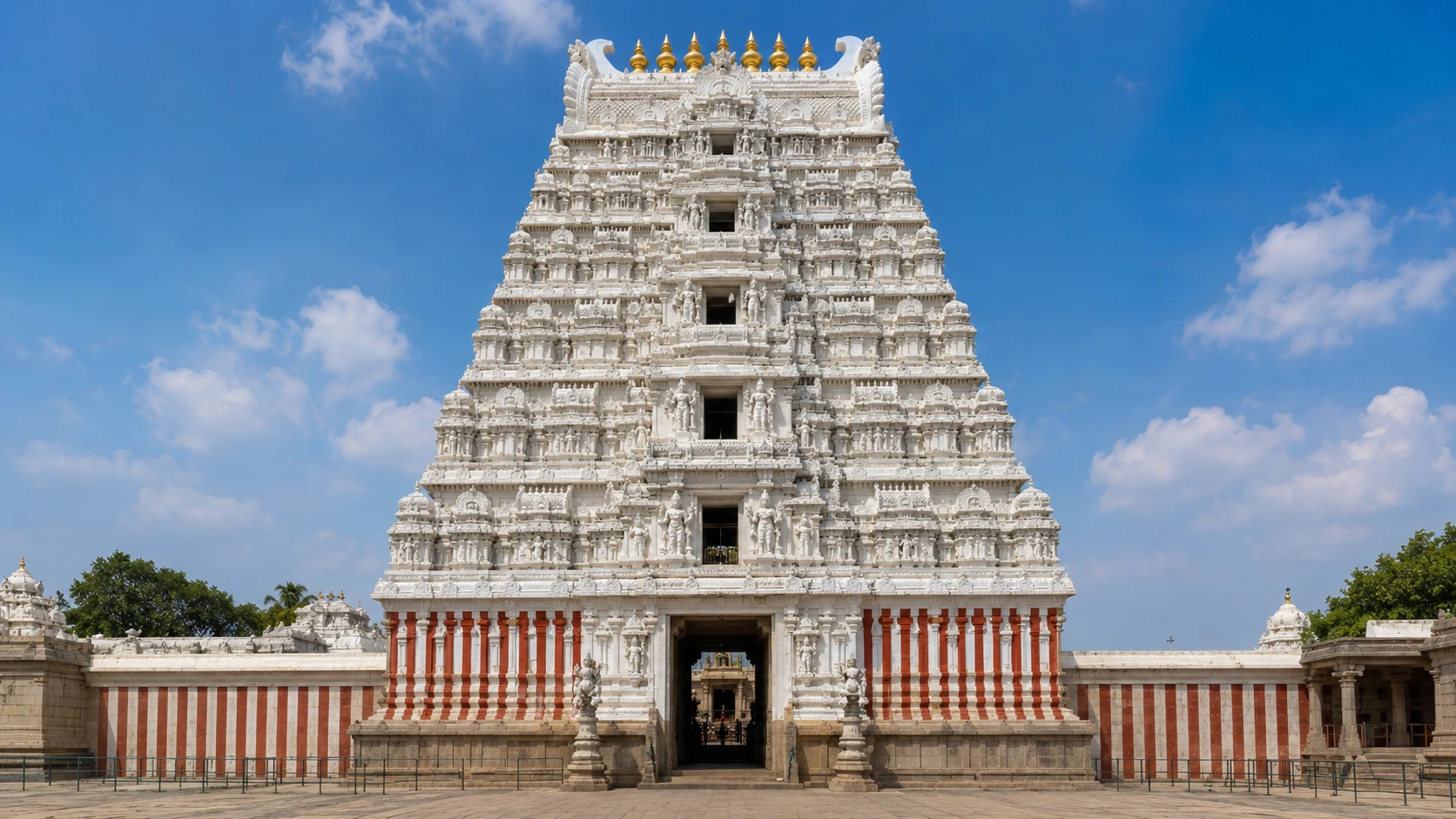
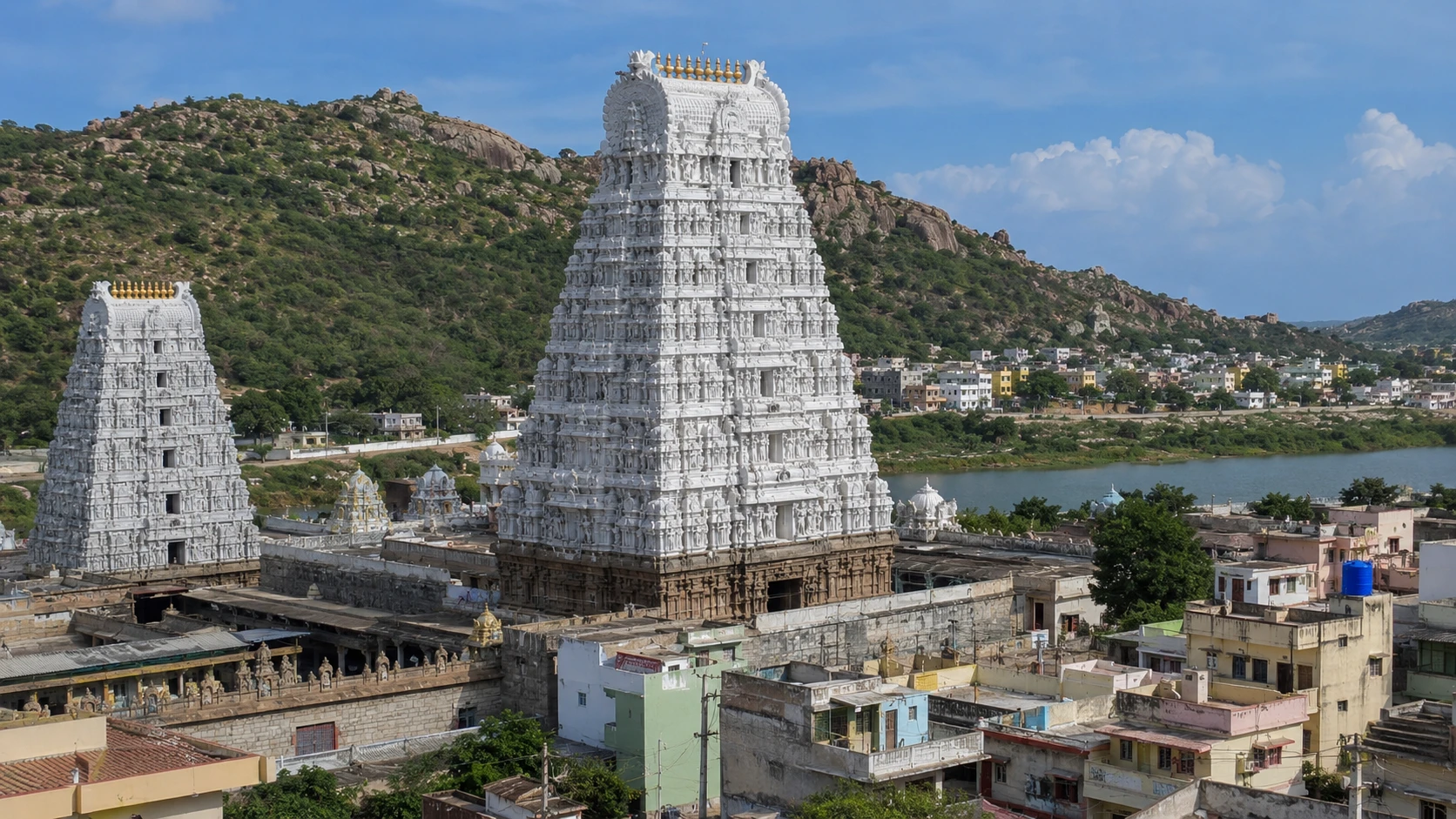
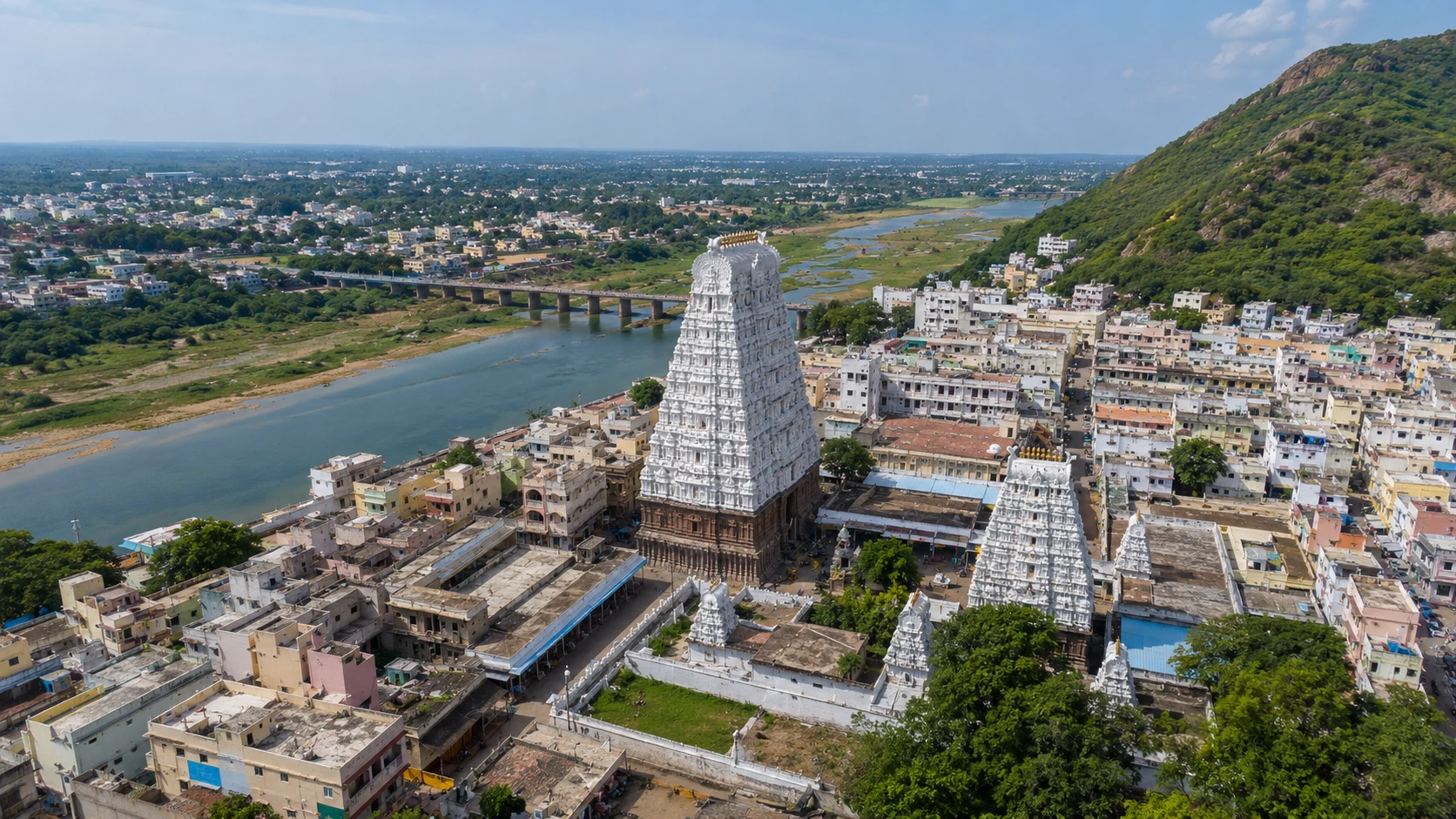
Tamil Drāviḍa (Dravidian) temple-construction style with substantive canonical Pallava-period foundational architectural framework (5th, 9th c. CE) and canonical Cōḻa-period, Pāṇḍya-period, Vijayanagara-period, and Nāyak-period subsequent architectural elaboration. The canonical temple-complex is structured around the canonical Vāyu Liṅga inner sanctum and the integrated canonical principal architectural envelope. Distinctive architectural elements include: the canonical principal Rāja-Gōpuram (the canonical main entrance gopuram, approximately 36.5 meters in height, canonically constructed by Vijayanagara emperor Kṛṣṇadevarāya in 1516 CE, the canonical Rāja-Gōpuram operated as one of the tallest South Indian gopurams until the canonical 26 May 2010 structural collapse; the canonical reconstructed Rāja-Gōpuram was canonically inaugurated in 2018 after substantive canonical Andhra Pradesh state government and Archaeological Survey of India coordinated reconstruction program); the canonical Vāyu Liṅga inner sanctum (the canonical principal sanctum housing the canonical swayambhu Vāyu Liṅga with the canonical two-sanctum-lamps iconographic register); the canonical Pātāla Gaṇapati subterranean sub-shrine (the canonical Gaṇeśa-shrine accessed by canonical descent below the principal temple-complex elevation, the canonical pātāla-level Gaṇapati operating as the canonical subterranean iconographic register); the canonical Jñānaprasūnāmbikā Devī sub-shrine (the canonical principal Devī-consort shrine, dedicated to canonical Pārvatī as Jñānaprasūnāmbikā 'the Mother of Wisdom-Flower'); the canonical Kaṇṇappa Nāyaṉār sub-shrine (the canonical Kaṇṇappa-attainment commemoration shrine integrated within the canonical temple-complex envelope); and the broader canonical Tamil Drāviḍa sub-shrine infrastructure operating across the canonical temple-precinct envelope. The temple-complex envelope is sited along the canonical Suvarṇamukhī riverbank, with the canonical river operating as the canonical sacred-water anchor for canonical bathing observances. Architectural elevation: the temple is canonically situated on a hillside-and-riverbank elevation, with the canonical entrance through the canonical Rāja-Gōpuram leading into the canonical broader temple-complex envelope
Open
06:00 – 21:00
Aarti
06:00 · 09:30 · 12:00 · 18:00 · 20:00
Special
The canonical daily worship cycle at the Śrī Kālahastīśvara Temple is the canonical Andhra Pradesh state Endowments Department-administered liturgical infrastructure operating across the canonical daily framework: Suprabhātam / morning awakening worship (approximately 06:00); morning aarati (approximately 09:30); noon worship (approximately 12:00); evening aarati (approximately 18:00); night-worship (approximately 20:00, including the canonical evening culminating darshan). The corpus-distinctive Rāhu-Ketu Sarpa-Doṣa Pariharam Pūjā is the canonical principal year-round liturgical engagement at the canonical temple, operating across the canonical daily worship cycle with substantial year-round pilgrim flow distinct from the canonical festival-period-peaked pilgrim flow profile of most other major South Indian canonical Hindu temples. The canonical principal annual festival programming centers on the canonical Mahā Śivarātri (February-March, the canonical pan-Hindu Śaiva observance) drawing canonical pilgrim flow exceeding 100,000+ at festival peak, and the canonical 10-day Brahmotsavam (typically March-April, the canonical Vasanta-season festival program) drawing substantial regional pilgrim flow
The Sacred Legend · पवित्र कथा
The Śrī Kālahastīśvara Temple at Srikalahasti, southern Andhra Pradesh, occupies a structurally distinctive position within the canonical Pañca Bhūta Sthalam five-elements Tamil Śaiva framework and the broader canonical pan-South-Indian Śaiva temple-tradition framework. The canonical temple-complex (situated at the heart of Srikalahasti town within Tirupati district, approximately 36 km north-east of Tirumala along the canonical Suvarṇamukhī riverbank) is the canonical Vāyu (Air) Sthalam of the canonical Pañca Bhūta Sthalam framework, the canonical second of the five canonical Tamil Śaiva canonical shrines each embodying one of the five mahābhūta classical elements (Chidambaram = Ākāśa/Space, Srikalahasti = Vāyu/Air, Tiruvannamalai = Agni/Fire, Thiruvanaikaval = Apas/Water, Kanchipuram-Ekambareśvara = Pṛthvī/Earth, in the canonical sequence of subtle-to-gross elemental densification). The site's canonical theological centerpiece, the canonical Vāyu Liṅga, a canonical swayambhu (self-manifested) liṅga form of Śiva embodying the canonical wind-element, operates as the canonical iconographic-and-theological seat of the canonical Pañca Bhūta Sthalam Vāyu-framework. The Vāyu Liṅga is canonically distinguished by two corpus-distinctive iconographic features: (1) the canonical never-touched-by-human-hand convention, the canonical liṅga is canonically held to be too sacred (and too directly the canonical Vāyu element) for canonical direct human contact, with all canonical abhiṣeka offerings poured to canonically flow around rather than upon the canonical liṅga, the canonical liturgical infrastructure thus preserving the canonical liṅga in canonical untouched register across at least a millennium of canonical documented continuity; and (2) the canonical two-sanctum-lamps iconographic register, two canonical lamps continuously burning at the canonical Vāyu Liṅga sanctum are canonically observed to flicker, sway, and move continuously even in the canonical absence of any apparent canonical natural air-current or canonical breeze (the canonical sanctum is canonically enclosed with no canonical open ventilation), operating as the canonical visual proof-text of the canonical Vāyu-element divine presence at the canonical Vāyu Sthalam framework. The corpus-distinctive flickering-lamps phenomenon is canonically integrated into the canonical pilgrim devotional engagement as the canonical real-time iconographic register of the canonical Vāyu Liṅga's canonical air-element identity. The site's name 'Śrī-Kāla-Hasti' canonically derives from the canonical Spider-Serpent-Elephant mokṣa narrative: 'Śrī' (Sanskrit 'sacred,' here canonically interpreted as the canonical spider), 'Kāla' (the canonical serpent), and 'Hasti' (the canonical elephant), three canonical creatures who canonically attained mokṣa at the canonical site through their individual canonical austerity-and-devotion of the canonical Śiva-liṅga. The canonical narrative is preserved through the canonical Skanda Purāṇa's Kālahastīśvara Māhātmyam section and operates as the canonical theological-etymological framework of the canonical site's name. The site is further the canonical mokṣa-attainment site of Kaṇṇappa Nāyaṉār, the canonical 7th-century Tamil Śaiva hunter-saint, canonically held to be one of the canonical 63 Nāyaṉmārs of the canonical Tamil Śaiva tradition, who canonically attained Śiva-darshan at Śrī Kālahasti through his canonical extreme bhakti, including the canonical extraordinary canonical narrative episode in which the canonical hunter-saint offered his own canonical eyes to canonically replace the canonical bleeding eyes of the canonical Śiva-liṅga (the canonical Kaṇṇappa narrative preserved in the canonical Periya Purāṇam of Sēkkiḻār, 12th c. CE, the canonical Tamil Śaiva hagiographic corpus). The site is one of the canonical principal Rāhu-Ketu Sarpa-Doṣa Pariharam pilgrimage anchors in pan-India, the canonical principal South-Indian site for canonical Rāhu-Ketu sarpa-doṣa / serpent-affliction remediation in canonical Hindu astrological tradition, alongside the canonical Trimbakeśvara Jyotirliṅga of the canonical Mahārāṣṭra regional canonical zone. The canonical Rāhu-Ketu Pūjā at Srikalahasti operates as a substantial year-round canonical pilgrim-engagement framework, distinguishing Srikalahasti from canonical festival-period-peaked canonical pilgrim flow profiles at most other major canonical South Indian temples (Srikalahasti's canonical pilgrim flow profile reflects substantial year-round Rāhu-Ketu remedy-pilgrim engagement alongside the canonical Mahā Śivarātri festival peak). The canonical Vijayanagara-period emperor Kṛṣṇadevarāya (1509, 1529 CE) canonically constructed the canonical principal Rāja-Gōpuram (main canonical entrance gopuram) in 1516 CE, with the canonical gopuram operating as one of the canonical tallest South Indian gopurams (approximately 36.5 meters in canonical height) until its canonical collapse on 26 May 2010 due to canonical age-related structural failure; the canonical reconstructed Rāja-Gōpuram was canonically inaugurated in 2018 following the canonical Andhra Pradesh state government and Archaeological Survey of India coordinated reconstruction program. The site operates as the canonical second Tier A entry of the Eternal Raga Pañca Bhūta Sthalam sweep, with the corpus-distinctive Vāyu Liṅga iconographic register + Rāhu-Ketu pilgrimage anchor + Kaṇṇappa Nāyaṉār attainment narrative + Spider-Serpent-Elephant mokṣa etymological framework operating as the integrated canonical theological-historical framework of the canonical site.
Sacred Designationपवित्र पदनाम
Pancha Bhoota
Element: air
Sacred Origin Storyपवित्र उत्पत्ति कथा
Source: Skanda Purāṇa's canonical Kālahastīśvara Māhātmyam section (canonical Sanskrit Sthala Purāṇa of Srikalahasti, preserving the canonical Vāyu-attainment narrative and the canonical Spider-Serpent-Elephant mokṣa narrative); Periya Purāṇam of Sēkkiḻār (12th c. CE, canonical Tamil Śaiva hagiographic corpus, preserving the canonical Kaṇṇappa Nāyaṉār attainment narrative); canonical Tēvāram corpus (canonical hymns of Tiruñāṉacampantar / Sambandar and Cuntarar / Sundaramūrti on the canonical Tiruk-Kāḷatti Tamil Śaiva tradition); canonical regional Telugu Śaiva canonical literature (the canonical Kālahasti Māhātmyam in Telugu Śaiva recensions, integrating the canonical Andhra Pradesh regional canonical Śaiva tradition); canonical Pallava-period and Cōḻa-period inscriptional record
The canonical Skanda Purāṇa's Kālahastīśvara Māhātmyam preserves the canonical Srikalahasti theological narrative as the integrated Vāyu-attainment narrative culminating in the canonical Spider-Serpent-Elephant mokṣa narrative that gives the canonical site its canonical name.
The canonical narrative records that the canonical Vāyu (the canonical wind-god, one of the canonical Pañca Devatā of the canonical mahābhūta elemental framework) performed canonical austerity at the canonical Srikalahasti site, seeking canonical Śiva's canonical recognition of his canonical elemental sovereignty.
Canonical Śiva, moved by the canonical Vāyu's austerity, canonically granted the canonical Vāyu the canonical privilege of having his canonical wind-element become the canonical liṅga-form at the canonical site, the canonical Vāyu Liṅga thus arising as the canonical swayambhu (self-manifested) form integrating the canonical Vāyu element with the canonical Śiva-liṅga theological framework.
The canonical Vāyu Liṅga at Srikalahasti is thus canonically held to be the canonical principal earthly residence of the canonical Vāyu-element divine presence within the canonical pañca-element framework. The canonical narrative further records the canonical Spider-Serpent-Elephant mokṣa narrative as the canonical theological-etymological framework of the canonical site's name.
The canonical narrative is as follows: a canonical spider (Sanskrit Śrī, canonically interpreted as the canonical spider in the canonical etymological framework), a canonical serpent (Sanskrit Kāla), and a canonical elephant (Sanskrit Hasti) each canonically discovered the canonical Vāyu Liṅga at the canonical site and each canonically performed their individual canonical devotion.
The canonical spider canonically wove a canonical web-canopy above the canonical liṅga to canonically protect the canonical liṅga from canonical falling debris. The canonical serpent canonically placed canonical precious gems on the canonical liṅga as canonical ornamental offerings.
The canonical elephant canonically poured canonical water from the canonical Suvarṇamukhī river through its canonical trunk onto the canonical liṅga as canonical abhiṣeka and canonically offered canonical flowers picked with its canonical trunk.
Each canonical creature was canonically unaware of the canonical other two creatures' canonical worship, and each canonically perceived the canonical preceding creature's offerings as canonical obstructions to be canonically cleared away (the canonical elephant canonically clearing the canonical spider's web and the canonical serpent's gems; the canonical serpent canonically removing the canonical wet flowers placed by the canonical elephant; the canonical spider re-weaving the canonical web each canonical morning).
The canonical conflict among the canonical three creatures escalated, with canonical Śiva canonically observing the canonical conflict and canonically testing the canonical creatures' canonical devotion. In the canonical narrative's culmination, canonical Śiva canonically appeared to the canonical three creatures and canonically granted all three the canonical mokṣa, with the canonical creatures canonically merging into the canonical Vāyu Liṅga and the canonical site canonically receiving the canonical 'Śrī-Kāla-Hasti' (Spider-Serpent-Elephant) name.
The canonical Spider-Serpent-Elephant mokṣa narrative operates as the canonical principal etymological-theological framework of the canonical site's name and as the canonical principal devotional anchor for the canonical pan-creature spiritual-egalitarian theological framework of the canonical Śaiva tradition.
The canonical narrative further integrates the canonical Kaṇṇappa Nāyaṉār attainment narrative, the canonical 7th-century Tamil Śaiva hunter-saint Kaṇṇappa (also canonically known as Tiṇṇaṉ before his canonical hunter-saint identity) was a canonical Boya-tribal hunter who canonically discovered the canonical Vāyu Liṅga at Srikalahasti during his canonical hunting expeditions and canonically conceived an canonical extraordinary devotion to the canonical liṅga.
The canonical Kaṇṇappa daily canonical offerings included canonical pre-tasted meat-offerings (the canonical hunter-saint canonically tasting the meat to ensure its quality for the canonical liṅga-offering, the canonical practice canonically operating outside the canonical brahmanical-orthodox offering convention but reflecting the canonical hunter-saint's canonical sincere bhakti), canonical wild flowers, and canonical water carried in his canonical mouth.
The canonical narrative's culminating episode records that the canonical Śiva-liṅga began canonically bleeding from its canonical eyes (a canonical test of Kaṇṇappa's devotion); the canonical Kaṇṇappa canonically gouged out one of his canonical own eyes and canonically pressed it into the canonical bleeding socket of the canonical liṅga's first eye, canonically stopping the canonical bleeding; when the canonical second eye of the canonical liṅga then began canonically bleeding, the canonical Kaṇṇappa canonically placed his canonical foot upon the canonical liṅga to canonically mark its canonical position (so that he could canonically locate the second eye after gouging out his canonical second eye); canonical Śiva, moved by the canonical extraordinary devotion, canonically appeared and canonically granted the canonical Kaṇṇappa canonical mokṣa, canonically restoring the canonical Kaṇṇappa's canonical eyes and canonically integrating the canonical Kaṇṇappa into the canonical 63 Nāyaṉmārs canonical Tamil Śaiva saint-tradition.
The canonical Kaṇṇappa attainment narrative is preserved in the canonical Periya Purāṇam of Sēkkiḻār (12th c. CE) and operates as the canonical principal Tamil Śaiva hagiographic anchor for the canonical hunter-saint canonical extreme-bhakti theological framework.
The corpus documents the integrated Vāyu-attainment + Spider-Serpent-Elephant mokṣa + Kaṇṇappa Nāyaṉār attainment primary narrative framework as the canonical principal theological framework of the canonical Srikalahasti site.
Sources cited:
- Skanda Purāṇa, canonical Kālahastīśvara Māhātmyam section (canonical Sanskrit Sthala Purāṇa of Srikalahasti)
- Periya Purāṇam of Sēkkiḻār (12th c. CE), canonical Kaṇṇappa Nāyaṉār attainment narrative
- Tēvāram corpus, canonical hymns of Tiruñāṉacampantar / Sambandar and Cuntarar / Sundaramūrti on the canonical Tiruk-Kāḷatti Tamil Śaiva tradition
- Regional Telugu Śaiva canonical literature, canonical Kālahasti Māhātmyam Telugu recensions
- Pallava-period and Cōḻa-period inscriptional record at the canonical Srikalahasti temple
- Vijayanagara-period inscriptional record
- Peterson, Indira Viswanathan, 'Poems to Siva: The Hymns of the Tamil Saints' (Princeton University Press, 1989)
- Shulman, David Dean, 'Tamil Temple Myths' (Princeton University Press, 1980)
- Stein, Burton, 'Vijayanagara' (Cambridge University Press, 1989)
- Nilakanta Sastri, K. A., 'A History of South India' (Oxford University Press, 1955)
- Government of Andhra Pradesh, Endowments Department documentation
- Archaeological Survey of India, Srikalahasti gopuram reconstruction project documentation (2010, 2018)
Other Traditions · अन्य परंपराएँ
Rāhu-Ketu Sarpa-Doṣa Pariharam canonical Hindu astrological tradition, canonical Rāhu-Ketu remedial pilgrimage anchor framework
The canonical Rāhu-Ketu Sarpa-Doṣa Pariharam framework at Srikalahasti operates as a canonical supplementary canonical theological-astrological framework integrated with the canonical primary Vāyu-attainment narrative. The canonical Hindu astrological tradition holds the canonical Rāhu and Ketu (the canonical shadow-planets / chāyā-grahas of the canonical nine-planet Navagraha framework, canonically held to be the canonical ascending and descending lunar nodes of the canonical lunar-solar conjunction astronomical framework) to canonically cause canonical sarpa-doṣa (canonical serpent-affliction) and canonical nāga-doṣa (canonical naga-affliction) in canonical natal-chart configurations, particularly when canonical Rāhu and Ketu canonically afflict the canonical lagna (ascendant), the canonical seventh house (marriage / partnership house), or canonical other canonical sensitive house-positions in the canonical Vedic-astrology natal-chart framework.
The canonical Rāhu-Ketu sarpa-doṣa is canonically associated with canonical delays in marriage, canonical childlessness, canonical professional obstacles, and canonical other canonical karmic-affliction frameworks per the canonical Vedic-astrology tradition.
The canonical Rāhu-Ketu Pūjā at Srikalahasti operates as the canonical principal remediation pilgrimage in pan-India (alongside the canonical Trimbakeśvara Jyotirliṅga of Mahārāṣṭra and the canonical Kālahasti-Trimbak canonical paired pilgrimage framework).
The canonical Pūjā operates through canonical liturgical infrastructure including canonical Rāhu-Kāla observance (the canonical Rāhu-auspicious daily time-window, varying by day of week per the canonical Vedic-astrology framework), canonical Nāga-pratiṣṭhā (the canonical naga-installation ritual), canonical sarpa-saṁskāra ('serpent-rite' ritual), and the canonical broader Rāhu-Ketu remedial liturgical framework.
The canonical Pūjā is canonically performed throughout the year across the canonical daily worship cycle, operating as the canonical year-round principal liturgical engagement framework at the canonical Srikalahasti site and distinguishing the canonical site's canonical pilgrim flow profile from the canonical festival-period-peaked canonical pilgrim flow profile of most other major South Indian canonical Hindu temples.
Pañca Bhūta Sthalam canonical framework integration narrative, canonical Tamil Śaiva five-elements framework integration narrative
The canonical Pañca Bhūta Sthalam framework integration at Srikalahasti operates through the canonical Vāyu (Air) Sthalam designation that integrates Srikalahasti as the canonical second of the five canonical Tamil Śaiva canonical shrines each embodying one of the five mahābhūta classical elements.
The canonical framework comprises five canonical Tamil Śaiva sites: (1) Chidambaram (Ākāśa / Space), the canonical principal Pañca Sabhā anchor and the canonical first of the five elements; (2) Srikalahasti (Vāyu / Air), the canonical second of the five elements; (3) Tiruvannamalai (Agni / Fire), the canonical third of the five elements; (4) Thiruvanaikaval (Apas / Water), the canonical fourth of the five elements; (5) Kanchipuram-Ekambareśvara (Pṛthvī / Earth), the canonical fifth of the five elements.
The canonical Pañca Bhūta Sthalam framework operates within the canonical Tamil Śaiva tradition's distinctive theological framework where each canonical site's canonical liṅga-form embodies one of the five mahābhūta classical elements per the canonical Sāṅkhya-derived classical Hindu elemental cosmology.
The canonical Pañca Bhūta Sthalam pilgrim-circuit operates as a canonical coordinated multi-site pilgrim infrastructure, with canonical pilgrims undertaking the canonical extended circuit canonically engaging all five canonical sites in canonical coordinated darshan.
The canonical Srikalahasti site's canonical Vāyu Sthalam integration through the canonical Vāyu Liṅga + canonical two-flickering-lamps iconographic register + canonical never-touched-by-human-hand convention operates as the canonical site's canonical Pañca Bhūta Sthalam canonical theological-iconographic anchor.
Srikalahasti is corpus-distinctive within the Pañca Bhūta Sthalam framework as the only one of the five sites located in canonical Telugu-tradition Andhra Pradesh (the other four being located in canonical Tamil-tradition Tamil Nadu), reflecting the canonical cross-linguistic-cultural integration of the canonical Pañca Bhūta Sthalam framework across the canonical Tamil-Telugu canonical regional zones.
Tēvāram canonical Tamil Śaiva poet-saint canonical hymnal attestation
The canonical Tēvāram corpus's canonical Tamil Śaiva poet-saint canonical hymnal attestation at Srikalahasti operates through the canonical hymns of Tiruñāṉacampantar / Sambandar (c. 7th c. CE) and Cuntarar / Sundaramūrti (c. 8th, 9th c. CE) who canonically sang of the canonical 'Tiruk-Kāḷatti' Tamil Śaiva tradition at the canonical site.
The canonical Tamil Śaiva tradition canonically holds that the canonical Tamil Śaiva canonical poet-saints canonically visited the canonical Srikalahasti site and canonically composed canonical Tēvāram hymns at the canonical site, integrating the canonical site into the canonical broader Tamil Śaiva canonical Pāḍal-Peṟṟa Sthalam ('Sites Sung-of by the Saints') canonical pilgrimage framework, the canonical 275 canonical Tamil Śaiva sites canonically celebrated in the canonical Tēvāram corpus.
The canonical Srikalahasti site's inclusion in the canonical Pāḍal-Peṟṟa Sthalam framework reflects the canonical cross-linguistic-cultural Tamil Śaiva canonical engagement of the canonical Andhra Pradesh regional canonical Śaiva site, the canonical Tamil Śaiva poet-saints' canonical Telugu-region engagement representing the canonical canonical Tamil Śaiva tradition's canonical pan-South-Indian theological scope.
The canonical Kaṇṇappa Nāyaṉār attainment narrative's preservation in the canonical Periya Purāṇam similarly integrates the canonical Srikalahasti site into the canonical Tamil Śaiva canonical hagiographic tradition through the canonical Kaṇṇappa canonical 7th-century attainment narrative.
Scholarly Context
The Śrī Kālahastīśvara Temple at Srikalahasti occupies a structurally distinctive position in the corpus and is the second Tier A entry of the Eternal Raga Pañca Bhūta Sthalam sweep. The canonical theological framework operates through the integrated four-framework convergence: (1) the canonical Vāyu (Air) Sthalam of the Pañca Bhūta Sthalam framework, with the corpus-distinctive Vāyu Liṅga swayambhu form + canonical never-touched-by-human-hand convention + canonical two-sanctum-lamps flickering-iconographic register operating as the canonical visual proof-text of the canonical air-element divine presence; (2) the canonical Spider-Serpent-Elephant mokṣa narrative's canonical etymological-theological framework giving the canonical site its canonical name; (3) the canonical Kaṇṇappa Nāyaṉār canonical hunter-saint attainment narrative integrating the canonical Tamil Śaiva canonical hagiographic tradition; and (4) the canonical Rāhu-Ketu Sarpa-Doṣa Pariharam canonical Hindu astrological tradition's principal South-Indian remediation pilgrimage anchor framework. Srikalahasti is corpus-distinctive within the Pañca Bhūta Sthalam framework as the only one of the five sites located in canonical Telugu-tradition Andhra Pradesh, reflecting the canonical cross-linguistic-cultural integration of the canonical Pañca Bhūta Sthalam framework across the canonical Tamil-Telugu canonical regional zones. The canonical Rāhu-Ketu Pūjā's substantial year-round pilgrim engagement framework is corpus-distinctive within the broader corpus and operates as a distinguishing canonical operational feature of the canonical Srikalahasti site. The canonical Spider-Serpent-Elephant mokṣa narrative is preserved in the canonical Skanda Purāṇa's Kālahastīśvara Māhātmyam section and integrates the canonical pan-creature spiritual-egalitarian theological framework of the canonical Śaiva tradition. The canonical Kaṇṇappa Nāyaṉār narrative is preserved in the canonical Periya Purāṇam of Sēkkiḻār (12th c. CE) and operates as the canonical principal Tamil Śaiva hagiographic anchor for the canonical hunter-saint canonical extreme-bhakti theological framework. The site's historical depth, substantive canonical Pallava-period (5th, 9th c.) foundational construction, canonical Cōḻa-period (10th, 11th c.) elaboration, canonical Pāṇḍya-period subsequent patronage, canonical Vijayanagara-period major elaboration with Kṛṣṇadevarāya (1509, 1529 CE) constructing the canonical principal Rāja-Gōpuram in 1516 CE, canonical Nāyak / Reddy dynasties subsequent patronage, canonical British colonial period administrative arrangements, the canonical 26 May 2010 Rāja-Gōpuram collapse, and the canonical 2018 reconstructed Rāja-Gōpuram inauguration, operates within the broader pan-South-Indian historical framework documented through Stein 1980/1989, Nilakanta Sastri 1955, and the broader canonical Tamil-Telugu regional historical scholarship. The corpus documents the site as a Tier A canonical Pañca Bhūta Sthalam site within the Phase 4 Pañca Bhūta Sthalam sweep, with the canonical integrated four-framework convergence operating as the canonical theological-historical-iconographic-operational framework documented within the corpus's editorial framework. Three alternate accounts are surfaced under the mythology section: (1) the canonical Rāhu-Ketu Sarpa-Doṣa Pariharam canonical Hindu astrological tradition narrative; (2) the canonical Pañca Bhūta Sthalam framework integration narrative; and (3) the canonical Tēvāram canonical Tamil Śaiva poet-saint canonical hymnal attestation narrative. All three alternate accounts are canonically devotionally compatible with the primary Vāyu-attainment + Spider-Serpent-Elephant mokṣa + Kaṇṇappa Nāyaṉār attainment integrated narrative framework.
Historyइतिहास
Srikalahasti's historical depth as a sacred site integrates with the broader canonical southern Andhra Pradesh and the canonical Tamil-Telugu canonical regional zone Śaiva temple-tradition historical framework. The pre-canonical layer preserves canonical regional Tamil-Telugu Śaiva cultural-religious attestation through the canonical Tēvāram corpus's canonical Pāḍal-Peṟṟa Sthalam inclusion of the canonical 'Tiruk-Kāḷatti' site, the canonical hymns of Tiruñāṉacampantar / Sambandar (c. 7th c.
CE) and Cuntarar / Sundaramūrti (c. 8th, 9th c. CE) preserve the canonical earliest substantive Tamil Śaiva poetic-devotional attestation of the canonical Srikalahasti site. The canonical Kaṇṇappa Nāyaṉār canonical 7th-century attainment narrative (preserved in the canonical Periya Purāṇam of Sēkkiḻār, 12th c.
CE) operates as the canonical principal Tamil Śaiva canonical hagiographic anchor at the canonical site. The substantive canonical Pallava-period (5th, 9th c. CE) foundational construction operates as the canonical principal early architectural anchor of the canonical Srikalahasti temple, the canonical Pallava dynasty's canonical Tamil-Telugu canonical regional patronage program extended canonical architectural infrastructure to the canonical Srikalahasti site within the broader canonical Pallava-period Andhra Pradesh-Tamil Nadu canonical Śaiva temple-tradition framework.
The canonical Cōḻa-period (10th, 11th centuries) brought substantive canonical elaboration at the canonical Srikalahasti site, with the canonical Cōḻa dynasty's canonical Tamil Śaiva temple-tradition patronage program canonically extending to the broader Andhra Pradesh regional canonical Śaiva sites. The canonical Pāṇḍya dynasty patronage period continued canonical patronage.
The canonical Vijayanagara empire-era (mid-14th c. CE onwards) brought the most substantive canonical architectural elaboration at the canonical Srikalahasti site, with the canonical Vijayanagara-period emperor Kṛṣṇadevarāya (1509, 1529 CE), one of the canonical principal patrons of the canonical Vijayanagara empire's Tamil-Telugu canonical Śaiva temple-tradition framework, canonically constructing the canonical principal Rāja-Gōpuram (main canonical entrance gopuram) at Srikalahasti in 1516 CE.
The canonical Rāja-Gōpuram stood approximately 36.5 meters in canonical height and operated as one of the canonical tallest South Indian gopurams, integrating the canonical Vijayanagara-period architectural elaboration program with the canonical broader Vijayanagara empire-era Tamil-Telugu canonical Śaiva temple-tradition canonical architectural framework.
The canonical Nāyak dynasty (16th, 17th centuries) and canonical Reddy dynasty subsequent patronage continued canonical architectural-devotional infrastructure development at the canonical Srikalahasti site. The canonical British colonial period (1801 onwards) brought the canonical temple-complex into the colonial administrative arrangements as part of the canonical Madras Presidency / canonical Hyderabad Nizam-administered framework (the broader canonical southern-Andhra Pradesh regional zone canonical administrative framework varied across the canonical colonial period with the canonical Madras Presidency and canonical Hyderabad Princely State canonical administrative boundary shifts).
The canonical Pōst-Independence period (1947, present) initially placed the canonical Srikalahasti site within the canonical Madras State administrative framework; subsequently following the canonical 1953 Andhra State formation and the canonical 1956 States Reorganisation Act, the canonical Srikalahasti site canonically transferred to the canonical Andhra Pradesh state framework.
The canonical contemporary administrative arrangements operate under the canonical Andhra Pradesh state Endowments Department, distinct from the canonical Tirumala Tirupati Devasthanams (TTD) administrative framework that operates at the canonical nearby Tirumala-Venkateshwara temple, with the canonical Srikalahasti temple operating under canonical direct Andhra Pradesh state Endowments Department administration.
The canonical 26 May 2010 Rāja-Gōpuram collapse, in which the canonical Vijayanagara-period Rāja-Gōpuram of 1516 CE canonically collapsed due to age-related structural failure during the canonical evening hours, operated as a canonical major heritage event drawing canonical international attention.
The canonical collapse was canonically attributed to the canonical age-related structural deterioration of the canonical 500-year-old gopuram's canonical foundational stone-mortar infrastructure exacerbated by the canonical adjacent canonical Suvarṇamukhī river's canonical hydrogeological effects on the canonical foundation.
The canonical Andhra Pradesh state government and the canonical Archaeological Survey of India coordinated a substantive canonical reconstruction program from 2010 onwards, with the canonical reconstructed Rāja-Gōpuram canonically inaugurated in 2018 after canonical multi-year reconstruction operations.
The canonical reconstructed Rāja-Gōpuram canonically operates at approximately the canonical original 36.5-meter height with the canonical Vijayanagara-period architectural-iconographic register canonically restored. The canonical contemporary canonical temple-complex draws substantial canonical pilgrim flow, approximately 5,000, 10,000 daily on average, substantially higher festival-period and Rāhu-Kāla-period crowds (canonical Mahā Śivarātri festival peak exceeding 100,000+, canonical Rāhu-Kāla-period daily peaks during the canonical year-round Rāhu-Ketu Pūjā framework).
The substantial year-round Rāhu-Ketu Pūjā pilgrim flow distinguishes Srikalahasti's canonical pilgrim flow profile from canonical festival-period-peaked profiles of most other major canonical South Indian Hindu temples. The canonical Tirumala-Srikalahasti canonical regional pilgrim-circuit, in which canonical pilgrims undertaking the canonical Tirumala-Venkateshwara darshan canonically extend the canonical pilgrimage to include the canonical Śrī Kālahastīśvara darshan, operates as a canonical principal regional pilgrim infrastructure framework drawing substantial canonical multi-site pilgrim engagement.
Historical Timelineऐतिहासिक कालक्रम
Canonical Tēvāram corpus and Kaṇṇappa Nāyaṉār canonical 7th-century attestation period at Srikalahasti. The canonical hymns of Tiruñāṉacampantar / Sambandar (c. 7th c. CE) and Cuntarar / Sundaramūrti (c. 8th, 9th c. CE) canonically sang of the canonical 'Tiruk-Kāḷatti' Tamil Śaiva tradition at Srikalahasti, preserving the canonical earliest substantive Tamil Śaiva poetic-devotional attestation of the canonical Srikalahasti site and integrating the canonical site into the canonical Pāḍal-Peṟṟa Sthalam canonical pilgrimage framework. The canonical Kaṇṇappa Nāyaṉār canonical 7th-century attainment narrative (subsequently preserved in the canonical Periya Purāṇam of Sēkkiḻār, 12th c. CE) operates as the canonical principal Tamil Śaiva canonical hagiographic anchor at the canonical site, the canonical hunter-saint's canonical extraordinary bhakti culminating in his canonical eye-offering and canonical mokṣa attainment at the canonical Vāyu Liṅga.
Substantive canonical Pallava-period foundational construction at the canonical Srikalahasti temple. The canonical Pallava dynasty (5th, 9th centuries CE) canonically extended canonical architectural infrastructure to the canonical Srikalahasti site as part of the broader canonical Pallava-period Tamil-Telugu canonical Śaiva temple-tradition canonical regional patronage program. The canonical Pallava-period foundational construction established the canonical principal early architectural framework of the canonical Srikalahasti temple that would receive subsequent canonical Cōḻa-, Pāṇḍya-, Vijayanagara-, and Nāyak-period elaboration. The canonical Pallava-period inscriptional record at Srikalahasti documents the dynasty's canonical patronage of the canonical Tiruk-Kāḷatti site within the broader canonical Pallava-period architectural-devotional infrastructure development framework.
Canonical Cōḻa-period elaboration at the canonical Srikalahasti temple. The canonical Cōḻa dynasty's (9th, 13th centuries) canonical Tamil Śaiva temple-tradition patronage program canonically extended to the broader Andhra Pradesh regional canonical Śaiva sites including Srikalahasti, with the canonical Cōḻa-period architectural-devotional infrastructure development integrating Srikalahasti into the canonical broader Cōḻa-period pan-Tamil-Andhra canonical Śaiva temple-tradition framework. The canonical Cōḻa-period inscriptional record at Srikalahasti documents the canonical Cōḻa dynasty's canonical patronage of the canonical site alongside the canonical broader Cōḻa-period Tamil Śaiva temple-tradition canonical infrastructure framework.
Canonical Vijayanagara-period emperor Kṛṣṇadevarāya (reigned 1509, 1529 CE) construction of the canonical principal Rāja-Gōpuram at Srikalahasti in 1516 CE. The canonical Rāja-Gōpuram was canonically constructed at approximately 36.5 meters in canonical height, operating as one of the canonical tallest South Indian gopurams. The canonical Kṛṣṇadevarāya patronage of Srikalahasti integrated the canonical site into the broader canonical Vijayanagara empire-era Tamil-Telugu canonical Śaiva temple-tradition canonical architectural framework. The canonical Kṛṣṇadevarāya canonical patronage program at Srikalahasti operates as one of the canonical principal documented Vijayanagara-period elaboration anchors of the canonical site, with the canonical Rāja-Gōpuram standing as the canonical principal architectural feature of the canonical temple-complex envelope for approximately 494 years until the canonical 26 May 2010 collapse.
Canonical Nāyak / Reddy dynasties subsequent patronage and canonical British colonial period administrative arrangements at Srikalahasti. The canonical Nāyak dynasty (16th, 17th centuries) and canonical Reddy dynasty continued canonical architectural-devotional infrastructure development at the canonical Srikalahasti site after the canonical Vijayanagara empire's gradual decline. The canonical British colonial period (1801 onwards) brought the canonical temple-complex into the colonial administrative arrangements as part of the canonical Madras Presidency (the canonical southern-Andhra Pradesh regional zone canonical administrative framework varied across the canonical colonial period with the canonical Madras Presidency and canonical Hyderabad Princely State canonical administrative boundary shifts). The canonical continuous canonical Śaiva tradition operations at the canonical temple-complex continued through the canonical Nāyak-Reddy-colonial period administrative arrangements, with the canonical Vijayanagara-period Rāja-Gōpuram canonical architectural anchor continuing in canonical operation.
Canonical 26 May 2010 Rāja-Gōpuram collapse at Srikalahasti. The canonical Vijayanagara-period Rāja-Gōpuram of 1516 CE, the canonical principal entrance gopuram of the Śrī Kālahastīśvara Temple at approximately 36.5 meters in canonical height, canonically collapsed during the canonical evening hours of 26 May 2010 due to canonical age-related structural failure. The canonical collapse was canonically attributed to: (1) canonical age-related structural deterioration of the canonical 500-year-old gopuram's canonical foundational stone-mortar infrastructure; (2) canonical hydrogeological effects on the canonical foundation from the canonical adjacent Suvarṇamukhī river; (3) canonical accumulated stress from canonical decades of canonical pilgrim flow and canonical environmental exposure. The canonical collapse occurred in the canonical evening hours; canonical fortuitously the canonical surrounding canonical temple precinct had largely cleared after the canonical evening worship cycle, resulting in canonical no major reported casualties. The canonical collapse operated as a canonical major heritage event drawing canonical international attention and canonical immediate canonical heritage-preservation policy response from the canonical Government of Andhra Pradesh and the canonical Archaeological Survey of India. The canonical event canonically prompted broader canonical conservation reviews of the canonical aged heritage architectural infrastructure across the broader South Indian temple-tradition canonical heritage framework.
Canonical Andhra Pradesh state government and Archaeological Survey of India coordinated Rāja-Gōpuram reconstruction program. Following the canonical 26 May 2010 collapse, the canonical Government of Andhra Pradesh and the canonical Archaeological Survey of India canonically initiated a substantive canonical reconstruction program for the canonical principal Rāja-Gōpuram. The canonical reconstruction operations canonically extended across approximately 8 years, with the canonical reconstructed Rāja-Gōpuram canonically inaugurated in 2018. The canonical reconstructed Rāja-Gōpuram canonically operates at approximately the canonical original 36.5-meter height with the canonical Vijayanagara-period architectural-iconographic register canonically restored, the canonical reconstruction program canonically incorporated canonical modern engineering reinforcement of the canonical foundation while canonically preserving the canonical original Vijayanagara-period architectural-iconographic register at the canonical visible architectural surface. The canonical reconstruction program operates as one of the most substantive canonical heritage-reconstruction programs at a major canonical South Indian Hindu temple-complex within the canonical contemporary canonical heritage-conservation framework.
Contemporary canonical Andhra Pradesh state Endowments Department administrative framework at Srikalahasti. The canonical Andhra Pradesh state Endowments Department continues canonical temple operations under the canonical post-reconstruction framework. The canonical 21st century has brought substantial canonical infrastructure improvements including: coordinated canonical pilgrim management during the canonical Mahā Śivarātri festival (February-March, drawing canonical pilgrim flow exceeding 100,000+ at festival peak); coordinated canonical Rāhu-Ketu Sarpa-Doṣa Pariharam Pūjā infrastructure with canonical online booking integration for the canonical year-round Rāhu-Ketu Pūjā framework; coordinated canonical Tirumala-Srikalahasti pilgrim-circuit infrastructure supporting the substantial canonical Tirumala-Venkateshwara canonical Vaiṣṇava pilgrim flow extending the canonical pilgrimage to Srikalahasti for the canonical Śrī Kālahastīśvara darshan. The canonical 2022 Andhra Pradesh state district reorganization canonically transferred the canonical Srikalahasti site from the canonical historical Chittoor district to the canonical newly-formed Tirupati district. The canonical temple's substantial year-round pilgrim flow (5,000, 10,000 daily average, substantially higher festival-period and Rāhu-Kāla-period crowds) requires coordinated pilgrim management infrastructure operating across the canonical daily liturgical cycle.
What You'll Seeदर्शन में
The Śrī Kālahastīśvara Temple at Srikalahasti preserves the corpus-distinctive integrated iconographic register, the canonical Vāyu Liṅga swayambhu form + canonical never-touched-by-human-hand convention + canonical two-sanctum-lamps flickering iconographic register + canonical Pātāla Gaṇapati subterranean shrine + canonical Jñānaprasūnāmbikā Devī consort shrine + canonical Kaṇṇappa Nāyaṉār attainment commemoration.
The principal Vāyu Liṅga inner sanctum houses the canonical Vāyu Liṅga, a canonical swayambhu (self-manifested) liṅga form of Śiva embodying the canonical wind-element. The canonical Vāyu Liṅga is canonically distinguished by two corpus-distinctive iconographic features: (1) the canonical never-touched-by-human-hand convention, the canonical liṅga is canonically held to be too sacred (and too directly the canonical Vāyu element) for canonical direct human contact, with all canonical abhiṣeka offerings poured to canonically flow around rather than upon the canonical liṅga.
The canonical liturgical infrastructure includes the canonical pañcāmṛta-abhiṣeka and the canonical broader canonical Śaiva abhiṣeka register canonically performed at canonical proximate-but-not-direct distance from the canonical liṅga surface, preserving the canonical liṅga in canonical untouched register across at least a millennium of canonical documented continuity; (2) the canonical two-sanctum-lamps iconographic register, two canonical lamps (canonical ghee-lamps) continuously burning at the canonical Vāyu Liṅga sanctum are canonically observed to flicker, sway, and move continuously even in the canonical absence of any apparent canonical natural air-current or canonical breeze.
The canonical sanctum is canonically enclosed with canonical no canonical open ventilation, with the canonical sanctum-door canonically closed during canonical specific worship phases, yet the canonical lamps are canonically observed to canonically continue their canonical flickering motion across the canonical worship phases, operating as the canonical visual proof-text of the canonical Vāyu-element divine presence at the canonical Vāyu Sthalam framework.
The canonical phenomenon is canonically integrated into the canonical pilgrim devotional engagement as the canonical real-time iconographic register of the canonical Vāyu Liṅga's canonical air-element identity. The canonical Vāyu Liṅga is canonically further distinguished by canonical color-changing properties, the canonical liṅga is canonically held to canonically change canonical color hue across the canonical day (canonical sandalwood-white in the canonical morning, canonical pale-pink in the canonical noon, canonical reddish-brown in the canonical evening, per canonical regional pilgrim-tradition observation), the canonical color-change canonically attributed to the canonical liṅga's canonical vāyu-tattva subtle-air-element identity.
The integrated canonical inner sanctum's canonical iconographic register is supplemented by the canonical Jñānaprasūnāmbikā Devī sub-shrine (the canonical principal Devī-consort shrine, dedicated to canonical Pārvatī as Jñānaprasūnāmbikā 'the Mother of Wisdom-Flower,' housing the canonical Devī mūrti in canonical Tamil-Telugu Drāviḍa sculptural tradition) and the canonical Kaṇṇappa Nāyaṉār sub-shrine (the canonical commemoration shrine of the canonical 7th-century Tamil Śaiva hunter-saint canonical attainment narrative, integrating the canonical Kaṇṇappa canonical hagiographic anchor within the canonical temple-complex envelope).
The canonical Pātāla Gaṇapati subterranean sub-shrine, accessed by canonical descent below the principal temple-complex elevation, operates as the canonical subterranean iconographic register of the canonical Gaṇeśa sub-shrine, with the canonical pātāla-level (subterranean) Gaṇapati operating as a canonical distinctive architectural-iconographic feature within the canonical temple-complex envelope.
The broader canonical temple-complex's architectural-iconographic register includes: the canonical principal Rāja-Gōpuram (the canonical Vijayanagara-period 1516 CE main entrance gopuram, canonically reconstructed in 2018 following the canonical 26 May 2010 collapse, at approximately 36.5 meters in canonical height, the canonical Vijayanagara-period architectural-iconographic register canonically preserved at the canonical reconstructed surface); the canonical multi-pillared maṇḍapas (canonical pillared halls used for canonical festival processions and canonical liturgical infrastructure); the canonical Suvarṇamukhī riverbank sacred-water infrastructure providing the canonical bathing-observance anchor for canonical pilgrims; and the broader canonical Tamil-Telugu Drāviḍa sub-shrine infrastructure operating across the canonical temple-precinct envelope.
Distinctive Practicesविशिष्ट परंपराएँ
Rāhu-Ketu Sarpa-Doṣa Pariharam Pūjā (Corpus-Distinctive Year-Round Rāhu-Ketu Remedial Pilgrimage Anchor Liturgical Framework)
राहु-केतु सर्प-दोष परिहारम् पूजा (संग्रह-विशिष्ट वर्ष-भर राहु-केतु निवारण तीर्थ आधार धार्मिक ढाँचा)
Year-round canonical daily Rāhu-Ketu Pūjā observance, with canonical specific Rāhu-Kāla auspicious time-windows varying by day of week per the canonical Vedic-astrology framework. The canonical Rāhu-Ketu Pūjā is canonically performed across the canonical daily worship cycle as the canonical year-round principal liturgical engagement framework
The corpus-distinctive Rāhu-Ketu Sarpa-Doṣa Pariharam Pūjā at the Śrī Kālahastīśvara Temple operates as the canonical year-round principal liturgical engagement framework, the canonical principal Rāhu-Ketu remedial pilgrimage anchor in South India and one of the two canonical pan-India principal Rāhu-Ketu remediation sites (alongside the canonical Trimbakeśvara Jyotirliṅga of Mahārāṣṭra). The canonical Pūjā operates through coordinated devotional practices: (a) canonical Rāhu-Kāla observance, the canonical Pūjā is canonically performed during the canonical Rāhu-Kāla auspicious time-window varying by day of week per the canonical Vedic-astrology framework (canonical Monday: 07:30-09:00; canonical Tuesday: 15:00-16:30; canonical Wednesday: 12:00-13:30; canonical Thursday: 13:30-15:00; canonical Friday: 10:30-12:00; canonical Saturday: 09:00-10:30; canonical Sunday: 16:30-18:00, approximate canonical time-windows, canonically varying by canonical sunrise-time at the canonical site); (b) canonical Sankalpa, the canonical pilgrim canonically declares the canonical pūjā intent including the canonical natal-chart Rāhu-Ketu affliction profile and the canonical pūjā objective (canonical marriage-delay remediation, canonical childlessness remediation, canonical professional-obstacle remediation, canonical broader karmic-affliction remediation); (c) canonical Nāga-pratiṣṭhā, the canonical installation of canonical naga-statues or canonical naga-images on the canonical Vāyu Liṅga sanctum precinct as canonical pūjā material; (d) canonical Sarpa-saṁskāra ritual sequence, the canonical 'serpent-rite' canonical liturgical sequence integrating canonical sarpa-doṣa pariharam mantra-recitation, canonical mineral-and-grain offerings, canonical milk-pouring, and canonical the broader Rāhu-Ketu remedial liturgical framework; (e) canonical pradakṣiṇa, the canonical circumambulation of the canonical Vāyu Liṅga sanctum with canonical specific Rāhu-Ketu pradakṣiṇa-counts per canonical pūjā prescription; (f) canonical prasāda receipt, the canonical pūjā culminates in canonical consecrated prasāda receipt including canonical sandalwood-paste, canonical kumkum, and canonical consecrated offerings. The canonical Pūjā is canonically integrated with the broader canonical Tirupati-Srikalahasti regional pilgrim-circuit framework, with substantial canonical pilgrim flow undertaking the canonical Tirumala-Venkateshwara darshan and canonically extending to Srikalahasti for the canonical Rāhu-Ketu Pūjā observance.
The canonical Rāhu-Ketu Pūjā operates as the canonical principal remediation pilgrimage for canonical Rāhu-Ketu sarpa-doṣa in canonical Vedic-astrology tradition, with Srikalahasti's canonical Vāyu Liṅga divine presence canonically held to particularly remediate the canonical karmic-affliction frameworks associated with canonical Rāhu-Ketu natal-chart positions.
Two-Sanctum-Lamps Vāyu Iconographic Darshan, Corpus-Distinctive Real-Time Air-Element Visual Proof-Text Observance
दो-गर्भगृह-दीप वायु प्रतिमा-शास्त्रीय दर्शन, संग्रह-विशिष्ट वास्तविक-समय वायु-तत्त्व दृश्य प्रमाण-पाठ आचरण
Daily across the canonical six-aarti worship cycle and integrated into all canonical Vāyu Liṅga sanctum darshan observances; particularly weighted during the canonical evening worship cycle and the canonical Mahā Śivarātri festival period
The corpus-distinctive two-sanctum-lamps Vāyu iconographic darshan at the Śrī Kālahastīśvara Temple operates as the canonical real-time visual proof-text observance of the canonical Vāyu Liṅga's canonical air-element divine presence. The canonical observance operates through coordinated devotional practices: (a) canonical Vāyu Liṅga darshan engaging the canonical principal sanctum, with the canonical pilgrim canonically positioned to canonically observe the canonical two-sanctum-lamps' canonical continuous flickering motion alongside the canonical liṅga darshan; (b) canonical real-time visual proof-text observance, canonical pilgrims canonically observe the canonical lamps' canonical flickering, swaying, and moving motion that canonically continues across the canonical worship phases in the canonical absence of any apparent canonical natural air-current or canonical breeze (the canonical sanctum is canonically enclosed with canonical no canonical open ventilation), with the canonical observance canonically operating as the canonical Vāyu-element divine presence's canonical visual proof-text within the canonical pilgrim's canonical real-time experience; (c) canonical Vāyu mantra recitation alongside the canonical lamp-darshan observance, canonical pilgrims canonically recite canonical Vāyu-invocation mantras (canonical 'Om Vāyave Namaḥ' and canonical broader canonical Vāyu-Devatā mantra-recitation) integrating the canonical iconographic observance with the canonical liturgical-mantra framework; (d) canonical color-change observation, canonical pilgrims engaging the canonical Vāyu Liṅga darshan across multiple canonical times of the day canonically observe the canonical liṅga's canonical color-changing properties (canonical sandalwood-white in the canonical morning, canonical pale-pink in the canonical noon, canonical reddish-brown in the canonical evening, per canonical regional pilgrim-tradition observation), the canonical color-change canonically attributed to the canonical liṅga's canonical vāyu-tattva subtle-air-element identity. The corpus-distinctive two-sanctum-lamps Vāyu iconographic darshan is the principal documented real-time air-element visual proof-text liturgical observance within the broader corpus.
The canonical two-sanctum-lamps phenomenon operates as the canonical visual proof-text of the canonical Vāyu-element divine presence at the canonical Vāyu Sthalam framework, with the canonical lamps' canonical continuous flickering motion canonically operating as the canonical real-time iconographic register of the canonical liṅga's canonical air-element identity.
Kaṇṇappa Nāyaṉār Devotional Engagement, Corpus-Distinctive Tamil Śaiva Hunter-Saint Extreme-Bhakti Commemoration Framework
कण्णप्प नायन्मार भक्ति संलग्नता, संग्रह-विशिष्ट तमिल शैव शिकारी-संत असाधारण-भक्ति स्मारक ढाँचा
Year-round canonical daily engagement; particularly weighted during the canonical Mahā Śivarātri festival period and the canonical Kaṇṇappa Nāyaṉār commemoration days per the canonical Tamil Śaiva canonical liturgical calendar
The corpus-distinctive Kaṇṇappa Nāyaṉār devotional engagement at the Śrī Kālahastīśvara Temple operates through the canonical Kaṇṇappa Nāyaṉār sub-shrine integrated within the canonical temple-complex envelope. The canonical engagement operates through coordinated devotional practices: (a) canonical Kaṇṇappa sub-shrine darshan engaging the canonical Kaṇṇappa Nāyaṉār canonical sub-shrine within the canonical temple-complex envelope, with the canonical sub-shrine canonically housing canonical Kaṇṇappa Nāyaṉār iconographic register depicting the canonical hunter-saint in canonical Tamil Śaiva canonical hagiographic representation; (b) canonical Periya Purāṇam recitation, canonical pilgrims canonically recite portions of the canonical Periya Purāṇam of Sēkkiḻār (12th c. CE) containing the canonical Kaṇṇappa Nāyaṉār canonical hagiography, particularly the canonical eye-offering culminating episode; (c) canonical 63-Nāyaṉmār integration, canonical pilgrims engaging the broader canonical 63-Nāyaṉmār canonical Tamil Śaiva saint-tradition canonically engage Kaṇṇappa as one of the canonical principal canonical Nāyaṉmārs, with the canonical Kaṇṇappa attainment narrative canonically integrating the canonical Srikalahasti site into the canonical broader Tamil Śaiva canonical hagiographic framework; (d) canonical hunter-saint extreme-bhakti theological framework engagement, the canonical Kaṇṇappa narrative operates as the canonical principal Tamil Śaiva canonical theological framework for the canonical extreme-bhakti spiritual-egalitarian theology, with the canonical hunter-saint's canonical Boya-tribal identity and canonical pre-tasted-meat-offerings canonically operating outside the canonical brahmanical-orthodox offering convention while canonically constituting the canonical principal canonical Śaiva acceptance of canonical sincere bhakti from canonical extra-orthodox canonical devotional contexts.
The canonical Kaṇṇappa Nāyaṉār narrative operates as the canonical principal Tamil Śaiva canonical theological framework for the canonical extreme-bhakti spiritual-egalitarian theology, with the canonical Srikalahasti site operating as the canonical principal Kaṇṇappa attainment commemoration anchor within the broader canonical Tamil Śaiva canonical hagiographic framework.
Spider-Serpent-Elephant Mokṣa Narrative Devotional Engagement, Pan-Creature Spiritual-Egalitarian Etymological-Theological Framework
मकड़ी-सर्प-गज मोक्ष कथन भक्ति संलग्नता, पैन-प्राणी आध्यात्मिक-समतावादी व्युत्पत्ति-सैद्धान्तिक ढाँचा
Year-round canonical daily engagement integrated into the canonical Vāyu Liṅga darshan observance and the broader canonical site-name etymological framework
The canonical Spider-Serpent-Elephant Mokṣa narrative devotional engagement at the Śrī Kālahastīśvara Temple operates as the canonical etymological-theological framework of the canonical site's name and as the canonical pan-creature spiritual-egalitarian theological framework. The canonical engagement operates through coordinated devotional practices: (a) canonical Vāyu Liṅga darshan with the canonical Spider-Serpent-Elephant narrative integration, canonical pilgrims canonically engaging the canonical Vāyu Liṅga darshan canonically engage the canonical liṅga as the canonical mokṣa-attainment site of the canonical three creatures, integrating the canonical narrative framework with the canonical darshan observance; (b) canonical Skanda Purāṇa Kālahastīśvara Māhātmyam recitation, canonical pilgrims canonically recite portions of the canonical Skanda Purāṇa's Kālahastīśvara Māhātmyam containing the canonical Spider-Serpent-Elephant mokṣa narrative; (c) canonical pan-creature spiritual-egalitarian theological framework engagement, the canonical narrative operates as the canonical principal Śaiva canonical theological framework for the canonical pan-creature spiritual-egalitarian theology, with the canonical three creatures (canonical spider, canonical serpent, canonical elephant) canonically representing the canonical spectrum of canonical creaturely embodiment and the canonical Śaiva tradition's canonical acceptance of canonical sincere devotion from all canonical creaturely forms; (d) canonical etymological framework engagement, canonical pilgrims canonically engage the canonical site's canonical name ('Śrī-Kāla-Hasti') through the canonical etymological framework, with the canonical name canonically operating as the canonical theological-etymological anchor of the canonical site.
The canonical Spider-Serpent-Elephant mokṣa narrative operates as the canonical etymological-theological anchor of the canonical site's name and the canonical principal Śaiva canonical theological framework for the canonical pan-creature spiritual-egalitarian theology, with the canonical narrative canonically integrating the canonical Srikalahasti site into the canonical Śaiva tradition's canonical creature-acceptance theological framework.
Did You Know?क्या आप जानते हैं?
The corpus-distinctive Vāyu Liṅga at the Śrī Kālahastīśvara Temple is canonically distinguished by two iconographic features without parallel in the broader corpus: (1) the canonical never-touched-by-human-hand convention, the canonical liṅga is canonically held to be too sacred (and too directly the canonical Vāyu element) for canonical direct human contact, with all canonical abhiṣeka offerings poured to canonically flow around rather than upon the canonical liṅga, preserving the canonical liṅga in canonical untouched register across at least a millennium of canonical documented continuity; (2) the canonical two-sanctum-lamps iconographic register, two canonical lamps continuously burning at the canonical Vāyu Liṅga sanctum are canonically observed to flicker, sway, and move continuously even in the canonical absence of any apparent canonical natural air-current or canonical breeze. The canonical sanctum is canonically enclosed with canonical no canonical open ventilation, yet the canonical lamps' canonical continuous flickering motion canonically operates as the canonical real-time visual proof-text of the canonical Vāyu-element divine presence.
Skanda Purāṇa Kālahastīśvara Māhātmyam; regional Telugu Śaiva canonical literature; contemporary canonical Andhra Pradesh state Endowments Department documentation
The Śrī Kālahastīśvara Temple at Srikalahasti is the canonical principal Rāhu-Ketu Sarpa-Doṣa Pariharam pilgrimage anchor in pan-India alongside the canonical Trimbakeśvara Jyotirliṅga of Mahārāṣṭra. The canonical Rāhu-Ketu Pūjā operates as the canonical year-round principal liturgical engagement framework at the site, with canonical pilgrims engaging the canonical Pūjā for canonical sarpa-doṣa remediation in canonical Vedic-astrology natal-chart configurations (canonical marriage-delay, canonical childlessness, canonical professional-obstacle, canonical broader karmic-affliction frameworks). The substantial year-round Rāhu-Ketu Pūjā pilgrim engagement is corpus-distinctive, distinguishing Srikalahasti's canonical pilgrim flow profile from the canonical festival-period-peaked profiles of most other major canonical South Indian Hindu temples.
Canonical Vedic-astrology tradition; regional Telugu Śaiva-tradition canonical literature; contemporary Government of Andhra Pradesh documentation
The site's name 'Śrī-Kāla-Hasti' canonically derives from the canonical Spider-Serpent-Elephant mokṣa narrative: 'Śrī' (canonically interpreted as the canonical spider), 'Kāla' (the canonical serpent), and 'Hasti' (the canonical elephant), three canonical creatures who canonically attained mokṣa at the canonical site through their individual canonical austerity-and-devotion of the canonical Vāyu Liṅga. The canonical narrative is preserved in the canonical Skanda Purāṇa's Kālahastīśvara Māhātmyam section and operates as the canonical etymological-theological framework of the canonical site's name. The canonical narrative integrates the canonical pan-creature spiritual-egalitarian theological framework of the canonical Śaiva tradition, the three canonical creatures collectively representing the canonical spectrum of canonical creaturely embodiment (the canonical small-and-delicate spider, the canonical medium-cold-blooded serpent, the canonical large-warm-blooded elephant) and the canonical Śaiva tradition's canonical acceptance of canonical sincere devotion from all canonical creaturely forms.
Skanda Purāṇa Kālahastīśvara Māhātmyam section; regional Telugu Śaiva canonical Sthala Purāṇa tradition
The canonical Kaṇṇappa Nāyaṉār attainment narrative at Srikalahasti operates as the canonical principal Tamil Śaiva canonical hagiographic anchor for the canonical extreme-bhakti spiritual-egalitarian theology. The canonical 7th-century Tamil Śaiva hunter-saint Kaṇṇappa, a canonical Boya-tribal hunter who canonically discovered the canonical Vāyu Liṅga and canonically conceived an canonical extraordinary devotion, canonically attained mokṣa at the canonical site through his canonical eye-offering, when the canonical Śiva-liṅga began canonically bleeding from its canonical eyes (a canonical test of devotion), Kaṇṇappa canonically gouged out his canonical own eyes and canonically pressed them into the canonical bleeding sockets of the canonical liṅga, canonically stopping the canonical bleeding and canonically demonstrating the canonical extraordinary canonical bhakti. The canonical Kaṇṇappa narrative is preserved in the canonical Periya Purāṇam of Sēkkiḻār (12th c. CE), the canonical Tamil Śaiva hagiographic corpus celebrating the canonical 63 Nāyaṉmārs. Kaṇṇappa is canonically one of the canonical principal Nāyaṉmārs, with his canonical narrative operating outside the canonical brahmanical-orthodox offering convention while canonically constituting the canonical principal canonical Śaiva acceptance of canonical sincere bhakti from canonical extra-orthodox canonical devotional contexts.
Periya Purāṇam of Sēkkiḻār (12th c. CE); Tēvāram corpus; Peterson 'Poems to Siva' (1989)
The canonical Vijayanagara-period Rāja-Gōpuram of 1516 CE, canonically constructed by emperor Kṛṣṇadevarāya at approximately 36.5 meters in canonical height as one of the canonical tallest South Indian gopurams, canonically collapsed on 26 May 2010 due to canonical age-related structural failure. The canonical collapse was canonically attributed to canonical age-related structural deterioration of the canonical 500-year-old gopuram's canonical foundational stone-mortar infrastructure exacerbated by the canonical adjacent Suvarṇamukhī river's canonical hydrogeological effects. The canonical Government of Andhra Pradesh and the canonical Archaeological Survey of India coordinated a canonical reconstruction program from 2010 onwards, with the canonical reconstructed Rāja-Gōpuram canonically inaugurated in 2018 after canonical 8-year reconstruction operations. The canonical reconstructed gopuram canonically operates at approximately the canonical original 36.5-meter height with the canonical Vijayanagara-period architectural-iconographic register canonically restored at the canonical visible architectural surface and canonical modern engineering reinforcement at the canonical foundation.
Government of Andhra Pradesh, Endowments Department documentation; Archaeological Survey of India, Srikalahasti gopuram reconstruction project records (2010, 2018); Indian news media contemporary reporting
Srikalahasti is corpus-distinctive within the Pañca Bhūta Sthalam framework as the only one of the five sites located in canonical Telugu-tradition Andhra Pradesh (the other four, Chidambaram, Tiruvannamalai, Thiruvanaikaval, and Kanchipuram-Ekambareśvara, being located in canonical Tamil-tradition Tamil Nadu). The canonical Telugu-tradition Andhra Pradesh location of Srikalahasti within the canonical Tamil-Śaiva-anchored Pañca Bhūta Sthalam framework reflects the canonical cross-linguistic-cultural integration of the canonical framework across the canonical Tamil-Telugu canonical regional zones. The canonical site's canonical Tēvāram corpus inclusion ('Tiruk-Kāḷatti' canonical Tamil-Śaiva site designation) and the canonical Kaṇṇappa Nāyaṉār canonical Tamil-Śaiva hagiographic integration alongside the canonical Skanda Purāṇa Sanskrit Sthala Purāṇa anchor and the canonical regional Telugu Śaiva canonical literature integration constitute the canonical site's canonical pan-South-Indian theological-cultural integration framework.
Tēvāram corpus; Skanda Purāṇa Kālahastīśvara Māhātmyam; regional Telugu Śaiva canonical literature
Visitor Accessप्रवेश जानकारी
The temple-complex is open to all pilgrims regardless of background. Photography and videography are restricted inside the principal Vāyu Liṅga inner sanctum particularly during aarti and the canonical Rāhu-Ketu Pūjā observances; mobile phones should be carried switched off or deposited at the designated counter when entering the inner sanctum infrastructure. Footwear is removed at the entrance to the temple precinct. The temple operates from approximately 06:00 to 21:00 with the canonical multi-aarti daily worship cycle and the canonical Rāhu-Ketu Pūjā year-round liturgical infrastructure operating across the canonical daily framework.
Spiritual Basis
The canonical photography prohibition reflects the canonical standard major canonical Hindu temple-complex sanctum-photography policy, with particular sanctum-specific sensitivity at the canonical Vāyu Liṅga infrastructure given the canonical never-touched-by-human-hand convention and the canonical two-sanctum-lamps iconographic register's canonical real-time experiential framework.
Contemporary Context
The Śrī Kālahastīśvara Temple operates under the canonical Andhra Pradesh state Endowments Department administrative framework (distinct from the canonical Tirumala Tirupati Devasthanams / TTD administrative framework that operates at the canonical nearby Tirumala-Venkateshwara temple). The 21st century has brought substantial canonical infrastructure improvements including: the canonical 2010, 2018 Rāja-Gōpuram reconstruction program; coordinated canonical pilgrim management during the canonical Mahā Śivarātri festival (February-March, drawing canonical pilgrim flow exceeding 100,000+); coordinated canonical Rāhu-Ketu Sarpa-Doṣa Pariharam Pūjā infrastructure with canonical online booking integration for the canonical year-round Rāhu-Ketu Pūjā framework; coordinated canonical Tirumala-Srikalahasti pilgrim-circuit infrastructure. The canonical 2022 Andhra Pradesh state district reorganization canonically transferred the canonical Srikalahasti site from the canonical historical Chittoor district to the canonical newly-formed Tirupati district. The canonical temple's substantial year-round pilgrim flow (5,000, 10,000 daily average, substantially higher festival-period and Rāhu-Kāla-period crowds) requires coordinated pilgrim management infrastructure operating across the canonical daily liturgical cycle.
Practical Guidance
Allow approximately 2, 3 hours at the Śrī Kālahastīśvara Temple for the canonical Vāyu Liṅga darshan + broader canonical temple-complex engagement during off-peak periods (substantially longer during the canonical Rāhu-Kāla auspicious time-window when canonical Rāhu-Ketu Pūjā pilgrim flow is substantially elevated; substantially longer still during canonical Mahā Śivarātri festival peak). Pilgrims engaging the canonical Rāhu-Ketu Pūjā should plan to arrive during the canonical Rāhu-Kāla auspicious time-window varying by day of week, and should plan for canonical 1.5, 3 hours for the canonical full Rāhu-Ketu Pūjā liturgical sequence. Pilgrims undertaking the canonical Tirumala-Srikalahasti regional pilgrim-circuit typically allocate 1, 2 additional days beyond the canonical Tirumala-Venkateshwara darshan for the canonical Srikalahasti visit. Pilgrims undertaking the canonical Pañca Bhūta Sthalam pilgrim circuit typically allocate 7, 10 days for the canonical extended circuit covering all five sites. Modest, traditional dress is expected; the canonical Tamil-Telugu temple convention preserves traditional dress (saree/sari for women, dhoti/veshti for men, or modern modest attire) for the canonical inner sanctum darshan participation. Southern Andhra Pradesh's tropical climate brings warm-and-humid summers (April-June, with 35-42°C highs and high humidity), moderate north-east monsoon (October-December, with substantial rainfall to the canonical Coromandel Coast zone), and mild winters (December-February, with comfortable 20-28°C range).
Festivalsत्योहार
Mahā Śivarātri (Canonical Principal Annual Śaiva Festival)
महा शिवरात्रि (प्रामाणिक प्रमुख वार्षिक शैव उत्सव)
Phālguna (February-March per the canonical Hindu lunar calendar), on the canonical Caturdaśī (fourteenth night) of the canonical Kṛṣṇa-pakṣa (dark fortnight) of Phālguna
Mahā Śivarātri is the canonical principal annual Śaiva festival at the Śrī Kālahastīśvara Temple, the canonical pan-Hindu Śaiva 'Great Night of Śiva' observance featuring canonical all-night vigil, canonical four-prahar (four-watch) worship with canonical successive abhiṣekas, canonical Vāyu Liṅga darshan throughout the canonical night, and canonical comprehensive festival liturgical infrastructure. The canonical festival draws substantial canonical pilgrim flow exceeding 100,000+ at festival peak. The canonical festival operates as the canonical principal annual pilgrim-engagement framework alongside the substantial canonical year-round Rāhu-Ketu Pūjā framework.
Vasanta Brahmotsavam (Canonical 10-Day Spring-Season Annual Brahmotsavam)
वसंत ब्रह्मोत्सवम् (प्रामाणिक 10-दिवसीय वसंत-ऋतु वार्षिक ब्रह्मोत्सवम्)
Caitra-Vaiśākha (March-April per the canonical Hindu lunar calendar)
The canonical 10-day Vasanta Brahmotsavam at the Śrī Kālahastīśvara Temple is the canonical principal spring-season annual festival programming featuring canonical processional liturgical infrastructure, canonical kalyāṇa-utsavam (the canonical wedding-festival reenactment of Kālahastīśvara and Jñānaprasūnāmbikā), and the canonical broader Brahmotsavam canonical festival cycle. The canonical festival draws substantial canonical regional pilgrim flow, with the canonical festival processions canonically extending across the canonical broader Srikalahasti town infrastructure.
Kalyāṇotsavam (Canonical Kālahastīśvara-Jñānaprasūnāmbikā Wedding-Festival Observance)
कल्याणोत्सवम् (प्रामाणिक कालहस्तीश्वर-ज्ञानप्रसूनाम्बिका विवाह-उत्सव आचरण)
Various dates per the canonical Hindu calendar; canonically integrated with the canonical Vasanta Brahmotsavam festival cycle and additional canonical annual observances
The canonical Kalyāṇotsavam at the Śrī Kālahastīśvara Temple operates as the canonical wedding-festival reenactment of Kālahastīśvara (Śiva) and Jñānaprasūnāmbikā (Pārvatī), drawing canonical pilgrim engagement for the canonical marriage-blessings-related framework alongside the canonical broader Rāhu-Ketu Pūjā's canonical marriage-delay remediation framework. The canonical Kalyāṇotsavam canonical iconographic-narrative infrastructure operates as the canonical Tamil-Telugu canonical Śaiva tradition's canonical pan-marital-felicity ritual framework anchored at the canonical site.
Year-Round Rāhu-Ketu Pūjā Framework, Daily Rāhu-Kāla Observance
वर्ष-भर राहु-केतु पूजा ढाँचा, दैनिक राहु-काल आचरण
Year-round canonical daily framework, with canonical specific Rāhu-Kāla auspicious time-windows varying by day of week per the canonical Vedic-astrology framework
The canonical Rāhu-Ketu Pūjā framework operates as the canonical year-round principal liturgical engagement at the Śrī Kālahastīśvara Temple, operating as a distinguishing canonical operational feature of the canonical Srikalahasti site relative to the canonical festival-period-peaked pilgrim flow profile of most other major South Indian canonical Hindu temples. The canonical Pūjā is canonically performed during the canonical Rāhu-Kāla auspicious time-window varying by day of week (canonical Tuesday and Friday peaks given the canonical Rāhu-Kāla framework's canonical maximal liturgical potency on these days). The canonical pilgrim flow profile reflects substantial canonical year-round engagement alongside the canonical Mahā Śivarātri and canonical Vasanta Brahmotsavam festival peaks.
Broader Tamil-Telugu Śaiva Canonical Festival Cycle Coordinated Programming
व्यापक तमिल-तेलुगु शैव प्रामाणिक उत्सव चक्र समन्वित कार्यक्रम
Various dates per the canonical Tamil-Telugu canonical calendar
The broader canonical Tamil-Telugu Śaiva canonical festival cycle's coordinated programming at the Śrī Kālahastīśvara Temple integrates the canonical pan-Hindu Śaiva framework with the canonical regional Tamil-Telugu canonical cultural-religious framework. Key festivals include: canonical Karthikai Deepam (November-December, the canonical regional Tamil-Telugu festival-of-lights observance with canonical hilltop-lamp lighting at certain South Indian Śaiva sites); canonical Pradoṣa (canonical bi-monthly Śiva observance on the canonical 13th day of each fortnight); canonical Nāga Pañcamī (canonical regional naga-worship observance integrated with the canonical Rāhu-Ketu framework's canonical serpent-affliction theological framework); canonical Skanda Ṣaṣṭhī (canonical regional Subramaṇya observance); and the broader canonical Tamil-Telugu canonical Śaiva-festival cycle operating throughout the year.
Traditional Offeringsपारंपरिक अर्पण
Primary Offerings
Bilva (Vilvam) leaves, the canonical sacred bilva-leaf offering, the canonical principal Śaiva botanical offering
बिल्व (विल्वम्) पत्तियाँ, प्रामाणिक पवित्र बिल्व-पत्र अर्पण, प्रामाणिक प्रमुख शैव वनस्पति अर्पण
बिल्व-पत्र
The canonical bilva (vilvam) leaf is the canonical principal Śaiva botanical offering, canonically offered at the canonical Vāyu Liṅga sanctum at the canonical proximate-but-not-direct distance required by the canonical never-touched-by-human-hand convention. Canonical pilgrims canonically place the canonical bilva-leaves in the canonical sanctum offering-tray for canonical Pōdhu-priest engagement with the canonical liṅga.
Pañcāmṛta (the canonical five-fold elixir) abhiṣekam offering, milk, yogurt, ghee, honey, sugar, poured to canonically flow around rather than upon the canonical liṅga
पञ्चामृत (प्रामाणिक पञ्च-नेक्तर) अभिषेक अर्पण, दूध, दही, घी, मधु, शर्करा, प्रामाणिक लिङ्ग पर नहीं अपितु प्रामाणिक लिङ्ग के चारों ओर बहने हेतु डाला गया
पञ्चामृत
The canonical pañcāmṛta abhiṣekam offering at the Śrī Kālahastīśvara Temple is canonically performed under the canonical never-touched-by-human-hand convention, the canonical abhiṣeka liquid is canonically poured to canonically flow around rather than upon the canonical Vāyu Liṅga, with the canonical Pōdhu-priest infrastructure canonically operating the canonical abhiṣeka at canonical proximate-but-not-direct distance from the canonical liṅga surface. The canonical pañcāmṛta abhiṣekam is canonically integrated with the canonical Mahā Śivarātri festival and the canonical Vasanta Brahmotsavam festival programming.
Vibhūti (sacred ash), the canonical sacred-ash offering, applied as tilak by canonical pilgrims
विभूति (पवित्र भस्म), प्रामाणिक पवित्र-भस्म अर्पण
विभूति
Vibhūti (sacred ash) is the canonical principal Śaiva sacred-ash offering, applied as tilak on the canonical pilgrim's forehead at the canonical three horizontal-stripe tripuṇḍra pattern reflecting the canonical Śaiva tripuṇḍra-tilak convention. The canonical vibhūti returned as prasad carries the canonical Vāyu Liṅga-presence consecration.
Coconut, offered whole at the sanctum, representing the egoic self surrendered to Śiva
नारियल, गर्भगृह पर साबुत अर्पित
नारिकेल
The canonical coconut offering follows the canonical standard Tamil-Telugu canonical Hindu temple convention.
Akhaṇḍa-Jyot ghee and wicks for the canonical two-sanctum-lamps continuously-burning infrastructure
अखण्ड-ज्योत हेतु घी और बत्तियाँ
अखण्ड-ज्योतिः घृत-वर्तिका
The canonical Vāyu Liṅga sanctum maintains the canonical two-sanctum-lamps continuously-burning infrastructure, the corpus-distinctive iconographic register that flickers continuously in the canonical absence of any apparent canonical natural air-current. Canonical pilgrim offerings of canonical ghee and canonical wicks support the canonical continuous-burning infrastructure operating across the canonical daily worship cycle.
Unique to This Temple
Rāhu-Ketu Sarpa-Doṣa Pariharam Coordinated Offering (Corpus-Distinctive Year-Round Rāhu-Ketu Remedial Pilgrimage Anchor Offering Framework)
राहु-केतु सर्प-दोष परिहारम् समन्वित अर्पण
The corpus-distinctive Rāhu-Ketu Sarpa-Doṣa Pariharam coordinated offering at the Śrī Kālahastīśvara Temple operates through the canonical year-round Rāhu-Ketu Pūjā liturgical infrastructure. The offering operates through coordinated devotional practices: (a) canonical Rāhu-Kāla-timed offering material engaged with the canonical Pūjā liturgical infrastructure during the canonical day-of-week Rāhu-Kāla auspicious time-window; (b) canonical Nāga-pratiṣṭhā offering material, canonical naga-statues, canonical naga-images, canonical silver/gold naga-figurines canonically offered for canonical installation on the canonical Vāyu Liṅga sanctum precinct; (c) canonical milk-pouring offering material canonically poured around the canonical liṅga as part of the canonical Sarpa-saṁskāra ritual sequence; (d) canonical Rāhu-Ketu Stotra recitation alongside the canonical offering sequence integrating the canonical liturgical-mantra framework. The corpus-distinctive Rāhu-Ketu offering framework is the principal documented year-round Rāhu-Ketu remedial offering pattern within the broader corpus.
Two-Sanctum-Lamps Vāyu Darshan Observance Coordinated Offering
दो-गर्भगृह-दीप वायु दर्शन आचरण समन्वित अर्पण
The corpus-distinctive two-sanctum-lamps Vāyu darshan observance coordinated offering at the Śrī Kālahastīśvara Temple operates through coordinated devotional practices: (a) canonical ghee-lamp material offering engaged with the canonical Pōdhu-priest infrastructure operating the canonical two-sanctum-lamps continuously-burning framework; (b) canonical Vāyu mantra-recitation coordinated with the canonical lamp-darshan sequence; (c) canonical pilgrim engagement with the canonical real-time air-element visual proof-text observance during the canonical Vāyu Liṅga darshan.
Kaṇṇappa Nāyaṉār Devotional Engagement Commemoration Offering
कण्णप्प नायन्मार भक्ति संलग्नता स्मारक अर्पण
The corpus-distinctive Kaṇṇappa Nāyaṉār devotional engagement commemoration offering at the Śrī Kālahastīśvara Temple operates through the canonical Kaṇṇappa Nāyaṉār sub-shrine integrated within the canonical temple-complex envelope. The offering operates through coordinated devotional practices: (a) canonical Kaṇṇappa sub-shrine offering material engaged with the canonical hunter-saint canonical commemoration framework; (b) canonical Periya Purāṇam recitation alongside the canonical offering sequence; (c) canonical 63-Nāyaṉmār integration offering pattern engaging the broader canonical Tamil Śaiva canonical saint-tradition.
Offerings may be brought from outside or purchased at vendor counters near the canonical temple-complex precinct. The integrated Rāhu-Ketu Sarpa-Doṣa Pariharam coordinated offering + two-sanctum-lamps Vāyu darshan observance coordinated offering + Kaṇṇappa Nāyaṉār devotional engagement commemoration offering frameworks are corpus-distinctive at the Śrī Kālahastīśvara Temple. The canonical Andhra Pradesh state Endowments Department coordinates the canonical offering ecology including the canonical Rāhu-Ketu Pūjā coordinated offering arrangements, the canonical Mahā Śivarātri festival-period coordinated offering arrangements, and the canonical Vasanta Brahmotsavam festival-period coordinated offering arrangements.
How to Reachकैसे पहुँचें
The Śrī Kālahastīśvara Temple at Srikalahasti is well-accessible from the broader pan-Indian transport network, with the canonical site's proximity to Tirumala-Tirupati providing canonical comprehensive regional transport infrastructure.
By air, Tirupati International Airport (TIR), approximately 22 km south-west of Srikalahasti, provides full domestic connectivity (comprehensive coverage from Chennai, Bengaluru, Hyderabad, Mumbai, Delhi, Kolkata, and the broader pan-Indian domestic network) and limited international connectivity (primarily Sri Lanka, Singapore, and Gulf routes); Chennai International Airport (MAA), approximately 145 km south, provides comprehensive domestic and international connectivity; Bengaluru International Airport (BLR), approximately 290 km west, provides comprehensive domestic and international connectivity.
By rail, Srikalahasti Railway Station (KHT), approximately 1.5 km from the canonical temple, is on the Southern Railway's Renigunta-Gudur main-line corridor with canonical comprehensive connectivity from Tirupati (via Renigunta junction approximately 35 km south, the canonical principal regional railway hub providing canonical major-train connectivity including the canonical Tirupati-bound rail traffic), Chennai (approximately 3-4 hours by train), Vijayawada, Visakhapatnam, Hyderabad, Bengaluru, and the broader pan-Indian rail network.
From the railway station, the Śrī Kālahastīśvara Temple is reached by walking, local auto-rickshaw, or cycle-rickshaw services in approximately 5, 10 minutes. By road, Srikalahasti is connected via National Highway 716 (the canonical Tirupati-Srikalahasti-Chennai corridor) and the regional Andhra Pradesh state highway network, Andhra Pradesh State Road Transport Corporation (APSRTC) and the broader regional bus services operate from Tirupati (36 km, approximately 1 hour by road), Chennai (145 km, approximately 3 hours), Bengaluru (290 km, approximately 5-6 hours), Vijayawada (430 km, approximately 7-8 hours), and the broader regional South Indian transport network.
Pilgrims undertaking the canonical Tirumala-Srikalahasti regional pilgrim-circuit typically arrange hired road transport linking Tirumala-Tirupati with Srikalahasti as a canonical day-trip extension. Pilgrims undertaking the canonical Pañca Bhūta Sthalam pilgrim circuit typically arrange hired multi-day road transport linking Srikalahasti (Vāyu) with the broader Pañca Bhūta Sthalam sites, Chidambaram (Ākāśa, approximately 300 km south-east of Srikalahasti), Tiruvannamalai (Agni, approximately 190 km south of Srikalahasti), Thiruvanaikaval (Apas, approximately 360 km south of Srikalahasti near Tiruchirappalli), and Kanchipuram-Ekambareśvara (Pṛthvī, approximately 130 km south-east of Srikalahasti).
Plan Your Visitयात्रा की योजना
🌤 Best Season
October through March offers the most agreeable weather in southern Andhra Pradesh for the Śrī Kālahastīśvara Temple darshan and the broader regional pilgrim engagement, moderate temperatures with the canonical north-east monsoon's gradual recession through December, February, and mild winter weather through March. The canonical principal festival period, Mahā Śivarātri (February-March), falls within the agreeable winter weather period and draws substantial pan-South-Indian pilgrim flow exceeding 100,000+ at festival peak. The canonical Rāhu-Ketu Pūjā year-round framework operates continuously throughout the year; the cooler winter months (October-February) provide the most comfortable conditions for the substantial canonical Pūjā engagement. The hot dry summer months (April-June, with 35-42°C highs) and the active monsoon period (October-December, with substantial rainfall) require pilgrims' planning consideration; the canonical Vasanta Brahmotsavam festival (March-April) operates during the warm pre-summer season.
👘 Dress Code
Modest, traditional attire is expected at the Śrī Kālahastīśvara Temple, particularly for the canonical Vāyu Liṅga inner sanctum darshan participation and the canonical Rāhu-Ketu Pūjā observance. The canonical Tamil-Telugu temple convention preserves traditional dress (saree/sari for women, dhoti/veshti for men) for the canonical inner sanctum darshan, with modern modest dress also accepted at the outer prākāra. For the canonical Rāhu-Ketu Pūjā observance, canonical pilgrims canonically wear traditional attire reflecting the canonical formal liturgical engagement framework. For the canonical Mahā Śivarātri festival, canonical festival attire is the canonical pilgrim festival convention.
📱 Phones & Photography
Mobile phones must be deposited at the cloak counter before entering the principal Vāyu Liṅga inner sanctum, or carried in switched-off state during the canonical Rāhu-Ketu Pūjā observance and the canonical Vāyu Liṅga darshan. Photography and videography are restricted within the inner sanctum infrastructure particularly during aarti, the canonical Rāhu-Ketu Pūjā observance, and the canonical festival-period observances. Photography is generally permitted at the outer prākāra, on the temple-complex's open-air precincts (the canonical reconstructed Rāja-Gōpuram, the canonical broader temple-complex envelope, and the canonical Suvarṇamukhī riverbank infrastructure), and across the broader Srikalahasti town framework.
🏨 Accommodation
Srikalahasti has moderate accommodation infrastructure including the canonical Andhra Pradesh Tourism Development Corporation (APTDC) Haritha Hotel Srikalahasti, smaller private hotels in the temple-vicinity zone, and several pilgrim-tier lodges. For more substantial accommodation options, pilgrims typically use Tirupati (36 km south-west, with comprehensive accommodation infrastructure across all budget categories including the canonical Tirumala Tirupati Devasthanams / TTD pilgrim accommodation framework, the canonical APTDC accommodation framework, and substantial private-sector accommodation supporting the substantial canonical Tirumala-Venkateshwara pilgrim flow) as base city, undertaking day-trips or short overnight stays at Srikalahasti. During the canonical Mahā Śivarātri festival (February-March), accommodation demand at Srikalahasti substantially exceeds standard supply; advance booking is strongly recommended (often months ahead for premium accommodation, and accommodation at Tirupati is the canonical recommended fallback). Pilgrims undertaking the canonical Tirumala-Srikalahasti regional pilgrim-circuit typically arrange Tirupati-based accommodation with a canonical day-trip to Srikalahasti. Pilgrims undertaking the canonical Pañca Bhūta Sthalam pilgrim circuit typically use hired multi-day road transport with rotating overnight stays across the five canonical sites' regional accommodation infrastructure.
Book a Pujaपूजा बुक करें
The Śrī Kālahastīśvara Temple at Srikalahasti draws substantial canonical year-round pilgrim flow averaging 5,000, 10,000 daily, with the canonical Rāhu-Kāla auspicious time-window daily peaks and the canonical Mahā Śivarātri festival (February-March) bringing canonical festival-period peak crowds exceeding 100,000+. The substantial pilgrim concentration creates corresponding substantial vulnerability to third-party fraud, particularly given the canonical Rāhu-Ketu Pūjā framework's substantial year-round pilgrim demand and the canonical Tirumala-Srikalahasti regional pilgrim-circuit's substantial multi-site pilgrim flow. Third-party activity to navigate with care includes: informal-pandit intermediaries at the canonical temple-complex entrance soliciting 'authenticated Rāhu-Ketu VIP Pūjā coordination,' 'priority Vāyu Liṅga VIP darshan,' or 'guaranteed sarpa-doṣa pariharam complete remediation packages' at high cost outside the canonical official Sri Kalahasthiswara Devastanam priest-roster, pilgrims should engage ONLY the canonical official Sri Kalahasthiswara Devastanam administered priest-roster for canonical Rāhu-Ketu Pūjā coordination; travel-agency operators offering 'South Indian Pañca Bhūta Sthalam pilgrim circuit packages' combining the Śrī Kālahastīśvara Temple with the broader Pañca Bhūta Sthalam network, verify all multi-site circuit operators against each site's respective administrative office recognition before payment; travel-agency operators offering 'Tirumala-Srikalahasti integrated VIP packages' combining the canonical TTD darshan with the canonical Srikalahasti darshan, verify against both the canonical TTD administrative framework and the canonical Sri Kalahasthiswara Devastanam administrative framework before payment given the canonical separate administrative infrastructure of the two sites; online booking aggregators selling 'guaranteed Rāhu-Ketu VIP Pūjā slots' outside the canonical official Sri Kalahasthiswara Devastanam booking infrastructure, these are particularly common around major festival periods and should be approached with substantial caution; informal-vendor intermediaries near the canonical temple-complex selling 'authenticated Vāyu Liṅga-blessed prasad' or 'pre-prepared Rāhu-Ketu pūja-thali ready-prepared sets', pilgrims seeking these items should source through reputable Srikalahasti vendors rather than informal sellers. Any third-party website or service claiming to offer 'guaranteed Srikalahasti VIP darshan,' 'authenticated Rāhu-Ketu VIP integrated coordination,' or 'priority Mahā Śivarātri VIP integrated coordination' should be verified through the canonical Sri Kalahasthiswara Devastanam administrative channels before any payment.
Managed by: Sri Kalahasthiswara Devastanam, administered under the canonical Andhra Pradesh state Endowments Department. The canonical administration operates as the canonical direct state-level temple administrative framework distinct from the canonical Tirumala Tirupati Devasthanams (TTD) administrative framework that operates at the canonical nearby Tirumala-Venkateshwara temple. The canonical administration coordinates the canonical year-round Rāhu-Ketu Sarpa-Doṣa Pariharam Pūjā framework, the canonical Mahā Śivarātri festival programming, the canonical Vasanta Brahmotsavam festival programming, the canonical Kalyāṇotsavam observance programming, and the broader canonical Śaiva-tradition liturgical infrastructure. The canonical administration further coordinates the canonical Tirumala-Srikalahasti regional pilgrim-circuit infrastructure alongside the canonical TTD framework, supporting the substantial canonical Tirumala-Venkateshwara canonical Vaiṣṇava pilgrim flow extending the canonical pilgrimage to Srikalahasti for the canonical Śrī Kālahastīśvara darshan
Booking information verified: 2026-05-19
Sacred Soundsपवित्र ध्वनि
Skanda Purāṇa's Kālahastīśvara Māhātmyam recitation, the canonical Sanskrit Sthala Purāṇa of Srikalahasti preserving the canonical Vāyu-attainment narrative and the canonical Spider-Serpent-Elephant mokṣa narrative that gives the canonical site its name. The Māhātmyam operates as the canonical foundational Sanskrit textual anchor for the canonical Srikalahasti theological framework
purana
Periya Purāṇam of Sēkkiḻār (12th c. CE), canonical Tamil Śaiva hagiographic corpus celebrating the canonical 63 Nāyaṉmārs, with the canonical Kaṇṇappa Nāyaṉār canonical hunter-saint canonical eye-offering attainment narrative at Srikalahasti operating as the canonical principal Tamil Śaiva hagiographic anchor at the site
purana
Canonical Tēvāram corpus hymns on Tiruk-Kāḷatti (Srikalahasti), the canonical hymns of Tiruñāṉacampantar / Sambandar (c. 7th c. CE) and Cuntarar / Sundaramūrti (c. 8th, 9th c. CE) on the canonical Tiruk-Kāḷatti Tamil Śaiva tradition, integrating the canonical Srikalahasti site into the canonical Pāḍal-Peṟṟa Sthalam Tamil Śaiva canonical pilgrimage framework
stotram
Canonical Rāhu-Ketu Stotra corpus, canonical Sanskrit and regional Telugu stotras invoking the canonical Rāhu-Ketu shadow-planets in the canonical Vedic-astrology framework, canonically recited at the canonical Rāhu-Ketu Sarpa-Doṣa Pariharam Pūjā at Srikalahasti for the canonical sarpa-doṣa remediation framework
stotram
Vāyu invocation mantras, canonical Sanskrit mantra-recitation invoking the canonical Vāyu Devatā (canonical 'Om Vāyave Namaḥ' and canonical broader canonical Vāyu-Devatā mantra framework), canonically recited at the canonical Vāyu Liṅga darshan and integrated into the canonical Pañca Bhūta Sthalam Vāyu Sthalam liturgical framework
mantra
Om Namaḥ Śivāya, the canonical Pañcākṣarī (five-syllable) mantra of Śiva, the canonical foundational Śaiva mantra suitable for canonical universal recitation. The canonical Pañcākṣarī is canonically recited at the Śrī Kālahastīśvara Temple by canonical pilgrims engaging the canonical Vāyu Liṅga darshan and the canonical Rāhu-Ketu Pūjā observance
mantra
Regional Telugu Śaiva canonical literature, canonical Kālahasti Māhātmyam Telugu recensions and the broader canonical regional Telugu Śaiva canonical textual tradition integrating the canonical Andhra Pradesh regional canonical Śaiva framework with the canonical Tamil Śaiva canonical Pañca Bhūta Sthalam framework
philosophical
108 Japa Practice
Om Namaḥ Śivāya, Pañcākṣarī (Five-Syllable Śiva Mantra)
Chant 108 times in the spirit of this temple
Did You Know? · क्या आप जानते हैं?
The same translation error that turned '33 Koti' into '33 crore' in Hinduism also happened in Buddhism. The Chinese translation of Buddhist texts rendered 'Sapta Koti Buddha' (7 Supreme Buddhas) as '7 Crore Buddhas.' The Tibetan translation got it right: 7 types, not 7 crore. One Sanskrit word, misread across two major world religions, generated two identical misconceptions independently.
Related Contentसंबंधित सामग्री
Related Scriptures
Related Temples
Community Reflections
🕉️
Be the first to share your reflection.