Arunachaleswara
अरुणाचलेश्वर
The Arunachaleswara Temple at Thiruvannamalai, the canonical Agni (Fire) Sthalam of the Pañca Bhūta Sthalam five-elements Tamil Śaiva framework AND the canonical Citra Sabhā (Painting Hall) of the Pañca Sabhā five-dance-halls Tamil Śaiva framework, with the canonical sacred mountain Arunachala (approximately 813 meters in height) itself canonically held to be the canonical Agni Liṅga embodiment of Śiva, not a stone liṅga in a sanctum but the canonical entire mountain as the canonical fire-element manifestation; home to the corpus-distinctive Karthikai Deepam Mahā Deepam (the canonical annual hilltop flame on the canonical full-moon of Kārttika that demonstrates the canonical mountain's canonical Agni-element identity to canonical pilgrims across approximately 35 km canonical visibility radius) drawing canonical festival peak crowds exceeding 500,000-1,000,000+; the canonical Brahmā-Viṣṇu agni-stambha jyotirliṅga foundational narrative anchor; the canonical 14-km Girivalam (mountain-circumambulation) sacred-path canonical principal pilgrim practice framework; the canonical Ramana Maharshi (1879, 1950) modern advaita-Vedānta tradition's principal site; the third Tier A entry of the Eternal Raga Pañca Bhūta Sthalam sweep
Thiruvannamalai, Tamil Nadu, India
AruṇācaleśvaraAlso known as: Thiruvannamalai, Tiruvannamalai, Aruṇācalam, Arunachala, Arunachalam, Aruṇagiri (the canonical 'Red Mountain,' from aruṇa = red/dawn-colored + giri = mountain, reflecting the canonical mountain's canonical reddish hue particularly at canonical dawn and dusk), Arunachaleswara Temple, Annāmalaiyār Temple (the canonical Tamil form of the principal deity name), Sonagiri / Soṇāgiri (canonical Sanskrit alternate form, 'Red Mountain'), Sonāchalam (canonical Sanskrit alternate form), Agni Kṣetra (canonical Pañca Bhūta Sthalam Agni-element pilgrimage anchor designation)
Era
Pre-canonical Sangam-era Tamil cultural-religious attestation through the canonical Tamil literary corpus; substantive canonical Tēvāram corpus attestation (6th, 9th c. CE) of the canonical 'Tiruvaṇṇāmalai' Tamil Śaiva tradition; foundational canonical Pallava-period and Cōḻa-period (9th, 13th centuries) architectural patronage; canonical Pāṇḍya-period subsequent patronage; canonical Vijayanagara empire-era major elaboration with the canonical Rāja-Gōpuram construction (16th c.); canonical Nāyak dynasty patronage (16th, 17th c.); colonial-period administration; canonical 1896, 1950 Ramana Maharshi residence period (the canonical modern advaita-Vedānta tradition's foundational anchor); canonical post-Independence and contemporary canonical Tamil Nadu HR&CE administrative framework
Architecture
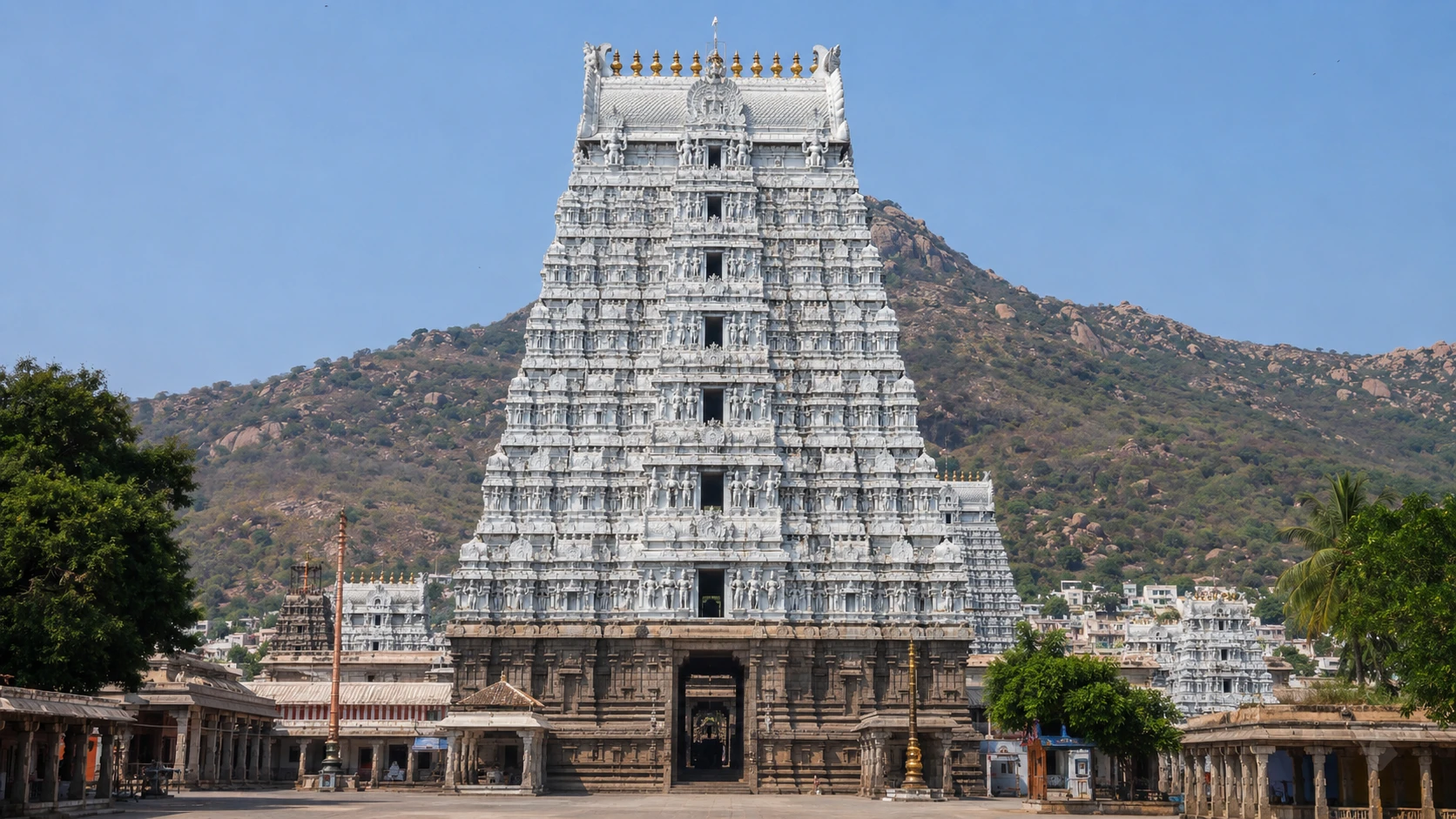
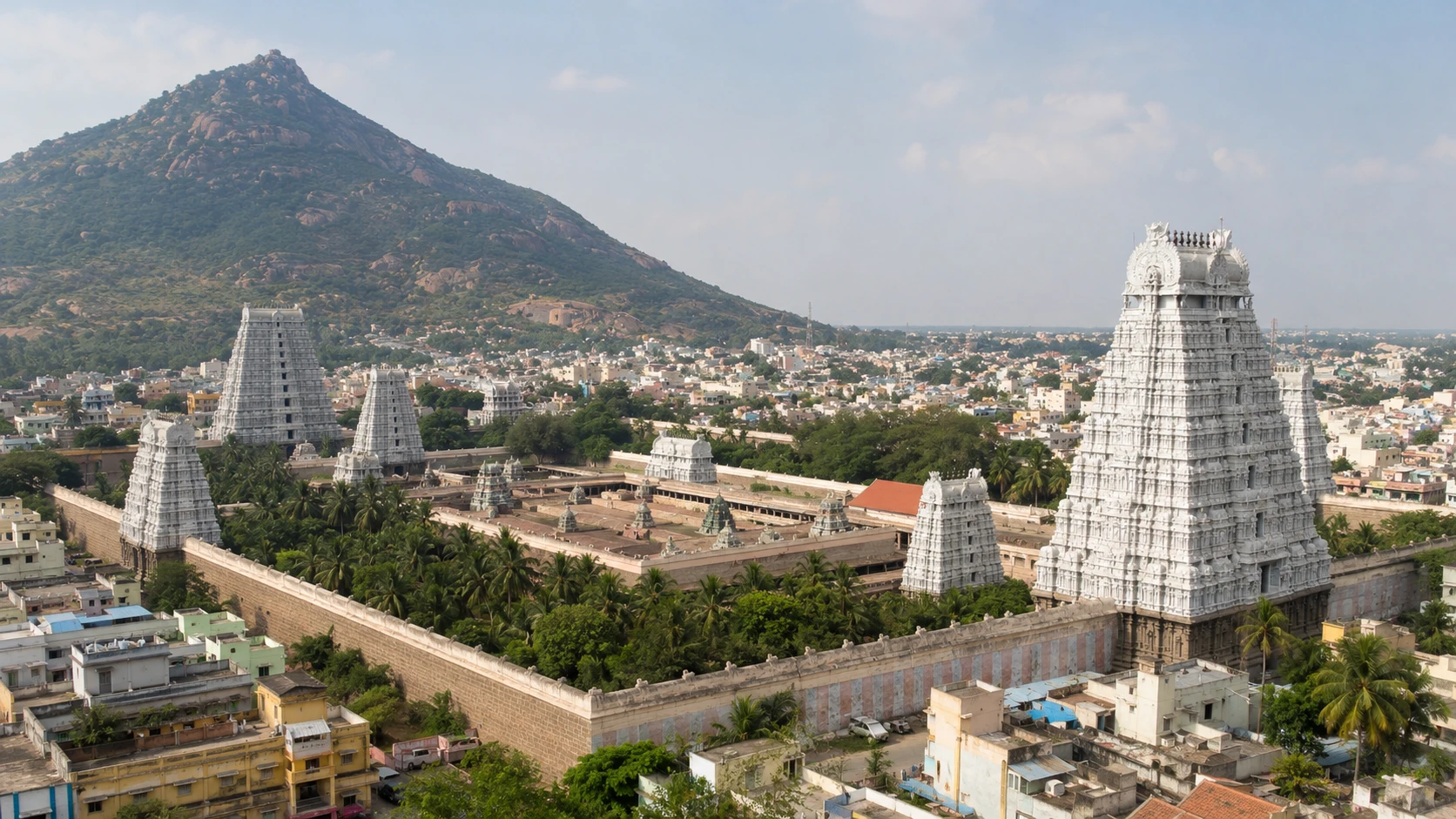
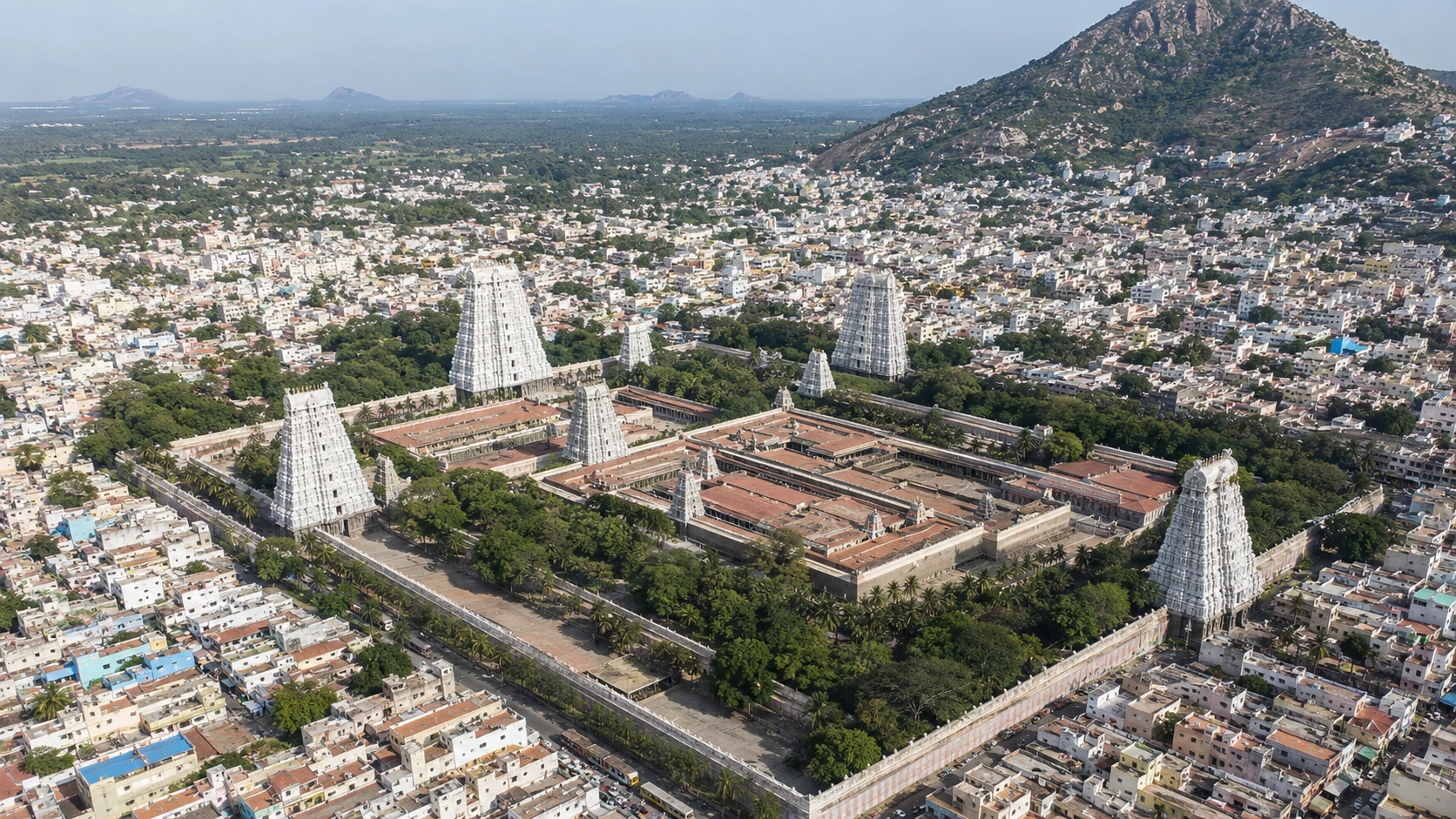
Tamil Drāviḍa (Dravidian) temple-construction style with substantive canonical Pallava-Cōḻa-Pāṇḍya-Vijayanagara-Nāyak architectural elaboration. The canonical Arunachaleswara temple-complex (approximately 25 acres at the canonical eastern foot of the canonical Arunachala mountain) is one of the most architecturally elaborate canonical Tamil Drāviḍa temple-complexes. Distinctive architectural elements include: the canonical principal Rāja-Gōpuram (the canonical Vijayanagara-period eastern entrance gopuram, canonically reaching approximately 66 meters in canonical height, one of the canonical tallest gopurams in pan-India, canonically constructed under canonical Vijayanagara-period patronage in the early 16th century); the canonical four cardinal gopurams (East / Rāja-Gōpuram, West, North, South, each substantively elaborated); the canonical Āyiram Kāl Maṇḍapam (the canonical 1000-Pillared Hall, a substantial canonical pillared hall used for canonical festival processions); the canonical Kambathu Iḷaiyāṉār Maṇḍapam (a substantial canonical pillared hall); the canonical Arunachaleswara Śiva inner sanctum (housing the canonical accessible iconographic register liṅga, with the canonical theological centerpiece being the canonical mountain itself); the canonical Unnamulai Amman / Apītakucāmpāḷ Devī sub-shrine (the canonical principal Devī-consort shrine); the canonical Pātāla-Liṅga subterranean liṅga shrine (canonically distinguished as the canonical meditation-site where Ramana Maharshi famously meditated in deep absorption upon his canonical 1896 arrival at Thiruvannamalai); the canonical Kīḻ Tirumalai Citra Sabhā sub-site (the canonical Pañca Sabhā 'Painting Hall' anchor); the canonical multi-pillared maṇḍapas and sub-shrine infrastructure operating across the canonical temple-precinct envelope; and the canonical Aṣṭa-Liṅga eight-direction shrines distributed across the canonical 14-km Girivalam circumambulation path encircling the canonical mountain (Indra-Liṅga east, Agni-Liṅga south-east, Yama-Liṅga south, Niruti-Liṅga south-west, Varuna-Liṅga west, Vāyu-Liṅga north-west, Kubera-Liṅga north, Iśāna-Liṅga north-east). The temple-complex envelope is sited along the canonical Arunachala mountain's canonical eastern base, with the canonical entrance through the canonical Rāja-Gōpuram leading into the canonical broader temple-complex envelope and the canonical temple-complex backdrop being the canonical Arunachala mountain itself
Open
05:30 – 21:30
Aarti
06:00 · 08:00 · 10:00 · 12:00 · 18:00 · 20:00
Special
The canonical six-kāla daily worship cycle (Ṣaṭ-kāla pūjā) at the Arunachaleswara Temple operates across the canonical daily framework: Suprabhātam / morning awakening worship (approximately 06:00); morning aarati (approximately 08:00); mid-morning worship (approximately 10:00); noon worship (approximately 12:00); evening aarati (approximately 18:00); night-worship (approximately 20:00). The corpus-distinctive Karthikai Deepam Mahā Deepam is the canonical principal annual festival programming centered on the canonical full-moon of Kārttika (November-December), drawing canonical festival peak crowds exceeding 500,000-1,000,000+, one of the canonical largest single-day Hindu pilgrimage events in South India. The canonical Paurṇamī Girivalam (full-moon-night mountain-circumambulation) operates as the canonical principal monthly canonical Girivalam observance, drawing canonical pilgrim flow of approximately 100,000-300,000+ on each canonical full-moon night across the canonical year-round monthly cycle. The canonical Brahmotsavam (10-day annual festival) operates during the canonical Kārttika month framework alongside the canonical Karthikai Deepam culminating peak
The Sacred Legend · पवित्र कथा
The Arunachaleswara Temple at Thiruvannamalai, Tamil Nadu, occupies a structurally singular position within the canonical Pañca Bhūta Sthalam five-elements Tamil Śaiva framework and the broader pan-South-Indian Śaiva temple-tradition framework. The canonical temple-complex (situated at the foot of the canonical sacred mountain Arunachala in Thiruvannamalai town, Thiruvannamalai district, Tamil Nadu, approximately 200 km south-west of Chennai) operates as the canonical co-located anchor for two distinct canonical Tamil Śaiva canonical theological frameworks: (1) the canonical Agni (Fire) Sthalam of the Pañca Bhūta Sthalam framework, the canonical third of the five canonical Tamil Śaiva canonical shrines each embodying one of the five mahābhūta classical elements (Chidambaram = Ākāśa, Srikalahasti = Vāyu, Thiruvannamalai = Agni, Thiruvanaikaval = Apas, Kanchipuram-Ekambareśvara = Pṛthvī); (2) the canonical Citra Sabhā (Painting Hall) of the Pañca Sabhā five-dance-halls framework, the canonical regional Tamil Śaiva canonical dance-hall site (situated at the canonical Kīḻ Tirumalai sub-area within the canonical broader Arunachala-Thiruvannamalai canonical sacred zone) operating as the canonical 'Painting Hall' anchor of the Pañca Sabhā framework alongside Chidambaram (Kanaka Sabhā / Golden Hall principal anchor), Madurai (Velli Ambalam / Rajata Sabhā / Silver Hall), Tirunelveli-Kutralam (Tāmra Sabhā / Copper Hall), and Tiruvalankadu (Ratna Sabhā / Ruby Hall). The site's corpus-distinctive theological-iconographic centerpiece is the canonical Arunachala mountain itself (approximately 2,668 feet / 813 meters in canonical height), canonically held to be the canonical Agni Liṅga embodiment of Śiva, NOT a stone liṅga housed within the canonical inner sanctum, but the canonical entire mountain as the canonical fire-element manifestation of Śiva. The canonical Arunachala-as-liṅga framework is corpus-distinctive within the broader Pañca Bhūta Sthalam framework, the four other Pañca Bhūta Sthalam sites canonically house a canonical liṅga form within the canonical inner sanctum (Chidambaram's Cidambara Rahasyam lingam-less Ākāśa-Liṅga, Srikalahasti's Vāyu Liṅga, Thiruvanaikaval's Apas Liṅga, Kanchipuram-Ekambareśvara's Pṛthvī Liṅga) whereas Thiruvannamalai's canonical Agni Liṅga IS the canonical mountain itself. The canonical Arunachaleswara Temple at the foot of the canonical mountain canonically houses a canonical inner sanctum liṅga as the canonical accessible iconographic register of the canonical Agni Sthalam framework, but the canonical theological centerpiece of the canonical site is the canonical mountain, with the canonical 14-km Girivalam (mountain-circumambulation) operating as the canonical principal pilgrim practice framework, and the canonical Karthikai Deepam Mahā Deepam annual festival operating as the canonical visual demonstration of the canonical mountain's canonical Agni-element identity. The canonical Karthikai Deepam Mahā Deepam, the canonical massive flame canonically lit on the canonical summit of Arunachala on the canonical full-moon night of Kārttika (November-December), uses canonical approximately 2,000-3,000 kg of canonical ghee and canonical wicks, canonically burns continuously for several days, and is canonically visible from approximately 35 km canonical visibility radius on a clear night. The canonical festival draws canonical extraordinary pilgrim flow, exceeding 500,000-1,000,000+ at festival peak, operating as one of the canonical largest single-day Hindu pilgrimage events in South India alongside the canonical Kumbh Melā framework's pan-India scale. The canonical foundational theological narrative, preserved in the canonical Arunachala Māhātmyam section of the Skanda Purāṇa and integrated across the broader canonical Śaiva canonical jyotirliṅga theological framework, records the canonical Brahmā-Viṣṇu agni-stambha narrative: canonical Brahmā and canonical Viṣṇu canonically disputed their relative supremacy; canonical Śiva manifested as a canonical infinite column of fire (the canonical agni-stambha / canonical jyotirliṅga form) and canonically challenged each to find one end of the canonical column; canonical Brahmā in the form of a canonical swan flew canonically upward seeking the canonical top, canonical Viṣṇu in the form of a canonical boar (varāha) dug canonically downward seeking the canonical bottom; neither could find an end; canonical Brahmā falsely claimed to have found the top (citing a canonical falling ketakī flower as canonical false-witness); canonical Viṣṇu honestly admitted defeat; canonical Śiva canonically punished canonical Brahmā (canonical no temple-worship in pan-India) and canonically praised canonical Viṣṇu; canonical Śiva canonically agreed to the canonical fire-column at Arunachala canonically becoming a canonical ordinary mountain so canonical devotees could canonically approach it. The canonical Brahmā-Viṣṇu agni-stambha narrative operates as the canonical foundational theological narrative for the canonical Arunachala site's canonical fire-column origin and the canonical principal Hindu narrative for the canonical relative-ranking of Śiva-Viṣṇu-Brahmā within the canonical Śaiva theological framework. The site is further the canonical principal residence-and-mokṣa-attainment site of Ramana Maharshi (1879, 1950), the canonical 20th-century jñāna-yoga master who canonically resided at the canonical foot of Arunachala for most of his canonical life (1896, 1950) and whose canonical advaita-Vedānta tradition canonically held Arunachala to be the canonical earthly embodiment of the canonical self-Self framework. The canonical Sri Ramanasramam at the canonical foot of the mountain operates as the canonical Ramana legacy site and draws substantial canonical international pilgrim engagement, with the canonical Ramana tradition's canonical 'Who Am I?' (Sanskrit nan yār) ātma-vicāra inquiry method canonically integrating the canonical Arunachala site into the canonical pan-international 20th-21st century advaita-Vedānta tradition framework. The canonical 14-km Girivalam (mountain-circumambulation) sacred-path operates as the canonical principal pilgrim practice framework at the canonical site, canonically performed barefoot, with the canonical 14-km path canonically incorporating the canonical Aṣṭa-Liṅga (eight-direction liṅga) shrines at canonical eight cardinal points around the canonical mountain corresponding to the canonical eight dik-pāla guardian-deity framework (Indra-east, Agni-south-east, Yama-south, Niruti-south-west, Varuna-west, Vāyu-north-west, Kubera-north, Iśāna-north-east). The canonical Paurṇamī Girivalam (full-moon-night canonical circumambulation) operates as the canonical principal monthly canonical Girivalam observance, drawing substantial canonical year-round monthly pilgrim flow alongside the canonical Karthikai Deepam annual peak. The site operates as the third Tier A entry of the Eternal Raga Pañca Bhūta Sthalam sweep with the corpus-distinctive integrated five-framework convergence (Agni Sthalam + Citra Sabhā + Mountain-as-Liṅga + Brahmā-Viṣṇu jyotirliṅga foundational narrative + Ramana Maharshi modern advaita-Vedānta tradition).
Sacred Designationपवित्र पदनाम
Pancha Bhoota
Element: fire
Sacred Origin Storyपवित्र उत्पत्ति कथा
Source: Arunachala Māhātmyam section of the Skanda Purāṇa (canonical Sanskrit Sthala Purāṇa of Thiruvannamalai-Arunachala preserving the canonical Brahmā-Viṣṇu agni-stambha narrative and the canonical Arunachala-as-Agni-Liṅga theological framework); canonical Tēvāram corpus (canonical hymns of Tirunāvukkaracar / Appar, Tiruñāṉacampantar / Sambandar, and Cuntarar / Sundaramūrti on the canonical 'Tiruvaṇṇāmalai' Tamil Śaiva tradition); regional Tamil Śaiva canonical literature on Arunachala including the canonical Aruṇagiri Nāthar's canonical Tiruppukaḻ corpus celebrating the canonical Subramaṇya tradition with Arunachala canonical context; the canonical Arunachala Akṣara Maṇa Mālai of Ramana Maharshi (the canonical 'Garland of Letters in Praise of Arunachala,' canonical 108-verse Tamil poetic-devotional work by Ramana Maharshi); the canonical Pallava-Cōḻa-Vijayanagara-Nāyak inscriptional record
The canonical Arunachala Māhātmyam section of the Skanda Purāṇa preserves the canonical Arunachala theological narrative as the integrated Brahmā-Viṣṇu agni-stambha narrative culminating in the canonical Arunachala mountain's canonical Agni Liṅga manifestation.
The canonical narrative records that canonical Brahmā (the canonical creator-deity of the canonical Trimūrti framework) and canonical Viṣṇu (the canonical preserver-deity of the canonical Trimūrti framework) canonically disputed their relative supremacy.
Their canonical dispute escalated to a canonical irreconcilable confrontation, prompting canonical Śiva (the canonical transformer-deity of the canonical Trimūrti framework) to canonically intervene. Canonical Śiva manifested as a canonical infinite column of fire (the canonical agni-stambha, the canonical 'fire-pillar,' a canonical jyotirliṅga form of Śiva integrating the canonical fire-element with the canonical liṅga theological framework) extending canonically from the canonical earth to the canonical infinite heavens with the canonical column's canonical top and canonical bottom both vanishing into the canonical infinite.
Canonical Śiva canonically challenged each deity to find one end of the canonical column: whoever could canonically locate the canonical top or the canonical bottom of the canonical agni-stambha would be canonically established as the canonical supreme of the canonical disputants.
Canonical Brahmā canonically transformed into a canonical haṃsa (canonical swan) and canonically flew canonically upward seeking the canonical top of the canonical column. Canonical Viṣṇu canonically transformed into a canonical varāha (canonical boar) and canonically dug canonically downward seeking the canonical bottom of the canonical column.
Both canonically traveled across canonical immense distances and canonical immense time-periods seeking the canonical ends, but the canonical agni-stambha was canonically infinite and neither could canonically find an end.
Canonical Brahmā, returning from his canonical futile search and unwilling to admit the canonical failure, canonically encountered a canonical falling ketakī flower (the canonical screwpine flower) and canonically conspired with the canonical flower to falsely claim that canonical Brahmā had reached the canonical top of the canonical column and that the canonical ketakī flower had canonically fallen from the canonical top, thus canonically lying to canonical Śiva.
Canonical Viṣṇu, returning from his canonical futile search, canonically honestly admitted his canonical inability to find the canonical bottom and canonically acknowledged canonical Śiva's canonical supremacy. Canonical Śiva, canonically perceiving canonical Brahmā's canonical falsehood, manifested from the canonical agni-stambha in his canonical anthropomorphic form.
Canonical Śiva canonically punished canonical Brahmā: (1) canonical no temple-worship in pan-India was to be canonically directed to canonical Brahmā (the canonical foundational theological framework for the canonical near-absence of canonical Brahmā-dedicated temples in canonical pan-India, with the canonical Puṣkara temple in Rajasthan operating as the canonical principal exception); (2) the canonical ketakī flower was canonically banned from canonical Śaiva worship offerings.
Canonical Śiva canonically praised canonical Viṣṇu and canonically established the canonical narrative as the canonical foundational Śaiva theological framework for the canonical relative-ranking of Śiva-Viṣṇu-Brahmā. Canonical Śiva canonically agreed to the canonical fire-column at Arunachala canonically becoming a canonical ordinary mountain so that canonical devotees could canonically approach it, the canonical agni-stambha canonically densifying into the canonical Arunachala mountain (the canonical 'Aruṇagiri,' the canonical 'Red Mountain,' the canonical name reflecting the canonical mountain's canonical reddish hue particularly at canonical dawn and dusk, which canonically preserves the canonical residual canonical fire-element coloration).
The canonical mountain is thus canonically held to be the canonical Agni Liṅga embodiment of Śiva, the canonical entire mountain as the canonical fire-element manifestation, with the canonical mountain's canonical fire-element identity canonically demonstrated annually through the canonical Karthikai Deepam Mahā Deepam summit-flame on the canonical full-moon of Kārttika.
The canonical narrative operates as the canonical foundational theological framework for: (1) the canonical Arunachala mountain's canonical Agni Liṅga status; (2) the canonical Pañca Bhūta Sthalam framework's canonical Agni Sthalam designation; (3) the canonical Śaiva tradition's canonical relative-ranking of Śiva-Viṣṇu-Brahmā; (4) the canonical Karthikai Deepam annual festival's canonical theological anchor.
The canonical narrative is preserved in the canonical Skanda Purāṇa's Arunachala Māhātmyam section and is canonically referenced across the broader canonical Śaiva canonical jyotirliṅga theological framework and the canonical Tamil Śaiva canonical Tēvāram corpus.
Sources cited:
- Skanda Purāṇa, Arunachala Māhātmyam section (canonical Sanskrit Sthala Purāṇa of Thiruvannamalai-Arunachala)
- Tēvāram corpus, canonical hymns of Tirunāvukkaracar / Appar, Tiruñāṉacampantar / Sambandar, and Cuntarar / Sundaramūrti on the canonical Tiruvaṇṇāmalai Tamil Śaiva tradition
- Regional Tamil Śaiva canonical literature on Arunachala
- Aruṇagiri Nāthar, Tiruppukaḻ corpus
- Ramana Maharshi, Arunachala Akṣara Maṇa Mālai (canonical 108-verse Tamil poetic-devotional work)
- Pallava-Cōḻa-Vijayanagara-Nāyak inscriptional record at the canonical Arunachaleswara Temple
- Peterson, Indira Viswanathan, 'Poems to Siva: The Hymns of the Tamil Saints' (Princeton University Press, 1989)
- Shulman, David Dean, 'Tamil Temple Myths' (Princeton University Press, 1980)
- Brunton, Paul, 'A Search in Secret India' (1934)
- Osborne, Arthur, 'Ramana Maharshi and the Path of Self-Knowledge' (Rider, 1954)
Other Traditions · अन्य परंपराएँ
Ramana Maharshi canonical modern advaita-Vedānta tradition narrative, canonical 20th-century jñāna-yoga residence-and-attainment framework
The canonical Ramana Maharshi narrative at Arunachala operates as the canonical modern advaita-Vedānta tradition's canonical principal residence-and-attainment narrative integrated with the canonical primary Brahmā-Viṣṇu agni-stambha narrative.
Ramana Maharshi, born Venkataraman Iyer in 1879 in Tiruchuli, Tamil Nadu, canonically experienced a canonical spontaneous death-experience at age 16 in 1896 that canonically catalyzed his canonical realization of the canonical ātman-Brahman identity per the canonical advaita-Vedānta tradition.
Following the canonical death-experience, the canonical 16-year-old Ramana canonically left his canonical home in Madurai and canonically traveled directly to Arunachala (Thiruvannamalai), having canonically been spiritually drawn to the canonical mountain through the canonical mountain's canonical reputation in the canonical Tamil Śaiva tradition as the canonical Agni Liṅga embodiment.
Ramana canonically arrived at Arunachala in September 1896 and canonically remained at the canonical site for the canonical remainder of his canonical life, approximately 54 years until his canonical death (mahā-nirvāṇa) in April 1950, never canonically leaving Arunachala throughout his canonical life.
Ramana canonically resided initially at the canonical Pātāla-Liṅga subterranean liṅga shrine within the canonical Arunachaleswara temple-complex, where he canonically meditated in canonical deep absorption (canonical sahaja samādhi) for canonical extended periods (the canonical narrative records that canonical insects canonically bit Ramana's canonical legs during this canonical period, and canonical Ramana canonically did not respond, reflecting the canonical depth of his canonical absorption).
Ramana subsequently canonically moved to various canonical sites on the canonical Arunachala mountain, including the canonical Skandāśrama on the canonical mountain's canonical eastern face. The canonical Sri Ramanasramam was canonically established at the canonical foot of the canonical mountain's canonical southern face in approximately 1922 and operates as the canonical Ramana legacy site.
Ramana's canonical advaita-Vedānta tradition canonically held Arunachala to be the canonical earthly embodiment of the canonical self-Self framework, with the canonical mountain canonically operating as the canonical 'Heart' of the canonical advaita-Vedānta realization framework.
Ramana's canonical 'Who Am I?' (Tamil 'Nāṉ yār?', the canonical ātma-vicāra method) operates as the canonical principal jñāna-yoga method canonically transmitted through the Ramana tradition, integrating the canonical advaita-Vedānta inquiry tradition with the canonical Arunachala site.
Ramana canonically composed canonical Tamil poetic-devotional works during his canonical Arunachala residence, particularly the canonical Arunachala Akṣara Maṇa Mālai ('Garland of Letters in Praise of Arunachala,' canonical 108-verse Tamil work) and the canonical Arunachala Pañcaratnam ('Five Gems of Arunachala,' canonical Sanskrit and Tamil works).
The Ramana tradition canonically attracted substantial canonical Western pilgrim engagement during the 20th century, including canonical Paul Brunton (whose canonical 1934 'A Search in Secret India' canonically introduced Ramana to Western audiences), canonical W.
Somerset Maugham (whose canonical 'The Razor's Edge' canonical novel canonically incorporates Ramana-inspired characters), and canonical Carl Jung. The Ramana tradition's canonical international engagement canonically operates as the canonical Arunachala site's canonical principal 20th-21st century cross-cultural devotional engagement framework, with substantial canonical contemporary pan-international pilgrim flow drawn through the Ramana tradition's canonical advaita-Vedānta theological framework.
Pañca Bhūta Sthalam canonical framework integration narrative, Tamil Śaiva five-elements framework integration narrative
The canonical Pañca Bhūta Sthalam framework integration at Thiruvannamalai-Arunachala operates through the canonical Agni (Fire) Sthalam designation that integrates Thiruvannamalai as the canonical third of the five canonical Tamil Śaiva canonical shrines each embodying one of the five mahābhūta classical elements (Chidambaram Ākāśa + Srikalahasti Vāyu + Thiruvannamalai Agni + Thiruvanaikaval Apas + Kanchipuram-Ekambareśvara Pṛthvī).
The canonical Arunachala-as-Agni-Liṅga framework is corpus-distinctive within the broader Pañca Bhūta Sthalam framework, Thiruvannamalai is the only one of the five Pañca Bhūta Sthalam sites where the canonical elemental-liṅga is canonically the canonical entire mountain itself (the other four sites canonically house a canonical liṅga form within the canonical inner sanctum).
The canonical Karthikai Deepam Mahā Deepam annual festival operates as the canonical visual demonstration of the canonical mountain's canonical Agni-element identity, with the canonical 2,000-3,000 kg ghee summit-flame canonically visible from approximately 35 km canonical visibility radius.
The canonical 14-km Girivalam (mountain-circumambulation) operates as the canonical principal pilgrim practice framework directly engaging the canonical Arunachala-as-Agni-Liṅga framework, the canonical Girivalam path canonically integrating the canonical Aṣṭa-Liṅga eight-direction shrines (Indra-east, Agni-south-east, Yama-south, Niruti-south-west, Varuna-west, Vāyu-north-west, Kubera-north, Iśāna-north-east) operating as the canonical eight dik-pāla guardian-deity framework anchored to the canonical mountain.
The Pañca Bhūta Sthalam framework integration at Thiruvannamalai is canonically devotionally compatible with the primary Brahmā-Viṣṇu agni-stambha narrative.
Pañca Sabhā Citra Sabhā integration narrative, canonical Tamil Śaiva canonical 'Painting Hall' framework integration
The canonical Pañca Sabhā Citra Sabhā integration at Thiruvannamalai-Arunachala operates through the canonical Citra Sabhā (Painting Hall) designation that integrates the canonical broader Arunachala-Thiruvannamalai sacred zone as the canonical regional Tamil Śaiva canonical 'Painting Hall' anchor of the Pañca Sabhā framework.
The canonical Citra Sabhā is canonically situated at the canonical Kīḻ Tirumalai sub-area within the canonical broader Arunachala-Thiruvannamalai canonical sacred zone (distinct from the canonical principal Arunachaleswara temple-complex), with the canonical 'painting hall' name reflecting the canonical wall-paintings canonically depicting Śiva-Naṭarāja in the canonical dance forms canonically held to have been performed there.
The canonical Pañca Sabhā framework's canonical regional theological literature integrates the canonical Citra Sabhā with the broader canonical Tamil Śaiva canonical Naṭarāja iconographic-theological framework anchored at Chidambaram (Kanaka Sabhā / Ānanda Tāṇḍava).
The canonical Pañca Sabhā pilgrim-circuit canonical Tamil Śaiva canonical regional pilgrim-circuit operates with Chidambaram as the canonical principal anchor and the four ancillary canonical dance-hall sites (Madurai Velli Ambalam / Rajata Sabhā, Tirunelveli-Kutralam Tāmra Sabhā, Tiruvalankadu Ratna Sabhā, Tiruvannamalai Citra Sabhā) canonically integrated with the canonical Chidambaram anchor.
The corpus documents Thiruvannamalai's canonical dual designation as both the canonical Pañca Bhūta Sthalam Agni Sthalam (the canonical PBS Agni-element anchor) AND the canonical Pañca Sabhā Citra Sabhā (the canonical 'Painting Hall' anchor), the canonical dual-framework anchoring operating as a corpus-distinctive integrated theological-iconographic register, integrating with the canonical Chidambaram parallel pattern (where Chidambaram operates as both Pañca Bhūta Sthalam Ākāśa Sthalam AND Pañca Sabhā Kanaka Sabhā principal anchor).
Scholarly Context
The Arunachaleswara Temple at Thiruvannamalai occupies a structurally singular position in the corpus and is the third Tier A entry of the Eternal Raga Pañca Bhūta Sthalam sweep. The canonical theological framework operates through the integrated five-framework convergence: (1) the canonical Agni (Fire) Sthalam of the Pañca Bhūta Sthalam framework, with the corpus-distinctive Arunachala-mountain-as-Agni-Liṅga theological framework where the canonical entire mountain (approximately 813 meters in canonical height) is canonically the canonical Agni-element manifestation of Śiva rather than a stone liṅga housed within a canonical inner sanctum; (2) the canonical Citra Sabhā (Painting Hall) of the Pañca Sabhā framework, with the canonical Kīḻ Tirumalai sub-site operating as the canonical regional Tamil Śaiva canonical 'Painting Hall' anchor; (3) the canonical Brahmā-Viṣṇu agni-stambha jyotirliṅga foundational narrative integrating the canonical Arunachala site into the canonical broader Śaiva canonical jyotirliṅga theological framework while operating as the canonical foundational Śaiva theological framework for the canonical relative-ranking of Śiva-Viṣṇu-Brahmā and the canonical near-absence of canonical Brahmā-dedicated temples in canonical pan-India; (4) the canonical 14-km Girivalam (mountain-circumambulation) sacred-path canonical principal pilgrim practice framework with the canonical Aṣṭa-Liṅga eight-direction shrines anchored to the canonical mountain; (5) the canonical Ramana Maharshi (1879, 1950) modern advaita-Vedānta tradition's canonical principal residence-and-attainment site with the canonical Sri Ramanasramam operating as the canonical Ramana legacy site drawing substantial canonical pan-international pilgrim engagement. The site's historical depth, substantive canonical Tēvāram corpus attestation (6th, 9th c. CE), canonical Pallava-Cōḻa foundational construction, canonical Cōḻa-period (10th, 11th c.) elaboration, canonical Pāṇḍya-period subsequent patronage, canonical Vijayanagara-period major elaboration with the canonical Rāja-Gōpuram construction (16th c.) reaching approximately 66 meters in canonical height (one of the canonical tallest gopurams in pan-India), canonical Nāyak-period elaboration, canonical British colonial period administrative arrangements, the canonical 1896, 1950 Ramana Maharshi residence period (the canonical modern advaita-Vedānta tradition's foundational anchor), and the canonical post-Independence canonical Tamil Nadu HR&CE administrative framework, operates within the broader pan-Tamil-regional historical framework documented through Stein 1980/1989, Nilakanta Sastri 1955, Peterson 1989, Shulman 1980, and the broader canonical modern Ramana Maharshi scholarly framework (Brunton 1934, Osborne 1954, Godman 1985, Mahadevan 1977). The corpus documents the site as a Tier A canonical Pañca Bhūta Sthalam + Pañca Sabhā dual-anchor entry within the Phase 4 Pañca Bhūta Sthalam sweep, with the canonical integrated five-framework convergence (Agni Sthalam + Citra Sabhā + Mountain-as-Liṅga + Brahmā-Viṣṇu jyotirliṅga foundational narrative + Ramana Maharshi modern advaita-Vedānta tradition) operating as the canonical theological-historical-iconographic-operational framework documented within the corpus's editorial framework. Three alternate accounts are surfaced under the mythology section: (1) the canonical Ramana Maharshi canonical modern advaita-Vedānta tradition narrative; (2) the canonical Pañca Bhūta Sthalam framework integration narrative; and (3) the canonical Pañca Sabhā Citra Sabhā integration narrative. All three alternate accounts are canonically devotionally compatible with the primary Brahmā-Viṣṇu agni-stambha narrative framework.
Historyइतिहास
Thiruvannamalai's historical depth as a sacred site integrates with the broader canonical northern Tamil Nadu canonical Śaiva temple-tradition heartland historical framework and the canonical modern advaita-Vedānta tradition framework.
The pre-canonical layer preserves indirect canonical Sangam-era references to the canonical Arunachala canonical Tamil cultural-religious infrastructure, though the canonical Sangam-era literary record does not preserve substantive direct attestation of the canonical Arunachaleswara temple itself.
The substantive canonical Thiruvannamalai temple-tradition historical attestation commences in the canonical Tēvāram corpus (c. 6th, 9th centuries CE), the canonical hymns of Tirunāvukkaracar / Appar (c. 7th c. CE), Tiruñāṉacampantar / Sambandar (c. 7th c. CE), and Cuntarar / Sundaramūrti (c. 8th, 9th c.
CE), the canonical first three of the canonical 63 Nāyaṉmārs, preserve the canonical earliest substantive Tamil Śaiva poetic-devotional attestation of the canonical Tiruvaṇṇāmalai canonical Tamil Śaiva tradition. The foundational canonical Pallava-period and canonical Cōḻa-period (9th, 13th centuries) architectural patronage operates as the canonical principal early architectural anchor of the canonical Arunachaleswara Temple, with the canonical Cōḻa dynasty's canonical Tamil Śaiva temple-tradition patronage program canonically extending substantive elaboration to the canonical Arunachala site within the broader canonical Cōḻa-period pan-Tamil canonical Śaiva temple-tradition framework.
The canonical Cōḻa-period inscriptional record at Arunachala documents the canonical Cōḻa dynasty's canonical patronage including canonical liturgical infrastructure development, canonical sub-shrine elaboration, and the canonical foundational architectural-iconographic register that would receive subsequent canonical Pāṇḍya-, Vijayanagara-, and Nāyak-period elaboration.
The canonical Pāṇḍya dynasty patronage period continued canonical patronage. The canonical Vijayanagara empire-era (mid-14th c. CE onwards) brought the most substantive canonical architectural elaboration at the canonical Arunachaleswara Temple.
The canonical principal Rāja-Gōpuram (the canonical eastern entrance gopuram) was canonically constructed under canonical Vijayanagara-period patronage in the early 16th century, reaching approximately 66 meters in canonical height, one of the canonical tallest gopurams in pan-India and a canonical architectural anchor that has continued to canonical present day.
The canonical Rāja-Gōpuram's canonical Vijayanagara-period architectural register integrates the canonical canonical pan-Tamil Vijayanagara empire-era canonical Śaiva temple-tradition canonical architectural framework. The canonical Nāyak dynasty (16th, 17th centuries) continued canonical architectural-devotional infrastructure development at the canonical Arunachaleswara Temple.
The canonical British colonial period (1801 onwards) brought the canonical temple-complex into the colonial administrative arrangements as part of the canonical Madras Presidency. The canonical Pōst-Independence period (1947, present) placed the canonical Arunachaleswara Temple within the canonical Madras State and subsequently canonical Tamil Nadu state framework, with the canonical contemporary administrative arrangements operating under the canonical Tamil Nadu Hindu Religious and Charitable Endowments Department (HR&CE) since the canonical 1959 Tamil Nadu HR&CE Act framework.
The canonical contemporary canonical Arunachaleswara Temple administration coordinates the canonical six-kāla daily worship cycle, the canonical Karthikai Deepam annual festival, the canonical Brahmotsavam annual festival cycle, the canonical Paurṇamī Girivalam monthly observance, and the broader canonical Tamil Śaiva festival cycle.
The canonical 20th century brought a canonical foundational additional historical layer at Arunachala through the canonical 1896, 1950 Ramana Maharshi residence period. Ramana Maharshi (born Venkataraman Iyer, 1879) canonically arrived at Arunachala in September 1896 at age 16 following his canonical death-experience and canonical realization of the canonical ātman-Brahman identity per the canonical advaita-Vedānta tradition.
Ramana canonically resided at Arunachala continuously until his canonical mahā-nirvāṇa in April 1950, never canonically leaving the site for approximately 54 years. The canonical Sri Ramanasramam was canonically established at the canonical foot of the canonical mountain's canonical southern face in approximately 1922 (the canonical building's canonical formal expansion occurred over several decades), with the canonical asram operating as the canonical Ramana legacy site since Ramana's canonical 1950 mahā-nirvāṇa.
The Ramana tradition's canonical international engagement during the 20th century brought substantial canonical Western pilgrim flow to Arunachala, integrating the canonical site into the canonical pan-international 20th-21st century advaita-Vedānta tradition framework.
The canonical Ramana Maharshi modern advaita-Vedānta tradition's residence-and-attainment at Arunachala operates as the canonical principal modern-era theological-spiritual anchor of the canonical site, integrated alongside the canonical broader Pañca Bhūta Sthalam + Pañca Sabhā + jyotirliṅga foundational narrative framework.
The temple draws canonical pilgrim flow exceeding 10,000, 30,000 daily on average and substantially higher festival-period crowds (the canonical Karthikai Deepam Mahā Deepam festival peak crowds canonically exceeding 500,000-1,000,000+, the canonical Paurṇamī Girivalam monthly full-moon peaks canonically exceeding 100,000-300,000+, the canonical Brahmotsavam festival cycle drawing substantial pan-South-Indian pilgrim engagement), making the Arunachaleswara Temple one of the most-visited canonical Tamil Śaiva temple sites in South India and a substantively-significant canonical cultural-religious destination within the broader pan-Indian Hindu temple-tradition framework.
The Ramana Maharshi tradition's canonical pan-international pilgrim engagement contributes substantial additional canonical Western and pan-international visitor flow to the canonical Sri Ramanasramam alongside the canonical Tamil Śaiva traditional pilgrim flow to the canonical Arunachaleswara Temple, with substantial canonical year-round pilgrim engagement profile distinct from the canonical festival-period-peaked pilgrim flow profile of most other major canonical South Indian Hindu temples.
Historical Timelineऐतिहासिक कालक्रम
Canonical Tēvāram corpus attestation of the canonical Tiruvaṇṇāmalai canonical Tamil Śaiva tradition. The canonical hymns of Tirunāvukkaracar / Appar (c. 7th c. CE), Tiruñāṉacampantar / Sambandar (c. 7th c. CE), and Cuntarar / Sundaramūrti (c. 8th, 9th c. CE), the canonical first three of the canonical 63 Nāyaṉmārs, canonically sang of the canonical Tiruvaṇṇāmalai canonical Tamil Śaiva tradition, preserving the canonical earliest substantive Tamil Śaiva poetic-devotional attestation of the canonical Arunachala site and integrating the canonical site into the canonical Pāḍal-Peṟṟa Sthalam canonical pilgrimage framework. The canonical Tēvāram corpus's canonical Tiruvaṇṇāmalai canonical hymns operate as the canonical foundational textual anchor for the canonical Arunachala canonical Tamil Śaiva tradition.
Foundational canonical Pallava-period and canonical Cōḻa-period architectural patronage at the canonical Arunachaleswara Temple. The canonical Pallava dynasty (5th, 9th centuries) and canonical Cōḻa dynasty (9th, 13th centuries) canonically extended substantive canonical architectural infrastructure to the canonical Arunachala site as part of the broader canonical Pallava-Cōḻa-period pan-Tamil canonical Śaiva temple-tradition canonical regional patronage program. The canonical Cōḻa-period (10th, 11th centuries) brought substantive canonical elaboration including canonical liturgical infrastructure development, canonical sub-shrine elaboration, and the canonical foundational architectural-iconographic register that would receive subsequent canonical Pāṇḍya-, Vijayanagara-, and Nāyak-period elaboration. The canonical Cōḻa-period inscriptional record at Arunachala documents the canonical Cōḻa dynasty's canonical patronage of the canonical site alongside the canonical broader Cōḻa-period Tamil Śaiva temple-tradition canonical infrastructure framework.
Canonical Vijayanagara empire-era major elaboration at the canonical Arunachaleswara Temple with the canonical principal Rāja-Gōpuram construction. The canonical Vijayanagara dynasty (canonical Tuluva dynasty period, including emperor Kṛṣṇadevarāya 1509, 1529 CE and his canonical successors) canonically extended substantive architectural patronage to Arunachala including the canonical construction of the canonical principal Rāja-Gōpuram (the canonical eastern entrance gopuram) reaching approximately 66 meters in canonical height, one of the canonical tallest gopurams in pan-India. The canonical Vijayanagara-period architectural elaboration integrates the canonical pan-Tamil Vijayanagara empire-era canonical Śaiva temple-tradition canonical architectural framework, with the canonical Rāja-Gōpuram operating as one of the canonical principal architectural anchors of the canonical site. The canonical Vijayanagara-period inscriptional record at Arunachala documents the canonical dynasty's canonical patronage program at the canonical site within the broader canonical Vijayanagara empire-era pan-Tamil canonical Śaiva temple-tradition canonical infrastructure development.
Canonical Nāyak dynasty patronage and canonical British colonial period administrative arrangements at Arunachala. The canonical Nāyak dynasty (16th, 17th centuries) continued canonical architectural-devotional infrastructure development at the canonical Arunachaleswara Temple, with the canonical multi-pillared maṇḍapa infrastructure and the broader canonical temple-precinct elaboration operating across the canonical Nāyak-period framework. The canonical British colonial period (1801 onwards) brought the canonical temple-complex into the colonial administrative arrangements as part of the canonical Madras Presidency, with the canonical Madras Government Hindu Religious Endowments framework (the canonical precursor to the canonical post-Independence Tamil Nadu HR&CE Act framework) operating as the canonical administrative anchor. The canonical Arunachala canonical Tamil Śaiva tradition operations continued throughout the canonical colonial period with the canonical Tamil Śaiva canonical liturgical framework canonically preserved.
Canonical Ramana Maharshi arrival at Arunachala. Venkataraman Iyer (subsequently Ramana Maharshi, 1879, 1950) canonically experienced a canonical spontaneous death-experience at age 16 in his canonical Madurai home in July 1896, canonically catalyzing his canonical realization of the canonical ātman-Brahman identity per the canonical advaita-Vedānta tradition. Following the canonical death-experience and canonical realization, the canonical 16-year-old Ramana canonically left his canonical Madurai home and canonically traveled directly to Arunachala (Thiruvannamalai), canonically having been spiritually drawn to the canonical mountain through the canonical mountain's canonical reputation in the canonical Tamil Śaiva tradition as the canonical Agni Liṅga embodiment. Ramana canonically arrived at Arunachala in September 1896 and canonically resided at the canonical Pātāla-Liṅga subterranean liṅga shrine within the canonical Arunachaleswara temple-complex, where he canonically meditated in canonical deep absorption (canonical sahaja samādhi) for canonical extended periods. The canonical 1896 arrival operates as the canonical foundational event of the canonical modern advaita-Vedānta tradition's canonical Arunachala anchor.
Canonical Sri Ramanasramam establishment at the canonical foot of the canonical Arunachala mountain's canonical southern face. The canonical Sri Ramanasramam was canonically established around 1922 (with the canonical formal expansion occurring over several subsequent decades) and operates as the canonical Ramana Maharshi residence-and-attainment site. The canonical asram canonically housed Ramana Maharshi from approximately 1922 through his canonical 1950 mahā-nirvāṇa and operates as the canonical Ramana legacy site since Ramana's canonical 1950 death. The canonical asram canonically operates as the canonical principal Ramana tradition canonical liturgical-administrative anchor and draws substantial canonical pan-international pilgrim engagement through the canonical Ramana tradition's canonical advaita-Vedānta theological framework.
Canonical Ramana Maharshi mahā-nirvāṇa on 14 April 1950 at the canonical Sri Ramanasramam. Ramana Maharshi canonically experienced his canonical mahā-nirvāṇa (canonical 'great-liberation,' the canonical death-event canonically interpreted in the canonical advaita-Vedānta tradition as the canonical jīvanmukta's canonical final mokṣa-attainment) on 14 April 1950 at the canonical Sri Ramanasramam after canonical 54 years of canonical continuous Arunachala residence (1896, 1950). Ramana's canonical mahā-nirvāṇa was canonically marked by the canonical reported appearance of a canonical luminous meteor that canonically traveled across the sky and canonically merged into the canonical Arunachala mountain at the canonical moment of his canonical death, a canonical phenomenon canonically witnessed by multiple canonical observers across the canonical surrounding regional zone, including canonical contemporary news media reporting from across India. The canonical mahā-nirvāṇa operates as the canonical foundational event of the canonical post-Ramana modern advaita-Vedānta tradition framework. The canonical Ramana tradition has continued canonical operations under the canonical Sri Ramanasramam administrative framework following the canonical mahā-nirvāṇa, with the canonical Ramana legacy site operating as the canonical principal modern advaita-Vedānta tradition's canonical pan-international pilgrim engagement anchor.
Canonical Tamil Nadu Hindu Religious and Charitable Endowments Department (HR&CE) administrative framework at the canonical Arunachaleswara Temple. The canonical 1959 Tamil Nadu HR&CE Act framework canonically established the canonical contemporary administrative arrangements at the canonical Arunachaleswara Temple as part of the canonical Tamil Nadu HR&CE administrative framework operating at most major canonical Tamil Nadu canonical Hindu temple-complexes. The canonical HR&CE administration coordinates the canonical six-kāla daily worship cycle, the canonical Karthikai Deepam annual festival, the canonical Brahmotsavam annual festival cycle, the canonical Paurṇamī Girivalam monthly observance, and the broader canonical Tamil Śaiva festival cycle at the canonical site.
Contemporary canonical Tamil Nadu HR&CE administrative framework at the canonical Arunachaleswara Temple alongside canonical Sri Ramanasramam continuation. The canonical Tamil Nadu HR&CE Department continues canonical temple operations under the canonical post-Independence administrative framework. The 21st century has brought substantial canonical infrastructure improvements including: coordinated canonical pilgrim management during the canonical Karthikai Deepam Mahā Deepam festival (November-December, drawing canonical festival peak crowds exceeding 500,000-1,000,000+); coordinated canonical Paurṇamī Girivalam monthly observance infrastructure with canonical security and pilgrim-flow management on the canonical 14-km Girivalam path; coordinated canonical Aṣṭa-Liṅga eight-direction shrine maintenance infrastructure; expanded canonical Brahmotsavam festival cycle programming. The canonical Sri Ramanasramam continues operations as the canonical Ramana legacy site, with substantial canonical pan-international pilgrim engagement drawn through the canonical Ramana tradition's canonical advaita-Vedānta theological framework. The canonical Ramana tradition's canonical international engagement during the 20th-21st century brought substantial canonical Western pilgrim flow to Arunachala, integrating the canonical site into the canonical pan-international 20th-21st century advaita-Vedānta tradition framework. The canonical temple's substantial year-round pilgrim flow (10,000, 30,000 daily average, substantially higher festival-period crowds including the canonical Karthikai Deepam peak exceeding 500,000-1,000,000+ and the canonical Paurṇamī Girivalam monthly full-moon peaks exceeding 100,000-300,000+) requires coordinated canonical pilgrim management infrastructure operating across the canonical daily liturgical cycle and the canonical Girivalam circumambulation framework.
What You'll Seeदर्शन में
The Arunachaleswara Temple at Thiruvannamalai preserves the corpus-distinctive integrated iconographic register, the canonical Arunachala-mountain-as-Agni-Liṅga theological centerpiece + canonical Arunachaleswara inner-sanctum accessible iconographic register liṅga + canonical Unnamulai Amman / Apītakucāmpāḷ Devī consort shrine + canonical Pātāla-Liṅga subterranean liṅga shrine + canonical Aṣṭa-Liṅga eight-direction Girivalam-path shrines + canonical Kīḻ Tirumalai Citra Sabhā Pañca Sabhā 'Painting Hall' sub-site + canonical Vijayanagara-period Rāja-Gōpuram.
The principal Arunachaleswara inner sanctum at the foot of the canonical Arunachala mountain canonically houses the canonical accessible iconographic register liṅga, the canonical stone liṅga form within the canonical inner sanctum that operates as the canonical pilgrim-accessible iconographic anchor of the canonical Agni Sthalam framework.
However, the canonical theological centerpiece of the canonical site is NOT this inner-sanctum liṅga but the canonical Arunachala mountain itself (approximately 813 meters in canonical height), canonically held to be the canonical Agni Liṅga embodiment of Śiva, with the canonical entire mountain operating as the canonical fire-element manifestation.
The canonical mountain's canonical reddish hue particularly at canonical dawn and dusk (the canonical etymological source of the canonical 'Aruṇagiri' = 'Red Mountain' name) is canonically held to preserve the canonical residual fire-element coloration from the canonical primordial agni-stambha narrative.
The canonical Arunachaleswara inner sanctum is canonically positioned at the canonical eastern foot of the canonical mountain, with the canonical inner-sanctum liṅga operating as the canonical accessible iconographic register and the canonical mountain operating as the canonical theological centerpiece.
The canonical inner sanctum is accompanied by the canonical Unnamulai Amman / Apītakucāmpāḷ Devī sub-shrine (the canonical principal Devī-consort shrine, dedicated to canonical Pārvatī as Unnamulai Amman / Apītakucāmpāḷ, 'the Mother whose breast is not suckled,' a canonical Devī-form anchor reflecting the canonical Devī's canonical pure-mother theological framework).
The canonical Pātāla-Liṅga subterranean liṅga shrine within the canonical Arunachaleswara temple-complex operates as a corpus-distinctive sub-sanctum: the canonical subterranean liṅga is canonically distinguished as the canonical meditation-site where Ramana Maharshi canonically meditated in canonical deep absorption (canonical sahaja samādhi) upon his canonical September 1896 arrival at Thiruvannamalai, with the canonical narrative recording that canonical insects canonically bit Ramana's canonical legs during this canonical period and canonical Ramana canonically did not respond, reflecting the canonical depth of his canonical advaita-Vedānta absorption.
The canonical Pātāla-Liṅga subterranean shrine operates as the canonical principal modern-era Ramana Maharshi commemoration anchor within the canonical Arunachaleswara temple-complex envelope. The canonical Aṣṭa-Liṅga eight-direction Girivalam-path shrines are canonically distributed across the canonical 14-km Girivalam circumambulation path encircling the canonical Arunachala mountain, with each canonical Aṣṭa-Liṅga corresponding to one of the canonical eight dik-pāla guardian-deities: Indra-Liṅga at the canonical east, Agni-Liṅga at the canonical south-east, Yama-Liṅga at the canonical south, Niruti-Liṅga at the canonical south-west, Varuna-Liṅga at the canonical west, Vāyu-Liṅga at the canonical north-west, Kubera-Liṅga at the canonical north, Iśāna-Liṅga at the canonical north-east.
The canonical Aṣṭa-Liṅga sub-shrines operate as the canonical principal Girivalam-path iconographic anchors, with canonical pilgrims canonically engaging each Aṣṭa-Liṅga at the canonical corresponding cardinal direction during the canonical 14-km circumambulation.
The canonical Citra Sabhā (Painting Hall) sub-site at the canonical Kīḻ Tirumalai sub-area of the canonical broader Arunachala-Thiruvannamalai sacred zone operates as the canonical Pañca Sabhā framework's canonical 'Painting Hall' anchor, with the canonical wall-paintings canonically depicting Śiva-Naṭarāja in the canonical dance forms canonically held to have been performed there.
The broader canonical temple-complex's architectural-iconographic register includes: the canonical principal Rāja-Gōpuram (the canonical Vijayanagara-period eastern entrance gopuram, approximately 66 meters in canonical height, one of the canonical tallest gopurams in pan-India); the canonical four cardinal gopurams (East / Rāja-Gōpuram, West, North, South, each substantively elaborated); the canonical Āyiram Kāl Maṇḍapam (the canonical 1000-Pillared Hall, a substantial canonical pillared hall used for canonical festival processions); the canonical Kambathu Iḷaiyāṉār Maṇḍapam; the canonical multi-pillared maṇḍapas and sub-shrine infrastructure operating across the canonical temple-precinct envelope; and the canonical Subramaṇya and Gaṇeśa sub-shrines.
The integrated 25-acre architectural envelope is one of the most architecturally elaborate canonical Tamil Drāviḍa temple-complexes in northern Tamil Nadu, with the canonical theological centerpiece being the canonical Arunachala mountain rising behind and above the canonical temple-complex envelope.
Distinctive Practicesविशिष्ट परंपराएँ
Karthikai Deepam Mahā Deepam (Corpus-Distinctive Annual Summit-Flame Visual Demonstration of Agni-Element Identity)
कार्तिकै दीपम् महा दीपम् (संग्रह-विशिष्ट वार्षिक शिखर-ज्वाला अग्नि-तत्त्व पहचान दृश्य प्रदर्शन)
Annually on the canonical full-moon night of Kārttika (Tamil month, November-December per the canonical Hindu lunar calendar). The canonical festival is the canonical principal annual festival programming at the Arunachaleswara Temple
The corpus-distinctive Karthikai Deepam Mahā Deepam at the Arunachaleswara Temple operates as the canonical principal annual festival programming and the canonical visual demonstration of the canonical Arunachala mountain's canonical Agni-element identity. The canonical festival operates through coordinated devotional practices: (a) canonical multi-day festival preparation, the canonical 10-day Brahmotsavam festival sequence canonically leads up to the canonical Karthikai Deepam culminating peak on the canonical full-moon night of Kārttika, with canonical successive canonical processional liturgical infrastructure including canonical mūrti-processions across the canonical broader Thiruvannamalai town and the canonical four canonical processional streets surrounding the canonical temple-complex; (b) canonical Bharaṇi Deepam preparation, on the canonical Bharaṇi-nakṣatra morning of Kārttika Pūrṇimā, the canonical preparatory liturgical infrastructure canonically prepares the canonical Mahā Deepam materials (approximately 2,000-3,000 kg of canonical ghee, canonical wicks, canonical iron-container cauldron, and the canonical mountain-summit installation infrastructure); (c) canonical Mahā Deepam ignition, on the canonical full-moon evening of Kārttika, the canonical massive flame is canonically ignited on the canonical summit of the canonical Arunachala mountain. The canonical flame canonically burns continuously for several days (canonically up to 10 days, with the canonical ghee-supply maintained throughout the canonical burn-period). The canonical flame is canonically visible from approximately 35 km canonical visibility radius on a clear night, operating as the canonical visual demonstration of the canonical mountain's canonical Agni-element identity to canonical pilgrims and observers across the canonical regional zone; (d) canonical festival peak pilgrim flow, the canonical festival draws canonical extraordinary pilgrim flow exceeding 500,000-1,000,000+ at festival peak, with canonical pilgrims canonically converging at Thiruvannamalai from across pan-South-India and the broader pan-Indian canonical Tamil Śaiva tradition framework. The canonical festival operates as one of the canonical largest single-day Hindu pilgrimage events in South India. The corpus-distinctive Karthikai Deepam Mahā Deepam is the principal documented annual elemental-visual-demonstration festival within the broader corpus, integrating the canonical Pañca Bhūta Sthalam framework's canonical Agni Sthalam designation with the canonical real-time annual visual proof-text of the canonical fire-element divine presence at the canonical Arunachala mountain.
The canonical Karthikai Deepam Mahā Deepam operates as the canonical annual visual demonstration of the canonical Arunachala mountain's canonical Agni-element identity, with the canonical summit-flame canonically held to be the canonical fire-element manifestation of Śiva at the canonical Agni Sthalam framework. The canonical full-moon night of Kārttika is canonically held to be the canonical theologically-optimal moment for the canonical Agni-element divine presence demonstration per the canonical Tamil Śaiva canonical festival framework.
14-km Girivalam Mountain-Circumambulation Sacred-Path Pilgrim Practice (Corpus-Distinctive Mountain-as-Liṅga Direct-Engagement Pilgrim Framework)
14-कि.मी. गिरिवलम् पर्वत-परिक्रमा पवित्र-मार्ग तीर्थयात्री अभ्यास (संग्रह-विशिष्ट पर्वत-को-लिङ्ग प्रत्यक्ष-संलग्नता तीर्थयात्री ढाँचा)
Year-round daily canonical engagement; particularly weighted during the canonical Paurṇamī (full-moon) nights with the canonical Paurṇamī Girivalam operating as the canonical principal monthly canonical observance; particularly substantial canonical engagement during the canonical Karthikai Deepam festival period
The corpus-distinctive 14-km Girivalam mountain-circumambulation sacred-path pilgrim practice at Thiruvannamalai operates as the canonical principal pilgrim practice framework engaging the canonical Arunachala-mountain-as-Agni-Liṅga theological framework directly. The canonical practice operates through coordinated devotional practices: (a) canonical 14-km circumambulation, canonical pilgrims canonically walk barefoot around the canonical Arunachala mountain along the canonical 14-km Girivalam sacred-path, canonically in clockwise direction (canonical pradakṣiṇa), engaging the canonical mountain-as-Agni-Liṅga directly as the canonical pilgrim engagement framework; (b) canonical Aṣṭa-Liṅga eight-direction shrine engagement, the canonical Girivalam path canonically passes through the canonical eight Aṣṭa-Liṅga shrines distributed across the canonical eight cardinal directions, with canonical pilgrims canonically engaging each Aṣṭa-Liṅga at the canonical corresponding cardinal direction (Indra-Liṅga east, Agni-Liṅga south-east, Yama-Liṅga south, Niruti-Liṅga south-west, Varuna-Liṅga west, Vāyu-Liṅga north-west, Kubera-Liṅga north, Iśāna-Liṅga north-east); (c) canonical Paurṇamī Girivalam monthly observance, the canonical full-moon-night canonical Girivalam operates as the canonical principal monthly canonical observance, drawing canonical pilgrim flow of approximately 100,000-300,000+ on each canonical full-moon night across the canonical year-round monthly cycle; (d) canonical extended-Girivalam variants, canonical alternative canonical Girivalam observances include the canonical Inner-Path Girivalam (canonical 7-km shorter path along the canonical inner-mountain perimeter) and the canonical Outer-Path Girivalam (canonical 14-km principal path); (e) canonical Karthikai Deepam festival-period Girivalam, the canonical Girivalam observance during the canonical Karthikai Deepam festival period draws extraordinary pilgrim flow alongside the canonical Mahā Deepam summit-flame observance, with canonical pilgrims canonically completing the canonical Girivalam while observing the canonical summit-flame above the canonical mountain. The corpus-distinctive 14-km Girivalam operates as the principal documented mountain-circumambulation pilgrim practice in the broader corpus, with the canonical practice canonically integrating the canonical mountain-as-Agni-Liṅga theological framework with the canonical canonical pilgrim direct-engagement infrastructure.
The canonical 14-km Girivalam operates as the canonical principal pilgrim practice framework directly engaging the canonical Arunachala-mountain-as-Agni-Liṅga theological framework, with the canonical pilgrim's canonical barefoot circumambulation operating as the canonical embodied devotional engagement with the canonical mountain's canonical Agni-element divine presence.
Ramana Maharshi Modern Advaita-Vedānta Tradition Pātāla-Liṅga Meditation Engagement
रमण महर्षि आधुनिक अद्वैत-वेदान्त परंपरा पाताल-लिङ्ग ध्यान संलग्नता
Year-round canonical daily engagement at the canonical Pātāla-Liṅga sub-shrine within the canonical Arunachaleswara temple-complex and at the canonical Sri Ramanasramam at the canonical foot of the canonical mountain's canonical southern face; particularly weighted during the canonical Jayanti (December-January, the canonical Ramana Maharshi birth-day commemoration) and the canonical Ārādhana (April, the canonical Ramana mahā-nirvāṇa commemoration) annual observances
The canonical Ramana Maharshi modern advaita-Vedānta tradition's Pātāla-Liṅga meditation engagement at Thiruvannamalai operates through the canonical Pātāla-Liṅga subterranean liṅga shrine (the canonical Ramana 1896 meditation-site within the canonical Arunachaleswara temple-complex) and the canonical Sri Ramanasramam (the canonical Ramana 1922 onwards residence-and-attainment site at the canonical foot of the canonical mountain's canonical southern face). The canonical engagement operates through coordinated devotional practices: (a) canonical Pātāla-Liṅga sub-shrine darshan engaging the canonical subterranean liṅga shrine where canonical Ramana Maharshi canonically meditated in canonical deep absorption upon his canonical September 1896 arrival; (b) canonical Sri Ramanasramam darshan engaging the canonical Ramana legacy site, including the canonical Ramana samādhi-shrine (the canonical site of Ramana's canonical April 1950 mahā-nirvāṇa-and-burial), the canonical Skandāśrama (canonical Ramana's canonical earlier residence on the canonical mountain's canonical eastern face), the canonical Virūpākṣa Cave (canonical additional Ramana residence-site), and the canonical broader canonical Ramana legacy infrastructure; (c) canonical 'Who Am I?' (canonical Tamil 'Nāṉ yār?') ātma-vicāra inquiry method engagement, canonical pilgrims canonically engage the canonical advaita-Vedānta inquiry method canonically transmitted through the canonical Ramana tradition, integrating the canonical advaita-Vedānta inquiry framework with the canonical Arunachala site engagement; (d) canonical Ramana literary corpus engagement, canonical pilgrims canonically engage the canonical Arunachala Akṣara Maṇa Mālai ('Garland of Letters in Praise of Arunachala,' canonical 108-verse Tamil), the canonical Arunachala Pañcaratnam ('Five Gems of Arunachala'), the canonical Upadeśa Sāra ('Essence of Instruction'), and the canonical broader canonical Ramana literary corpus. The canonical Ramana Maharshi tradition operates as the canonical principal modern-era theological-spiritual anchor of the canonical Arunachala site, with the canonical Ramana tradition's canonical pan-international pilgrim engagement integrating the canonical site into the canonical 20th-21st century advaita-Vedānta tradition framework.
The canonical Ramana Maharshi modern advaita-Vedānta tradition operates as the canonical principal modern-era theological-spiritual framework at Arunachala, with the canonical Ramana tradition canonically holding Arunachala to be the canonical earthly embodiment of the canonical self-Self framework and the canonical mountain canonically operating as the canonical 'Heart' of the canonical advaita-Vedānta realization framework.
Brahmā-Viṣṇu Agni-Stambha Jyotirliṅga Foundational Narrative Devotional Engagement
ब्रह्मा-विष्णु अग्नि-स्तम्भ ज्योतिर्लिङ्ग मूलभूत कथन भक्ति संलग्नता
Year-round canonical daily engagement integrated into the canonical Arunachala-mountain-as-Agni-Liṅga theological framework and the canonical Karthikai Deepam annual festival framework
The canonical Brahmā-Viṣṇu agni-stambha jyotirliṅga foundational narrative devotional engagement at Thiruvannamalai operates through the canonical Arunachala Māhātmyam Skanda Purāṇa narrative anchor and the canonical Arunachala-mountain-as-Agni-Liṅga theological framework. The canonical engagement operates through coordinated devotional practices: (a) canonical Arunachala Māhātmyam recitation, canonical pilgrims canonically recite portions of the canonical Skanda Purāṇa's Arunachala Māhātmyam containing the canonical Brahmā-Viṣṇu agni-stambha narrative; (b) canonical Arunachala-as-Agni-Liṅga darshan with the foundational narrative integration, canonical pilgrims canonically engaging the canonical Arunachala mountain darshan canonically engage the canonical mountain as the canonical Agni-Liṅga embodiment that canonically emerged from the canonical primordial agni-stambha fire-column; (c) canonical jyotirliṅga framework integration, the canonical Brahmā-Viṣṇu agni-stambha narrative integrates Arunachala into the canonical broader Śaiva canonical jyotirliṅga theological framework (though Arunachala is NOT one of the canonical 12 jyotirliṅgas, the canonical narrative integrates the canonical site into the canonical jyotirliṅga theological framework); (d) canonical Śiva-Viṣṇu-Brahmā relative-ranking theological framework engagement, the canonical narrative operates as the canonical principal Śaiva theological framework for the canonical relative-ranking of Śiva-Viṣṇu-Brahmā, with the canonical narrative canonically establishing Śiva's canonical supremacy and the canonical near-absence of canonical Brahmā-dedicated temples in canonical pan-India (with the canonical Puṣkara temple in Rajasthan operating as the canonical principal exception).
The canonical Brahmā-Viṣṇu agni-stambha narrative operates as the canonical foundational theological framework for: the canonical Arunachala mountain's canonical Agni Liṅga status; the canonical Pañca Bhūta Sthalam framework's canonical Agni Sthalam designation; the canonical Śaiva tradition's canonical relative-ranking of Śiva-Viṣṇu-Brahmā; the canonical Karthikai Deepam annual festival's canonical theological anchor.
Did You Know?क्या आप जानते हैं?
The corpus-distinctive theological centerpiece at Thiruvannamalai is the canonical Arunachala mountain itself (approximately 813 meters in canonical height), canonically held to be the canonical Agni Liṅga embodiment of Śiva, NOT a stone liṅga housed within the canonical inner sanctum but the canonical entire mountain as the canonical fire-element manifestation. Thiruvannamalai is the only Pañca Bhūta Sthalam site where the canonical elemental-liṅga is canonically the canonical entire mountain itself (the other four sites, Chidambaram, Srikalahasti, Thiruvanaikaval, Kanchipuram-Ekambareśvara, canonically house a canonical liṅga form within the canonical inner sanctum). The canonical mountain's canonical reddish hue particularly at canonical dawn and dusk (the canonical etymological source of the 'Aruṇagiri' = 'Red Mountain' name) is canonically held to preserve the canonical residual fire-element coloration from the canonical primordial agni-stambha narrative.
Skanda Purāṇa Arunachala Māhātmyam; regional Tamil Śaiva canonical Sthala Purāṇa tradition; Shulman 'Tamil Temple Myths' (1980)
The corpus-distinctive Karthikai Deepam Mahā Deepam at Arunachala, the canonical massive flame canonically lit on the canonical summit of the canonical Arunachala mountain on the canonical full-moon night of Kārttika (November-December), uses approximately 2,000-3,000 kg of canonical ghee and canonical wicks, canonically burns continuously for several days (canonically up to 10 days), and is canonically visible from approximately 35 km canonical visibility radius on a clear night. The canonical festival draws canonical extraordinary pilgrim flow exceeding 500,000-1,000,000+ at festival peak, operating as one of the canonical largest single-day Hindu pilgrimage events in South India. The canonical festival operates as the canonical annual visual demonstration of the canonical Arunachala mountain's canonical Agni-element identity per the canonical Pañca Bhūta Sthalam framework's canonical Agni Sthalam designation.
The canonical 14-km Girivalam mountain-circumambulation sacred-path at Arunachala operates as the canonical principal pilgrim practice framework engaging the canonical Arunachala-mountain-as-Agni-Liṅga theological framework directly. The canonical path canonically passes through the canonical Aṣṭa-Liṅga eight-direction shrines distributed across the canonical eight cardinal directions (Indra-Liṅga east, Agni-Liṅga south-east, Yama-Liṅga south, Niruti-Liṅga south-west, Varuna-Liṅga west, Vāyu-Liṅga north-west, Kubera-Liṅga north, Iśāna-Liṅga north-east, corresponding to the canonical eight dik-pāla guardian-deity framework). Canonical pilgrims canonically walk the canonical path barefoot, with the canonical Paurṇamī Girivalam (canonical full-moon-night canonical circumambulation) operating as the canonical principal monthly observance drawing canonical pilgrim flow of approximately 100,000-300,000+ on each canonical full-moon night.
The canonical 1879, 1950 Ramana Maharshi modern advaita-Vedānta tradition is canonically anchored at Arunachala, Ramana Maharshi (born Venkataraman Iyer, 1879) canonically arrived at Arunachala in September 1896 at age 16 following his canonical death-experience and canonical realization of the canonical ātman-Brahman identity, and canonically resided at Arunachala continuously until his canonical mahā-nirvāṇa on 14 April 1950, approximately 54 years, never canonically leaving the site. The canonical Sri Ramanasramam at the canonical foot of the canonical mountain operates as the canonical Ramana legacy site since Ramana's canonical 1950 death. The Ramana tradition's canonical international engagement during the 20th century brought substantial canonical Western pilgrim flow to Arunachala, including canonical Paul Brunton (whose canonical 1934 'A Search in Secret India' canonically introduced Ramana to Western audiences), canonical W. Somerset Maugham (whose canonical 'The Razor's Edge' canonical novel canonically incorporates Ramana-inspired characters), and canonical Carl Jung. The canonical mahā-nirvāṇa moment in April 1950 was canonically marked by the canonical reported appearance of a canonical luminous meteor that canonically traveled across the sky and canonically merged into the canonical Arunachala mountain, canonically witnessed by multiple canonical observers across the canonical surrounding regional zone.
The canonical Brahmā-Viṣṇu agni-stambha narrative preserved in the canonical Skanda Purāṇa's Arunachala Māhātmyam section operates as the canonical foundational Śaiva theological framework for the canonical relative-ranking of Śiva-Viṣṇu-Brahmā. The canonical narrative, in which canonical Śiva manifested as a canonical infinite fire-column, canonical Brahmā and canonical Viṣṇu canonically failed to find the column's canonical ends, canonical Brahmā canonically lied while canonical Viṣṇu honestly admitted defeat, and canonical Śiva canonically punished canonical Brahmā (no temple-worship in pan-India) and canonically praised canonical Viṣṇu, operates as the canonical principal Hindu narrative explanation for the canonical near-absence of canonical Brahmā-dedicated temples in canonical pan-India (with the canonical Puṣkara temple in Rajasthan operating as the canonical principal documented exception). The canonical agni-stambha narrative integrates Arunachala into the canonical broader Śaiva canonical jyotirliṅga theological framework, though Arunachala is NOT canonically one of the canonical 12 jyotirliṅgas.
The canonical principal Rāja-Gōpuram of the Arunachaleswara Temple, canonically constructed under canonical Vijayanagara-period patronage in the early 16th century, reaches approximately 66 meters (217 feet) in canonical height, operating as one of the canonical tallest gopurams in pan-India alongside the canonical Rajagopuram of the canonical Ranganathaswamy Temple at Srirangam (approximately 73 meters) and the canonical Rajagopuram of the canonical Meenakshi Temple at Madurai (approximately 51-52 meters for individual gopurams, with the canonical Meenakshi temple-complex featuring canonical 14 gopurams in its canonical architectural envelope). The canonical Arunachaleswara Rāja-Gōpuram operates as the canonical principal architectural anchor of the canonical Arunachaleswara Temple alongside the canonical mountain itself.
Thiruvannamalai is corpus-distinctive within the broader Pañca Bhūta Sthalam framework as the only one of the five sites bearing canonical dual-framework anchoring as both the canonical Pañca Bhūta Sthalam Agni Sthalam AND the canonical Pañca Sabhā Citra Sabhā (Painting Hall), alongside the parallel pattern at Chidambaram (which is both the Pañca Bhūta Sthalam Ākāśa Sthalam AND the Pañca Sabhā Kanaka Sabhā principal anchor) and Madurai (which is both the Shakti Pīṭha framework's Madurai Pīṭha AND the Pañca Sabhā Velli Ambalam / Rajata Sabhā). The canonical Citra Sabhā at the canonical Kīḻ Tirumalai sub-area within the canonical broader Arunachala-Thiruvannamalai canonical sacred zone operates as the canonical regional Tamil Śaiva 'Painting Hall' anchor of the Pañca Sabhā framework, with the canonical wall-paintings canonically depicting Śiva-Naṭarāja in the canonical dance forms canonically held to have been performed there.
Visitor Accessप्रवेश जानकारी
The temple-complex is open to all pilgrims regardless of background. Photography and videography are restricted inside the principal Arunachaleswara inner sanctum particularly during aarti and the canonical festival-period observances; mobile phones should be carried switched off or deposited at the designated counter when entering the inner sanctum infrastructure. Footwear is removed at the entrance to the temple precinct and at the canonical Sri Ramanasramam entrance. The temple operates from approximately 05:30 to 21:30 with the canonical six-kāla daily worship cycle. The canonical 14-km Girivalam path is open year-round; canonical pilgrims canonically engage the canonical Girivalam in canonical barefoot circumambulation. The canonical Sri Ramanasramam operates with separate canonical visiting hours and canonical canonical asram conduct conventions per the canonical Ramana tradition framework.
Spiritual Basis
The canonical photography prohibition reflects the canonical standard major canonical Hindu temple-complex sanctum-photography policy. The canonical Sri Ramanasramam canonical asram conduct conventions reflect the canonical Ramana tradition's canonical advaita-Vedānta canonical meditative-engagement framework, with canonical pilgrims canonically expected to maintain canonical silence and canonical meditative comportment within the canonical asram premises.
Contemporary Context
The Arunachaleswara Temple operates under the canonical Tamil Nadu Hindu Religious and Charitable Endowments Department (HR&CE) administrative framework since the canonical 1959 HR&CE Act framework. The 21st century has brought substantial canonical infrastructure improvements including: coordinated canonical pilgrim management during the canonical Karthikai Deepam Mahā Deepam festival (November-December, drawing canonical festival peak crowds exceeding 500,000-1,000,000+) with substantial canonical security and pilgrim-flow infrastructure; coordinated canonical Paurṇamī Girivalam monthly observance infrastructure with canonical security and pilgrim-flow management on the canonical 14-km Girivalam path drawing canonical 100,000-300,000+ pilgrim flow on each canonical full-moon night; coordinated canonical Aṣṭa-Liṅga eight-direction shrine maintenance infrastructure; expanded canonical Brahmotsavam festival cycle programming. The canonical Sri Ramanasramam continues operations as the canonical Ramana legacy site, with substantial canonical pan-international pilgrim engagement drawn through the canonical Ramana tradition's canonical advaita-Vedānta theological framework, integrating the canonical site into the canonical 20th-21st century advaita-Vedānta tradition framework. The canonical temple's substantial year-round pilgrim flow (10,000, 30,000 daily average, substantially higher festival-period crowds) requires coordinated pilgrim management infrastructure operating across the canonical daily liturgical cycle, the canonical Girivalam circumambulation framework, and the canonical Sri Ramanasramam canonical legacy infrastructure.
Practical Guidance
Allow approximately 3-5 hours at the Arunachaleswara Temple for the canonical Arunachaleswara inner sanctum darshan + Pātāla-Liṅga subterranean shrine + Unnamulai Amman Devī sub-shrine + broader canonical temple-complex engagement during off-peak periods (substantially longer during major festival peaks, particularly the canonical Karthikai Deepam festival). For the canonical 14-km Girivalam mountain-circumambulation, allow approximately 4-6 hours for the canonical barefoot circumambulation including the canonical Aṣṭa-Liṅga eight-direction shrine engagement (substantially longer during the canonical Paurṇamī Girivalam full-moon nights when crowds substantially elevate, and substantially longer during the canonical Karthikai Deepam festival peak). For the canonical Sri Ramanasramam darshan, allow approximately 2-4 hours for the canonical Ramana samādhi-shrine + canonical Skandāśrama + canonical Virūpākṣa Cave engagement (substantially longer for pilgrims engaging the canonical asram's canonical meditative-engagement programming). Pilgrims undertaking the canonical Pañca Bhūta Sthalam pilgrim circuit typically allocate 7, 10 days for the canonical extended circuit covering all five sites. Modest, traditional dress is expected; the canonical Tamil temple convention preserves traditional dress for the canonical inner sanctum darshan participation. Men entering the canonical inner sanctum are canonically expected to remove the canonical shirt/upper garment per the canonical traditional Tamil Śaiva sanctum-decorum convention. The canonical Girivalam path is canonically walked barefoot regardless of weather and time-of-day; canonical pilgrims should bring water, basic supplies, and canonical sun-protection for the canonical 14-km walk. Northern Tamil Nadu's tropical climate brings warm-and-humid summers (April-June, with 35-42°C highs and high humidity), moderate north-east monsoon (October-December, with substantial rainfall to the canonical Thiruvannamalai regional zone), and mild winters (December-February, with comfortable 18-28°C range, the canonical Karthikai Deepam festival period operating during the comfortable canonical winter weather period).
Festivalsत्योहार
Karthikai Deepam Mahā Deepam (Canonical Principal Annual Summit-Flame Festival)
कार्तिकै दीपम् महा दीपम् (प्रामाणिक प्रमुख वार्षिक शिखर-ज्वाला उत्सव)
Kārttika (November-December per the canonical Tamil calendar), with the canonical principal Mahā Deepam observance on the canonical full-moon night of Kārttika (Kārttika Pūrṇimā). The canonical festival sequence canonically operates as a canonical 10-day festival programming culminating on the canonical full-moon evening summit-flame ignition
Karthikai Deepam Mahā Deepam is the canonical principal annual festival programming at the Arunachaleswara Temple and one of the canonical largest single-day Hindu pilgrimage events in South India. The canonical 10-day festival sequence culminates on the canonical full-moon evening of Kārttika with the canonical Mahā Deepam ignition, a canonical massive flame using approximately 2,000-3,000 kg of canonical ghee, canonically lit on the canonical summit of Arunachala and canonically burning continuously for several days, canonically visible from approximately 35 km canonical visibility radius. The canonical festival draws canonical festival peak crowds exceeding 500,000-1,000,000+, operating as the canonical annual visual demonstration of the canonical Arunachala mountain's canonical Agni-element identity per the canonical Pañca Bhūta Sthalam Agni Sthalam framework. The canonical festival is canonically integrated with the broader canonical Tamil Śaiva Karthikai Deepam regional festival framework (which canonically operates across the broader canonical pan-Tamil canonical Śaiva temple-tradition framework as the canonical festival-of-lights observance), with the canonical Arunachala summit-flame canonically operating as the canonical canonical principal anchor of the canonical pan-Tamil Karthikai Deepam framework.
Brahmotsavam (Canonical 10-Day Annual Brahmotsavam Festival Cycle)
ब्रह्मोत्सवम् (प्रामाणिक 10-दिवसीय वार्षिक ब्रह्मोत्सवम् उत्सव चक्र)
Kārttika (November-December per the canonical Tamil calendar), canonically operating in coordination with the canonical Karthikai Deepam festival framework
The canonical 10-day Brahmotsavam at the Arunachaleswara Temple is canonically integrated with the canonical Karthikai Deepam festival cycle, operating as the canonical processional liturgical infrastructure across the canonical 10 festival days leading up to the canonical Karthikai Deepam culminating peak. The canonical Brahmotsavam features canonical mūrti-processions across the canonical four canonical processional streets surrounding the canonical temple-complex and across the broader canonical Thiruvannamalai town infrastructure, canonical kalyāṇotsavam-and-processional liturgical infrastructure, and the canonical broader canonical Tamil Śaiva canonical festival programming. The canonical festival draws substantial canonical regional pilgrim flow alongside the canonical Karthikai Deepam peak.
Paurṇamī Girivalam (Canonical Monthly Full-Moon-Night Mountain-Circumambulation Observance)
पौर्णमी गिरिवलम् (प्रामाणिक मासिक पूर्णिमा-रात्रि पर्वत-परिक्रमा आचरण)
Year-round canonical monthly observance on each canonical full-moon (Paurṇamī) night per the canonical Hindu lunar calendar
The canonical Paurṇamī Girivalam at Arunachala is the canonical principal monthly canonical Girivalam observance, canonical pilgrims canonically performing the canonical 14-km barefoot mountain-circumambulation on each canonical full-moon night. The canonical observance draws canonical pilgrim flow of approximately 100,000-300,000+ on each canonical full-moon night across the canonical year-round monthly cycle, with the canonical Paurṇamī Girivalam operating as a distinguishing canonical year-round pilgrim engagement framework at the canonical site alongside the canonical festival-period-peaked Karthikai Deepam observance. The canonical Paurṇamī nights of Chitra (April-May), Vaisakha (May-June), and Kārttika (November-December) draw particularly elevated canonical pilgrim flow.
Mahā Śivarātri (Canonical Annual Śaiva Festival)
महा शिवरात्रि (प्रामाणिक वार्षिक शैव उत्सव)
Phālguna (February-March per the canonical Hindu lunar calendar), on the canonical Caturdaśī (fourteenth night) of the canonical Kṛṣṇa-pakṣa (dark fortnight) of Phālguna
Mahā Śivarātri at the Arunachaleswara Temple is the canonical pan-Hindu Śaiva 'Great Night of Śiva' observance featuring canonical all-night vigil, canonical four-prahar (four-watch) worship with canonical successive abhiṣekas, canonical Arunachaleswara inner sanctum darshan throughout the canonical night, and canonical comprehensive festival liturgical infrastructure. The canonical festival draws substantial canonical pilgrim flow alongside the canonical Karthikai Deepam festival peak as a secondary major annual festival programming.
Broader Tamil Śaiva Canonical Festival Cycle Coordinated Programming + Ramana Maharshi Jayanti / Ārādhana Annual Observances
व्यापक तमिल शैव प्रामाणिक उत्सव चक्र समन्वित कार्यक्रम + रमण महर्षि जयन्ती / आराधना वार्षिक आचरण
Various dates per the canonical Tamil and Hindu canonical calendars
The broader canonical Tamil Śaiva canonical festival cycle's coordinated programming at the Arunachaleswara Temple integrates the canonical pan-Hindu Śaiva framework with the canonical regional Tamil canonical cultural-religious framework. Key festivals include: canonical Pradoṣa (canonical bi-monthly Śiva observance on the canonical 13th day of each fortnight); canonical Tamil New Year (April, the canonical regional Tamil calendrical observance); canonical Skanda Ṣaṣṭhī (canonical regional Subramaṇya observance); and the broader canonical Tamil Śaiva canonical festival cycle operating throughout the year. The canonical Ramana Maharshi tradition operates two canonical principal annual observances at the canonical Sri Ramanasramam: (1) canonical Jayanti (the canonical Ramana Maharshi birth-day commemoration, December-January per the canonical Tamil calendar); (2) canonical Ārādhana (the canonical Ramana mahā-nirvāṇa anniversary commemoration, on or around 14 April annually). The canonical Ramana commemoration observances draw canonical pan-international pilgrim engagement at the canonical Sri Ramanasramam.
Traditional Offeringsपारंपरिक अर्पण
Primary Offerings
Bilva (Vilvam) leaves, the canonical sacred bilva-leaf offering, the canonical principal Śaiva botanical offering
बिल्व (विल्वम्) पत्तियाँ, प्रामाणिक पवित्र बिल्व-पत्र अर्पण
बिल्व-पत्र
The canonical bilva (vilvam) leaf is the canonical principal Śaiva botanical offering, canonically offered at the canonical Arunachaleswara inner sanctum. Canonical pilgrims canonically place the canonical bilva-leaves at the canonical sanctum offering framework, with the canonical leaves canonically used in the canonical bilva-arcana liturgical infrastructure.
Pañcāmṛta (the canonical five-fold elixir) abhiṣekam offering, milk, yogurt, ghee, honey, sugar
पञ्चामृत अभिषेक अर्पण
पञ्चामृत
The canonical pañcāmṛta abhiṣekam offering at the Arunachaleswara Temple is canonically integrated with the canonical six-kāla daily worship cycle and the canonical Karthikai Deepam Mahā Deepam festival programming.
Vibhūti (sacred ash), the canonical sacred-ash offering
विभूति (पवित्र भस्म)
विभूति
Vibhūti is the canonical principal Śaiva sacred-ash offering, applied as canonical tilak on the canonical pilgrim's forehead at the canonical three horizontal-stripe tripuṇḍra pattern. The canonical vibhūti returned as prasad carries the canonical Arunachaleswara-presence consecration.
Coconut, offered whole at the sanctum, representing the egoic self surrendered to Śiva
नारियल
नारिकेल
The canonical coconut offering follows the canonical standard Tamil canonical Hindu temple convention.
Akhaṇḍa-Jyot ghee and wicks for the canonical sanctum continuously-burning lamps + canonical Karthikai Deepam Mahā Deepam ghee-supply contribution
अखण्ड-ज्योत हेतु घी और बत्तियाँ + प्रामाणिक कार्तिकै दीपम् महा दीपम् घी-आपूर्ति योगदान
अखण्ड-ज्योतिः घृत-वर्तिका
The canonical Arunachaleswara Temple maintains continuously-burning lamps at the canonical inner sanctum and across the canonical sub-shrine infrastructure. The canonical Karthikai Deepam Mahā Deepam summit-flame uses approximately 2,000-3,000 kg of canonical ghee canonically contributed through canonical pilgrim offerings and canonical institutional sponsorship coordinated by the canonical Tamil Nadu HR&CE Department.
Unique to This Temple
Karthikai Deepam Mahā Deepam Summit-Flame Ghee-Supply Coordinated Offering (Corpus-Distinctive Annual Summit-Flame Visual Demonstration Offering)
कार्तिकै दीपम् महा दीपम् शिखर-ज्वाला घी-आपूर्ति समन्वित अर्पण
The corpus-distinctive Karthikai Deepam Mahā Deepam summit-flame ghee-supply coordinated offering at the Arunachaleswara Temple operates through the canonical 2,000-3,000 kg ghee-supply liturgical infrastructure. The offering operates through coordinated devotional practices: (a) canonical ghee-contribution offering material engaged with the canonical Tamil Nadu HR&CE Department's canonical Karthikai Deepam canonical ghee-supply coordination; (b) canonical wick-contribution offering material engaged with the canonical summit-flame canonical wick-infrastructure; (c) canonical pilgrim engagement with the canonical summit-flame canonical visual proof-text observance from the canonical broader Thiruvannamalai town and the canonical 35-km visibility radius zone; (d) canonical Karthikai Deepam canonical liturgical recitation alongside the canonical summit-flame observance.
14-km Girivalam Aṣṭa-Liṅga Eight-Direction Shrine Coordinated Offering (Corpus-Distinctive Mountain-Circumambulation Offering Framework)
14-कि.मी. गिरिवलम् अष्ट-लिङ्ग आठ-दिशा मंदिर समन्वित अर्पण
The corpus-distinctive 14-km Girivalam Aṣṭa-Liṅga eight-direction shrine coordinated offering at Arunachala operates through the canonical 14-km circumambulation framework engaging the canonical Aṣṭa-Liṅga eight-direction shrines (Indra-east, Agni-south-east, Yama-south, Niruti-south-west, Varuna-west, Vāyu-north-west, Kubera-north, Iśāna-north-east). The offering operates through coordinated devotional practices: (a) canonical Aṣṭa-Liṅga offering material engaged at each cardinal-direction shrine during the canonical 14-km circumambulation; (b) canonical Paurṇamī Girivalam full-moon-night canonical offering pattern; (c) canonical mountain-as-Agni-Liṅga direct-engagement offering observance.
Pātāla-Liṅga Ramana Maharshi Commemoration Offering
पाताल-लिङ्ग रमण महर्षि स्मारक अर्पण
The corpus-distinctive Pātāla-Liṅga Ramana Maharshi commemoration offering at the Arunachaleswara temple-complex operates through the canonical Pātāla-Liṅga subterranean liṅga shrine, the canonical Ramana 1896 meditation-site. The offering operates through coordinated devotional practices: (a) canonical Pātāla-Liṅga sub-shrine offering material; (b) canonical Ramana Maharshi commemoration framework offering integrated with the canonical Sri Ramanasramam canonical legacy site engagement; (c) canonical Ramana literary corpus canonical recitation alongside the canonical offering sequence (canonical Arunachala Akṣara Maṇa Mālai, canonical Arunachala Pañcaratnam, canonical Upadeśa Sāra).
Brahmā-Viṣṇu Agni-Stambha Foundational Narrative Engagement Offering
ब्रह्मा-विष्णु अग्नि-स्तम्भ मूलभूत कथन संलग्नता अर्पण
The canonical Brahmā-Viṣṇu agni-stambha foundational narrative engagement offering at the Arunachaleswara Temple operates through the canonical Arunachala Māhātmyam canonical narrative anchor and the canonical Arunachala-mountain-as-Agni-Liṅga theological framework. The offering operates through coordinated devotional practices: (a) canonical Arunachala Māhātmyam canonical recitation alongside the canonical offering sequence; (b) canonical Arunachala-as-Agni-Liṅga darshan offering with the foundational narrative integration; (c) canonical jyotirliṅga framework integration offering pattern (integrating Arunachala into the canonical broader Śaiva canonical jyotirliṅga theological framework).
Offerings may be brought from outside or purchased at vendor counters near the canonical temple-complex precinct. The integrated Karthikai Deepam Mahā Deepam coordinated offering + 14-km Girivalam Aṣṭa-Liṅga coordinated offering + Pātāla-Liṅga Ramana commemoration offering + Brahmā-Viṣṇu agni-stambha narrative engagement offering frameworks are corpus-distinctive at the Arunachaleswara Temple. The canonical Tamil Nadu HR&CE Department coordinates the canonical offering ecology including the canonical Karthikai Deepam canonical ghee-supply coordination, the canonical Brahmotsavam festival-period coordinated offering arrangements, and the canonical six-kāla daily worship cycle coordinated offering framework.
How to Reachकैसे पहुँचें
The Arunachaleswara Temple at Thiruvannamalai is well-accessible from the broader pan-Indian transport network. By air, Chennai International Airport (MAA), approximately 200 km north-east of Thiruvannamalai, provides comprehensive domestic and international connectivity as India's principal regional South Indian hub serving as the primary international gateway; Bengaluru International Airport (BLR), approximately 245 km west, provides comprehensive domestic and international connectivity; Pondicherry Airport (PNY), approximately 110 km east, provides limited domestic connectivity (primarily Chennai-Pondicherry-Hyderabad-Bengaluru regional flights); Tiruchirappalli International Airport (TRZ), approximately 240 km south, provides full domestic connectivity and limited international connectivity (particularly Gulf and Sri Lanka routes).
By rail, Thiruvannamalai Railway Station (TNM), approximately 2 km from the canonical Arunachaleswara temple-complex, is on the Southern Railway's Villupuram-Katpadi corridor with canonical comprehensive connectivity from Chennai (via Villupuram junction approximately 90 km east, the canonical principal regional railway hub providing canonical major-train connectivity), Tirupati, Bengaluru, and the broader pan-Indian rail network.
Katpadi Junction, approximately 80 km north of Thiruvannamalai, operates as the canonical second regional railway hub providing canonical comprehensive Chennai-Bengaluru main-line corridor connectivity. From Thiruvannamalai Railway Station, the canonical Arunachaleswara Temple is reached by walking, local auto-rickshaw, or cycle-rickshaw services in approximately 5, 10 minutes.
By road, Thiruvannamalai is connected via National Highway 38 (the canonical Salem-Vellore-Tirupati corridor segment) and the regional Tamil Nadu state highway network, Tamil Nadu State Transport Corporation (TNSTC) and the broader regional bus services operate from Chennai (200 km, approximately 4-5 hours by road), Bengaluru (245 km, approximately 5-6 hours), Pondicherry (110 km, approximately 2.5 hours), Vellore (80 km, approximately 1.5 hours), Tirupati (190 km, approximately 4 hours), Tiruchirappalli (240 km, approximately 5 hours), and the broader regional South Indian transport network.
Pilgrims undertaking the canonical Pañca Bhūta Sthalam pilgrim circuit typically arrange hired multi-day road transport linking Thiruvannamalai (Agni) with the broader Pañca Bhūta Sthalam sites, Chidambaram (Ākāśa, approximately 180 km east of Thiruvannamalai), Srikalahasti (Vāyu, approximately 190 km north of Thiruvannamalai), Thiruvanaikaval (Apas, approximately 240 km south of Thiruvannamalai near Tiruchirappalli), and Kanchipuram-Ekambareśvara (Pṛthvī, approximately 130 km north-east of Thiruvannamalai).
Pilgrims engaging the canonical Sri Ramanasramam typically combine the canonical Arunachaleswara Temple darshan with the canonical Sri Ramanasramam visit as a canonical integrated multi-site engagement; the canonical Sri Ramanasramam is canonically located approximately 2-3 km from the canonical Arunachaleswara Temple at the canonical foot of the canonical mountain's canonical southern face.
Plan Your Visitयात्रा की योजना
🌤 Best Season
October through March offers the most agreeable weather in northern Tamil Nadu for the Arunachaleswara Temple darshan, the canonical 14-km Girivalam circumambulation, and the canonical Sri Ramanasramam engagement, moderate temperatures with the canonical north-east monsoon's gradual recession through December, February, and mild winter weather through March. The canonical principal festival period, Karthikai Deepam Mahā Deepam during the canonical Tamil month of Kārttika (November-December), falls within the comfortable canonical winter weather period and draws canonical festival peak crowds exceeding 500,000-1,000,000+. The canonical Paurṇamī Girivalam monthly full-moon-night canonical observance operates throughout the year; the cooler winter months (October-March) provide the most comfortable conditions for the canonical 14-km barefoot circumambulation. The hot dry summer months (April-June, with 35-42°C highs) and the active monsoon period (October-November, with substantial rainfall) require pilgrims' planning consideration; the canonical 14-km Girivalam circumambulation during the hot summer months requires substantial canonical hydration and canonical sun-protection planning.
👘 Dress Code
Modest, traditional attire is expected at the Arunachaleswara Temple, particularly for the canonical Arunachaleswara inner sanctum darshan participation. The canonical Tamil temple convention preserves traditional dress (saree/sari for women, dhoti/veshti for men) for the canonical inner sanctum darshan, with modern modest dress also accepted at the outer prākāra. Men entering the canonical inner sanctum are canonically expected to remove the canonical shirt/upper garment per the canonical traditional Tamil Śaiva sanctum-decorum convention. For the canonical Karthikai Deepam festival, traditional Tamil regional attire is the canonical pilgrim festival convention. For the canonical 14-km Girivalam circumambulation, modest comfortable attire is appropriate; the canonical Girivalam path is canonically walked barefoot regardless of weather. For the canonical Sri Ramanasramam, modest meditative attire is appropriate alongside the canonical asram canonical conduct convention of canonical silence and canonical meditative comportment within the canonical asram premises.
📱 Phones & Photography
Mobile phones must be deposited at the cloak counter before entering the principal Arunachaleswara inner sanctum, or carried in switched-off state during the canonical inner sanctum darshan. Photography and videography are restricted within the inner sanctum infrastructure particularly during aarti and the canonical festival-period observances. Photography is generally permitted at the outer prākāra, on the temple-complex's open-air precincts (the canonical Rāja-Gōpuram and broader temple-complex envelope, the canonical Āyiram Kāl Maṇḍapam, the canonical multi-pillared maṇḍapas), on the canonical 14-km Girivalam path (the canonical Aṣṭa-Liṅga shrines, the canonical mountain views, the canonical Sri Ramanasramam surroundings), and across the broader Thiruvannamalai town framework. At the canonical Sri Ramanasramam, photography is canonically permitted at the canonical outer precincts but canonically restricted at the canonical Ramana samādhi-shrine and the canonical asram meditation halls per the canonical asram conduct convention.
🏨 Accommodation
Thiruvannamalai has substantial accommodation infrastructure supporting the substantial canonical Karthikai Deepam festival pilgrim flow, the canonical year-round Paurṇamī Girivalam monthly full-moon pilgrim flow, and the canonical Sri Ramanasramam canonical international pilgrim engagement. Accommodation options include: (1) the canonical Sri Ramanasramam canonical guest infrastructure (canonical advance application required for canonical asram stay, with canonical strict conduct conventions of canonical silence and canonical meditative comportment); (2) the canonical Tamil Nadu Tourism Development Corporation (TTDC) Hotel Tamil Nadu Thiruvannamalai; (3) substantial private accommodation infrastructure across all budget categories in the canonical Thiruvannamalai town including canonical pilgrim-tier lodges, canonical mid-range hotels, and canonical premium accommodation supporting the canonical Sri Ramanasramam canonical pan-international pilgrim flow; (4) substantial canonical Girivalam-path lodges and canonical pilgrim infrastructure along the canonical 14-km circumambulation path. During the canonical Karthikai Deepam festival (November-December), accommodation demand substantially exceeds standard supply; advance booking is strongly recommended (often months ahead for premium accommodation). Pilgrims undertaking the canonical Pañca Bhūta Sthalam pilgrim circuit typically use hired multi-day road transport with rotating overnight stays across the five canonical sites' regional accommodation infrastructure.
Book a Pujaपूजा बुक करें
The Arunachaleswara Temple at Thiruvannamalai draws substantial canonical pilgrim flow averaging 10,000, 30,000 daily, with the canonical Paurṇamī Girivalam monthly full-moon nights drawing 100,000-300,000+ pilgrim flow on each full-moon and the canonical Karthikai Deepam Mahā Deepam festival (November-December) bringing canonical festival peak crowds exceeding 500,000-1,000,000+. The substantial pilgrim concentration creates corresponding substantial vulnerability to third-party fraud, particularly given the canonical Karthikai Deepam festival's canonical extraordinary pilgrim flow and the canonical year-round Paurṇamī Girivalam monthly full-moon pilgrim flow. Third-party activity to navigate with care includes: informal-pandit intermediaries at the canonical temple-complex entrance soliciting 'authenticated Karthikai Deepam VIP darshan,' 'priority summit-flame VIP viewing access,' or 'guaranteed Pātāla-Liṅga Ramana commemoration packages' at high cost outside the canonical official Tamil Nadu HR&CE priest-roster, pilgrims should engage ONLY the canonical official Tamil Nadu HR&CE administered priest-roster for canonical ritual coordination; travel-agency operators offering 'South Indian Pañca Bhūta Sthalam pilgrim circuit packages' combining the Arunachaleswara Temple with the broader Pañca Bhūta Sthalam network, verify all multi-site circuit operators against each site's respective administrative office recognition before payment; travel-agency operators offering 'Sri Ramanasramam VIP integrated packages' combining the canonical Arunachaleswara Temple darshan with the canonical Sri Ramanasramam canonical asram engagement, verify against the canonical separate Sri Ramanasramam administrative framework, since the canonical asram canonically operates under canonical strict conduct conventions and canonical advance application requirements that cannot be canonically bypassed through third-party packages; online booking aggregators selling 'guaranteed Karthikai Deepam VIP darshan slots' or 'guaranteed Paurṇamī Girivalam VIP coordination' outside the canonical official Tamil Nadu HR&CE coordinated portal infrastructure, these are particularly common around major festival periods and should be approached with substantial caution; informal-vendor intermediaries near the canonical temple-complex selling 'authenticated Arunachaleswara-blessed prasad' or 'pre-prepared Karthikai Deepam Mahā Deepam ghee-contribution kits', pilgrims seeking these items should source through reputable Thiruvannamalai vendors rather than informal sellers. Any third-party website or service claiming to offer 'guaranteed Thiruvannamalai VIP darshan,' 'authenticated Karthikai Deepam VIP integrated coordination,' 'priority Pañca Bhūta Sthalam VIP integrated coordination,' or 'guaranteed Sri Ramanasramam VIP asram-stay' should be verified through the canonical Tamil Nadu HR&CE Department channels (for the Arunachaleswara Temple) or the canonical Sri Ramanasramam administrative channels (for the canonical asram engagement) before any payment.
Managed by: Arunachaleswara Temple, administered under the canonical Tamil Nadu Hindu Religious and Charitable Endowments Department (HR&CE) since the canonical 1959 Tamil Nadu HR&CE Act framework. The canonical Tamil Nadu HR&CE Department coordinates the canonical six-kāla daily worship cycle, the canonical Karthikai Deepam Mahā Deepam annual festival programming, the canonical 10-day Brahmotsavam festival cycle, the canonical Paurṇamī Girivalam monthly observance infrastructure, the canonical Mahā Śivarātri annual festival programming, and the broader canonical Tamil Śaiva festival cycle. The canonical Sri Ramanasramam operates under a canonical separate administrative framework as the canonical Ramana Maharshi legacy site, with the canonical asram canonical advance application required for canonical asram-stay and canonical strict canonical conduct conventions per the canonical Ramana tradition canonical advaita-Vedānta canonical meditative-engagement framework
Booking information verified: 2026-05-19
Sacred Soundsपवित्र ध्वनि
Arunachala Māhātmyam recitation, the canonical Sanskrit Sthala Purāṇa of Thiruvannamalai-Arunachala (preserved within the canonical Skanda Purāṇa framework) preserving the canonical Brahmā-Viṣṇu agni-stambha foundational narrative and the canonical Arunachala-as-Agni-Liṅga theological framework. The Māhātmyam operates as the canonical foundational Sanskrit textual anchor for the canonical Thiruvannamalai theological framework
purana
Canonical Tēvāram corpus hymns on Tiruvaṇṇāmalai, the canonical hymns of Tirunāvukkaracar / Appar (c. 7th c. CE), Tiruñāṉacampantar / Sambandar (c. 7th c. CE), and Cuntarar / Sundaramūrti (c. 8th, 9th c. CE), the canonical first three of the canonical 63 Nāyaṉmārs, canonically singing of the canonical Tiruvaṇṇāmalai canonical Tamil Śaiva tradition. The Tēvāram corpus operates as the canonical foundational textual anchor for the canonical Arunachala canonical Tamil Śaiva tradition
stotram
Periya Purāṇam of Sēkkiḻār (12th c. CE), canonical Tamil Śaiva hagiographic corpus celebrating the canonical 63 Nāyaṉmārs, with canonical references to the canonical Tiruvaṇṇāmalai / Arunachala canonical Tamil Śaiva tradition integrated through the canonical Nāyaṉmār canonical hagiographic framework
purana
Ramana Maharshi's Arunachala Akṣara Maṇa Mālai ('Garland of Letters in Praise of Arunachala'), canonical 108-verse Tamil poetic-devotional work composed by Ramana Maharshi at Arunachala. The canonical work operates as the canonical principal Ramana literary corpus liturgical anchor at the canonical site, canonically recited at the canonical Sri Ramanasramam and across the canonical pan-international Ramana tradition framework
stotram
Ramana Maharshi's Arunachala Pañcaratnam ('Five Gems of Arunachala'), canonical Sanskrit and Tamil works by Ramana Maharshi, canonical secondary Ramana literary corpus liturgical anchor at Arunachala. The canonical work operates alongside the canonical Arunachala Akṣara Maṇa Mālai as the canonical principal canonical Ramana-tradition liturgical corpus
stotram
Ramana Maharshi's Upadeśa Sāra ('Essence of Instruction'), canonical Sanskrit and Tamil philosophical work by Ramana Maharshi presenting the canonical advaita-Vedānta canonical ātma-vicāra inquiry framework. The canonical work operates as the canonical principal canonical Ramana-tradition philosophical-instructional anchor at Arunachala and across the broader canonical 20th-21st century advaita-Vedānta tradition framework
philosophical
Aruṇagiri Nāthar's Tiruppukaḻ corpus, canonical Tamil Śaiva canonical Tiruppukaḻ ('Sacred Praise') canonical hymnal corpus celebrating the canonical Subramaṇya tradition with the canonical Arunachala canonical context. The canonical Aruṇagiri Nāthar canonical tradition canonically integrates the canonical Arunachala canonical Tamil Śaiva tradition with the canonical pan-Tamil canonical Subramaṇya canonical tradition framework
stotram
Canonical Karthikai Deepam liturgical recitation, canonical Tamil-tradition canonical Kārttika Pūrṇimā liturgical literature canonically recited at the canonical Karthikai Deepam Mahā Deepam festival programming. The canonical liturgical corpus integrates the canonical pan-Tamil Karthikai Deepam canonical festival framework with the canonical Arunachala canonical Agni Sthalam canonical theological framework
stotram
Om Namaḥ Śivāya, the canonical Pañcākṣarī (five-syllable) mantra of Śiva, the canonical foundational Śaiva mantra suitable for canonical universal recitation. The canonical Pañcākṣarī is canonically recited at the Arunachaleswara Temple by canonical pilgrims engaging the canonical Arunachaleswara inner sanctum darshan, the canonical 14-km Girivalam circumambulation, and the canonical Pātāla-Liṅga subterranean shrine darshan
mantra
108 Japa Practice
Om Namaḥ Śivāya, Pañcākṣarī (Five-Syllable Śiva Mantra)
Chant 108 times in the spirit of this temple
Did You Know? · क्या आप जानते हैं?
The same translation error that turned '33 Koti' into '33 crore' in Hinduism also happened in Buddhism. The Chinese translation of Buddhist texts rendered 'Sapta Koti Buddha' (7 Supreme Buddhas) as '7 Crore Buddhas.' The Tibetan translation got it right: 7 types, not 7 crore. One Sanskrit word, misread across two major world religions, generated two identical misconceptions independently.
Related Contentसंबंधित सामग्री
Related Scriptures
Related Temples
Community Reflections
🕉️
Be the first to share your reflection.