Varadaraja Perumal (Kanchipuram)
वरदराज पेरुमाल कांचीपुरम
The Divya Desam of Kanchi where Vishnu stands as Varadaraja, the boon-granting king, on the elephant hill
Kanchipuram, Tamil Nadu, India
Varadarāja Perumāḷ, KāñcīpuramAlso known as: Varadaraja Perumal Temple, Devarajaswamy Temple, Hastagiri, Attiyuran, Perumal Koil
Era
An ancient Divya Desam sung by the Alvars, greatly expanded under the Cholas, Vijayanagara and the Nayakas; the hundred-pillared hall is a celebrated work of Vijayanagara sculpture
Architecture
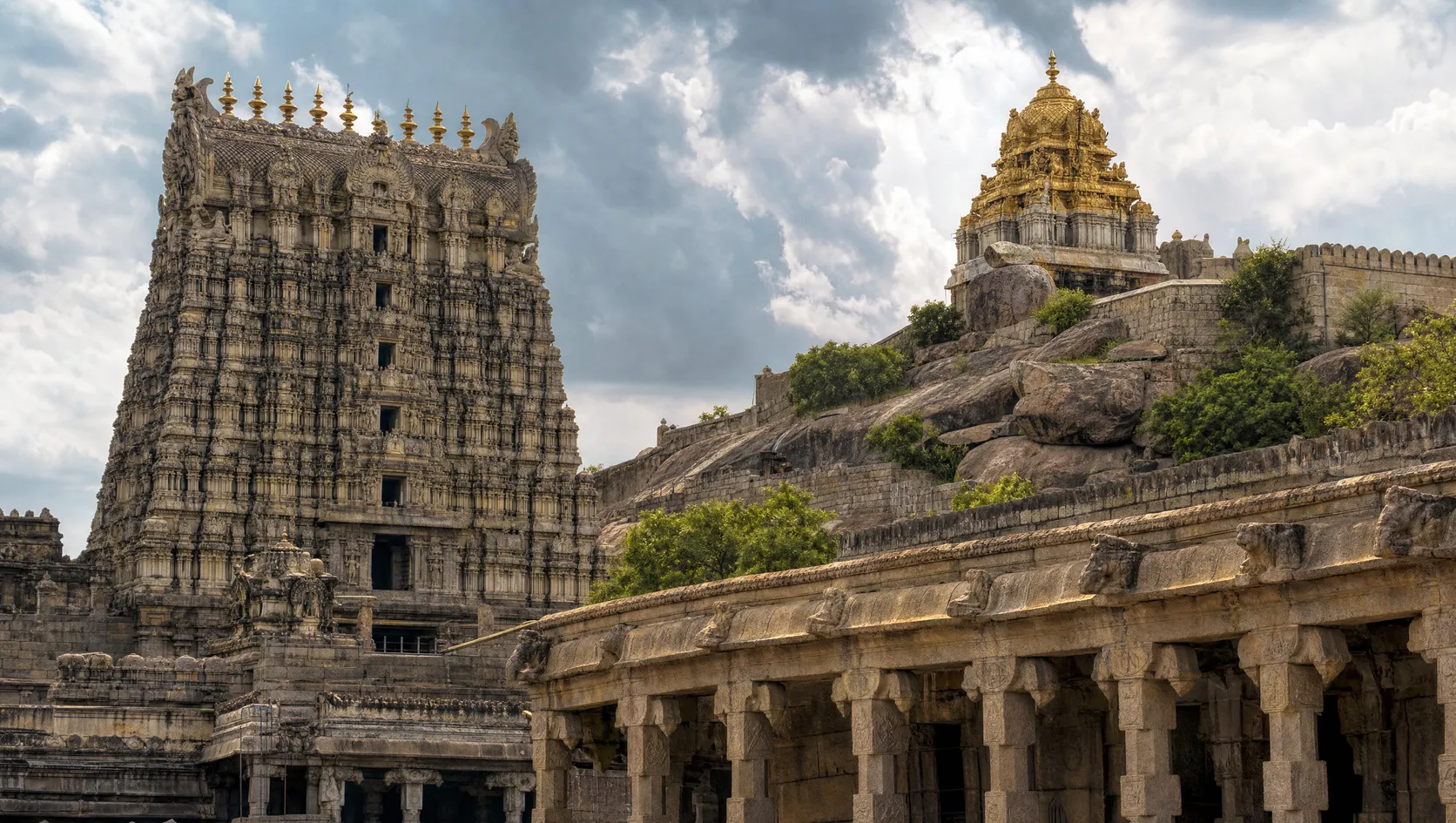
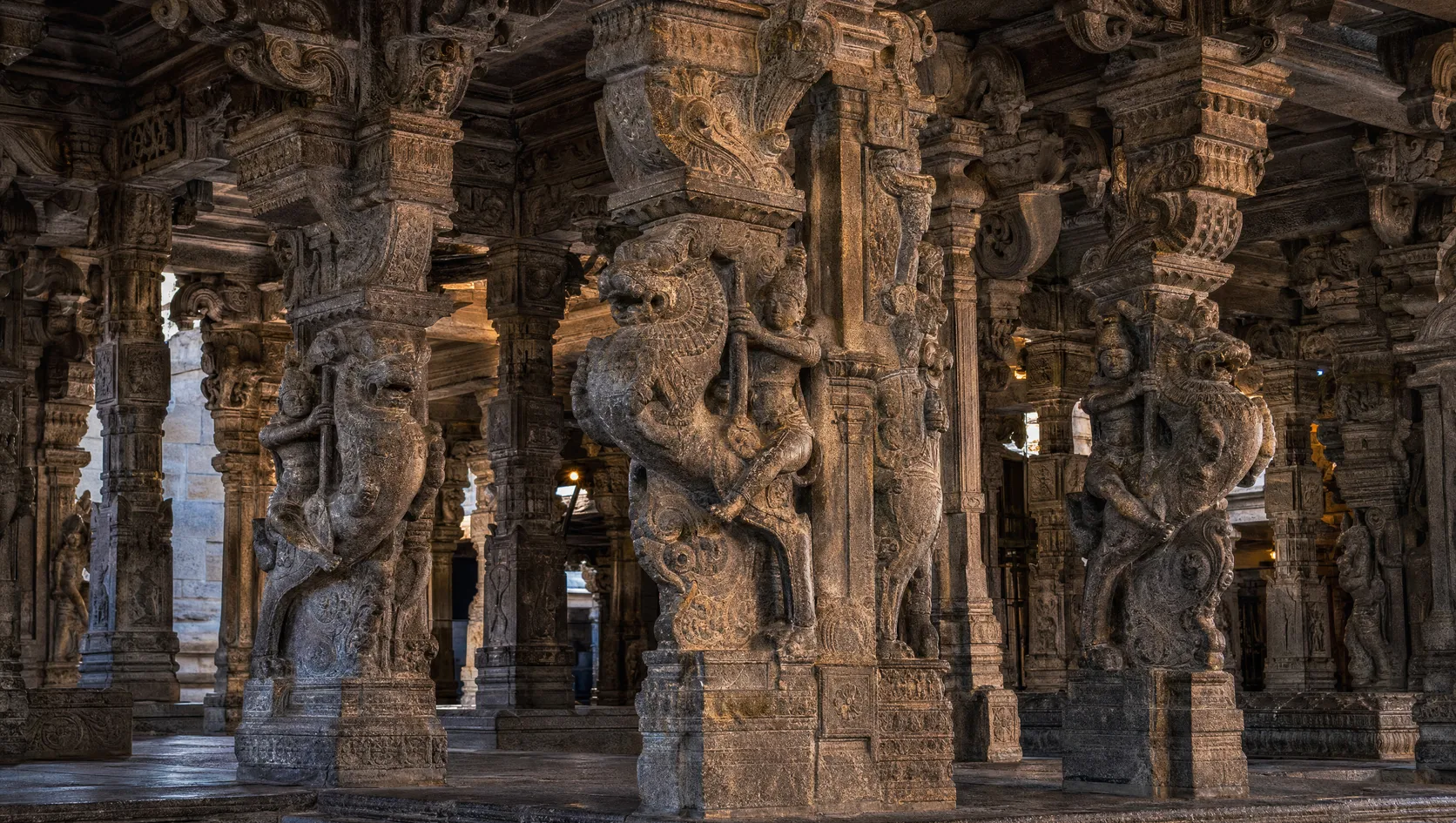
Dravidian, on the Hastagiri hill within a large walled complex, noted for its hundred-pillared mandapa with its carved yali pillars and the great temple tank
Open
06:00 – 20:00
Special
The temple observes a full Srivaishnava ritual round with several daily services to Varadaraja and the recitation of the Nalayira Divya Prabandham. Timings run in sessions through the day with a midday break and vary with the festival calendar; they should be confirmed locally.
The Sacred Legend · पवित्र कथा
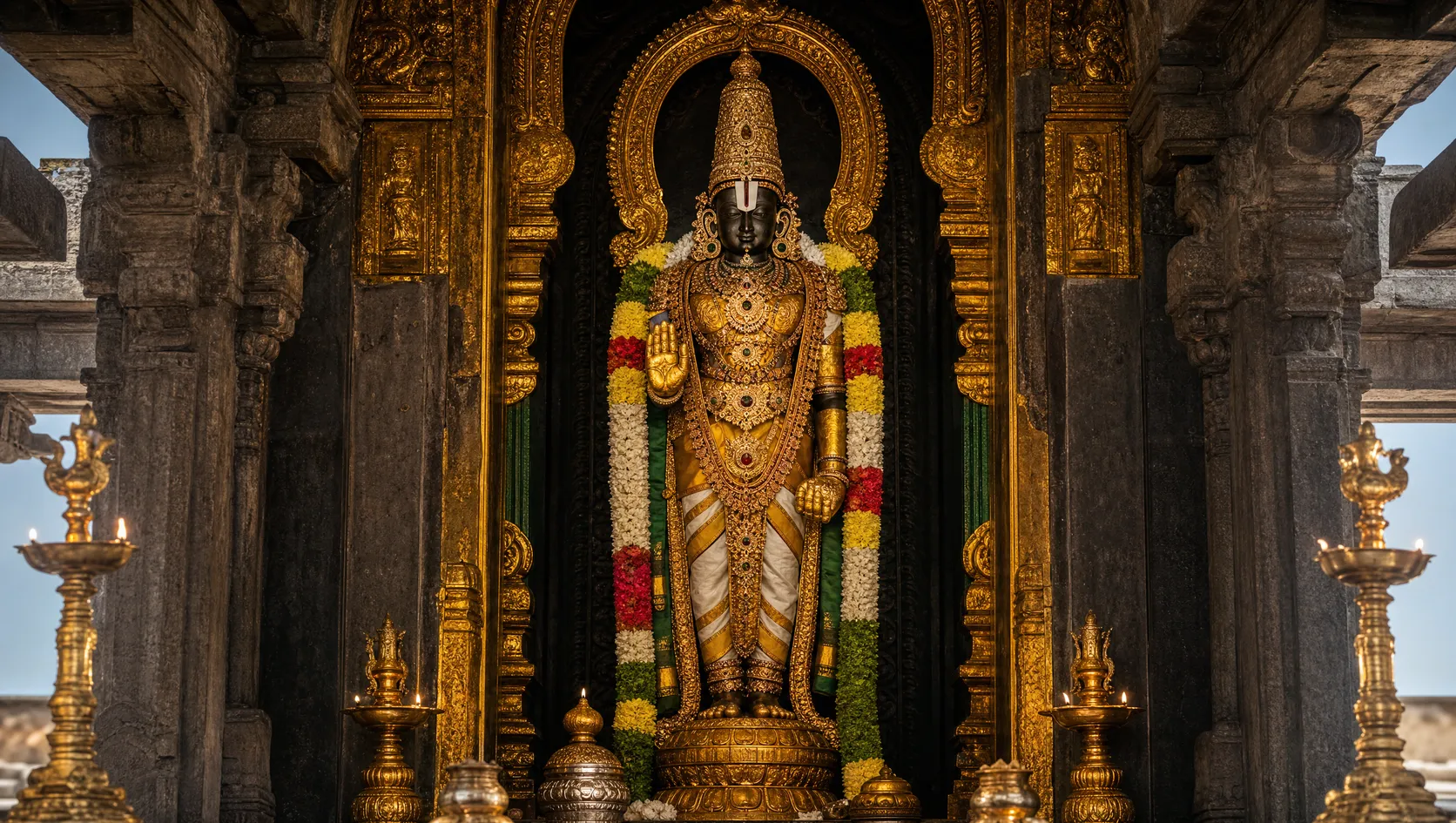
Kanchipuram is a rare city, sacred to Vishnu, Shiva and the goddess alike, and in the old reckoning it is spoken of as two halves: Shiva-Kanchi around the great Ekambareshwara temple, and Vishnu-Kanchi around this one, the temple of Varadaraja Perumal. Of the three great temples of the city, the Vaishnava tradition holds Varadaraja to be the crown, one of the 108 Divya Desams and among the most important Vishnu temples of the south. Varadaraja means the king who grants boons, and that is how the Lord stands here: not reclining as at Srirangam nor seated, but upright on the hill called Hastagiri, the elephant hill, in the posture of a giver, his hand raised in the gesture that bestows. The tradition tells that Brahma himself performed a great sacrifice here to see Vishnu, and that the Lord rose from the sacrificial fire to grant his wish, appearing as Varadaraja, the boon-giving king, on the hill. The temple is inseparable from the Srivaishnava acharyas, above all Ramanuja, who is bound to Kanchi and to this Lord. To this day the temple keeps at its heart an image of Vishnu carved from a fig tree, the Athi Varadar, kept submerged in the temple tank and brought up for worship only once in decades, a hidden god whose rare appearance draws millions.
Sacred Designationपवित्र पदनाम
Sacred Origin Storyपवित्र उत्पत्ति कथा
Source: The Srivaishnava tradition and the Sthala Purana of Kanchi, with the story of Brahma's sacrifice and the appearance of Varadaraja
The tradition holds that Brahma, the creator, wished to see Vishnu face to face and performed a great ashvamedha, a horse sacrifice, on this spot at Kanchi to draw him forth. The goddess Saraswati, in some tellings displeased, sent the river Vegavati as a flood to disrupt the sacrifice, and Vishnu lay across its path to hold back the waters and let the rite go on; and from the sacrificial fire itself the Lord rose in answer to Brahma, appearing as Varadaraja, the king who grants boons, upon the hill that came to be called Hastagiri.
The name Hastagiri, the elephant hill, is drawn into the story too, for the tradition connects the site with the elephant-king Gajendra and with the serpent Adishesha, said to form the hill itself. The Lord stands here upright, not reclining, in the posture of a giver, and his very appearance from the fire of Brahma's sacrifice makes him the god who comes when called, who rises to grant the devotee's desire.
At the heart of the temple's tradition is the Athi Varadar, an image of Vishnu carved from the wood of a fig tree, the original form of the Lord here. Held to be the more ancient image, it rests submerged in the temple tank, and is raised for public worship only once in about forty years, a hidden god who returns to sight across the span of a generation, so that to see the Athi Varadar is a once-in-a-lifetime grace.
Sources cited:
- Sthala Purana of Kanchi (Varadaraja tradition)
- Srivaishnava tradition and the Nalayira Divya Prabandham
- Temple tradition of the Athi Varadar
Other Traditions · अन्य परंपराएँ
The Srivaishnava acharya tradition
Scholarly Context
Varadaraja Perumal is among the principal temples of Kanchipuram, a city that is one of the most important religious centres of the Tamil country and among the seven cities held to grant liberation. The temple is a Divya Desam, attested in the hymns of the Alvars, and was greatly developed under the Cholas and above all the Vijayanagara empire and the Nayakas, whose sculptors produced the celebrated hundred-pillared hall with its rearing yali pillars, among the finest works of late medieval temple sculpture in the south. Historically the temple is closely tied to the Srivaishnava tradition and to Ramanuja, who is associated with Kanchi in his early life before Srirangam. The division of Kanchi into Shiva-Kanchi and Vishnu-Kanchi, with Varadaraja as the chief temple of the latter, reflects the city's character as a shared sacred centre in which the great traditions were each given their quarter. The Athi Varadar, the fig-wood image kept submerged and raised only once in about four decades, is a striking instance of a temple's ritual structured around rarity: the last raising, in 2019, drew crowds in the millions over its weeks of display, a modern demonstration of the enduring power of the tradition. Scholars note the temple as a major monument of Vijayanagara-Nayaka art and a living centre of Srivaishnava worship.
Historyइतिहास
Varadaraja Perumal is the foremost Vaishnava temple of Kanchipuram and one of the 108 Divya Desams, sacred to Vishnu as Varadaraja, the boon-granting king, who stands upright on the Hastagiri hill within the temple. Its antiquity is attested by the hymns of the Alvars, and it grew over the centuries under the Cholas, the Vijayanagara emperors and the Madurai Nayakas into the large walled complex seen today.
The tradition holds that Vishnu appeared here as Varadaraja from the fire of a great sacrifice performed by Brahma, and the Lord's standing, boon-giving form gives the temple its character as a place of granted wishes. The temple is bound to the Srivaishnava tradition and to Ramanuja, associated with Kanchi in his early life, and it stands as the chief temple of Vishnu-Kanchi, the Vaishnava half of a city sacred to Vishnu, Shiva and the goddess together.
The Vijayanagara and Nayaka periods gave the temple much of its present grandeur, including the celebrated hundred-pillared hall, a masterwork of sculpture with its rearing yali pillars, and the great gopurams and enclosures. The temple has been endowed and maintained across the centuries as one of the principal shrines of the Tamil country.
At the heart of its tradition is the Athi Varadar, an image of Vishnu carved from fig wood, held to be the older form of the Lord, which rests submerged in the temple tank and is raised for public worship only once in about forty years. Its last appearance, in 2019, drew crowds in the millions over the weeks of its display, a striking modern testimony to the temple's hold on the devotion of the south. Varadaraja Perumal remains a living centre of Srivaishnava worship and a principal destination for pilgrims to Kanchipuram.
Historical Timelineऐतिहासिक कालक्रम
The Alvars, the Tamil poet-saints of Vishnu, sing the Lord of Kanchi in the Nalayira Divya Prabandham, establishing Varadaraja Perumal as a Divya Desam of great antiquity.
The Alvars' hymns are the earliest firm evidence of the temple's importance among the Divya Desams.
Under the Pallavas of Kanchi and then the Cholas the temple is developed and endowed, part of the flowering of Kanchipuram as a great religious and cultural centre of the Tamil country.
Ramanuja, the philosopher of Vishishtadvaita, is associated with Kanchi in his early life, studying under Yadava Prakasha and bound to the Lord Varadaraja before his work centred on Srirangam.
Ramanuja's early association with Kanchi and Varadaraja is a cherished part of the temple's tradition.
Like the other great temples of the south, Kanchipuram faces the disruption of the invasions of the early fourteenth century, and its temples pass through a period of danger before recovery under Vijayanagara.
The Vijayanagara emperors richly endow and expand the temple, and its sculptors produce the celebrated hundred-pillared hall with its rearing yali pillars, among the finest works of the era's temple art.
The hundred-pillared mandapa is regarded as a masterwork of Vijayanagara sculpture.
The Madurai Nayakas continue the temple's development, adding to its halls, gopurams and endowments and enriching its festivals.
The temple is documented in colonial-era surveys of Kanchipuram, which record its standing as the chief Vaishnava temple of the city and note its architecture and the tradition of the Athi Varadar.
The Athi Varadar, the fig-wood image kept submerged in the temple tank, is raised for public worship after about forty years and draws crowds in the millions over the weeks of its display.
The raising of the Athi Varadar roughly once in four decades is among the most remarkable of the temple's observances, and the 2019 event drew extraordinary numbers.
Varadaraja Perumal remains a living centre of Srivaishnava worship and a principal destination for pilgrims to Kanchipuram, taken together with the Kamakshi Amman and Ekambareshwara temples of the city.
What You'll Seeदर्शन में
The presiding image of the temple is Varadaraja Perumal, Vishnu standing upright on the Hastagiri hill in the posture of a boon-giver, one hand raised in the gesture that bestows grace. Unlike the reclining Ranganatha of Srirangam or the seated forms of other shrines, this is the Lord standing to give, his very stance the meaning of his name: the king who grants. The sanctum sits atop the hill within the temple, reached by steps, and over it rises the Punyakoti Vimana.
His consort is Perundevi Thayar, the great goddess, who has her own large shrine within the complex, so that the temple holds the Lord and the Goddess each in their own precinct, as at the major Vaishnava temples. Around them the enclosures hold the shrines of the Alvars and acharyas and the images of the tradition.
The temple's most extraordinary image is one usually unseen: the Athi Varadar, an image of Vishnu carved from the wood of a fig tree, held to be the older, original form of the Lord here. It rests submerged in the temple tank, brought up for public worship only once in about forty years, so that most who venerate the temple will see it at most once in a lifetime. The great architectural glory of the temple is the hundred-pillared hall, whose pillars are carved as rearing yalis, the mythical lion-beast, and other figures of astonishing intricacy, among the finest sculpture of the Vijayanagara age.
Distinctive Practicesविशिष्ट परंपराएँ
The Rare Darshan of the Athi Varadar
अत्ति वरदर का विरल दर्शन
Once in about forty years
The Athi Varadar, the fig-wood image held to be the original form of the Lord, is kept submerged in the temple tank and raised for public worship only once in roughly four decades. When it is raised, over some weeks, it draws crowds in the millions, for most devotees a once-in-a-lifetime darshan.
A god who returns to sight only once in a generation makes darshan itself a matter of grace and timing rather than of will. Most who long to see the Athi Varadar will have one chance in a lifetime, and some none, so that the rare appearance turns an ordinary act, the seeing of an image, into a gift no one can command. The submersion between appearances keeps the older Lord hidden, so that his surfacing is felt as a genuine return, the god come up from the waters to be seen.
Worship of the Boon-Granting Lord
वरदायी प्रभु की उपासना
Year-round, at the sanctum on the hill
Devotees come to Varadaraja above all to seek boons, in keeping with his name and his standing, boon-giving form, climbing the steps of the Hastagiri to the sanctum to lay their prayers before the Lord who rose from the sacrificial fire to grant a wish.
The Lord's very posture, standing with the hand of giving raised, invites the devotee to ask. The origin myth, in which Vishnu rises from Brahma's sacrifice in direct answer to a wish, sets the temple's key: this is the god who comes when called and grants what is sought, and the worship here is shaped by that promise, the prayer brought in confidence to a Lord whose name is the granting of prayers.
Recitation of the Nalayira Divya Prabandham
नालायिर दिव्य प्रबंधम् का पाठ
Daily in worship and in the Adhyayana festival
As a Divya Desam, the temple keeps the recitation of the Alvars' Tamil hymns, the Nalayira Divya Prabandham, in its worship, sung before Varadaraja beside the Sanskrit rites, and given fullest voice in the Adhyayana Utsavam.
To sing the Tamil hymns before the Lord is to worship him in the language of the Alvars who first saw and sang him, and to keep the temple within the living tradition of the Divya Desams. The Prabandham is held as the Veda in Tamil, and its recitation before Varadaraja binds the boon-granting Lord of Kanchi to the whole circuit of the hundred and eight abodes and the poet-saints who hallowed them.
Did You Know?क्या आप जानते हैं?
Varadaraja Perumal is the foremost Vaishnava temple of Kanchipuram and the crown of Vishnu-Kanchi, one of the 108 Divya Desams sung by the Alvars.
Srivaishnava tradition
The Lord stands upright on the Hastagiri hill in the posture of a boon-giver; his name Varadaraja means the king who grants boons, and the tradition says he rose from the fire of Brahma's sacrifice.
Sthala Purana of Kanchi
The temple keeps the Athi Varadar, a fig-wood image of Vishnu held to be its original form, submerged in the temple tank and raised for worship only once in about forty years.
Temple tradition
The last raising of the Athi Varadar, in 2019, drew crowds in the millions over the weeks of its rare public display.
Contemporary reports of the 2019 darshan
The temple's hundred-pillared hall, with its rearing yali pillars, is among the finest works of Vijayanagara-era temple sculpture in the south.
Art-historical study
The temple is bound to Ramanuja, associated with Kanchi and the Lord Varadaraja in his early life before his work centred on Srirangam.
Srivaishnava acharya tradition
Kanchipuram is one of the seven cities held to grant liberation, and the old tradition divides it into Shiva-Kanchi and Vishnu-Kanchi, with Varadaraja the chief temple of the Vaishnava half.
Puranic tradition of the seven mokshapuris
The tradition tells that Vishnu lay across the flood of the Vegavati river to hold back its waters and let Brahma's sacrifice proceed, so the Lord is also remembered here as the one who stemmed the river's rush.
Sthala Purana of Kanchi
The consort of Varadaraja is Perundevi Thayar, the great goddess, who has her own large shrine within the complex, so that the temple holds the Lord and the Goddess each in their own precinct.
Temple tradition
The Athi Varadar rests in the temple tank called Ananthasaras, and over the sanctum on the Hastagiri hill rises the Punyakoti Vimana.
Temple tradition
Visitor Accessप्रवेश जानकारी
The temple is open to Hindus, and the sanctum of Varadaraja on the Hastagiri hill is reached by climbing steps within the complex. As at many major Vaishnava temples of the south, entry to the innermost precinct is restricted to Hindus. The complex is large, with the sanctum on the hill, the shrine of Perundevi Thayar, the celebrated hundred-pillared hall and the great temple tank; allow time to see them. A dress code of traditional attire applies, and footwear is left outside the temple. Timings run in sessions through the day with a midday closure. On ordinary days the temple allows an unhurried visit; it becomes extremely crowded during the rare raising of the Athi Varadar and during major festivals. Confirm current timings and any restrictions locally before visiting.
Spiritual Basis
The climb up the Hastagiri to the sanctum is itself a small pilgrimage, the ascent to the standing Lord on the hill, and the passage through the enclosures orders the approach from the outer world to the boon-giving god at the height. The restriction of the innermost precinct to Hindus follows the practice of the major Vaishnava temples of the south, preserving the ritual purity of the sanctum according to their tradition. The Lord's boon-granting form makes the temple a place of asking, and the tradition holds that Varadaraja receives the prayers of all who climb to him; the ordering of access shapes that approach rather than denying it.
Contemporary Context
Varadaraja Perumal is one of the busiest temples of Kanchipuram, drawing pilgrims year-round as the chief Vaishnava shrine of the city, and enormous crowds on the rare occasions when the Athi Varadar is raised. Most visitors take it together with the Kamakshi Amman and Ekambareshwara temples, the three great shrines of the city. The temple is administered as a major institution with organised worship and festival management. On ordinary days the visit is straightforward; during the Athi Varadar darshan, which recurs only once in about forty years, the crowds are among the largest gathered at any temple, and special arrangements govern the darshan.
Practical Guidance
Allow a couple of hours to climb to the sanctum of Varadaraja, see the shrine of Perundevi Thayar, and take in the hundred-pillared hall and the temple tank. Non-Hindu visitors can appreciate much of the architecture, above all the sculpture of the pillared hall, but should note the restriction at the innermost precinct. Dress traditionally and leave footwear outside. Combine the visit with the Kamakshi Amman and Ekambareshwara temples and the Kanchi Kamakoti Peetham, all close within the city. If an Athi Varadar raising is in progress, expect vast crowds and long waits, and follow the special arrangements in force.
Festivalsत्योहार
Brahmotsavam (Garuda Sevai)
ब्रह्मोत्सवम् (गरुड़ सेवै)
May-Jun (Vaikasi)
The great annual Brahmotsavam of the temple, whose most famous day is the Garuda Sevai, when Varadaraja is taken in procession on the golden Garuda vahana, a spectacle that draws vast crowds to see the Lord ride his eagle mount through the streets of Kanchi.
Vaikuntha Ekadasi
वैकुण्ठ एकादशी
Dec-Jan (Margazhi)
The Vaishnava festival of the gate of heaven, observed at Varadaraja as at the Divya Desams, with the opening of the Paramapada Vasal and special worship of the Lord over the sacred days of Margazhi.
Adhyayana Utsavam
अध्ययन उत्सवम्
Dec-Jan (Margazhi)
The festival of the recitation of the Nalayira Divya Prabandham, when the Tamil hymns of the Alvars are chanted in full before the Lord, a central observance of the Srivaishnava year at the Divya Desams.
Athi Varadar Darshan
अत्ति वरदर दर्शन
Once in about forty years
The rare raising of the Athi Varadar from the temple tank for public worship, recurring only once in roughly four decades, is the most extraordinary observance of the temple, drawing crowds in the millions over its weeks.
Traditional Offeringsपारंपरिक अर्पण
Primary Offerings
Tulasi (holy basil)
तुलसी
तुलसी
Tulasi, the holy basil beloved of Vishnu, is the offering most proper to Varadaraja as to any form of Vishnu, laid at his feet and woven into his garlands, without which no worship of Vishnu is complete.
Prayers for boons
वरदान की प्रार्थनाएँ
In keeping with the Lord's boon-granting form, devotees bring their prayers and vows to Varadaraja above all, seeking the fulfilment of their wishes from the king who grants; the offering of a heartfelt prayer is central to the worship here.
Garlands and flowers
मालाएँ और पुष्प
Garlands of flowers, with tulasi, are offered to Varadaraja and to the goddess Perundevi Thayar, and garlands that have adorned the deity are returned to devotees as a blessing.
Recitation of the Prabandham and the Sahasranama
प्रबंधम् और सहस्रनाम का पाठ
The recitation of the Alvars' Tamil hymns and of the Vishnu Sahasranama is held a high offering to Varadaraja, the god worshipped in sung word as in flower and food, and the offering of hymn is central to the temple's daily worship.
Sacred food (prasadam)
प्रसाद
The food offered to Varadaraja and shared with devotees as prasadam is received as the Lord's grace made tangible. As at the great Vaishnava temples, the prasadam carries the touch of the Lord to whom it was first offered, and is taken home as a blessing for those who could not come.
Lamps and the deepa aradhana
दीप और दीप आराधना
Lamps are offered to Varadaraja in the deepa aradhana, the waving of light before the deity that is the climax of each worship, when the standing, boon-giving Lord is shown to the devotee in the glow of the flame. The offering of light marks the rhythm of the temple's daily services on the Hastagiri hill.
Unique to This Temple
The Offering of the Wish to the Boon-Granting Lord
वरदायी प्रभु को इच्छा की भेंट
What is particular to Varadaraja is that the temple is above all a place of asking, and the offering the tradition holds highest is the wish itself, brought in trust to the Lord whose very name and posture promise its granting. The god rose from the fire of Brahma's sacrifice in answer to a desire, and the devotee comes to him in the same confidence, laying a prayer before the king who grants. A pilgrim brings tulasi, flowers and food as at any shrine of Vishnu, but here the heart of the offering is the vow or the wish carried up the Hastagiri to the standing Lord, and the blessing sought is the boon. The offering and the blessing meet in the granted wish: the devotee offers his need, and Varadaraja, the king of boons, is held to give.
Offerings at Varadaraja Perumal follow the Srivaishnava tradition, with tulasi, flowers, garlands and the recitation of the Prabandham and the Vishnu Sahasranama central, and the bringing of prayers and vows to the boon-granting Lord especially characteristic. Eternal Raga presents these practices as a devotional tradition; specific seva and offering arrangements should be confirmed with the temple.
How to Reachकैसे पहुँचें
The temple stands in Vishnu-Kanchi, the eastern part of the temple city of Kanchipuram in northern Tamil Nadu, and is reached as part of a visit to the city.
By air: Chennai International Airport is the nearest, roughly 75 km away, well connected to the rest of India and abroad, from which Kanchipuram is reached by road.
By rail: Kanchipuram has its own railway station, and the larger junction of Chengalpattu is nearby, both connected to Chennai and the wider network.
By road: Kanchipuram is well connected by road to Chennai, Chengalpattu and the towns of northern Tamil Nadu, served by frequent buses and taxis. Within the city the temple is in Vishnu-Kanchi, a short distance from the Kamakshi Amman temple and the other great shrines, easily reached by autorickshaw.
Most pilgrims take Varadaraja Perumal together with the Kamakshi Amman and Ekambareshwara temples and the Kanchi Kamakoti Peetham, the great shrines of the city.
Plan Your Visitयात्रा की योजना
🌤 Best Season
October to March is the most comfortable period in Kanchipuram, with milder temperatures and lower humidity, the best time for a visit that takes in the temple and the city's other shrines. The Brahmotsavam in Vaikasi (May-June) and Vaikuntha Ekadasi in Margazhi (December-January) are the temple's major festivals and draw large crowds. April to June is hot in this part of Tamil Nadu, and the middle of the day is best avoided for temple visits then. The northeast monsoon, roughly October to December, brings rain but the city remains accessible. Early morning and evening are the most atmospheric times to be at the temple, when worship is active and the heat least.
👘 Dress Code
Traditional and modest dress is expected. Men commonly wear a dhoti or trousers with a shirt; women a saree or salwar kameez. Footwear is left outside the temple. As a major Vaishnava temple, Varadaraja Perumal expects respectful traditional attire.
📱 Phones & Photography
Photography is restricted, and generally not permitted within the sanctum and inner enclosures; follow the posted rules and the directions of temple staff, and keep phones silenced within the shrines. During the Athi Varadar darshan, special photography rules apply.
🏨 Accommodation
Kanchipuram is a well-developed temple city with a full range of accommodation, from guest houses and lodges to hotels, much of it geared to pilgrims visiting its many temples. Its proximity to Chennai also makes a day visit feasible for those based in the city. Demand rises around the Brahmotsavam and other festivals, and enormously during an Athi Varadar raising, when booking far ahead is essential. Outside those periods the city absorbs its visitors easily.
Sacred Soundsपवित्र ध्वनि
Did You Know? · क्या आप जानते हैं?
The same translation error that turned '33 Koti' into '33 crore' in Hinduism also happened in Buddhism. The Chinese translation of Buddhist texts rendered 'Sapta Koti Buddha' (7 Supreme Buddhas) as '7 Crore Buddhas.' The Tibetan translation got it right: 7 types, not 7 crore. One Sanskrit word, misread across two major world religions, generated two identical misconceptions independently.
Related Contentसंबंधित सामग्री
Related Scriptures
Community Reflections
🕉️
Be the first to share your reflection.