Kamakshi Amman Temple
कामाक्षी अम्मन मंदिर
The Mother of all forms, whose Śrī Cakra is the geometry of the cosmos
Kanchipuram, Tamil Nadu, India
Kāmākṣī AmmaṉAlso known as: Sri Kamakshi Amman, Kamakshi Mata, Shanta Kamakshi, Tapas Kamakshi, Lalita Tripurasundari, Kanchi Kamakshi, Para-Shakti Kamakshi
Era
Pre-Pallava Kanchi sthala-shakti; canonical Pīṭha attestation by 8th, 12th c.; major Adi Shankara establishment (8th c., Sri Chakra placement and Kanchi Kamakoti Peetham foundation); current temple structure substantially Pallava-Chola-Vijayanagara layered construction (9th, 16th c.) with continuing renovation under Tamil Nadu HR&CE administration
Architecture
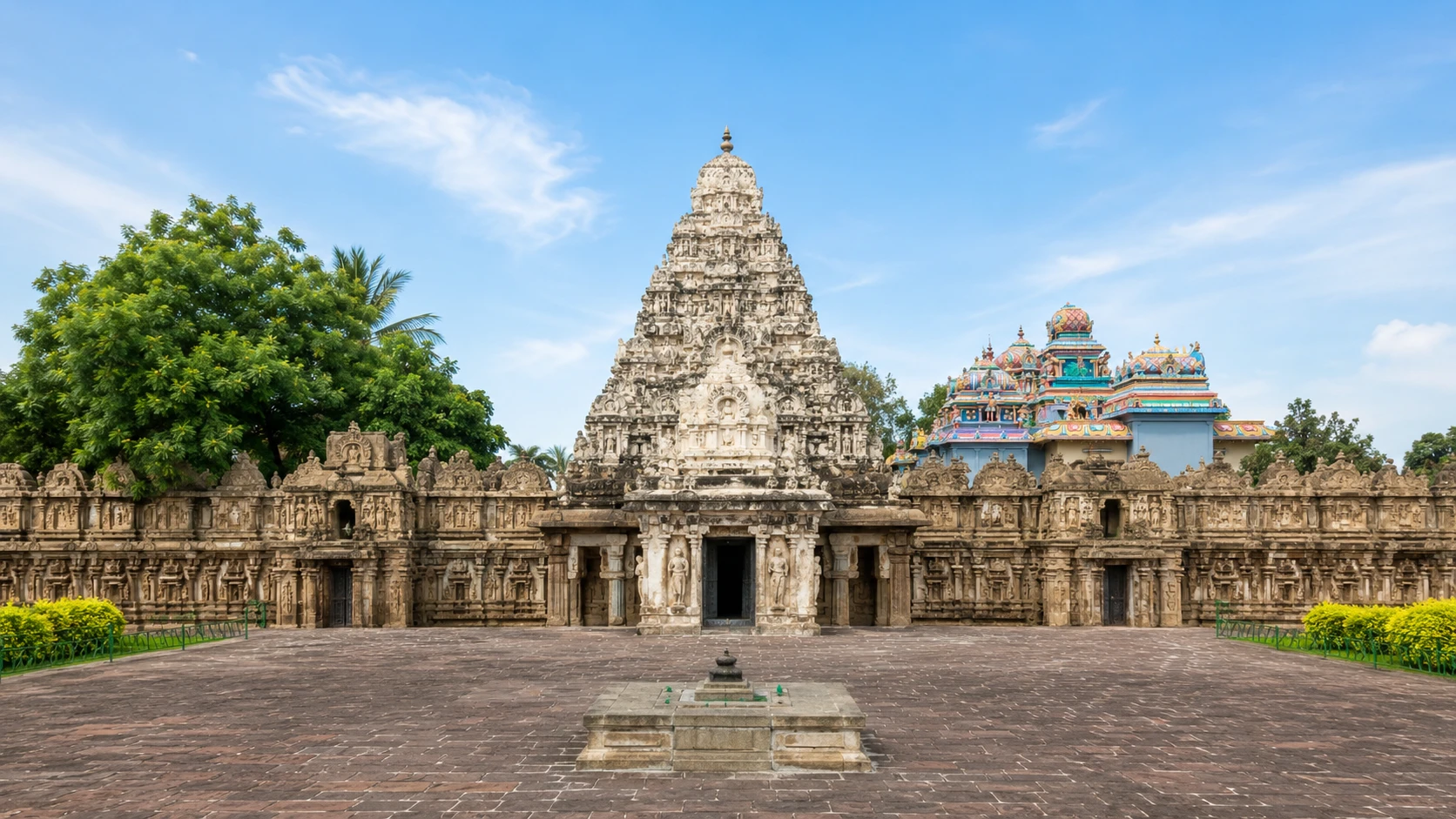
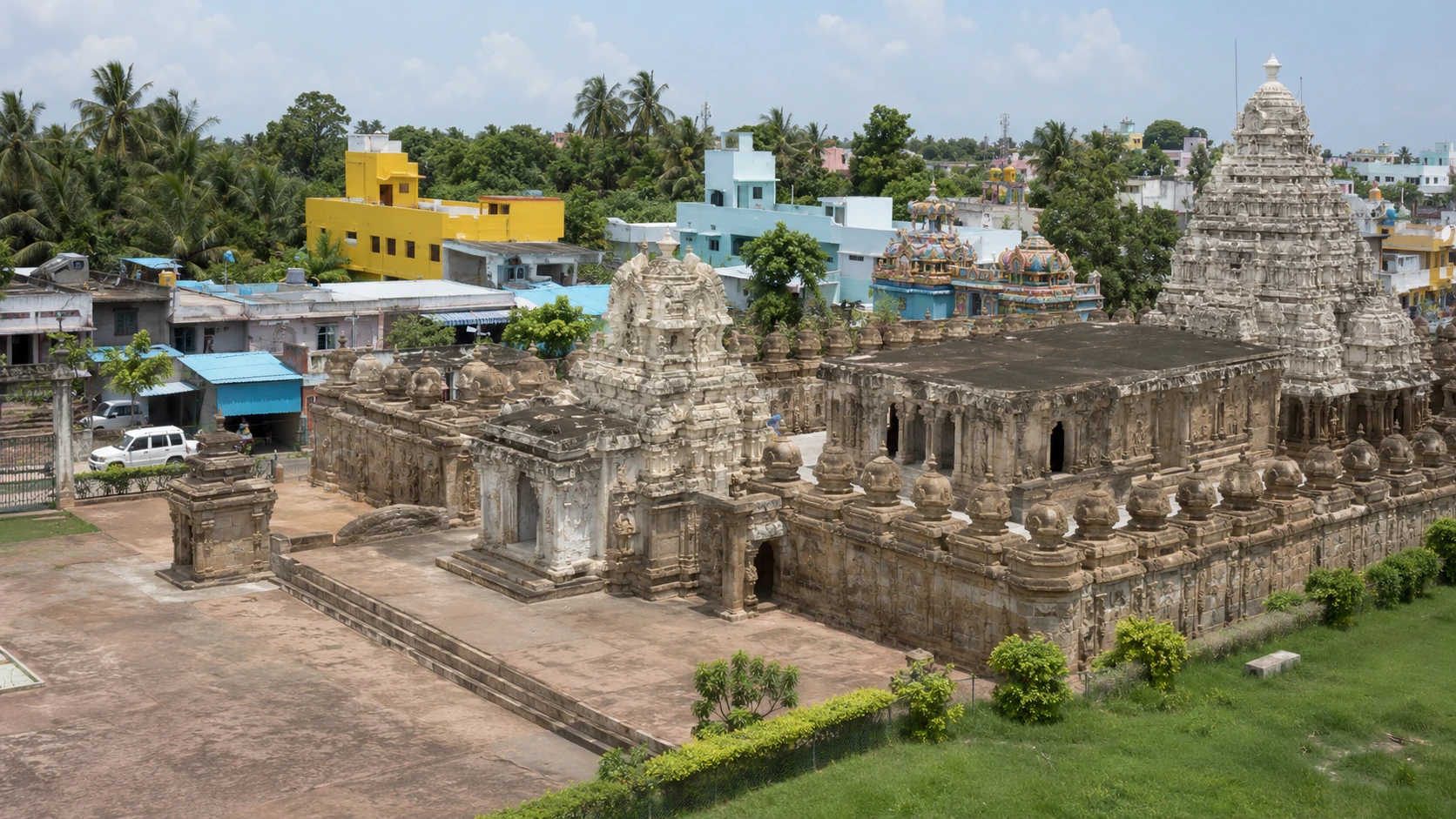
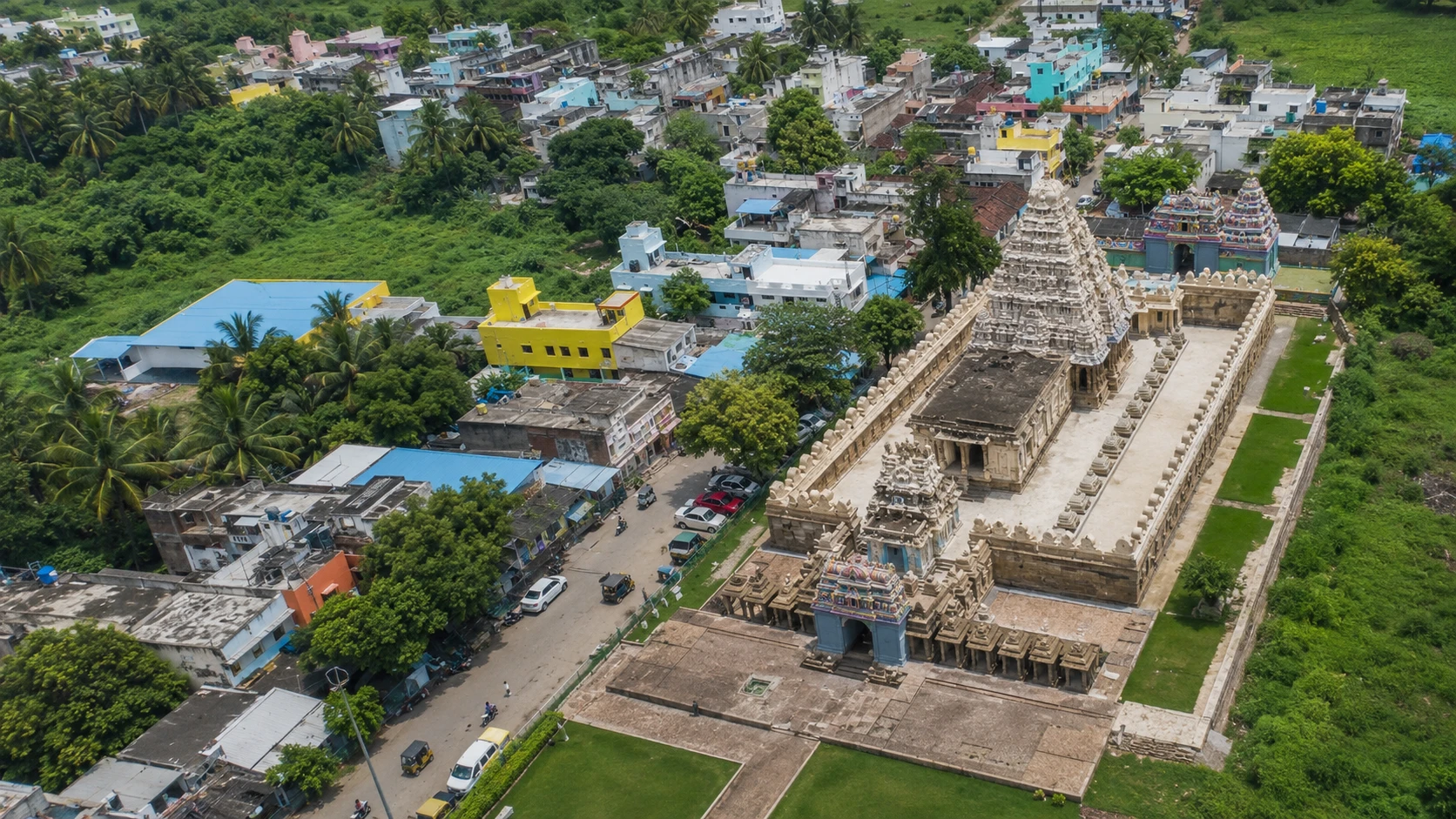
Dravidian (Drāviḍa) tradition; layered Pallava (9th c. core), Chola (10th, 13th c. mandapas and shrines), Vijayanagara (14th, 16th c. gopuram expansions and outer prākāra), and modern renovation phases. The central garbhagriha houses the Shanta Kamakshi murti in the unique Padmasana posture (lotus-seat); the Gayatri Mandapam adjacent contains the original Sri Chakra slab placed by Adi Shankara
Open
05:30 – 21:00
Aarti
05:45 · 08:00 · 11:30 · 17:30 · 20:00
Special
The Friday darshan cycle is particularly significant, Friday is the canonical Devī-day across the Tamil Devī temple tradition, and Kamakshi receives extended morning aarti programmes and special abhiṣeka rites on Fridays. The annual Brahmotsavam (10-day temple festival in Māsi, Feb, Mar) and the Navrātri cycle (Sharad, Sept, Oct) draw substantial regional and national pilgrim flow; the Pankuni Uttiram (Mar, Apr) celebrating the Devī's marital union is also a major festival in the Kanchi calendar
The Sacred Legend · पवित्र कथा
The story Kanchipuram tells of itself begins with two Kāmākṣīs, one fierce, one peaceful, separated by Ādi Śaṅkarācārya's intervention in the 8th century. The older Devī was Tapas Kāmākṣī, the austerity-Mother, whose presence at Kanchi was overwhelming in the way that pre-Tantric Devī presences in southern India often were, radiant, demanding, terrifying in her uncontained śakti. Pilgrims approached and could not stand the heat of her gaze. Adi Shankara, traveling south on his cycle of dig-vijaya, arrived at Kanchipuram and stood before the Tapas Kāmākṣī, and what he did then is the founding act of the temple's modern form. He inscribed the Śrī Cakra, the supreme yantra of the Tripurā tradition, the geometric form that is at once the cosmos in its symbolic compression and the Devī in her metaphysical fullness, on a stone slab and placed it before the Devī in what is now the Gāyatrī Maṇḍapam. The Śrī Cakra absorbed the heat of her presence and translated it into the disciplined geometry of yantra-worship. The fierce Tapas Kāmākṣī became the peaceful Śānta Kāmākṣī, seated in the lotus posture before the Śrī Cakra she had been transformed by, and the temple has worshipped this Śānta form ever since. From this establishment flowed the Kanchi Kāmakoṭi Pīṭham, one of the four (or five) principal Advaita Vedānta seats in India, founded by Adi Shankara and continuing as a living lineage to the present day, and the Śrī Vidyā tradition of southern India that takes Kāmākṣī as its principal Devī. So when a pilgrim enters the Kāmākṣī temple at Kanchi, they enter not just a Śakti Pīṭha (Kāñchyāṁ Kāmākṣī, position 2 in Ādi Śaṅkara's own Aṣṭādaśa Stotram) but a living lineage of Vedānta-Tantric integration that has shaped Hindu thought for over a thousand years. The Devī presides over the city that is also a Sapta Purī, one of the seven cities where dying grants liberation, and her Śrī Cakra is the geometric ground on which the entire architecture of Śrī Vidyā stands.
Sacred Designationपवित्र पदनाम
Shakti Peeth
Body part: Skeleton / Bones (Asthi)
Shakti: Kāmākṣī (also enumerated under the technical Pīṭhanirṇaya name Devagarbhā)
Bhairava: Ruru
One of the Seven Moksha Citiesसप्त पुरी
Sacred Origin Storyपवित्र उत्पत्ति कथा
Source: Devī Bhāgavata Purāṇa, Skandha VII (canonical 51-Pīṭha enumeration); Kālikā Purāṇa, Chapters 18 and 60, 62 (52-list, asthi body-part attribution); Pīṭhanirṇaya (Tantric pīṭha-enumeration treatise, naming the Devī as Devagarbhā at Kanchi); Aṣṭādaśa Śakti Pīṭha Stotram attributed to Ādi Śaṅkarācārya (Kāñchyāṁ Kāmākṣī, position 2); Kāmākṣī-Vilāsa (regional Sanskrit hagiographical text on Adi Shankara's establishment); Mūkapañcaśatī of Mūka Kavi (5th, 6th c. devotional praise-poem to Kamakshi)
The Satī narrative arrives at Kanchi in a form that the Devī's deeper local identity substantially reshapes. When Viṣṇu cut Satī's body with the Sudarśana Cakra, the bones, the asthi, the structural skeleton, fell at Kāñchipuram, and the Pīṭha arose at the site that became Śakti Pīṭha.
The Devī was named Kāmākṣī, 'she whose eyes are kāma', the eyes of love, of desire, of the creative force that draws the cosmos into manifestation, and her presence at Kanchi was understood from the earliest layers of the tradition to be not just a body-fragment shrine but a presence of the Devī in her near-cosmic fullness.
The body-part attribution (asthi / bones) is canonical in the standard Pīṭha enumeration, but Kāmākṣī's theological standing at Kanchi exceeds the single-body-part framework that organizes other Pīṭhas. Some traditions read her as the Pīṭha where the entire structural integrity of Satī's body, the bone-cage, the architecture that holds the rest together, fell, making her the Pīṭha that anchors all the other Pīṭhas (her bones are the ground on which the other fragments' shrines stand).
The Pīṭhanirṇaya enumerates her under the technical name Devagarbhā ('Devī-womb'), the cosmic generative ground from which all forms emerge, making the same theological point in the Tantric vocabulary. Onto this older Pīṭha foundation arrived, in the 8th century CE, Ādi Śaṅkarācārya, the great Advaita Vedānta master traveling south on his dig-vijaya cycle, and his establishment of the Śrī Cakra at the temple in what is now the Gāyatrī Maṇḍapam fundamentally reshaped the temple's devotional grammar.
The pre-Adi-Shankara Tapas Kāmākṣī was the fierce, hot, demanding presence whose darshan was overwhelming; Adi Shankara's Śrī Cakra placement absorbed this heat into the disciplined geometric structure of Śrī Vidyā yantra-worship, and the Devī took her present Śānta Kāmākṣī form, peaceful, seated in lotus, the geometric ground for the Vedānta-Tantric integration that defines the temple's modern identity.
The Kanchi Kāmakoṭi Pīṭham, founded by Adi Shankara as one of the four (some traditions, five) principal Advaita seats of India, has presided as the institutional continuation of this establishment for over twelve hundred years.
Sources cited:
- Devī Bhāgavata Purāṇa, Skandha VII (canonical 51-Pīṭha enumeration)
- Kālikā Purāṇa, Chapters 18 and 60, 62 (52-list tradition; asthi body-part attribution)
- Pīṭhanirṇaya (Tantric pīṭha-enumeration treatise; names Devī as Devagarbhā at Kanchi)
- Aṣṭādaśa Śakti Pīṭha Stotram attributed to Ādi Śaṅkarācārya (Kāñchyāṁ Kāmākṣī, position 2)
- Kāmākṣī-Vilāsa, regional Sanskrit hagiographical text on Adi Shankara's establishment at Kanchi
- Mūkapañcaśatī of Mūka Kavi, early devotional praise-poem (5th, 6th c.) of 500 verses to Kamakshi in five centuries
- Soundarya Lahari attributed to Ādi Śaṅkarācārya, foundational Śrī Vidyā text whose composition is traditionally linked to Adi Shankara's time at the Kanchi Kamakshi temple
- Sircar, D. C., 'The Śākta Pīṭhas' (Motilal Banarsidass, 1948; revised 1973)
- Brooks, Douglas Renfrew, 'Auspicious Wisdom: The Texts and Traditions of Śrīvidyā Śākta Tantrism in South India' (SUNY Press, 1992), foundational scholarly treatment of Kanchi Śrī Vidyā tradition
- Cenkner, William, 'A Tradition of Teachers: Śaṅkara and the Jagadgurus Today' (Motilal Banarsidass, 1983), Kanchi Kamakoti Peetham lineage
Other Traditions · अन्य परंपराएँ
Devagarbhā / Tantric Pīṭhanirṇaya enumeration
The Pīṭhanirṇaya, an authoritative Tantric Pīṭha-enumeration treatise consulted across multiple regional Śākta traditions, names the Devī at Kanchi not as Kāmākṣī but as Devagarbhā, 'Devī-womb' or 'the cosmic generative ground', and gives the Bhairava as Ruru.
On this Tantric reading, the Kanchi Pīṭha is theologically positioned as the cosmic-generative pole from which the Devī's other Pīṭha-manifestations emerge: Devagarbhā is the Mother-womb of the entire Pīṭha network, and her Kanchi shrine accordingly anchors the cosmic generative function rather than a single body-part attribution.
The popular and devotional name Kāmākṣī is theologically harmonized with Devagarbhā, Kāmākṣī's 'eyes of kāma' are the generative gaze of the cosmic Mother-womb, but the two names emphasize different aspects of the same theological positioning. This reading is preserved in the Pīṭhanirṇaya manuscripts and in regional Tantric Śākta liturgy across eastern and southern India.
Mūkapañcaśatī devotional tradition (pre-Adi-Shankara Tapas Kāmākṣī era)
The Mūkapañcaśatī, attributed to a 5th, 6th century mute poet (Mūka Kavi) whose speech the Devī is held to have restored, is a five-hundred-verse devotional praise-poem to Kāmākṣī in five centuries (śatakas), each century treating one aspect of the Devī's presence.
The poem predates Adi Shankara's establishment of the Śrī Cakra at the temple and reflects the pre-Adi-Shankara Tapas Kāmākṣī devotional vocabulary, the Devī's fierce splendour, her overwhelming radiance, her demanding presence.
Modern Kanchi devotional life integrates the Mūkapañcaśatī alongside the post-Adi-Shankara Śrī Vidyā liturgy, treating the older tradition as the substrate that Adi Shankara's establishment did not erase but disciplined. This makes Kāmākṣī one of the few major Pīṭhas with substantial pre-Adi-Shankara devotional literature preserved in living recitation.
Scholarly Context
Kāmākṣī at Kāñchipuram occupies a uniquely integrated theological position at the intersection of multiple traditions. First, the canonical Śakti Pīṭha network: she is named uncontested across all three major Pīṭha enumerations (51, 52, 18-Aṣṭādaśa), with the Pīṭhanirṇaya additionally identifying her as Devagarbhā, the cosmic generative ground. Second, the Sapta Purī Mokṣapurī tradition: Kanchipuram is one of the seven cities where dying grants liberation, and Kāmākṣī is the Devī-pole of Kanchi's Mokṣapurī standing. This makes her one of only three Pīṭha-Devīs in the entire corpus whose shrine sits within a Sapta Purī city (the others being Viśālākṣī at Kashi and Mahākālī at Ujjain). Third, the Śrī Vidyā tradition: Ādi Śaṅkarācārya's 8th-century establishment of the Śrī Cakra at the temple is the foundational moment of the South Indian Śrī Vidyā lineage, and Kāmākṣī is its principal Devī. Fourth, the Kanchi Kāmakoṭi Pīṭham: the institutional Advaita Vedānta lineage that Adi Shankara founded at Kanchi has presided as one of the four (some traditions, five) principal Advaita seats of India for over twelve hundred years, with successive Śaṅkarācāryas serving as both Vedānta teachers and Kāmākṣī devotees, Sri Chandrashekarendra Saraswati (the Mahāperiyava, 1894, 1994), the 68th Śaṅkarācārya of the Peetham, is one of the most universally venerated modern Hindu spiritual figures, and his association with Kāmākṣī shaped much of 20th-century Kanchi devotional life. Fifth, the Kanchi temple-city ecology: Kanchipuram is divided historically into Śiva Kāñchī (the Ekambareshwara core, with the Pṛthvī-Liṅga, one of the five elemental Liṅgas of southern India) and Viṣṇu Kāñchī (the Varadarāja Perumāḷ core, one of the 108 Divya Deśam Vaiṣṇava shrines). Kāmākṣī presides from a position that integrates both poles, she is structurally the Devī-pole of a city otherwise divided between Śiva and Viṣṇu, and her temple is canonically visited as part of the Tamil regional Three-Mother circuit (Kāmākṣī at Kanchi + Mīnākṣī at Madurai + Akhilāṇḍeśvarī at Thiruvanaikaval). The convergence of these five frameworks, Pīṭha + Sapta Purī + Śrī Vidyā + Kanchi Kāmakoṭi + Tamil Three-Mother, makes Kāmākṣī one of the most theologically rich single shrines in the Indian sacred geography, comparable in density to Vishalakshi at Kashi (Mokṣapurī triple-embedding) but with a different structural shape (here it is the Vedānta-Tantra integration through Adi Shankara's establishment that anchors the density). Douglas Renfrew Brooks's 'Auspicious Wisdom' (1992) and William Cenkner's 'A Tradition of Teachers' (1983) are foundational scholarly treatments of the Kanchi Śrī Vidyā and Kāmakoṭi Pīṭham traditions respectively.
Historyइतिहास
Kāñchipuram's historical depth as a Hindu religious and civic centre is exceptional even by Tamil Nadu standards. Pre-Pallava settlement at the site is documented to at least the 2nd century BCE through archaeological evidence and early Tamil Sangam literature; by the time the Pallava dynasty established its capital at Kanchipuram in the early 4th century CE, the city was already a recognized centre of religious and intellectual life in southern India.
The Pallava period (c. 275, 897 CE) saw the consolidation of Kanchipuram as one of the great temple-cities of medieval India, with major Pallava-era construction at the Kailasanathar temple (8th c.), the Vaikuntha Perumal temple (8th c.), and the early phases of what would become the Ekambareshwara complex.
The Kāmākṣī temple's pre-Pallava sthala-shakti standing predates these formal temple constructions; the goddess was the indwelling Devī of Kanchi as an urban-religious site before the formal architectural elaboration of the medieval temple-city.
The canonical formalization of Kāmākṣī within the pan-Indian Śakti Pīṭha network is documented by the 8th, 12th centuries CE through the Devī Bhāgavata, Kālikā Purāṇa, Pīṭhanirṇaya, and the Ashtadasha Stotram traditions.
The single most consequential historical event in the temple's history is Ādi Śaṅkarācārya's establishment of the Śrī Cakra at the temple in the 8th century CE, the precise dating of Adi Shankara's life is contested (the traditional dating gives 788, 820 CE; some scholars argue for earlier or later periods), but his establishment at Kanchi is universally affirmed across Adi Shankara hagiographical traditions, and the Kanchi Kāmakoṭi Pīṭham that he founded as a continuing institutional lineage has presided at the temple from that point to the present.
The Chola period (10th, 13th c.) brought substantial temple construction across the Kanchipuram ecology with major Chola-era patronage extending to the Kāmākṣī temple's mandapa expansions and ritual infrastructure; the Vijayanagara period (14th, 16th c.) brought the gopuram expansions and outer prākāra construction that give the temple its present-day visual profile.
Tamil Nadu's Hindu temple ecology was substantially preserved through the Mughal era due to the region's geographic remoteness from the principal Mughal centres of power and the corresponding limited reach of Mughal-era temple-disruption campaigns; Kāmākṣī at Kanchi was within this preserved zone and her temple continued operating without major destruction throughout the period.
The 18th-century Maratha and Nayaka periods brought continuing patronage and maintenance; the British colonial period (18th, 20th c.) saw the temple incorporated into the broader administrative framework that has continued under the Government of Tamil Nadu's Hindu Religious and Charitable Endowments (HR&CE) Department since 1951.
The 20th century brought the towering presence of Sri Chandrashekarendra Saraswati (Mahāperiyava, 1894, 1994), the 68th Śaṅkarācārya of the Kanchi Kāmakoṭi Pīṭham, whose seven-decade tenure shaped 20th-century Hindu devotional life across India and whose association with Kāmākṣī temple is documented at every level of the temple's modern ritual and devotional ecology.
His successors Sri Jayendra Saraswati (69th, 1935, 2018) and Sri Vijayendra Saraswati (70th, current) continue the Peetham lineage and the Kāmākṣī devotional tradition to the present day.
Historical Timelineऐतिहासिक कालक्रम
Pre-Pallava and early-Pallava establishment of Kanchipuram as a major urban-religious centre of southern India. Archaeological and early Tamil Sangam literary evidence places urban settlement at the site to at least the 2nd century BCE. By the time of the Pallava dynasty's establishment of Kanchipuram as its capital in the early 4th century CE, the city was already a recognized centre of Buddhist, Jain, Śaiva, Vaiṣṇava and Śākta religious activity in living proximity. The Devī Kāmākṣī's standing as the sthala-shakti of Kanchi predates the formal medieval temple-city architecture and is the foundational religious-civic substrate onto which the canonical Pīṭha narrative subsequently arrived.
Canonical formalization of Kāmākṣī within the pan-Indian Śakti Pīṭha network through textualization in the Devī Bhāgavata Purāṇa (Skandha VII), Kālikā Purāṇa (Chapters 18, 60, 62), the Pīṭhanirṇaya (under the technical Devī-name Devagarbhā), and the Aṣṭādaśa Śakti Pīṭha Stotram attributed to Ādi Śaṅkarācārya (Kāñchyāṁ Kāmākṣī, position 2). The body-part attribution (asthi / bones) and the Bhairava attribution (Ruru per Pīṭhanirṇaya) are documented across the primary canonical sources with substantial recension variability, see scholarlyNote.
Kanchipuram's position-2 standing in the Adi Shankara recension of the Aṣṭādaśa Stotram is canonically uncontested across the Adi Shankara, Gujarati and most other recensions. Eternal Raga's corpus has internally adopted the Karnataka recension for the position-2 slot (placing Mūkāmbikā at Kollur there), this is a curatorial decision about internal Ashtadasha enumeration consistency, not a theological assessment, and Kāmākṣī's 18-Ashtadasa membership is fully affirmed in this entry with ashtadasa_position set to null. The body-part attribution shows substantial recension variability across primary sources, modern compilations and Sircar 1948 give asthi (skeleton/bones) as the dominant attestation; the Pīṭhanirṇaya uses the alternate Devī-name Devagarbhā; some regional readings give prishtha (back/spine) or treat Kāmākṣī as Kāmarūpiṇī (the form of Kāma/desire). The Bhairava attribution Ruru is canonically dominant per Pīṭhanirṇaya; some Tamil regional traditions identify the Bhairava-pair with the local Shiva form at the Ekambareshwara temple (Pṛthvī-Liṅga, one of the five elemental Liṅgas of southern India). The corpus reports the canonical attestations with explicit acknowledgment of variability.
Ādi Śaṅkarācārya's establishment of the Śrī Cakra at the Kāmākṣī temple in the Gāyatrī Maṇḍapam, the single most consequential historical event in the temple's history and the foundational moment of the South Indian Śrī Vidyā tradition. Traditional Adi Shankara hagiography places this event during his dig-vijaya cycle of pan-Indian travel; the precise dating of Adi Shankara's life is scholarly contested (traditional dating 788, 820 CE; some academic scholars argue for earlier or later periods), but his establishment at Kanchi is universally affirmed across all major Adi Shankara hagiographical sources. The Śrī Cakra placement transformed the pre-Adi-Shankara Tapas Kāmākṣī (the fierce austerity-Devī of the older Tamil tradition) into the Śānta Kāmākṣī (the peaceful Devī of the modern temple), absorbing the Devī's fierce splendour into the disciplined geometry of yantra-worship and integrating the Tantric Śrī Vidyā tradition with the Advaita Vedānta framework. The same establishment founded the Kanchi Kāmakoṭi Pīṭham as one of the four (some traditions, five) principal Advaita Vedānta seats of India, with continuing institutional lineage from Adi Shankara to the present day.
Adi Shankara's establishment at Kanchi is the single most-attested event in his hagiographical tradition aside from his foundational works (Brahma-Sūtra Bhāṣya, Upaniṣad commentaries) and the foundation of his other principal maṭhas. The Kanchi Kāmakoṭi Pīṭham's institutional lineage from Adi Shankara to the present-day 70th Śaṅkarācārya is one of the longest continuously documented Hindu institutional lineages, academic scholarship discusses the question of whether the Kanchi Pīṭham was founded by Adi Shankara himself or by a later figure in his immediate spiritual lineage (the four-versus-five maṭha question), but devotionally and traditionally the Kanchi Pīṭham is universally affirmed as one of Adi Shankara's foundational establishments and is treated as such in the temple's living tradition. Eternal Raga reports the traditional attestation with explicit acknowledgment of the scholarly debate on dating and maṭha enumeration.
Sustained Chola and Vijayanagara patronage of the Kāmākṣī temple ecology. The Chola period (10th, 13th c.) brought major mandapa expansions, ritual infrastructure development and integration of the Kāmākṣī temple into the broader Tamil regional temple-network through which Chola royal patronage flowed; Chola-era inscriptions document grants for temple maintenance, ritual sponsorship and festival coordination. The Vijayanagara period (14th, 16th c.) brought the gopuram expansions (the four directional towers) and outer prākāra construction that give the temple its present-day Dravidian visual profile, with major patronage from Krishnadevaraya (r. 1509, 1529) documented in surviving inscriptions. The 16th-century Nayaka period continued this patronage framework; the Kāmākṣī temple was a focal site of southern Indian royal-religious patronage across the medieval-to-early-modern period.
The seven-decade adhiṣṭhāna of Sri Chandrashekarendra Saraswati (Mahāperiyava, the 'great elder', 1894, 1994), the 68th Śaṅkarācārya of the Kanchi Kāmakoṭi Pīṭham. Mahāperiyava's tenure as head of the Pīṭham (formal ascension 1907, active leadership 1907, 1994) shaped 20th-century Hindu devotional life across India to a degree matched by very few modern Hindu religious figures. His association with the Kāmākṣī temple was woven through the entirety of his devotional life, he supervised festival observances, ritual coordination, temple renovation projects, and the continued tradition of Vedānta-Tantra integration through the Pīṭham. He was universally venerated across sectarian boundaries in modern Hindu life; pilgrims from across India travel to Kanchi specifically because of the Mahāperiyava association, and his presence is invoked at every level of the temple's modern ritual ecology. His successors Sri Jayendra Saraswati (69th, 1935, 2018) and Sri Vijayendra Saraswati (70th, current) have continued the Peetham lineage and the Kāmākṣī devotional tradition.
The Mahāperiyava's veneration crosses sectarian and academic-devotional boundaries, his role as a 20th-century Hindu spiritual figure is documented in academic and devotional sources alike. The Kanchi Kāmakoṭi Pīṭham archives maintain extensive records of his tenure and his association with the Kāmākṣī temple specifically; modern Tamil devotional literature treats the Mahāperiyava, Kāmākṣī association as one of the defining axes of 20th-century Kanchi devotional life.
Modern administration of the Kāmākṣī temple under the Government of Tamil Nadu Hindu Religious and Charitable Endowments (HR&CE) Department, established by the Madras HR&CE Act of 1951 and continuing under successive Tamil Nadu legislative frameworks. The HR&CE administration coordinates temple operations, festival logistics, ritual infrastructure maintenance, donation processing and pilgrim coordination, working alongside the hereditary priestly families (the temple's traditional Bhattar lineage) and in coordination with the Kanchi Kāmakoṭi Pīṭham for the broader devotional-institutional framework. The 21st century has brought substantial improvements in pilgrim infrastructure (queue management, accommodation coordination, festival logistics) while preserving the temple's deep ritual continuity.
What You'll Seeदर्शन में
The garbhagriha of the Kāmākṣī Ammaṉ temple is the structural centre of a layered Dravidian temple-complex whose visual profile was elaborated across Pallava, Chola, Vijayanagara and modern construction phases. The principal murti is unique in the corpus: Śānta Kāmākṣī is enshrined in the seated lotus-posture (Padmāsana), a meditation-contemplation posture rather than the standing or royal-relaxed lalitāsana that characterizes most Devī murtis.
The seated-lotus iconography is theologically integral to the temple's central narrative: this is the form the Devī took when Adi Shankara's Śrī Cakra placement absorbed the heat of her pre-establishment Tapas Kāmākṣī presence, and the meditative seated posture iconographically encodes that transformation.
The Devī is four-armed: the upper hands hold the pāśa (noose) and the aṅkuśa (goad), and, uniquely for Kāmākṣī among Devī forms, the lower hands hold the sugarcane bow (ikṣukoṇḍa) and the five flower-arrows (pañca-puṣpa-bāṇa), iconographic markers shared with the Lalitā-Tripurasundarī form of the Śrī Vidyā tradition that Kāmākṣī is the principal Devī of.
The murti is draped through the day in red silk and ornamented with substantial gold and gemstone jewellery; on festival days the alaṅkāra (adornment) is elaborated substantially, including the sodaśa-śṛṅgāra ornaments and the special silk vestments preserved from successive Śaṅkarācārya patronage.
The garbhagriha is compact in the manner of major Dravidian temples, small in proportion to the elaboration of the outer mandapas and gopurams, with the murti's compressed power complementing the architectural scale. Adjacent to the garbhagriha lies the Gāyatrī Maṇḍapam, the temple's second iconographic pole: the stone slab on which Adi Shankara is held to have inscribed the Śrī Cakra is preserved here, in continuous worship for over twelve hundred years.
The Gāyatrī Maṇḍapam's Śrī Cakra is not separable from the temple's central worship, pilgrims canonically darshan both the Śānta Kāmākṣī murti and the Śrī Cakra slab as the two iconographic poles of a single integrated devotional practice.
The temple's outer architecture is signature Dravidian: four directional gopurams (the eastern gopuram is the principal entrance and the most photographed), outer prākāra with subsidiary shrines for the major associated deities (the Sapta Mātṛkā, Bhairava, the Navagrahas, the regional sthala-deities), and the temple tank (Pañcagaṅgā Tīrtha) for ritual ablution.
The Vijayanagara-era gopuram expansions and Krishnadevaraya-period embellishments give the outer profile its 16th-century-elaborated form; the inner sanctum preserves earlier Pallava and Chola layers.
Distinctive Practicesविशिष्ट परंपराएँ
Śrī Cakra Darshan at the Gāyatrī Maṇḍapam
गायत्री मण्डपम में श्री चक्र दर्शन
Daily; Friday darshan is particularly weighted as the canonical Devī-day; Sri Vidya initiates may perform full Cakra-pūjā on prescribed days within their dīkṣā traditions
The corpus-distinctive practice of Kāmākṣī is the dual-pole darshan that pairs the Śānta Kāmākṣī murti in the central garbhagriha with the Śrī Cakra in the Gāyatrī Maṇḍapam. The pairing is theologically integral and pilgrims complete both as a single integrated darshan rather than treating them as separate shrines. The murti is the personal-devotional form of the Devī, Śānta Kāmākṣī in her meditation-posture absorbing the pre-establishment fierce Tapas Kāmākṣī presence; the Śrī Cakra in the adjacent maṇḍapam is the geometric-cosmic form of the same Devī, the yantra-anchor whose 8th-century establishment by Adi Shankara grounds the temple's entire post-establishment devotional architecture. For Śrī Vidyā initiates with formal dīkṣā into the tradition's mantra and practice cycles, full Śrī Cakra worship, Bhuvana-nyāsa, Kala-nyāsa, Mātṛka-nyāsa and the layered āvaraṇa-pūjās, may be performed at the Gāyatrī Maṇḍapam on prescribed days; for uninitiated pilgrims, simple darshan with flowers and kumkum is the appropriate observance. The pairing represents the Vedānta-Tantra integration that Adi Shankara's establishment instantiated and that the Kanchi Kāmakoṭi Pīṭham has continued for over twelve hundred years.
The murti and the yantra are not two separate objects of worship but two aspects of a single Devī, the personal-accessible form and the cosmic-geometric form. The Śrī Vidyā tradition's foundational insight is that the Devī is approached most completely through the integration of both modes: the murti grants the bhakti-devotional approach (personal, emotional, relational), the Śrī Cakra grants the jñāna-tantric approach (geometric, contemplative, structural), and the pilgrim who completes both has approached the Devī through both halves of the Vedānta-Tantra synthesis. This is what Adi Shankara's establishment instantiated, and the daily practice of dual-pole darshan at Kāmākṣī is the lived continuation of his integration, for over twelve hundred years now, pilgrims have completed this dual darshan as the canonical Kāmākṣī devotional experience.
Tamil Three-Mother Circuit (Mukkālṭṭi Darshan / Trishakti Tīrtha-Yātrā)
तमिल त्रि-माता परिक्रमा (मुक्काळ्ट्टि दर्शन / त्रिशक्ति तीर्थ-यात्रा)
Year-round; particularly observed during Sharad Navrātri, the Pankuni Uttiram cycle, and as part of the major South Indian Devī pilgrimage seasons
The corpus-distinctive Tamil regional pilgrim observance is the coordinated darshan at the three principal Devī temples of Tamil Nadu, Kāmākṣī at Kanchipuram, Mīnākṣī at Madurai, and Akhilāṇḍeśvarī at Thiruvanaikaval near Tiruchirapalli. The three-temple circuit (Mukkālṭṭi Darshan in regional Tamil usage) is theologically encoded as the Trishakti, the three powers of the Devī: in the canonical pairing, Kāmākṣī represents Icchā-śakti (the will, the desiring-creative power), Mīnākṣī represents Kriyā-śakti (the active-implementing power), and Akhilāṇḍeśvarī represents Jñāna-śakti (the knowing-discriminating power). Pilgrims completing the full circuit cover approximately 700 kilometres across Tamil Nadu's central and southern temple geography, typically over a 5, 10 day pilgrim cycle. The circuit is among the most-cited regional South Indian Devī pilgrimage traditions and the three temples coordinate festival schedules and pilgrim guidance accordingly. For Kāmākṣī specifically, the Mukkālṭṭi pilgrim flow is one of the principal seasonal pilgrim categories at the temple alongside Sapta Purī Mokṣapurī pilgrims and Śrī Vidyā tradition pilgrims.
The Trishakti structure encodes the metaphysical claim that the Devī's complete presence is distributed across the three temples, no single shrine in the trio carries the full śakti by itself; the three together constitute the integrated Devī. Pilgrims who complete only one or two have approached the Devī partially; the full circuit is the canonical pilgrim grammar of Tamil Nadu's Devī devotional tradition. The Icchā-Kriyā-Jñāna attribution to the three Devīs varies across regional traditions (some sources reverse Icchā and Jñāna; the structural Trishakti claim holds across all attestations), reflecting the tradition's internal diversity within a stable overall framework. The circuit is also chronologically meaningful, many pilgrim families undertake the full Mukkālṭṭi as a once-in-a-lifetime observance, marking major life transitions (marriage, family-deaths, retirement) with the complete journey.
Friday Devī Observance and Lalitā Sahasranāma Archana
शुक्रवार देवी आचरण और ललिता सहस्रनाम अर्चना
Every Friday year-round; particularly intensified during the major Tamil Devī festival seasons
Friday is the canonical Devī-day across the Tamil temple tradition, and at Kāmākṣī the Friday observance is particularly elaborated through the Śrī Vidyā tradition. The principal Friday rite is the Lalitā Sahasranāma archana, the thousand-name kumkum-archana in which the priest recites the 1000 names of Lalitā-Tripurasundarī (the Śrī Vidyā Devī, with whom Kāmākṣī is identified) and the devotee accumulates the consecrated kumkum and flower-petals offered against each name. The full archana takes approximately 45, 60 minutes and is sponsored by the devotee at the temple counter. Married women particularly come on Fridays for the suhāg-blessing the Devī confers; Śrī Vidyā initiates particularly come for the deeper mantra-resonance the day's astrological alignment supports. The Friday morning aarti programme is extended substantially with multiple abhiṣekas (ritual ablutions) performed across the morning, and the temple's pilgrim flow on Fridays is one of the principal weekly peaks alongside the festival cycle peaks.
The Lalitā Sahasranāma archana is the Śrī Vidyā tradition's principal devotional liturgy, and its Friday recitation at Kāmākṣī is the most-densely-attended weekly ritual at the temple. The 1000 names, each one a distinct facet of the Devī's manifest presence, together constitute a complete devotional approach to Lalitā-Tripurasundarī, with the kumkum-and-flower accumulation against each name making the abstract liturgy materially concrete. The consecrated kumkum returned at the end of the archana carries the protective weight of the full thousand-name invocation. Friday is structurally appropriate because the day is astrologically governed by Śukra (Venus), the planet of love, beauty and the creative-feminine principle, all aspects that resonate with the Lalitā-Kāmākṣī presence the archana invokes.
Did You Know?क्या आप जानते हैं?
Adi Shankara's 8th-century placement of the Śrī Cakra at the Kāmākṣī temple is the only documented Vedānta-Tantra integration moment at any Śakti Pīṭha in the corpus, and the only Pīṭha where the fierce form of the Devī (Tapas Kāmākṣī) was transformed into the peaceful form (Śānta Kāmākṣī) through the establishment of a specific yantra by a specific historical figure. The transformation is theologically encoded in the murti itself: Śānta Kāmākṣī's unique Padmāsana (seated lotus posture), distinct from the standing or lalitāsana postures of most other Devī murtis, iconographically represents the meditation-contemplation pose the Devī took as the Śrī Cakra absorbed her pre-establishment fierce splendour. The same establishment founded the Kanchi Kāmakoṭi Pīṭham as one of the four (or in some traditions, five) principal Advaita Vedānta seats of India, with continuing institutional lineage from Adi Shankara to the present-day 70th Śaṅkarācārya.
Cenkner, 'A Tradition of Teachers' (1983); Brooks, 'Auspicious Wisdom' (1992); Kāmākṣī-Vilāsa; Saundarya Laharī
Kāmākṣī at Kanchipuram occupies the densest theological convergence point of any single shrine in the corpus, five distinct frameworks converge here: (1) the canonical Śakti Pīṭha network (with the Pīṭhanirṇaya additionally naming her as Devagarbhā, the cosmic generative ground); (2) the Sapta Purī Mokṣapurī tradition (Kanchipuram is one of seven cities where dying grants liberation); (3) the Śrī Vidyā Tantric tradition (Adi Shankara's Śrī Cakra establishment makes her the principal Devī of South Indian Śrī Vidyā); (4) the Kanchi Kāmakoṭi Pīṭham (one of the four principal Advaita Vedānta seats of India); and (5) the Tamil Three-Mother circuit (the Trishakti triad with Mīnākṣī at Madurai and Akhilāṇḍeśvarī at Thiruvanaikaval). Most major Pīṭhas converge two or three frameworks; the five-framework convergence at Kāmākṣī is unique in the corpus and reflects the singular position of Kanchipuram in Tamil-and-pan-Indian Hindu sacred geography.
Brooks, 'Auspicious Wisdom' (1992); Cenkner, 'A Tradition of Teachers' (1983); Sircar, 'The Śākta Pīṭhas' (1948)
The murti of Śānta Kāmākṣī is iconographically unique among major Devī forms: she is depicted seated in Padmāsana (the lotus-meditation posture), rather than the standing posture of Mīnākṣī or the seated royal-relaxed lalitāsana of Lakṣmī, Sarasvatī or most other Devī murtis. The Padmāsana iconography is theologically integral to the temple's central narrative, it represents the meditation-contemplation pose the Devī took when Adi Shankara's Śrī Cakra absorbed her pre-establishment Tapas Kāmākṣī fierceness. The lower-hand iconography (sugarcane bow and five flower-arrows) is the canonical Śrī Vidyā Lalitā-Tripurasundarī iconography, encoding the Devī's identification with the Śrī Vidyā tradition's principal form at the iconographic level.
Brooks, 'Auspicious Wisdom' (1992); Tamil Devī iconographic literature; Kāmākṣī-Vilāsa
The Mūkapañcaśatī, a 500-verse Sanskrit devotional praise-poem to Kāmākṣī attributed to a 5th, 6th century mute poet (Mūka Kavi) whose speech the Devī is held to have restored, is one of the few major pre-Adi-Shankara Devī devotional literary works preserved in continuous living recitation. The poem predates Adi Shankara's Śrī Cakra establishment by approximately two to three centuries and reflects the older Tapas Kāmākṣī devotional vocabulary (fierce splendour, overwhelming radiance, demanding presence) that Adi Shankara's establishment subsequently disciplined into the Śānta form. Modern Kanchi liturgy integrates the Mūkapañcaśatī alongside the post-Adi-Shankara Śrī Vidyā materials, making Kāmākṣī one of the few major Pīṭhas with both pre-Adi-Shankara and post-Adi-Shankara devotional substrates preserved in living recitation.
Sri Chandrashekarendra Saraswati, the Mahāperiyava, 68th Śaṅkarācārya of the Kanchi Kāmakoṭi Pīṭham (1894, 1994), is one of the most universally venerated modern Hindu spiritual figures, with veneration crossing sectarian and academic-devotional boundaries. His seven-decade leadership of the Peetham (active 1907, 1994) shaped 20th-century Hindu devotional life across India, and his association with the Kāmākṣī temple is woven through the entirety of his ministry. Modern Tamil and pan-Indian devotional literature treats the Mahāperiyava-Kāmākṣī association as one of the defining axes of 20th-century Kanchi devotional life. He was famously austere in personal practice, with documented examples of his choosing simple ritual approaches over elaborate ones, and his discourses ('Deivathin Kural' / 'Voice of God', compiled in multiple volumes) are widely consulted by contemporary Hindu families.
Visitor Accessप्रवेश जानकारी
The shrine is open to all pilgrims regardless of background. Photography and videography are strictly prohibited inside the sanctum (garbhagriha) and the Gāyatrī Maṇḍapam (where the Śrī Cakra is housed); phones should be carried switched off or deposited at the temple's designated counter. Footwear is removed at the entrance to the temple precinct. The Gāyatrī Maṇḍapam access for darshan of the Śrī Cakra is open to all pilgrims; full Śrī Cakra worship (Cakra-pūjā with nyāsa sequences) requires prior dīkṣā into the Śrī Vidyā tradition and is performed by initiated devotees on prescribed days. The temple operates from approximately 05:30 to 21:00; Fridays and festival days bring substantially extended morning and evening programmes.
Spiritual Basis
The photography prohibition reflects the standard sanctum-photography policy of major Śakti Pīṭhas and Tamil temple convention generally. The Gāyatrī Maṇḍapam's Śrī Cakra carries additional sensitivity, the Śrī Vidyā tradition holds that prolonged image-capture of the yantra disrupts its consecrated charge, though this restriction is enforced practically as a photography prohibition rather than explained theologically to general pilgrims. The Śrī Cakra worship initiation requirement reflects the Śrī Vidyā tradition's classical mantra-discipline: the Pañcadaśākṣarī, Ṣoḍaśākṣarī and the layered yantra-pūjā mantras carry initiation-protection because their improper use is held to harm both the practitioner and the broader devotional ecology.
Contemporary Context
The Tamil Nadu HR&CE Department coordinates temple operations, festival logistics, ritual infrastructure maintenance and pilgrim coordination, working alongside the hereditary Bhattar priestly families and in coordination with the Kanchi Kāmakoṭi Pīṭham. The 21st century has brought substantial improvements in pilgrim infrastructure (queue management, accommodation coordination, festival logistics) while preserving the temple's deep ritual continuity. There are no caste, gender or sectarian access restrictions in modern practice. During Sharad Navrātri peak days, Brahmotsavam (Māsi), Pankuni Uttiram, and Friday Lalitā Sahasranāma archana hours, queue durations can extend substantially.
Practical Guidance
For pilgrims completing the dual-pole Kāmākṣī darshan, allow at least 90 minutes, Śānta Kāmākṣī in the central garbhagriha first, then Śrī Cakra darshan at the Gāyatrī Maṇḍapam. Friday Lalitā Sahasranāma archana sponsorships can be arranged at the temple counter on arrival; for elaborate sponsored rituals during festival periods, advance coordination through the temple office is recommended. For the Tamil Three-Mother circuit (Mukkālṭṭi), plan a 5, 10 day itinerary covering Kanchipuram, Madurai and Thiruvanaikaval, Tamil Nadu Tourism and HR&CE-coordinated tour packages are available, though pilgrims should verify the specific arrangements against official temple guidance. Modest, traditional dress is expected; head covering is customary at the sanctum, particularly during Friday observance and festival days. The Kanchipuram pilgrim-circuit also includes the Ekambareshwara temple (Pṛthvī-Liṅga), the Varadaraja Perumal temple (Divya Deśam), and the Kailasanathar temple (Pallava-era heritage), many pilgrims combine Kāmākṣī darshan with these neighbouring shrines.
Festivalsत्योहार
Māsi Brahmotsavam (10-day annual temple festival)
माशि ब्रह्मोत्सवम (10-दिवसीय वार्षिक मंदिर उत्सव)
Feb-Mar (Māsi month)
The principal annual festival of the Kāmākṣī temple, a 10-day cycle in the Tamil month of Māsi (Feb, Mar) featuring elaborate processional rituals, the Devī's vāhana (vehicle) cycle through different mounts on different days, special abhiṣekas at the Śrī Cakra in the Gāyatrī Maṇḍapam, and the culminating Theertha-vāri (consecrated-water procession) on the closing day. The Brahmotsavam follows the standard South Indian Dravidian temple festival grammar with the corpus-distinctive Śrī Vidyā elaborations at Kāmākṣī. Substantial regional and national pilgrim flow during the 10-day cycle, with peak attendance on the major procession days. The Kanchi Kāmakoṭi Pīṭham coordinates the festival's devotional-institutional dimensions; the HR&CE Department coordinates logistics and security.
Pankuni Uttiram
पंगुनि उत्तरम
Mar-Apr (Pankuni month, Uttiram naksatra)
Pankuni Uttiram celebrates the Devī's marital union (Tirukkalyāṇam) in the Tamil temple calendar, the Devī is symbolically wedded to her divine consort on this day, and the festival is widely observed across Tamil Devī temples. At Kāmākṣī the marital-union framing has a specific theological inflection: the Devī's union with the Vedānta-Tantra integration that Adi Shankara's establishment instantiated is symbolically renewed each year on this day. Pankuni Uttiram brings substantial regional pilgrim flow, with the major procession-day and special darshan timings drawing married couples and families seeking marital blessings. The festival is also one of the principal observances for unmarried devotees seeking the Devī's blessing for marriage.
Sharad Navrātri
शरद नवरात्र
Sep-Oct
The autumn Navrātri at Kāmākṣī is observed with full nine-night aarti liturgy, kanyā-pūjā observances on Aṣṭamī and Navamī, Sarasvatī-pūjā observances on the ninth and tenth days (per Tamil regional convention), and the substantial pilgrim flow that characterizes the autumn Devī cycle in Tamil Nadu. The Kanchi Kāmakoṭi Pīṭham coordinates the Peetham's annual Navrātri programme alongside the temple's liturgical observances; pilgrims who maintain regular Kāmākṣī devotion treat Sharad Navrātri as the year's most-weighted Devī cycle alongside the Māsi Brahmotsavam. The Pīṭham's Śaṅkarācārya conducts public discourses during the Navrātri days, drawing devotees from across India.
Ādi Śaṅkara Jayantī
आदि शंकर जयंती
Apr-May (Vaiśākha Śukla Pañcamī)
The corpus-distinctive Kāmākṣī observance, Vaiśākha Śukla Pañcamī marks the traditional birth anniversary of Ādi Śaṅkarācārya, and at the Kanchi Kāmakoṭi Pīṭham (which Adi Shankara founded) the day is observed with substantial liturgical elaboration that radiates through the Kāmākṣī temple. The temple programme includes special abhiṣeka at the Śrī Cakra in the Gāyatrī Maṇḍapam (which Adi Shankara established), recitations of Adi Shankara's foundational works (Saundarya Laharī, the Devī-aparādha-kṣamāpana-stotra), and the Kanchi Pīṭham's Śaṅkarācārya conducting principal observances. The day draws substantial pilgrim flow from across India, devotees of the Adi Shankara tradition undertake the journey specifically for Ādi Śaṅkara Jayantī at Kanchi. The festival is one of the very few corpus shrines where a founder-figure's jayantī carries festival-level liturgical weight in the temple's annual calendar, reflecting Kāmākṣī's unique structural integration with the Adi Shankara establishment.
Traditional Offeringsपारंपरिक अर्पण
Primary Offerings
Red flowers, hibiscus, lotus, marigold, red roses
लाल पुष्प, गुड़हल, कमल, गेंदा, लाल गुलाब
पुष्प-माल्य; जपा-कुसुम; पद्म
Red flowers are the canonical floral offering across the Shākta tradition. At Kāmākṣī, the hibiscus (japā-kusum) and lotus (padma) carry particular weight, the lotus because of the Devī's Padmāsana iconography (she is the goddess on the lotus, and the lotus is therefore the seat-offering as well as the floral offering), and the hibiscus because of its canonical Śākta association. Flowers are offered at the parapet, placed before the murti by the priests, and incorporated into the daily alaṅkāra. During Friday Lalitā Sahasranāma archana, red flowers and petals are offered against each of the thousand names, the accumulation against each name turns the abstract liturgy into materially concrete devotional act.
Silk vestment (Pattu Sari) and Chunari
रेशम वस्त्र (पट्टु साड़ी) और चुनरी
क्षौम; उत्तरीय
Kanchipuram's textile tradition, the city is the principal centre of South Indian silk-weaving and the source of the canonical Kāñchīpuram silk sari worn at major Hindu weddings across the subcontinent, makes silk offerings at the Kāmākṣī temple structurally appropriate. Pilgrims offer Kāñchīpuram silk sarees and chunari to the Devī, sometimes with specific motifs (the Kāmākṣī Amman silk weave includes corpus-distinctive temple-tower and Śrī Cakra motifs preserved across hereditary weaving families). The offered silk is incorporated into the Devī's daily alaṅkāra rotation and on festival days the major silk vestments are layered into the elaborated adornment.
Coconut
नारियल
नारिकेल
Coconut, offered whole or broken before the sanctum, represents the egoic self surrendered to the Devī. The hard outer shell is the worldly persona; the meat and water within are the inner being; breaking the coconut at the shrine is the symbolic offering of the self in its layers. At Kāmākṣī the coconut offering is also Tamil-temple-canonical, the coconut-breaking ritual is woven into the standard Tamil Devī temple offering grammar, and the temple's coconut-receiving infrastructure (separate counter, water-channel for the released coconut water) reflects the regional ritual integration.
Sindoor and Kumkum (vermilion offerings)
सिंदूर और कुंकुम
सिन्दूर; कुङ्कुम-तिलक
Sindoor and kumkum offerings are central at any Devī shrine, but at Kāmākṣī the kumkum carries additional weight because of the Lalitā Sahasranāma archana tradition, the kumkum offered against each of the thousand names during the Friday archana, accumulated across the duration, returns to the devotee as the most-charged prasad-item of the Kāmākṣī devotional cycle. Married women carry consecrated Kāmākṣī-kumkum home for the household altar and for personal application; the kumkum is held to confer the Devī's suhāg-blessing protection and her broader benevolent gaze across the household. Sindoor is similarly offered for marital wellbeing and the husband's longevity.
Akhand-Jyot ghee and wicks
अखंड-ज्योत हेतु घी और बत्तियाँ
अखण्ड-ज्योतिः घृत-वर्तिका
The shrine maintains continuously-burning lamps in the garbhagriha and the Gāyatrī Maṇḍapam, refilled in cycle by the priests. Pilgrims offer ghee and wicks to be added to these lamps. At Kāmākṣī the lamp-maintenance is theologically significant in dual register: the garbhagriha lamp illuminates the Śānta Kāmākṣī murti (the personal-devotional pole), and the Gāyatrī Maṇḍapam lamp illuminates the Śrī Cakra slab placed by Adi Shankara (the geometric-cosmic pole). The continuous burning at both poles symbolically maintains the Vedānta-Tantra integration that Adi Shankara's establishment instantiated.
Unique to This Temple
Sugarcane Offering (Ikṣukoṇḍa Symbolic Offering)
गन्ना अर्पण (इक्षुकोदण्ड प्रतीकात्मक अर्पण)
The sugarcane offering is corpus-distinctive to Kāmākṣī because of the iconographic sugarcane bow (ikṣukoṇḍa) that the Devī holds in her lower hand as her canonical Śrī Vidyā Lalitā-Tripurasundarī attribute. The bow is one of her four iconographic implements (the other being the five flower-arrows / pañca-puṣpa-bāṇa, the pāśa, and the aṅkuśa); the symbolic offering at the shrine of a length of sugarcane, or in some traditions a small bow fashioned from sugarcane segments, references the iconographic attribute and the broader Śrī Vidyā mythological cycle in which the Devī's sugarcane bow shoots flower-arrows that awaken desire and creative force in the cosmos. The offering is most weighted during the Pankuni Uttiram festival (Devī's marital union) and during Śrī Vidyā tradition observances. The sugarcane is processed by the temple kitchen and returned as prasad in modified form (sugarcane juice or jaggery), making the offering's circulation completely temple-internalized.
Lalitā Sahasranāma Archana Kumkum (the consecrated kumkum from the thousand-name archana)
ललिता सहस्रनाम अर्चना कुंकुम (सहस्र-नाम अर्चना से पावनीकृत कुंकुम)
The Lalitā Sahasranāma archana kumkum is the corpus-distinctive Kāmākṣī prasad, the kumkum that has been offered against each of the thousand names of Lalitā-Tripurasundarī during the archana liturgy, accumulated across the 45, 60 minute recitation, and returned to the devotee in a small consecrated packet. The kumkum carries the protective and devotional charge of the complete thousand-name invocation. Married women carry the consecrated kumkum home for daily forehead application and household-altar use; the kumkum is held to maintain the Devī's gaze across the household and the marriage. Pilgrims who cannot attend the Friday archana in person may sometimes have the archana sponsored on their behalf and the consecrated kumkum couriered or returned via family members; the corpus-distinctive completion of the archana liturgy as a take-home prasad-item is unique among Devī shrines.
Offerings may be brought from outside or purchased at vendor counters in the temple-precinct approach. Tamil temple offering convention is more structured than at many North Indian temples, the offerings should be presented through the temple counter or the priest rather than placed directly on the murti, and the offering coordination follows the Bhattar priestly families' liturgical schedule. For Lalitā Sahasranāma archana sponsorship, the booking is made at the temple counter on arrival or in advance through the HR&CE coordination; the consecrated kumkum is returned at the end of the archana. The Kāmākṣī temple's offering ecology is closely coordinated with the Kanchi Kāmakoṭi Pīṭham, major sponsored rituals and the substantial elaborations during the festival cycle pass through the Pīṭham's traditional priestly families.
How to Reachकैसे पहुँचें
Kanchipuram is one of the most accessible Tamil Nadu temple-cities for both domestic and international pilgrims, with substantial transport infrastructure converging through Chennai. By air, Chennai International Airport (MAA) at Meenambakkam, 75 km from Kanchipuram, offers full domestic and international connectivity (direct flights from Delhi, Mumbai, Bengaluru, Kolkata, Hyderabad and major Indian cities; international connectivity to Southeast Asia, the Middle East, Europe and the Americas).
Pre-arranged taxis and bus services connect the airport to Kanchipuram (1.5, 2.5 hours depending on traffic). By rail, Kanchipuram Railway Station (KIP) is 2 km from the temple precinct, with regular suburban-rail and express connectivity to Chennai Egmore and Chennai Central (90 minutes to 2 hours).
The Chengalpattu Junction (30 km from Kanchipuram) provides connectivity to broader Tamil Nadu and inter-state rail networks. By road, Kanchipuram is on State Highway 4 with direct connectivity to Chennai (75 km, 2 hours), Vellore (75 km), Tiruvannamalai (115 km), and the Bengaluru-Chennai corridor (Kanchipuram is 280 km from Bengaluru by NH 48).
Tamil Nadu State Transport Corporation (TNSTC) and SETC run frequent bus services from Chennai and across Tamil Nadu. Within Kanchipuram, the Kāmākṣī temple is in the old city centre, approximately 2 km from the railway station, auto-rickshaws and cycle-rickshaws provide convenient access.
The temple is within walking distance (1, 1.5 km) of the other major Kanchipuram temples including Ekambareshwara and Varadaraja Perumal, allowing pilgrims to combine multiple darshans in a single day.
Plan Your Visitयात्रा की योजना
🌤 Best Season
November through February offers the most agreeable weather, cool, dry, and clear, ideal for the walking-intensive Kanchipuram temple-circuit. March through May bring intense pre-monsoon heat that makes the temple-precinct walking arduous; the monsoon months (June-October) bring substantial rainfall and high humidity, with the northeast monsoon (October-December) particularly active in Tamil Nadu's coastal interior. The major festival seasons, Māsi Brahmotsavam (Feb-Mar), Pankuni Uttiram (Mar-Apr), Ādi Śaṅkara Jayantī (Apr-May), Sharad Navrātri (Sept-Oct), bring extraordinary pilgrim flow and either the peak experience or the period to avoid depending on visitor purpose.
👘 Dress Code
Modest, traditional attire is expected, Tamil temple convention recommends traditional dress for darshan: for women, sarees, salwar-kameez or full-length skirts with covered shoulders; for men, dhoti or full-length trousers with a shirt or kurta. Some Tamil temples require dhoti specifically for men entering the inner sanctum; the Kāmākṣī temple's general convention permits trousers but pilgrims approaching the Gāyatrī Maṇḍapam for full Śrī Cakra worship typically wear dhoti. Comfortable walking footwear is essential for the temple-circuit (footwear is removed at the precinct entrance). Head covering is customary at the sanctum, particularly during Friday observance, festival days and the Lalitā Sahasranāma archana.
📱 Phones & Photography
Mobile phones must be deposited at the cloak counter before entering the sanctum, or carried in switched-off state. Photography and videography are strictly prohibited within the garbhagriha and the Gāyatrī Maṇḍapam (where the Śrī Cakra is housed); signage is posted at both entrances and enforcement is active. Photography is permitted in the outer prākāra, on the temple's outer mandapas and at the gopurams. The Tamil temple photography convention generally is more restrictive than at many North Indian temples, pilgrims should observe staff guidance and refrain from image-capture in any inner-precinct area where uncertainty exists.
🏨 Accommodation
Kanchipuram has a moderate accommodation inventory, heritage and mid-range hotels in the temple-circuit area, dharamshala accommodation operated by the Kanchi Kāmakoṭi Pīṭham and other trusts for budget pilgrims, and Tamil Nadu Tourism Development Corporation (TTDC) guesthouses. Many international pilgrims and longer-stay visitors base in Chennai (75 km, 1.5, 2 hours by road) and undertake Kanchipuram as a day-trip or two-day visit, given Chennai's substantially broader accommodation inventory and the convenient road/rail connectivity. The Mahabalipuram temple-coastal cluster (60 km from Kanchipuram) is sometimes combined with the Kanchipuram pilgrim circuit. Advance booking is essential during Māsi Brahmotsavam (Feb-Mar), Pankuni Uttiram (Mar-Apr) and Sharad Navrātri (Sept-Oct) when accommodation across Kanchipuram tends to be fully occupied; off-peak periods allow walk-in bookings.
Book a Pujaपूजा बुक करें
Kanchipuram is a high-volume Tamil Nadu pilgrim site, and the Kāmākṣī temple ecology attracts substantial third-party intermediary activity, including travel-agency operators offering 'Kanchipuram-Mahabalipuram-Tirupati combined pilgrimage packages' that may charge significantly above market for routine arrangements, online booking aggregators selling 'guaranteed Lalitā Sahasranāma archana sponsorship' or 'VIP darshan' outside official HR&CE channels, ghat-side and gopuram-approach touts steering pilgrims toward unverified prasad vendors and silk-shopping intermediaries (Kanchipuram is also a major silk-shopping destination, which creates a parallel ecosystem of commerce-religious-tourism intermediaries that pilgrims should navigate with care), and various 'authenticated Sri Vidya dīkṣā arrangement' offers that should be treated with extreme caution, formal Śrī Vidyā initiation is a serious tantric undertaking with traditional dīkṣā-lineage requirements and is not appropriate for casual transaction. Any third-party website or service claiming to offer 'guaranteed Kāmākṣī VIP darshan,' 'instant Sri Chakra puja access,' or 'authenticated Pīṭham-sanctioned ritual coordination' should be verified through Tamil Nadu HR&CE Department channels or known Kanchi Kāmakoṭi Pīṭham contacts before any payment. Prasad-sweets and silk merchandise sold by non-trust vendors in the temple-circuit bazaar may not be temple-consecrated or authentically temple-sponsored even when sold as such, verify sourcing through HR&CE-approved vendors if the consecration matters.
Managed by: Tamil Nadu Hindu Religious and Charitable Endowments (HR&CE) Department for temple administration and standard seva-booking; the Kanchi Kāmakoṭi Pīṭham coordinates the broader devotional-institutional framework including festival programming and Pīṭham-sponsored observances; hereditary Bhattar priestly families handle on-site ritual execution
Booking information verified: 2026-05-17
Sacred Soundsपवित्र ध्वनि
Ashtadasha Shakti Pīṭha Stotram (attributed to Ādi Śaṅkarācārya; names Kāñchyāṁ Kāmākṣī at position 2 in the eighteen-shrine Adi Shankara recension)
stotram
Saundarya Laharī (the 'Wave of Beauty') attributed to Ādi Śaṅkarācārya, the foundational 100-verse Śrī Vidyā text whose composition is traditionally linked to Adi Shankara's time at the Kanchi Kāmākṣī temple. The text's first 41 verses (the Ānanda Laharī section) are particularly associated with Sri Vidya yantra-tantra; the remaining 59 verses describe the Devī's iconographic and theological aspects.
stotram
Lalitā Sahasranāma, the thousand-name hymn to Lalitā-Tripurasundarī from the Brahmāṇḍa Purāṇa (Lalitopākhyāna section); the central Śrī Vidyā liturgy and the principal Friday archana text at the Kāmākṣī temple
stotram
Mūkapañcaśatī of Mūka Kavi, 500-verse Sanskrit devotional praise-poem to Kāmākṣī in five centuries (śatakas), attributed to a 5th, 6th century mute poet whose speech the Devī is held to have restored. Preserved in continuous living recitation at the Kanchi Kāmākṣī temple as the pre-Adi-Shankara devotional substrate
kavya
Śrī Vidyā Tri-Bīja (Om Aim Hrīṁ Śrīm), the three-seed Devī mantra suitable for non-initiated recitation; the Pañcadaśākṣarī and Ṣoḍaśākṣarī Śrī Vidyā mantras require formal dīkṣā into the tradition and are not published
mantra
Did You Know? · क्या आप जानते हैं?
The same translation error that turned '33 Koti' into '33 crore' in Hinduism also happened in Buddhism. The Chinese translation of Buddhist texts rendered 'Sapta Koti Buddha' (7 Supreme Buddhas) as '7 Crore Buddhas.' The Tibetan translation got it right: 7 types, not 7 crore. One Sanskrit word, misread across two major world religions, generated two identical misconceptions independently.
Related Contentसंबंधित सामग्री
Related Scriptures
Related Temples
Mookambika (Kollur)
मूकाम्बिका मंदिर
Kollur, Karnataka
Ambaji
अंबाजी
Ambaji, Gujarat
Vishalakshi Temple
विशालाक्षी मंदिर
Varanasi, Uttar Pradesh
Mangala Gauri Temple
मंगला गौरी मंदिर
Gaya, Bihar
Avanti (Harasiddhi Mata)
अवंती शक्तिपीठ
Ujjain, Madhya Pradesh
Lanka Shankari Temple
लंका शंकरी मन्दिर
Trincomalee, Eastern Province
Chamundeshwari
चामुण्डेश्वरी
Mysore, Karnataka
Mahalakshmi Kolhapur
महालक्ष्मी कोल्हापुर
Kolhapur, Maharashtra
Kamakhya Temple
कामाख्या मंदिर
Guwahati, Assam
Jwala Devi
ज्वाला देवी
Jwalamukhi, Himachal Pradesh
Meenakshi Temple
मीनाक्षी मंदिर
Madurai, Tamil Nadu
Kashi Vishwanath
काशी विश्वनाथ
Varanasi, Uttar Pradesh
Vaishno Devi
वैष्णो देवी
Katra, Jammu and Kashmir
Community Reflections
🕉️
Be the first to share your reflection.