Kamakhya Temple
कामाख्या मंदिर
Where Sati's yoni fell and the goddess bleeds
Guwahati, Assam, India
KāmākhyāAlso known as: Kamakhya Devi Mandir, Kamakhya Temple, কামাখ্যা মন্দিৰ, कामाख्या मंदिर, Yoni Pitha, Nilachal Mahapeetham, Kamarupa Kamakhya, Adi Shakti Peetha
Era
Worship at the site is pre-textual and likely pre-Vedic; canonical Kalika Purana attestation by 10th, 11th century; current main shikhara consecrated 1565 (Koch period) after destruction in 1498
Architecture
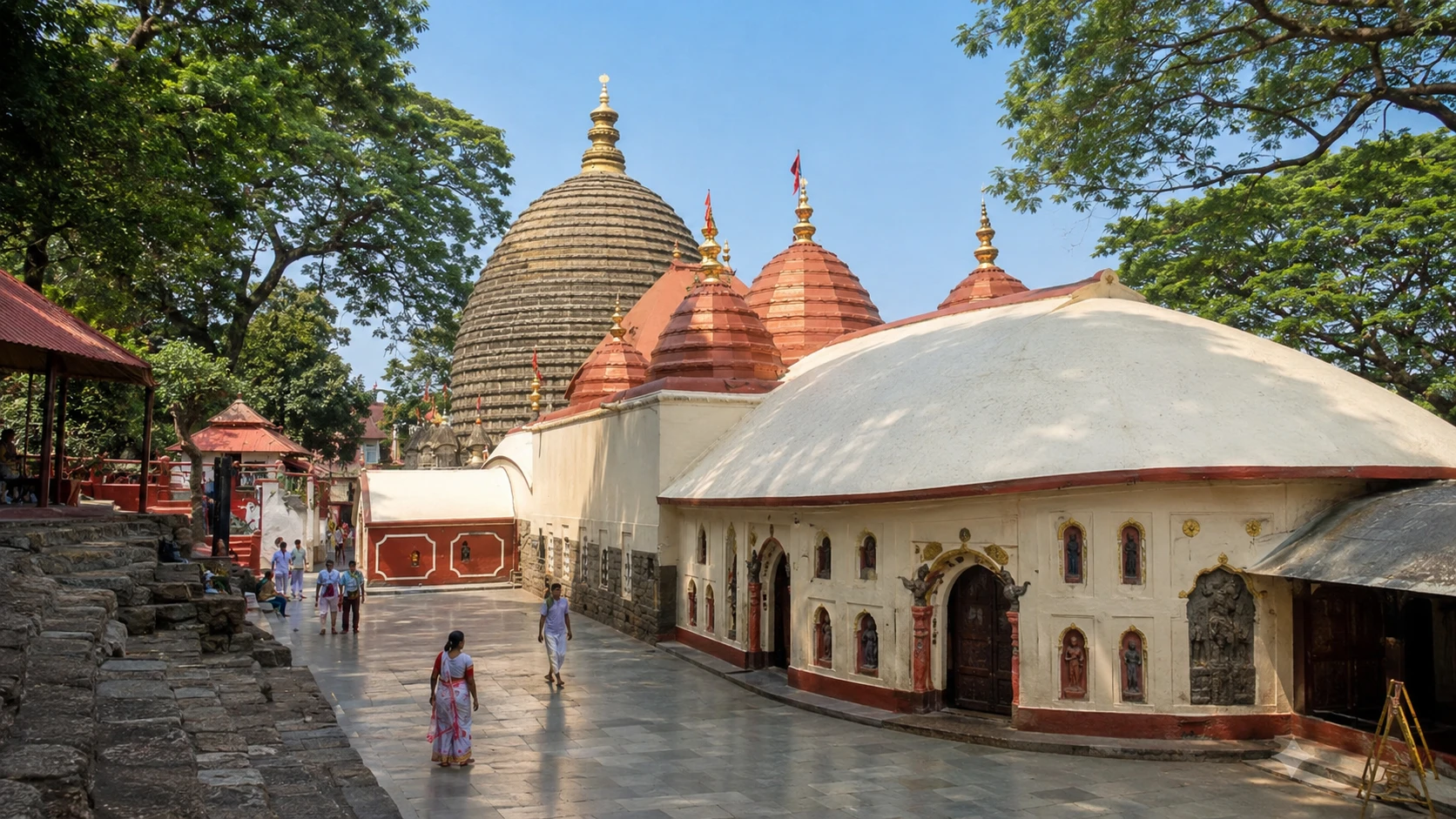
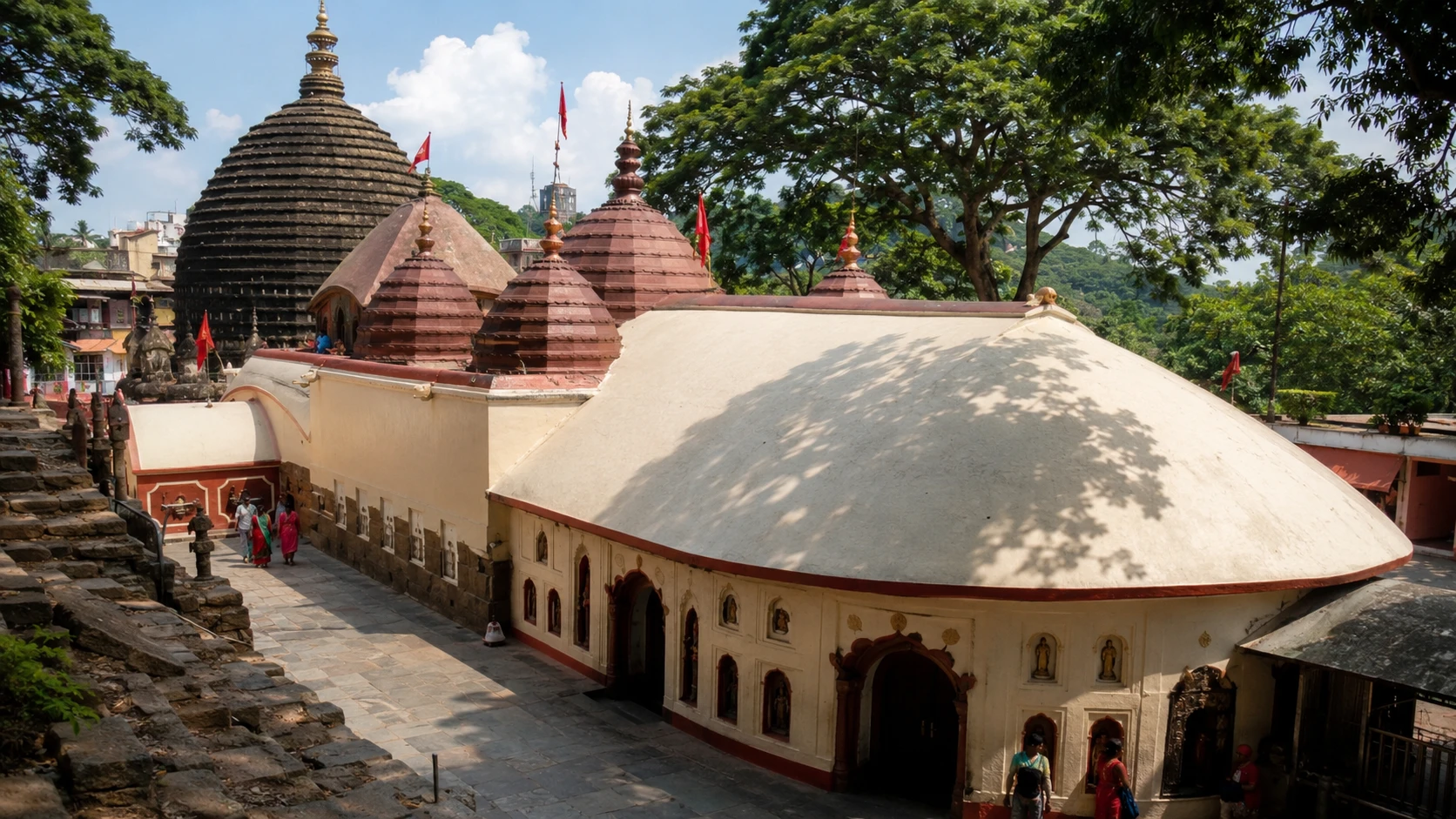
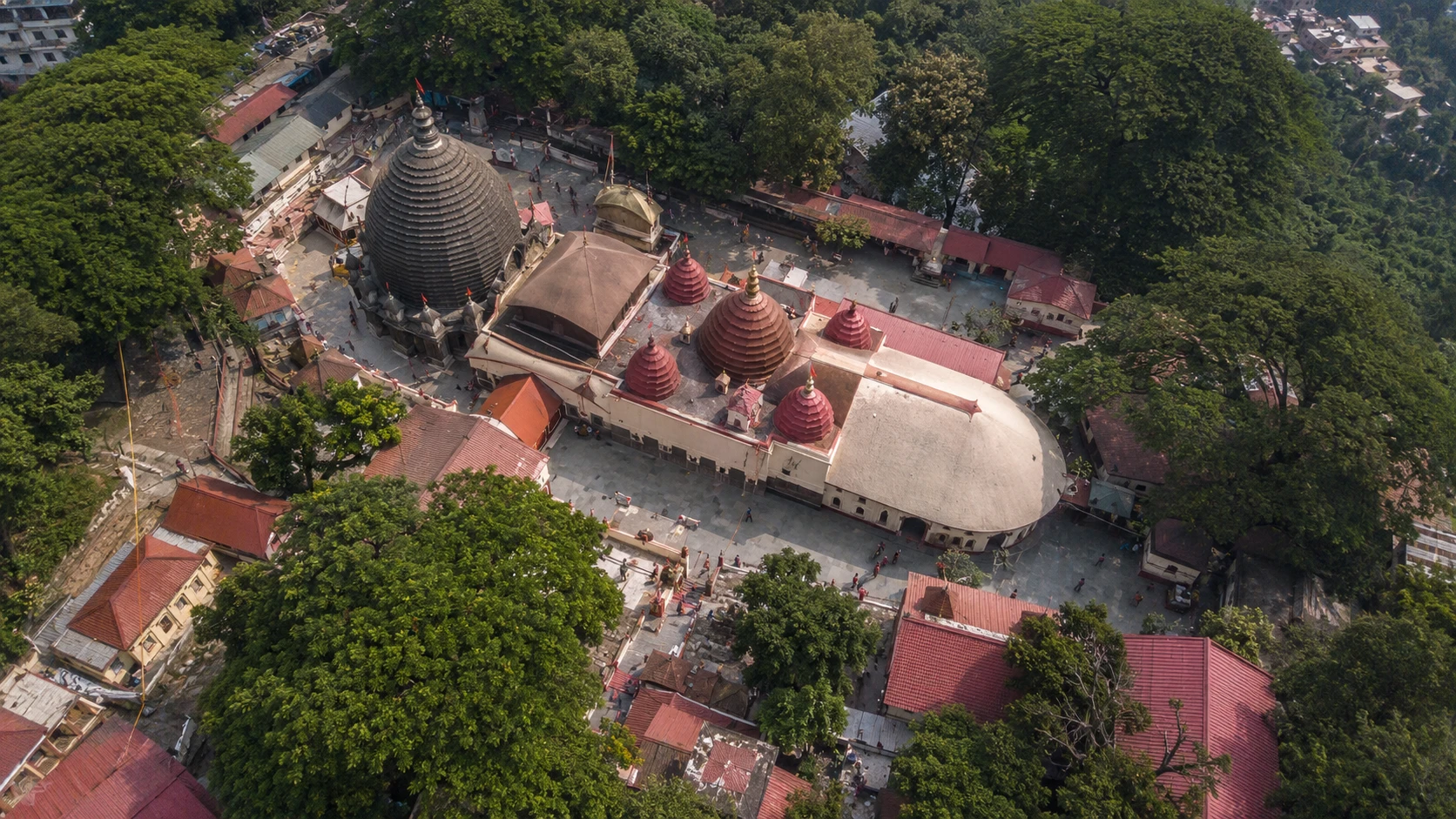
Nilachal style, a distinctive hemispherical (rambha) dome over a cruciform base, fusing North Indian shikhara tradition with regional Koch-Ahom adaptation
Open
05:30 – 22:00
Aarti
05:30 · 08:00 · 12:00 · 19:00
Special
Sparsha (touch) darshan available for additional fee; entire Nilachal complex hosts ten subsidiary shrines to the Dasha Mahavidya (Kali, Tara, Tripura Sundari, Bhuvaneshwari, Bhairavi, Chinnamasta, Dhumavati, Bagalamukhi, Matangi, Kamala); temple closes for 3 days during Ambubachi Mela (mid-June) and reopens on the fourth
The Sacred Legend · पवित्र कथा
Kamakhya is the only major shrine in India where the Divine Feminine is worshipped in her most fundamental form, not as a sculpted murti but as a natural rock cleft shaped like a yoni, kept perpetually moist by an underground spring whose iron-rich waters turn red each summer. For three days in the lunar month of Ahar, when the goddess is said to enter her menstrual cycle, the temple closes its doors entirely. When they reopen on the fourth day, the Ambubachi Mela begins, one of the largest devotional gatherings in eastern India. Here on Nilachal Hill above the Brahmaputra at Guwahati, where Sati's yoni fell during Vishnu's dismemberment of her corpse, the Mother Goddess does not hide her power. She is bleeding, fertile, and supreme, and her bleeding is sanctified, not shamed.
Sacred Designationपवित्र पदनाम
Shakti Peeth
Body part: Yoni, the womb / sacred genitalia of Sati
Shakti: Kamakhya
Bhairava: Umananda
Sacred Origin Storyपवित्र उत्पत्ति कथा
Source: Kalika Purana (chapters 60, 80), the primary canonical text on Kamakhya. Supplemented by the Devi Bhagavata Purana, the Yogini Tantra, the Mahabhagavata Purana, and the Pithanirnaya.
When Daksha Prajapati held his great yajna at Kankhal and refused to invite his daughter Sati's husband Shiva, Sati went uninvited, and there, before the assembled gods, she heard her father curse her chosen lord with words she could not bear. She rose from her seat, kindled the fire of her own tapas within her body, and consumed herself in flame. The yajna grounds fell silent.
Shiva, when the news reached him, arrived with his ganas and laid waste to Daksha's hall in grief beyond reason.
He lifted Sati's charred body upon his shoulder and began the tandava, a dance of cosmic dissolution. The earth shook. The mountains trembled. The cycle of creation itself began to falter, for Shiva would not stop until the universe was unmade. The gods, terrified, beseeched Vishnu to intervene.
Vishnu followed Shiva through the heavens, and from his Sudarshana chakra he loosed precisely-aimed cuts that severed Sati's body, piece by piece, while she still rested upon her lord's shoulder. As each part fell to the earth below, Shiva's grief lightened, until at last he carried nothing, and the dance ended.
Fifty-one places where Sati's body fell became Shakti Peethas, pillars of the goddess's presence on earth. To the easternmost edge of the subcontinent, on a hill above the Brahmaputra in the land that would be called Kamarupa, fell her yoni, the seat of generation, the source of all life. The hill turned blue as the body part touched it.
Thereafter it was called Nilachal, the blue mountain. And the goddess who manifested there, where the womb of the Adi Shakti had come to rest, took the name Kamakhya, 'she who is known through kama,' through desire, through the generative force that births worlds.
The Kalika Purana explains that this is no ordinary Shakti Peetha. The yoni is not a part of Sati's body but the part, the source from which all bodies, divine and mortal, arise. To worship at Kamakhya is therefore to worship at the womb of the cosmos itself. The goddess here is not a consort, not an aspect, not a fragment.
She is the Mahashakti in her primordial form, and the iron-rich spring that keeps the yoni-shaped stone perpetually moist, that turns red every June when she is said to menstruate, is the visible sign that she is alive and fertile at this place.
No carved image presides over the inner sanctum. The garbhagriha contains only the natural rock cleft, covered in red cloth and silk, with water from the underground spring welling up through it. Devotees descend a narrow stairway into the womb-cave of the earth, and there touch the stone, and through the stone, the goddess herself.
Sources cited:
- Kalika Purana, chapters 60, 80 (primary canonical text on Kamakhya, c. 10th, 11th century, Sanskrit)
- Devi Bhagavata Purana, Skandha 7, chapter 30 (Shakti Peetha enumeration)
- Yogini Tantra, Patala 9, 11 (Shakta-Tantric textual tradition specific to Kamarupa)
- Mahabhagavata Purana (alternate Shakti Peetha enumeration)
- Pithanirnaya (anonymous medieval Sanskrit text enumerating 51 Shakti Peethas)
Other Traditions · अन्य परंपराएँ
Kalika Purana (Naraka-Bhagadatta narrative) and Mahabharata, Sabha Parva (semi-historical Kamarupa kingdom)
An older tradition, embedded within the Kalika Purana itself and corroborated by passages in the Mahabharata's Sabha Parva, frames Kamakhya not only through Sati's dismemberment but through the lineage of Naraka, the asura-king of Pragjyotishpura.
Born to Bhumi (the Earth Goddess) and Varaha (Vishnu's boar avatar) at the moment Varaha lifted the earth from the cosmic ocean, Naraka established his kingdom at Pragjyotishpura, the ancient name for the region now centered on Guwahati. He worshipped Kamakhya as his tutelary deity.
The Kalika Purana describes how the sage Vasishtha later cursed Naraka's descendants when they neglected proper worship, declaring that brahmins would abandon the temple for a yuga, explaining, in mythological terms, the long predominance of non-brahmin tantric officiants (Daivajna Brahmins, Bordeuri lineage) at Kamakhya.
Naraka was eventually slain by Krishna at the request of the gods, but his son Bhagadatta continued the worship and led troops on the Kaurava side at the Mahabharata war.
Modern academic scholarship (Bani Kanta Kakati, Hugh Urban, Patricia Dold), Shakta-tribal syncretism hypothesis
A second tradition, articulated by 20th- and 21st-century scholars rather than classical texts, holds that Kamakhya's deepest historical layer is non-Vedic and pre-Aryan: a goddess of fertility, blood, and earth originally worshipped by the indigenous Khasi, Garo, and Bodo-Kachari peoples of the region.
In this reading, the rock-cleft yoni worship at Nilachal predates its absorption into pan-Indian Shakta theology by centuries or millennia, and the Kalika Purana's narrative framework (sometimes dated 10th, 11th century) represents the moment of formal Sanskritic incorporation rather than the moment of origin.
Bani Kanta Kakati's 'The Mother Goddess Kamakhya' (1948) is the foundational study; Hugh Urban's 'The Power of Tantra' (2010) and Patricia Dold's work on the Kalika Purana extend the analysis. Devotees may regard this as a separate, scholarly framework rather than a competing devotional tradition.
Scholarly Context
Modern scholarship places the Kalika Purana, the principal canonical text on Kamakhya, between the 10th and 11th centuries CE, composed in or near the Kamarupa region itself. Patricia Dold and Hugh Urban have written extensively on Kamakhya as the most consequential Shakta-Tantric center in eastern India, with the unique distinction of housing all ten Mahavidya shrines within a single temple complex. Bani Kanta Kakati's foundational 1948 study argued for deep tribal-syncretic roots of the cult, a thesis that subsequent archaeological and anthropological work has largely supported. Sir Edward Gait's 'A History of Assam' (1906, revised 1926) remains the standard modern history covering the temple's medieval period under Mlechchha, Koch, and Ahom patronage. The destruction date of 1498 by Kalapahar is well-attested across Persian (Riyaz-us-Salatin) and Assamese (buranji) chronicles, though specific architectural details of the pre-1498 structure are not recoverable.
Historyइतिहास
Kamakhya's documented history reaches back to the early Kamarupa kingdom under the Varman dynasty (4th, 7th century CE), whose rulers, Pushyavarman, Bhutivarman, and Bhaskaravarman, are mentioned in the Allahabad Pillar Inscription of Samudragupta and in the travel accounts of the Chinese pilgrim Xuanzang (Hiuen Tsang), who visited Kamarupa around 643 CE and described its capital as Pragjyotishpura.
Though Xuanzang's account does not explicitly name Kamakhya, it confirms an established Sanskritic religious culture in the region by the seventh century. Successor dynasties, the Salasthambha (Mlechchha) line, the Pala kings of Kamarupa (10th, 12th century, distinct from the Bengal Palas), and various intermediate rulers, extended royal patronage to the Kamakhya cult, as attested by copper-plate inscriptions and by the composition of the Kalika Purana itself, which is widely understood as a Kamarupa-region production reflecting royal Shakta theology.
The temple's institutional life entered crisis in 1498, when Kalapahar, a general under Sulaiman Karrani of the Bengal Sultanate, infamous in eastern India for systematic temple destruction, sacked the original structure.
The architectural evidence for what stood before this date is lost; only fragmentary masonry remains, much of it incorporated into the foundations of the rebuilt temple.
Reconstruction came under the Koch dynasty. In 1565, King Naranarayan and his brother Chilarai (also called Sukladhwaj, the renowned general) undertook a complete rebuild of the Kamakhya shrine, using the architect Megh Mukdam. The current Nilachal-style temple, with its distinctive hemispherical dome over a cruciform base, dates from this Koch reconstruction.
The Darang Raj Vamshavali and surviving inscriptions at the temple corroborate the dates and patronage.
Under the Ahom dynasty, which ruled the Brahmaputra valley from the 13th to the early 19th century, Kamakhya received continuous royal patronage. King Pratap Singha (r. 1603, 1641) consolidated Ahom support for the temple. King Pramatta Singha (r. 1744, 1751) commissioned major repairs and the silver canopy that still covers the inner sanctum.
Subsequent Ahom kings, Rajeshwar Singha, Lakshmi Singha, added subsidiary shrines for the ten Mahavidya goddesses, giving the complex its mature form. The Bordeuri Samaj, the traditional priestly council that continues to administer ritual life at the temple today, traces its institutional lineage to this Koch-Ahom period.
Under British administration (1826 onward, after the Treaty of Yandabo), the temple operated under the supervision of the Government of Assam, with Bordeuri ritual autonomy preserved. In the post-Independence era, the temple is governed by the Kamakhya Devalaya Bordeuri Samaj in coordination with the Assam government, and is included in the Government of India's PRASAD pilgrimage development scheme.
The Ambubachi Mela, once a regional gathering, has grown into an annual pilgrimage drawing over a million devotees during a three-to-four-day window each June, with infrastructure expanded under successive state tourism initiatives.
Historical Timelineऐतिहासिक कालक्रम
Kamarupa kingdom under the Varman dynasty extends royal Shakta patronage to the cult of the goddess at Nilachal Hill. The Allahabad Pillar Inscription of Samudragupta (c. 350 CE) lists Kamarupa as a frontier kingdom; the Chinese pilgrim Xuanzang visited Pragjyotishpura around 643 CE during the reign of Bhaskaravarman and recorded an established Sanskritic religious culture in the region.
Xuanzang's record confirms Sanskritic religious practice in 7th-century Kamarupa but does not name Kamakhya specifically. The temple's exact form before 1498 is not recoverable from primary sources; archaeological evidence is fragmentary. The Varman-era association with Nilachal cult worship is inferred from continuity with later Mlechchha and Pala-period epigraphy rather than direct contemporary attestation.
Composition of the Kalika Purana, the principal canonical Sanskrit text on Kamakhya, the goddess's iconography, the geography of Nilachal Hill, the Naraka-Bhagadatta lineage, and the ritual framework for Shakta worship at the temple. The text is widely understood as a Kamarupa-region production reflecting royal Shakta theology of the period.
Dating of the Kalika Purana is debated; estimates range from the 9th to the 12th century, with scholarly consensus settling between 10th and 11th. The 'discovery' type here marks the canonical textual emergence rather than a singular discovery event.
Destruction of the original Kamakhya temple by Kalapahar (Kalu Khan), general under Sultan Sulaiman Karrani of the Bengal Sultanate. The original architectural form, the structure that stood through the Varman, Mlechchha, Pala, and earlier Koch periods, was effectively reduced to ruins, and the goddess's worship at the site entered a period of dormancy until the mid-16th century reconstruction.
Kalapahar's name appears across Persian, Bengali, and Assamese sources, with his campaigns variously dated 1498 or in the years immediately surrounding. The thoroughness of destruction at Kamakhya is uncontested across sources, though specific casualty and looting figures (where they appear) reflect chronicle conventions rather than verifiable counts.
Reconstruction of the Kamakhya temple by Koch king Naranarayan and his brother and general Chilarai (Sukladhwaj), executed by the master architect Megh Mukdam. The current Nilachal-style temple, with its distinctive hemispherical (rambha) dome over a cruciform sanctum base, dates from this reconstruction. The Koch project re-established active worship at the yoni-pitha and laid the institutional foundation for the temple's Ahom-period flourishing.
Ahom king Pramatta Singha commissions major repairs, the silver canopy over the inner sanctum, and additional structural reinforcement. His successors, Rajeshwar Singha and Lakshmi Singha, added subsidiary shrines for the ten Mahavidya goddesses across the Nilachal complex, completing the temple's mature architectural and theological form as a Dasha Mahavidya Peetha.
What You'll Seeदर्शन में
Kamakhya is unique among major Hindu shrines: the inner sanctum contains no carved murti at all. The devotee descends a narrow stone staircase into a low, cave-like chamber beneath the temple floor, the garbhagriha in the most literal sense, a womb-cave, and there, in near-darkness lit only by oil lamps, encounters the goddess as a natural cleft in the bedrock, shaped like a yoni and perpetually wet from an underground spring.
The cleft is draped in red cloth and silk, festooned with hibiscus garlands, and surrounded by offerings of red flowers, kumkum, and silver coins. A silver canopy commissioned by the Ahom king Pramatta Singha in 1744 covers the chamber above.
The water that wells up through the stone is iron-rich; during the summer months it acquires a reddish-brown tinge, which devotees and the canonical Kalika Purana identify as the goddess's menstrual flow.
The temple itself, viewed from outside, exhibits the distinctive Nilachal style, a hemispherical (rambha) dome rising over a cruciform base, painted in deep red and ochre, studded with sculpted dancing forms of Devi, gana figures, and lotus motifs.
The dome is unlike both classical Nagara shikhara and Dravidian vimana; it is a regional Koch-Ahom innovation that emerged from the 1565 reconstruction.
The Nilachal complex houses ten subsidiary shrines for the Dasha Mahavidya, Kali, Tara, Tripura Sundari (Shodashi), Bhuvaneshwari, Bhairavi, Chinnamasta, Dhumavati, Bagalamukhi, Matangi, and Kamala. Each Mahavidya has her own small temple within walking distance of the main shrine, making Kamakhya the only single site in India where all ten Mahavidyas can be worshipped in one pilgrimage.
The Chinnamasta and Tara shrines, perched on adjacent ridges of Nilachal, are particularly important Tantric sites in their own right.
Distinctive Practicesविशिष्ट परंपराएँ
Ambubachi Mela, the menstrual closure of the goddess
अंबुबाची मेला, देवी का रजस्राव-काल
Annual, mid-June (lunar month of Ahar, typically 22, 26 June; dates vary by panchang)
For three days each summer, when the iron-rich spring beneath the temple is said to flow most heavily and the surrounding waters acquire a reddish tinge, the temple is declared closed because the goddess is in her menstrual cycle. All worship is suspended. No cooking, no agriculture is to be undertaken in the surrounding region. On the morning of the fourth day, the temple's doors reopen amidst a pilgrim gathering that has, in recent decades, grown to over a million devotees. Sadhus, Tantric practitioners, and ordinary devotees from across India and Nepal converge on Nilachal Hill. The first prasad distributed on reopening day is a piece of red cloth, Angabastra, that has been placed near the yoni-stone during the closure, believed to carry the goddess's menstrual blessing.
The Ambubachi observance is the most powerful inversion of menstrual taboo in any major Hindu tradition. Where most Indian temples bar menstruating women from entry, Kamakhya closes the temple because the goddess herself is menstruating, and reopens it as a celebration of her fertility. The teaching is direct: the bleeding feminine is not impure but generative, not to be hidden but to be revered. The Kalika Purana states explicitly that the menstrual cycle of the Mother Goddess is the cosmic equivalent of the agricultural cycle, both are the means by which life renews itself, and both demand honor.
Sparsha Darshan, touching the yoni-stone
स्पर्श दर्शन, योनि-शिला का स्पर्श
Daily during open hours, subject to queue and seva fee
Unlike most major temples where the inner sanctum is viewed from a distance, Kamakhya permits devotees to descend into the garbhagriha and physically touch the moist yoni-stone with their fingertips, then bring those fingertips to their forehead. The descent is via a narrow, low-ceilinged stairway; the chamber is small, often crowded, and the entire encounter is conducted in near-darkness. A small seva fee facilitates a separate sparsha queue; ordinary darshan (without touching) is free.
The schema of Hindu darshan is usually visual, the devotee sees the deity, and the deity sees the devotee. At Kamakhya, darshan is haptic. The believer does not merely see the goddess; she touches her, and through that touch enters into a relationship that the temple's tradition holds to be more intimate than any sculpted murti can offer. The stone is wet; her presence is felt as moisture on the fingertips. This is the goddess as immediate, embodied, present in matter, not above it.
Bali Prathā, Shakta animal offering
बलि प्रथा, शाक्त पशु-अर्पण
Primarily during Durga Puja, Kali Puja, and Manasa Puja; also offered by individual devotees fulfilling vows
Kamakhya is among the few major Hindu temples in India where animal sacrifice (bali) continues as an open, traditional ritual. The most common offerings are male goats and pigeons; buffalo sacrifice once practiced during Durga Puja is now rare and restricted. The bali is performed by traditional Bordeuri officiants in a designated outer courtyard, never inside the inner sanctum. Devotees offering bali typically do so in fulfillment of a vow (manat), to seek a child, a cure from illness, success in an undertaking, or release from a chronic affliction. The meat of the offering is then distributed and consumed.
Shakta theology, as articulated in the Kalika Purana and Yogini Tantra, holds that the goddess of the yoni-pitha is also the goddess of blood, and that life given in offering returns to its source. The Kalika Purana includes the 'Rudhiradhyaya' chapter specifically codifying which animals may be offered, in what manner, and with what mantras. Modern Hindu reformist traditions oppose bali; the practice remains contested. Eternal Raga documents the tradition without endorsement or condemnation, in keeping with respectful pluralism. Initiation in Shakta-Tantric ritual is required for the officiating priests; lay devotees observe rather than perform the rite.
Did You Know?क्या आप जानते हैं?
The reddish tinge that colors the underground spring at Kamakhya each summer, interpreted in tradition as the goddess's menstrual flow, has a measurable geological basis. Nilachal Hill sits over iron-rich rock; the seasonal flow regime concentrates oxidized iron compounds in the water during pre-monsoon months. The Kalika Purana, composed at least a thousand years before this geology was scientifically understood, treated the phenomenon as evidence of the goddess's living presence. Both readings, the geological and the devotional, point to the same source: this is a place where the earth itself bleeds.
Geological Survey of India regional reports on Nilachal Hill (iron-content of subsurface springs); Patricia Dold, 'Pilgrimage to Kamakhya through Text and Lived Religion' (2011); Kalika Purana, chapter 62
Kamakhya is the only temple in India where all ten Mahavidya goddesses, Kali, Tara, Tripura Sundari, Bhuvaneshwari, Bhairavi, Chinnamasta, Dhumavati, Bagalamukhi, Matangi, and Kamala, have their own dedicated shrines within a single complex. Pilgrims can complete a full Dasha Mahavidya darshan in a single visit, an opportunity unavailable elsewhere in the subcontinent.
Survey of Kamakhya Nilachal complex; Hugh B. Urban, 'The Power of Tantra' (2010); Bani Kanta Kakati, 'The Mother Goddess Kamakhya' (1948)
Kamakhya is the only major Shakti Peetha worshipped not as a sculpted murti but as a natural rock formation. The inner sanctum contains no anthropomorphic image of the goddess, only the wet yoni-shaped cleft in the bedrock, draped in red cloth. Even in iconographic art outside the sanctum, Kamakhya is most often depicted symbolically (as a yoni-yantra) rather than as a humanoid figure.
Kalika Purana, chapter 60; field observation; Bani Kanta Kakati (1948)
The silver canopy that hangs above the inner sanctum was commissioned in 1744 by Ahom king Pramatta Singha. It is one of the finest surviving examples of medieval Assamese silverwork, with engraved Shakta motifs and a continuous band of Mahavidya iconography along its lower edge. Despite being nearly three centuries old and continuously exposed to incense smoke and humidity, it has required only minor restoration in its lifetime.
Ahom buranjis (royal chronicles); Surya Kumar Bhuyan, 'Anglo-Assamese Relations 1771, 1826' (1949); Department of Archaeology, Assam, survey records
The Kalika Purana, though classified as an Upapurana (minor Purana), is regarded in Shakta tradition as authoritative on the level of the major Mahapuranas, specifically because of its detailed treatment of Kamakhya, the Shakti Peetha tradition, and the worship of the goddess in her yoni-form. It is one of the few Puranic texts whose composition can be localized to a specific region (Kamarupa) and dated with reasonable confidence (10th, 11th century).
Biswanarayan Shastri, 'Kalikapurana' critical edition (Nag Publishers, 1991); R.C. Hazra, 'Studies in the Upapuranas, Vol. 2' (1963)
Visitor Accessप्रवेश जानकारी
Kamakhya famously inverts the menstrual-restriction tradition observed at most Hindu temples. Women are welcome at Kamakhya at all times, including during their menstrual cycles, the goddess herself menstruates here, and to consider human menstruation impure at her temple would contradict the foundational theology of the site. The only annual closure is when the goddess is in her own cycle (Ambubachi, three days each June), during which the entire temple is closed to all devotees regardless of gender. Photography is strictly prohibited inside the inner sanctum (garbhagriha) and the staircase descending to it; phones and cameras must be deposited at the counter before sparsha darshan. Footwear is removed at the prescribed point on the temple's exterior. Animal sacrifice is performed in a designated outer courtyard during certain festivals; visitors uncomfortable with this tradition may time their visit to avoid the bali courtyard.
Sparsha darshan involves descending into a low, dark, crowded chamber, pilgrims with claustrophobia, mobility limitations, or strong heat-and-humidity sensitivity should pace themselves and consider visiting in cooler months (October, March). The temple permits a separate priority queue (Sheegra Darshan) for an additional fee; rates are published at the entrance and are subject to change. During Ambubachi Mela, expect extreme crowding, multi-hour queues, limited accommodation, and temple closure for the first three days, first-time pilgrims may prefer non-Ambubachi months to absorb the temple's atmosphere unhurried.
Festivalsत्योहार
Ambubachi Mela
अंबुबाची मेला
Jun (Ahar / Ashadha; typically 22, 26 June, dates per panchang)
The most consequential festival at Kamakhya and one of the largest Shakta pilgrimages in eastern India. The temple closes for three days when the goddess is said to enter her menstrual cycle, and reopens on the fourth day amidst a gathering that draws over a million devotees, sadhus, Tantric practitioners, lay pilgrims, and curious travelers, to Nilachal Hill. Red cloth (Angabastra) placed near the yoni-stone during the closure is distributed as prasad on reopening day; it is considered the most sought-after Kamakhya blessing. Pilgrims travel from across India and Nepal; the Assam government has progressively expanded infrastructure to accommodate the gathering.
Durga Puja / Navratri
दुर्गा पूजा / नवरात्रि
Sep-Oct (Ashwin Shukla Pratipada to Dashami)
The nine-night festival of the goddess is observed with particular intensity at Kamakhya, where the goddess is understood not as Durga the warrior alone but as the underlying Mahashakti from whom all Devi forms emerge. Each of the nine nights is dedicated to one of the Navadurga aspects, with parallel worship across the ten Mahavidya subsidiary shrines. Animal offerings (bali) are performed during Mahashtami and Mahanavami in the designated outer courtyard. The festival culminates on Vijayadashami with a procession (though distinct from the public Durga immersion of Bengal).
Manasa Puja
मनसा पूजा
Aug (Shravan-Bhadrapada)
Manasa, the regional serpent goddess of Assam and Bengal, is worshipped at Kamakhya during the monsoon as a tutelary of fertility and protection from snakebite. The festival has indigenous roots predating the temple's Sanskritic phase; in Kamakhya's syncretic tradition, Manasa is understood as one of the regional manifestations of the Adi Shakti whose primary form resides in the yoni-pitha. Songs of the Manasamangal Kavya tradition are sung in the temple courtyard during the festival days.
Kali Puja / Deepavali
काली पूजा / दीपावली
Oct-Nov (Kartika Amavasya)
On the new-moon night of Kartik, when much of India celebrates Lakshmi at Deepavali, Kamakhya and eastern India honor Kali, the dark, fierce, formless Mahavidya who, in Shakta theology, is the night-aspect of the same Shakti worshipped by day at the yoni-pitha. The Kali temple at Nilachal hosts night-long ritual; the main Kamakhya shrine remains lit and accessible to devotees. The contrast with western and northern India's Lakshmi-Deepavali observance illustrates the regional diversity of the Hindu festive calendar.
Traditional Offeringsपारंपरिक अर्पण
Primary Offerings
Red Hibiscus (Japa / Joba)
लाल जपाकुसुम (जोबा)
जपाकुसुम
The bright crimson hibiscus is the most iconic Devi offering in Shakta tradition. Its color matches the red cloth that drapes the goddess, the kumkum that marks her forehead, and the menstrual flow that sanctifies the Ambubachi observance. The Devi Bhagavata describes the goddess as 'crimson as the morning sun, fond of the japa flower above all others'. At Kamakhya, hibiscus garlands are laid directly on the yoni-stone and atop the silver canopy.
Sindoor / Kumkum (Vermilion)
सिंदूर / कुमकुम
सिन्दूर
Sindoor, the red vermilion mark, is offered to the goddess and then taken back by devotees as a blessing. For women devotees, applying Kamakhya's sindoor in the central parting of the hair is considered a particularly powerful blessing for marital harmony and fertility. The color symbolism is consistent with the temple's foundational theology: red is the color of life-blood, of fertility, of the generative power that the goddess embodies.
Red Chunari / Lal Saree
लाल चुनरी / लाल साड़ी
रक्ताम्बर
Devotees offer red cloth, a chunari, a saree, or simply a length of red silk or cotton, to be draped over the goddess. The Bordeuri attendants accept these offerings and rotate them through the sanctum across multiple devotees; the cloth retains the moisture of the yoni-stone and is later returned to devotees as Angabastra-prasad. To offer a red saree at Kamakhya is to participate in the ancient practice of clothing the goddess in the color of her own essence.
Coconut (Narikela)
नारियल
नारिकेल
The whole coconut, with husk and water intact, is offered to the goddess and ritually broken by the priest. In Shakta symbolism the coconut is read as the ego (ahamkara): its hard outer husk represents the false self that must be cracked open through devotion, releasing the sweet water and white flesh, the purified inner being, to the goddess. Coconuts offered at Kamakhya are often distributed as prasad after the ritual.
Pan-Supari (Betel Leaf and Areca Nut)
पान-सुपारी
ताम्बूल
In eastern Indian Devi worship, Bengali, Assamese, Odia traditions alike, pan-supari is offered as a mark of welcome and hospitality to the goddess, treating her as an honored guest in the temple. The betel leaf represents earth, the areca nut represents seed, and together they offer the goddess the basic substances of life. The offering pre-dates the temple's Sanskritic incorporation and reflects the indigenous tribal substratum that Kakati's 1948 study traced.
Ghee Diya (Clarified Butter Lamp)
घी का दीया
घृत-दीप
Lamps lit with ghee are offered before the goddess at every aarti. In the dim womb-cave of the inner sanctum, the steady amber flame of a ghee diya is often the only meaningful light, and the encounter between devotee and yoni-stone is illuminated by it. The flame represents the transformation of matter into light, of the body into devotion, the principle the entire temple embodies.
Unique to This Temple
Angabastra, the Ambubachi Red Cloth
अंगवस्त्र, अंबुबाची लाल वस्त्र
During the three-day Ambubachi closure, red cloth, silk or fine cotton, is placed inside the closed sanctum near the yoni-stone, where it absorbs the moisture and the iron-rich flow of the underground spring. When the temple reopens on the fourth morning, this cloth, now called Angabastra, 'body-garment' of the goddess, is the most sought-after prasad in all of Kamakhya. Devotees who receive even a small piece of Angabastra treasure it for life; it is wrapped, framed, or worn during important religious occasions. Distribution is managed by the Bordeuri Samaj on reopening day, with the largest pieces reserved for senior pilgrims and the smaller squares distributed widely.
Bhog, Cooked Rice Offering
भोग, पका हुआ चावल अर्पण
On major festival days, Durga Puja, Kali Puja, and Manasa Puja in particular, cooked bhog is offered to the goddess and then distributed as mahaprasad to assembled devotees. The Kamakhya bhog typically includes pulao or khichuri (rice cooked with lentils, ghee, and mild spices in the Bengali-Assamese style), vegetables, payesh (rice-milk pudding), and seasonal sweets. The communal sharing of bhog after offering reflects Shakta theology's insistence that the goddess's prasad is the goddess herself in edible form, to eat it is to receive her into the body directly.
Hibiscus, red cloth, kumkum, coconut, and pan-supari can be brought from outside or purchased at vendor stalls along the Nilachal Hill road and at the temple base. The Bordeuri Samaj also operates an official offering counter inside the temple complex; offerings purchased there are pre-prepared in traditional thalis for direct presentation to the priest. Outside vendors may attempt to overcharge or substitute lower-quality items during Ambubachi and Durga Puja, verify weights and prices before purchase. Animal offerings (bali) are organized only on specific festival days and require advance arrangement with the Bordeuri Samaj; this is a Shakta-Tantric ritual and is not undertaken casually.
How to Reachकैसे पहुँचें
Kamakhya sits atop Nilachal Hill in western Guwahati, about 8 km from Guwahati city center and 20 km from Lokpriya Gopinath Bordoloi International Airport (LGBIA), Assam's principal airport. By air, LGBIA is well-connected to Delhi, Kolkata, Mumbai, Bangalore, Chennai, Hyderabad, and the major Northeast hubs; pre-paid taxis from the airport to Kamakhya take 45, 60 minutes depending on traffic.
By rail, Kamakhya Junction (KYQ) sits at the foot of Nilachal Hill and is served by major express trains including the Saraighat Express from Howrah, the Brahmaputra Mail from Delhi, and the Vande Bharat services connecting eastern hubs; Guwahati Junction (GHY), about 10 km from the temple, is the larger station with wider train coverage.
From either station, shared autos, app-based taxis (Uber, Ola), and the temple's own shuttle service climb the winding road up Nilachal Hill to the temple complex. The final ascent has hairpin bends; during monsoon the road can become slippery, and during Ambubachi crowds make vehicular access slow, pilgrims often choose to walk the last stretch.
Local Assam State Transport buses connect Guwahati's central bus stand to the base of Nilachal Hill, from which the temple is a 1.5 km walk uphill or a short shared-vehicle ride.
Plan Your Visitयात्रा की योजना
🌤 Best Season
October to March is the most comfortable period, temperatures range from 12, 25°C, humidity is low, and the post-monsoon greenery makes the Nilachal climb pleasant. Avoid the peak monsoon (June-August) unless visiting specifically for Ambubachi: heavy rain, leech presence on hill paths, and slippery temple steps reduce the experience. April-May is hot and humid. The two most spiritually charged times, Ambubachi (mid-June) and Durga Puja (Sep-Oct), are also the most crowded; first-time visitors who want unhurried darshan should choose November-February when crowds are manageable.
👘 Dress Code
Modest, traditional attire is expected. For men: dhoti and shirt, or full-length trousers with a shirt or kurta; sleeveless garments are discouraged. For women: saree, salwar-kameez, or long skirt with covered shoulders and head; a dupatta or chunni for head covering is recommended inside the inner sanctum. Leather items (belts, wallets, watches with leather straps) should be removed or left outside as a mark of respect. Footwear is removed at the prescribed outer boundary of the temple.
📱 Phones & Photography
Photography and videography are strictly prohibited inside the inner sanctum (garbhagriha) and on the staircase descending into it. Phones, cameras, and recording devices must be deposited at the designated counter before entering the sparsha darshan queue; lockers are provided. Outside the inner sanctum, in the outer mandapa, courtyards, and Mahavidya subsidiary shrines, photography is generally permitted except where signs indicate otherwise. During Ambubachi Mela, additional restrictions may be enforced; follow the on-site guidance from Bordeuri officiants and Assam Police personnel.
🏨 Accommodation
The Kamakhya Devalaya Bordeuri Samaj operates several guest houses on and near Nilachal Hill, primarily catering to pilgrims. The Assam Tourism Development Corporation runs Prashanti Tourist Lodge near the temple base. Beyond temple-affiliated options, Guwahati city offers a wide range of hotels (budget to luxury) within 20, 30 minutes' drive; staying in Guwahati and commuting to the temple is the standard choice for non-Ambubachi visits. During Ambubachi Mela, lodging on Nilachal Hill is fully booked months in advance, and government-erected tent cities accommodate the overflow; pilgrims attending Ambubachi should book early or be prepared to camp. The trust's official channels publish accommodation listings each year.
Sacred Soundsपवित्र ध्वनि
Devi Suktam (Vāk Sūkta, Rig Veda 10.125)
stotram · 420
Mahishasura Mardini Stotram (Ayi Giri Nandini, attributed to Adi Shankara)
stotram · 540
Devi Kavacham (from Durga Saptashati)
kavacham · 600
Lalita Sahasranama (Brahmanda Purana)
sahasranama · 2400
Kamakhya Stotram (from Kalika Purana)
stotram · 360
Did You Know? · क्या आप जानते हैं?
The same translation error that turned '33 Koti' into '33 crore' in Hinduism also happened in Buddhism. The Chinese translation of Buddhist texts rendered 'Sapta Koti Buddha' (7 Supreme Buddhas) as '7 Crore Buddhas.' The Tibetan translation got it right: 7 types, not 7 crore. One Sanskrit word, misread across two major world religions, generated two identical misconceptions independently.
Related Contentसंबंधित सामग्री
Related Scriptures
Community Reflections
🕉️
Be the first to share your reflection.