Tripura Sundari Mata
त्रिपुर सुंदरी माता
Sri Vidya's principal goddess in her seat at the three-cities
Udaipur, Tripura, India
Tripurā SundarīAlso known as: Tripura Sundari, Tripureshwari, Lalita Tripura Sundari, Sodashi, Matabari Devi, Kurma Pitha, Matabari, ত্রিপুরা সুন্দরী, ত্রিপুরেশ্বরী, ললিতা ত্রিপুর সুন্দরী, মাতাবাড়ি, কুর্ম পীঠ
Era
Origin pre-historic per Puranic Sri Vidya tradition; present temple consecrated 1501 CE by Maharaja Dhanya Manikya (recorded in the Tripura Rajamala); continuous Manikya dynasty patronage from the 14th century to 1949; current administration under the Government of Tripura's Tripura Sundari Devasthan / Devasthan Trust framework
Architecture
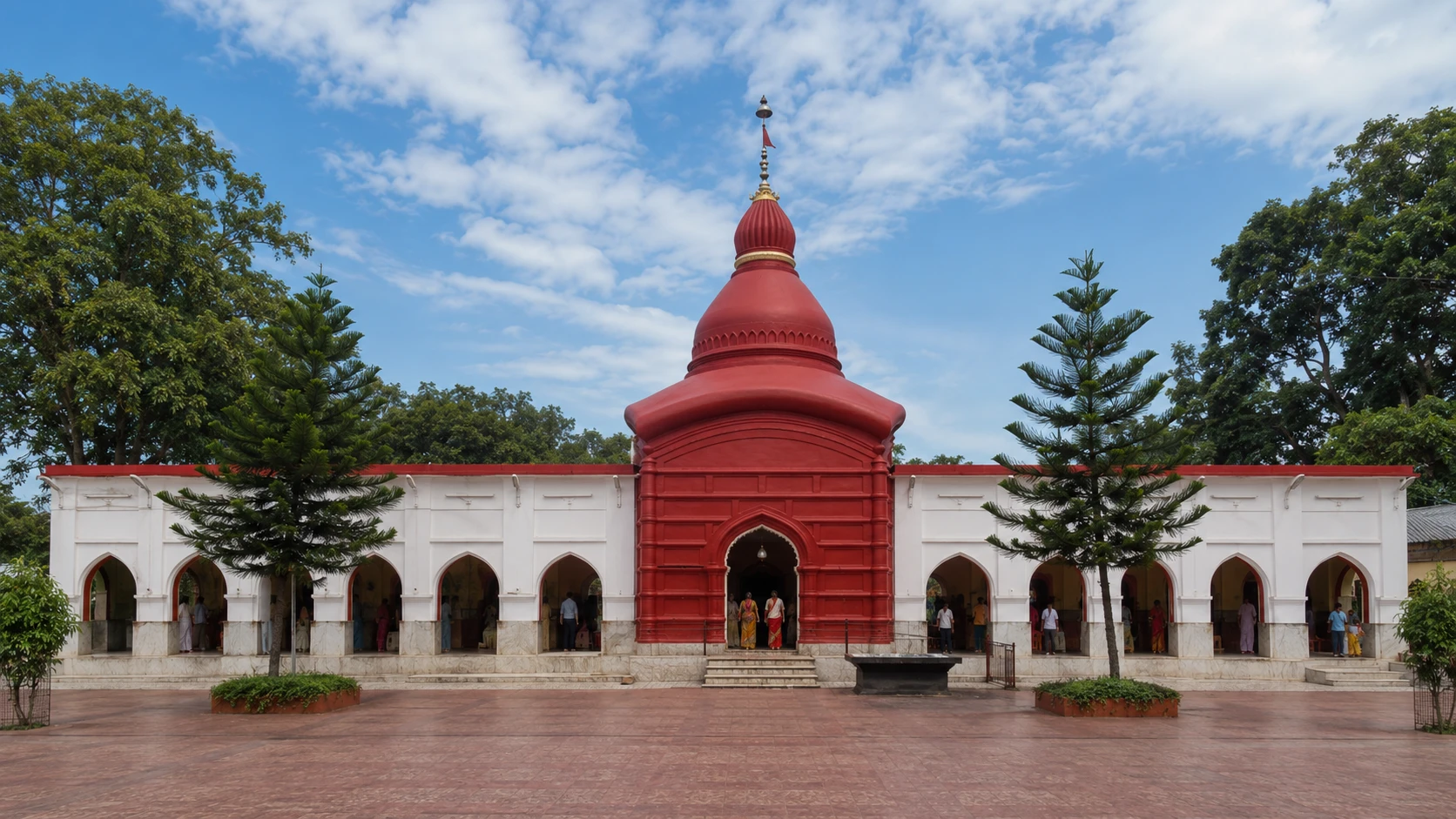
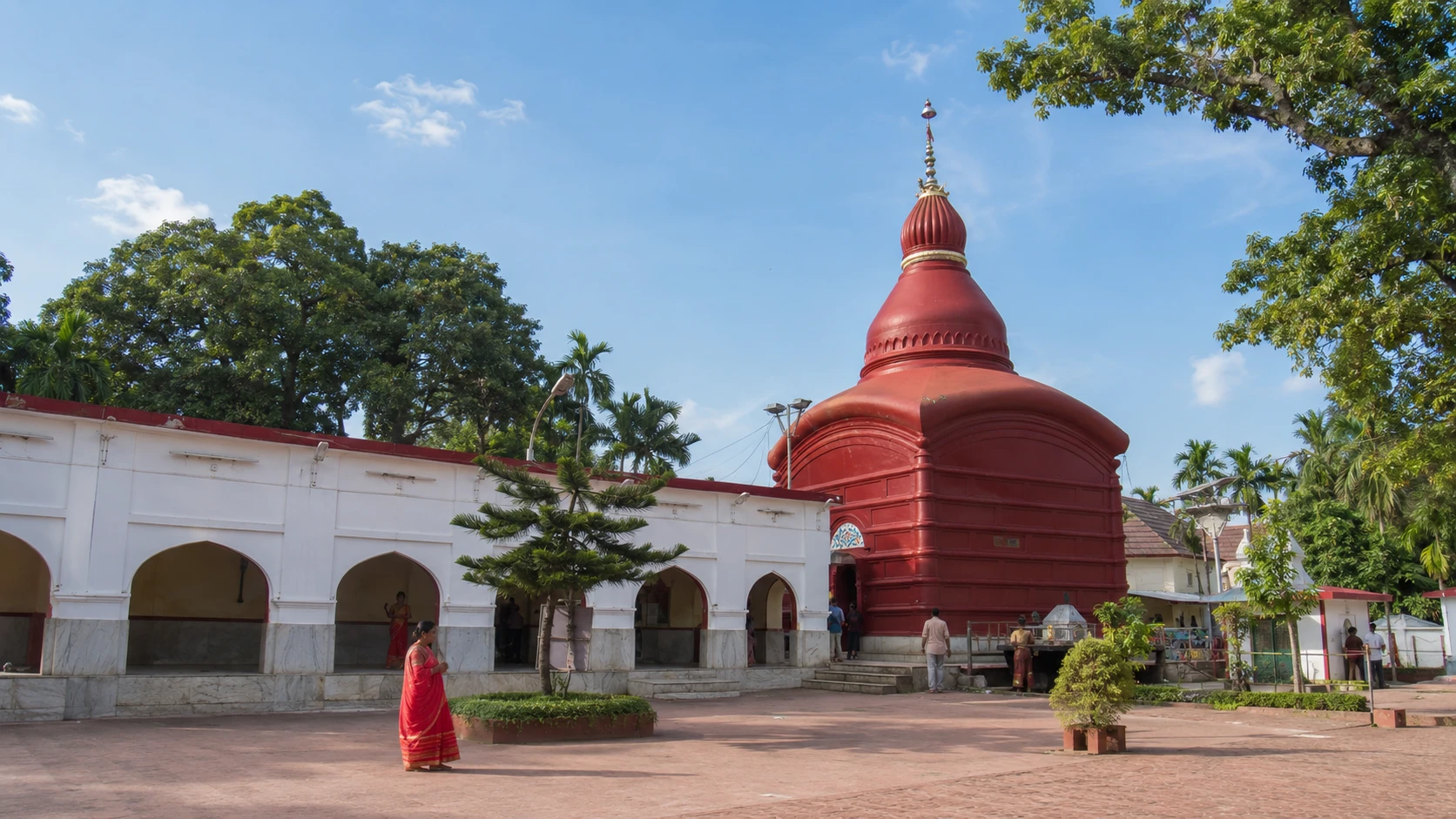
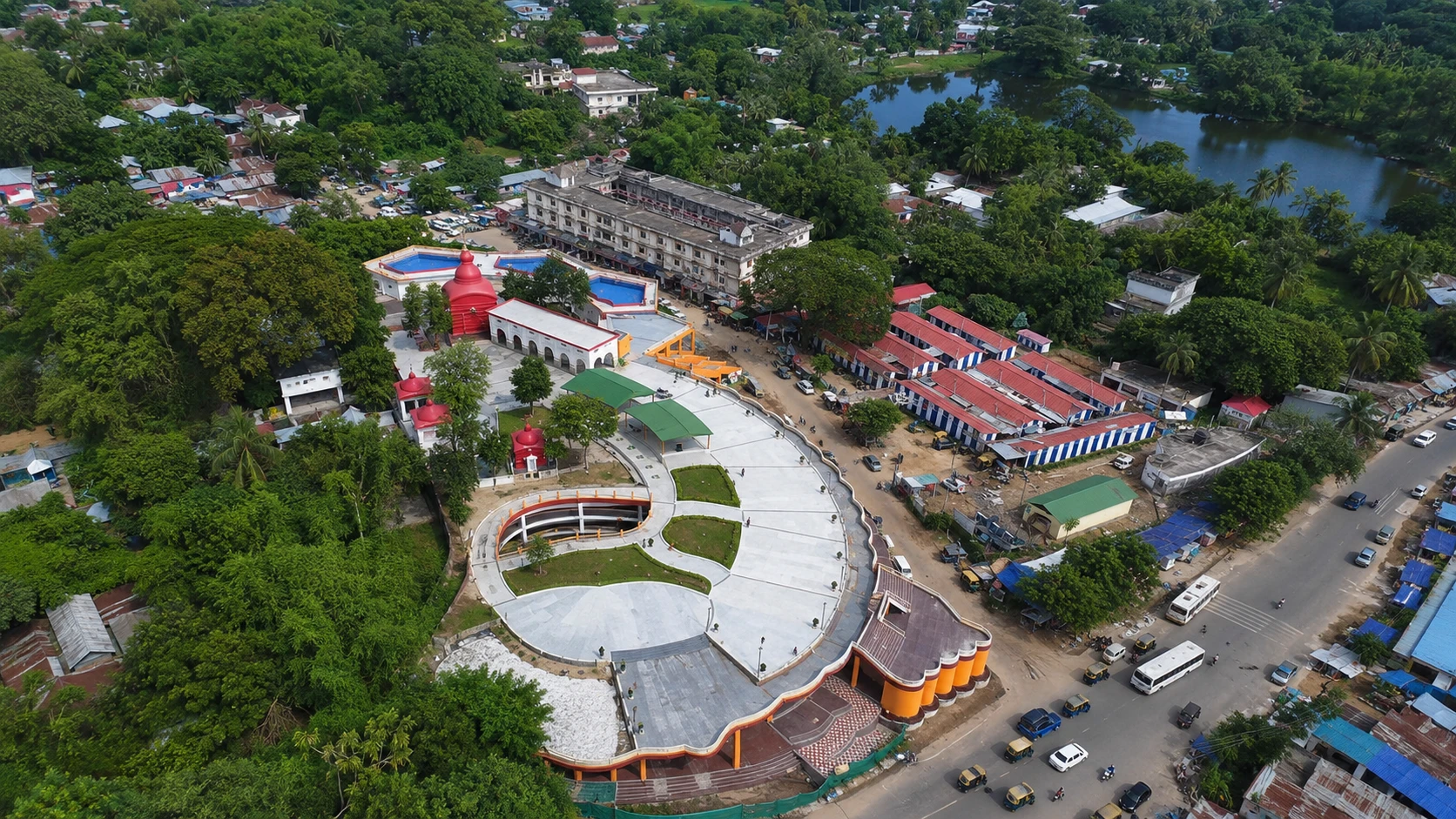
Distinctive Kurma Pitha (tortoise-shape) plan, a square base supporting a hemispherical brick-and-stucco dome that gives the temple its tortoise-shell silhouette; the form draws on Bengali ek-ratna and char-chala temple grammars layered with Mughal-era regional dome work; the present compound includes the main shrine, a Chhota Mata (smaller-mother) subsidiary shrine, and the adjoining Kalyan Sagar tank
Open
05:00 – 21:00
Aarti
05:30 · 12:30 · 18:30 · 20:30
Special
Diwali / Kali Puja three-day mega-mela (October, November), among the largest Devi festivals in northeast India, drawing pilgrims from across Bengal, Tripura, Assam, Bangladesh, and the wider Bengali-speaking world; Durga Puja Navami and Vijayadashami draws are very large in October; Pausha Sankranti observance in mid-January maintains Manikya-era royal ritual continuities; Tantric anushthana cycles conducted on amavasya (new moon) nights are administered under Devasthan Trust supervision and follow lineage-internal protocols
The Sacred Legend · पवित्र कथा
At Udaipur in the southern hills of Tripura, in a temple built in the shape of a tortoise rising from a sacred tank, sits one of the most theologically demanding Devi shrines in India. The goddess here is not a regional form of the cosmic Devi but the cosmic Devi herself, Lalita Tripura Sundari, sovereign of the three cities, principal goddess of the Sri Vidya tradition, the Devi whose thousand names compose the Lalita Sahasranama and whose geometric body is the Sri Yantra. The kingdom of Tripura's Manikya dynasty, ruling unbroken from the 14th century until the kingdom's accession to India in 1949, held her as their kuladevi, the family goddess of the royal lineage. The present temple was consecrated in 1501 CE by Maharaja Dhanya Manikya, an event recorded in the Tripura Rajamala, the dynasty's own chronicle. Locally she is the Matabari, 'Mother's House', and pilgrims approach her shrine as one would a mother's home, by way of the sacred tank of Kalyan Sagar where tortoises rise to be fed and where the sound of bells carries across the water.
Sacred Designationपवित्र पदनाम
Shakti Peeth
Body part: Right foot (dakṣiṇa-pāda) per the regional Bengali-Tripuri Mahatmya tradition and the temple's own canonical claim. The body-part attribution varies across recensions of the 51-Peetha enumeration, some sources place a fragment of the right foot at this site, others identify the seat with broader Tantric body-part categories that do not map cleanly onto the linear 51-list. The right-foot attribution is the regionally affirmed reading and the one carried in the temple's living ritual life.
Shakti: Tripurā Sundarī / Lalitā Tripurā Sundarī, the principal goddess of the Sri Vidya tradition and one of the Daśa Mahāvidyās (Ten Great Wisdom-Goddesses); here understood not as a regional manifestation of the cosmic Devi but as the cosmic Devi herself, in her most theologically central form
Bhairava: Tripureśa, 'Lord of the Three Cities', the Bhairava paired with the Devi in the Pithanirnaya enumeration of the Shakti Peethas
Sacred Origin Storyपवित्र उत्पत्ति कथा
Source: Brahmanda Purana (Lalita Mahatmya / Lalitopakhyana, the foundational text of the Sri Vidya tradition); the regional Tripura Mahatmya transmitted through the temple's priestly lineage; the Tripura Rajamala (the chronicle of the Manikya dynasty); Devi Bhagavata Purana; the Tantric exegetical literature on Lalita Tripura Sundari including the Vamakeshvara Tantra and Nityashodashikarnava
The Brahmanda Purana's Lalita Mahatmya, the foundational text of the Sri Vidya tradition, tells of the goddess's manifestation to slay the asura Bhandasura, who had been generated from the ashes of Kama (the god of love) burnt by Shiva's third eye, and who had grown into a tyrant ruling from the city of Shonita.
The gods, unable to defeat him, performed a great fire-sacrifice; from the central flame emerged Lalita Tripura Sundari, Devi of overwhelming beauty seated on a throne supported by the four directions, holding the sugar-cane bow of desire, the five flowery arrows of perception, the noose, and the goad.
With her army of attendant Shaktis she marched on Shonita and, after a long cosmic battle, slew Bhandasura. The Sri Yantra, the geometric form of the goddess herself, was given by her at the close of the battle as the meditation seat from which her devotees would forever approach her.
The 'Tripura' of her name carries several readings woven together in the tradition. In the cosmological reading, she is the goddess who reigns over three cities, the heavens, the earth, and the underworld, uniting all three under her sovereignty.
In the psychological reading taken up by the Sri Vidya schools, the three cities are the three states of consciousness, waking (jāgrat), dream (svapna), and deep sleep (suṣupti), across which her presence pervades, with a fourth state (turīya) being her own undivided being from which the three arise.
In the Tantric reading developed in the Nityashodashikarnava and the commentaries of Bhaskararaya, she is identical with the cosmic creative impulse itself, the Ādya Śakti, prior to and underlying all forms.
At the Udaipur temple, known locally as Matabari, the Mother's House, the goddess is enshrined in this most theologically central form. The Sthala Mahatmya transmitted through the temple's priestly lineage places her here as the Adya Shakti of the Tripura region.
The Manikya Maharajas, who ruled the kingdom of Tripura unbroken from the 14th century until 1949, held her as their kuladevi, the goddess of the royal family, and inserted the worship at her shrine into the very structure of the kingdom's coronation rites.
Maharaja Dhanya Manikya consecrated the present temple in 1501 CE; the event is recorded in the Tripura Rajamala, the dynasty's own chronicle, and the lineage of consecrating Maharajas is traced from his line.
The temple is built in the shape of a tortoise, the Kurma Pitha. The tortoise form bears two layered theological meanings. In the Puranic reading, the tortoise is Vishnu's Kurma avatara, who at the cosmic churning of the ocean of milk bore the mountain Mandara on his back so that the gods and asuras could churn the cosmic ocean from it; the Devi at Tripura sits on the cosmic tortoise as on a stable foundation that bears the world.
In the Tantric reading, the tortoise form is one of the body-postures of meditation (kurma-āsana), and the temple itself is read as a body sat in meditation, with the goddess seated at the heart of that body, pilgrims who walk the parikrama of the temple's outer wall are walking the contour of the meditating body of the cosmos.
The specific identification of Lalita Tripura Sundari with the principal goddess of all Sri Vidya, rather than as one Devi form among several, is the theological premise that gives the temple its distinctive weight. At Kanyakumari the goddess is the eternal virgin; at Kamakhya she is the cosmic feminine in her cyclical body; at Mahalakshmi Kolhapur she is sovereignty and abundance.
At Tripura Sundari Udaipur she is simply the Devi, the Ādya Śakti from whom all other forms unfold and to whom the Sri Vidya seeker is, by long initiation, finally returned.
Sources cited:
- Brahmanda Purana, Lalita Mahatmya / Lalitopakhyana (the foundational Sri Vidya text)
- Devi Bhagavata Purana, Skanda VII and Skanda IX
- Vamakeshvara Tantra and Nityashodashikarnava (canonical Sri Vidya Tantras; cited theologically rather than for ritual prescription)
- Bhaskararaya, commentary on the Lalita Sahasranama (Saubhagya Bhaskara; 18th century, the standard learned commentary)
- Tripura Rajamala, the chronicle of the Manikya dynasty (compiled across multiple reigns; covers the 1501 CE consecration by Dhanya Manikya and subsequent royal patronage)
- Sthala Mahatmya transmitted through the temple's hereditary priestly lineage and the Devasthan Trust
Other Traditions · अन्य परंपराएँ
Shakti Peetha right-foot tradition, the regional Bengali-Tripuri Mahatmya account
Separately and earlier in the cosmic chronology, the Shakti Peetha tradition holds that when Vishnu cut Sati's body apart with the Sudarshana chakra to release Shiva from his grief, fragments of her body fell to earth at fifty-one consecrated sites. The regional Bengali-Tripuri Mahatmya tradition places the falling of the right foot (dakṣiṇa-pāda) at this site.
The Devi installed here, by this reading, is the cosmic Devi taking residence at the spot where her own body found earth; the Bhairava paired with her is Tripureśa, the Lord of the Three Cities, the watchman of the cosmic threshold she now guards.
The right-foot attribution is well-attested in the regional Mahatmya literature transmitted in Bengali across the Tripura-Sylhet-Cachar Bengali-speaking corridor, and is the reading carried in the temple's living ritual life, though it is worth noting that the body-part attribution at this site varies across canonical recensions of the 51-Peetha enumeration, with some texts identifying the seat through broader Tantric body-part categories rather than the linear right-foot reading.
The Kurma Pitha tradition, the temple as cosmic tortoise
A theologically distinct alternate account focuses not on the body of Sati but on the body of the temple itself. The Kurma Pitha, 'Tortoise Seat', reading holds that the present temple's tortoise-shaped structure is not an architectural curiosity but the recapitulation in built form of Vishnu's Kurma avatara who bore the mountain Mandara on his back during the cosmic churning.
The Devi at Tripura, by this reading, sits on the cosmic tortoise as on a stable seat from which she presides over the churning of the world; the temple's physical form is a teaching about her cosmological position. A secondary layer reads the tortoise as the kurma-āsana, the meditative body-posture, with the temple itself a body in meditation and the Devi at its heart.
This reading is favoured in the Sri Vidya hermeneutic and is invoked particularly in the temple's connection to the broader Lalita tradition.
Scholarly Context
Tripura Sundari Udaipur sits at the intersection of several distinct strands of Hindu tradition that scholarship treats with care. First, the Sri Vidya stream: Lalita Tripura Sundari is the principal goddess of the Sri Vidya Tantric school, codified in the medieval commentaries of Lakshmidhara, Bhaskararaya, and the modern continuation through figures like Brahmananda Saraswati and the Kanchi Kamakoti lineage. The contemporary scholarship, Douglas Renfrew Brooks, 'Auspicious Wisdom: The Texts and Traditions of Srividya Sakta Tantrism in South India' (SUNY Press, 1992); Sanjukta Gupta on Tantric initiation lineages; Mark Dyczkowski on the broader Tantric corpus, establishes Lalita Tripura Sundari as the most theologically articulated of the Devi forms in classical Sanskritic Tantric literature, with Sri Vidya remaining a living initiatory lineage today. Second, the Shakti Peetha stream: the body-part attribution of the right foot to this site is well-attested in the regional Bengali-Tripuri Mahatmya literature, though the 51-Peetha enumeration as a whole carries textual variants and the temple's Ashtadasa (18-Peetha) inclusion is differently recognized across recensions of the Adi Shankara Stotram tradition, the temple's regional standing as a Maha Shakti Peetha is well-established in living pilgrim and dynastic tradition while the precise canonical positioning is layered. Third, the dynastic stream: the Manikya dynasty, ruling Tripura from the 14th century to 1949, is documented in the Tripura Rajamala, a remarkable royal chronicle compiled across multiple reigns and translated into Bengali in the 19th century, and the chronicle's attestation of the 1501 CE consecration is one of the better-documented temple-founding events in eastern Indian dynastic history. Fourth, the literary stream: Rabindranath Tagore's 1887 novel 'Rajarshi' (later adapted as the 1890 play 'Visarjan') drew on the Manikya dynasty's history and the temple's tradition of animal sacrifice to construct a fictional king who agonizes over the relationship between devotion and non-violence; the novel placed the temple firmly in the modern Bengali literary consciousness, where it remains read as both devotional and critical engagement with the tradition. The temple today is administered under the Government of Tripura's Devasthan Trust framework, with ritual life continuing in the Bengali idiom that has predominated since the dynastic period.
Historyइतिहास
The Tripura Sundari Temple's documented history begins firmly with the 1501 CE consecration recorded in the Tripura Rajamala, the chronicle of the Manikya dynasty. Maharaja Dhanya Manikya, the dynasty's reigning Maharaja at the time, is documented in the Rajamala as having ordered the construction of the present temple following a dream-revelation of the Devi; the consecration involved the installation of the principal image and the dedication of the Kalyan Sagar tank.
The Rajamala carries the consecration year, the names of presiding priests, and the lineage of attendant ritual specialists, making the founding of this temple one of the better-documented royal religious endowments in pre-modern eastern India.
The Manikya dynasty, claiming descent from the Chandra Vamsha (lunar lineage) and bearing the suffix 'Manikya' from a 14th-century coronation tradition, ruled the kingdom of Tripura unbroken from approximately 1280 CE until the kingdom's accession to the Indian Union in 1949.
Through this six-century span, Tripura Sundari at Udaipur served as the kuladevi shrine, the family-goddess temple of the royal lineage, and royal patronage continued unbroken across reigns. The temple's daily ritual was integrated into the royal court's own ceremonial calendar; the Maharaja's coronation rites included formal obeisance and the recital of specific verses dedicated to the goddess.
The reign of Maharaja Govinda Manikya in the mid-17th century is preserved as a particularly contemplated period in the Rajamala. Govinda Manikya's tenure was marked by religious reform impulses including questions about the temple's tradition of animal sacrifice.
Two centuries later, Rabindranath Tagore would draw on this period to construct the fictional king of his 1887 novel 'Rajarshi' (The King-Sage) and the 1890 dramatic adaptation 'Visarjan' (Immersion), works in which the protagonist king agonizes over the practice of animal sacrifice at his kuladevi shrine and ultimately moves toward abolition.
Tagore's literary engagement made the Tripura Sundari Temple, and the broader question of Bengali-Hindu engagement with traditional ritual, a central text of modern Bengali literary culture; the temple is still read through Tagore's lens in much of the Bengali reading public, even as the temple's own ritual life continues in lineages that predate the literary engagement.
The accession of the kingdom of Tripura to the Indian Union on 15 October 1949 ended the Manikya dynasty's formal sovereignty; Maharaja Bir Bikram Kishore Manikya had died the previous year (1947), and his minor son's regency negotiated the accession through the Government of India's standard instrument.
The temple, which had been the dynasty's kuladevi shrine, transitioned to administration under the Government of Tripura, first as a Union Territory (1956), then as a full state (1972), with the Devasthan Trust framework giving formal modern shape to the temple's continuing public role.
The hereditary priestly lineages continued, and the ritual life of the temple maintained continuity through the political transition.
The temple today serves as both a major pilgrimage destination for the Bengali-speaking world (drawing pilgrims from across Bengal, Tripura, Assam, the Northeast more broadly, and Bangladesh) and as a living center of Sri Vidya initiatory lineage; the Tantric anushthana cycles that have continued unbroken since the Manikya period are administered under the Devasthan Trust within lineage-internal protocols not made public, while the temple's outer ritual life, daily aarti, abhishekam, Diwali Kali Puja, and the broader festival calendar, is fully accessible to all pilgrims.
Historical Timelineऐतिहासिक कालक्रम
Consecration of the present Tripura Sundari Temple by Maharaja Dhanya Manikya, the reigning Manikya Maharaja of the kingdom of Tripura. The Tripura Rajamala, the dynasty's chronicle, compiled across multiple reigns and the only sustained royal chronicle of any Tripura dynasty surviving from the pre-colonial period, records the consecration as having followed a dream-revelation of the Devi to the Maharaja, and documents the installation of the principal image, the dedication of the Kalyan Sagar tank adjacent to the temple, and the lineage of presiding priests appointed at the consecration. The consecration date is among the better-documented temple foundings in pre-modern eastern Indian dynastic history.
Reign of Maharaja Govinda Manikya. The Rajamala preserves the Govinda Manikya period as one of religious reform impulses including questions about the temple's tradition of animal sacrifice. Govinda Manikya's reign also saw consolidation of the temple's role in the kingdom's coronation rites and the formalization of the priestly lineages that continue to officiate today. The period is significant in itself as a moment of dynastic-religious reflection, and is the historical basis on which Rabindranath Tagore would two centuries later construct the fictional king of his 1887 novel 'Rajarshi'.
The exact dates of Govinda Manikya's reign are given somewhat variably in the Rajamala and in secondary scholarship; the mid-17th century is the conventional placement. The historical Govinda Manikya and the fictional protagonist of Tagore's Rajarshi should not be conflated, Tagore drew on the historical setting but his protagonist's specific actions and inner life are literary construction, not historical record.
Publication of Rabindranath Tagore's novel 'Rajarshi' (The King-Sage), drawing on the Manikya dynasty's history and the Tripura Sundari Temple's tradition of animal sacrifice to construct a fictional king who agonizes over the relationship between devotion and non-violence and ultimately moves toward abolishing the sacrifice at his kuladevi shrine. The 1890 dramatic adaptation 'Visarjan' (Immersion) brought the same material to the Bengali stage. The works placed the temple firmly in modern Bengali literary consciousness and made the broader question of Bengali-Hindu engagement with traditional ritual a central text of Bengali modernity. The temple is still read in much of the Bengali reading public through Tagore's lens, even as the temple's own ritual life continues in lineages that predate and stand independent of the literary engagement.
Tagore's literary engagement with the temple's animal sacrifice tradition is a work of literature, not a historical critique with reformist intent; the relationship between Tagore's text and the temple's continuing ritual life is complex and is the subject of ongoing critical conversation. Surfaced here as a cultural-historical event of major significance for the temple's place in modern Bengali consciousness, without editorial endorsement of either Tagore's literary position or the temple's continuing tradition.
Accession of the Kingdom of Tripura to the Indian Union. Maharaja Bir Bikram Kishore Manikya had died on 17 May 1947, two and a half months before Indian independence; the regency of his minor son Kirit Bikram Kishore Manikya, exercised by the Maharani Kanchanprabha Devi, negotiated the kingdom's accession through the standard Instrument of Accession on 15 October 1949. The accession ended the Manikya dynasty's six-century-long unbroken sovereignty over Tripura, and the temple, which had been the dynasty's kuladevi shrine throughout that span, transitioned to administration under the Government of India (initially as Tripura state Part C, later Union Territory, and from 1972 a full state). The Tripura Sundari Devasthan Trust framework took its modern form in the years following accession, formalizing the temple's transition from royal patronage to state-administered public trust.
Tripura achieves full statehood within the Indian Union under the North-Eastern Areas (Reorganisation) Act, 1971, effective 21 January 1972, with Manipur, Tripura, and Meghalaya simultaneously upgraded from Union Territory to full state status. The Tripura Sundari Temple, by this point administered under the Devasthan Trust framework, came under the state Government of Tripura's continuing administrative oversight, and the temple's modern public-trust status took its current shape. Subsequent decades saw infrastructural expansion of the pilgrim facilities, the formalization of the Diwali Kali Puja mela's crowd-management protocols (the mela by the 1980s drew several hundred thousand pilgrims annually), and the temple's emergence as the principal religious tourism destination of the state.
What You'll Seeदर्शन में
The principal image at the Tripura Sundari Temple is a roughly five-foot-tall stone murti of dark, near-black colour, polished smooth across more than five centuries of continuous abhisheka. The image is anthropomorphic, depicting the Devi as a regal seated figure adorned in red silk with gold ornaments, her face the most attended-to point of darshan.
Pilgrim and ritual descriptions across the Manikya period and afterward consistently describe the image as 'kali-like in hue', meaning dark of stone, not iconographically a Kali, and traditional Bengali Shakta visual sensibility reads the dark stone as the substance from which all colour emerges, the cosmic ground of light rather than its absence.
The Devi's iconographic identity in Sri Vidya theology, Lalita Tripura Sundari with the sugar-cane bow of desire, the five flowery arrows of perception, the noose, and the goad, seated on the throne supported by the cosmic Shaktis, is held devotionally rather than rendered literally in the murti.
Tantric tradition teaches that the cosmic iconography is the meditative form perceived by the initiated practitioner, of which the temple murti is the consecrated focal point but not the visual reproduction. Pilgrims to the temple thus encounter the dark stone image of the Mother in her seated, regal form; initiated Sri Vidya practitioners read into that form the full iconographic identity carried by the Lalita Sahasranama and Lalita Trishati.
Adjacent to the principal sanctum, within the same compound, stands the Chhota Mata Bari, the 'small mother's house', housing a subsidiary smaller image. The Tripura Rajamala records that Maharaja Dhanya Manikya, the same king who consecrated the principal temple in 1501 CE, carried this smaller image with him during his military campaigns and that the Chhota Mata Bari was constructed to permanently install the campaign-image upon his return.
The two shrines, the principal stone image and the smaller campaign image, together compose the temple's complete iconographic field.
The temple structure itself is the most distinctive iconographic statement of the site. The Kurma Pitha plan, a square base supporting a hemispherical brick-and-stucco dome that gives the temple its tortoise-shell silhouette when viewed from the surrounding pilgrim path, is unique among the major Devi shrines of India in being explicitly built in a non-human form.
The form is read theologically in two layers: the tortoise as Vishnu's Kurma avatara who bore the cosmic mountain at the churning of the ocean of milk, and the tortoise as the kurma-asana (meditative body-posture) of which the temple is the architectural recapitulation.
Pilgrims walking the parikrama of the temple's outer wall are read as circumambulating the meditating body of the cosmos.
The Kalyan Sagar tank, immediately adjacent to the temple on its eastern side, is integral to the iconographic field. Tortoises and large fish, including a population of rohu and other freshwater species held in tradition to be sacred and never to be harmed, live in the tank year-round; pilgrims feed them as part of the standard devotional sequence.
The water of the tank is itself drawn upon in temple ritual at specific points in the year. The combined image, temple-as-tortoise rising from a tank in which living tortoises swim, is the visual signature of Tripura Sundari and the photograph by which the temple is most often recognized.
Distinctive Practicesविशिष्ट परंपराएँ
Sri Vidya Lalita Sahasranama Anushthana, public-facing recitation cycle
श्री विद्या ललिता सहस्रनाम अनुष्ठान, सार्वजनिक पाठ चक्र
Daily morning and evening within the temple's recitation calendar; intensive multi-day anushthanas during Navarathri, Lalita Panchami, and Lalita Jayanti
The Lalita Sahasranama, the thousand names of Lalita Tripura Sundari drawn from the Brahmanda Purana's Lalita Mahatmya, is recited daily at the temple by lineage priests as part of the standard worship cycle, and intensively across multi-day anushthanas during the Sri Vidya festival days. The public-facing recitation is open to all pilgrims; devotees who know the text join in audibly, while others receive its blessing through presence. Distinct from this open recitation, the temple's hereditary priestly lineage maintains separate Tantric anushthana cycles in the Sri Vidya stream, conducted on amavasya (new moon) nights and at specified seasonal points; these latter cycles follow lineage-internal protocols, require formal Sri Vidya initiation, and are not published or made available for general participation.
The Lalita Sahasranama is the canonical Sri Vidya text in which the goddess's thousand epithets are recited as a continuous meditation on her cosmic and immanent identity. At the Devi's most theologically central seat, the daily recitation is held to be more than commemoration, it is the direct, continuous offering of the text to the goddess who is its subject. The distinction between the public recitation and the lineage-internal Tantric anushthana reflects a deep traditional teaching: that Sri Vidya carries both an open transmission, in which the goddess gives herself to whoever attends to her names, and an initiated transmission, in which the same goddess is approached through ritually-disciplined disciplines that exist within continuous lineage and require formal teacher-student transmission.
Diwali Kali Puja Mega-Mela, three-day observance
दिवाली काली पूजा मेगा-मेला, त्रि-दिवसीय आचरण
The three days of Kali Puja / Diwali (October, November, on the new moon of Kartik in the Bengali calendar)
The Tripura Sundari Diwali / Kali Puja mela is among the largest Devi festivals in northeast India, drawing several hundred thousand pilgrims across three days from Bengal, Tripura, Assam, the wider northeast, and Bangladesh. The full festival sequence includes night-long Kali Puja on the new-moon night, large-scale public feasting (anna-prasada) for tens of thousands, processional carrying of the smaller Chhota Mata image around the temple compound, and the lighting of thousands of oil lamps around the Kalyan Sagar tank, the reflection of which on the still water is among the festival's most photographed moments. The temple's tortoise dome is illuminated throughout. The mela's logistical operation is handled jointly by the Devasthan Trust, the Government of Tripura, and the district administration, with crowd-management protocols, medical posts, and pilgrim-flow regulation formalized since the 1980s. Animal sacrifice (chhag bali) has historically formed part of the temple's Kali Puja ritual sequence, see also operationalNotice, and pilgrims unfamiliar with this dimension of the practice are advised to be informed in advance of visit.
Diwali / Kali Puja is the night of the new moon, the cosmic moment of greatest darkness, in which the Devi is approached as the source from which light itself emerges. At Tripura Sundari, identified with the Adya Shakti, this approach is amplified by the temple's location at the seat of the cosmic Mother who, in the Lalita Mahatmya, slew Bhandasura in the long cosmic battle. The mela's scale, and the public feasting that anchors its social form, enacts the Devi's hospitality: pilgrims travel from across the Bengali-speaking world to be fed by the Mother on this night, and the act of returning fed is the act of returning as her child.
Kalyan Sagar Tortoise and Fish Feeding
कल्याण सागर कछुआ और मछली भोजन
Throughout pilgrim hours; particularly observed before or after the principal darshan, and intensively during the Diwali mela
The Kalyan Sagar tank that runs along the temple's eastern side is home to a year-round population of tortoises and large freshwater fish, including rohu and other species, held in tradition to be sacred and never to be harmed. Feeding them is part of the standard Matabari pilgrim sequence. Pilgrims acquire small packets of puffed rice (khoi) or chickpeas from vendors along the tank's edge and scatter them onto the water surface; tortoises and fish surface in groups to feed, and the disturbance of the water turns the tank's reflection of the temple into a slow shimmer that pilgrim narrative describes as the Devi acknowledging the offering. The practice is small in ritual scale but central in devotional grammar: the pilgrim has approached the Mother's house, and before or after entering, has fed the living beings she shelters.
The pre-darshan feeding of sacred animals is a Shakta devotional grammar of arriving with offerings already made to the Mother's children before approaching the Mother herself. The tortoises in the Kalyan Sagar are also iconographically resonant, the temple itself is the Kurma Pitha, the tortoise-seat, and the living tortoises in the tank are her household members. The pilgrim who has fed them has, in the grammar of the tradition, been received into the Mother's house before entering its inner chamber.
Did You Know?क्या आप जानते हैं?
The Tripura Sundari Temple is the only major Devi shrine in India built in the shape of a tortoise, the Kurma Pitha, or 'tortoise seat'. The architectural form is not a stylistic flourish but a theological statement made in stone: the temple is simultaneously the cosmic tortoise of Vishnu's Kurma avatara (who bore the cosmic mountain Mandara at the churning of the ocean of milk, with the Devi seated on his back as on a stable foundation) and the meditative body-posture of kurma-asana (in which the temple is read as a body sat in meditation with the goddess at its heart). Pilgrims who walk the parikrama of the outer wall are read as circumambulating the meditating body of the cosmos itself.
Architectural studies of the Manikya-era temple structure; Sri Vidya Tantric commentary on kurma-asana; temple Sthala Mahatmya
The Manikya dynasty's continuous patronage of the Tripura Sundari Temple, from approximately the 14th century until the kingdom's accession to India in 1949, is among the longest unbroken royal-religious continuities in Indian history. Most pre-modern Indian kingdoms changed dynastic lines multiple times across six centuries; the Manikya dynasty's combination of dynastic continuity, single-temple kuladevi commitment, and surviving chronicle (the Tripura Rajamala) makes the Tripura Sundari Temple a documented case study in how a Hindu kingdom integrated a Devi shrine into its constitutional self-understanding across more than two dozen reigns.
Tripura Rajamala; Jagadish Gan-Chaudhuri, Tripura: The Land and Its People (1980); Government of India White Paper on Indian States
Rabindranath Tagore's 1887 novel 'Rajarshi' (The King-Sage) and its 1890 dramatic adaptation 'Visarjan' (Immersion) are the works that placed the Tripura Sundari Temple in the modern Bengali literary canon. Tagore drew on the Manikya dynasty's history and the temple's tradition of animal sacrifice to construct a fictional king who agonizes over the relationship between devotion and non-violence. The works remain widely read and performed; for many Bengali readers the temple is first encountered through Tagore's pages and only afterward as a pilgrimage destination. The relationship between Tagore's literary engagement and the temple's continuing ritual life is itself the subject of contemporary critical conversation.
Rabindranath Tagore, Rajarshi (1887) and Visarjan (1890); Krishna Kripalani, Rabindranath Tagore: A Biography (Oxford University Press, 1962)
The Kalyan Sagar tank adjoining the temple is the only Devi-temple tank in eastern India whose sacred tortoises form part of the pilgrim's standard devotional encounter. Pilgrims feed puffed rice or chickpeas to the tortoises and large fish, including rohu, that surface in groups to receive offerings; the practice is a small but central element of the Matabari pilgrim sequence and is taught to children visiting the temple as their first act of giving to the goddess's household.
Temple Sthala Mahatmya; Devasthan Trust pilgrim guidance; standard Bengali pilgrim-circuit accounts
Tripura Sundari Udaipur is one of the very few Devi shrines in India where the goddess is theologically identified not as a regional or specific form of the cosmic Devi, but as the cosmic Devi herself in her principal form. In the Sri Vidya tradition the Devi here is Lalita Tripura Sundari, the same goddess whose thousand names are recited in the Lalita Sahasranama and whose hundred verses are the Soundarya Lahari, and the temple is treated within Sri Vidya as a seat of the principal Devi rather than as one Shakti Peetha among many. The Shakti Peetha right-foot identification and the Sri Vidya principal-Devi identification are both held at the same site without contradiction; pilgrims approach through whichever theological layer their tradition emphasizes.
Brahmanda Purana Lalita Mahatmya; Douglas Renfrew Brooks, Auspicious Wisdom: The Texts and Traditions of Srividya Sakta Tantrism in South India (SUNY Press, 1992); Bhaskararaya, commentary on Lalita Sahasranama
Visitor Accessप्रवेश जानकारी
The Tripura Sundari Temple is open to devotees of all backgrounds, faiths, and nationalities for darshan. Photography is prohibited inside the principal sanctum and within demarcated zones; phones must be silenced. The temple maintains a traditional ritual life that includes practices unfamiliar to many contemporary pilgrims, particularly the historic tradition of animal sacrifice (chhag bali) which has formed part of the temple's Kali Puja ritual sequence and whose legal status has been the subject of judicial and policy attention in recent years; see operationalNotice. The temple's Tantric Sri Vidya anushthana cycles operate under lineage-internal protocols within the Devasthan Trust framework, require formal initiation, and are not open to general participation; the temple's outer ritual life, daily aarti, abhishekam, Lalita Sahasranama recitation, festival sequences, is fully accessible to all pilgrims.
Spiritual Basis
The temple's framing of public-facing and lineage-internal practice reflects a traditional Tantric teaching about the two transmissions of the Sri Vidya: an open transmission in which the goddess offers herself through her names to whoever attends, and an initiated transmission in which the same goddess is approached through ritually-disciplined practice within continuous teacher-student lineage. The two are not ranked, both are full transmissions; they differ in form, not in completeness of access to the Devi. The Devasthan Trust's separation of the two streams in administrative protocol is the modern institutional expression of this traditional theological structure.
Contemporary Context
The temple is administered by the Government of Tripura under the Devasthan Trust framework, with hereditary priestly lineages maintaining the ritual life under Trust supervision. Cameras and phones are accepted at a cloak-room counter at the main entrance; tokens are returned on exit. Pilgrims sensitive to animal sacrifice traditions should consult the operationalNotice and plan visit timing accordingly; the Kali Puja three-day mela window concentrates such ritual activity, while the rest of the temple year sees a quieter daily ritual cycle of Lalita Sahasranama recitation, aarti, and abhishekam without sacrificial elements.
Practical Guidance
Plan to arrive at the temple by mid-morning on regular days; allow 60, 90 minutes for the full Matabari pilgrim sequence (Kalyan Sagar feeding, principal darshan, Chhota Mata darshan, parikrama). During the Diwali / Kali Puja mela, expect heavy crowds, pre-book accommodation in Udaipur or Agartala, and arrive prepared for several-hour darshan queues. Pilgrims sensitive to traditional sacrificial ritual practice should avoid the mela's central day or position visits before/after the principal evening ritual.
Festivalsत्योहार
Diwali / Kali Puja Three-Day Mela
दिवाली / काली पूजा त्रि-दिवसीय मेला
October, November (Kartik amavasya, Bengali calendar)
The temple's largest annual festival and one of the largest Devi festivals in northeast India; draws several hundred thousand pilgrims across three days from the Bengali-speaking world (Bengal, Tripura, Assam, Bangladesh). Includes night-long Kali Puja on the new-moon night, large-scale public feasting, the Chhota Mata processional, and the illumination of the Kalyan Sagar tank with thousands of oil lamps. See distinctivePractices for fuller detail and accessNotes for considerations regarding traditional sacrificial elements.
Durga Puja (Saptami through Vijayadashami)
दुर्गा पूजा (सप्तमी से विजयदशमी)
September, October (Ashwin, Bengali calendar)
The pan-Bengali Durga Puja observance is observed at the temple with full Bengali ritual grammar, drawing large pilgrim numbers during Saptami through Vijayadashami. Although Tripura Sundari is theologically the Adya Shakti rather than specifically Durga, the regional Bengali Shakta calendar integrates the Durga Puja celebration into the temple's annual cycle; the Devi receives bhog, alankaras across the festival days, and the Vijayadashami day brings the Manikya-era royal-style closing rites traditionally performed at the temple.
Lalita Panchami
ललिता पंचमी
September, October (fifth day of Sharadiya Navarathri)
The fifth day of the Sharadiya (autumn) Navarathri is the canonical day of Lalita Tripura Sundari worship across the Sri Vidya tradition. At the Devi's principal seat at Udaipur, Lalita Panchami carries unique theological weight: the festival day is held as the day of the Devi's own appearing in the world, and the temple's Lalita Sahasranama anushthana on this day is among the longest and most intensively-observed of the year. Pilgrims who time their Matabari yatra to this single day report it as the most fully theologically realized darshan available at the temple outside the lineage-internal Tantric cycles.
Pousha Sankranti
पौष संक्रांति
Mid-January (Pousha, Magh transition, Bengali calendar)
The mid-January Pousha Sankranti observance at the temple preserves a Manikya-era ritual continuity: the celebration was incorporated by the dynasty into the temple's ritual calendar as a winter-solstice-adjacent royal observance, and continues today in a public form. The festival is smaller than Diwali Kali Puja or Durga Puja but theologically and historically significant as a marker of the dynastic legacy that the temple continues to carry; sweet pithas (rice cakes) traditional to the Bengali Pousha Sankranti are offered to the Devi and distributed as prasad.
How to Reachकैसे पहुँचें
By air: Maharaja Bir Bikram Airport at Agartala (AGT, ~70 km from Udaipur) is the principal airport for Tripura state, with daily direct flights from Kolkata (the primary connection, ~50 min), Delhi (~3 hrs direct or one-stop via Kolkata), Guwahati, Bengaluru, and several other Indian metros.
From Agartala airport, taxis and pre-arranged transport reach Udaipur in approximately 1.5, 2 hours on the state highway.
By rail: Udaipur Railway Station is approximately 3 km from the temple, with rail connectivity from Agartala (the state capital) and onward via the Lumding, Badarpur, Agartala rail corridor to the broader Indian Railways network.
Note that rail connectivity to Tripura, while now well-established, is a recent infrastructural development; pilgrims from outside the northeast often find air travel via Agartala the more practical option.
By road: NH-44 (the Agartala, Sabroom national highway running through southern Tripura) passes through Udaipur and provides road connectivity from Agartala (55 km, 1.5, 2 hrs) and from southern Tripura points. Tripura Road Transport Corporation buses operate frequent services on the Agartala, Udaipur route; private taxis and pre-booked transport are widely available.
Within Udaipur town, the temple is within easy walking distance of most central accommodation; auto-rickshaws cover the short distance from the railway station.
Plan Your Visitयात्रा की योजना
🌤 Best Season
October through February is the best period to visit: temperatures are pleasant (15, 28°C), humidity is moderate, and the regional monsoon has passed. October, November is also the peak festival period, Durga Puja and Diwali Kali Puja mela both fall in this window, so pilgrims must choose between optimal weather plus festival energy (with heavy crowds and accommodation pressure) or the quieter mid-December through February period with full weather comfort but reduced ritual intensity. March through May is hot and increasingly humid (28, 35°C). June through September is the heavy monsoon period typical of northeast India: rains are intense and prolonged, road travel from Agartala can be affected, and the temple compound's outdoor elements (Kalyan Sagar parikrama, courtyard) are less comfortably accessible.
👘 Dress Code
Traditional modest dress is expected. Men: dhoti or trousers with a shirt or kurta; the inner sanctum does not require upper-garment removal at this temple (unlike Kanyakumari Bhagavathy and certain other southern Devi shrines), but the dress should be clean and modest. Women: saree, salwar-kameez, or long skirt with modest top; head covering is appreciated though not required. Avoid shorts, sleeveless tops, and revealing dress at the temple. Footwear is removed before entering the temple compound.
📱 Phones & Photography
Mobile phones and cameras are not permitted inside the principal sanctum or in demarcated zones of the temple complex. A cloak-room counter at the main entrance accepts phones, cameras, and bags for the duration of darshan; tokens are returned on exit. Photography is permitted in the outer compound, at the Kalyan Sagar tank, and of the temple's tortoise-form exterior from outside the inner perimeter.
🏨 Accommodation
Udaipur town offers limited accommodation; the more substantial options are at Agartala (55 km), which most pilgrims from outside the state use as a base. In Udaipur itself, the Tripura Tourism Development Corporation operates a tourist lodge; private guesthouses and modest hotels are available, particularly clustered near the temple compound. The Devasthan Trust maintains some pilgrim dharamshala accommodation, generally allocated on first-come-first-served basis with stronger demand during festival seasons. During the Diwali Kali Puja mela, advance booking from Agartala accommodation is essential, at-the-temple accommodation is typically fully committed weeks in advance.
Book a Pujaपूजा बुक करें
Booking links and phone numbers are verified periodically but may change without notice. Always confirm the destination URL belongs to the official temple trust before payment. Several operational fields for the Tripura Sundari Temple are intentionally null in this record pending a dedicated verification pass against Government of Tripura / Devasthan Trust listings; the on-ground sponsorship route through the temple administrative office remains the most reliable channel for pilgrims travelling from outside the state. Two additional contextual notices apply to this temple. First, the temple maintains a traditional ritual life that has historically included animal sacrifice (chhag bali) as part of the Kali Puja three-day mela ritual sequence; the legal and policy status of this practice in state-administered temples has been the subject of judicial and policy attention in recent years, and pilgrims sensitive to this dimension should plan visit timing with this in mind, the temple's regular daily ritual cycle outside the Kali Puja mela window does not include sacrificial elements. Second, the temple's Tantric Sri Vidya anushthana cycles operate under lineage-internal protocols within the Devasthan Trust framework, require formal Sri Vidya initiation, and are not open to general participation or made available for public booking; pilgrims seeking initiation should approach established Sri Vidya lineages directly rather than through the temple's public booking interface.
Managed by: Tripura Sundari Devasthan Trust, Government of Tripura, Tripura Sundari Mandir (Matabari), Udaipur, Gomati district, Tripura
Pushpanjali (general floral offering)
पुष्पांजलि (सामान्य पुष्प अर्पण)
Abhishekam (special anointing)
अभिषेकम् (विशेष अभिषेक)
Lalita Sahasranama Archana (full thousand-name recitation)
ललिता सहस्रनाम अर्चना (पूर्ण सहस्र-नाम पाठ)
Festival-day special puja sponsorship
उत्सव-दिवस विशेष पूजा प्रायोजन
Sacred Soundsपवित्र ध्वनि
Lalita Sahasranama, the thousand names of Lalita Tripura Sundari from the Brahmanda Purana's Lalita Mahatmya; the canonical Sri Vidya text whose recitation is the central public-facing daily anushthana at the temple, with the Devi here understood as the literal subject of every name in the text
stotram · 2820
Soundarya Lahari, Adi Shankara's hundred-verse Sri Vidya hymn to the Devi, the foundational Sanskrit poetic text of the Lalita Tripura Sundari tradition; the first 41 verses (Ananda Lahari) describe the cosmic Devi, the remaining 59 (Soundarya Lahari proper) describe her beauty in fully embodied iconographic detail
stotram · 2640
Lalita Trishati, the three hundred names of Lalita Tripura Sundari, structurally drawn from the fifteen syllables of the Panchadashakshari mantra (twenty names per syllable); a Sri Vidya canonical text held to have been transmitted to Agastya by Hayagriva, recited at Tripura Sundari Udaipur during the more intensive anushthana cycles
stotram · 1380
Bhavani Ashtakam, Adi Shankara's eight-verse plea to the Devi as the sole refuge ('na tāto na mātā na bandhur na dātā... tvameva tvameva tvameva tvameva'); recited daily across Shakta traditions and particularly resonant at sites where the Devi is understood as the cosmic Mother in her principal form
stotram · 285
Ashtadasa Shakti Peetha Stotram, the canonical text on the eighteen seats of the Devi attributed to Adi Shankara; recited as part of the broader Shakti Peetha devotional grammar in which Tripura Sundari is held as one of the great seats, with Bhairava Tripureśa as the paired guardian of the cosmic threshold
stotram · 312
Did You Know? · क्या आप जानते हैं?
The same translation error that turned '33 Koti' into '33 crore' in Hinduism also happened in Buddhism. The Chinese translation of Buddhist texts rendered 'Sapta Koti Buddha' (7 Supreme Buddhas) as '7 Crore Buddhas.' The Tibetan translation got it right: 7 types, not 7 crore. One Sanskrit word, misread across two major world religions, generated two identical misconceptions independently.
Related Contentसंबंधित सामग्री
Related Scriptures
Related Temples
Mahalakshmi Kolhapur
महालक्ष्मी कोल्हापुर
Kolhapur, Maharashtra
Vaishno Devi
वैष्णो देवी
Katra, Jammu and Kashmir
Kamakhya Temple
कामाख्या मंदिर
Guwahati, Assam
Chamundeshwari
चामुण्डेश्वरी
Mysore, Karnataka
Jwala Devi
ज्वाला देवी
Jwalamukhi, Himachal Pradesh
Naina Devi
नैना देवी
Bilaspur, Himachal Pradesh
Meenakshi Temple
मीनाक्षी मंदिर
Madurai, Tamil Nadu
Community Reflections
🕉️
Be the first to share your reflection.