Naina Devi
नैना देवी
The goddess of eyes, where Sati's gaze fell upon the Himachal hills
Bilaspur, Himachal Pradesh, India
Nainā DevīAlso known as: Naina Devi Ji, Sri Naina Devi, नैना देवी, ਨੈਣਾ ਦੇਵੀ, Mahishpeeth Wali Mata (regional), Naina Bhagwati, The Goddess of Bilaspur Hill
Era
Regional tradition dates organized worship at the site to at least the 8th century CE through the discovery narrative of Naina the Gujjar boy; documented royal patronage from the medieval Kahlur (Bilaspur Riyasat) dynasty from approximately the 16th century; current temple structure substantially reflects 19th- and 20th-century renovations
Architecture
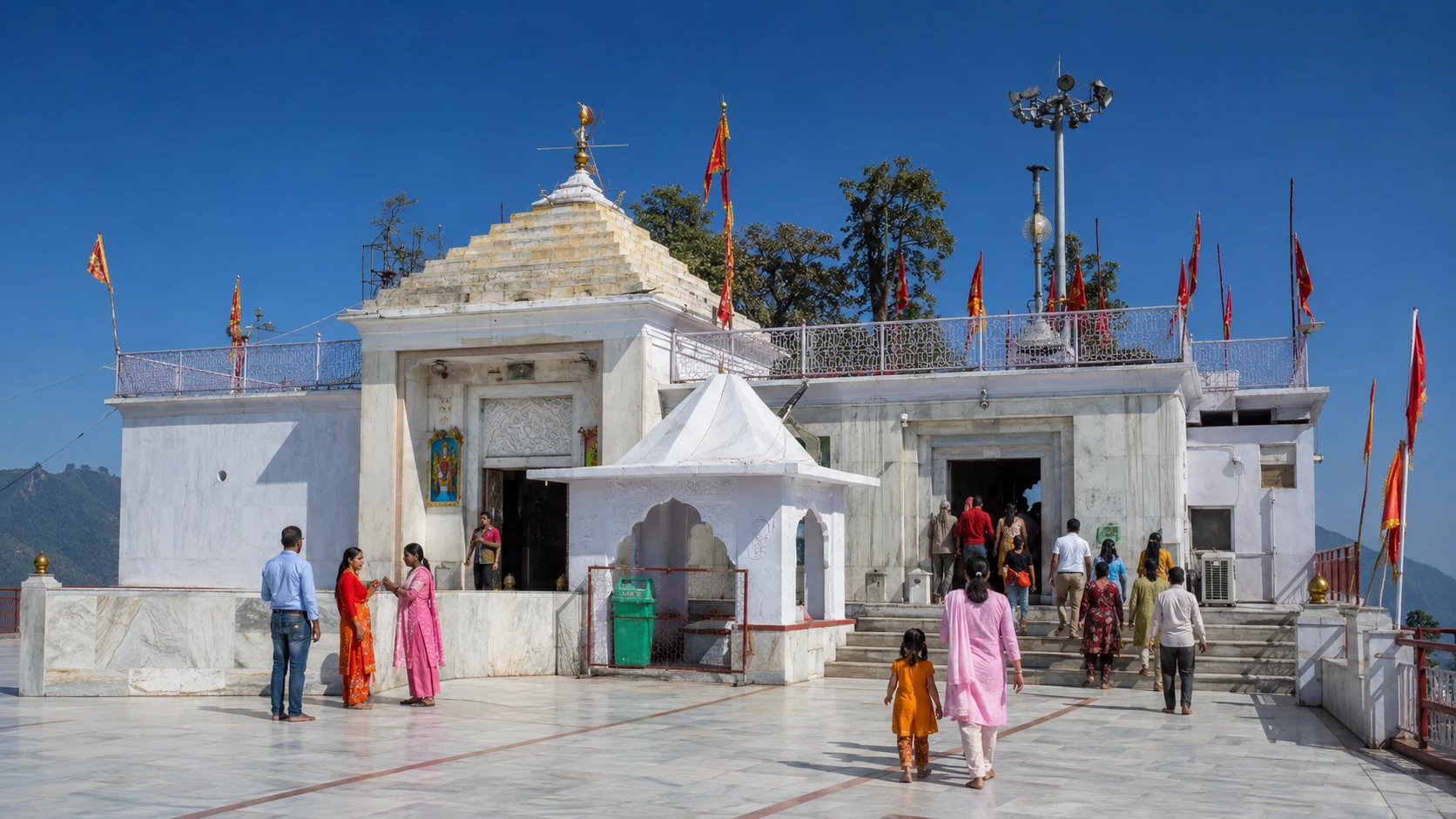
Modern Pahari temple architecture with marble platforms ascending the hilltop, white-painted temple structures, and a domed central sanctum; the architectural form is functional pilgrim-infrastructure rather than classical, built to accommodate the very high pilgrim volumes the shrine receives during major festivals
Open
05:00 – 22:00
Aarti
05:00 · 12:00 · 19:00 · 21:00
Special
The principal daily aartis are conducted at dawn, midday, evening, and night-close; during Sharad Navratri, Chaitra Navratri, and the Shravan Mela the cycle is extended and intensified, with additional aartis added through peak nights. The Mansik Manat, vow-fulfillment, tradition is particularly strong at Naina Devi: devotees making important life-vows are guided by the temple priests through specific ritual sequences for petition and fulfillment. The temple operates a structured queue-management system with separate corridors for general darshan, sponsored sevas, and VIP/elderly access.
The Sacred Legend · पवित्र कथा
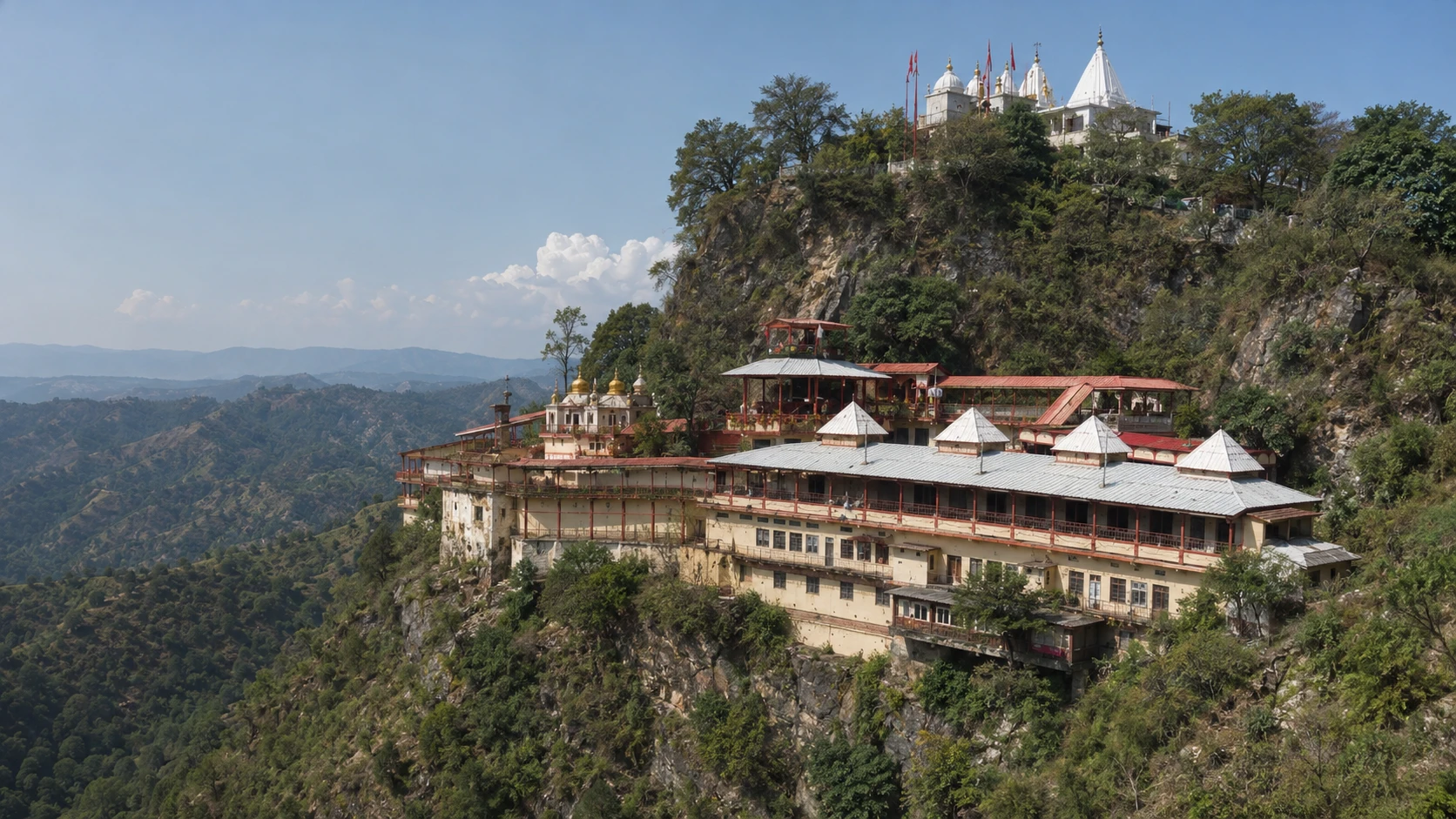
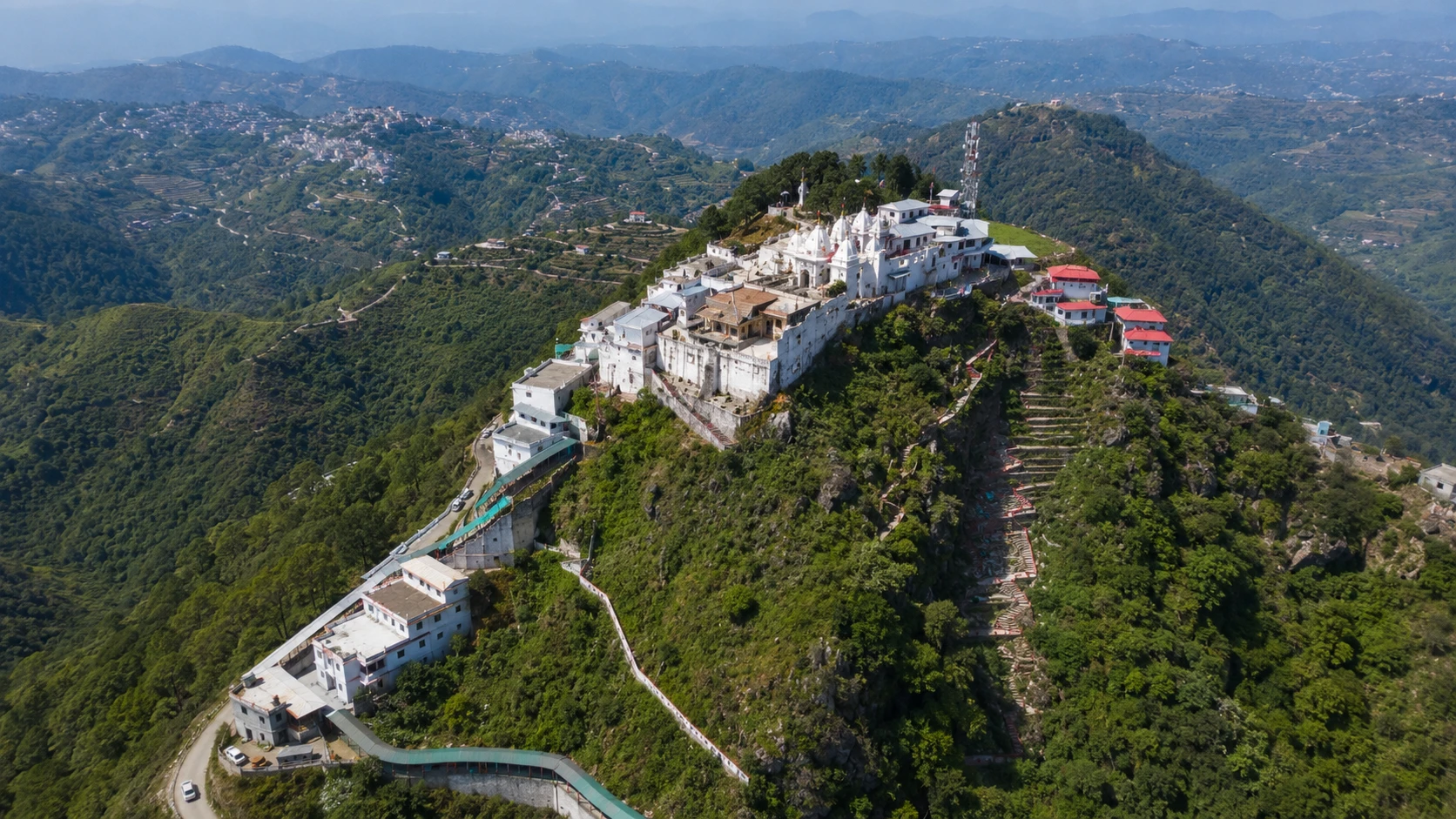
On a hilltop ridge in Bilaspur district, Himachal Pradesh, looking out across the Bhakra Reservoir and the Shivalik foothills toward the higher Dhauladhar ranges, sits one of the most regionally beloved goddess shrines in northern India. Sri Naina Devi, 'the goddess of eyes', is among the Five Shakti Peethas of Himachal, the regional circuit (with Jwala Devi at Jwalamukhi, Chintpurni at Una, Chamunda Devi and Brajeshwari Devi at Kangra) that Punjabi, Dogra, and Pahari pilgrim families have walked for centuries. Her name carries her body-part attribution: nain means 'eye' in Hindi, and regional tradition holds that Sati's eyes fell at this hilltop when Vishnu's chakra severed her body during Shiva's grief-mad tandava. The strict canonical 51-Peetha enumerations of the Pithanirnaya and Devi Bhagavata place the 'eyes' Peetha at Sugandha in present-day Bangladesh rather than at Naina Devi specifically, but the popular Hindu devotional tradition of north-western India has named this hilltop her eye-seat for at least the past several centuries, and Naina Devi's Maha Shakti Peetha status is grounded in this widespread regional consensus rather than in the classical Sanskrit lists. The temple sits at approximately 1,100 metres elevation, accessed from the base parking at the hill's foot by either a stone-paved foot-trek of about a kilometre (around 30 minutes climb) or a modern ropeway (2, 3 minute aerial ride) installed in the 2010s to expand pilgrim access for the elderly and mobility-limited. From the temple complex at the summit, the view across the Bhakra Reservoir, the artificial lake created by the Bhakra Dam in the 1960s, which reshaped the regional geography, is itself part of the pilgrim experience: the goddess of eyes watches over a vista that was itself remade by human engineering within living memory. The temple's central murti depicts the goddess in seated Devi form, dressed in red and gold, with three eyes, including the central third eye that gives the shrine its name. Punjab and Himachal pilgrim families have come here for at least seven centuries; the temple's modern infrastructure can move tens of thousands of pilgrims daily during Navratris and the Shravan Mela; and across all of these centuries the goddess at the summit has watched with her three eyes over the climbing devotees and the wider hills beyond.
Sacred Designationपवित्र पदनाम
Shakti Peeth
Body part: Eyes (netra), per popular Hindu tradition that associates the name 'Naina' (Hindi for 'eyes') with Sati's body-part attribution at this site. The strict canonical Pithanirnaya, Tantra Chudamani, and Devi Bhagavata enumerations identify the 'eyes' Shakti Peetha with Sugandha (present-day Bangladesh) rather than with Naina Devi; Naina Devi's eye-attribution is regionally grounded rather than classically textually anchored
Shakti: Naina Devi, the seated goddess with three eyes
Bhairava: Less canonically standardized at this site; some regional sources name Kalu Bhairava, others leave the attribution unnamed
Sacred Origin Storyपवित्र उत्पत्ति कथा
Source: Regional Pahari and Punjabi devotional tradition; Naina Devi Mahatmya (regional Hindi/Pahari text); Sri Naina Devi Ji Temple Trust canonical narrative.
When Daksha Prajapati's great yajna ended in Sati's self-immolation and Shiva's grief-mad tandava, the gods sent Vishnu to halt the dance before it unmade the cosmos. Vishnu followed Shiva through the sky and from his Sudarshana chakra loosed precise cuts that severed Sati's body, piece by piece, while she still rested upon her lord's shoulder.
As each part fell to the earth below, Shiva's grief lightened, until at last he carried nothing, and the dance ended. The places where Sati's body fell became Shakti Peethas, pillars of the goddess's presence on earth.
To a hilltop ridge in the western Himalayan foothills, at what is now Bilaspur district, fell Sati's eyes. The body part that sees, that watches, that bears witness, the goddess's organ of perception. The Mother Goddess took her seat at the place where her eyes had touched the earth, and from that seat she watches still: across the surrounding hills, across the flow of the Sutlej and (since the 1960s) across the Bhakra Reservoir that fills the valley below, across the generations of pilgrims who climb the path to her summit.
Her name in regional Hindi, Naina, meaning 'eyes', encodes her body-part attribution into the very word by which she is called.
The canonical 51-Peetha enumerations of the Pithanirnaya, Tantra Chudamani, and Devi Bhagavata Purana do not specifically locate the eye-Peetha at this hilltop, they identify Sugandha, in present-day Bangladesh, as the canonical 'eyes' site.
Some traditions reconcile this by speaking of multiple eye-Peethas (one for each of Sati's eyes, or one for the eyes as a paired body part and another for the third eye specifically). The popular Hindu devotional tradition of north-western India has, however, named Naina Devi as an eye-Peetha for at least the past several centuries; her status as a Maha Shakti Peetha is grounded in widespread regional and pilgrim consensus rather than in the classical Sanskrit textual enumerations.
The honest historical account is that Naina Devi occupies a place in modern Hindu devotional geography parallel to Vaishno Devi's: a major popular Shakti Peetha whose canonical textual placement is more layered than her devotional placement.
Woven through this Sati-eyes attribution is a second foundational tradition: the discovery narrative of Naina the Gujjar. According to regional tradition, in the 8th century CE, or in some accounts later, with the dating loose, a young Gujjar boy named Naina, who grazed cattle on the hill, observed that one cow in his herd was producing no milk back at the village.
Following the cow up the hill, he saw the cow voluntarily emptying her milk over a particular rock at the summit. The boy meditated at the rock; in some accounts the Devi appeared to him directly, in others he received the goddess's blessing in dream.
The first organized worship at the site was established by the boy, and the temple has carried his name, Naina, the goddess of the boy who saw, alongside the eye-Peetha attribution ever since.
Sources cited:
- Pithanirnaya (anonymous medieval Sanskrit text enumerating 51 Shakti Peethas)
- Tantra Chudamani (medieval Sanskrit Tantric text)
- Devi Bhagavata Purana, Skandha 7
- Kalika Purana, chapters 18 (Sati's dismemberment)
- Naina Devi Mahatmya (regional Pahari Hindi devotional tradition)
- Sri Naina Devi Ji Temple Trust canonical narrative
- Regional Kahlur (Bilaspur Riyasat) royal devotional records
Other Traditions · अन्य परंपराएँ
The eye-Peetha disambiguation between Naina Devi and Sugandha (Bangladesh), comparative Shakta enumeration tradition
The relationship between Naina Devi and the canonical eye-Peetha attribution requires direct engagement. The strict canonical Sanskrit enumerations of Shakta tradition, the Pithanirnaya, Tantra Chudamani, and Devi Bhagavata Purana, uniformly identify Sugandha, in the Barisal-Shikarpur region of present-day Bangladesh, as the Shakti Peetha where Sati's nose (or in some lists, eyes) fell.
Sugandha is the textually-anchored eye-Peetha. Naina Devi at Bilaspur, despite her name's eye-attribution, does not appear in the strict canonical 51-Peetha lists. Several reconciliations exist in modern devotional and scholarly discourse: (1) the canonical tradition may have multiple sites for paired body parts, with one eye at Sugandha and another at Naina Devi; (2) the Naina Devi attribution may post-date the original 51-Peetha enumeration and represent a later regional accretion to the broader Shakta sacred geography; (3) the canonical and popular traditions may simply coexist without requiring reconciliation, as Hindu sacred geography has always accommodated layered and overlapping attributions across textual and regional sources.
Eternal Raga presents Naina Devi's status as a Maha Shakti Peetha grounded in popular tradition while transparently noting that the strict canonical eye-Peetha is Sugandha, both are devotionally true within their respective frameworks.
Naina the Gujjar discovery narrative, the regional folk-founding tradition
Alongside the canonical Sati-eyes attribution sits a second foundational tradition, the discovery narrative of Naina the Gujjar, the cowherd boy whose name the temple carries. In this regional Pahari folk-founding story, traditionally dated to the 8th century CE (though the exact dating varies widely across sources), a young Gujjar boy named Naina grazed his family's cattle on the hill where the temple now stands.
He observed that one of his cows produced no milk when she returned to the village at evening, despite grazing the same hill as the rest of the herd. Curious, he followed the cow up the hill one day and saw her stop at a particular rock at the summit, where she voluntarily emptied her milk over the rock, offering the milk to the place itself rather than waiting to be milked by the village.
The boy understood the rock to be sacred; in some accounts the Devi appeared to him directly in vision, in others he received her presence in dream. He established the first organized worship at the site, planting saplings, scattering wildflowers, and announcing to the village what he had seen.
The temple's name preserves the boy's contribution to its founding: Naina, the goddess of the boy who saw. The story is performed in regional devotional song during major festivals and is among the temple's most beloved narrative traditions.
Scholarly Context
Modern scholarship on Naina Devi engages with three principal questions: (1) the relationship between Naina Devi and the canonical eye-Peetha at Sugandha (Bangladesh), discussed at length in the alternateAccounts above, the consensus position is that Naina Devi is a popular regional Maha Shakti Peetha whose canonical textual placement is layered rather than identical with the strict 51-Peetha enumerations; (2) the historical dating of the Naina-Gujjar foundational narrative, which is loose across sources but most commonly placed in the 8th, 10th century CE range; and (3) the temple's modern transformation under the Kahlur (Bilaspur Riyasat) royal patronage and subsequent post-Independence state institutional framework. The shrine's classical Sanskrit textual presence is limited compared to the Adi Shakti Peethas or the Ashtadasa Stotram peethas; the strength of the modern tradition is regional rather than pan-Indian, Punjabi, Dogra, and Pahari pilgrim families form the overwhelming demographic majority of Naina Devi pilgrims, with significant flows also from Haryana, Delhi, and the broader north-western Hindu cultural region. The shrine's 2008 stampede event resulted in 146 documented deaths and substantial subsequent infrastructure expansion under the temple Trust; this event is treated in scholarly literature on Indian temple safety and crowd management as a reference case alongside other major-shrine incidents.
Historyइतिहास
Naina Devi's documented history is structured around four layers: ancient regional sacred-geography tradition, the medieval Naina-Gujjar foundational narrative, the Kahlur (Bilaspur Riyasat) period of royal patronage, and the modern post-Independence transformation including the 2008 stampede event and subsequent infrastructure overhaul.
The ancient layer is loosely dated but well-attested in regional tradition. The Naina-Gujjar discovery narrative is most commonly placed in the 8th, 10th century CE range; the dating is loose across sources but the narrative itself is firmly preserved in Pahari devotional memory and provides the temple's foundational identity.
Earlier organized worship at the site may exist but is not anchored by epigraphic or archaeological evidence.
The medieval Kahlur period, the Bilaspur Riyasat ruled by the Kahlur dynasty from approximately the 7th century CE through to its merger with India in 1948, provided the temple with sustained institutional support. The Kahlur rulers regarded Naina Devi as a kuladevi (clan goddess) of the dynasty and funded temple construction, ritual cycles, and pilgrim infrastructure across multiple reigns.
The temple's current structural form derives substantially from late-Kahlur period renovations in the 18th and 19th centuries, with further work in the early 20th century. British colonial gazetteers, including the Bilaspur State Gazetteer entries from the late 19th and early 20th centuries, provide formal documentation of the shrine's pilgrim flow patterns and ritual practices during this period.
The post-Independence transformation accelerated through the second half of the 20th century. The Kahlur Riyasat merged into India in 1948 and was integrated into the Indian Union; Bilaspur district was constituted, and the surrounding region was reshaped by the construction of the Bhakra Dam (operational from 1963), which created the artificial Bhakra Reservoir visible today from the temple summit.
The Bhakra project displaced parts of original Bilaspur town and changed the regional geography materially; the Naina Devi hilltop itself remained unaffected. The Sri Naina Devi Ji Temple Trust, operating under the Himachal Pradesh state framework, took over administrative responsibility for the shrine, the Yatra route, and pilgrim infrastructure.
The most consequential recent event in the temple's modern history is the 30 August 2008 stampede during the Shravan Mela peak. On the morning of Shravan Saptami, approximately 146 pilgrims died and over 150 were injured in a stampede on the descending steps of the temple complex.
The immediate trigger appears to have been a combination of a retaining wall partial collapse and panic rumors among the dense crowd; the subsequent government inquiry attributed the casualties to inadequate crowd-management infrastructure for the festival-period volumes.
The Trust's response in the years following included substantial infrastructure expansion: widened step corridors, additional access routes, the Naina Devi Ropeway (installed in the early 2010s) to relieve pressure on the foot-trek route, expanded CCTV surveillance, and tightened crowd-management protocols during peak periods.
The 2008 event remains a cautionary reference point in pilgrim safety planning at Naina Devi, and the temple's subsequent infrastructure has been substantially shaped by the lessons learned.
Historical Timelineऐतिहासिक कालक्रम
Regional Pahari tradition dates the Naina-Gujjar discovery narrative to this period, the foundational story in which a young Gujjar cowherd boy named Naina observes a cow voluntarily emptying her milk over a rock at the hill's summit, meditates at the rock, and receives the goddess's appearance in dream or vision. The boy establishes the first organized worship at the site, and the temple has carried his name ever since. The dating is loose across sources; the narrative's persistence in regional devotional memory is well-attested.
The Naina-Gujjar narrative is a foundational devotional tradition rather than a historiographic record. Its dating is variable across sources, ranging from the 8th century in some regional accounts to as late as the 12th, 13th century in others. The narrative's persistence in Pahari devotional discourse is well-attested; the specific century of the historical Naina is unrecoverable from available evidence.
The Kahlur dynasty of Bilaspur (Bilaspur Riyasat, ruling from approximately the 7th century CE until merger with India in 1948) regards Naina Devi as a kuladevi (clan goddess) and funds substantial temple construction, ritual cycles, and pilgrim infrastructure across multiple reigns. The temple's current structural form derives substantially from late-Kahlur period renovations in the 18th and 19th centuries. The Kahlur royal patronage establishes Naina Devi as a major regional pilgrimage center across the Bilaspur, Kangra, Mandi, and broader Himachal hill states' devotional networks.
The Kahlur Riyasat of Bilaspur merges with the Indian Union following Indian Independence, ending princely-state rule. Bilaspur district is constituted within the Indian Republic; the Sri Naina Devi temple's administrative governance transitions from royal patronage to post-Independence state institutional frameworks. The transition occurs alongside the broader reorganization of the Punjab hill states; Bilaspur initially became a Chief Commissioner's province before being merged into Himachal Pradesh in 1954.
On the morning of Shravan Saptami, during the peak Shravan Mela festival crowd, a stampede on the descending steps of the temple complex results in approximately 146 pilgrim deaths and over 150 injuries. The immediate trigger appears to have been a combination of a retaining wall partial collapse and panic rumors spreading through the dense crowd; the subsequent government inquiry attributed the casualties to inadequate crowd-management infrastructure for the festival-period volumes. The event is among the most consequential safety events in modern Indian temple history. The Sri Naina Devi Ji Temple Trust's response in subsequent years included substantial infrastructure overhaul: widened step corridors, additional access routes, the Naina Devi Ropeway (installed in the early 2010s) to relieve pressure on the foot-trek route, expanded CCTV surveillance, and tightened crowd-management protocols during peak periods.
Casualty figures are drawn from the official government inquiry; some early media reports gave slightly varying numbers in the immediate aftermath. The 146-death figure is the officially recorded count. The event is included not to deter pilgrims but for editorial transparency regarding documented safety considerations at this high-volume shrine. The subsequent infrastructure overhaul has substantially altered the temple's pilgrim-safety profile.
Inauguration of the Naina Devi Ropeway (cable car) under joint state government and private partnership, providing pilgrim aerial access between the hill base and the temple summit. The ropeway covers the approximately 1 km of climbing distance in a 2, 3 minute aerial ride, substantially expanding access for elderly pilgrims, those with mobility limitations, and pilgrims wishing to avoid the foot-trek during high-crowd festival peaks. The ropeway represents the most consequential pilgrim-infrastructure investment at Naina Devi in the modern era and was directly motivated by the lessons of the 2008 stampede, providing a structural alternative to the high-volume foot-trek that had been the principal access route.
The exact year of ropeway commissioning has varied in published reports; multi-phase construction and operational milestones occurred across approximately 2012, 2015. Eternal Raga treats this as an early-2010s modern infrastructure event rather than narrowly dating to a specific commissioning ceremony.
What You'll Seeदर्शन में
At the top of the climbing path, whether walked or ridden by ropeway, sits the temple complex on a marble-paved hilltop platform, with the principal sanctum at its centre. Inside the inner shrine the goddess presides in her seated Devi form: a carved murti dressed daily in red and gold cloths, ornamented with silver and gold jewelry, garlanded with red flowers, and bearing the three eyes that give the temple its name.
The third eye, set vertically in the centre of the forehead, is the iconographic feature that anchors the entire devotional logic of the shrine: the goddess of eyes, with the third eye that sees through appearance to truth, watches every devotee who climbs the path. To stand before her at the inner shrine is to be seen by all three of her eyes simultaneously.
The goddess is flanked at the inner sanctum by smaller subsidiary murtis representing her attendant aspects, the configuration varies slightly with festival period and ritual cycle, but the central three-eyed Naina form is constant. The walls of the inner chamber bear devotional paintings of the Devi Mahatmya episodes; the ceiling is dome-shaped with subtle ornamental detail.
The architectural style is functional Pahari temple, white-painted exterior surfaces, marble flooring, brass and silver decorative work, built for high pilgrim throughput rather than monumental impression.
The surrounding hilltop complex includes a series of marble-paved courtyards stepping down the hill, a small subsidiary shrine to Hanuman (whose presence in regional Devi tradition is conventional), the Mansik Manat designated area where devotees make vow-petitions, and the modern queue corridors with electronic display boards added after the 2008 infrastructure overhaul.
The view across the Bhakra Reservoir to the south and west, with the higher Himalayan ridges visible to the north on clear days, provides a sacred geographic context that pilgrims often describe as itself meditative, the goddess of eyes watches an expansive view, and the devotee at the summit briefly shares that view.
The two access routes, the stone-paved foot-trek with approximately 1 km of climbing distance and somewhere between 600 and 800 stone steps depending on path variations, and the modern ropeway opened in the early 2010s, converge at the temple's outer perimeter.
Pilgrims who arrive by foot are sometimes regarded by traditional devotees as having completed a more theologically complete Yatra; ropeway pilgrims defend their choice as appropriate given health, age, or scheduling, and the temple Trust treats both modes as fully valid devotional approaches.
Distinctive Practicesविशिष्ट परंपराएँ
Mansik Manat, vow-making with the goddess of eyes
मानसिक मनौती, नयनों की देवी से व्रत-निर्माण
Year-round; particularly active during Shravan Mela (July-August), both Navratris, and on auspicious individual lunar tithis
Mansik Manat, literally 'mental vow', is the practice of making an internal devotional commitment to the goddess in return for a petition or intercession. The practice is universal across Hindu devotional tradition but is regarded as particularly resonant at Naina Devi because of the temple's theological framing: the goddess of eyes sees the petitioner's true intent, including the internal vow held silently in the heart. A devotee facing a significant challenge, illness in the family, examination, marriage prospects, employment, childbirth, comes to Naina Devi, stands before the three-eyed goddess at the inner shrine, and silently formulates a vow: if the petition is granted, the devotee will return for a specific offering, sponsor a specific seva, undertake a specific austerity, or fulfill a specific gift to the temple. The vow is not spoken aloud; the goddess's third eye is regarded as reading directly the petitioner's intention. When the petition is fulfilled, the devotee returns to complete the manat, and the temple's Mansik Manat tradition includes specific designated areas and ritual sequences for these fulfillment visits.
The Mansik Manat tradition reflects Naina Devi's particular theological identity as the goddess whose vision extends through outward appearance to inward intention. Where a vow at most Hindu temples is reinforced by being spoken aloud or written and submitted, at Naina Devi the silent internal vow is the canonical form, because the goddess of eyes does not need the vow vocalized to know it. The teaching is one of authentic devotional intent: the goddess responds to what the petitioner actually wants rather than to what the petitioner verbalizes, and the manat that gets fulfilled is the manat that comes from the heart's true commitment rather than from external formality. The tradition has become particularly meaningful for north-western Indian families navigating major life decisions; the Naina Devi Yatra often coincides with weddings, examinations, business launches, and similar life inflection points where the silent vow's specificity matters.
Five Shakti Peethas of Himachal, the regional pilgrimage circuit
हिमाचल के पाँच शक्ति पीठ, क्षेत्रीय तीर्थयात्रा परिपथ
Pilgrim families typically complete the five-Peetha circuit across 4, 7 days, often during Navratri windows or in the cooler October, March months
Naina Devi is one of the Five Shakti Peethas of Himachal, a regional pilgrimage circuit recognized in Pahari, Punjabi, and Dogra devotional tradition that links five major Himachal Devi shrines: Naina Devi (Bilaspur), Jwala Devi (Jwalamukhi), Chintpurni (Una district), Chamunda Devi (Kangra), and Brajeshwari Devi (Kangra). Pilgrim families undertake the full circuit as a sequenced Yatra across multiple days, typically traveling by hired vehicle or bus along a route that connects the five sites. The circuit's geography forms an arc across the Himachal lower hills; the sequence followed varies by family preference, but a common pattern starts at Naina Devi (closest to Chandigarh/Punjab origin points) and proceeds northward through the other four. The circuit pilgrimage has become institutionalized in Himachal Tourism's Devi-circuit promotion and in regional pilgrim-service operator packages; it represents one of the most regionally distinctive group-pilgrimage traditions in North India.
The five-Peetha circuit reflects a deep Shakta principle: that the goddess's manifestations across regional sacred geography are connected rather than isolated, and that visiting one without the others is theologically incomplete. Each Peetha addresses a specific Devi aspect, Naina the goddess of eyes, Jwala the goddess of flames, Chintpurni the goddess of completed worries, Chamunda the fierce warrior aspect, Brajeshwari the maternal-prosperity aspect, and completing the circuit allows the pilgrim to receive Devi blessing across the full theological spectrum these five forms cover. For Punjabi, Pahari, and Dogra families the circuit also functions as a multi-generational devotional commitment: families return to the circuit at significant life points (children's births and marriages, deaths and anniversaries, new business ventures, educational milestones), making the Five Shakti Peethas a touchstone tradition spanning decades.
Shravan Mela Four-Monday Observances
श्रावण मेला चार-सोमवार पालन
Each of the four Mondays of Shravan month (July-August), with Shravan Saptami and Shravan Ashtami as the cycle's peak days
The Shravan Mela at Naina Devi unfolds across the four Mondays of the Shravan month (Monday being traditionally sacred to Shiva, with the Shakta tradition extending the day's auspiciousness to Devi worship). Each Monday of Shravan draws successive intensified pilgrim flow; the cycle peaks at Shravan Saptami and Shravan Ashtami (the seventh and eighth days of the bright fortnight), which historically have brought the year's largest single-day pilgrim crowds. The festival pattern derives from the broader pan-Indian Shravan-month devotional cycle but takes on particular weight at Naina Devi because of the eye-Peetha attribution, the goddess of eyes is regarded as especially responsive during this month-long observance. The 2008 stampede event occurred during this Shravan peak (on Shravan Saptami specifically), which has made Shravan Mela the focus of the temple's most intensive crowd-management protocols in subsequent years; even with substantially expanded infrastructure, the four-Monday peak remains the most crowd-intensive period of the temple year, and pilgrims wishing to avoid extreme crowding should consider visiting outside this window.
The Shravan month's pan-Indian Hindu auspiciousness derives from multiple intersecting traditions: the month's association with Shiva (whose tandava following Sati's death is the precondition for the Shakti Peetha framework), with the goddess's protective-maternal Shakta tradition, and with the monsoon agricultural cycle in northern India. At Naina Devi the Shravan Mela combines these layers into the year's most concentrated devotional window. The four-Monday cycle structures the month into a graduated build-up; each Monday is theologically auspicious in itself, and the cumulative force of successive Mondays produces the festival's peak intensity. The cycle's continuation despite the 2008 tragedy reflects the temple's central place in regional devotional life: the response to the stampede was infrastructure transformation rather than festival cancellation, on the principle that the goddess's continued worship is non-negotiable.
Did You Know?क्या आप जानते हैं?
Naina Devi's name encodes her body-part attribution into the very word by which she is called: 'nain' in Hindi means 'eye', and the temple's name means literally 'the goddess of eyes'. The central murti at the inner shrine bears three eyes, including the vertical third eye in the centre of the forehead that anchors the temple's theological identity. Among Indian Devi shrines the explicit linguistic encoding of body-part attribution into the temple name is unusual; it makes Naina Devi one of the most clearly self-identifying Shakta sites in north-western Indian sacred geography.
Naina Devi Mahatmya (regional tradition); Sri Naina Devi Ji Temple Trust documentation; standard Hindi-Sanskrit etymological references
Naina Devi is one of the Five Shakti Peethas of Himachal, a regional pilgrimage circuit recognized in Pahari, Punjabi, and Dogra devotional tradition that links five major Himachal Devi shrines (Naina Devi, Jwala Devi, Chintpurni, Chamunda Devi, Brajeshwari Devi). Pilgrim families typically undertake the full circuit across 4, 7 days as a multi-shrine Yatra, traveling by hired vehicle along a route that arcs across the Himachal lower hills. The circuit pilgrimage has become institutionalized in Himachal Tourism's Devi-circuit promotion and represents one of the most regionally distinctive group-pilgrimage traditions in North India.
Himachal Pradesh Tourism Department Devi-circuit publications; regional Pahari devotional tradition; comparative studies of North Indian pilgrimage circuits
The view from the Naina Devi hilltop across the Bhakra Reservoir provides one of the most distinctive sacred-geography vistas in Indian Devi pilgrimage. The reservoir, an artificial lake covering approximately 168 square kilometres, was created in 1963 by the completion of the Bhakra Dam on the Sutlej River; the dam's construction reshaped the regional geography materially and displaced parts of original Bilaspur town. The Naina Devi hill itself remained unaffected, but the view from the temple summit now opens across an expanse of water that did not exist before living memory. The juxtaposition, an ancient goddess watching over a modern engineered landscape, has become part of the temple's contemporary devotional imagery.
Bhakra Beas Management Board project documentation; geographic surveys of the Sutlej-Bhakra region; modern pilgrim ethnography
The 30 August 2008 stampede at Naina Devi, in which approximately 146 pilgrims died and over 150 were injured during the Shravan Mela peak, prompted one of the most consequential pilgrim-infrastructure transformations at any Indian Devi shrine in modern times. The Trust's subsequent response, widened step corridors, additional access routes, the Naina Devi Ropeway (early 2010s), expanded CCTV surveillance, and tightened crowd-management protocols, has substantially altered the temple's pilgrim-safety profile. The 2008 event is treated in scholarly literature on Indian temple safety as a reference case alongside other major-shrine incidents and remains a cautionary note in pilgrim safety planning, with the surviving infrastructure transformation serving as a positive structural response.
Government of Himachal Pradesh judicial inquiry report; subsequent academic studies on Indian temple crowd safety; Sri Naina Devi Ji Temple Trust public communications
The temple's foundational discovery narrative, Naina the Gujjar cowherd boy who saw a cow voluntarily emptying her milk over a rock at the hill summit, and established the first organized worship there, is among the most widely-known Pahari folk-founding stories in Himachal devotional tradition. The temple carries the boy's name (Naina) rather than the goddess's body-part attribution alone, an unusual feature in Indian temple-naming conventions where the founding human is typically subordinated to the deity. The narrative reflects the deep regional integration of folk-founding stories with classical Shakta theology, both layers coexist in the temple's living devotional life without contradiction.
Regional Pahari Mahatmya tradition; M.K. Aggarwal, 'Pahari Bhakti Sahitya'; comparative studies of Indian temple naming conventions
Visitor Accessप्रवेश जानकारी
Naina Devi is open to all visitors regardless of gender, caste, religious background, or age. There is no menstrual restriction on women entering the shrine. The Pahari Himachal Shakta tradition has historically been open-access. Photography is prohibited inside the inner sanctum; phones and cameras must be deposited at the locker counter at the temple entrance, or pocketed and not used inside. Footwear is removed at the prescribed outer boundary. The marble floor of the inner sanctum can be cold in winter, bring warm socks if visiting between November and February. Children, the elderly, and pregnant women are all welcomed, with the ropeway providing access for those who cannot make the foot climb. Significant queue-management protocols are in place during Shravan Mela and Navratri peaks following the 2008 stampede event.
Pilgrims approaching Naina Devi: choose between the foot-trek (approximately 1 km of climbing, 600-800 stone steps, 25, 45 minutes for an average adult) or the ropeway (2, 3 minute aerial ride, requires ticket purchase at the base). For elderly pilgrims, those with mobility limitations, or pilgrims with infants, the ropeway is strongly recommended. During Shravan Mela peaks and Navratri windows, both routes can be crowded; expect 1, 3 hour total round-trip including darshan during peak periods. Photography is prohibited inside the inner sanctum; deposit phones and cameras at the locker counter before entering. Carry warm layers in winter (the hilltop temperatures are 5, 8°C cooler than at the base parking) and rain protection during monsoon (July-September; landslide risk on approach roads). The Mansik Manat designated area is on the inner-shrine side; ask priests for guidance on the appropriate ritual sequence for vow-petitions or vow-fulfillment.
Festivalsत्योहार
Shravan Mela
श्रावण मेला
Jul-Aug (Shravan month, particularly the four Mondays and the Saptami-Ashtami peak)
The Shravan Mela is Naina Devi's largest annual pilgrim event, unfolding across the four Mondays of Shravan month and peaking at Shravan Saptami and Shravan Ashtami (the seventh and eighth days of the bright fortnight). The festival pattern derives from the broader Shravan-month devotional cycle (Monday being traditionally sacred to Shiva and the Shakta tradition extending the day's auspiciousness to Devi worship), but takes particular weight at Naina Devi because of the eye-Peetha attribution. Hundreds of thousands of pilgrims attend across the festival window; the temple operates substantially expanded queue-management, additional ropeway capacity, and tightened crowd-management protocols following the 2008 stampede precedent. The festival window is the most crowd-intensive period of the Naina Devi year; pilgrims wishing to avoid extreme crowding should consider the cooler-season festivals or off-peak periods.
Sharad Navratri
शरद नवरात्रि
Sep-Oct (Ashwin Shukla Pratipada to Dashami)
The autumn nine-night festival of the goddess draws Naina Devi's second-largest annual pilgrim flow. Each of the nine nights is dedicated to one of the Navadurga aspects, with parallel intensified worship at the inner shrine. The festival concludes on Vijayadashami, celebrating the goddess's victory aspect. Sharad Navratri is regarded as more devotionally focused and slightly less crowd-overwhelming than the Shravan Mela; many Punjabi and Pahari families schedule the Naina Devi pilgrimage specifically for this window, often as part of the Five Shakti Peethas of Himachal circuit completion.
Chaitra Navratri
चैत्र नवरात्रि
Mar-Apr (Chaitra Shukla Pratipada to Navami)
The spring nine-night festival is Naina Devi's third major annual peak. Like Sharad Navratri, the festival dedicates each of the nine nights to a Navadurga aspect. Chaitra Navratri overlaps the spring agricultural cycle in the Himachal foothills and is auspicious for new beginnings; many pilgrim families schedule the Yatra during Chaitra to coincide with new business ventures, examination cycles, or wedding-season planning. The festival concludes on Rama Navami.
Hari Mela
हरि मेला
Oct-Nov (post-Diwali period)
The Hari Mela is a smaller regional fair that follows the Diwali period, drawing pilgrim flow from Punjab, Haryana, and Himachal on a quieter and more contemplative devotional cycle than the major festivals. The fair includes traditional Pahari folk performances, regional food and craft vendors at the hill base, and additional aartis at the inner shrine. For pilgrims who prefer to visit outside the Shravan or Navratri peaks, the Hari Mela offers a meaningful festival window with substantially smaller crowds.
Traditional Offeringsपारंपरिक अर्पण
Primary Offerings
Red Chunari / Cloth
लाल चुनरी / वस्त्र
रक्ताम्बर
The red chunari is among Naina Devi's most-offered cloth offerings. Pilgrim families bring chunaris ranging from simple cotton lengths to gold-bordered silk pieces, presented at the inner shrine and bound at designated areas in the temple complex. The chunaris that accumulate on the shrine periphery are visible records of devotional commitments across generations of Punjabi, Pahari, and Dogra pilgrim families. The cloth's red colour carries the standard Shakta significance of vitality, blood, and the goddess's protective-maternal aspect; at Naina Devi the chunari is also bound up with the Mansik Manat tradition, where pilgrims tie chunaris in connection with specific silent vows.
Red Flowers, roses, hibiscus, marigolds
लाल पुष्प, गुलाब, गुड़हल, गेंदा
जपाकुसुम
Red flowers, particularly roses and hibiscus, with marigolds during the autumn festival season, are offered at the inner shrine and garland the central murti throughout the day. Garlands are refreshed during each aarti cycle; pilgrims purchase flower garlands from vendor stalls at the base of the hill (or at the ropeway base counter) for presentation by the priests on the devotee's behalf. The combination of red flowers, red chunaris, and red sindoor produces the distinctive visual register of Naina Devi darshan.
Sindoor (Vermilion)
सिंदूर
सिन्दूर
Sindoor is applied to the central murti's forehead daily, specifically to and around the third eye, the iconographic feature that anchors the temple's theological identity. A portion is returned to women devotees who apply it in the central parting of their hair as a Shakta blessing for marital harmony and household protection. At Naina Devi the sindoor application carries a particular meaning: the goddess of eyes blesses the devotee whose forehead now bears the same red mark that adorns her own.
Coconut (Narikela)
नारियल
नारिकेल
Whole coconut with husk and water intact is offered at the temple and ritually broken by the Sebait. The broken coconut is partly retained for use in temple bhog preparation, partly returned to the devotee as prasad. At Naina Devi, coconut offerings are particularly central during Shravan Mela, when families bring large numbers of coconuts as part of their Yatra observance, the coconut's symbolism (the ego cracked open through devotion) aligns with the Mansik Manat tradition's focus on internal commitment.
Pahari Mishri and Sweets
पहाड़ी मिश्री और मिठाइयाँ
मिष्टान्न
Mishri (crystalline rock sugar) is offered at the inner shrine and forms the most commonly distributed return-prasad at Naina Devi. Small mishri pieces are given to pilgrims as they exit, carrying the goddess's blessing in solid form. Alongside mishri, regional Pahari sweets, pinni (a Punjabi-Pahari winter sweet of flour, ghee, sugar, and dry fruits), besan ladoo, and traditional milk-fudge varieties, are offered and distributed. The Pahari flavor profile distinguishes Naina Devi prasad from plains-Indian Devi temple offerings.
Dry Fruits, almonds, raisins, walnuts
सूखे फल, बादाम, किशमिश, अखरोट
शुष्क-फल
Dry fruits, almonds, raisins, walnuts, are a regionally distinctive Naina Devi offering, drawing on the Himachal hills' position as a producer and trade route for Himalayan-region dry fruits. Pilgrim families bring small packets to the shrine; the offering connects the Bhawan ritual to the regional agricultural and trade economy. As at other Himachal Devi shrines (notably Vaishno Devi in adjacent J&K), the dry fruit offering is particularly suited to the cooler-climate context of the hilltop temple and is among the prasad items pilgrims commonly carry home.
Unique to This Temple
Manat Chunari Bandhan, the vow-fulfillment cloth binding
मनौती चुनरी बंधन, मनौती-पूर्ति वस्त्र बंधन
The Manat Chunari Bandhan at Naina Devi is the most theologically charged form of the standard chunari offering, the cloth bound at the temple as ritual completion of a Mansik Manat (silent vow) the devotee made to the goddess. The pattern: a devotee facing a significant life challenge, illness, examination, marriage prospects, employment, childbirth, comes to Naina Devi, stands before the three-eyed goddess at the inner shrine, and silently formulates a vow that the goddess (with her third eye) reads directly from the petitioner's heart. The vow includes a specific commitment: if the prayer is fulfilled, the devotee will return and tie a chunari at the shrine in acknowledgment. When the prayer is fulfilled, the devotee returns to complete the manat by tying the promised chunari. The chunaris that accumulate at the inner-shrine periphery are visible records of fulfilled vows across generations of pilgrims; the practice is central to Punjabi, Pahari, and Dogra devotional culture, where the Naina Devi manat-fulfillment Yatra is a familial commitment passed across multiple generations.
Hilltop Aarti Sponsorship, sponsored participation in the inner-shrine aartis
पर्वत-शिखर आरती प्रायोजन, आंतरिक-देवालय आरतियों में प्रायोजित भागीदारी
Devotees who wish to participate in the temple's most concentrated ritual moments, the dawn, midday, evening, and night-close aartis at the inner shrine, can sponsor and join through the Trust's seva system. Sponsorship is arranged in advance through the Trust office at the hill base or via designated coordination channels (the Trust does not currently maintain a centralized online portal for aarti sponsorship to Eternal Raga's verified knowledge, so in-person or phone arrangements are required). The sponsoring devotee or family is given a designated position at the aarti, with the priests performing the worship in their name and including the family in the ritual recitation. Aarti sponsorship at Naina Devi is particularly meaningful for Mansik Manat fulfillment occasions, when a family completes a major vow with a sponsored aarti as the ritual completion act.
Standard offerings (chunari, flowers, coconut, sindoor, sweets, dry fruits) can be purchased from vendor stalls at the hill base or from official Trust counters at the ropeway base. The Trust counter prices are fixed and recommended; outside-vendor pricing is unregulated and can spike during festival periods, particularly Shravan Mela. Manat Chunari Bandhan and Aarti Sponsorship arrangements require advance coordination through the Trust office; pilgrims should not attempt to arrange these through unaffiliated middlemen at Chandigarh or Anandpur Sahib transport hubs. Animal sacrifice is not part of Naina Devi's ritual tradition, the temple is strictly vegetarian, with no bali tradition.
How to Reachकैसे पहुँचें
Naina Devi sits on a hilltop in Bilaspur district, Himachal Pradesh, with the hill base accessible by road from Punjab and broader north-western India. By air, the nearest airport is Chandigarh International Airport (IXC, 110 km south); Gaggal Airport at Dharamshala (DHM, 175 km) is an alternative for pilgrims combining the Naina Devi visit with the Kangra Valley.
Pre-paid taxis cover the Chandigarh-to-Naina-Devi route in approximately 3 hours via Anandpur Sahib. By rail, Anandpur Sahib Railway Station (24 km, in Punjab) is the closest railhead with regular taxi service onward to the hill base; Kiratpur Sahib (15 km) is closer but smaller; Chandigarh Junction (110 km) is the largest hub for broader train coverage.
By road, Naina Devi connects via Punjab and Himachal state highways to Chandigarh (110 km), Bilaspur (70 km), Una (90 km), and Dharamshala (175 km); regular bus services operate from Chandigarh, Pathankot, Una, Bilaspur, and Mandi.
Once at the hill base parking area, pilgrims have two access options: the foot-trek (approximately 1 km of climbing, 25, 45 minutes for an average adult) or the ropeway (2, 3 minute aerial ride, ticket purchase at the official counter at the base).
Plan Your Visitयात्रा की योजना
🌤 Best Season
October to March is the most comfortable period, Naina Devi hilltop temperatures range 8, 22°C with crisp clear weather, the temple area is dry and well-walked, and the festival cycle (Sharad Navratri in Sep-Oct, Chaitra Navratri in Mar-Apr, Hari Mela in Oct-Nov) provides spiritually charged windows without the Shravan-period crowd intensity. Avoid the peak monsoon (July-September): heavy rainfall, occasional landslide risk on approach roads, slippery stone-paved steps, and (especially) the Shravan Mela crowd peak make this the most challenging window. Summer (April-June) is mild and pleasant on the hilltop but the lower-altitude approach routes from Chandigarh and Punjab can be hot. Winter (December-February) brings cold nights and the marble floor of the inner sanctum can be unpleasantly cold; bring warm socks. The Shravan Mela window in particular brings the year's most concentrated crowds; first-time pilgrims prioritizing unhurried darshan should choose November-February.
👘 Dress Code
Modest, traditional attire is expected. For men: trousers and shirt or kurta; sleeveless garments are discouraged. For women: saree, salwar-kameez, or long skirt with covered shoulders; head covering is not strictly required but considered respectful. Leather items should be removed before entering the inner sanctum. Footwear is removed at the prescribed outer boundary. Practical note: bring warm layers in winter (Naina Devi hilltop nights can drop to single digits Celsius) and warm socks regardless of season, as the inner sanctum marble floor stays cool year-round. Comfortable walking footwear is essential for the foot-trek route; pilgrims using the ropeway still face some walking on uneven surfaces at the temple complex.
📱 Phones & Photography
Photography and videography are prohibited inside the inner sanctum. Phones, cameras, and recording devices must be deposited at the locker counter at the temple entrance, or pocketed and not used inside. Photography is permitted in the outer courtyards, at the Hanuman subsidiary shrine, in the ropeway approach areas, and at the hilltop's outer viewing platforms, except where signage indicates otherwise. The Trust's policy reflects both ritual decorum (the goddess's interior space should not be mediated through images) and crowd-flow management (camera flashes and tripods disrupt queue movement at this high-volume shrine).
🏨 Accommodation
Naina Devi town and the surrounding hill-base area have a modest accommodation infrastructure tailored to pilgrim flow: small hotels and dharamshalas near the temple base, with Himachal Pradesh Tourism Development Corporation operating recognized government-sector options. Larger and better-equipped accommodation is available at Bilaspur (70 km) and Chandigarh (110 km), which serve as bases for pilgrims combining the Naina Devi visit with broader regional travel. Anandpur Sahib (24 km, in Punjab) is another option for pilgrims combining the visit with Sikh pilgrimage sites. During Shravan Mela, Sharad Navratri, and Chaitra Navratri, Naina Devi accommodation reaches saturation; book through verified channels at least 4, 6 weeks in advance for these windows. The Himachal Pradesh state tourism department maintains accommodation listings.
Sacred Soundsपवित्र ध्वनि
Devi Suktam (Vāk Sūkta, Rig Veda 10.125)
stotram · 420
Mahishasura Mardini Stotram (Ayi Giri Nandini, attributed to Adi Shankara)
stotram · 540
Naina Devi Aarti / Naina Devi Stuti (regional Pahari tradition)
aarti · 360
Devi Kavacham (from Durga Saptashati)
kavacham · 600
Lalita Sahasranama (Brahmanda Purana)
sahasranama · 2400
Did You Know? · क्या आप जानते हैं?
The same translation error that turned '33 Koti' into '33 crore' in Hinduism also happened in Buddhism. The Chinese translation of Buddhist texts rendered 'Sapta Koti Buddha' (7 Supreme Buddhas) as '7 Crore Buddhas.' The Tibetan translation got it right: 7 types, not 7 crore. One Sanskrit word, misread across two major world religions, generated two identical misconceptions independently.
Related Contentसंबंधित सामग्री
Related Scriptures
Community Reflections
🕉️
Be the first to share your reflection.