Kashi Vishwanath
काशी विश्वनाथ
Lord of the Universe in the city even Shiva does not leave
Varanasi, Uttar Pradesh, India
Kāśī ViśvanāthaAlso known as: Kashi Vishwanath, Vishweshwar, Vishveshwara, Vishwanatha, Kashi Vishwanath Mandir, Kashi Vishweshwar Jyotirlinga, Avimukteshwar
Era
Continuously consecrated kshetra since at least the 1st millennium BCE; documented temple structures from the early medieval period; current structure built 1780
Architecture
Nagara (North Indian shikhara form); Maratha-period reconstruction with later Sikh-era gold plating
Open
03:00 – 23:00
Aarti
03:00 · 04:00 · 11:30 · 19:00 · 21:00 · 22:30
Special
Mangala Aarti at 03:00 (advance booking required); Sugam Darshan and Sparsh Darshan tickets available; live darshan streamed via the official trust portal during major aartis
The Sacred Legend · पवित्र कथा
Kashi Vishwanath is the seventh Jyotirlinga and the heart of Hinduism's most ancient continuously-inhabited sacred city, Kashi, called by the Skanda Purana the 'Avimukta' kshetra, the place that even Lord Shiva does not abandon during the dissolution of the cosmos. Vishvanatha, the Lord of the Universe, sits at the city's spiritual centre on the western bank of the Ganga, where pilgrims have bathed for at least three millennia, and where dying within the kshetra-boundary is held to bring moksha by the whispering of Shiva's Tarak Mantra into the dying ear. The temple has been destroyed and rebuilt across more than a thousand years; its current structure was raised in 1780 by Maharani Ahilyabai Holkar of Indore beside the older sanctum site, and its three shikharas were plated with approximately 820 kilograms of gold by Maharaja Ranjit Singh of Punjab in 1835. In December 2021 the Kashi Vishwanath Dham corridor, opening the temple precinct down to the Ganga at Manikarnika Ghat, completed a centuries-long architectural arc, even as the temple's full historical record, including the contested events of 1669 and the adjacent Gyanvapi premises, remains the most actively debated of any Jyotirlinga site.
Sacred Designationपवित्र पदनाम
7th of 12 Jyotirlingas
बारह ज्योतिर्लिंगों में 7th
One of the Seven Moksha Citiesसप्त पुरी
Sacred Origin Storyपवित्र उत्पत्ति कथा
Source: Skanda Purana (Kashi Khanda) and Linga Purana, widely-attested
In the beginning, before time had begun and before form had taken shape from formlessness, Lord Brahma and Lord Vishnu came into a great contest. Each claimed to be the supreme principle of the cosmos. Their dispute grew so fierce that the heavens themselves trembled and the lower worlds began to crack.
To settle the contest, a pillar of light appeared between them, vast beyond measure, blazing with a fire that contained all the fires of the worlds, with no visible top and no visible bottom. From within this pillar a voice spoke: 'Whichever of you can find my beginning or my end, that one shall be supreme.'
Vishnu took the form of the great boar Varaha and dove downward into the earth, descending through realm after realm to find the pillar's base. He searched for what would have been a thousand years had time existed; he never found the bottom. At last he returned, in honest exhaustion, and bowed: 'I cannot find it. The pillar has no beginning.'
Brahma took the form of the great swan Hamsa and flew upward, ascending through realm after realm to find the pillar's top. He searched for the same thousand years and never found it. But unlike Vishnu, Brahma could not bear to return defeated.
On his way back he passed a Ketaki flower falling slowly from somewhere higher than where he had reached, and he persuaded the flower to bear false witness with him. Returning, Brahma claimed: 'I have touched the top. The Ketaki flower is my witness.'
From the pillar, the form of Lord Shiva emerged, terrible in his knowledge of the deception. He turned to Brahma: 'You have lied. For this, you shall have no temples on earth, no worship in human cities, no shrines built to your form.' To the Ketaki flower he said: 'You shall never again be offered to me in worship.' To Vishnu, who had spoken truth in defeat, he said: 'You shall be worshipped equally with me.
Wherever there is a Shiva shrine, there shall also be a Vishnu shrine; the two of us together shall hold the cosmos.'
Then the great pillar of light, which had been the supreme of supreme principles, the form-without-form from which Shiva himself had emerged, settled into manifest signs upon the earth. Twelve Jyotirlingas appeared across the world, each a place where the infinite pillar had touched.
And of these twelve, the one that was held to be the very centre, the heart-pillar from which all the others took their bearing, settled in the city that would come to be called Kashi.
But Shiva did more than place a Jyotirlinga here. He chose this city as his own dwelling. The Skanda Purana records his vow to the assembled gods: 'I shall not leave this place. Even when the cosmos dissolves at the end of the kalpa, when all other places are returned to formlessness, this city shall remain. This is Avimukta, the never-abandoned.
And to all who die within its boundaries, I myself shall whisper the Tarak Mantra into the ear at the moment of passing, by which the soul shall be taken across the ocean of rebirth and granted moksha.'
Thus Kashi Vishvanatha, Lord of the Universe, became not only the seventh Jyotirlinga but the spiritual centre of all moksha-seeking in the Hindu world. The lingam in the inner sanctum is held to be the very pillar of light that first appeared between Brahma and Vishnu, settled now into manifest stone, attended by Shiva who has never since left.
The Ganga that flows past the city is held to be his consort taking earthly form, and the cremation ghats along the river are held to be the only place where the lord himself attends every burning, ear close to the dying, mantra ready.
Sources cited:
- Skanda Purana, Kashi Khanda (especially Chapters 26, 35 on the Jyotirlinga and Avimukta narratives)
- Linga Purana, Section on the Twelve Jyotirlingas
- Shiva Purana, Vidyeshwar Samhita and Koti Rudra Samhita
- Kashi Rahasya (a regional sthala-mahatmya tradition)
Scholarly Context
Modern scholarship (Diana Eck, 'Banaras: City of Light' (1982), the most authoritative single-volume modern study; Diana Eck, 'India: A Sacred Geography' (2012)) treats Kashi as a continuously-inhabited sacred geography whose layered history is uniquely entangled, the Jyotirlinga tradition, the Avimukta moksha-tradition, the Sapt Puri designation, the parallel Vaishnava sacred geography (Bindu Madhava at Panchganga Ghat), the parallel Shakta tradition (Visalakshi Shakti Peeth near Manikarnika), and the parallel Buddhist heritage (Sarnath, where the Buddha gave the first sermon) all share the same cluster of land. The temple's continuous identity across more than a millennium of layered destructions and reconstructions is itself a subject of historical study; the relationship between the present Ahilyabai Holkar shrine (1780) and the temple structure that preceded the events of 1669 is the most actively debated single question in modern Indian religious history. Recent scholarship, Audrey Truschke's 'Aurangzeb: The Man and the Myth' (2017), Richard Eaton's 'India in the Persianate Age' (2019), and the ongoing legal proceedings concerning the adjacent Gyanvapi premises, represents a range of contested perspectives on the Mughal-era record. Eternal Raga records the Jyotirlinga's documented continuity at this kshetra without adjudicating the contested historiography of specific structures or the legal status of adjacent premises.
Historyइतिहास
Kashi's history as a sacred kshetra is among the longest documented continuities of any urban centre on earth. Pilgrimage traditions referenced in early Buddhist texts (the Pali Canon's references to Kasi as a great kingdom, c. 6th century BCE), in the Mahabharata, and in early Puranic compilation give the city a religious centrality that pre-dates almost every other extant Hindu pilgrimage site.
The Skanda Purana's Kashi Khanda, generally dated to the 7th, 9th centuries CE compilation horizon, codifies the city's role as the seat of Vishvanatha and the kshetra of moksha, drawing on still-older oral and ritual traditions.
The documented architectural history of the Vishvanatha temple is layered and turbulent. The earliest concrete temple references appear in early medieval inscriptions; the structure underwent destruction during the Ghor invasions of north India (1194, under Qutb-ud-din Aibak) and was rebuilt within a generation.
It was destroyed again in the Sharqi-Sultanate period (1447, under Hussain Shah Sharqi of Jaunpur). A major reconstruction took place in 1585 under Akbar's revenue minister Raja Todar Mal, whose Mughal-period restoration represented a stable phase of nearly a century during which Kashi flourished as a major pilgrimage centre.
In 1669, by an order of the Mughal emperor Aurangzeb, the Vishvanatha temple was demolished, a documented event recorded in Maasir-i-Alamgiri, the official Mughal chronicle of his reign. The historical relationship between the demolished temple and the Gyanvapi mosque that subsequently stood adjacent to the present temple complex remains the subject of active scholarly, archaeological, and legal investigation in the modern era.
The present Kashi Vishwanath temple was built in 1780 by Maharani Ahilyabai Holkar of Indore, the celebrated Maratha queen-regent who reconstructed numerous sacred sites across the subcontinent during the 18th century, beside the older sanctum location.
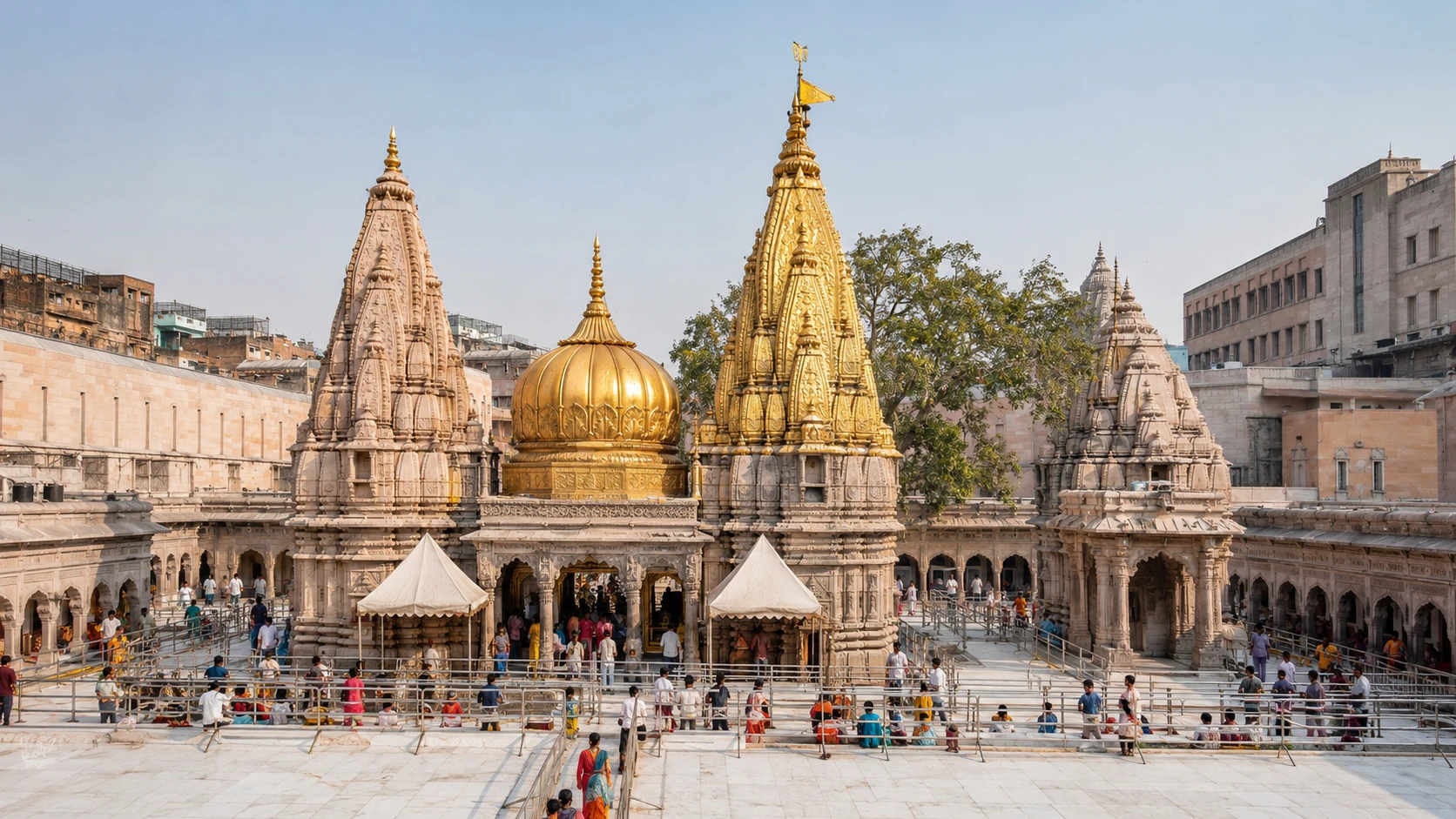
In 1835, Maharaja Ranjit Singh of the Sikh Empire donated approximately 820 kilograms of gold to plate the temple's three shikharas, giving the temple its iconic gilded skyline visible above the Banaras rooftops to this day.
In the modern era, the temple is administered by the Shri Kashi Vishwanath Temple Trust under the Government of Uttar Pradesh, an arrangement formalised by the Shri Kashi Vishwanath Temple Act, 1983, which placed the temple under state administration.
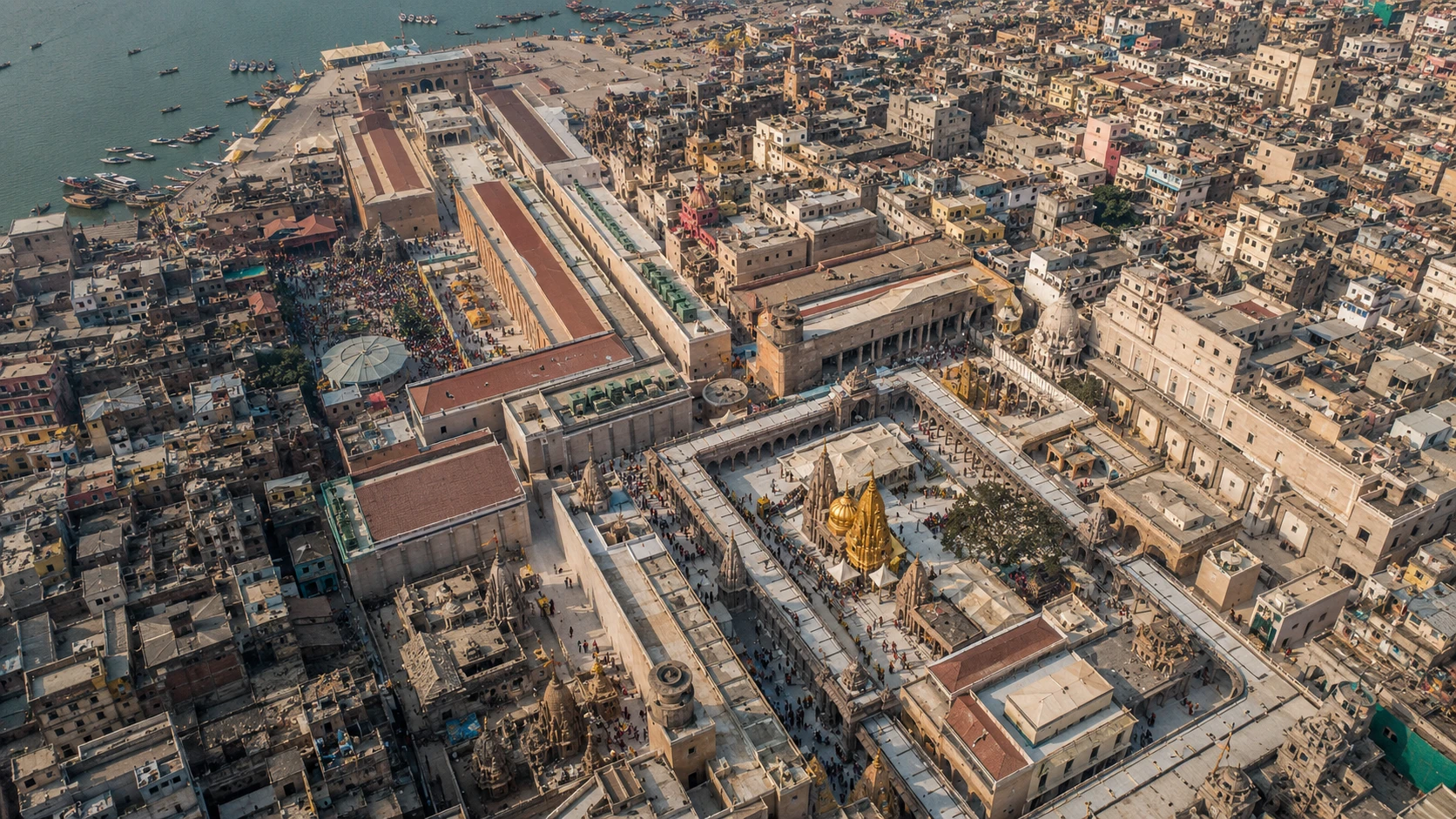
In December 2021 the Kashi Vishwanath Dham, a corridor and precinct project opening the temple grounds down to the Ganga at Manikarnika and Lalita Ghats, was inaugurated, completing a major modernisation of pilgrim infrastructure while drawing both support for improved access and concern from preservationists about the older built fabric of the surrounding mohallas.
The corridor connects, for the first time in the modern era, the temple precinct directly to the cremation ghat at Manikarnika, a spatial reunion of the moksha-tradition's two poles, the lingam and the funeral pyre, that the Skanda Purana placed at the heart of Kashi's sanctity.
Historical Timelineऐतिहासिक कालक्रम
Compilation horizon of the Skanda Purana's Kashi Khanda, the most authoritative classical text on Kashi's sacred geography, codifying the Vishvanatha Jyotirlinga's status, the Avimukta narrative, and the moksha-at-death tradition that defines the kshetra. Earlier oral traditions and ritual practices are presumed; this is the textual horizon at which the city's role becomes pan-Indian rather than regional.
Puranic compilation horizons are subject to ongoing philological debate. The 7th, 9th century range reflects mainstream scholarly consensus on the Kashi Khanda's textual stabilization, but earlier and later layers within the text are well-recognized.
Sack of the Vishvanatha temple during the Ghurid invasion of north India under Qutb-ud-din Aibak, general of Muhammad of Ghor. The temple structure of the period was substantially damaged. The event is recorded in Persian chronicles of the conquest as part of a broader campaign across the Ganga doab.
Casualty and destruction figures in early Persian conquest chronicles are written in a panegyric mode and require scholarly contextualization. The structural damage to the temple is independently attested by the absence of pre-13th-century inscriptions on later structures and by the patterns of subsequent reconstruction.
Reconstruction of the Vishvanatha temple, traditionally attributed to local rulers and merchants of the Gahadavala, post-Gahadavala period of north Indian Hindu polities. The reconstructed temple persisted through the early Delhi Sultanate as a continuing pilgrimage centre.
Destruction of the Vishvanatha temple during the rule of Hussain Shah Sharqi of the Jaunpur Sultanate. The destruction is recorded in regional chronicles of the period as part of broader Sharqi campaigns into the Banaras region.
Major reconstruction of the Vishvanatha temple under the patronage of Raja Todar Mal, revenue minister to the Mughal emperor Akbar. Built in the Mughal-era Nagara revival style, this structure represented the temple's most architecturally accomplished phase since the early medieval period and was the immediate predecessor of the events of 1669.
Demolition of the Vishvanatha temple by order of the Mughal emperor Aurangzeb, recorded in the official chronicle Maasir-i-Alamgiri. The order is dated to the 9th of April 1669 in the chronicle. The historical relationship between the demolished temple structure and the Gyanvapi premises adjacent to the present temple is the subject of ongoing scholarly, archaeological, and legal investigation.
The demolition of 1669 is well-attested in Mughal court sources. The motivations attributed to Aurangzeb in different scholarly traditions vary substantially, ranging from explicitly religious-iconoclastic readings (the older mainstream view) to political-pragmatic readings (Truschke, 2017) to readings emphasizing local political contexts (Eaton, 2019). The relationship between the demolished structure and subsequent buildings, including the western wall of the Gyanvapi mosque, is the subject of active archaeological investigation. Eternal Raga records the documented event without adjudicating the contested historiography of the surrounding interpretive questions.
The present Kashi Vishwanath temple was built by Maharani Ahilyabai Holkar of Indore, beside the location of the older sanctum. The reconstruction was part of Ahilyabai's extensive 18th-century programme of temple-building and restoration across the Indian subcontinent, including major works at Somnath, Vishnupad in Gaya, Grishneshwar, and many other Jyotirlingas and pilgrimage sites.
Maharaja Ranjit Singh, founder of the Sikh Empire of Punjab, donated approximately 820 kilograms of gold to plate the three shikharas of the Kashi Vishwanath temple. The donation was part of a broader pattern of Sikh-empire patronage of Hindu sacred sites; the gilded shikharas have given the temple its characteristic skyline visible above the Banaras rooftops to this day. The temple is consequently sometimes referred to in regional usage as 'Suvarnamandir' (golden temple), distinct from the Sikh Harmandir Sahib of the same English name.
The 820 kg figure is the canonical attestation in temple trust and regional historical records. Slight variations in cited weight appear across secondary sources (some give the figure as approximately one ton, others as approximately 1000 maunds in pre-metric units); the order of magnitude is uncontested across sources.
The Shri Kashi Vishwanath Temple Act, 1983 was passed by the Uttar Pradesh Legislative Assembly, formalising state administration of the temple under the Shri Kashi Vishwanath Temple Trust. Prior to the Act, the temple had been managed under varying trust arrangements descending from the Holkar-period endowment. The Act vests temple property and operations in a state-supervised trust, with the District Magistrate of Varanasi as ex-officio member.
The Kashi Vishwanath Dham, a corridor and precinct project opening the temple grounds down to the Ganga at Manikarnika and Lalita Ghats, was inaugurated by Prime Minister Narendra Modi. The project involved acquisition and demolition of multiple structures in the surrounding mohallas, the relocation or restoration of approximately 40 smaller shrines that had been embedded in the older built fabric, and the creation of a 320-metre paved corridor connecting the temple to the river. The project was completed at an estimated cost of approximately INR 339 crore.
The Kashi Vishwanath Dham project drew both substantial public support, particularly for improved pilgrim access and the physical reunion of the temple with the Manikarnika cremation ghat, and concern from heritage preservationists about the loss of older built fabric in the surrounding mohallas. The approximately 40 smaller shrines documented during demolition were either incorporated into the new corridor design, relocated, or recorded as casualties of the construction; the precise count and disposition of each is documented in trust and government records but is itself the subject of ongoing scholarly attention.
What You'll Seeदर्शन में
The Vishvanatha Jyotirlinga is housed in the inner sanctum (garbhagriha) of the temple, set within a square silver yoni-pitha. The lingam itself is comparatively small, a dark, smooth stone rising approximately 60 centimetres above the silver platform, and is held by tradition to be the very pillar of light from the primal contest of Brahma and Vishnu, settled now into manifest stone.
Unlike most Jyotirlingas, Kashi Vishwanath permits Sparsh Darshan: devotees who pay for the early-morning paid darshan slot may touch the lingam directly, a practice attested in regional ritual texts as carrying particular spiritual potency for the surrender of self to the deity.
The sanctum is small, barely large enough to hold a few priests and a single line of devotees at a time, and unornamented; its smallness is deliberate, the architectural counterpart to the Skanda Purana's idea that this shrine is the heart-pillar of the cosmos in which all creation is held tightly.
Above the lingam is suspended a continuous abhishekam pot from which sacred water drips through the day; the silver platform is heaped with bilva leaves, marigold, and, on certain days, gold coins from royal devotees that are recycled into temple maintenance.
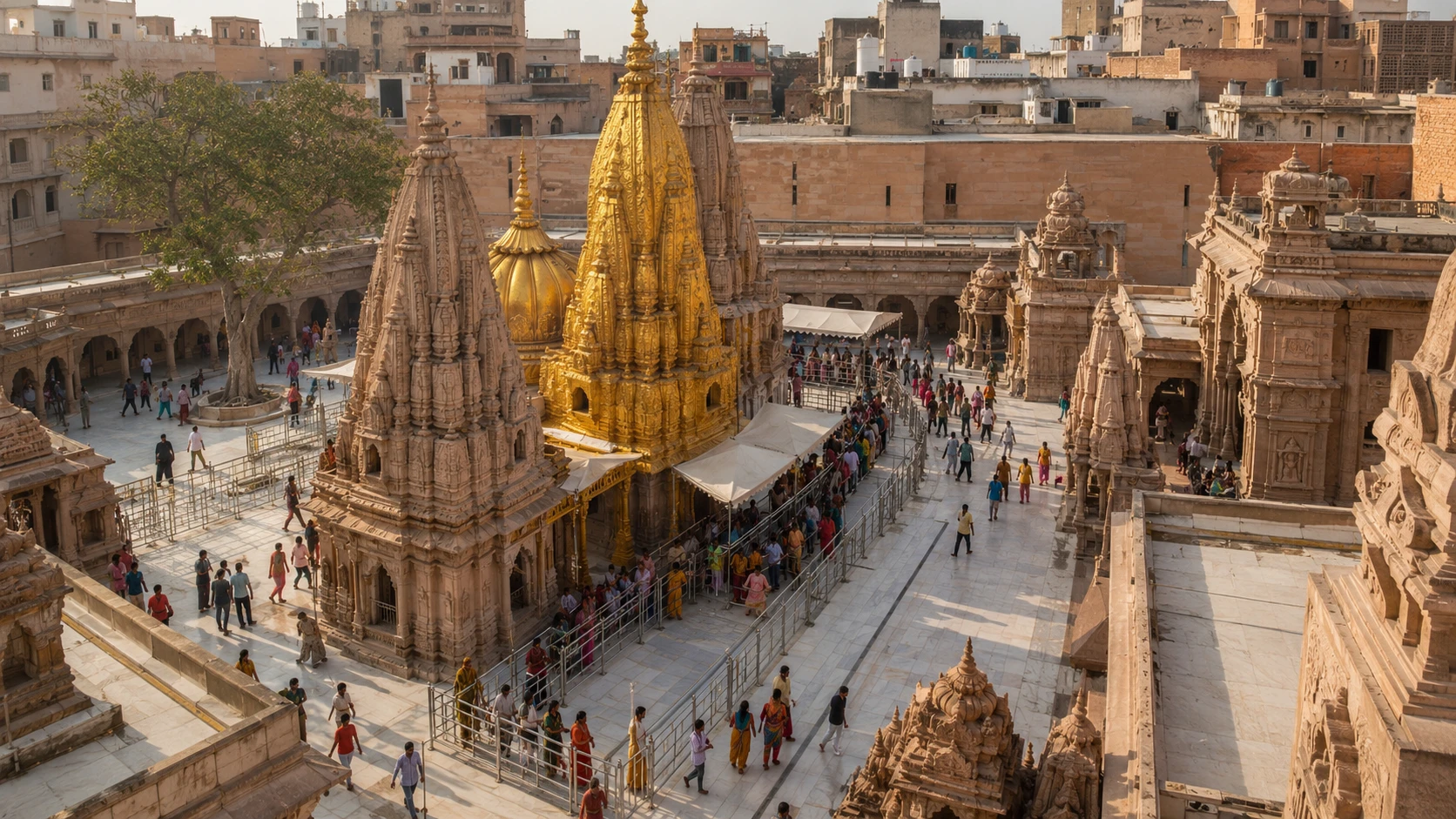
Above the sanctum rises the temple's most recognizable feature: three shikharas plated in gold leaf, totalling approximately 820 kilograms of gold donated by Maharaja Ranjit Singh in 1835. The two visible primary shikharas, over the Vishvanatha sanctum and the adjacent Annapurna shrine, and the smaller third spire over the inner mandap give the temple its skyline that catches the dawn light first across the Banaras rooftops.
From the river, in early morning, the gold of the shikharas precedes the sun.
The complex around the central sanctum is dense with smaller shrines: Annapurna (Shiva's consort in her form as the goddess of food, considered Vishvanatha's inseparable counterpart in Kashi), Vishvakarma, Avimukteshwar (the Avimukta-protector form of Shiva), Dhandapani Bhairava (the kshetrapala or guardian of the kshetra), and a Vishnu shrine acknowledging the truthfulness recognized in the Brahma, Vishnu story.
Adjacent to the temple grounds, and one of the kshetra's most intricate geographic relationships, stands the Gyanvapi premises, with the Gyanvapi well that the Skanda Purana names as the well of jnana (spiritual knowledge) at the centre of the kshetra.
The 2021 Kashi Vishwanath Dham corridor opened a 320-metre paved approach from the temple precinct down to the Ganga at Manikarnika and Lalita Ghats, the first time in the modern era that the lingam and the great cremation ghat are spatially connected by a direct walking route.
The corridor's design preserved approximately 40 smaller embedded shrines that had been integrated into the older mohalla fabric, relocating or restoring them along the new route.
Distinctive Practicesविशिष्ट परंपराएँ
Mangala Aarti at 03:00
मंगला आरती (प्रातः ३:००)
Daily, 03:00 (advance ticketed booking required)
The temple's first aarti of the day takes place at 03:00, earlier than at most major Hindu temples, and admission is by paid advance booking only. A small group of pilgrims (capacity is strictly limited) gathers in the inner mandap while the priests perform the ritual washing, anointment, and dressing of the lingam, attended by the chanting of Vedic hymns and the kindled cotton-wick lamps. The aarti's earliness is held to be appropriate to Kashi's nature as a city that does not sleep at the cosmic level, the ritual catches the deity in the moment of transition from cosmic stillness to the day's manifestation.
The Mangala Aarti embodies the Skanda Purana's notion that Shiva at Kashi is in continuous attendance to the kshetra, never in sleep, never in absence. The 03:00 timing places the worshipper at the brahma-muhurta, the auspicious pre-dawn watch traditionally held to be the time when the boundary between this world and the others is thinnest. To attend Mangala Aarti at Kashi Vishvanatha is to stand at that boundary alongside the unbroken vigil that the Avimukta tradition attributes to Shiva himself.
Sparsh Darshan (Touching the Lingam)
स्पर्श दर्शन
Daily during the early morning paid darshan window (approximately 03:00, 04:30)
Of all twelve Jyotirlingas, Kashi Vishwanath is among only a handful that permit devotees to physically touch the lingam during darshan. The Sparsh Darshan window, accessed by paid ticket through the trust's official booking channels, allows the pilgrim a brief moment of direct contact with the dark stone of the Vishvanatha. The contact is performed under priest supervision; the pilgrim usually offers Ganga jal, sandal paste, and a bilva leaf during the touch, then steps aside to make way for the next devotee.
Sparsh Darshan reflects the particular theological intimacy of Kashi: this is the kshetra where Shiva is held to attend personally to every pilgrim's death and to whisper the moksha-mantra in person. The physical touch of the lingam is the daily ritual rehearsal of that final moment of contact, a small surrender now of the body to the deity, anticipating the great surrender at the end. Devotees who undertake Sparsh Darshan often describe it as the practice that most fundamentally distinguishes a Kashi pilgrimage from any other Jyotirlinga visit.
Ganga Jal Abhishekam
गंगा जल अभिषेकम
Year-round, with peak intensity during Shravan (July, August)
Pilgrims to Kashi Vishwanath traditionally bathe in the Ganga at one of the ghats, most commonly Dashashwamedh or Manikarnika, before darshan, then carry water from the river in a small kalash to offer at the lingam during abhishekam. The 2021 corridor's direct route from Manikarnika Ghat to the temple makes this practice especially fluid: the pilgrim now walks a 320-metre paved path from river to lingam carrying the consecrating water. During Shravan Mondays the practice intensifies, with miles-long queues of saffron-clad kanwariyas (who have walked from distant Ganga sources) processing into the temple with their kanwar-pots of Ganga water.
The Ganga and the Vishvanatha lingam are theologically inseparable in Kashi: the river is the consort of the deity in earthly form, and the abhishekam returns to the lingam the water that flows from his own matted locks. Carrying Ganga water from the ghat to the sanctum and pouring it over the lingam is the ritual completion of a circle that the geography of the kshetra encodes, water from the consort offered to the lord, the kshetra returning to itself.
Mukti Bhavan Tradition (Dying in Kashi)
मुक्ति भवन परंपरा (काशी में देह-त्याग)
Year-round; observed by terminally-ill devotees and elderly pilgrims who undertake to spend their final days in the kshetra
Among Kashi's most extraordinary living traditions is the practice of dying in Kashi for moksha. Several Mukti Bhavans (liberation guesthouses) operate in the kshetra, the most famous being the Kashi Labh Mukti Bhawan near Manikarnika, where terminally-ill devotees and elderly pilgrims who have undertaken the resolve to die in Kashi take rooms for their final days, weeks, or sometimes months. Volunteers and resident priests sing bhajans through the days; family members or hired attendants stay with the dying. Upon death, the body is taken directly to Manikarnika Ghat for cremation in the kshetra. The tradition is held to be the most direct enactment of the Tarak Mantra promise of the Skanda Purana.
The Mukti Bhavan tradition is the practical extension of the Avimukta promise. The Skanda Purana's vow that Shiva himself attends every death within the kshetra and whispers the Tarak Mantra makes physical presence in Kashi at the moment of death the highest spiritual aspiration in this tradition. The Mukti Bhavans exist as institutional structures supporting that aspiration; their continued operation across centuries is one of Hindu civilization's longest-running expressions of a single theological promise, a city with infrastructure for liberation.
Did You Know?क्या आप जानते हैं?
The Skanda Purana records Shiva's promise that any soul dying within the boundary of Kashi receives the Tarak Mantra whispered directly by Shiva into the dying ear, granting immediate liberation from the cycle of rebirth. This is the only place in Hindu sacred geography where moksha is held to be guaranteed by location of death, making Kashi unique among the world's religious traditions in offering an explicit geographical pathway to ultimate liberation.
Skanda Purana, Kashi Khanda; Diana Eck, Banaras: City of Light (1982)
Approximately 820 kilograms of pure gold were donated by Maharaja Ranjit Singh of the Sikh Empire in 1835 to plate the temple's three shikharas. The gold remains intact today, periodically restored by the Trust; the gilded skyline is visible from across Banaras and is the temple's most recognized visual signature.
Sikh court records of the Lahore Durbar (1835); Khushwant Singh, A History of the Sikhs
Kashi Vishwanath is among only a handful of major Jyotirlingas that permit Sparsh Darshan, the practice of pilgrims physically touching the lingam during darshan. This intimacy is theologically grounded in Kashi's identity as the kshetra where Shiva is held to be in personal attendance on every pilgrim, and it is regarded by tradition as among the most spiritually weighted experiences available in Hindu pilgrimage.
Shri Kashi Vishwanath Temple Trust ritual records; Diana Eck, Banaras: City of Light
Of the seven Sapt Puri cities (Ayodhya, Mathura, Maya/Haridwar, Kashi, Kanchi, Avantika/Ujjain, and Dvaraka) that Hindu tradition holds to grant moksha, Kashi is the only one that is also a Jyotirlinga site, uniquely combining the moksha-of-place tradition with the moksha-of-darshan tradition. Mahakaleshwar at Avantika (Ujjain) is the only other Sapt Puri / Jyotirlinga overlap; Kashi alone among the Sapt Puri also bears the Avimukta name.
Sapt Puri tradition codified in the Garuda Purana and the Skanda Purana
Kashi Vishwanath has six aartis daily, Mangala (03:00), Bhog (11:30), Madhyahna Bhog (12:00 wider), Sapta Rishi (19:00), Shringar Bhog (21:00), and Shayan (22:30), the most of any Jyotirlinga. The aarti rhythm reflects the Avimukta theology that Shiva at Kashi is in continuous active attendance to the kshetra, requiring multiple ritual moments through the day rather than the single morning-and-evening rhythm of most temples.
Shri Kashi Vishwanath Temple Trust daily schedule; Skanda Purana, Kashi Khanda on the Avimukta tradition
The 2021 Kashi Vishwanath Dham corridor reunited the temple with the Manikarnika cremation ghat by a direct 320-metre paved walking route, the first time in the modern era that the lingam and the great cremation ghat are spatially connected. The reunion is theologically significant: the Skanda Purana places both poles of Kashi's moksha tradition (the Vishvanatha lingam where Shiva dwells, and the Manikarnika pyre where he attends every cremation) at the heart of the kshetra's sanctity, but for centuries built fabric had grown up between them.
Government of India / UP Government Kashi Vishwanath Dham project records (2021); Skanda Purana, Kashi Khanda
Kashi (Varanasi) is among the world's oldest continuously-inhabited urban centres. Archaeological excavations at the Rajghat plateau adjacent to the modern city show settlement strata from at least the 11th century BCE, and Buddhist Pali Canon references to Kasi as a major kingdom date the city's prominence to the 6th century BCE. The continuous worship of Shiva at the Vishvanatha kshetra over more than two millennia represents one of the longest documented unbroken religious continuities at any single site in human history.
Archaeological Survey of India Rajghat excavation reports; Pali Canon (Theragatha and Sutta Nipata references); Diana Eck, Banaras: City of Light (1982)
Visitor Accessप्रवेश जानकारी
Kashi Vishwanath welcomes devotees of all backgrounds for darshan. There are no entry restrictions based on gender, age, or origin. What is distinctive about access at Kashi Vishwanath is the strict security regime: mobile phones, cameras, leather items (belts, wallets), and bags must be deposited at security checkpoints before entering the temple precinct. Photography is strictly prohibited within the temple complex, and especially in the inner sanctum. The corridor's open layout post-2021 has eased pilgrim flow significantly, but security checks remain rigorous, particularly during festival periods.
Allow at least 30, 45 minutes for security clearance during off-peak hours; up to 2, 3 hours during festival days. Phone deposit lockers are available at the corridor entrance and at the Vishwanath Gali entrance; carry a small purse or pouch for valuables that you cannot leave. Sugam Darshan tickets (priority queue) are available through the official trust portal; Sparsh Darshan tickets for the early morning lingam-touching window must be booked well in advance. During Shravan Mondays and Maha Shivratri, expect queues of several hours even with priority tickets.
Festivalsत्योहार
Maha Shivratri
महाशिवरात्रि
Feb-Mar (Phalgun Krishna Chaturdashi)
The most important festival at any Shiva temple, observed at Kashi Vishwanath with all-night vigil (jagaran), continuous abhishekam from before dawn through the next dawn, four prahar pujas through the watches of the night, and millions of pilgrims approaching from across north India. The temple opens earlier than usual, the corridor and gallis fill from late afternoon, and the central nishitha kala puja at midnight is the most crowded ritual moment of the Hindu calendar at this temple. Ranbhari Ekadashi falls during the lead-up and is observed with a distinctive Kashi gulal-throwing procession from the temple, said to start the city's Holi.
Shravan Month (Sawan)
श्रावण मास (सावन)
Jul-Aug (Shravan)
The entire month of Shravan brings the largest pilgrim flow of the year to Kashi Vishwanath. Each Monday (Shravan Somvar) sees hundreds of thousands of saffron-clad kanwariyas, pilgrims who have walked from Sultanganj, Gaumukh, or other Ganga sources carrying kanwar-pots of Ganga water, arriving to perform abhishekam. The temple opens through the night during Shravan; abhishekam is continuous; food and water arrangements are made by the trust and city administration to handle the crowds. The third Shravan Somvar is held to be the most spiritually charged.
Annakut and Annapurna Shringar
अन्नकूट और अन्नपूर्णा शृंगार
Oct-Nov (Kartik Shukla Pratipada, day after Diwali)
Annakut at Kashi Vishwanath is among the most distinctive festivals at the temple, for it is here that the Annapurna shrine adjacent to Vishvanatha receives its most elaborate annual decoration. The image of Annapurna is dressed in gold and ornaments and offered the chappan-bhog: the 'fifty-six offerings' of food, mountains of grain, sweets, and prepared dishes that the goddess of food has provided to the city. Devotees queue overnight for the rare darshan of Annapurna in her gold form, which is unveiled only on this single day each year.
Dev Deepawali
देव दीपावली
Nov (Kartik Shukla Purnima)
Dev Deepawali, the 'Diwali of the gods', falls on Kartik Purnima fifteen days after Diwali. It is uniquely observed at Kashi: every step of the city's eighty-four ghats along the Ganga is lit with oil lamps from dusk through the night, totalling more than a million diyas. The Vishvanatha temple participates as the sacred axis of this celebration; aarti at Dashashwamedh Ghat is timed to coincide with the temple's evening rituals. From the river, in a boat at dusk, the entire city appears to be lit by the gods themselves, the visual realization of the kshetra's name as the City of Light.
Rangbhari Ekadashi
रंगभरी एकादशी
Mar (Phalgun Shukla Ekadashi, six days before Holi)
Rangbhari Ekadashi is the day, by Kashi tradition, that Lord Shiva brings his bride Parvati home to Kashi after their marriage. The temple celebrates with a unique gulal (coloured powder) procession from the Vishvanatha sanctum, with the priests sprinkling gulal on devotees from the temple itself, an act traditionally held to start Banaras's Holi a week before the rest of north India. The procession is one of the most photographed devotional moments in the Hindu calendar; the air around the temple turns saffron and pink for an afternoon.
Traditional Offeringsपारंपरिक अर्पण
Primary Offerings
Bel Patra (Bilva leaves)
बेल पत्र
बिल्व पत्र
The three leaflets of the bilva represent the three eyes of Shiva, the prongs of his trident, and the cosmic functions of creation, preservation, and dissolution. The Shiva Purana states that even a single bilva leaf, offered with devotion, surpasses elaborate rituals. At Kashi Vishwanath, devotees often offer bilva accompanied by a brief silent recitation of the Mahamrityunjaya, the temple's overlap of leaf-offering and mantra-recitation being one of the most characteristic small acts of Kashi devotion.
Ganga Jal (Sacred Ganges water)
गंगा जल
गङ्गा जल
Ganges water is offered for abhishekam, the ritual bathing of the lingam, at every major Shiva temple, on the principle that Shiva is the holder of Ganga in his matted locks. At Kashi the practice carries unique theological weight: the temple stands on the western bank of the Ganga itself, and the river that flows past the temple is held to be the consort of the deity in earthly form. To offer Ganga water at Kashi Vishvanatha is to return the river to its source.
Panchamrit (Five sacred substances)
पंचामृत
पञ्चामृत
The ritual bathing of the lingam with five sacred substances, milk, curd, honey, ghee, and sugar, is performed at all major Shiva temples. Each substance carries symbolic meaning: milk for purity, curd for prosperity, honey for sweet speech, ghee for victory, and sugar for happiness. The five together represent the five elements (panchabhuta) returning to their cosmic source.
Vibhuti (Sacred ash)
विभूति
विभूति
Sacred ash applied to the lingam and to the devotee's forehead. Vibhuti embodies the truth that all material existence eventually returns to ash, a constant reminder of impermanence. At Kashi, where the kshetra-tradition includes the cremation pyres of Manikarnika, vibhuti carries an unusually direct theological weight: the ash on the forehead is a small daily anticipation of the ash that the body itself will become.
Dhatura flowers and fruit
धतूरा के फूल और फल
धत्तूर
The trumpet-shaped dhatura flower, despite its toxic nature, is sacred to Shiva. The plant is said to have emerged when Shiva consumed the halahala poison during the churning of the cosmic ocean, the flower represents Shiva's capacity to absorb what is poisonous and transform it into an offering returned to him in worship. Offering dhatura is held to remove fear of death from the devotee.
Camphor (Karpur)
कर्पूर
कर्पूर
Camphor is offered during aarti, particularly at the six daily aartis of Kashi Vishwanath. Camphor is held to be a perfect offering because, when burned, it leaves no residue, embodying the ideal of devotion that surrenders entirely without trace. The clear blue camphor flame held before the lingam at the Mangala Aarti is one of the temple's most quietly powerful images.
Unique to This Temple
Direct Ganga Jal from the Adjacent Ghats
निकटवर्ती घाटों का प्रत्यक्ष गंगा जल
Pilgrims to Kashi Vishwanath traditionally bathe at one of the adjacent ghats, Dashashwamedh, Manikarnika, or Lalita, and carry water from the river in a small kalash or copper pot directly to the temple, offering it during darshan as part of the abhishekam. The 2021 corridor's direct route from Manikarnika Ghat now makes this practice especially fluid: the pilgrim now walks a 320-metre paved path from river to lingam carrying the consecrating water. This is among the most distinctive offerings at Kashi: the water is not bought, not commercially packaged, but personally drawn from the kshetra's own consecrating river.
Annapurna Prasad
अन्नपूर्णा प्रसाद
Adjacent to the Vishvanatha sanctum stands the shrine of Annapurna, Shiva's consort in her form as the goddess of food, considered Vishvanatha's inseparable counterpart in Kashi. Devotees who complete Vishvanatha darshan typically also receive Annapurna Prasad, a simple consecrated offering of cooked grain, sweets, and lentils prepared in the temple's kitchen. On the annual Annakut day (the day after Diwali), this prasad expands to the chappan-bhog, fifty-six dishes, and pilgrims queue overnight for the rare gold-form darshan of the goddess. The pairing of Vishvanatha and Annapurna in Kashi devotional practice is understood as: the Lord of the Universe is fed by the Goddess of Food.
The Trust maintains official offering counters within the temple precinct selling pre-packaged bundles (bilva, flowers, panchamrit, agarbatti, camphor) and prasad. Devotees are welcome to bring offerings from outside, with one specific local note: many pilgrims also carry water from one of the adjacent Ganga ghats in a small kalash for offering, this is among the most characteristic Kashi practices. Avoid carrying glass containers within the precinct (security restrictions); a small copper or steel vessel is the traditional choice.
How to Reachकैसे पहुँचें
Varanasi is among the best-connected pilgrimage cities in north India, with direct rail and air links from across the country. The temple sits in the heart of the old city on the western bank of the Ganga; final approach to the temple itself is on foot, either through the older Vishwanath Gali (a maze of narrow medieval streets) or via the post-2021 corridor that runs from the river up to the temple precinct.
By air, Lal Bahadur Shastri International Airport (Babatpur), about 26 km from the temple, is the nearest hub. Direct domestic flights connect Varanasi to Delhi, Mumbai, Bangalore, Hyderabad, Kolkata, and several other major cities; international flights connect from Bangkok, Sharjah, and a handful of other destinations.
From the airport, taxis (pre-paid counter at the airport, or app-based) take 45, 75 minutes to reach the temple area; auto-rickshaws are a budget alternative for the longer route.
By rail, Varanasi has three principal stations: Varanasi Junction (Cantt) is the main station and is approximately 5 km from the temple, the busiest by trains and most pilgrim-arrivals. Banaras Railway Station (Manduadih) on the city's western edge is approximately 4 km from the temple. Pt.
Deen Dayal Upadhyaya Junction (formerly Mughalsarai) across the river is about 19 km away and is a major junction with many through-trains. Direct trains run from Delhi, Mumbai, Kolkata, Howrah, Patna, and most major north and central Indian cities. Pre-paid auto-rickshaws and taxis are available at all three stations; cycle-rickshaws are a slower but characteristic option.
Within the city, the final approach to the temple is on foot from Godowlia chowk (the central pedestrian square of the old city), a 10-minute walk through the gallis. Pilgrims arriving via the Ganga can also take a boat to Manikarnika Ghat or Lalita Ghat and ascend through the new corridor, a 5-minute walk from the river to the temple.
Vehicles are not permitted close to the temple precinct; this is by design and pre-dates the corridor.
Many pilgrims combine Kashi Vishwanath with Sarnath (the Buddhist site where the Buddha gave his first sermon, 10 km from Varanasi), Vindhyachal Devi (a major Shakta site, 80 km away), and the Kashi-Prayagraj-Ayodhya circuit. Allahabad/Prayagraj is 125 km west; Ayodhya is approximately 200 km north-west.
Plan Your Visitयात्रा की योजना
🌤 Best Season
October to March is the most comfortable period, daytime temperatures range from 15, 28°C, the post-monsoon air is clear, and the boat rides at dawn are at their most photogenic. Avoid May to mid-July (peak summer, often 38, 45°C, oppressively humid as the monsoon nears). The monsoon (mid-July to September) brings heavy rain that can flood the lower ghats and disrupt boat rides; the temple itself remains open. November and the Kartik Purnima Dev Deepawali festival are the most spiritually charged times for the city as a whole. Expect large crowds during Maha Shivratri (Feb-Mar), Shravan Mondays (July-Aug), and Dev Deepawali (Nov).
👘 Dress Code
Modest dress is expected. For men, full-length trousers or dhotis with a shirt or kurta; many male devotees enter the sanctum bare-chested with a dhoti for Sparsh Darshan. For women, sarees, salwar suits, or long skirts with covered shoulders are appropriate. The temple does not formally enforce a strict dress code but immodest dress will be turned away by security at the entrance. A head covering is optional but appreciated in the sanctum during prayer. Footwear must be removed well before entering the temple precinct; designated shoe-deposit areas are at the corridor entrance and at the Vishwanath Gali entrance.
📱 Phones & Photography
Mobile phones, cameras, smart watches, and any electronic recording devices must be deposited at security checkpoints before entering the temple precinct, this is strictly enforced. Phone-deposit lockers are available at both the corridor entrance (from the river side) and the Vishwanath Gali entrance (from the city side). Photography of any kind is prohibited within the precinct, and especially in the inner sanctum. Pilgrims wishing to photograph the temple exterior should do so from the river or from the corridor's outer plaza before entering security.
🏨 Accommodation
Varanasi has accommodation in every category from luxury hotels to budget pilgrim dharamshalas. The Trust operates a Bhakt-Niwas guesthouse for pilgrims staying for festival visits, with priority for those who have booked Sparsh Darshan or special pujas. UP Tourism's Hotel Rahi Tourist Bungalow and the Diamond Hotel offer mid-range options near the city centre. Heritage hotels along the ghats, Brij Rama Palace at Darbhanga Ghat, the BrijGhat Suites, offer luxury experiences with direct ghat-side views. For pilgrims preferring traditional dharamshala-style accommodation, several smaller dharamshalas operate in the gallis around the temple, run by community trusts and regional caste associations. For those undertaking the Mukti Bhavan tradition, the Kashi Labh Mukti Bhawan near Manikarnika is the most established institutional option.
Sacred Soundsपवित्र ध्वनि
Did You Know? · क्या आप जानते हैं?
The same translation error that turned '33 Koti' into '33 crore' in Hinduism also happened in Buddhism. The Chinese translation of Buddhist texts rendered 'Sapta Koti Buddha' (7 Supreme Buddhas) as '7 Crore Buddhas.' The Tibetan translation got it right: 7 types, not 7 crore. One Sanskrit word, misread across two major world religions, generated two identical misconceptions independently.
Related Contentसंबंधित सामग्री
Related Scriptures
Community Reflections
🕉️
Be the first to share your reflection.