Vaidyanath
वैद्यनाथ
The ninth Jyotirlinga, where Shiva is healer and where Sati's heart fell
Deoghar, Jharkhand, India
VaidyanāthaAlso known as: Baidyanath, Baba Baidyanath, Baba Baidyanath Dham, Vaidyanatha Jyotirlinga, Hridya Peeth, Cita-bhumi, Ravaneshwar
Era
Pilgrimage tradition referenced from the Pala period (8th, 12th century); current main shrine and 22-sub-shrine complex consolidated through the 18th, 19th centuries; major modern reforms and access reorganization through the 20th century
Architecture
Nagara, eastern Indian sub-style with a tall white-painted shikhara and pyramidal sub-shrine cluster
Open
04:00 – 21:00
Aarti
04:00 · 06:00 · 12:00 · 19:00 · 21:00
Special
Shravan Kanwar Yatra (Jul, Aug, world's largest annual religious procession); Maha Shivaratri all-night arghya; the Shiva-Parvati Vivaha (marriage) thread-tying ritual at the temple's Gathbandhan flag is a Deoghar-specific darshan element
The Sacred Legend · पवित्र कथा
Vaidyanath at Deoghar is the ninth Jyotirlinga and the only Jyotirlinga that is also a Shakti Peeth, the single shrine in the canonical correspondence where Shiva and Shakti reside in adjacent garbhagrihas, a Bhairava-Devi pair welded together by overlapping Puranic geographies. The Shiva Purana places its origin in Ravana's most extreme tapas, when the rakshasa-king cut off his nine heads one by one to compel Shiva's appearance, and Shiva at last appeared not only to grant a boon but to heal the very wounds Ravana had inflicted on himself, for here Shiva is the divine physician, the Vaidyanath who binds the wounds of those who come. The Devi Bhagavata Purana places it in the dismemberment of Sati: as Vishnu's chakra severed her body across the subcontinent, her heart (hridaya) fell to this spot, making Deoghar the Hridya Peeth among the fifty-one Shakti shrines. For one full month each year, in Shravan, more than ten million pilgrims walk barefoot from Sultanganj on the Ganga to Deoghar, over a hundred kilometres carrying water-pots on their shoulders, in what is considered the largest annual religious procession in the world. Few sites in Hindu sacred geography hold so many traditions in a single place.
Sacred Designationपवित्र पदनाम
9th of 12 Jyotirlingas
बारह ज्योतिर्लिंगों में 9th
Shakti Peeth
Body part: heart (hridaya)
Shakti: Jaya Durga (also known as Hridambika)
Bhairava: Vaidyanath / Baidyanath
Sacred Origin Storyपवित्र उत्पत्ति कथा
Source: Shiva Purana (Koti Rudra Samhita) and Padma Purana, widely-attested
In the age of the asuras, when Ravana ruled Lanka in the south, he was already known as the most learned scholar and the most powerful warrior of his time, a master of the Vedas, of music, of statecraft, of war. But beyond all these masteries, his heart belonged to Shiva.
Ravana resolved that Shiva should not remain distant in the Himalayas; the Lord should come and reside in Lanka, where Ravana could worship him daily.
He climbed Mount Kailash and began an austerity such as the world had not seen. For thousands of years he sat without food or water. When still Shiva did not appear, Ravana drew his sword and cut off one of his ten heads, offering it as a sacrifice. Then a second. Then a third. Each head he offered, his devotion deepening, until nine had fallen.
As Ravana raised his sword for the tenth and final head, the one that would end his life, Shiva at last appeared. The Lord was moved beyond restraint by this devotion that knew no limit. He healed Ravana's nine self-inflicted wounds with a single touch, for Shiva, in this aspect, is Vaidyanath, the divine physician, and restored the severed heads.
Then he asked Ravana to name his boon.
'Reside with me in Lanka,' Ravana said. 'Come with me, in your form as the lingam, and let no place but Lanka know your presence after this day.'
Shiva agreed, but laid one condition: the Jyotirlinga must not be placed on the ground at any point on the journey south. The moment its weight rested on the earth, it would remain there forever. Ravana, exultant, took the Jyotirlinga and began his return.
But the gods watched in alarm. If Shiva himself reached Lanka, the asura's power would become unassailable. The cosmic balance would collapse. Vishnu and the Devas conspired. As Ravana passed through the place that would come to be called Deoghar, the abode of the gods, Vishnu caused the asura to feel a sudden, irresistible need to relieve himself.
He could not put the lingam down. He looked desperately for a brahmin who could hold it.
A cowherd boy appeared on the path, Vishnu in disguise, in some accounts; in others, the boy is Ganesha himself. Ravana, seeing a brahmin child suitable to the task, pressed the Jyotirlinga into his hands and made him swear: 'Hold this. Do not place it on the ground until I return. If you must put it down, call me three times first.' The boy agreed.
Ravana stepped aside. The cowherd waited. The lingam grew heavy in his small hands, heavier and heavier, until even a divine boy could not hold it. He called once: 'Ravana!' No answer came. He called twice. Still nothing. He called the third time, and then placed the Jyotirlinga gently on the ground.
Ravana returned to find the lingam fixed in the earth. He pulled at it with all the strength of his ten arms. He pressed his thumb against the lingam's crown to lever it free. The Jyotirlinga did not move. Even Ravana, slayer of armies, lifter of Mount Kailash itself, could not raise it. He left the print of his thumb on the stone.
The mark is said to remain visible on the lingam at Deoghar to this day.
Shiva then spoke: 'I have remained here, in this place that the gods have arranged. From this day, this site shall be the Vaidyanath Jyotirlinga, ninth among the twelve. Here I am the physician, for I healed your wounds in the Himalayas, and here I shall heal the wounds of all who come to me.
The earth at this place shall be called Deoghar, the abode of the gods, for the gods themselves brought me here.'
The Shiva Purana adds that this Jyotirlinga is the special Lord of healing, that those who come to Vaidyanath with affliction of body or mind find relief, because the Lord here is not only the slayer of demons but also the binder of wounds.
Sources cited:
- Shiva Purana, Koti Rudra Samhita, Chapter 21 (Vaidyanath Jyotirlinga origin)
- Padma Purana, Patala Khanda, Ravana's tapas narrative
- Linga Purana, Jyotirlinga origin sections
- Devi Bhagavata Purana, Skandha 7, Shakti Peeth enumeration including Hridya Peeth
Other Traditions · अन्य परंपराएँ
Parli Vaijnath (Maharashtra), alternate Jyotirlinga claim
A separate temple at Parli (also called Parli Vaijnath or Parali Vaijnath) in the Beed district of Maharashtra asserts that it, and not Deoghar, is the true ninth Jyotirlinga. The textual hinge for this claim is the canonical Dwadasha Jyotirlinga Stotram phrase 'parlyam vaidyanatham cha' (परल्यां वैद्यनाथं च), which Maharashtra-tradition commentators read as anchoring the location at Parli rather than at Deoghar.
The Parli Vaijnath narrative shares the broad arc of the Ravana Atmalinga story but localizes the lingam's setting-down at Parli, near the Brahma river. The temple is administered by the Maharashtra State Devasthan registry as a major regional shrine, and many Marathi-speaking pilgrims regard Parli, not Deoghar, as the canonical Vaidyanath.
Among Hindi-speaking, Bengali-speaking, and Mithila-region pilgrim communities, however, Deoghar holds canonical primacy, supported by the Shiva Purana's geographical references, the integration with the Hridya Shakti Peeth, the Pala-era pilgrimage tradition, and the unmatched scale of the Shravan Kanwar Yatra.
Baijnath at Kangra (Himachal Pradesh), minor alternate claim
A 13th-century stone temple at Baijnath in the Kangra valley of Himachal Pradesh, dedicated to Vaidyanath as Shiva the physician, is sometimes presented in regional Pahari tradition as a Jyotirlinga site. Built in 1204 CE during the Trigarta-era under merchant patronage and famous for its preserved Nagara architecture, the Baijnath shrine carries genuine devotional significance and is a recognized destination on the Himalayan Shiva pilgrimage circuit.
However, the Baijnath claim does not appear in mainstream Stotram-correspondence lists; the temple is treated by most modern Shaiva traditions as a major regional Vaidyanath shrine rather than as one of the twelve Jyotirlingas. The shared name 'Vaidyanath' (Shiva as physician) reflects a pan-Indian devotional concept, not necessarily a Jyotirlinga-canonical identification.
Scholarly Context
The Vaidyanath Jyotirlinga is the most genuinely contested attribution in the twelve-Jyotirlinga canon. The textual hinge is a single phrase in the canonical Dwadasha Jyotirlinga Stotram (traditionally attributed to Adi Shankaracharya): 'parlyam vaidyanatham cha' (परल्यां वैद्यनाथं च). The Maharashtra reading parses 'parlyam' as 'at Parli' and anchors the Jyotirlinga at Parli Vaijnath in Beed district. The eastern-Indian reading parses the same phrase as a more general locative ('in the place [of Vaidyanath]') and reads the canonical site as Deoghar, supported by the Shiva Purana's geographical references to the Ravana narrative, the Padma Purana's identification of Cita-bhumi with the eastern plateau, and the integration of the Jyotirlinga shrine with the Hridya Shakti Peeth (a Shaiva-Shakta integration that Parli does not share). Modern scholarship (Diana Eck, 'India: A Sacred Geography', 2012; D.C. Sircar, 'The Sakta Pithas', 1973) treats the dispute as a feature of the tradition's living regional reception, with both readings carrying legitimate pilgrim and textual support, rather than as a contradiction to be resolved in favor of either side. The Eternal Raga corpus follows the manifest's anchor at Deoghar, supported by the eastern-Indian Shaiva-Shakta consensus, while presenting the Parli reading respectfully.
Historyइतिहास
The documented history of Vaidyanath at Deoghar is unusually thin compared to its mythological prominence, a function of the eastern-plateau region's distance from major imperial centres before the modern era, the loss of regional records during the Bengal Sultanate-to-Mughal-to-Company transitions, and the predominantly oral character of the priestly Pandey lineage that has managed the temple since at least the late medieval period.
The earliest external references to the shrine appear in Pala-period (8th, 12th century) inscriptions and Buddhist-Hindu syncretic texts from Bihar and Bengal, which name Vaidyanath as a major Shaiva-Shakta pilgrimage destination of the eastern plateau.
By the early modern period, the shrine had become a primary regional pilgrimage centre integrated with the broader Bengali and Mithila Shaiva-Shakta calendar.
Local Trust tradition attributes the consolidation of the present 22-shrine complex to Maharaja Puran Mal of the Gidhaur (Gidhour) zamindari around 1596 CE. Whether this reflects a single major reconstruction or a longer process of accretion is unclear from the surviving evidence; the date and attribution are widely cited in regional devotional and Trust literature but lack a single dated inscription tying Maharaja Puran Mal personally to the temple.
What is well-attested is that by the 18th century the temple was administered by a hereditary priestly community, the Sardar Pandey lineage and associated Pandey families, under whose stewardship the modern Kanwar Yatra tradition appears to have crystallized into its current form.
Colonial-era District Gazetteers (notably L.S.S. O'Malley's 'Bengal District Gazetteer: Santhal Parganas', 1910) document the temple as one of the largest pilgrimage centres in eastern India by visitor volume, with detailed descriptions of the Shravan Kanwar tradition, the Sultanganj-to-Deoghar walking route, and the priestly administration.
The British administration treated Vaidyanath under the Bengal Religious Endowments framework but did not directly intervene in its management.
The 20th century saw two major transitions. First, Acharya Pranavananda's Bharat Sevashram Sangha, founded in 1917, took up reform activity at Deoghar, including pilgrim welfare, accommodation, and access reform, and continues to operate substantial institutions in the temple town today.
Second, the post-Independence reform legislation, particularly Article 17 of the Constitution and the Bihar Hindu Religious Endowments Act, opened temple darshan to all castes, ending centuries of restrictive access. The Maharaja-of-Gidhaur trustee role transitioned through this period to a state-supervised Babulnath / Baidyanath Mandir Trust framework.
In 2000, the State of Bihar was reorganized; Deoghar district fell within the newly-created State of Jharkhand. The temple is now administered by the Babulnath Trust under Jharkhand state oversight, with the Sardar Pandey priestly lineage continuing to hold ritual responsibility.
Today Deoghar is one of the most-visited Hindu pilgrimage sites in India, with the Shravan month seeing pilgrim volumes that rival or exceed those at any other Jyotirlinga.
Historical Timelineऐतिहासिक कालक्रम
Pala-period inscriptional and textual references identify Vaidyanath as a major Shaiva-Shakta pilgrimage centre of the eastern Indian plateau. The shrine appears in Bihar-Bengal Buddhist-Hindu syncretic literature alongside Bodh Gaya and the Vikramashila monastic complex, suggesting an established pilgrim circuit by the early medieval period. The integration of the Jyotirlinga shrine with the Hridya Shakti Peeth tradition appears to have crystallized during this era, though precise dated inscriptions are sparse.
Pre-modern documentation of Deoghar Vaidyanath is genuinely thin. The Pala-era references cited above are textual and inscriptional but do not produce a single dated structural attribution to the present shrine; the architectural history of the temple before the 16th century is largely reconstructed from survey and tradition rather than from datable phases.
Local Trust tradition attributes the consolidation of the present main shrine and the 22-sub-shrine complex to Maharaja Puran Mal of the Gidhaur (Gidhour) zamindari, who is said to have undertaken a major reconstruction in this period. Whether this reflects a single dated rebuilding or a longer process of accretion is unclear; the attribution is widely cited in regional devotional and Trust literature.
The 1596 attribution to Maharaja Puran Mal is widely cited but lacks a single contemporary dated inscription tying him personally to the temple. Caution is appropriate: the safer formulation is 'late 16th century, traditionally attributed to the Gidhaur zamindari of Maharaja Puran Mal,' rather than a precise single-year reconstruction.
L.S.S. O'Malley publishes the 'Bengal District Gazetteer: Santhal Parganas' for the Government of Bengal, including a detailed colonial-administrative description of the Vaidyanath temple, the Sardar Pandey priestly administration, the Shravan Kanwar Yatra route from Sultanganj on the Ganga, and the temple's pilgrim economy. This is the earliest comprehensive external documentation of the modern Deoghar pilgrimage system. The Gazetteer notes annual Shravan pilgrim figures already running into the hundreds of thousands at the turn of the 20th century, establishing Vaidyanath as among the highest-volume Hindu pilgrimage destinations in colonial India.
Following the adoption of the Constitution of India (1950) and the enactment of the Bihar Hindu Religious Endowments Act, temple darshan at Vaidyanath was formally opened to all castes, ending the historical access restrictions that had governed entry to the Garbhagriha. The transition was contested and gradual rather than abrupt, reflecting the broader patterns of post-Independence temple-entry reform across India. The Maharaja-of-Gidhaur trustee role transitioned through this period to a state-supervised trust framework.
The State of Bihar is reorganized under the Bihar Reorganization Act, 2000; Deoghar district falls within the newly-created State of Jharkhand. Administrative oversight of the temple transitions to Jharkhand state authorities, while the Sardar Pandey priestly lineage continues to hold ritual responsibility under the Babulnath / Baidyanath Mandir Trust. The transition does not affect daily ritual life but reorganizes the legal-administrative framework of temple endowments and pilgrim infrastructure.
What You'll Seeदर्शन में
The Vaidyanath Jyotirlinga is a swayambhu (self-manifested) lingam of dark stone, set on a circular yoni-pitha in the central garbhagriha of the main shrine. By tradition, a depression visible on the upper face of the lingam is the print of Ravana's thumb, left when the asura, returning to find the lingam fixed in the earth, pressed his thumb against the stone in a final attempt to lever it free.
Devotees are not permitted to touch the lingam directly during regular darshan, but the thumb-mark is identifiable from the priestly side of the sanctum and forms part of every ritual narration of the temple's origin.
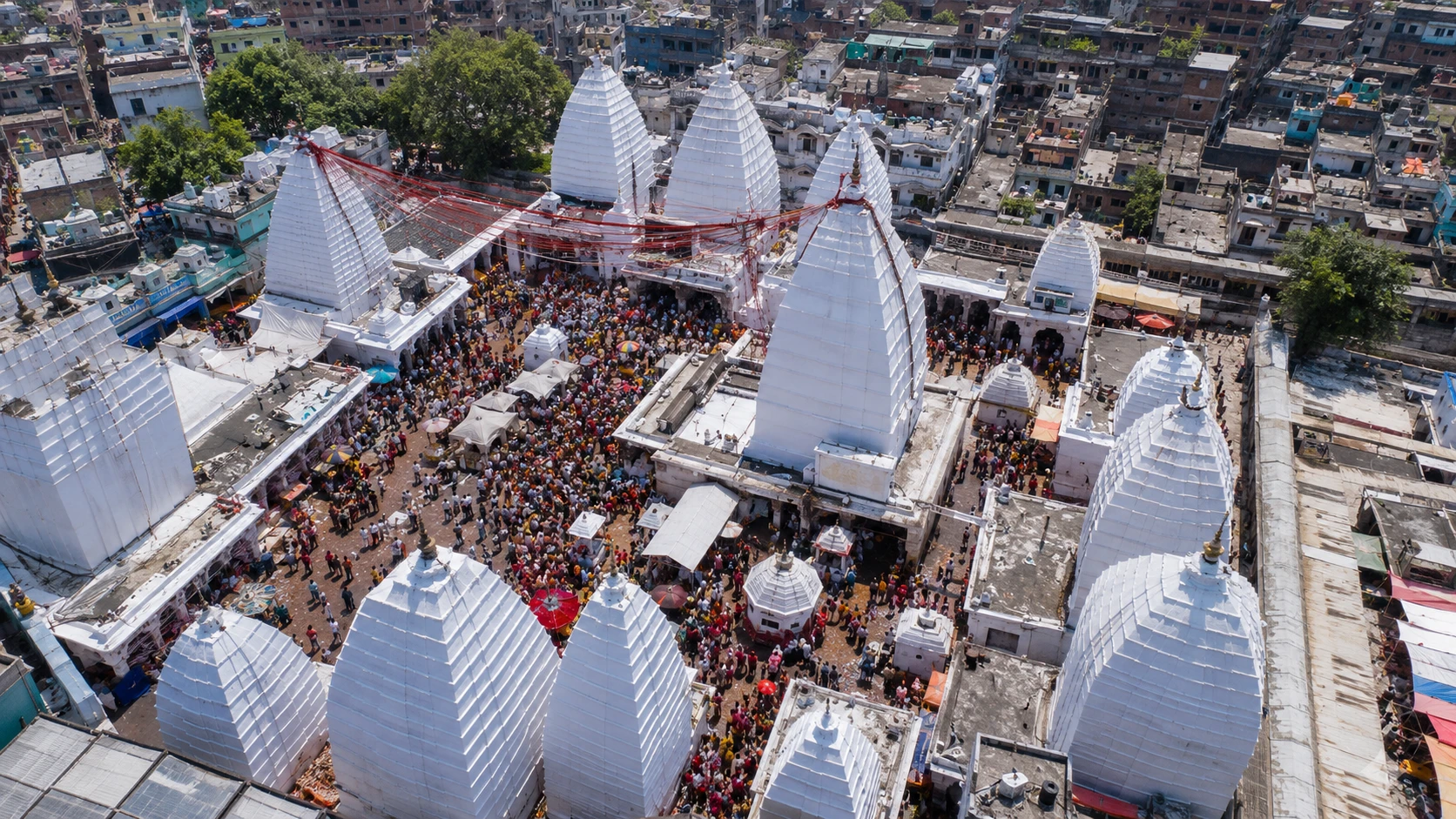
The Vaidyanath shrine does not stand alone. The main garbhagriha is part of a 22-shrine complex enclosed within a single high stone wall, the largest such Jyotirlinga complex in India by sub-shrine count. The Jyotirlinga shrine and the adjacent Maa Parvati / Jaya Durga shrine, the Shakti Peeth where Sati's heart is said to have fallen, are the two principal sanctums.
The remaining shrines include Sankat Mochan Hanuman, Anand Bhairav, Ganesh, Lakshmi-Narayan, Brahma, Surya, Saraswati, Tara, Kali, and a cluster of secondary Shiva and Devi forms. Pilgrims circumambulate the entire complex, taking darshan at each sub-shrine in a prescribed sequence.
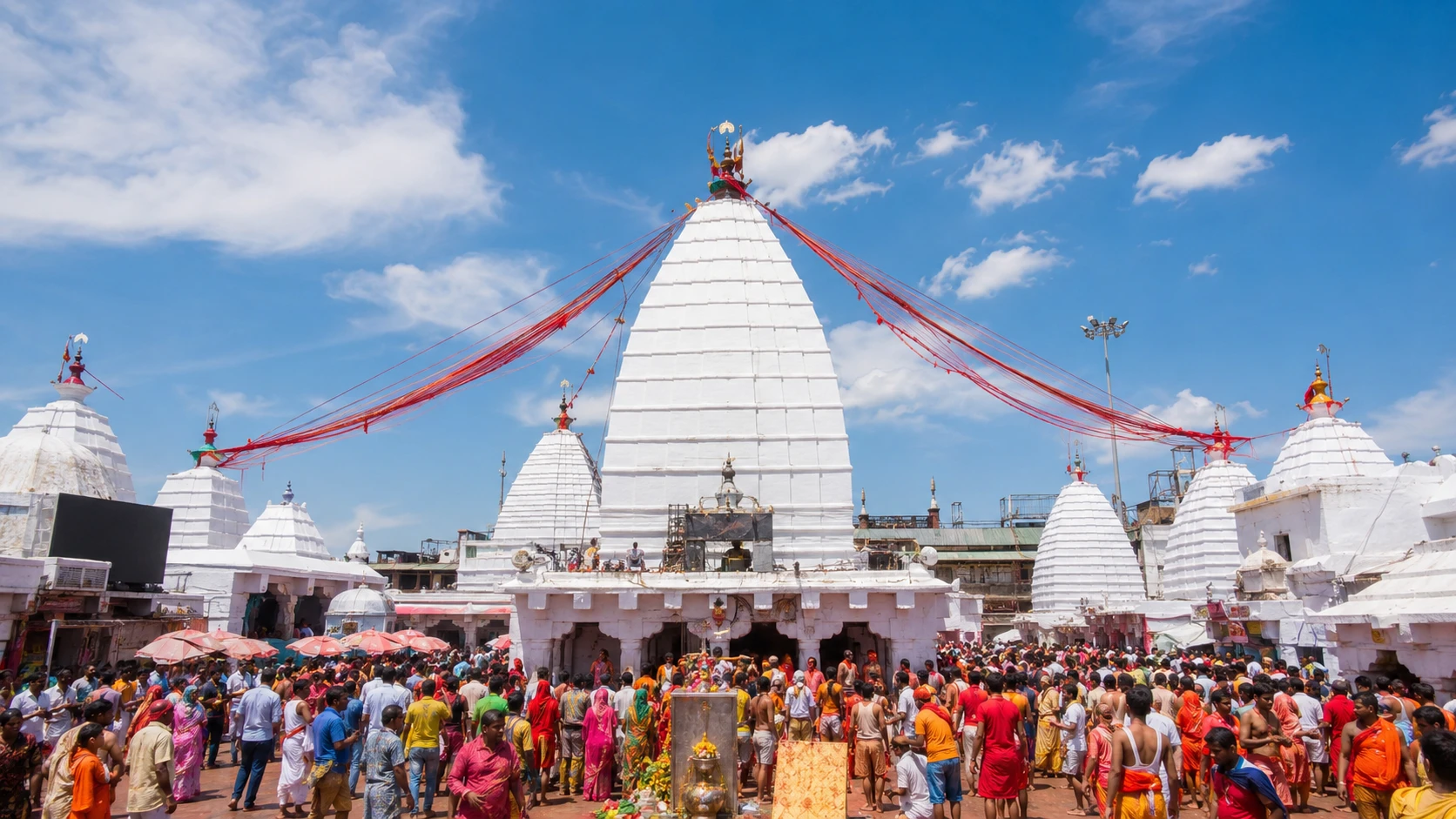
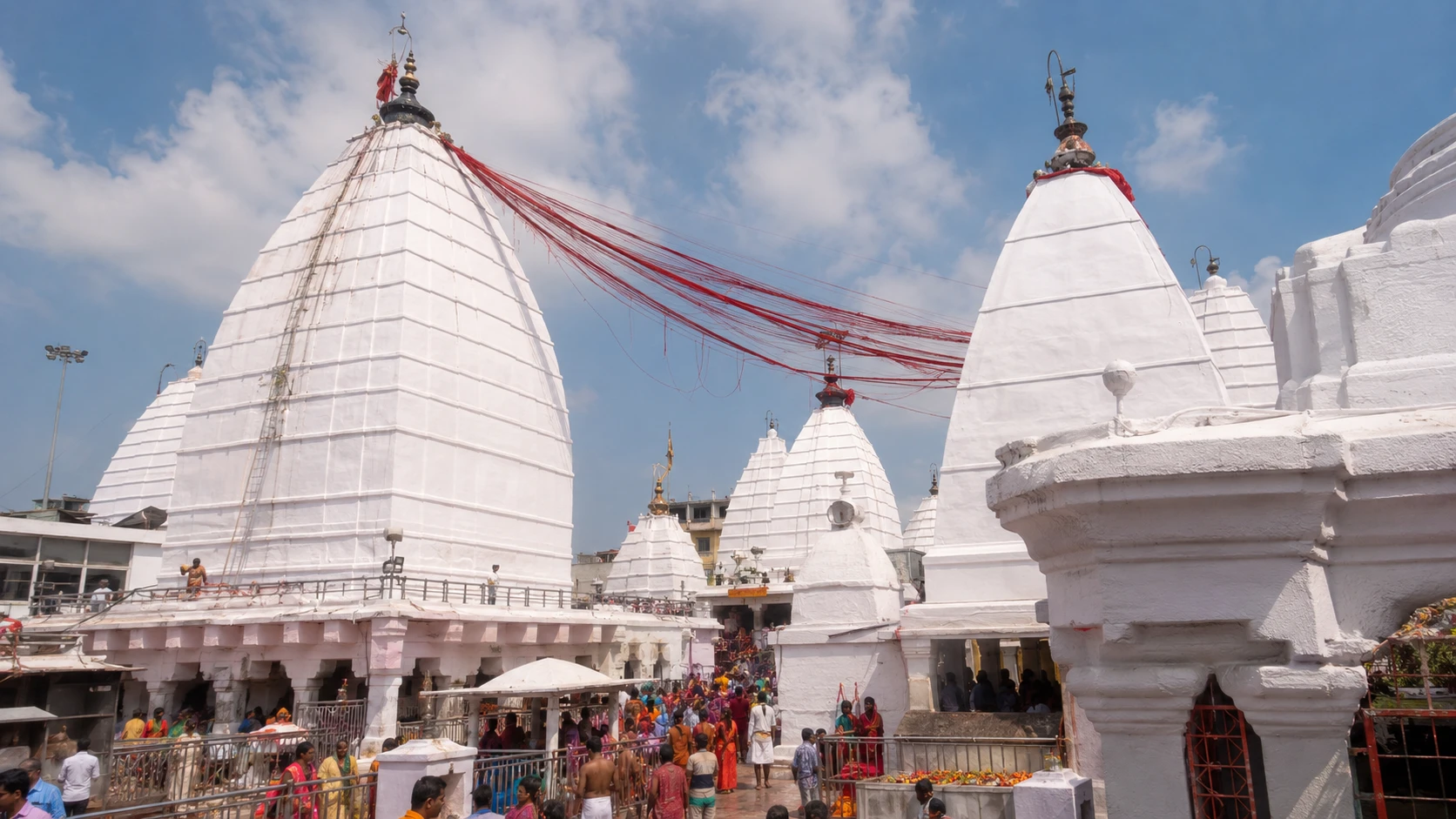
The two principal shrines are connected by a sacred red thread, the Gathbandhan, strung daily between the shikharas of the Vaidyanath and Parvati shrines. The thread is a literal cord of cotton or silk, knotted by the priests in the morning ritual and replaced when frayed; pilgrims often request a small length of the thread as prasad.
The Gathbandhan is the temple's iconographic signature, and no other Jyotirlinga in the canonical correspondence carries this ritual binding of Shiva and Shakti at the architectural level.
The main shikhara above the Vaidyanath sanctum is a tall white-painted Nagara tower in the eastern Indian sub-style, a stepped pyramidal form rising to a Panchashula (five-pointed brass crown) rather than the more common single kalasha.
The Panchashula is itself the object of pilgrim attention: devotees gathered in the courtyard frequently glance upward to ensure the brass is intact, and the trust replaces or repairs the Panchashula in a ceremonial event of its own.
The sub-shrines around the Vaidyanath core have their own smaller shikharas, creating the dense vertical cluster that is the temple complex's most-photographed external view.
Distinctive Practicesविशिष्ट परंपराएँ
Gathbandhan, The Sacred Thread Joining Shiva and Shakti
गठबंधन, शिव और शक्ति को जोड़ने वाला पवित्र धागा
Daily; the thread is renewed in the morning ritual and replaced when frayed
A red cotton or silk thread is strung daily between the shikharas of the Vaidyanath Jyotirlinga shrine and the adjacent Maa Parvati / Jaya Durga shrine, the Shakti Peeth where Sati's heart is said to have fallen. The thread, called the Gathbandhan, is knotted by the priests as part of the morning ritual sequence and is treated as a literal architectural enactment of the marriage bond between Shiva and Shakti. Pilgrims often request a small length of the thread as prasad to carry home, particularly newlyweds and couples seeking blessings for marriage. No other Jyotirlinga in the canonical correspondence carries this ritual binding at the architectural level, at Deoghar alone the Bhairava and the Devi share not only adjacent geography but a daily-renewed cord linking their crowns.
Deoghar is the only canonical site where Shiva (as Vaidyanath the Bhairava) and Shakti (as Hridya Peeth Devi) are paired in adjacent garbhagrihas. The Gathbandhan thread makes this pairing visible to the pilgrim eye and continuous in time: every dawn, the bond is re-tied. To carry a length of the thread home is to carry a piece of that bond into one's own household, which is why couples seek it as a wedding prasad and why the practice of tying Gathbandhan thread at weddings across eastern India traces its devotional resonance to this temple.
Shravan Kanwar Yatra, The Sultanganj to Deoghar Walking Pilgrimage
श्रावण कांवड़ यात्रा, सुलतानगंज से देवघर पैदल तीर्थयात्रा
Throughout the lunar month of Shravan (Jul, Aug); peaks on Shravan Somvars and on the closing Shravani Purnima
For the full lunar month of Shravan, an estimated 10 million-plus pilgrims walk barefoot from Sultanganj on the Ganga to the Vaidyanath temple at Deoghar, a distance of approximately 108 km, carrying decorated bamboo shoulder-poles called kanwars hung with sealed pots of Ganga water at each end. The water is poured over the Jyotirlinga as abhishekam at the destination. Pilgrims wear saffron, abstain from leather, walk only by daylight, and observe strict ritual purity throughout the walk. The route is lined with rest-camps, langars (free community kitchens), medical posts, and devotional music played continuously. By widely-cited estimates this is the largest annual religious procession in the world by participant count, dwarfing the rolling totals of Hajj or any single-day festival; the procession is a continuous month-long event rather than a single peak day.
The Kanwar Yatra is at once a vow (vrat), a tapasya, and an enactment. The water is from the Ganga, the river that flows from Shiva's matted locks, and it is being returned to Shiva himself at the Jyotirlinga. The 108 km walk on bare feet, in monsoon mud, fasting, and continuously, is an austerity offered for healing of the body, healing of family illness, fulfillment of unmet desires, or simple gratitude. Vaidyanath is the divine physician; the Kanwar pilgrim arrives carrying not only Ganga water but also their illness, their grief, or their gratitude, and offers all of it together at the lingam.
Manokamna Lingam, Vaidyanath as the Wish-Fulfilling Lord of Healing
मनोकामना लिंग, चिकित्सा के मनोकामना-पूर्ति भगवान वैद्यनाथ
Year-round; particularly observed during the Kanwar Yatra and on Pradosh days
Vaidyanath is the only Jyotirlinga whose presiding name (Vaidya = physician, natha = Lord) directly invokes the deity's role as a healer of body and mind. The Shiva Purana's origin narrative, in which Shiva healed Ravana's nine self-inflicted wounds before granting the boon, anchors a centuries-old devotional tradition in which devotees come specifically to Vaidyanath for relief from physical illness, mental distress, infertility, or chronic affliction. The Manokamna (wish-fulfilling) tradition is observed by lighting a ghee lamp at the lingam, mentally offering one's specific affliction to the Lord, and committing to a follow-up offering when the wish is granted. Many devotees return year after year for this follow-up offering, making Vaidyanath one of the few Jyotirlingas where repeat-pilgrim relationships with the deity are explicitly named in temple tradition.
The Vaidyanath aspect of Shiva is unique within the Jyotirlinga canon: where Mahakaleshwar emphasizes Shiva-as-Time, Kashi Vishwanath Shiva-as-Liberator, and Somnath Shiva-as-Indestructible, Vaidyanath emphasizes Shiva-as-Healer. The Manokamna tradition is the experiential expression of that theological emphasis, devotees come not for cosmic transcendence but for the very specific healing of a very specific wound, and the temple holds space for that specificity in a way few other major shrines do.
Did You Know?क्या आप जानते हैं?
Vaidyanath at Deoghar is the only Jyotirlinga that is also a Shakti Peeth, the only site in the canonical correspondence where Shiva and Shakti reside in adjacent garbhagrihas as a Bhairava-Devi pair. The integration is so structurally distinctive that Deoghar is sometimes called the 'Hridya Peeth' (heart shrine) in Shakta literature and 'Vaidyanath Dham' in Shaiva literature, and pilgrims often take darshan in both shrines as a single act of worship.
Shiva Purana (Koti Rudra Samhita) and Devi Bhagavata Purana (Skandha 7); D.C. Sircar, 'The Sakta Pithas' (1973)
The annual Shravan Kanwar Yatra to Deoghar is widely cited as the largest annual religious procession in the world by participant count. Across the lunar month of Shravan (July, August), more than 10 million pilgrims walk barefoot the 108 km from Sultanganj on the Ganga to the Vaidyanath temple, carrying Ganga water in sealed pots to pour over the Jyotirlinga. The procession is continuous through the month rather than concentrated on a single day; on Shravan Somvars (Mondays) the volume peaks, with major checkpost-counted pilgrim numbers running into millions on a single day.
Government of Jharkhand and Government of Bihar Shravan Mela administrative reports; Census of India pilgrimage statistics
A depression visible on the upper face of the Jyotirlinga is identified by tradition as the print of Ravana's thumb, left when the asura, returning to find the lingam fixed in the earth at Deoghar, pressed his thumb against the stone in a final attempt to lever it free. The mark is part of every ritual narration of the temple's origin and is identifiable from the priestly side of the sanctum during darshan.
Shiva Purana, Koti Rudra Samhita, Chapter 21; Babulnath Trust ritual literature on the Vaidyanath origin
The temple complex contains 22 sub-shrines enclosed within a single high wall, the largest Jyotirlinga complex by sub-shrine count in India. The Vaidyanath Jyotirlinga and the adjacent Maa Parvati / Jaya Durga (Hridya Peeth) shrine are the two principal sanctums; the remaining 20 include Sankat Mochan Hanuman, Anand Bhairav, Ganesh, Lakshmi-Narayan, Brahma, Surya, Saraswati, Tara, Kali, and a cluster of secondary Shiva and Devi forms. Pilgrims circumambulate the entire complex in a prescribed sequence, taking darshan at each sub-shrine.
Babulnath Trust temple-layout records; Archaeological Survey of India description of the Baidyanath Dham complex
Vaidyanath is the only Jyotirlinga whose presiding name directly invokes the deity's role as physician and healer (Vaidya = physician, natha = Lord). Where other Jyotirlingas emphasize Shiva-as-Time (Mahakaleshwar), Shiva-as-Liberator (Kashi Vishwanath), or Shiva-as-Indestructible (Somnath), Deoghar emphasizes Shiva-as-Healer, and the Manokamna tradition of returning year after year to fulfill a vow once the wish has been granted is woven into the temple's distinctive devotional calendar.
Shiva Purana, Koti Rudra Samhita; Babulnath Trust Manokamna tradition records
Visitor Accessप्रवेश जानकारी
Vaidyanath welcomes devotees of all backgrounds for darshan. There are no entry restrictions based on caste, gender, age, or origin, the historical caste restrictions that governed sanctum entry were ended in the 1950s following the adoption of the Constitution of India and the Bihar Hindu Religious Endowments Act. Footwear must be removed at the temple entrance. Photography is prohibited in the inner sanctum (garbhagriha) and during abhishekam, but is permitted in the outer courtyards. Direct touching of the Jyotirlinga is restricted; abhishekam offerings are passed to the priests for offering. During the Shravan month and on Maha Shivaratri, sanctum darshan is reorganized into a continuous fast-moving queue with strict crowd-management protocols, and the Gathbandhan thread between Shiva and Shakti shrines is renewed multiple times per day to accommodate the volume of thread-prasad requests.
During Shravan and Maha Shivaratri, plan for queue waits of 4, 8 hours or longer; during ordinary days, sanctum darshan typically takes 30, 90 minutes. Carry a sealed water bottle and identification. The temple's main gate is at Bhuteshwarnath Marg; during the Mela period, alternate entry points are activated. Pilgrims travelling for the Kanwar Yatra should register at Sultanganj at the start of the walk; medical posts and rest-camps are maintained along the entire route by the state government and volunteer organizations. Avoid third-party 'guides' or 'pandits' offering accelerated darshan from outside the temple gates, only the priests inside the sanctum and the Trust's official Shighra darshan counters are authorized to facilitate priority access.
Festivalsत्योहार
Shravani Mela / Shravan Kanwar Yatra
श्रावणी मेला / श्रावण कांवड़ यात्रा
Jul-Aug (full lunar month of Shravan)
The Shravani Mela is Vaidyanath's defining annual event and one of the largest religious gatherings in the world, a month-long pilgrimage in which more than 10 million devotees walk barefoot the 108 km from Sultanganj on the Ganga to Deoghar carrying Ganga water for abhishekam at the Jyotirlinga. The mela transforms the entire route and the temple town for the lunar month: rest-camps, langars, medical posts, and devotional music continuously animate the path, and the temple operates extended darshan windows with continuous abhishekam through every Shravan Somvar. No other Jyotirlinga sees pilgrim volumes of this scale concentrated into a single calendar month.
Maha Shivaratri
महाशिवरात्रि
Feb-Mar (Phalgun Krishna Chaturdashi)
The most important Shaiva festival of the year, observed at Vaidyanath with all-night darshan and continuous abhishekam through the four watches (pahar) of the night. Devotees fast through the day and offer water, bilva, and ghee diyas at the lingam; the midnight nishitha-kala darshan window is considered the most spiritually charged hour. Crowds during Shivaratri are second only to the Shravan Mela in volume; many pilgrims who came for the Mela return for Shivaratri to complete their year's vow cycle.
Vivah Panchami / Shiva-Parvati Marriage Observance
विवाह पंचमी / शिव-पार्वती विवाह अनुष्ठान
Nov-Dec (Margashirsha Shukla Panchami)
Vivah Panchami marks the wedding of Rama and Sita in the Mithila tradition, and at Deoghar, embedded in the same Mithila-Magadha cultural region, the day is also observed as a Shiva-Parvati marriage commemoration, given Vaidyanath's unique pairing with the Hridya Shakti Peeth. The Gathbandhan thread between the Shiva and Parvati shrines is ceremonially re-tied with extended ritual on this day, and married couples often visit specifically to seek blessings for the longevity of their union. The festival reflects the Mithila-region cultural emphasis on marriage as a sacred bond mirrored in the divine pair.
Tripuri Purnima (Kartik Purnima)
त्रिपुरी पूर्णिमा (कार्तिक पूर्णिमा)
Nov (Kartik Shukla Purnima)
Tripuri Purnima commemorates Shiva's destruction of the demon Tripurasura. At Vaidyanath, the full-moon night sees the temple specially illuminated with deepamala (lamp-tower) ceremonies in both the Shiva and Shakti courtyards, and a fair (mela) on a smaller scale than the Shravani Mela animates the temple precincts for several days around the date. Devotees offer ghee diyas across the 22-shrine complex, lighting the entire enclosure for the night.
Traditional Offeringsपारंपरिक अर्पण
Primary Offerings
Bel Patra (Bilva leaves)
बेल पत्र
बिल्व पत्र
The three leaflets of the bilva tree represent the three eyes of Shiva, the trident he wields, and the cosmic functions of creation, preservation, and dissolution. The Shiva Purana states that even a single bilva leaf, offered with devotion, surpasses elaborate rituals. At Vaidyanath, bilva is offered in immense quantities during Shravan, when continuous abhishekam runs through every Monday and the sanctum receives thousands of leaves an hour. Outside the Mela, devotees often place a single leaf on the Jyotirlinga with their Manokamna whispered alongside it.
Sultanganj Ganga Jal (Kanwar offering)
सुलतानगंज गंगा जल (कांवड़ अर्पण)
गङ्गा जल
Ganga water specifically drawn from the ghat at Sultanganj, where the Ganga turns north at a unique geological bend, is the canonical abhishekam offering at Vaidyanath. The 108 km Kanwar Yatra is built around the carrying and pouring of this water; pilgrims who cannot walk the full route still arrange for sealed Sultanganj jal to be brought to Deoghar so that the abhishekam at the lingam is performed with water from the canonical source. In the Vaidyanath devotional tradition, Sultanganj-jal abhishekam is considered the most efficacious offering for the Manokamna (wish-fulfilling) tradition, especially for healing of body and family.
Panchamrit (Five sacred substances)
पंचामृत
पञ्चामृत
The ritual bathing of the lingam with five sacred substances, milk, curd, honey, ghee, and sugar, is performed at Vaidyanath through the resident priesthood. Each substance has symbolic meaning: milk for purity, curd for prosperity, honey for sweet speech, ghee for victory, and sugar for happiness. The five together represent the five elements (panchabhuta) returning to their cosmic source. At Vaidyanath, panchamrit abhishekam typically follows the Sultanganj-jal abhishekam in the morning ritual sequence, with the sweetened mixture poured after the pure water has been offered.
Vibhuti (Sacred ash)
विभूति
विभूति
Sacred ash applied to the lingam and to the devotee's forehead. Vibhuti represents the ultimate truth that all material existence eventually returns to ash, a constant reminder of impermanence. Three horizontal lines (tripundra) drawn across the forehead with vibhuti symbolize the three realms Shiva governs and the three gunas of nature. At Vaidyanath, vibhuti is distributed as prasad after darshan, and devotees often carry small portions home for daily worship, particularly significant for those whose Vaidyanath visit was for healing, where the vibhuti becomes a daily continuation of the Manokamna.
Dhatura flowers and fruit
धतूरा के फूल और फल
धत्तूर
The trumpet-shaped dhatura flower and its spiked fruit, despite the plant's toxicity, are sacred to Shiva. The plant is said to have emerged when Shiva consumed the halahala poison during the churning of the cosmic ocean, the flower represents Shiva's capacity to transform poison into something offered back to him in worship. At Vaidyanath, dhatura is offered with particular significance because Vaidyanath is the divine physician: the offering of poison-bearing flora to the healer carries an unspoken theological logic about the transmutation of toxic affliction into healed grace.
Coconut
नारियल
नारिकेल
The coconut symbolizes the human ego, which must be broken before Shiva for spiritual progress. At Vaidyanath, the coconut is part of the standard arpan (offering) bundle alongside bilva, flowers, and dhatura, and is broken in the temple courtyard before darshan. During the Manokamna fulfillment visits, devotees often offer a specific number of coconuts (commonly 11, 21, or 108) corresponding to the magnitude of the wish that was granted.
Unique to This Temple
Gathbandhan Thread (Shiva-Shakti Bond Prasad)
गठबंधन धागा (शिव-शक्ति बंधन प्रसाद)
A length of the red Gathbandhan thread that connects the Vaidyanath and Maa Parvati shrine shikharas, requested as prasad. The thread is renewed in the morning ritual; lengths of the previous day's thread are distributed by the priests to devotees who request them. Newlyweds, couples seeking blessings for marriage, and those undertaking long-term household vows particularly seek this thread, which is considered to carry the daily-renewed bond between the Bhairava and the Devi at Deoghar. Tied at the wrist or kept in a household shrine, the thread is unique to Vaidyanath among Jyotirlinga prasads.
Bhang Prasad
भांग प्रसाद
Bhang, a preparation of cannabis leaves traditionally associated with Shiva in his ascetic and matted-locks aspects, is offered at Vaidyanath particularly on Maha Shivaratri and during Shravan. Devotees consume bhang as prasad in conjunction with darshan, treating it as a Shiva-favored substance rather than a recreational one. The practice is centuries old in the eastern-Indian Shaiva tradition and is conducted within the temple's ritual framework rather than as a private indulgence; the bhang prasad context is distinct from the recreational use of the substance and is accompanied by mantra recitation and ritual restraint.
Kala Til (Black Sesame), Healing Offering
काला तिल, चिकित्सा अर्पण
Black sesame seeds, offered with the specific intention of healing chronic illness or removing affliction, are a Vaidyanath-specific component of the Manokamna offering tradition. The kala-til is poured into the abhishekam vessel along with the Sultanganj jal, or sprinkled at the lingam base by the priests. Til carries a long association in Shaiva-Shakta ritual with the dissolution of accumulated karma; at the temple of the divine physician, this dissolution is invoked specifically toward affliction of body and mind.
Devotees may bring offerings from outside; vendor stalls in the temple market and at the route checkposts during Shravan sell pre-assembled bundles of bilva, flowers, dhatura, and a small coconut. The Babulnath Trust permits walk-in abhishekam offerings during designated darshan windows, conducted by the resident priesthood. During the Shravan Mela, abhishekam queues are continuous and offerings are passed forward in rapid sequence; pilgrims who want a more deliberate ritual experience are advised to visit outside the Mela period. Photography during abhishekam is not permitted. Pilgrims arriving with sealed Sultanganj jal should keep the seal intact until the priest accepts the vessel, broken seals will not be accepted for the canonical abhishekam.
How to Reachकैसे पहुँचें
Deoghar lies on the Santhal Parganas plateau in the Jharkhand state of eastern India, roughly equidistant between Patna (Bihar) and Kolkata (West Bengal). The most common rail approach is via Jasidih Junction (~7 km from the temple), a major mainline station on the Howrah, Delhi route with direct trains from Kolkata, Delhi, Patna, Mumbai, Bangalore, and most major Indian cities.
Shared autos, e-rickshaws, and pre-paid taxis are readily available at Jasidih Station; the run from Jasidih to the temple takes 15, 20 minutes outside the Mela period, considerably longer during Shravan due to traffic restrictions.
A second rail option is Baidyanath Dham Station (~1 km from the temple), which handles passenger trains and is heavily expanded into a Mela station during Shravan with special Kanwar-pilgrim trains terminating here. Most ordinary mainline trains do not stop at Baidyanath Dham; this station serves the Mela traffic and short-distance regional services.
By air, Deoghar Airport (Deoghar Civil Enclave, ~10 km) opened to commercial flights in 2022 and now offers limited daily domestic connections, primarily to Delhi, Kolkata, and Patna. For a wider flight network, Patna Airport (~250 km, ~5 hour drive), Ranchi Airport (~250 km, ~5 hour drive), and Kolkata Netaji Subhas Chandra Bose International Airport (~370 km, ~7 hour drive) are the regional alternatives.
Kolkata is the typical international entry.
By road, Deoghar is connected by NH-114A and NH-133 to Patna, Bhagalpur, Dumka, and Kolkata. Government and private bus services run from Patna (~6 hours), Kolkata (~7 hours), Ranchi (~5 hours), and Bhagalpur (~3 hours).
The Sultanganj, Deoghar Kanwar route runs along NH-133 and connecting state highways; during Shravan, traffic on this route is heavily managed by the Bihar and Jharkhand state administrations with restrictions on commercial vehicles to allow safe pilgrim walking.
For pilgrims undertaking the Kanwar Yatra, the journey begins at Sultanganj on the Ganga (in Bhagalpur district, Bihar), where pilgrims fill sealed pots with Ganga water before starting the 108 km walk. The route passes through Tarapur, Suiya, Abrakhi, Lakhanpur, and Goradih, with rest-camps and medical posts spaced every few kilometres during the Mela.
Most Kanwar pilgrims complete the walk in 3, 5 days; some undertake the Dak Bam (express) tradition, walking continuously without rest in 24, 36 hours.
Plan Your Visitयात्रा की योजना
🌤 Best Season
October to March is the most comfortable period for non-Mela darshan, temperatures range from 12, 25°C with low humidity and clear skies. April, June is hot (35, 42°C in the Santhal Parganas) and best avoided unless visiting for Akshaya Tritiya or specific summer observances. The monsoon (June, September) brings the Shravan Mela, which is the spiritually defining time but also the most physically demanding: heavy rain, slippery roads, mass crowds, and pilgrim-management logistics that override the ordinary visiting rhythm. November to February is the most pleasant darshan window; if you want quiet sanctum time and clear winter air, this is the season. The Vivah Panchami observance (Nov-Dec) and Tripuri Purnima (Nov) fall within this window and add devotional richness without the Mela-scale crowds.
👘 Dress Code
Modest, traditional dress is expected, sarees, salwar suits, dhotis, or full-length trousers with covered shoulders. Avoid leather items inside the temple complex. During the Shravan Mela, Kanwar pilgrims wear saffron exclusively and remain barefoot; non-Kanwar pilgrims are not required to follow this code but should expect to remove footwear at the temple entrance regardless of season. A light shawl or wrap is useful in winter mornings.
📱 Phones & Photography
Mobile phones must be on silent within the temple complex. Photography with phones is permitted in the outer courtyards and around the 22-shrine complex but is strictly prohibited inside the inner sanctum (garbhagriha) of the Vaidyanath shrine and during abhishekam. Some sub-shrines allow photography; signage at each sanctum indicates the policy. During the Shravan Mela, phone use is discouraged in the queue lines for crowd-flow reasons; large devotional groups follow strict no-phone protocols voluntarily.
🏨 Accommodation
Deoghar town has a wide range of accommodation, from Babulnath Trust dharamshalas and pilgrim guesthouses (often subsidised, basic but clean) to mid-range hotels and a small selection of business-class properties. The Bharat Sevashram Sangha operates a major pilgrim ashram with substantial capacity. During the Shravan Mela, accommodation is heavily booked, pilgrims are advised to book several months in advance or to arrange stays in Jasidih or smaller towns along the Kanwar route and travel in to the temple. Outside the Mela period, walk-in availability is generally good in November, February. Religious-trust accommodation is the most authentic option for traditionally-minded pilgrims; commercial hotels in the Karnibagh and Ramkrishna Vivekananda Marg areas offer better amenities.
Sacred Soundsपवित्र ध्वनि
Did You Know? · क्या आप जानते हैं?
The same translation error that turned '33 Koti' into '33 crore' in Hinduism also happened in Buddhism. The Chinese translation of Buddhist texts rendered 'Sapta Koti Buddha' (7 Supreme Buddhas) as '7 Crore Buddhas.' The Tibetan translation got it right: 7 types, not 7 crore. One Sanskrit word, misread across two major world religions, generated two identical misconceptions independently.
Related Contentसंबंधित सामग्री
Related Scriptures
Community Reflections
🕉️
Be the first to share your reflection.