Somnath
सोमनाथ
First among the twelve Jyotirlingas
Prabhas Patan, Gujarat, India
SomanāthaAlso known as: Somanatha, Prabhas Patan Jyotirlinga, Deo Patan, Someshwar
Era
Origin pre-historic per Puranic tradition; documented temple from the 7th century; current structure consecrated 1951
Architecture
Chalukya / Maru-Gurjara (Solanki style)
Open
06:00 – 21:00
Aarti
07:00 · 12:00 · 19:00
Special
Light & Sound Show 19:45, 20:45 daily, narrating the temple's history of destruction and rebirth
The Sacred Legend · पवित्र कथा
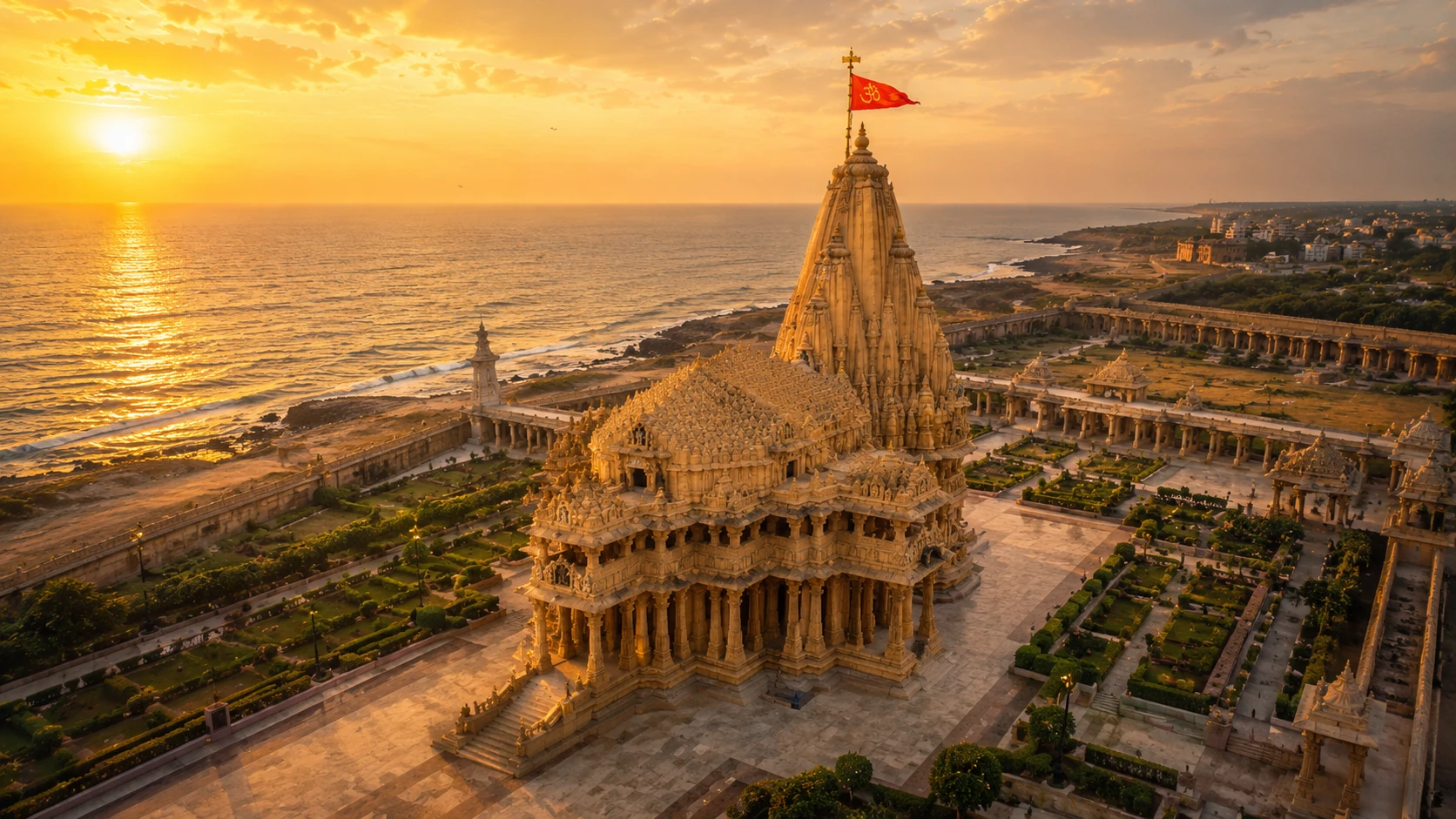
Somnath is not just a Jyotirlinga, it is a symbol of civilizational endurance. Destroyed seven times by invaders across a thousand years, rebuilt eight times by faith, and consecrated in its current form by India's first President in 1951, it stands on the Saurashtra coast where the Arabian Sea meets the confluence of three rivers. The Shivling here is said to have been worshipped first by Soma, the Moon God himself, seeking release from a curse, making this temple's origin story one of the oldest in the entire Jyotirlinga tradition.
Sacred Designationपवित्र पदनाम
1st of 12 Jyotirlingas
बारह ज्योतिर्लिंगों में 1st
Sacred Origin Storyपवित्र उत्पत्ति कथा
Source: Shiva Purana (Koti Rudra Samhita) and Skanda Purana (Prabhasa Khanda), widely-attested
In the beginning of the Dvapara Yuga, Daksha Prajapati gave his twenty-seven daughters in marriage to Chandra, the Moon God, also called Soma. The twenty-seven daughters were the Nakshatras, the lunar mansions that mark the heavens. But Chandra, captivated by the beauty of Rohini alone among his wives, neglected the other twenty-six.
When the slighted daughters returned to their father in tears, Daksha grew enraged. He summoned Chandra to his court and pronounced a terrible curse: 'You shall waste away. Your light, the very thing that gives you your name, shall diminish until you are nothing.' From that day, Chandra began to lose his radiance. Night by night his light dimmed. The world grew dark.
Tides slowed. Plants that depended on the moon withered. The cosmos itself began to falter.
In desperation, Chandra sought counsel from the gods. Brahma directed him to Prabhas Kshetra, this place where the western sea meets the confluence of three rivers, and instructed him to perform tapas in honor of Lord Shiva. Chandra came to this coast. He installed a Shivling here, and for many years he meditated, performing the deepest austerities, offering the rarest rituals.
Shiva, pleased by the devotion, appeared before him. He could not undo Daksha's curse, even the gods could not negate the words of Prajapati, but he could mitigate it. 'You shall wax and wane,' Shiva declared. 'For half the month you shall lose your light, but for the other half you shall regain it.
The cosmos shall not be destroyed by your fading; it shall live with your rhythm.' This is the cycle of the moon's phases that the world has known ever since.
In gratitude, Chandra requested that Shiva remain at this place forever. Shiva agreed, and the Shivling Chandra had worshipped became one of the twelve Jyotirlingas, pillars of light through which Shiva's infinite presence manifests. Because Soma (Chandra) was the first to worship Shiva here, the temple is called Somnath, 'Lord of Soma.'
The Shiva Purana adds that this Jyotirlinga is the first among the twelve, both in chronology and in significance. Devotees who circumambulate it are said to gain release from afflictions of the mind and curses laid upon them, for here, the Moon God himself was released from a god's curse.
Sources cited:
- Shiva Purana, Koti Rudra Samhita, Chapters 14, 19
- Skanda Purana, Prabhasa Khanda
- Linga Purana, Section on Jyotirlinga origins
Scholarly Context
Modern scholarship (Diana Eck, 'India: A Sacred Geography', 2012; Romila Thapar, 'Somanatha: The Many Voices of a History', 2004) treats the Soma-Daksha narrative as part of an integrated mythological tradition that connects the temple to the lunar calendar, the tide cycle, and the cosmological function of waxing and waning. The story is consistent across Puranic sources, with regional embellishments rather than substantive variations.
Historyइतिहास
Somnath's documented history begins around the 7th century, with archaeological evidence pointing to a stone structure consecrated in the area during the rule of the Maitraka kings of Vallabhi. The temple grew in stature through the early medieval period, becoming one of the wealthiest religious institutions in western India.
Persian and Arabic chronicles from the 10th century onward describe Somnath as a destination for vast pilgrimages, supported by extensive land grants and patronage from the Chaulukya (Solanki) dynasty.
The temple's defining historical pattern emerged from the 11th century onward: a cycle of destruction by invaders followed by reconstruction by devotees and rulers. Mahmud of Ghazni's raid in 1026 was the first and best-documented of these destructions, recorded by his court historian Al-Utbi and supplemented by Al-Biruni's near-contemporary account.
Subsequent reconstructions by Bhimadeva I (1031, 1042) and Kumarapala (1169) restored the temple to grandeur, only for it to be destroyed again in 1299 by Alauddin Khilji's general Ulugh Khan, and again in 1395, 1413, and most catastrophically in 1665 by Aurangzeb's army.
Throughout these cycles, the Shivling itself was reportedly removed, broken, replaced, or hidden, the exact details disputed across primary sources. What is consistent is the temple's persistence: each destruction was followed by a reconstruction, often by the next dynasty to come to power.
The modern history of Somnath begins on November 13, 1947, the day Sardar Vallabhbhai Patel, then India's Home Minister, visited the ruins of the temple and committed the new Republic of India to its restoration. This was a politically significant moment: Patel framed the reconstruction as an act of national restoration, drawing both support and criticism.
The current structure was designed by Prabhashankar Sompura in the Chalukya style, built by the Government of India and a public trust, and consecrated by Dr. Rajendra Prasad, India's first President, on May 11, 1951. The Shree Somnath Trust manages the temple today.
Historical Timelineऐतिहासिक कालक्रम
First documented stone temple at Somnath, attributed to the Maitraka kings of Vallabhi based on Chinese pilgrim Hiuen Tsang's accounts and archaeological evidence.
Earlier wooden structures may have existed before the stone temple. Tradition holds the original temple in gold (Soma's era), then silver (Ravana's era), then sandalwood (Krishna's era), then stone, but these earlier structures are pre-archaeological.
Raid by Mahmud of Ghazni; the temple was attacked, the Shivling reportedly broken, and substantial wealth (an estimated 20 million dinars) carried back to Ghazni. Defenders were killed in numbers court chronicles place at 50,000.
Casualty figures cited in Persianate court chronicles ('50,000 defenders killed') are likely elevated for rhetorical and political effect. Modern scholarship (Romila Thapar, 'Somanatha: The Many Voices of a History', 2004) recommends treating the figures as approximate and notes that Sanskrit sources from the period are notably silent or differently-toned about the raid, suggesting the event's historical magnitude has been variously constructed across traditions. The structural damage to the temple, however, is well-attested across multiple independent sources.
Reconstruction by Bhimadeva I of the Chaulukya (Solanki) dynasty. The new temple was built in stone in the Chalukya architectural style.
Major renovation and expansion by Kumarapala of the Chaulukya dynasty, who is credited with elevating Somnath to its peak medieval grandeur.
Destroyed during Alauddin Khilji's Gujarat campaign by his general Ulugh Khan. The temple was sacked and the Shivling broken.
Reconstruction by Mahipala I of the Chudasama dynasty of Saurashtra. The Shivling was restored at the consecrated site.
Destroyed by Zafar Khan, governor of Gujarat under the Tughlaq Sultanate.
Demolished on the orders of Mughal emperor Aurangzeb during his anti-temple campaigns. This was the most thorough destruction of the temple in its history; the site was reduced to ruins, and an Islamic structure was built atop the ruins.
The temple remained in ruins for nearly three centuries after this destruction, the longest period of dormancy in its documented history. Pilgrimage continued informally at the ruined site, and a small temple was maintained nearby by Ahilyabai Holkar in 1783, but the main shrine was not restored until the 20th century.
Ahilyabai Holkar, the queen of Indore, built a small temple near the ruins to maintain pilgrimage continuity. This temple still stands adjacent to the modern structure.
Sardar Vallabhbhai Patel, then India's Home Minister and Deputy Prime Minister, visited the ruins of Somnath and committed the new Republic of India to its restoration. He famously said the temple should be 'restored not by the government, but by the people of India.'
Current temple consecrated by Dr. Rajendra Prasad, India's first President, on May 11, 1951 (Vaisakha Purnima). The temple was designed by Prabhashankar Sompura in the Chalukya style and constructed by the Shree Somnath Trust. President Prasad's address at the consecration is considered a foundational moment in independent India's relationship with its religious heritage.
Major renovation and beautification of the temple complex undertaken by the Shree Somnath Trust, including the addition of a museum displaying artifacts from the various historical phases of the temple.
What You'll Seeदर्शन में
The Jyotirlinga rests in the inner sanctum (garbhagriha) of the temple. The current lingam is a smooth, dark stone Shivling installed during the 1951 consecration, set on a circular yoni-pitha. Above the lingam hangs an arrangement of bilva leaves, often replenished throughout the day.
The sanctum is windowless, lit primarily by oil lamps and ghee diyas during darshan, creating an atmosphere of inward focus.
The surrounding sanctum walls bear sculpted depictions of Shiva in his various aspects, Nataraja in cosmic dance, Ardhanarishvara as the dual Shiva-Shakti, Bhairava in fierce form. The pillars of the surrounding mandapa are intricately carved in the Chalukya style, with floral and geometric motifs.
Directly outside the sanctum stands the Sabha Mandap (assembly hall), where devotees gather for darshan. The temple's famous Baan Stambh (Arrow Pillar) on the southern wall bears an inscription stating that there is no land between this point and Antarctica along the southward line, a remarkable geographical claim that modern measurement has confirmed within reasonable accuracy.
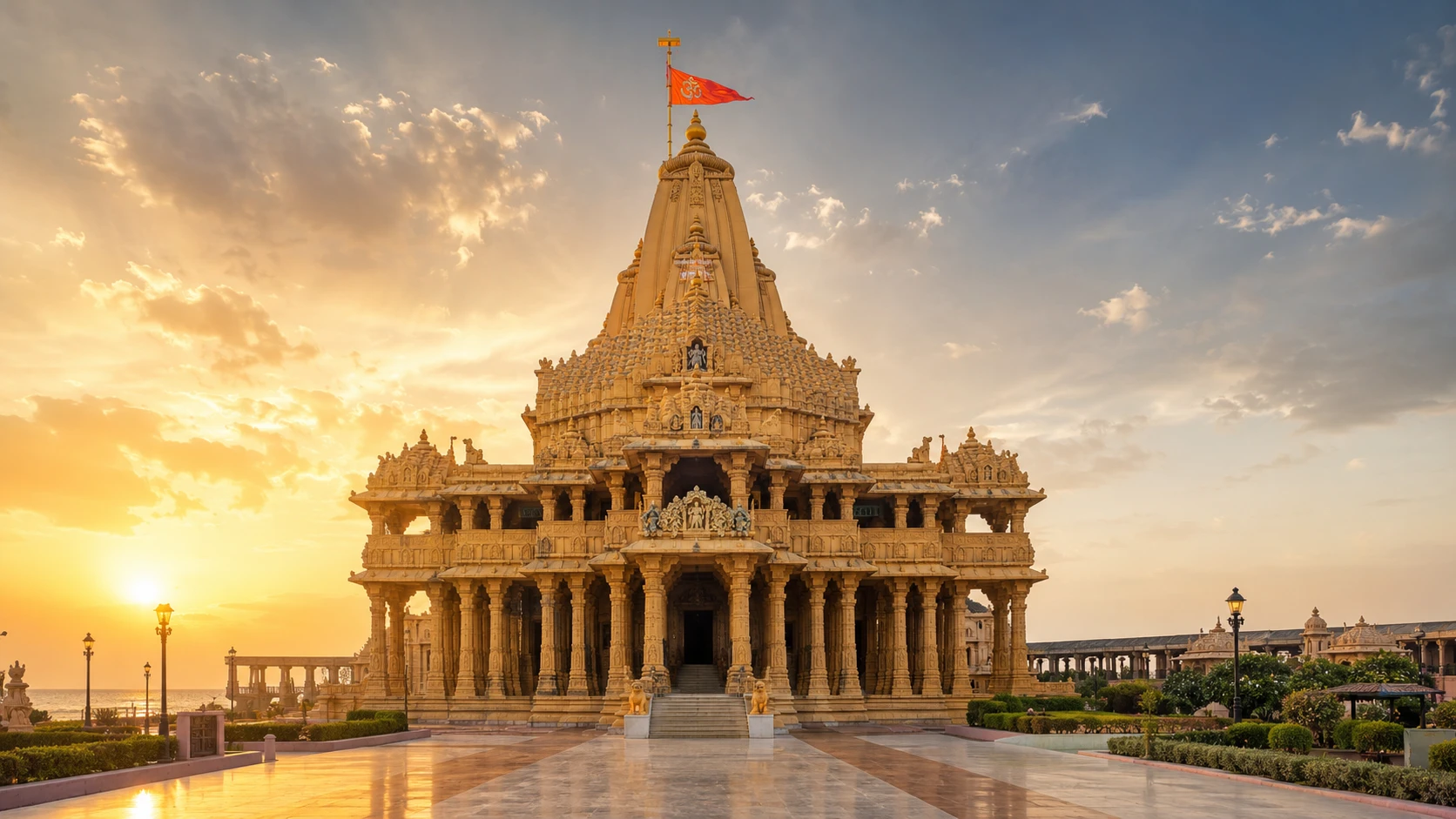
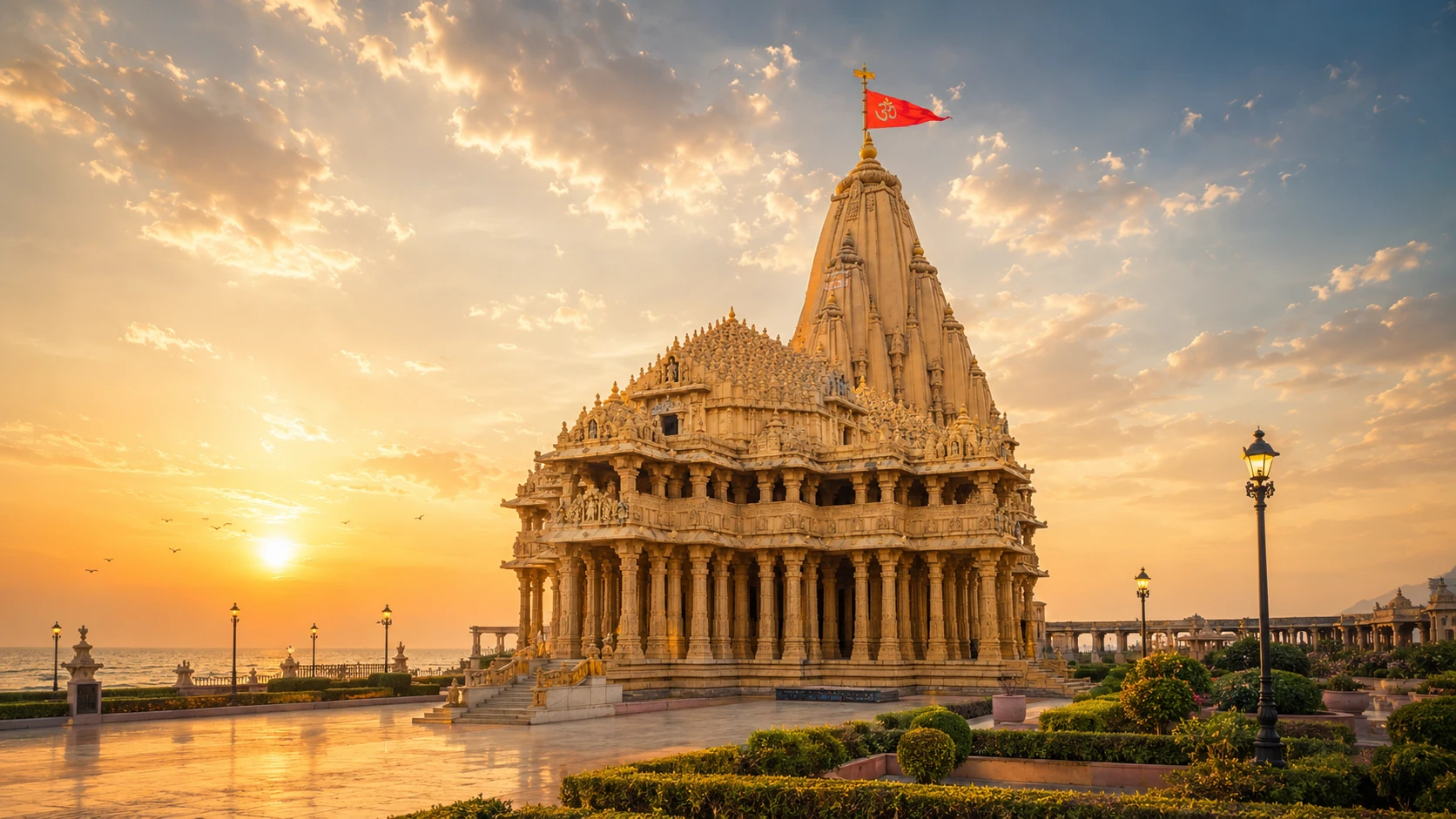
The temple's shikhara (spire) rises 155 feet above the sanctum, topped by a kalasha (pinnacle pot) and dhwaj (flag). The flag is changed daily in a ceremonial ritual; old flags are distributed as prasad to devotees.
Distinctive Practicesविशिष्ट परंपराएँ
Daily Flag Ceremony (Dhwajarohan)
ध्वजारोहण
Daily, before the morning aarti
Each morning, the saffron flag atop the temple's shikhara is ceremoniously lowered and a new flag is raised. The descended flag is cut into pieces and distributed as prasad to devotees who request it. This is one of the few major Hindu temples where a daily flag ceremony is performed, and the flag prasad is highly sought.
The flag represents Shiva's eternal sovereignty over the temple, and its daily renewal symbolizes the continuous renewal of devotion itself. Devotees who keep the flag-prasad in their homes believe it carries Shiva's protection.
Triveni Sangam Snan
त्रिवेणी संगम स्नान
Year-round, especially auspicious during Kartik Purnima
Pilgrims traditionally bathe at the Triveni Sangam, the confluence of the Hiran, Kapila, and Saraswati rivers, just north of the temple, before entering for darshan. The Saraswati here is considered a subterranean river that meets the visible Hiran and Kapila at this sacred coastal point, before all three flow into the Arabian Sea.
The confluence of three rivers meeting the sea is among the most sacred geographical configurations in Hindu thought, symbolic of the meeting of multiple energies before they dissolve into the infinite. Bathing here is said to wash away accumulated karma.
Light & Sound Show on Temple History
ध्वनि और प्रकाश शो
Daily, 19:45, 20:45 (after evening aarti)
A daily one-hour light-and-sound presentation narrates the temple's millennium-long history of destruction and reconstruction, projected onto the temple's outer walls. The show, called 'Jay Somnath,' is one of the most popular features for visitors and was inaugurated in 2018 in collaboration with the trust.
Unique among Jyotirlingas, Somnath openly reckons with its history of destruction. The show is not just spectacle but a meditation on the temple's symbolic meaning: that some flames cannot be extinguished by force.
Did You Know?क्या आप जानते हैं?
Somnath has been destroyed and rebuilt eight times across approximately a thousand years. The current structure, consecrated in 1951, is the eighth temple at this site. No other major Hindu temple in India has documented this destruction-rebuilding cycle so completely.
Archaeological Survey of India site reports; Romila Thapar, 'Somanatha: The Many Voices of a History' (2004)
An inscription on the temple's southern wall, the famous Baan Stambh (Arrow Pillar), declares that there is no landmass between Somnath and Antarctica along a straight southward line. Modern geographic measurement has confirmed this is largely accurate; the South Pole region is the next continental landmass directly south of this point.
Baan Stambh inscription; verified via modern cartographic analysis
Dr. Rajendra Prasad, who consecrated the current temple in 1951, did so against the wishes of Prime Minister Jawaharlal Nehru, who felt the President of a secular state should not preside over a religious consecration. The disagreement is a documented moment in early Indian Republic political history.
Government of India archival records; Rajmohan Gandhi, 'Patel: A Life' (1991)
The temple's reconstruction in 1951 was funded by public donations rather than government money, Sardar Patel insisted that this was a project of 'the people of India.' The Shree Somnath Trust, established to manage these funds, continues to operate the temple as an autonomous institution today.
Shree Somnath Trust founding documents; Government of India records
The temple's current shikhara (spire) is 155 feet (47.2 meters) tall, the tallest Jyotirlinga shikhara in India. It is topped by a kalasha weighing approximately 10 tonnes and a 27-foot dhwaj (flag staff).
Shree Somnath Trust architectural specifications
Somnath is the only Jyotirlinga where the Shivling has been physically replaced multiple times due to historical destruction, yet the consecrated location has remained unchanged for over a millennium. The same patch of earth has held a Shivling continuously, in some form, since Puranic times.
Archaeological Survey of India; Shree Somnath Trust historical records
The Sompura family, the architectural lineage that designed the current temple in 1951, has been associated with temple architecture in Gujarat for centuries. Prabhashankar Sompura, the chief architect of the 1951 reconstruction, came from a family that had built temples for over 30 generations.
Sompura family records; Gujarat Department of Archaeology
Visitor Accessप्रवेश जानकारी
Somnath welcomes devotees of all backgrounds for darshan. There are no entry restrictions based on gender, age, or origin. Photography is permitted in the outer halls, courtyards, and grounds, but is prohibited in the inner sanctum (garbhagriha), particularly during abhishekam. Mobile phones must be silenced or switched off in the sanctum area. Footwear must be removed before entering the temple complex.
VIP darshan with priority queue is available for INR 300 per person, useful during peak pilgrimage seasons (Maha Shivratri, Kartik Purnima, Shravan month). Photo ID is mandatory for all darshan and security checks at the temple complex entrance.
Festivalsत्योहार
Maha Shivratri
महाशिवरात्रि
Feb-Mar (Phalgun Krishna Chaturdashi)
The most important festival at any Shiva temple, observed at Somnath with all-night vigil, continuous abhishekam, and special darshan windows opened around midnight (the auspicious nishitha kala). Devotees from across India travel to Somnath specifically for this festival; the Trust often opens additional facilities to accommodate the pilgrim crowds.
Kartik Purnima
कार्तिक पूर्णिमा
Nov (Kartik Shukla Purnima)
Sacred bath at the Triveni Sangam followed by darshan is the central practice. Kartik Purnima is also called Tripuri Purnima, the day Shiva is said to have killed the demon Tripurasura. The full moon night sees the temple specially illuminated and a major fair held on the sea-facing grounds.
Shravan Month
श्रावण मास
Jul-Aug (Shravan)
The entire month of Shravan is considered most auspicious for Shiva worship. At Somnath, the abhishekam services run continuously through the day, and Mondays (Shravan Somvars) draw the largest pilgrim crowds. Many devotees undertake the Saurashtra Trikon, a pilgrimage circuit visiting Somnath, Dwarka, and Bet Dwarka, during this month.
Somnath Sthapana Diwas (Founding Day)
सोमनाथ स्थापना दिवस
May 11 (anniversary of 1951 consecration)
The temple trust observes May 11 as the anniversary of the 1951 consecration. Special pujas and a commemoration of Sardar Patel's role in the reconstruction are held. This is a relatively modern observance reflecting the temple's specific 20th-century history.
Traditional Offeringsपारंपरिक अर्पण
Primary Offerings
Bel Patra (Bilva leaves)
बेल पत्र
बिल्व पत्र
The three leaflets of the bilva tree represent the three eyes of Shiva, the trident he wields, and the cosmic functions of creation, preservation, and dissolution. The Bilva is said to be sacred to Shiva because Lakshmi once worshipped him with these leaves to be reborn as Sita. The Shiva Purana states that even a single bilva leaf, offered with devotion, surpasses elaborate rituals.
Ganga Jal (Sacred Ganges water)
गंगा जल
गङ्गा जल
Ganges water is used for abhishekam, the ritual bathing of the Jyotirlinga. Devotees believe the water carries the purifying power of Shiva himself, who is said to hold Ganga in his matted locks. At Somnath, where the Arabian Sea meets the Triveni Sangam confluence, the abhishekam carries particular significance, water from three sacred sources may be used in the morning ritual, mingling Ganga water with water from the Triveni.
Panchamrit (Five sacred substances)
पंचामृत
पञ्चामृत
The ritual bathing of the lingam with five sacred substances, milk, curd, honey, ghee, and sugar, is performed at all major Shiva temples. Each substance has symbolic meaning: milk for purity, curd for prosperity, honey for sweet speech, ghee for victory, and sugar for happiness. The five together represent the five elements (panchabhuta) returning to their cosmic source.
Vibhuti (Sacred ash)
विभूति
विभूति
Sacred ash applied to the lingam and to the devotee's forehead. Vibhuti represents the ultimate truth that all material existence eventually returns to ash, a constant reminder of impermanence. Three horizontal lines (tripundra) drawn across the forehead with vibhuti symbolize the three realms Shiva governs and the three gunas (qualities) of nature.
Dhatura flowers
धतूरा के फूल
धत्तूर
The trumpet-shaped dhatura flower, despite its toxic nature, is sacred to Shiva. The plant is said to have emerged when Shiva consumed the halahala poison during the churning of the cosmic ocean, the flower represents Shiva's capacity to transform poison into something offered back to him in worship. Offering dhatura is said to remove fear of death from the devotee.
Coconut
नारियल
नारिकेल
While coconut is offered at most temples, at Somnath the practice carries particular weight given the temple's coastal setting. The coconut symbolizes the human ego, which must be broken before Shiva for spiritual progress. At Somnath, devotees often bring a coconut offering in remembrance of the meeting of waters at the Triveni Sangam, a symbolic offering of the meeting of multiple energies to Lord Shiva.
Unique to This Temple
Somnath Trust Prasad
सोमनाथ ट्रस्ट प्रसाद
The Shree Somnath Trust prepares an official prasad available at counters within the temple complex. The prasad is consecrated through the morning aarti and includes traditional sweets prepared in temple kitchens. Devotees often carry this prasad home as a tangible blessing from one of the most ancient Jyotirlingas, a piece of Somnath that travels with the pilgrim back into daily life.
Triveni Sangam Water Offering
त्रिवेणी संगम जल अर्पण
Pilgrims who bathe at the Triveni Sangam often carry water from the confluence in a small kalash (pot) and offer it during darshan as part of their abhishekam. This is a Somnath-specific practice that reflects the temple's unique geography, three rivers and the sea meeting at this single point, all consecrated through offering to Shiva.
Devotees are welcome to bring offerings from outside, though the Shree Somnath Trust maintains official counters within the temple complex selling pre-packaged offering bundles, prasad, and ritual items. The trust prefers natural materials (real flowers, traditional substances) over synthetic offerings. Photography is not permitted within the inner sanctum during abhishekam.
How to Reachकैसे पहुँचें
Somnath is in the Gir Somnath district of Gujarat, on the southern Saurashtra coast. The closest railway station is Veraval Junction, just 7 km from the temple, Veraval has direct trains from Ahmedabad, Mumbai, Rajkot, Delhi, and several other major cities. Pre-paid taxis and shared autos are readily available at Veraval Station.
By air, the closest airport is Diu (about 85 km, ~2 hour drive), but Diu has limited flights. Most pilgrims fly to Rajkot Airport (190 km, ~3.5 hour drive) or Ahmedabad Airport (412 km, ~7 hour drive). Ahmedabad is the more reliable choice for international travelers and offers more flight options.
By road, Somnath is well-connected by Gujarat State Road Transport Corporation (GSRTC) buses and private operators from Ahmedabad, Rajkot, Junagadh, Diu, and Mumbai. The drive from Ahmedabad takes about 7 hours via NH-27 and SH-32. The journey from Mumbai (770 km) is typically broken into two days.
Pilgrims often combine Somnath with a visit to Dwarka (200 km north along the coast, a 4-hour drive), forming the western edge of the Saurashtra Trikon pilgrimage circuit. Buses, taxis, and trains run regularly between the two temples. Bet Dwarka, an island temple off Dwarka, completes the circuit.
Plan Your Visitयात्रा की योजना
🌤 Best Season
October to March is the most comfortable period, temperatures range from 20, 30°C with low humidity. Avoid May, June (peak summer, 35, 42°C) unless you specifically want to time the visit for Somnath Sthapana Diwas (May 11). The monsoon (July, September) brings heavy rain and rough seas; the temple remains open but the Triveni Sangam can be unsafe for bathing. Maha Shivratri (Feb-Mar) and Kartik Purnima (November) are the most spiritually charged times but also the most crowded.
👘 Dress Code
Modest dress is expected. For men, full-length trousers or dhotis; shirts with sleeves are appropriate. For women, sarees, salwar suits, or long skirts with covered shoulders are appropriate. The temple does not formally enforce a strict dress code, but gestures of modesty are expected and appreciated. A head covering is recommended (not required) inside the sanctum during prayer.
📱 Phones & Photography
Mobile phones must be on silent mode within the temple complex. Photography with phones is permitted in the outer halls and grounds but not in the inner sanctum (garbhagriha), particularly during abhishekam. The temple's main security checkpoint at the entrance does not require phone deposit, but separate lockers are available for valuables.
🏨 Accommodation
The Shree Somnath Trust operates Sagar Darshan Atithi Gruh, a clean and well-maintained guest house adjacent to the temple complex with sea-facing rooms. Booking is recommended through the trust website or by phone, especially during festival seasons. Beyond the trust accommodation, Veraval (7 km away) has a wide range of hotels from budget to mid-range, and Diu (85 km, also accessible) offers beach hotels for those wanting to combine temple visit with coastal stay. For pilgrims preferring traditional dharamshala-style accommodation, several smaller dharamshalas exist near the temple complex run by community trusts.
Book a Pujaपूजा बुक करें
Booking links and phone numbers are verified periodically but may change without notice. Always confirm the destination URL belongs to the official Shree Somnath Trust (somnath.org) before payment. Phone numbers and email addresses listed here are provided by the official temple authority where available; verify on the trust's official website before contacting. Several fraudulent websites with similar URLs exist, book only through the verified somnath.org domain.
Managed by: Shree Somnath Trust
Mahapuja
महापूजा
Akhand Jyot (year-long oil lamp)
अखंड ज्योत
Soma Yagna
सोम यज्ञ
Annadaan (food donation)
अन्नदान
Booking information verified: 2026-05-02
Sacred Soundsपवित्र ध्वनि
Did You Know? · क्या आप जानते हैं?
The same translation error that turned '33 Koti' into '33 crore' in Hinduism also happened in Buddhism. The Chinese translation of Buddhist texts rendered 'Sapta Koti Buddha' (7 Supreme Buddhas) as '7 Crore Buddhas.' The Tibetan translation got it right: 7 types, not 7 crore. One Sanskrit word, misread across two major world religions, generated two identical misconceptions independently.
Related Contentसंबंधित सामग्री
Related Scriptures
Community Reflections
🕉️
Be the first to share your reflection.