Dwarkadhish
द्वारकाधीश
Krishna's western kingdom, the sea-built city of gates
Dwarka, Gujarat, India
DvārakādhīśaAlso known as: Dwarakadhish, Dwarkadheesh, Jagat Mandir, Trilok Sundar, Dwarkanath, Ranchhodrai, Nij Mandir
Era
Origin per Puranic tradition (end of Dvapara Yuga); earliest stone structure traced by inscriptional evidence to roughly the 8th, 9th century CE; current temple substantively a 15th, 16th century reconstruction with extensive 19th-century renovations under the Gaekwads of Baroda
Architecture
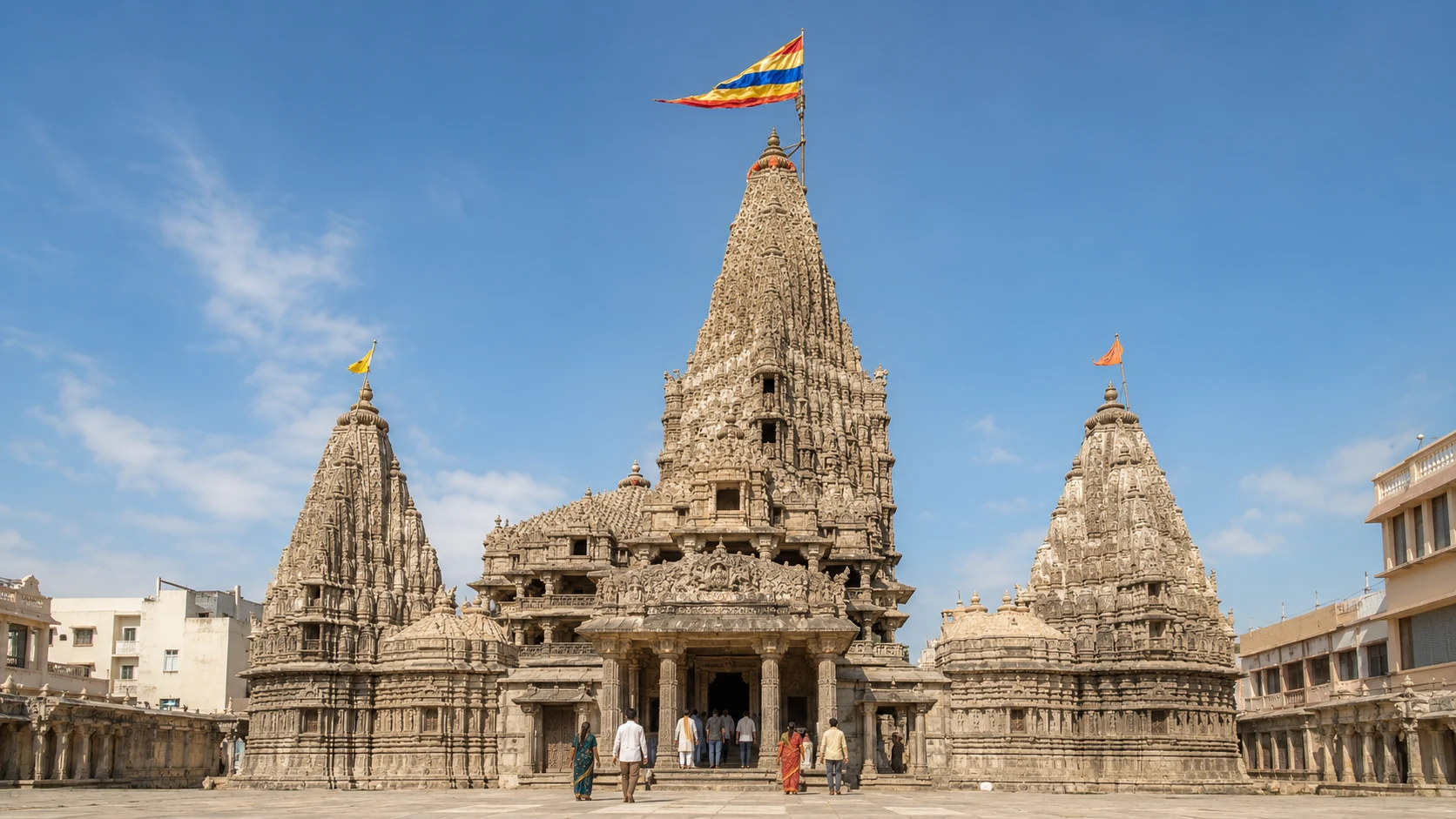
Maru-Gurjara (Chalukya / Solanki), a five-storey limestone structure rising approximately 78 metres, supported by 72 carved pillars; two principal gates, Swarga Dwar (gate of heaven, the exit toward the Gomti) and Moksha Dwar (gate of liberation, the main entrance)
Open
Approx. 06:30 (Mangala Aarti onwards), the temple closes for some hours in the afternoon and reopens for evening darshan – Approx. 21:30 (Shayan Aarti); afternoon Anavasara closure between Rajbhog and Utthapan; verify the daily schedule on the trust's communications during festival weeks
Aarti
06:30 Mangala Aarti · 08:00 Shringar Aarti · 11:00 Rajbhog Aarti · 17:00 Utthapan Aarti · 19:30 Sandhya Aarti · 21:00 Shayan Aarti
Special
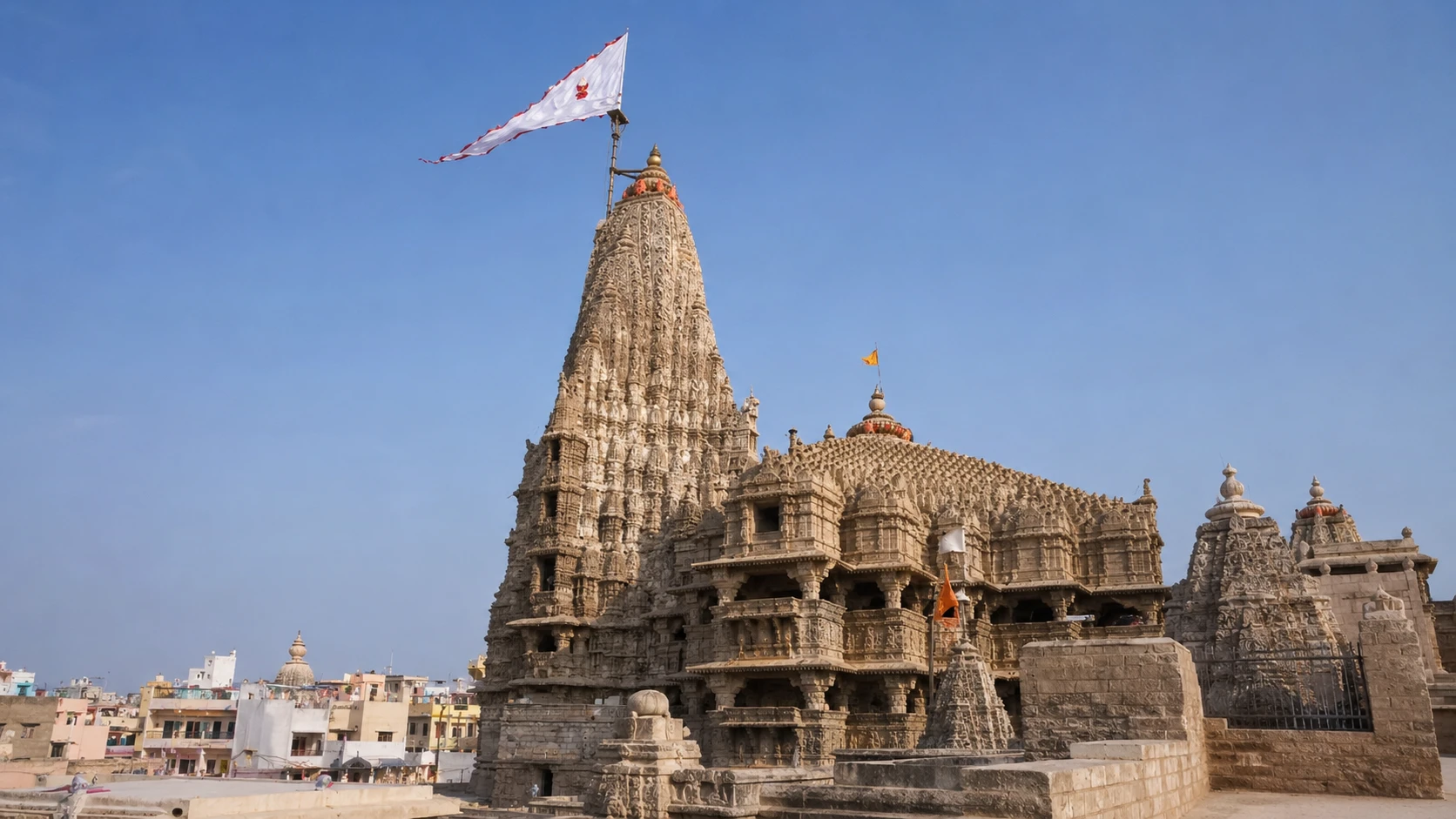
The daily Dhwajarohan (flag-changing ceremony), the saffron flag bearing the sun-and-moon emblem is hoisted atop the 78-metre shikhara up to five times each day; pilgrims sponsor the flag months in advance, and the procession of the flag-bearer family up the inner spiral staircase is one of the most photographed rituals on the Saurashtra coast
The Sacred Legend · पवित्र कथा
Dwarkadhish is the temple of Krishna not as cowherd or lover but as king, Dvārakādhīśa, the lord of Dvārakā, the sovereign who founded a city on land reclaimed from the western sea after fleeing Jarasandha's seventeen sieges of Mathura. The Bhagavata Purana names this the city of gates, built overnight by Vishvakarma at Krishna's command and absorbed back into the ocean on the day he left the world. The temple, a five-storey Maru-Gurjara structure rising 78 metres above the Gomti where it meets the Arabian Sea, is the western dham of Adi Shankaracharya's pan-India Char Dham circuit, the seventh of the Mokshapuri cities that grant liberation, and the seat of the Sharada Peetham, one of the four mathas Shankara established to hold his teaching across the subcontinent. Indian marine archaeologists working off the coast since 1979 have documented submerged structures that tradition reads as the very Dvaraka the Bhagavata describes; whether the underwater stones are Krishna's city or an older harbour of the same name, every pilgrim who climbs the Moksha Dwar enters a temple built where the texts say he ruled.
Sacred Designationपवित्र पदनाम
west
चार धाम
One of the Seven Moksha Citiesसप्त पुरी
Sacred Origin Storyपवित्र उत्पत्ति कथा
Source: Bhagavata Purana, Skandhas 10, 11 (Krishna's life, the founding of Dwarka, and the city's submergence); Mahabharata (Mausala Parva, destruction of the Yadavas); Vishnu Purana, Book 5; Harivamsa Purana, widely-attested
When Jarasandha, the king of Magadha, came against Mathura for the seventeenth time, Krishna and Balarama looked at the city they had been protecting and saw that protecting it any longer meant grinding their people between two armies. Jarasandha was bound to come back. The Yadavas needed a place his armies could not reach.
Krishna, the texts say, asked Vishvakarma, the architect of the gods, to build a new city. Vishvakarma asked where. Krishna pointed to the western sea. He had been promised by Varuna, the lord of waters, a stretch of land at the place the Saurashtra peninsula juts furthest into the Arabian Sea; Varuna would draw back his waters, the land would rise, and on it Vishvakarma would build the city in a single night.
So the texts describe it: the sea retreating, the architect of the gods working through the dark hours, and at dawn the Yadavas waking to find their new home, Dvārakā, the city of gates, named for the many gates by which the world could enter and leave.
Krishna ruled here as king, not as the playful child of Gokul or the cowherd of Vrindavan. The Bhagavata's Krishna in Dvaraka is the diplomat of the Mahabharata war, the strategist who places himself unarmed in Duryodhana's court, the householder with eight queens (Rukmini, Satyabhama, Jambavati, Kalindi, Mitravinda, Bhadra, Lakshmana, Nagnajiti) and the storied sixteen thousand who came under his roof when he rescued them from Narakasura.
The poor Brahmin Sudama walks here from Sandipani's ashram with parched rice tied in a cloth, and walks back to a mansion. The chariot of the Mahabharata war comes home here. Justice is dispensed under his eye.
At the end of his life, after the Mahabharata war is over and a generation has passed, Gandhari's curse on the Yadavas comes due. The Yadavas, drunk at Prabhas Patan, fight one another to death. Krishna walks away from the wreckage to the forest at Bhalka Tirth, where a hunter's arrow grazes his foot, and from there he returns to Vaikuntha.
On that very day, the texts say, the sea reclaims Dvaraka. The waters that were drawn back to make the land rise rise back over it. The city of gates is closed by water.
The shrine that stands today at Dwarka is held by tradition to have been founded by Vajranabh, Krishna's great-grandson, on the small portion of the city that did not sink; later layers were rebuilt by successive devotees and rulers.
Inside the sanctum, Krishna stands as Dvārakādhīśa, four-armed, holding shankha, chakra, gada, and padma, wearing the gold of a king, watched over by Devaki and Vasudeva, with Rukmini in her own shrine a few steps away.
Sources cited:
- Bhagavata Purana, Skandhas 10, 11 (Krishna's life in Dwarka, the city's founding, the Yadavas' destruction, and the submergence)
- Mahabharata, Mausala Parva (the destruction of the Yadavas at Prabhas Patan)
- Vishnu Purana, Book 5
- Harivamsa Purana (the Bhavishya Parva, accounts of Dwarka's submergence)
- Skanda Purana, Prabhasa Khanda (Saurashtra geography)
Scholarly Context
Modern scholarship treats Dwarka as the convergence of three threads. The first is textual: the Bhagavata, Mahabharata, and Vishnu Purana are consistent in placing Krishna's western capital at this site and in narrating its submergence, but the texts in their current redacted form cannot be dated with confidence to before the early centuries CE, and the events they describe are placed in a Dvapara Yuga that scriptural chronology and academic chronology do not align. The second is archaeological: the Marine Archaeology Centre of the National Institute of Oceanography (NIO), led from 1979, 80 by S. R. Rao, documented submerged stone structures off the present Dwarka coast and off Bet Dwarka, including walls, jetties, and what Rao argued were town-plan grids; subsequent surveys by the Archaeological Survey of India have continued the documentation. The interpretation of the underwater finds remains debated, Rao's identification of these as 'the lost city of Dvaraka' is widely cited in popular and Hindu-tradition publications but is not unanimous in academic Indology. The third thread is the temple's own architectural history: the present Jagat Mandir is substantively a 15th, 16th century reconstruction in the Maru-Gurjara style, with inscriptional evidence pointing to earlier shrine layers from the 8th, 9th century CE and to a tradition of Vajranabh's foundation that is canonical-traditional rather than independently documented. The Adi Shankaracharya foundation of the Sharada Peetham at Dwarka in the late 8th or early 9th century is institutionally continuous and externally documented from the medieval period onwards. Many devotional traditions, including the Vallabhacharya Pushtimarg lineage that arose in the 15th, 16th century, treat both mainland Dwarka and the offshore Bet Dwarka island as a single sacred geography; pilgrim circuits typically include both.
Historyइतिहास
Dwarka's documented history begins with inscriptional traces of a stone shrine at the site by the 8th, 9th century CE, and with the foundation in the late 8th or early 9th century of the Sharada Peetham, the western of Adi Shankaracharya's four cardinal mathas, establishing Dwarka as one of the institutional anchors of pan-Indian Hindu monasticism.
Tradition records the temple itself as a much older foundation by Vajranabh, Krishna's great-grandson; this is canonical-traditional and not independently corroborated, but the site's continuous Vaishnava sanctity from at least the early medieval period is undisputed.
Through the medieval period, Dwarkadhish was patronised by successive western Indian rulers, first the Maitrakas of Vallabhi, then the Chaulukya (Solanki) dynasty of Anhilwara whose architectural vocabulary the present temple inherits, then the Vaghela rulers of Gujarat.
In 1473, Mahmud Begada, the Sultan of Gujarat, raided Dwarka and destroyed the temple; the Persian-language chronicles of his reign (Mirat-i-Sikandari, Mirat-i-Ahmadi) record the demolition. The subsequent reconstruction in the 15th, 16th century, in the Maru-Gurjara style with substantial Solanki revivalism, established the form pilgrims see today.
The Vallabhacharya Pushtimarg tradition, founded by Sri Vallabhacharya (1479, 1531), made Dwarka one of its principal sanctified centres; the eighth haveli of the Pushtimarg's bhuvan-sequence is at Dwarka, and the sect's institutional patronage from the 16th century onward consolidated the temple's standing across the Vaishnava world.
Through the 18th and 19th centuries the temple came under the patronage of the Gaekwads of Baroda, who funded major renovations; the present-day shikhara, much of the carved stonework, and significant portions of the temple compound date in their visible form to this Gaekwad era.
Modern administration is vested in the Devasthan Samiti operating under the Dwarkadhish Mandir Committee, with state oversight from the Government of Gujarat's Devasthan Department. The Marine Archaeology Centre of the National Institute of Oceanography (NIO) and the Archaeological Survey of India have conducted underwater investigations off the coast of Dwarka and Bet Dwarka since 1979, 80 under S.
R. Rao and successors; the findings, submerged stone structures interpreted by some as the lost city of Dvaraka, have made Dwarka one of the few major Hindu pilgrimage sites with an active maritime-archaeological frontier. The 1998 Saurashtra cyclone caused minor damage; the more recent Cyclone Tauktae (May 2021) prompted preventive evacuations from the coastal precincts.
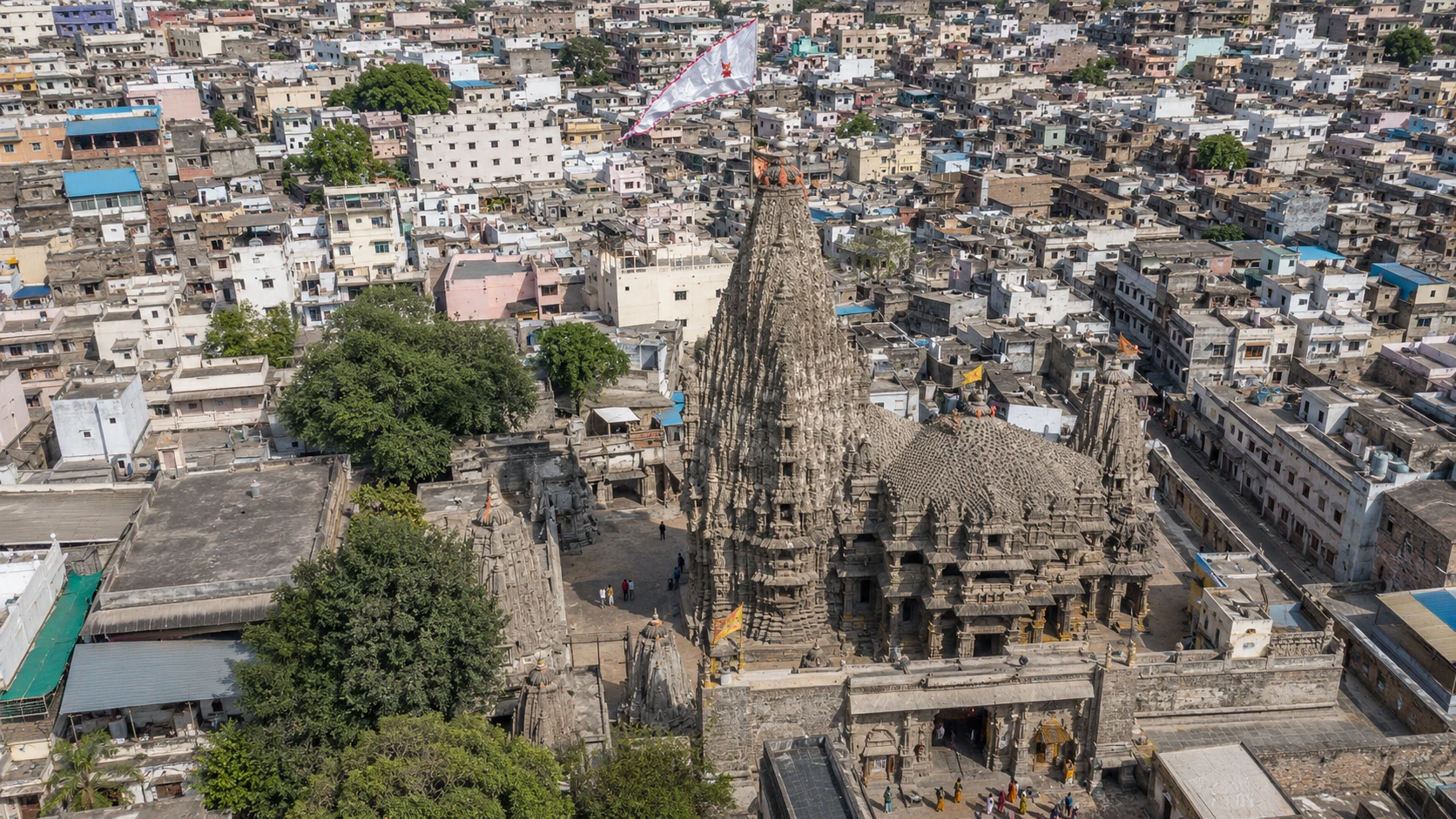
The temple's high-flag tradition, the Dhwajarohan ceremony, where the saffron flag is changed up to five times daily, has continued unbroken through all of this; the flag is visible from kilometres at sea, a maritime landmark for the Saurashtra coast.
Historical Timelineऐतिहासिक कालक्रम
The temple's foundation is attributed by tradition to Vajranabh, Krishna's great-grandson, who is said to have established the original shrine on the small portion of Dvaraka that did not submerge after Krishna's ascent. The Bhagavata Purana and Mahabharata's Mausala Parva are the principal textual anchors. Inscriptional and architectural evidence places a continuous shrine at the site by the 8th, 9th century CE, but the Vajranabh foundation itself is canonical-traditional rather than independently documented.
The dating of these texts in their current redacted forms remains the subject of ongoing scholarship. The pre-medieval continuity of Dwarka as a sacred coastal site is supported by archaeological surveys; the specific Vajranabh attribution belongs to traditional rather than independently corroborated history.
Adi Shankaracharya establishes the Sharada Peetham (Dwaraka Pithh) at Dwarka as the western of his four cardinal mathas, and appoints the first Shankaracharya. The institution becomes a continuous custodian of Advaita Vedanta in western India and a principal authority on the temple's ritual order. The Sharada Peetham's institutional continuity through subsequent centuries is externally documented and represents the most stable institutional thread in Dwarka's history.
The dating of Adi Shankara's life is itself debated (traditional 788, 820 CE; some modern scholars argue earlier dates). The Dwarka matha foundation, like the other three matha foundations, is consistent across all major Shankara hagiographies but, as with much of the Shankara biographical record, is hagiographic tradition for the foundation event itself, while the institutional outcomes are historically continuous from later periods.
Mahmud Begada, the Sultan of Gujarat, raids Dwarka and destroys the temple. The Persian-language chronicles of the Gujarat Sultanate (Mirat-i-Sikandari by Sikandar bin Muhammad and Mirat-i-Ahmadi by Ali Muhammad Khan) record the demolition as part of Begada's broader Saurashtra campaign. The Shankaracharya of the Sharada Peetham at the time is said to have escaped with the principal murti, which was sheltered until reconstruction.
The Persian chronicles' account of Begada's Saurashtra campaign is broadly accepted; the specific details of the temple's interior destruction and the priestly response derive from a combination of Persian sources and the Sharada Peetham's own tradition. Casualty figures, where given, follow the rhetorical conventions of medieval court chronicles and should be treated as approximate.
Reconstruction of the Jagat Mandir in the Maru-Gurjara (Solanki revivalist) style following Begada's destruction. The substantive form of the present temple, the five-storey shikhara, the Swarga Dwar and Moksha Dwar gates, the 72-pillared assembly hall, dates to this rebuilding. In parallel, Sri Vallabhacharya (1479, 1531) and the Pushtimarg tradition he founded establish Dwarka as one of the seven principal Pushtimarg-sanctified centres; the sect's institutional patronage from the 16th century consolidates the temple's standing across the Vaishnava world. The Bet Dwarka shrine across the Gulf of Kutch is also restored and integrated into the Dwarka pilgrim circuit during this period.
Marine archaeological investigations off Dwarka and Bet Dwarka are initiated in 1979, 80 by the Marine Archaeology Centre of the National Institute of Oceanography (NIO) under the leadership of S. R. Rao, and continued by the Archaeological Survey of India. Submerged stone structures, walls, jetties, and what Rao argued were town-plan grids, are documented at depths between 4 and 12 metres off the coast. Rao's interpretation of these as 'the lost city of Dvaraka' is widely cited but remains debated in academic Indology. In parallel, the temple comes under modern administrative oversight: the Devasthan Samiti operates under the Government of Gujarat's Devasthan Department; the temple has weathered the 1998 Saurashtra cyclone and Cyclone Tauktae (May 2021) without major structural damage; the daily Dhwajarohan ceremony continues unbroken.
The interpretation of the underwater Dwarka and Bet Dwarka finds remains contested. S. R. Rao's identification of these as the historical city described in the Bhagavata is widely cited in popular and Hindu-tradition publications and is endorsed by the temple authorities; some academic Indologists treat the dating and identification more cautiously. The structures are uncontroversially ancient maritime architecture; the precise period and identification with the Mahabharata-era Dvaraka is the contested question.
What You'll Seeदर्शन में
Inside the inner sanctum of the Jagat Mandir, Krishna stands as Dvārakādhīśa, the king. Roughly a metre tall, carved in dark stone (the temple tradition holds it to be a shaligram-class black stone consecrated by Vajranabh), the murti is four-armed in the standard Vishnu disposition: upper right hand holds the gada (mace, called Kaumodaki), upper left the chakra (Sudarshan), lower right the padma (lotus), lower left the shankha (Panchajanya).
Unlike the Vrindavan or Mathura forms, child Krishna, butter thief, flute player, this Krishna is sovereign. He wears the gold crown of a king, a jewelled chest-piece, royal robes that are changed several times each day during the six aartis, and a garland of fresh tulsi and mountain flowers brought daily by the temple priests.
To his right and left, smaller subsidiary murtis stand: Devaki and Vasudeva (his parents), Balarama (his elder brother), and Subhadra (his sister) in some configurations. Rukmini, his principal queen, has her own larger shrine about two kilometres away on the road toward Bet Dwarka, a separation the local tradition reads as the lovers' lifelong tension between the duties of queenship and the closeness of marriage.
The Jagat Mandir itself is built around the murti as a five-storey structure of carved limestone, 72 pillars supporting an elaborate sabha-mandapa beneath an 78-metre shikhara crowned by the daily-changed saffron flag visible from kilometres at sea. Photography is strictly prohibited inside the sanctum.
Distinctive Practicesविशिष्ट परंपराएँ
Dhwajarohan, the daily flag-changing ceremony
ध्वजारोहण, दैनिक ध्वज-परिवर्तन समारोह
Up to five times daily, year-round; advance booking through the temple trust (waiting period commonly extends to several years)
Atop the 78-metre shikhara of the Jagat Mandir flies a saffron flag bearing the sun and moon, the emblems of the Yaduvansha, the lineage of Krishna. The flag is changed up to five times each day. A specific family (the Abhoti / Abhoji Brahmins) holds the hereditary right to climb the inner spiral staircase, replace the previous flag with the next sponsor's, and release the old flag down. The new flag is gifted to the sponsoring family along with consecrated prasad. Sponsorship slots typically book several years in advance and are passed within families across generations.
The flag is a public, distance-visible declaration that Dvārakādhīśa is in residence and the day is being kept in his name. Mariners off the Saurashtra coast for centuries have read the flag as a navigational mark; pilgrims approaching the temple read it as a signal that worship has not ceased. The act of changing the flag five times each day re-asserts that Krishna's reign is not a memory but a continuous present, and that families who can trace their sponsorship back six generations are still part of his court.
The two-gate darshan path, Moksha Dwar in, Swarga Dwar out
दो-द्वार दर्शन-पथ, मोक्ष द्वार से प्रवेश, स्वर्ग द्वार से निर्गमन
Continuous during open hours; the standard pilgrim path through the temple
The Jagat Mandir has two principal entrances, and the pilgrim is meant to use them in a specific order. Pilgrims enter through Moksha Dwar, the Gate of Liberation, on the eastern side, climb to the sanctum for darshan of Dvārakādhīśa, and then exit through Swarga Dwar, the Gate of Heaven, on the western side, descending the 56 stone steps that lead down to Gomti Ghat where the Gomti river meets the sea. Many pilgrims bathe in the Gomti at the foot of these steps before leaving the temple precinct. The path is named for what it is meant to enact: liberation entered, heaven exited toward, with darshan of Krishna as the threshold between.
Dvaraka, in the Bhagavata, is the city of gates, and the temple makes this literal in the body of the pilgrim. The geography of entry and exit is itself a teaching: the worshipper does not loop back to where they began but moves through Krishna's house toward a different threshold than the one they came in by. The 56 steps to Gomti Ghat, and the salt-spray from the Arabian Sea that meets the Gomti's fresh water at the bottom, re-locate the pilgrim from the kingdom of mortals into the larger geography the texts call moksha-bhumi.
Six aartis a day, Krishna as king in the haveli rhythm
दिन में छह आरतियाँ, हवेली-लय में राजा कृष्ण
Daily, year-round: Mangala (06:30), Shringar (08:00), Rajbhog (11:00), Utthapan (17:00), Sandhya (19:30), Shayan (21:00)
Dwarkadhish runs on the six-aarti haveli rhythm of the Pushtimarg tradition rather than the simpler morning-evening puja schedule of most Vishnu temples. Mangala wakes the deity at dawn; Shringar dresses him in his daily ornaments and royal attire; Rajbhog offers the king's noon meal; Utthapan rouses him from his afternoon rest (the temple is closed during these hours, an Anavasara that mirrors the deity's siesta); Sandhya is his evening worship; Shayan puts him to bed. The robes, ornaments, and bhog change at every aarti. The rhythm comes from Sri Vallabhacharya's Pushtimarg, founded in the 15th, 16th century, which treats Krishna as a beloved householder king whose daily life is to be tended in detail.
The Pushtimarg theological move at Dwarka is to treat Krishna not as a deity to be petitioned at fixed prayer times but as a sovereign whose household runs on a king's clock. The six aartis are not six chances for the devotee to come, they are six episodes of Krishna's day that the devotee may witness. The shift in emphasis is from the worshipper's needs to the deity's life. Pilgrims who stay long enough to attend all six aartis in a single day report a peculiar effect: the temple stops feeling like a destination and starts feeling like a household.
Did You Know?क्या आप जानते हैं?
Indian marine archaeologists working off the coast of Dwarka and Bet Dwarka since 1979, 80 have documented submerged stone structures at depths of 4 to 12 metres, walls, jetties, and what some interpret as town-plan grids, in the very stretch of sea where the Bhagavata Purana says Krishna's city sank on the day he ascended. S. R. Rao of the National Institute of Oceanography identified these as the historical Dvaraka in his 1999 study; the identification is widely cited though academically contested. Few major Hindu pilgrimage sites have an active maritime-archaeological frontier of this kind.
S. R. Rao, 'The Lost City of Dvaraka' (Aditya Prakashan, 1999); NIO Marine Archaeology Centre publications; Archaeological Survey of India Underwater Archaeology Wing reports
The 78-metre shikhara of the Jagat Mandir is one of the tallest in western India, and the saffron flag at its peak is visible for tens of kilometres along the Saurashtra coast and at sea. Mariners have used it as a navigational landmark since at least the medieval period. The flag is changed up to five times daily, and a specific Brahmin family holds the hereditary right to make the climb up the inner spiral staircase to do so.
James Burgess and Henry Cousens, 'The Architectural Antiquities of Northern Gujarat' (1903); Devasthan Samiti publications; Indian Navy hydrographic charts of the Saurashtra coast
Dwarkadhish is one of only a handful of major Indian temples that anchor three distinct devotional categories simultaneously, Adi Shankaracharya's Char Dham (the four cardinal pilgrimages, of which Dwarka is the western), the Sapt Puri (the seven Mokshapuri cities granting liberation, of which Dwarka is the seventh), and the Pushtimarg of Sri Vallabhacharya (which sanctifies Dwarka as one of its principal centres). Few temples carry all three labels; the convergence is what makes the pilgrim density at Dwarka unique in western India.
Mokshapuri Stotram (canonical Sanskrit verse listing the seven Mokshapuri cities); Adi Shankara hagiographies; Pushtimarg sectarian texts including Vallabhakhyana
Pilgrims to Dwarkadhish typically also complete a wider circuit known to local tradition as the Panch Tirth or Dwarka Mandala, the main Dwarkadhish temple, Rukmini Devi Temple about two kilometres east, the Nageshwar Jyotirlinga about 17 kilometres north, Bet Dwarka (the island said to be Krishna's actual residence, a short ferry ride across the Gulf of Kutch), and Gopi Talav (a freshwater lake associated with Krishna's gopi companions). The cluster encodes the larger Dvaraka geography that the Bhagavata describes, a kingdom, not a single temple.
Skanda Purana, Prabhasa Khanda; Devasthan Samiti pilgrim guides; Government of Gujarat Tourism Department publications
The Jagat Mandir's principal assembly hall is supported by 72 elaborately carved stone pillars and is one of the finest surviving examples of Maru-Gurjara revivalist architecture from the post-Begada reconstruction era (15th, 17th century). The pillar capitals carry depictions of Krishna's life, the rasa-leela, the lifting of Govardhan, the Mahabharata charioteering, and the ceiling medallions in places echo the temple architecture of the Solanki dynasty whose vocabulary the rebuilders deliberately revived. Architectural historians read the temple as a conscious archaeological gesture: a Maru-Gurjara building rebuilt with Maru-Gurjara grammar three centuries after the original style had passed out of regional use.
James Burgess and Henry Cousens, 'The Architectural Antiquities of Northern Gujarat' (1903); M. A. Dhaky, studies on Maru-Gurjara architecture; Archaeological Survey of India temple architecture monographs
Visitor Accessप्रवेश जानकारी
Dwarkadhish is open to all visitors regardless of faith or sect; there is no entry restriction by community. Photography is strictly prohibited inside the sanctum and during the six daily aartis; mobile phones must be silenced and pocketed. The temple closes for several hours each afternoon for Anavasara (the deity's siesta), verify the daily schedule before planning afternoon darshan. Sponsored sevas including Dhwajarohan and the Mangala/Shayan aarti darshan slots require advance booking through the trust, often booked months to years in advance. The temple sits on the Saurashtra coast and is subject to occasional cyclone advisories during May, November; on cyclone-warning days, darshan timings may be curtailed and the upper shikhara closed.
Spiritual Basis
The afternoon Anavasara closure is the most distinctive access constraint and rests on the Pushtimarg theology that treats Krishna as a household sovereign whose daily rhythm, including rest, must be respected by his devotees. The sanctum photography prohibition is partly the standard ritual-purity concern and partly a recognition that the murti and his attire are continually re-staged through the day; pilgrims are asked to receive what is in front of them rather than to take it home in image.
Festivalsत्योहार
Krishna Janmashtami
कृष्ण जन्माष्टमी
August, September (Bhadrapada Krishna Ashtami)
The single largest festival at Dwarkadhish, Krishna's birth observed at midnight with abhishek of the murti, a special darshan window, and the symbolic enactment of the infant Krishna's transfer from Mathura prison across the Yamuna. At Dwarka, the festival is read additionally as the birthday of the king the texts call Dvārakādhīśa: pilgrim numbers double, the Dhwajarohan ceremony uses a special Janmashtami-design flag, and the haveli aartis are extended through the night. Pushtimarg pilgrims travel from Gujarat, Mumbai, and Rajasthan to time their visit to this day.
Holi (Pushtimarg-style)
होली (पुष्टिमार्ग-शैली)
March (Phalguna Purnima)
The Pushtimarg tradition's celebration of Holi at Dwarkadhish is among the most flamboyant in western India, abeer, gulal, and rose petals are showered on the murti and the assembled devotees through the day, the temple courtyard is washed in colour, and traditional fagua songs are sung in the haveli style of the Pushtimarg. The festival commemorates Krishna's Vrindavan-era play with the gopis, reframed at Dwarka as the king allowing his court a day of festive informality.
Annakut (Govardhan Puja)
अन्नकूट (गोवर्धन पूजा)
October, November (Kartika Shukla Pratipada, the day after Diwali)
Annakut at Dwarkadhish is the day a mountain of fifty-six (chappan-bhog) or one hundred and eight food preparations is offered to Krishna, commemorating his lifting of Mount Govardhan to shelter the cowherds from Indra's rains. The food mountain is built in front of the sanctum through the morning and distributed as prasad through the afternoon. The festival's Pushtimarg flavour is unmistakable, the sect's particular reverence for Govardhan as the embodiment of Krishna shapes the day's liturgy at Dwarka more than anywhere outside Vrindavan and Nathdwara.
Tulsi Vivah
तुलसी विवाह
October, November (Kartika Shukla Ekadashi to Purnima)
The annual marriage of Vishnu and Tulsi, staged in temple courtyards across the Vaishnava world, is observed at Dwarkadhish with particular elaboration. A small Krishna murti is symbolically married to a tulsi plant in a four-day mandap ceremony that mirrors the rituals of a household wedding: haldi, mehendi, baraat, the seven pheras, and the post-marriage rituals. The festival opens the auspicious wedding season for Hindus and is treated at Dwarka as the king's own re-affirmation of marital bond.
Traditional Offeringsपारंपरिक अर्पण
Primary Offerings
Tulsi Mala / Tulsi Leaves
तुलसी माला / तुलसी पत्र
तुलसी
The tulsi plant is Vishnu's most beloved offering, identified in the Padma Purana as the gopi Vrinda who took this form to remain perpetually at his feet. At Dwarkadhish the murti's daily shringar always includes a fresh tulsi mala layered over the chest-piece; tulsi malas and individual leaves are distributed as prasad to pilgrims. Devotees take home a few leaves or a mala for their household altar.
Mishri (rock sugar) and Mawa-Pedhas
मिश्री और मावा-पेड़ा
Crystalline rock sugar, the sweet of the gopi tradition, is among the most characteristic offerings to Krishna across the Pushtimarg world, and at Dwarkadhish it is layered with mawa-pedhas (milk fudge) and dry fruits in the prasad packets distributed at the trust counter. The bhog menu at Rajbhog and Annakut is built around mishri's place in Krishna-leela household offerings.
Yellow flowers and silk (peetambar)
पीले पुष्प और पीताम्बर
Yellow is Krishna's colour, the texts describe his peetambar (yellow silk garment) as the inseparable mark of his royal form. At Dwarkadhish, devotees offer yellow marigolds, yellow lotuses, and lengths of yellow silk that the priests use to dress the deity at Shringar Aarti. Sponsoring a peetambar offering for a specific aarti is a popular seva.
Panchamrit and ghee for abhishek
पंचामृत और घी अभिषेक हेतु
The traditional five-substance mixture of milk, curd, ghee, honey, and sugar that forms the abhishek-prasad of any Vishnu temple. At Dwarkadhish, panchamrit is the principal liquid offering at Mangala Aarti and Janmashtami midnight abhishek; the panchamrit-prasad distributed afterward is among the most-sought offerings of the pilgrim's visit. Pure cow's ghee, untouched by leather or animal contact, is preferred for the abhishek.
Gomti water (Gomti tirth-jal)
गोमती जल (गोमती तीर्थ-जल)
Water from the Gomti at Gomti Ghat, at the foot of the Swarga Dwar steps where the river meets the Arabian Sea, is taken home by many pilgrims in small sealed bottles as tirtha-jal. The mingling of fresh river water and salt sea at this exact point is read in the local tradition as the meeting of mortal and divine geography; the jal is used in domestic puja for years afterward.
Unique to This Temple
Dhwaja Seva (flag sponsorship)
ध्वज सेवा (ध्वज प्रायोजन)
Sponsoring one of the five daily flags at the 78-metre shikhara is the most distinctive seva at Dwarkadhish, and one of the most heavily booked. The sponsoring family's name is recorded in the temple's flag register; the family is invited to participate in the flag-changing procession (though only the hereditary Abhoti Brahmins climb the inner staircase); the previous flag is gifted back to the family as a relic, having flown over Dvārakādhīśa for several hours. Booking the Dhwaja Seva typically requires advance scheduling of several months to several years; cost is set by the trust and varies by season.
Annakut Bhog Sponsorship
अन्नकूट भोग प्रायोजन
Sponsorship of a portion of the Annakut food-mountain (chappan-bhog or one hundred and eight preparations) on the day after Diwali is among the most spiritually weighted sevas in the Pushtimarg calendar. Sponsoring families fund preparation of named items in the bhog spread; certificates and prasad are distributed in the family's name. Booking is through the trust office and opens months before Diwali.
Pilgrims may bring tulsi, fruit, mishri, and pure ghee from outside, but in practice most purchase trust-vetted offering packets at counters near the temple entrance. Sevas at the haveli aartis (Mangala, Shringar, Shayan) and Dhwaja Seva should be booked well in advance through the trust; on-the-day availability of the most coveted slots is rare. The prasad counter at Swarga Dwar distributes the standard tulsi-mishri-mawa packet that pilgrims take home.
How to Reachकैसे पहुँचें
Dwarka sits on the western tip of the Saurashtra peninsula in Gujarat. The town is well-connected by rail and road; the nearest airport is at Jamnagar.
By rail: Dwarka Railway Station is in town, about 2 km from the temple. It sits on the Western Railway's Mumbai, Okha line, with direct trains from Mumbai (overnight; ~14 hours), Ahmedabad (~9, 10 hours), Rajkot (~3 hours), Jamnagar (~2 hours), and Okha (~30 minutes; the railhead for Bet Dwarka ferries).
Pilgrim demand is high in the Janmashtami and winter season; advance booking is strongly recommended.
By road: NH-51 (the Saurashtra coastal highway) connects Dwarka to Jamnagar, Rajkot, and Ahmedabad; from Mumbai, the route is via Vadodara, Ahmedabad, Rajkot. Total driving distances: Ahmedabad ~440 km (7, 8 hours); Mumbai ~960 km (16, 18 hours, typically broken at Vadodara or Ahmedabad); Rajkot ~225 km (~4 hours); Jamnagar ~135 km (~2.5 hours).
State-run Gujarat State Road Transport Corporation (GSRTC) buses operate from all major Gujarat cities; private operators run sleeper coaches from Mumbai and Ahmedabad.
By air: The nearest airport is Jamnagar (~135 km, ~2.5 hours by road), with limited domestic connections from Mumbai and Ahmedabad. Rajkot Airport (~225 km) has more flights. Sardar Vallabhbhai Patel International Airport at Ahmedabad (~440 km) is the closest international hub for overseas pilgrims; from Ahmedabad, train and road connections take over.
Local access: Within Dwarka, the temple is at the centre of a pedestrian-friendly old town. Auto-rickshaws and local taxis connect the railway station, the bus stand, and the temple. For the Bet Dwarka leg, take a road or train to Okha (~30 km north of Dwarka) and the regular ferry across the Gulf of Kutch, the crossing takes about 20 minutes and runs through daylight hours; ferry timings are weather-sensitive.
Plan Your Visitयात्रा की योजना
🌤 Best Season
October to March is by far the best window, clear skies, daytime temperatures of 20, 30°C, low humidity, and the festival calendar (Diwali, Annakut, Tulsi Vivah, Holi) clustered through the season. April and May are intensely hot (35, 42°C) and physically draining at the seafront temple. June to September is the south-west monsoon, humidity is heavy, rains are intermittent but can be torrential, and the late monsoon period overlaps with cyclone advisory windows for the Saurashtra coast. Janmashtami (August, September) is the temple's largest festival and draws enormous pilgrim crowds despite the monsoon; pilgrims who prioritise that day should plan for weather contingencies.
👘 Dress Code
Modest dress is expected, full-length trousers, salwar suit, or saree; covered shoulders. The temple does not enforce a strict gender-segregated dress code but the Pushtimarg cultural setting at Dwarka skews traditional, and pilgrims who attend the morning haveli aartis often wear clean, festive Indian attire. Footwear is removed at the main entrance and stored at trust-managed counters. A head covering is recommended (not mandated) for both men and women in the inner sanctum.
📱 Phones & Photography
Photography is strictly prohibited inside the sanctum and during the six daily aartis. Photography is permitted in the outer courtyard, on the steps of Swarga Dwar, and at Gomti Ghat. The trust asks that phones be silenced and pocketed during darshan. Mobile signal at Dwarka is generally good, Reliance Jio, Airtel, and BSNL all maintain reliable coverage in the town; data is consistently usable.
🏨 Accommodation
The Devasthan Samiti operates official Bhaktinivas guest houses adjacent to the temple complex, bookable through the trust. Gujarat Tourism Development Corporation (GTDC) runs the Toran Tourist Hotel near the temple. A wide range of private hotels, dharamshalas, and Pushtimarg sect-affiliated guesthouses operate across price points; the town's hotel capacity has expanded significantly with the Char Dham yatra circuit's growth in the 2010s and 2020s. During Janmashtami and the major festival weeks, advance booking by several weeks is essential. Bet Dwarka has limited accommodation; most pilgrims do the Bet Dwarka leg as a day trip from a Dwarka base. Okha (the railhead for the Bet Dwarka ferry) has additional budget options.
Book a Pujaपूजा बुक करें
Booking links and phone numbers are verified periodically but may change without notice. The official trust portal for all Dwarkadhish sevas, donations, and Dhwaja Seva sponsorships is dwarkadhish.org, operated by the Shri Dwarkadhish Devasthan Samiti. Multiple fraudulent websites mimic the trust's branding and the Pushtimarg sect's iconography to accept payments for sevas they cannot deliver, the Samiti and the Government of Gujarat Devasthan Department have issued public advisories warning against these. Always confirm the destination URL belongs to the official trust before payment. Travel agents claiming to offer 'guaranteed' Mangala Aarti slots, Shayan Aarti slots, or expedited Dhwaja Seva at Janmashtami should be treated with caution; the only path to those slots is through the trust's own booking system. Phone numbers and email contacts are not currently published on the trust portal in a single canonical place; verify on the trust's website before contacting.
Managed by: Shri Dwarkadhish Devasthan Samiti (Dwarkadhish Mandir Committee), under the Government of Gujarat Devasthan Department
Mangala Aarti Darshan (06:30 slot)
मंगला आरती दर्शन (06:30 अवसर)
Shringar Aarti Darshan
शृंगार आरती दर्शन
Shayan Aarti Darshan (21:00 slot)
शयन आरती दर्शन (21:00 अवसर)
Dhwaja Seva (flag sponsorship)
ध्वज सेवा (ध्वज प्रायोजन)
Abhishek Puja
अभिषेक पूजा
Annakut Bhog Sponsorship (Govardhan Puja, day after Diwali)
अन्नकूट भोग प्रायोजन (गोवर्धन पूजा, दीवाली के अगले दिन)
Booking information verified: 2026-05-07
Sacred Soundsपवित्र ध्वनि
108 Japa Practice
Om Namo Bhagavate Vasudevaya
Chant 108 times in the spirit of this temple
Did You Know? · क्या आप जानते हैं?
The same translation error that turned '33 Koti' into '33 crore' in Hinduism also happened in Buddhism. The Chinese translation of Buddhist texts rendered 'Sapta Koti Buddha' (7 Supreme Buddhas) as '7 Crore Buddhas.' The Tibetan translation got it right: 7 types, not 7 crore. One Sanskrit word, misread across two major world religions, generated two identical misconceptions independently.
Related Contentसंबंधित सामग्री
Related Scriptures
Community Reflections
🕉️
Be the first to share your reflection.