Badrinath
बद्रीनाथ
The northern dham, Vishnu's tapasya seat in the Himalayas
Badrinath, Uttarakhand, India
BadrīnāthaAlso known as: Badari, Badarinarayan, Badrinarayan, Badari Vishal, Vishal Badri, Badarikashrama
Era
Pilgrimage site referenced in the Mahabharata, Vishnu Purana, and Bhagavata Purana; current temple's structural ancestry traced to a late-8th- or early-9th-century reconsecration by Adi Shankaracharya, with substantial reconstructions by the Garhwal kings in the 17th century and major post-1803-earthquake repairs through the 19th century
Architecture
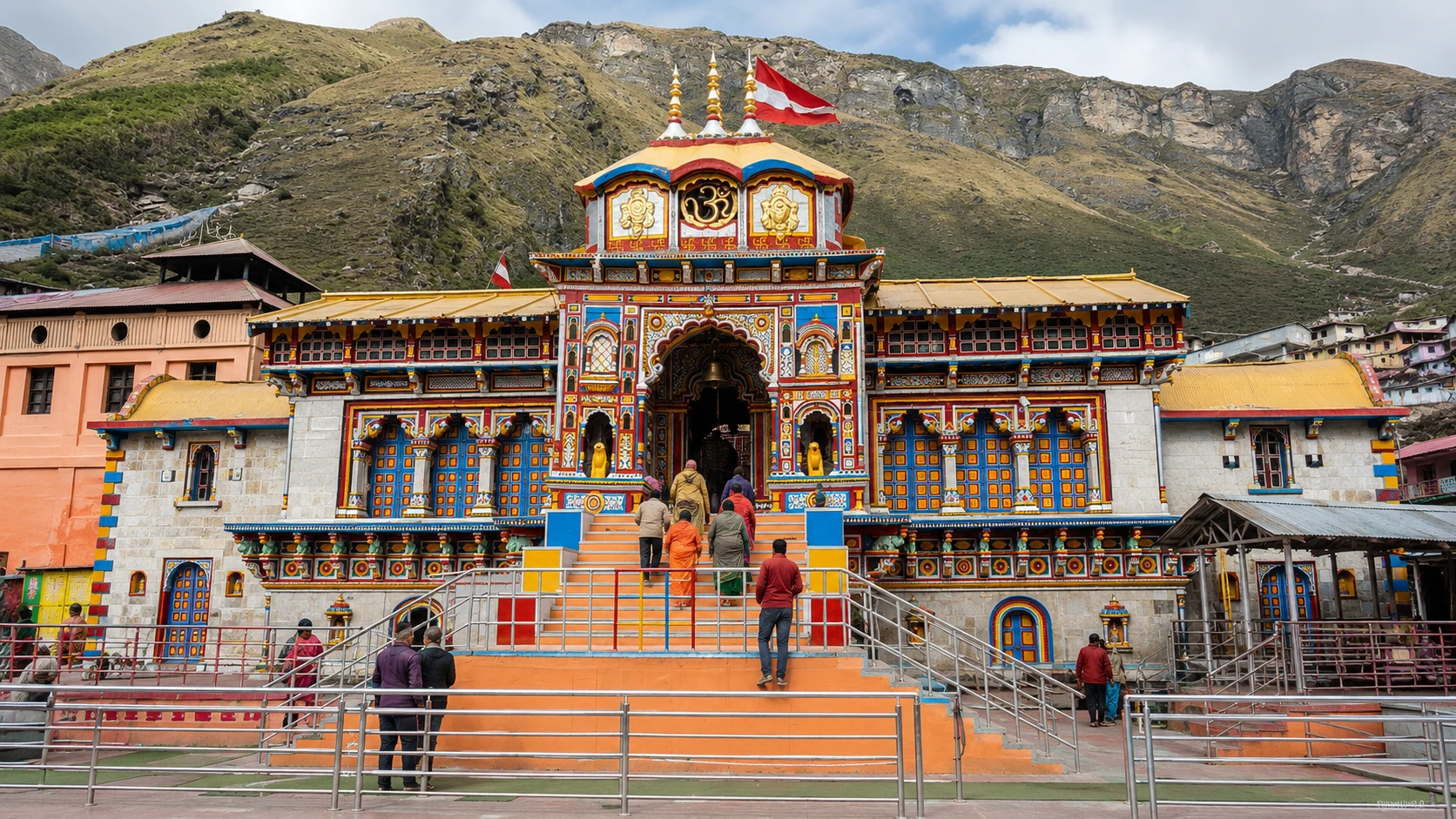
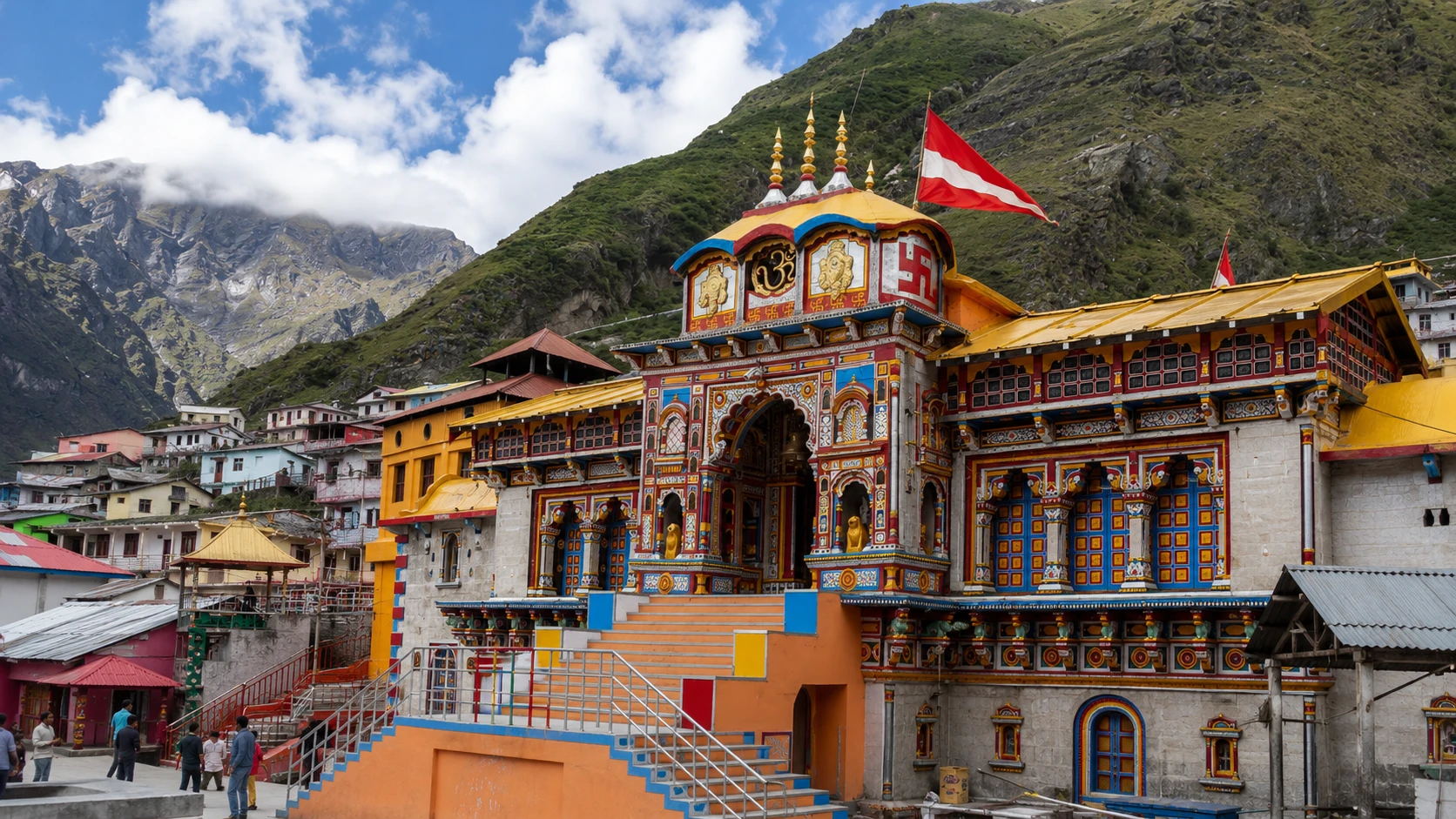
Garhwali Pahari with Nagara stylistic elements; distinctive conical shikhara of stone painted in white and gold, with the temple front in striped red, gold, and yellow; small in footprint by South Indian standards, scaled to its high-altitude setting
Open
Approx. 04:30 (Maha Abhishek, ticketed) and 06:00, 07:00 onward for general darshan during the six-month yatra season – Approx. 21:00 (Shayan Aarti); the temple is closed for kapaat-band for six months in winter, opening on Akshay Tritiya (late April / early May) and closing on the day after Vijayadashami / shortly after Diwali (October, November); winter worship continues at Pandukeshwar (Yoga Dhyan Badri) and Joshimath (Narasimha temple)
Aarti
04:30 Maha Abhishek (paid pass) · 07:00 Mangal Aarti · Afternoon Bhog and Geet Govind paath · 21:00 Shayan Aarti
Special
Kapaat opening on Akshay Tritiya (procession of the Uddhav-ji and Kuber-ji utsava-murtis from Pandukeshwar with the rawal and the Garhwal Scouts band); Mata Murti Mela; Badri-Kedar Festival; the kapaat closure ceremony before the six-month winter shutdown, these dates are announced annually by the Shri Badrinath, Shri Kedarnath Mandir Samiti (BKTC)
The Sacred Legend · पवित्र कथा
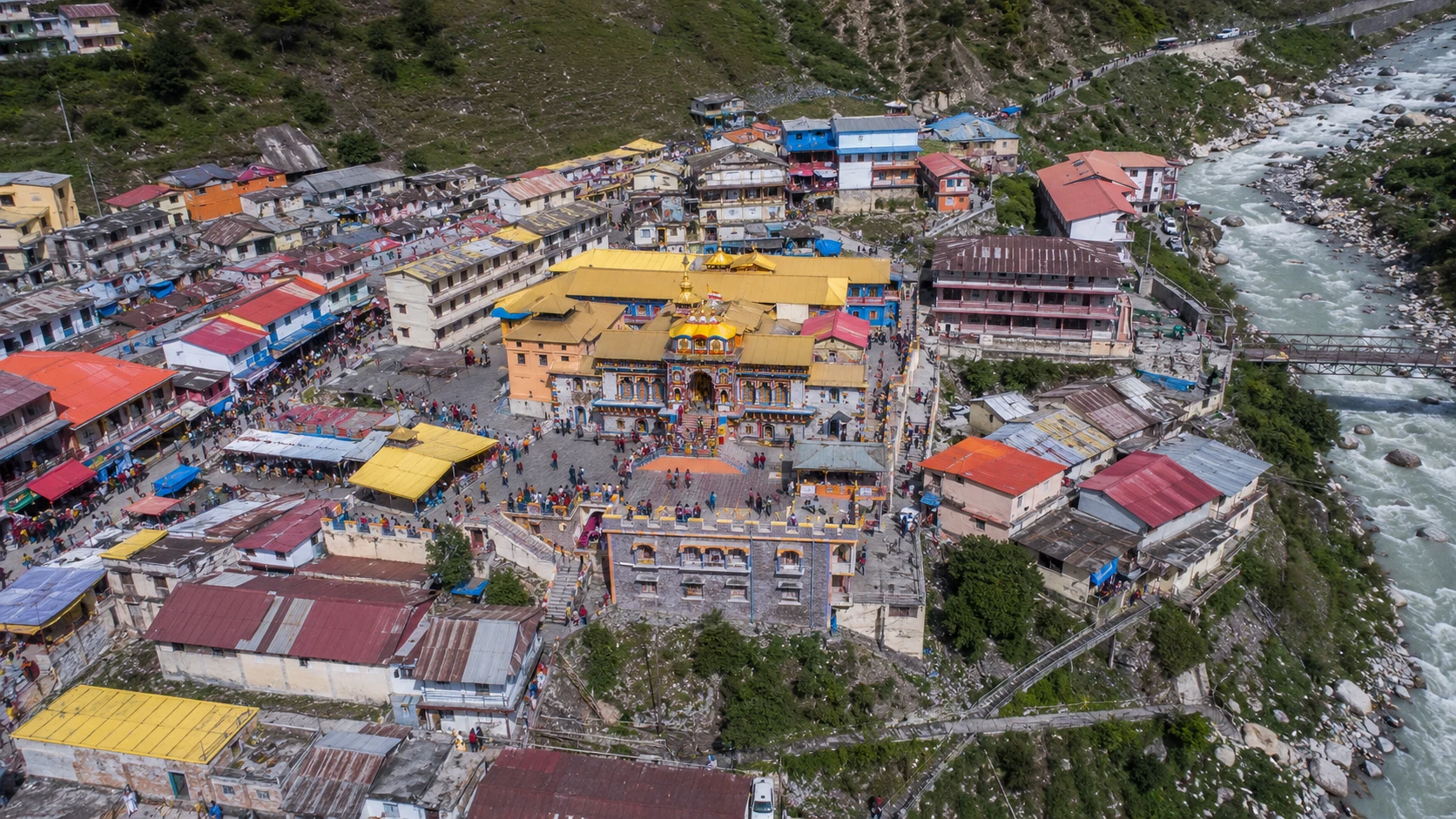
Badrinath is where Vishnu is said to have sat in tapasya for thousands of years beneath a badari (jujube) tree that Lakshmi became to shield him from snow and sun, and where, to this day, he is woken and put to sleep on a six-month rhythm dictated by the Himalayas themselves. As the northern dham of Adi Shankaracharya's pan-Indian Char Dham circuit and the topmost of Uttarakhand's Chota Char Dham, the temple sits at 3,133 metres on the banks of the Alaknanda, between the Nara and Narayana mountain ranges, with hot sulphur springs called Tapt Kund bubbling up at its very gates while glaciers ring the valley behind. Its chief priest, the rawal, is by an unbroken tradition a Namboothiri Brahmin from Kerala: an institutional bridge stretched the entire length of the Indian subcontinent and held in place for over a thousand years.
Sacred Designationपवित्र पदनाम
north
चार धाम
Sacred Origin Storyपवित्र उत्पत्ति कथा
Source: Bhagavata Purana, Skanda Purana (Vaishnava Khanda, Badarikashrama Mahatmya), Mahabharata (Aranyaka Parva, Mahaprasthanika Parva), Vishnu Purana, widely-attested
In an age before this age, when the world's evils gathered weight and the gods grew anxious, Vishnu took the twin form of Nara and Narayana, two ascetic sages, indistinguishable, who descended on the slopes of the Himalayas at the place the texts call Badarikashrama. Here, where the Alaknanda was already old, they sat in penance.
Narayana chose a spot beneath a badari tree, the wild jujube whose fruits the mountain ascetics ate. He sat in unmoving meditation, his body absorbing the snow that fell upon him in winter and the burning sun that struck him in summer. Lakshmi, who had followed him into the mountains, watched as the seasons tried to reach him.
In time she could no longer bear it. She took the form of the badari tree itself, its branches thickening, its leaves becoming a roof, its body becoming a shelter, and stood above him, taking upon herself every snowflake and every spear of sunlight that the elements aimed at her lord.
From this act, the place takes its name: Badari-natha, the lord of the badari, the lord whose lady became the tree.
The texts hold a second meditation here. The Pandavas, in their final journey, are said to have passed through Badarikashrama on their way to Swargarohini, the path of ascent that begins, the Mahabharata says, in these mountains. Bhima built the bridge across the Saraswati at Mana, the village above Badrinath; his footprint is shown there still.
The cave of Vyasa, where the Mahabharata is said to have been dictated to Ganesha, is shown a kilometre upstream. Whether any of this is geography or whether it is the way memory writes itself onto a landscape, every Char Dham pilgrim who reaches Badrinath walks a little of the same ground.
Through all of this, the murti of Vishnu at Badrinath is unusual: not a metalwork or a stone carving in the manner of southern temples, but a self-revealed black shaligram, found, the tradition says, in a kund of the Alaknanda, retrieved by Adi Shankaracharya in the ninth century when the murti had been hidden during a period of waning Vaishnava worship in the region, and reinstalled in the form pilgrims now see.
He sits in padmasana, hands held in dhyana mudra, with Nara-Narayana, Kubera, Narada, Uddhava, and Garuda arranged around him.
Sources cited:
- Bhagavata Purana, Skandha 4 (Nara-Narayana avatar references)
- Skanda Purana, Vaishnava Khanda, Badarikashrama Mahatmya
- Mahabharata, Aranyaka Parva (Pandavas at Badarikashrama) and Mahaprasthanika Parva (final journey)
- Vishnu Purana, Book 3, Chapter 4
Other Traditions · अन्य परंपराएँ
Garhwali sthala-purana / oral folk tradition along the Char Dham route
A folk tradition told widely along the Char Dham route holds that Badrinath was originally a meditation seat of Shiva. Vishnu, seeking a place for his own tapasya in the Himalayas, came upon the spot and saw it was already occupied. Rather than confront Shiva, he took the form of a crying infant.
Parvati, distracted and unable to ignore the wailing, picked up the child; the child wept inconsolably and refused to leave. Their meditation broken, Shiva and Parvati gave up the seat and walked away to a quieter place in the same range, which became Kedarnath. The infant transformed back into Vishnu and took up the seat at Badrinath.
Pilgrims walking the Char Dham circuit hear this story told as the reason Kedarnath and Badrinath sit so close together in the same Garhwal range, only some forty kilometres apart by aerial line, Shiva and Vishnu, displaced and chosen, never quite leaving each other's company.
Scholarly Context
Modern scholarship distinguishes several layers in the Badrinath tradition. The Mahabharata's references to Badarikashrama and the Bhagavata's Nara-Narayana account establish the site's mythological antiquity, but no archaeological evidence places a permanent stone shrine here in pre-medieval times, the high-altitude setting and six-month winter snowpack make continuous structures difficult, and seasonal worship at a sacred geography is the more likely early form. The reconsecration by Adi Shankaracharya, traditionally placed in the late 8th or early 9th century CE, is consistent with the establishment of Jyotirmath (Joshimath) as one of the four cardinal Shankara mathas; but the dating of Shankara himself remains debated (traditional 788, 820 CE; some modern scholars argue earlier dates). The current temple structure substantially post-dates Shankara: the Garhwal kings of the Pawar (Pala) dynasty rebuilt and patronised the temple from the 17th century, the catastrophic 1803 earthquake destroyed much of Garhwal's stonework, and the 19th-century rebuilding under the King of Jaipur and subsequent Garhwali patrons established the contours pilgrims see today. The unbroken Namboothiri rawal lineage from Kerala, itself an institutional creation traceable to Shankara's pan-Indian framework, has been the most stable element of the temple's history.
Historyइतिहास
Badrinath's documented history begins with its place in early Sanskrit literature, the Mahabharata, the Bhagavata Purana, and the Vishnu Purana name it as Badarikashrama, a site of penance in the Himalayas, but the first phase of institutional consolidation belongs to Adi Shankaracharya's late-8th- or early-9th-century reorganisation of pan-Indian Hindu monastic geography.
Tradition records that Shankara recovered a buried Vishnu murti from a kund in the Alaknanda, reinstalled it at Badrinath, and established Jyotirmath (Joshimath, the lower-elevation winter seat) as one of the four cardinal Shankara mathas; he also instituted the practice of appointing a Namboothiri Brahmin from his own Kerala homeland as the rawal, chief priest, of Badrinath, an arrangement that has continued unbroken for over a thousand years.
Through the medieval period, the temple was patronised by successive Garhwali rulers, first the Katyuri kings, then from the 14th century the Pawar (Pala) dynasty of Garhwal, who built and rebuilt the structure. The current temple's substantive form dates to the 17th century.
The Great Garhwal Earthquake of 1 September 1803 caused widespread destruction across Garhwal and damaged Badrinath; Sawai Jagat Singh, the Maharaja of Jaipur, funded major reconstruction over the early to mid-19th century, supplemented by Garhwali patrons.
The British colonial period saw little structural intervention but improved pilgrimage infrastructure with the construction of the Hardwar, Badrinath road through the late 19th and early 20th centuries.
Modern administration is vested in the Shri Badrinath, Shri Kedarnath Mandir Samiti (BKTC), constituted by Uttar Pradesh state legislation in 1939 and continued under Uttarakhand on the state's formation in 2000. The 2013 Uttarakhand floods, while sparing Badrinath far more than Kedarnath, severely damaged the access route via Govindghat and the helipad infrastructure, prompting a multi-year rebuild.
The Char Dham Pariyojana, a Government of India highway expansion project to provide all-weather road access to all four Uttarakhand dhams, initiated 2016, has remained in stages of completion and the subject of environmental litigation.
The Uttarakhand Char Dham Shrine Management Act of 2019, which created a Devasthanam Management Board to centralise administration of fifty-one temples including the four dhams, was repealed in November 2021 following sustained protests by the priest collectives, restoring traditional administration via BKTC and the local purohit communities.
Historical Timelineऐतिहासिक कालक्रम
References to Badarikashrama in the Mahabharata, the Vishnu Purana, and the Bhagavata Purana establish the site's status as a Vaishnava pilgrimage destination from very early Sanskrit literature. The Pandavas' final journey toward Swargarohini, said to begin from Mana (the village above Badrinath), is recorded in the Mahabharata's Mahaprasthanika Parva. The pre-medieval form of worship at the site is understood by historians as seasonal pilgrimage to a sacred geography rather than as continuous shrine activity.
The dating of these Sanskrit texts in their current redacted forms is itself the subject of ongoing scholarship. The mythological geography of Badarikashrama predates the existence of any current physical structure on the site, and seasonal high-altitude pilgrimage in the pre-Shankara era is consistent with what the texts describe.
Adi Shankaracharya is said to have reconsecrated the temple at Badrinath, recovering a buried shaligram murti of Vishnu from a kund in the Alaknanda river and reinstalling it in the sanctum. Shankara also established Jyotirmath (Joshimath) as the northern of his four cardinal mathas, and instituted the tradition by which the rawal (chief priest) of Badrinath is drawn from the Namboothiri Brahmin community of Kerala, an institutional bridge stretching the entire length of the subcontinent that has continued unbroken to the present.
The dating of Adi Shankara's life remains contested in scholarship (traditional 788, 820 CE; some modern scholars place him earlier). The Badrinath reconsecration is consistent across all major Shankara hagiographies but, like much of the Shankara biographical record, is hagiographic tradition rather than independently corroborated history. The institutional outcomes, Jyotirmath as a Shankara matha, the unbroken Namboothiri rawal lineage, are historically continuous and externally documented from later periods.
Major reconstruction and patronage by the Pawar (Pala) dynasty kings of Garhwal. The current temple's substantive structural form, the conical shikhara, the temple plan, the immediate precinct, takes shape in this period. Land grants and pilgrim infrastructure expand under successive Garhwali rulers, and the temple becomes the focal point of the kingdom's religious patronage.
The Great Garhwal Earthquake of 1 September 1803, estimated by paleoseismologists at magnitude ~7.5, caused widespread destruction across the central Himalayas. The Badrinath temple was significantly damaged, requiring extensive rebuilding. Reconstruction was funded over the following decades primarily by Sawai Jagat Singh, the Maharaja of Jaipur, supplemented by Garhwali patrons; this multi-decade rebuild substantially defines the temple's current external form.
The 1803 earthquake's magnitude has been variously estimated by paleoseismologists; Bilham's reconstruction (M~7.5) is at the upper end of accepted estimates. The earthquake also damaged structures in the Mathura and Delhi regions and is among the most consequential pre-instrumental Himalayan seismic events on record.
The June 2013 Uttarakhand floods devastated the Char Dham yatra region, killing several thousand pilgrims and locals primarily in the Kedarnath valley but also damaging the access road and helipad infrastructure between Govindghat and Badrinath; Badrinath itself was less severely affected than Kedarnath, but the yatra was suspended and rescue operations across the region became one of the largest non-combat air evacuations in Indian history. Subsequent reconstruction under the Char Dham Pariyojana highway project (initiated 2016) and expanded seasonal helicopter services operated under DGCA permissions have transformed pilgrim access. Administrative reform attempts, the Uttarakhand Char Dham Shrine Management Act of 2019 creating a Devasthanam Management Board, and its repeal in November 2021 after sustained priest-collective protests, left the Shri Badrinath, Shri Kedarnath Mandir Samiti (BKTC) as the operational temple management authority, working alongside the local purohit communities.
Casualty figures for the 2013 Uttarakhand floods vary by source: official Government of India estimates list 5,748 confirmed dead or presumed dead, while independent assessments suggest the actual figure may be higher. The bulk of casualties occurred in the Kedarnath valley rather than at Badrinath.
What You'll Seeदर्शन में
The murti at Badrinath is unusual among major Vaishnava temples, not a metalwork or stone-carved icon but a self-revealed (svayambhu) black shaligram, about a metre tall, that tradition says was retrieved by Adi Shankaracharya from a kund of the Alaknanda.
Vishnu sits in padmasana, legs folded in lotus, hands held in dhyana mudra at the lap, depicted as Badari Narayana, the meditating ascetic form. The natural contours of the shaligram are read devotionally: faint depressions held to be eyes, a curve interpreted as the meditation posture, the broad central form taken as the seated body.
He wears the daily ornament, a gold crown and silver kavacha, placed by the rawal after the morning Maha Abhishek, and through the day fresh tulsi mala, sandal paste, and flowers are added by the temple priests. Around him in the sanctum stand smaller subsidiary murtis of Nara and Narayana (Vishnu's twin sage-form), Kubera (lord of wealth and traditional patron of the Himalayan north), Narada with the veena, Uddhava the friend-counsellor, and Garuda.
A separate Lakshmi shrine within the precinct holds the goddess who, the tradition says, became the badari tree itself. Photography is strictly prohibited inside the sanctum; what pilgrims see is exactly what the texts describe, and what they cannot photograph, they remember.
Distinctive Practicesविशिष्ट परंपराएँ
Niranjan Maha Abhishek (the rawal's bare-handed ghee abhishek)
निरंजन महा अभिषेक
Daily during the yatra season, ~04:30 (paid darshan pass; advance booking through BKTC)
Before any other devotee enters the sanctum each morning, the rawal performs the Niranjan Maha Abhishek, a continuous ritual bath of the murti with ghee, milk, panchamrit, and Tapt Kund water. The defining element: the ghee abhishek is performed by the rawal alone, with bare hands, in a state of absolute ritual purity. The rawal is the only person at Badrinath permitted to physically touch the murti. Devotees holding the paid Maha Abhishek pass watch from immediately outside the sanctum and receive abhishek-prasad afterwards.
The svayambhu murti is treated not as an installed deity requiring routine daily puja but as Vishnu in tapasya, receiving the tactile devotion of one priest who has surrendered everything to remain fit to touch him. The rawal's single hand carries the offering of the entire pilgrim community, and the ritual concentrates the temple's whole devotional weight in one moment of bare-handed contact between celibate priest and self-revealed stone.
Tapt Kund pre-darshan bath at the temple gate
मंदिर के द्वार पर तप्त कुंड स्नान
Year-round during the open season, traditionally before darshan
At the very gate of the temple, immediately below the main steps, two natural sulphur kundas, Tapt Kund and the smaller Narad Kund, bubble up year-round at temperatures around 45°C, even as glaciers ring the valley behind. Pilgrims traditionally bathe at the kund before climbing to darshan. Separate enclosed bathing areas for men and women have been built. The water is mineralogically distinctive (high sulphur content) and held to have healing properties; the BKTC manages the kund's flow and the bathing infrastructure.
The hot kund at the cold mountain's foot is read in pilgrim tradition as Vishnu's tapas-warmth surfacing through the ice, a sign that the deity is present even when the body of the worshipper is freezing. Bathing at Tapt Kund is the physical preparation for darshan: one comes to Vishnu warm, washed, and bodily ready to enter his presence. The geothermal contrast is also itself read as a teaching: the heat of meditation, the snow of the world, and the unmoved seat between them.
Six-month seasonal kapaat opening and closing procession
छह माह कपाट उद्घाटन और समापन यात्रा
Annual: opening on Akshay Tritiya (April, May), closing the day after Vijayadashami / shortly after Diwali (October, November)
On Akshay Tritiya, the temple's doors are ceremonially opened by the rawal in a procession that brings the utsava-murtis (the festival idols of Uddhava-ji and Kuber-ji) up from their winter seat at Pandukeshwar. The Garhwal Scouts band leads, the rawal walks behind, and the first lamp inside the sanctum is lit, a flame the priests claim has been preserved, on tradition, through the matha at Joshimath since the previous closure. On the closing day in autumn, the procession reverses: the murtis are carried down to Pandukeshwar (where worship continues as Yoga Dhyan Badri), the temple is locked, and Vishnu is said to enter his six-month sleep.
Badrinath is the only Char Dham where the deity follows the Himalayan rhythm literally, opening with the spring, closing with the snowfall. The rawal-led procession, the kept flame, and the relocated worship at Pandukeshwar are the institutional embodiment of a theology in which Vishnu's tapasya is not a static event but a season. Pilgrims who time their journey to either ceremony carry away an experience that no all-year temple can offer.
Did You Know?क्या आप जानते हैं?
Badrinath is the only major Char Dham temple closed for six months of the year. The doors shut shortly after Diwali and do not reopen until Akshay Tritiya the following spring; through the winter, worship is conducted not at Badrinath itself but at Pandukeshwar (Yoga Dhyan Badri) and Joshimath, where the utsava-murtis are carried by the rawal in formal procession at each transition.
Shri Badrinath, Shri Kedarnath Mandir Samiti (BKTC) public communications and annual yatra schedules
At the very gate of Badrinath, in a valley ringed by glaciers, hot sulphur springs called Tapt Kund bubble up year-round at temperatures near 45°C. Pilgrims traditionally bathe in the kund before climbing the steps to darshan, a thermal contrast no other Char Dham offers, and a geological feature attributed to the same Himalayan tectonic activity that built the surrounding peaks.
Geological Survey of India publications on Garhwal hot springs; Wadia Institute of Himalayan Geology field reports
The chief priest of Badrinath, the rawal, is by an unbroken thousand-year tradition a Namboothiri Brahmin from Kerala, recruited from a specific lineage. He must be a lifelong celibate, the only person permitted to physically touch the murti, and the institutional embodiment of Adi Shankaracharya's pan-Indian framework: a Kerala-born priest serving a Himalayan shrine at the northern end of the subcontinent he taught of as a single sacred geography.
BKTC records; G. C. Pande, 'Life and Thought of Sankaracarya' (1994); profile reportage in The Hindu and Indian Express on the rawal lineage
Three kilometres beyond Badrinath, on the banks of the Saraswati at its confluence with the Alaknanda, lies Mana, long marketed as 'the last Indian village before Tibet,' though the formal Indo-China border is a further trek north. Above Mana sits Vyas Gufa, the cave where the Mahabharata is said to have been dictated to Ganesha; just below it the Saraswati emerges from the rocks and is bridged by a natural stone slab called Bheema Pul, said in tradition to have been thrown across by Bhima for Draupadi's passage; six kilometres further trek lies the 122-metre Vasudhara Falls, said to fall only on the truly virtuous.
Survey of India topographic sheets; Garhwal pilgrimage gazetteers; BKTC published guides; Atkinson, 'The Himalayan Gazetteer' (1882)
Badrinath is the central, most-visited temple of a five-shrine network called the Pancha Badri, Vishal Badri (the main Badrinath temple), Yoga Dhyan Badri at Pandukeshwar (where the utsava-murtis spend the six winter months), Bhavishya Badri at Subain (where, tradition holds, the deity will move when Badrinath itself becomes inaccessible at the end of Kali Yuga), Vriddha Badri at Animath (the 'old' Badrinath), and Adi Badri near Karnaprayag (the original or 'first' Badrinath of an earlier era). The five together encode a much older Vaishnava pilgrimage geography across the upper Alaknanda valley.
Skanda Purana, Kedara Khanda; Char Dham Pariyojana cultural surveys; Diana L. Eck, 'India: A Sacred Geography' (2012)
Visitor Accessप्रवेश जानकारी
Badrinath sits at 3,133 m (10,279 ft), and altitude sickness (acute mountain sickness, AMS) is a real risk for elderly pilgrims, those with cardiovascular conditions, pregnant women, and anyone arriving rapidly from the plains. The state government mandates yatra registration through the official Tourist Care Uttarakhand portal before pilgrims may begin the road climb; daily caps may apply at peak season. The temple is closed for six months each winter (kapaat-band), outside the open season the town itself is largely shut. Photography is strictly prohibited inside the sanctum. Mobile signal is limited and ATMs are scarce; pilgrims should carry sufficient cash. Helicopter services are weather-dependent and routinely cancelled at short notice.
Spiritual Basis
The seasonal closure is not an access restriction in the conventional sense, it is the deity's own withdrawal into Himalayan rest. Pilgrims who wish to offer worship through the winter are directed to Pandukeshwar and Joshimath, where the utsava-murtis and the matha worship continue without interruption. The altitude itself, and the bodily preparation it demands, is part of the pilgrimage's traditional teaching: Badrinath is meant to be earned, not merely arrived at.
Festivalsत्योहार
Akshay Tritiya / Kapaat Opening
अक्षय तृतीया / कपाट उद्घाटन
April, May (Vaishakha Shukla Tritiya; exact date announced annually on Maha Shivratri or Basant Panchami by the BKTC pandit committee in consultation with the Tehri royal house)
The most distinctive festival in the entire Char Dham calendar, the day the doors of Badrinath open after six months of winter closure. The procession from Pandukeshwar carrying the utsava-murtis, accompanied by the Garhwal Scouts band and a long pilgrim train, climbs to Badrinath on the morning of opening; the rawal performs the first puja, the akhand jyoti is rekindled, and the yatra season begins. Pilgrim numbers on opening day are typically capped by the state administration; advance registration is mandatory.
Mata Murti ka Mela
माता मूर्ति का मेला
Bhadrapada (typically September)
An annual fair held at the small Mata Murti shrine three kilometres from the main temple, honouring the mother of Nara and Narayana, the mother whose tapasya is said to have brought the twin avatar into being. The festival commemorates Murti Devi's role in her sons' incarnation, and the procession from the main temple to her shrine is among the few major Garhwali festivals at this altitude with a distinctly local flavour.
Badri-Kedar Utsav
बद्री-केदार उत्सव
June (eight days; dates set annually by the Uttarakhand Department of Culture and Tourism)
An eight-day cultural festival held jointly at Badrinath and Kedarnath, instituted by the Uttarakhand state government to highlight Garhwali music, dance, and devotional traditions. Artists from across India perform on grounds adjacent to the temples; the festival is one of the principal soft-power expressions of the dual dham identity, drawing pilgrims who time their journey to coincide with the cultural programme.
Vijayadashami / Kapaat Closing
विजयादशमी / कपाट समापन
October, November (the day after Vijayadashami; exact date announced annually by BKTC)
The closing ceremony, the inverse of the Akshay Tritiya opening. The rawal performs the final pujas of the season; the utsava-murtis are placed in palanquins and carried in procession down to Pandukeshwar, where worship continues through the winter as Yoga Dhyan Badri. The akhand jyoti is preserved (its continuity through the closed months is a matter of priestly tradition rather than externally verifiable claim), the doors are sealed, and pilgrims who time their visit to closing day witness one of the most evocative ceremonies in the Char Dham calendar, a temple being put to sleep.
Traditional Offeringsपारंपरिक अर्पण
Primary Offerings
Tulsi Mala / Tulsi Leaves
तुलसी माला / तुलसी पत्र
तुलसी
The tulsi plant is Vishnu's most beloved offering, identified in the Padma Purana as the gopi Vrinda who took this form to remain perpetually at his feet. At Badrinath, fresh tulsi leaves are arranged on the murti during the abhishek, and tulsi malas are distributed as prasad. Devotees take home a few leaves or a mala for daily worship; the tulsi from the high-altitude precincts is held to carry particular potency.
Pure Cow's Ghee (for abhishek)
शुद्ध गाय का घी
Ghee abhishek is the principal liquid offering at Badrinath. The Niranjan Maha Abhishek, the rawal's bare-handed ghee bath of the murti, is the highest seva at the temple. Devotees offer ghee in small brass vessels at the temple counter; the ghee is consolidated for use in the daily abhishek and in feeding the akhand jyoti. Cow's ghee, untouched by leather or animal contact, is preferred.
Mishri (rock sugar)
मिश्री
Crystalline sugar offered to Vishnu at Badrinath, often together with batashas, makhana, and dry fruits. The offering is symbolic of the sweetness of devotional surrender; in the bhakti tradition, mishri is associated with the Krishna-leela household offerings the gopis would have made, and at Badrinath it is among the items most commonly sealed into the trust prasad packet.
Panchamrit
पंचामृत
The traditional five-substance mixture of milk, curd, ghee, honey, and sugar that forms the abhishek-prasad of any Vishnu temple. At Badrinath the panchamrit takes on particular significance because it is offered to the svayambhu shaligram itself, and the prasad distributed downstream is among the most sought offerings of the entire yatra.
Tapt Kund Holy Water
तप्त कुंड जल
Water from the Tapt Kund hot spring at the temple's gate is taken home by many pilgrims in small containers as tirtha-jal. The geothermal warmth at the foot of glaciers is read as Vishnu's tapasya-heat surfacing through the mountain; the jal is held to carry healing and purifying properties and is used in domestic puja by pilgrims for years after the visit.
Unique to This Temple
BKTC Trust Prasad (Mishri-Tulsi packet)
BKTC ट्रस्ट प्रसाद (मिश्री-तुलसी पैकेट)
The official Trust prasad at Badrinath is a small packet of mishri (rock sugar), tulsi leaves taken from the temple's morning offering, and dry fruits, a deliberately mountain-scaled offering reflecting what is reliably available at high altitude. The packet is sealed and distributed at counters near the temple exit and through the BKTC office; a small donation is customary. Pilgrims often take multiple packets to distribute among family at home, since this is among the few prasads from a Char Dham that travels well and keeps for weeks.
Akhand Jyoti sponsorship
अखंड ज्योति प्रायोजन
Devotees may sponsor a portion of the akhand jyoti, the continuous flame burning inside the sanctum during the open season, traditionally said to be preserved through the closed months at the matha. Sponsorship covers the ghee for one day or for one season's flame and is among the most spiritually valued offerings at the temple. Sponsorship is arranged through the BKTC office; certificates are issued to sponsors.
Pilgrims may bring tulsi, fruit, and pure ghee from outside, but in practice most purchase trust-vetted offering packets at the BKTC counters near the entrance, the trust packets are inspected, hygienic at altitude, and ensure the offering reaches the abhishek. Sevas including the Niranjan Maha Abhishek pass should be booked in advance through the BKTC portal during the open season; on-the-day availability of the highest-tier sevas is rare. The prasad counter is separate from the seva booking counter; expect short queues at both during peak hours.
How to Reachकैसे पहुँचें
Badrinath sits in Chamoli district, Uttarakhand, in the Garhwal Himalayas. The temple is reachable by road only; there is no rail line and no operating airport at altitude. Most pilgrims approach via Haridwar or Rishikesh as the staging hubs.
By rail: The nearest railway stations are Rishikesh (~295 km, 9, 10 hours by mountain road) and Haridwar Junction (~315 km, 10, 11 hours). Haridwar has more train connections from across India; Rishikesh sits closer to the road network into Garhwal.
Onward from either station, travel is by shared taxi, private taxi, or the Uttarakhand Transport Corporation buses; the road climbs through Devprayag (Alaknanda, Bhagirathi confluence), Rudraprayag (Alaknanda, Mandakini), Karnaprayag (Alaknanda, Pindar), Nandprayag, and Joshimath before the final stretch to Badrinath.
By road: NH-7 (formerly NH-58) is the main artery from Rishikesh through the Panch Prayag, the five river confluences, to Joshimath and on to Badrinath. The road is fully tarmac in dry conditions but is subject to landslides during and after the monsoon. Most pilgrims break the journey at Joshimath (~41 km below Badrinath) for an overnight halt before the final climb.
The state government regulates traffic flow on the upper road; certain stretches operate as one-way at posted hours, particularly near Joshimath where the road has been the subject of ongoing geological monitoring since 2023.
By air: The nearest airport is Jolly Grant near Dehradun (~310 km, 10, 11 hours by road). For pilgrims who want to skip the road climb, seasonal helicopter services operating under DGCA permission run from the Sahastradhara Helipad in Dehradun and from sector helipads to a dedicated Badrinath helipad close to the temple.
Operators rotate annually; booking is exclusively through the official Uttarakhand state portal, and prices vary considerably by year and demand. Services are routinely cancelled at short notice for weather.
Yatra registration: All pilgrims to any Uttarakhand Char Dham must register through the state's official Tourist Care Uttarakhand portal (registrationandtouristcare.uk.gov.in) before travel. Identity verification takes place at registration counters in Haridwar and Rishikesh before pilgrims are permitted onto the upper road. Daily pilgrim caps may apply during peak season.
From Delhi: The total Delhi-to-Badrinath drive (~530 km via NH-334 / NH-7) is typically broken across two days, with overnight halts at Rishikesh and Joshimath.
Plan Your Visitयात्रा की योजना
🌤 Best Season
The kapaat-open window, late April/Akshay Tritiya through October/Vijayadashami, defines the entire visiting season; outside this window the temple is closed and Badrinath town is largely shut. Within the open season, May to early June and mid-September to mid-October are the most settled periods. July and August see the south-west monsoon, landslides and road closures are common, daily rainfall is heavy, and pilgrim numbers thin out. Mid-June to early July are the busiest weeks (school holidays, Char Dham peak season). November onward is too cold; even before the official closure, snow has often begun to fall and night temperatures drop below zero. Pilgrims with health concerns should avoid the highest-altitude, lowest-temperature shoulders of the season.
👘 Dress Code
Modest dress is expected, but the binding constraint is the cold. Even during summer, daytime temperatures at Badrinath rarely exceed 18°C and night temperatures fall to 4, 8°C; the temple itself sits in a wind tunnel along the Alaknanda. Layered woollens and a windproof outer shell are essential year-round; rainwear during monsoon. Inside the sanctum the standard temple modesty applies, full-length trousers or salwar/saree, covered shoulders. Footwear is removed at the outer step; socks may be worn on the cold stone. A head covering is recommended (though not mandated) for both men and women in the inner sanctum.
📱 Phones & Photography
Mobile photography is permitted in the temple's outer courtyard and on the steps but is strictly prohibited inside the sanctum and during darshan. The BKTC asks that phones be silenced and pocketed during the Maha Abhishek and Shayan Aarti. A practical caveat: mobile signal at Badrinath is limited; BSNL has the strongest coverage at altitude, and even on supported networks data is intermittent. Pilgrims should not rely on real-time connectivity for navigation, payments, or emergency contact; the BKTC and the state administration maintain separate emergency channels.
🏨 Accommodation
BKTC operates official guest houses adjacent to the temple complex, bookable through the BKTC portal during the yatra season. Garhwal Mandal Vikas Nigam (GMVN), the state tourism corporation, runs additional Tourist Rest Houses (TRHs) at Badrinath and at Joshimath, the standard halt before the climb; GMVN bookings are made through their official portal. A range of private hotels and dharamshalas operate during the open season, capacity expands and contracts annually with pilgrim flow. Joshimath (about 45 km below) has substantially more accommodation than Badrinath itself and is the recommended overnight halt for pilgrims arriving late in the day. During festival peaks (Akshay Tritiya, Janmashtami, kapaat closing), advance booking is strongly recommended; same-day availability is rare. Note that Joshimath has been the subject of subsidence concerns since January 2023, when ground cracks appeared across parts of the town; some structures have been declared unsafe and accommodation availability there has fluctuated as a result. Pilgrims should verify their booking's status before travel.
Book a Pujaपूजा बुक करें
Booking links and phone numbers are verified periodically but may change without notice. The official trust portal for all Badrinath sevas and donations is badarikedar.org, operated by the Shri Badrinath, Shri Kedarnath Mandir Samiti (BKTC). Multiple fraudulent websites mimic the trust's branding and accept payments for sevas they cannot deliver, the BKTC has issued public advisories warning against these, and the Uttarakhand state administration has filed police complaints in several documented cases. Always confirm the destination URL belongs to the official temple trust before payment. Yatra registration is a separate process operated by the Uttarakhand state government at registrationandtouristcare.uk.gov.in, not by the BKTC; do not pay any fee for a Char Dham yatra registration that claims to be 'expedited' through a third party. Helicopter ticketing is operated through the state portal only; rotating private operators publish their availability there each season. Phone numbers and email contacts are not currently published on the trust portal in a single canonical place; verify on the trust's website before contacting.
Managed by: Shri Badrinath, Shri Kedarnath Mandir Samiti (BKTC) / Shri Badrinath, Shri Kedarnath Temples Committee
Maha Abhishek (Niranjan Maha Abhishek pass)
महा अभिषेक (निरंजन महा अभिषेक पास)
Abhishek Puja
अभिषेक पूजा
Veda Paath
वेद पाठ
Vishnu Sahasranama Paath
विष्णु सहस्रनाम पाठ
Geet Govind Paath
गीत गोविंद पाठ
Akhand Jyoti Sponsorship (one-day or seasonal)
अखंड ज्योति प्रायोजन (एक-दिवसीय या मौसमी)
Booking information verified: 2026-05-07
Sacred Soundsपवित्र ध्वनि
Did You Know? · क्या आप जानते हैं?
The same translation error that turned '33 Koti' into '33 crore' in Hinduism also happened in Buddhism. The Chinese translation of Buddhist texts rendered 'Sapta Koti Buddha' (7 Supreme Buddhas) as '7 Crore Buddhas.' The Tibetan translation got it right: 7 types, not 7 crore. One Sanskrit word, misread across two major world religions, generated two identical misconceptions independently.
Related Contentसंबंधित सामग्री
Related Scriptures
Community Reflections
🕉️
Be the first to share your reflection.