Tirumala Tirupati (Govindaraja)
तिरुपति गोविंदराज स्वामी
The elder brother at the foot of the hills, Vishnu reclining as Govindaraja, who gave away his wealth for his brother's wedding
Tirupati, Andhra Pradesh, India
Śrī Govindarāja Svāmī (Tirupati)Also known as: Govindaraja Swamy Temple Tirupati, Govindarajaswamy Temple, Thiruchanoor-adjacent Govindaraja
Era
Consecrated at Tirupati by Ramanuja in the twelfth century, associated with the Alvar tradition, and enlarged under the Vijayanagara emperors and later chiefs, the great gopuram of the town temple among their works
Architecture
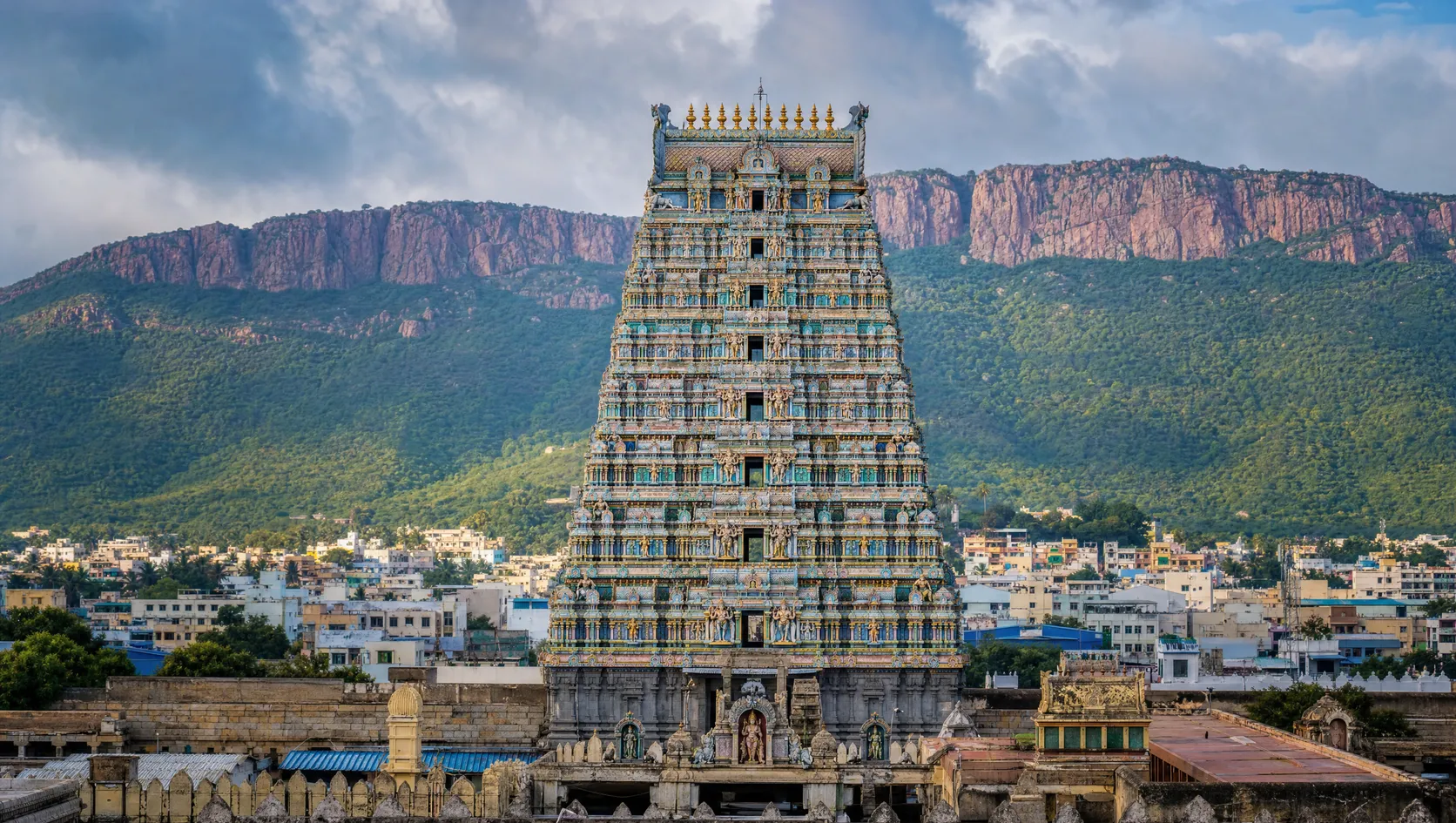
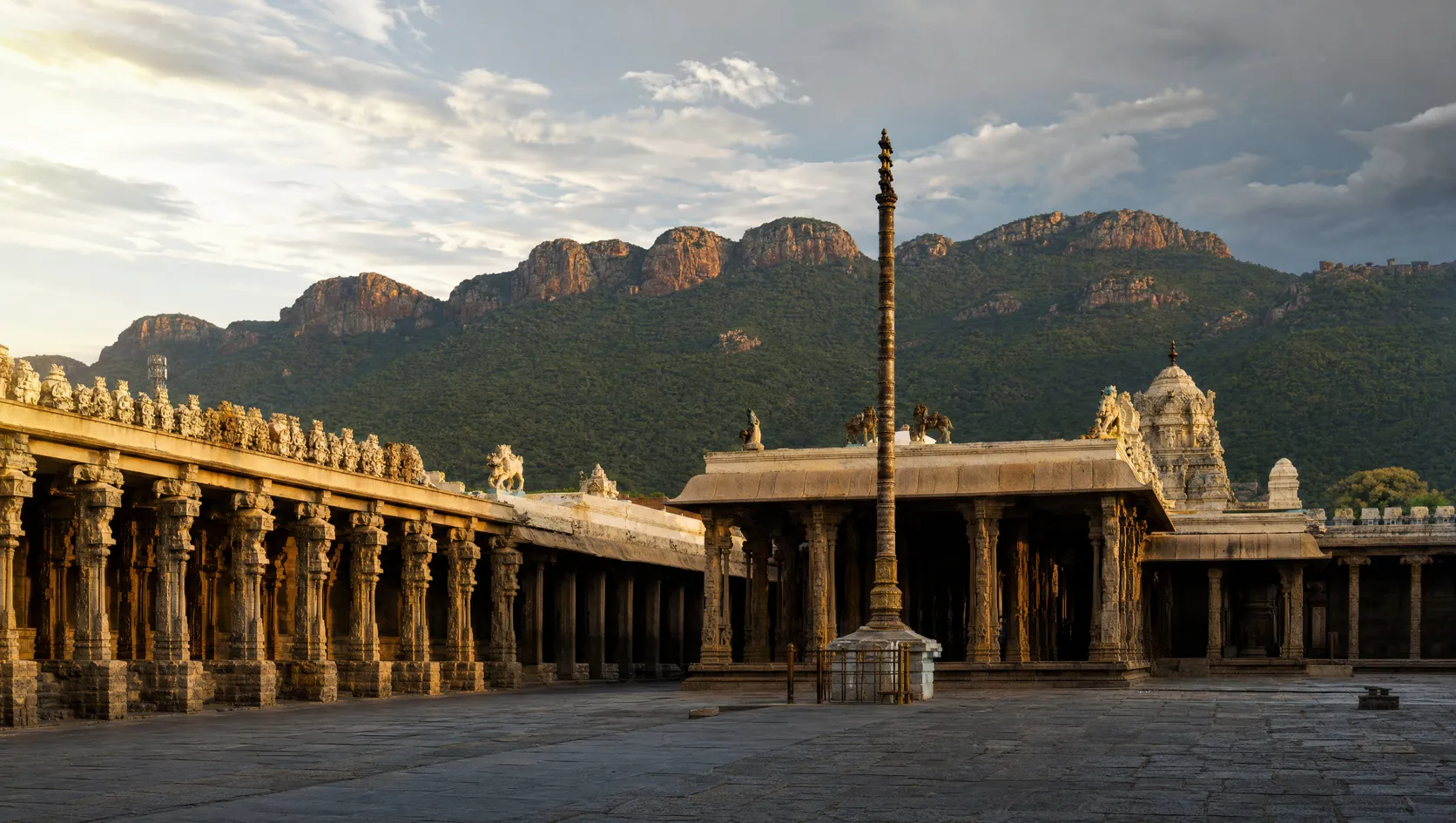
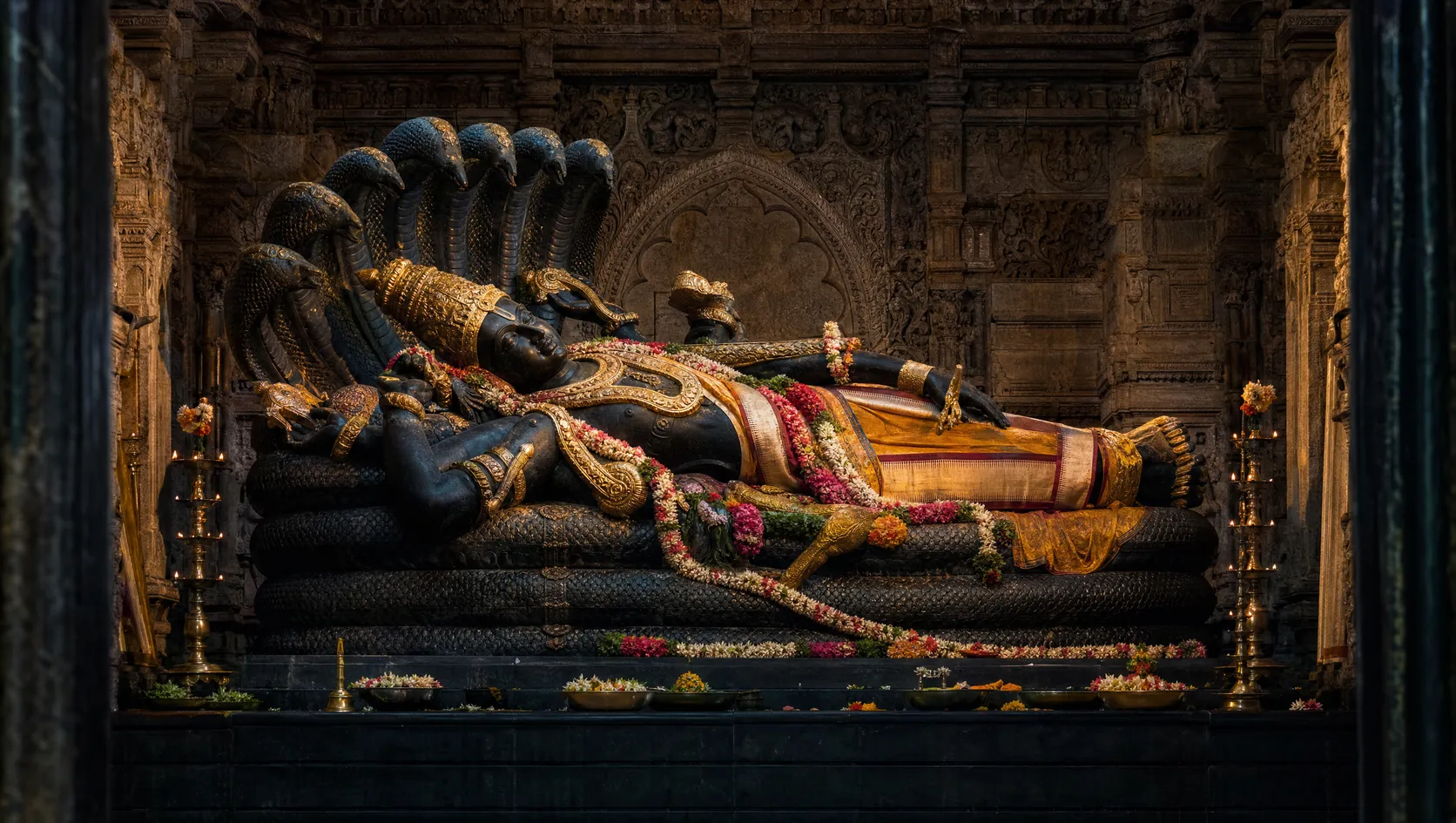
Dravidian, with a very tall gopuram over the entrance, spacious prakara enclosures, pillared mandapas, and the sanctum of the reclining Govindaraja with the shrine of Pundarikavalli Thayar
Open
05:00 – 21:00
Special
The temple, administered by the Tirumala Tirupati Devasthanams, observes a full Srivaishnava round of daily services to Govindaraja, with the recitation of the Nalayira Divya Prabandham. Timings run in sessions through the day with a midday break and vary with the festival calendar; they should be confirmed locally.
The Sacred Legend · पवित्र कथा
At the foot of the seven hills of Tirumala, in the heart of the town of Tirupati, Vishnu lies down. Not seated in state as his brother sits enthroned on the hill above, but reclining full length upon the coils of Adisesha in the posture the tradition calls Bhujanga Sayanam, the serpent-couch, is Govindaraja, and the town that has grown around him is one of the great Divya Desams, the abodes of Vishnu sung by the Alvar poet-saints. The reason he lies down is the most tender story of this whole sacred country. Govindaraja, the tradition holds, is the elder brother of Venkateswara, the Lord of the hill, and it was he who conducted his younger brother's marriage to Padmavati and paid for it. To meet the vast expenses of a divine wedding the elder brother emptied his treasury entirely, gave away all that he had, and having spent everything he stretched himself out to rest, exhausted and at peace, as one who has given his whole wealth for love of his brother and keeps nothing back. So the town-god reclines while the hill-god stands, and to this day, the tradition adds, Govindaraja keeps the accounts of Venkateswara, the elder brother managing the younger's affairs from the plain below. Here Ramanuja himself set the deity in the twelfth century, bringing to Tirupati a form of the reclining Lord and consecrating him at the foot of the hills, so that the great acharya of Srivaishnavism is bound into the very foundation of this temple. Pundarikavalli Thayar, the goddess, is enshrined beside him, and above the whole rises one of the tallest gopurams of the region, marking from far off the main temple of Tirupati town, the reclining brother who watches over the plain while the standing brother watches from the hill.
Sacred Designationपवित्र पदनाम
Sacred Origin Storyपवित्र उत्पत्ति कथा
Source: The Srivaishnava tradition of Tirumala-Tirupati, the sthala tradition of Govindaraja, and the association with Ramanuja
The mythology of Govindaraja is inseparable from the wedding of Venkateswara, the great story of the hill above. In that story Vishnu, having come to dwell on the seven hills as Srinivasa, falls in love with Padmavati, the daughter of the local king, and to marry her he must meet the enormous cost of a divine wedding, for which he borrows a vast treasure from Kubera, the lord of wealth, a loan he is said to be repaying to this day through the offerings of his devotees.
Into this story the tradition of the town temple folds the figure of Govindaraja as the elder brother who made the wedding possible. It is Govindaraja, the elder, who conducts the younger brother's marriage, arranges and finances it, and to meet its expenses empties his own treasury utterly, giving away everything he possesses for the love of his brother. Having spent all his wealth on the wedding, and keeping nothing back for himself, the elder brother lies down to rest, and this is why Govindaraja reclines: he is the one who gave away all he had, stretched out in the peace of one who has held nothing back. The reclining posture, Bhujanga Sayanam upon the serpent Adisesha, is thus read here not only as the cosmic sleep of Vishnu but as the rest of the generous brother after the great gift.
And the tradition adds a further tender detail: that Govindaraja, from his temple in the town below, keeps the accounts of Venkateswara on the hill, the elder brother managing the younger's affairs and treasury, so that even in the reclining Lord's rest there is a watchful care over the great temple above. The two brothers, the standing Lord of the hill and the reclining Lord of the plain, are worshipped together as one story, and pilgrims to Tirumala are told that a visit to Venkateswara is incomplete without the darshan of Govindaraja below.
Sources cited:
- Srivaishnava tradition of Tirumala-Tirupati
- Sthala tradition of the Govindaraja temple
- Nalayira Divya Prabandham and the Alvar tradition
Other Traditions · अन्य परंपराएँ
The tradition of Ramanuja and the establishment of Govindaraja at Tirupati
Scholarly Context
The Govindaraja temple of Tirupati town is best understood as one half of the great twin sacred complex of Tirumala-Tirupati, the standing Venkateswara on the hill and the reclining Govindaraja on the plain, worshipped together within a single tradition. The temple is counted in the Srivaishnava reckoning among the abodes sung by the Alvars, and Thirumangai Alvar in particular is associated with the reclining Lord. Historically the establishment of Govindaraja at Tirupati is bound to Ramanuja and the Srivaishnava consolidation of the twelfth century, and the tradition of the deity's relocation from Chidambaram in a period of sectarian conflict, and its re-consecration at the foot of the hills, is one of the well-remembered episodes of that era. The physical temple was then greatly enriched under the Vijayanagara emperors, whose devotion to Tirumala-Tirupati was famous and whose patronage endowed both the hill and the town shrines; the tall gopuram and the mandapas of the town temple belong to this and to the later chiefly patronage. Scholars treat the Tirumala-Tirupati complex as one of the most important and best-endowed centres of southern Vaishnavism, and the Govindaraja temple as the principal shrine of the town below the hill, its wedding mythology and its reclining deity giving the plain its own devotional focus distinct from, yet inseparably joined to, the celebrated Venkateswara above.
Historyइतिहास
The Govindaraja temple stands in the heart of Tirupati town, at the foot of the Tirumala hills, and is the principal shrine of the town below the celebrated Venkateswara temple on the hill above. Dedicated to Vishnu as Govindaraja, who reclines here full length upon the serpent Adisesha in the posture called Bhujanga Sayanam, it is counted among the Divya Desams sung by the Alvars and is inseparable, in worship and in story, from the great hill temple to which it is joined.
The temple's establishment at Tirupati is bound to Ramanuja, the philosopher of Vishishtadvaita and the organiser of Srivaishnavism, who is remembered as having consecrated the reclining Govindaraja at the foot of the hills in the twelfth century. The tradition holds that the deity had been displaced from Chidambaram in a period of sectarian conflict, and that Ramanuja gathered the form of the reclining Lord and set him anew at Tirupati, binding the town temple into the worship of the hill and giving the plain its own great shrine.
The mythology that shapes the temple is the story of Venkateswara's wedding. Govindaraja is held to be the elder brother of the Lord of the hill, the one who conducted his younger brother's marriage to Padmavati and paid for it, emptying his treasury entirely to meet the cost of a divine wedding. Having given away all his wealth and kept nothing back, the elder brother lies down to rest, and so Govindaraja reclines, the generous brother at peace after the great gift, and keeps, the tradition adds, the accounts of Venkateswara from the town below.
Under the Vijayanagara emperors, whose devotion to Tirumala-Tirupati was celebrated and whose patronage endowed both the hill and the town, the temple was greatly enriched, and to this and to the later chiefly patronage belong the tall gopuram that marks the temple from afar and the pillared mandapas of the complex. Through the centuries the town of Tirupati grew around the shrine, which became its main temple, while the hill above drew the pilgrims of all India to Venkateswara.
In the modern era the temple, like the hill shrine, has come under the administration of the Tirumala Tirupati Devasthanams, and it remains a living centre of Srivaishnava worship. Most pilgrims who climb to Venkateswara also come to the reclining Govindaraja below, for the tradition holds the darshan of the hill incomplete without the darshan of the brother on the plain, and the great festivals of the town temple, above all Vaikuntha Ekadasi and the annual Brahmotsavam, draw immense crowds.
Historical Timelineऐतिहासिक कालक्रम
The reclining Govindaraja is remembered in the Srivaishnava tradition among the abodes of Vishnu sung by the Alvars, the Tamil poet-saints; Thirumangai Alvar in particular is associated with the reclining Lord, giving the deity an attested place in the Divya Desam tradition.
The Alvars' activity is generally placed across the middle centuries of the first millennium; their hymns are the earliest devotional witness to the reclining Govindaraja in the Srivaishnava reckoning.
A form of the reclining Govindaraja is worshipped at Chidambaram, the great temple town of the Tamil country, before the sectarian conflicts of the early medieval period displace the deity.
The tradition of Govindaraja's earlier worship at Chidambaram is the background to the deity's later establishment at Tirupati.
In a period of sharp Shaiva-Vaishnava conflict the reclining Govindaraja is displaced from Chidambaram, an episode the Srivaishnava tradition remembers with grief, setting in motion the deity's move southward and then to Tirupati.
The displacement of the deity from Chidambaram is remembered as one of the traumatic episodes of the sectarian conflicts of the era.
Ramanuja, the philosopher of Vishishtadvaita, consecrates the reclining Govindaraja at Tirupati, at the foot of the Tirumala hills, establishing the town temple and binding it into the worship of the hill above.
Ramanuja's consecration of Govindaraja at Tirupati is remembered as the foundation of the town temple and a landmark of the Srivaishnava consolidation of the twelfth century.
Under Ramanuja's ordering the town temple of Govindaraja and the hill temple of Venkateswara are drawn into a single tradition of worship, and the story of the two brothers, the reclining Lord of the plain and the standing Lord of the hill, takes its enduring shape.
The temple continues under the patronage of the ruling houses of the region, the Telugu Cholas and other chiefs endowing the shrine, as Tirupati grows in importance as a Vaishnava centre at the foot of the hills.
The Vijayanagara emperors, whose devotion to Tirumala-Tirupati was celebrated, richly endow both the hill and the town temples; the Govindaraja shrine is enlarged and enriched under their patronage, sharing in the golden age of the twin complex.
The Vijayanagara emperors, above all Krishnadevaraya, were among the greatest patrons of Tirumala-Tirupati, and their gifts to the complex are recorded in numerous inscriptions.
Under the later chiefs and the Nayaka period the town temple is further built up, and the tall gopuram and pillared mandapas that mark the Govindaraja temple of Tirupati are raised, giving the shrine its commanding presence over the town.
The town of Tirupati grows around the Govindaraja shrine, which becomes its principal temple and the devotional heart of the plain below the hill, while the hill above draws pilgrims from across India to Venkateswara.
The temple and the twin complex of Tirumala-Tirupati are documented in colonial-era surveys and gazetteers of the region, which record the town shrine of Govindaraja and its standing as the main temple of Tirupati below the hill.
The Govindaraja temple, like the hill shrine, comes under the organised administration of the Tirumala Tirupati Devasthanams, which manages the worship, festivals and endowments of the twin complex as one great institution.
The Tirumala Tirupati Devasthanams administers both the hill and the town temples within the modern institutional framework.
The Govindaraja temple remains a living centre of Srivaishnava worship and the main temple of Tirupati town; most pilgrims who visit Venkateswara on the hill also come to the reclining Govindaraja below, and the temple's great festivals, above all Vaikuntha Ekadasi and the annual Brahmotsavam, draw immense crowds.
What You'll Seeदर्शन में
The presiding image of the Govindaraja temple is Vishnu reclining at full length upon the coils of the serpent Adisesha, in the posture the tradition calls Bhujanga Sayanam, the serpent-couch, one of the great forms of the Lord. This is the Moolavar, the immovable image in the innermost sanctum, and unlike the standing Venkateswara of the hill, Govindaraja is worshipped lying down, his form stretched out in rest, the many hoods of Adisesha spread above him.
The reclining posture carries, at Tirupati, a meaning particular to this temple. Where the reclining Vishnu is elsewhere read as the cosmic sleep of yoga-nidra between the ages of the world, here the tradition adds the tender reading of the elder brother at rest, the one who gave away all his wealth for his younger brother's wedding and, having kept nothing back, lies down in the peace of one who has held nothing for himself. The generous exhaustion of the giver and the cosmic sleep of the Lord are held together in the one reclining form.
The name Govindaraja itself belongs to Vishnu as Krishna, Govinda, the cowherd and protector, the king of cows, and the deity of the town temple bears that gracious name of the pastoral Lord. Beside him the goddess Pundarikavalli Thayar is enshrined in her own precinct, the consort of the reclining Govindaraja, and the temple holds also the shrines proper to a great Vaishnava complex, the Alvars and the acharyas among them, with Ramanuja, who established the deity here, given his honoured place. Over the whole rises the tall gopuram of the town temple, marking from far across Tirupati the shrine of the brother who reclines on the plain below the hill.
Distinctive Practicesविशिष्ट परंपराएँ
Darshan of the Two Brothers
दो भाइयों का दर्शन
Year-round, joined to the pilgrimage to Tirumala
The tradition holds that a pilgrimage to Venkateswara on the hill is incomplete without the darshan of Govindaraja in the town below, and so most pilgrims who climb to the hill also come to the reclining Lord of the plain. The two brothers, the standing Lord above and the reclining Lord below, are worshipped as one story, and the visit to the town temple completes the journey to the hill.
To worship both brothers is to complete a single act of devotion, for the tradition binds the hill and the plain into one story of love: the elder who gave everything for the younger's wedding, and the younger who reigns on the hill through that gift. The pilgrim who bows before Venkateswara and then before the reclining Govindaraja honours the whole of that story, the standing Lord who received and the reclining Lord who gave, and finds in the two forms one grace, one family of the divine made present above the town and within it.
Recitation of the Nalayira Divya Prabandham
नालायिर दिव्य प्रबंधम् का पाठ
Daily in worship, and centrally in the Adhyayana Utsavam
As a Divya Desam and a Srivaishnava temple established by Ramanuja, the Govindaraja shrine gives the Tamil hymns of the Alvars, the Nalayira Divya Prabandham, a central place in its worship, recited beside the Sanskrit Veda before the reclining Lord, and presented in full during the Adhyayana Utsavam, the festival of the hymns.
That the Tamil hymns are sung beside the Sanskrit Veda is the defining mark of Srivaishnavism, the tradition Ramanuja organised and set into this very temple. The Prabandham is honoured as the Dravida Veda, the Veda in Tamil, and the Alvars as seers on a level with the ancient rishis. To recite their hymns before Govindaraja is to worship the reclining Lord in the language of devotion, and to keep the temple, from its foundation by Ramanuja, within the living stream of the acharya's tradition.
Vaikuntha Ekadasi and the Gate of Heaven
वैकुण्ठ एकादशी और स्वर्ग का द्वार
Vaikuntha Ekadasi, in Margazhi (Dec-Jan)
On Vaikuntha Ekadasi, one of the great festivals of the temple, the gate of the highest heaven, the Vaikuntha Dwaram, is opened, and vast crowds pass through it before the reclining Govindaraja in the belief that the Lord grants a vision of Vaikuntha to those who do so. It is among the most thronged days of the town temple's year.
The opening of the gate of heaven makes a doctrine walkable. To pass through the Vaikuntha Dwaram before the reclining Lord is to enact bodily the passage into the highest heaven that the tradition promises to the devotee of Vishnu. That this is done before Govindaraja, the brother who gave away all his wealth, joins the promise of heaven to the temple's own story of a love that keeps nothing back, so that the surrender the pilgrim makes is met by the generosity the reclining Lord embodies.
The Reclining Darshan of Govindaraja
गोविंदराज का शयन-दर्शन
Year-round, at the sanctum of the reclining Lord
The central darshan of the temple is of the reclining Govindaraja in Bhujanga Sayanam, seen lying full length upon Adisesha, a form distinct from the standing Venkateswara of the hill. Devotees come to behold the Lord at rest, and the tradition teaches them to see in the posture both the cosmic sleep of Vishnu and the peace of the brother who gave everything.
To stand before a reclining god is to be met by a different grace than that of the standing or seated Lord. The reclining form speaks of rest, of a love that has spent itself and lies at peace, and at Tirupati the tradition reads that rest as the generosity of the elder brother, so that the darshan of the sleeping Govindaraja teaches the devotee that the Lord's giving is total, that he holds nothing back, and that his rest is the fullness of one who has poured out all he had for love.
Did You Know?क्या आप जानते हैं?
Govindaraja is counted among the 108 Divya Desams and is the great temple of Tirupati town, at the foot of the Tirumala hills, distinct from the Venkateswara temple on the hill above.
Srivaishnava tradition of Tirumala-Tirupati
The tradition holds Govindaraja to be the elder brother of Venkateswara, the one who conducted his younger brother's wedding to Padmavati and paid for it, emptying his treasury entirely.
Sthala tradition of Govindaraja
Govindaraja reclines because, having given away all his wealth for the wedding and kept nothing back, the elder brother lies down to rest, at peace as one who has held nothing for himself.
Sthala tradition of Govindaraja
The reclining Govindaraja was established at Tirupati by Ramanuja in the twelfth century, the tradition holding that the deity was brought here after being displaced from Chidambaram in a period of sectarian conflict.
Srivaishnava acharya tradition
The town temple is marked from afar by one of the tallest gopurams of the region, rising over the shrine as the main temple of Tirupati below the hill.
Temple surveys
The tradition adds that Govindaraja, from the town below, keeps the accounts of Venkateswara on the hill, the elder brother managing the younger's affairs and treasury even in his rest.
Sthala tradition of Govindaraja
The name Govindaraja belongs to Vishnu as Krishna, Govinda, the cowherd and king of cows, so the reclining Lord of the town bears the gracious name of the pastoral God.
Vaishnava tradition
The goddess of the temple is Pundarikavalli Thayar, the consort of the reclining Govindaraja, enshrined in her own precinct within the complex.
Temple tradition
Most pilgrims who climb to Venkateswara on the hill also visit the reclining Govindaraja below, for the tradition holds the pilgrimage to the hill incomplete without the darshan of the brother on the plain.
Srivaishnava tradition of Tirumala-Tirupati
Visitor Accessप्रवेश जानकारी
The temple is open to devotees, and the inner sanctum of the reclining Govindaraja is reached through the enclosures of the complex. As at many major Vaishnava temples, entry to the innermost precinct is intended for Hindus, and this is signposted at the temple. The shrine sits in the heart of Tirupati town and is very busy, above all because most pilgrims to Venkateswara on the hill also come here; expect queues, and dense crowds on festival days, especially at Vaikuntha Ekadasi and the annual Brahmotsavam. A dress code of traditional attire applies, and footwear is left outside the temple. Timings run in sessions through the day with a midday closure, and vary with the festival calendar. The temple is administered by the Tirumala Tirupati Devasthanams, and darshan and seva arrangements are managed as part of the twin complex. Confirm current timings and any restrictions locally before visiting.
Spiritual Basis
The passage inward through the enclosures to the reclining Lord is itself a spiritual form, an approach from the busy town to the still centre where Govindaraja sleeps. The restriction of the innermost precinct to Hindus follows the practice of the major Vaishnava temples, which preserve the ritual purity of the sanctum according to their tradition. The god's accessibility is held to be real for all his devotees within these forms: Govindaraja is the generous brother who gave away everything, the Lord who holds nothing back from those who come to him, and the ordering of the enclosures and the queues shapes that approach rather than denying it. The whole intent of the temple is that the devotee reach the reclining Lord and stand before the one who gave all for love.
Contemporary Context
The Govindaraja temple is one of the busiest shrines of Tirupati, drawing pilgrims year-round, above all because it is joined to the immense pilgrimage to Venkateswara on the hill; the great majority of those who visit Tirumala also come to the reclining Lord below. The town of Tirupati has grown around the shrine, so that the sacred and the everyday are woven together through the streets. The temple is administered by the Tirumala Tirupati Devasthanams, with organised queues, darshan and seva arrangements, and festival management for the great occasions. Vaikuntha Ekadasi and the annual Brahmotsavam in particular draw very large crowds, and visitors on those days should expect long waits; a visit on an ordinary day allows a far more unhurried darshan of the reclining Govindaraja and the shrine of Pundarikavalli Thayar.
Practical Guidance
Allow time to move through the enclosures and see the principal shrines: the sanctum of the reclining Govindaraja, the shrine of Pundarikavalli Thayar, and the shrines of the Alvars and acharyas within the complex. The temple is easily reached in the heart of Tirupati town, a short distance from the railway station, and is naturally combined with the pilgrimage to Venkateswara on the hill. Dress traditionally and leave footwear outside. Expect the temple to be busy, since most Tirumala pilgrims also visit; a visit early in the day or outside the great festivals allows a calmer darshan. On Vaikuntha Ekadasi and during the Brahmotsavam the crowds are immense, and those days should be chosen only if the festival itself is the aim. Confirm timings and darshan arrangements through the Tirumala Tirupati Devasthanams.
Festivalsत्योहार
Vaikuntha Ekadasi
वैकुण्ठ एकादशी
Dec-Jan (Margazhi)
A great festival of the temple, when the gate of the highest heaven, the Vaikuntha Dwaram, is opened and vast crowds pass through it before the reclining Govindaraja, seeking a vision of Vaikuntha. It is among the most thronged and sacred days of the town temple's year.
Brahmotsavam
ब्रह्मोत्सवम्
Annual, on the temple's festival calendar
The great annual festival of the temple, over which the processional Govindaraja is taken in procession on the many vahanas around the enclosures and the streets of Tirupati, the fullest celebration of the reclining Lord's public presence in the town, drawing immense crowds.
Adhyayana Utsavam
अध्ययन उत्सवम्
Dec-Jan (Margazhi), around Vaikuntha Ekadasi
The festival of the recitation of the Nalayira Divya Prabandham, when the Tamil hymns of the Alvars are chanted and presented in full before the reclining Govindaraja over its days, a central observance of the Srivaishnava year at a temple established by Ramanuja.
Ramanuja Jayanti
रामानुज जयंती
Apr-May (Chithirai)
The appearance day of Ramanuja, the founder-teacher of the Srivaishnava tradition and the acharya who established the reclining Govindaraja at Tirupati, observed with particular reverence at the temple that owes its foundation to him.
Traditional Offeringsपारंपरिक अर्पण
Primary Offerings
Tulasi (holy basil)
तुलसी
तुलसी
Tulasi, the holy basil beloved of Vishnu, is the offering most proper to Govindaraja as to any form of Vishnu, laid at his feet and woven into his garlands. No worship of Vishnu is complete without it, and at the Govindaraja temple it is offered to the reclining Lord in his rest.
Sacred food (prasadam)
प्रसाद
प्रसादम्
The food offered to Govindaraja and shared with devotees as prasadam carries the grace of the reclining Lord made tangible. Administered as part of the Tirumala Tirupati Devasthanams, the temple distributes prasadam to its pilgrims, and to receive it is to carry away a portion of the Lord's blessing.
Garlands of flowers
पुष्प-मालाएँ
पुष्पमाला
Garlands of flowers, with tulasi, are offered to Govindaraja and to the goddess Pundarikavalli Thayar, and garlands that have adorned the deity are returned to devotees as a blessing carrying the touch of the Lord.
Recitation of the Prabandham and the Sahasranama
प्रबंधम् और सहस्रनाम का पाठ
Beyond material offerings, the recitation of the Alvars' Tamil hymns, the Nalayira Divya Prabandham, and of the Vishnu Sahasranama, the thousand names of Vishnu, is held a high offering to Govindaraja, the reclining Lord worshipped as much in sung word as in flower and food. At a temple established by Ramanuja the offering of hymn is central to the daily worship.
Chanting of the name Govinda
गोविंद नाम का जप
गोविन्द
The calling of the name Govinda, the gracious name of Vishnu as Krishna the cowherd, is a beloved offering at Tirupati, where the cry of the name rises constantly from the pilgrims of the town and the hill. To chant Govinda before the reclining Govindaraja is to offer the Lord his own name in love, the simplest and most constant of the offerings of the twin complex.
Unique to This Temple
The Offering to the Brother Who Gave Everything
उस भाई को भेंट जिसने सब कुछ दिया
What is particular to the Govindaraja temple is that its Lord is worshipped as the elder brother who gave away all his wealth for his younger brother's wedding and kept nothing back. The offering the tradition holds highest here is fitted to that story: the devotee who has come to the reclining Lord is taught to give himself in the same spirit of holding nothing back, in loving surrender, prapatti, to the god who reclines because he gave all. A pilgrim brings tulasi, flowers, prasadam and the chanting of Govinda as at any shrine of Vishnu, but the offering this temple sets highest is the turning of the heart to the generous Lord, the trust that as Govindaraja withheld nothing for love of his brother, so he withholds nothing from the devotee who casts himself upon his grace. The offering and the blessing meet in that surrender: the devotee gives himself, and the reclining Lord, who has already given everything, receives him.
Offerings at the Govindaraja temple follow the Srivaishnava tradition, with tulasi, flowers, garlands and prasadam central, the recitation of the Prabandham and the Vishnu Sahasranama held as offerings of word, and the chanting of the name Govinda beloved throughout the twin complex of Tirumala-Tirupati. Eternal Raga presents these practices as a devotional tradition; specific seva and offering arrangements should be confirmed with the temple and the Tirumala Tirupati Devasthanams.
How to Reachकैसे पहुँचें
The Govindaraja temple stands in the heart of Tirupati town, at the foot of the Tirumala hills in the Chittoor district of Andhra Pradesh, and is very easily reached.
By air: Tirupati Airport at Renigunta is about 15 km away, connected to Chennai, Hyderabad, Bengaluru and other cities.
By rail: Tirupati railway station, a major railhead well connected across the south, is a short distance from the temple in the town, and the shrine is among the first sights of many pilgrims arriving by train.
By road: Tirupati is well served by road, with frequent buses, autos and taxis, and is connected to Chennai, Bengaluru, Hyderabad and the towns of the region; the temple is at the centre of the town and easily found beneath its tall gopuram.
Most visitors combine the Govindaraja temple with the pilgrimage to Venkateswara on the Tirumala hill above, reached by road or by the footpath up the hill, and many also visit the temple of Padmavati at Tiruchanoor nearby; the tradition holds the pilgrimage to the hill incomplete without the darshan of the reclining Govindaraja in the town below.
Plan Your Visitयात्रा की योजना
🌤 Best Season
September to March is the most comfortable time to visit, with milder weather at the foot of the hills. The Margazhi month (December-January) brings the temple's greatest observances, Vaikuntha Ekadasi and the Adhyayana Utsavam, a spiritually rich but very crowded season. April to June is hot in the region, though festivals fall in this period too and draw pilgrims. The temple, in the heart of the busy town of Tirupati, is thronged year-round because most Tirumala pilgrims also visit it. Early morning and evening sessions are the most atmospheric, when the temple is active with worship. On ordinary days a visit is unhurried; on the great festival days, and whenever the hill pilgrimage swells, it becomes an immense gathering.
👘 Dress Code
Traditional and modest dress is required. Men commonly wear a dhoti or trousers with a shirt; women a saree or salwar kameez. Footwear is left outside the temple. As a major Vaishnava temple administered by the Tirumala Tirupati Devasthanams, the Govindaraja shrine expects respectful traditional attire throughout the enclosures.
📱 Phones & Photography
Photography is restricted, and generally not permitted within the inner enclosures and the sanctum; cameras and phones may need to be deposited or kept away in the innermost areas. Follow the posted rules and the directions of temple staff, and keep phones silenced within the shrines.
🏨 Accommodation
Tirupati is a major pilgrimage town with a full range of accommodation, from the guest houses and lodges maintained by the Tirumala Tirupati Devasthanams to hotels of all standards across the town, and the Govindaraja temple sits in the heart of it, easily reached from most lodgings. Demand rises sharply around Vaikuntha Ekadasi, the Brahmotsavam and other great festivals, and whenever the hill pilgrimage swells, when booking well ahead is advisable. Outside the great occasions the town, geared to constant pilgrimage, absorbs its visitors readily.
Sacred Soundsपवित्र ध्वनि
Did You Know? · क्या आप जानते हैं?
The same translation error that turned '33 Koti' into '33 crore' in Hinduism also happened in Buddhism. The Chinese translation of Buddhist texts rendered 'Sapta Koti Buddha' (7 Supreme Buddhas) as '7 Crore Buddhas.' The Tibetan translation got it right: 7 types, not 7 crore. One Sanskrit word, misread across two major world religions, generated two identical misconceptions independently.
Related Contentसंबंधित सामग्री
Related Scriptures
Community Reflections
🕉️
Be the first to share your reflection.