Oppiliappan Koil
ओप्पिलिअप्पन कोविल
One of the 108 Divya Desams, where Vishnu stands as Oppiliappan and accepts all his food without salt
Thirunageshwaram, Tamil Nadu, India
Śrī Oppiliappan (Uppiliappan) KōvilAlso known as: Uppiliappan Koil, Thiruvinnagar, Oppiliappan Venkatachalapathy Temple
Era
An ancient temple sung by the Alvars in the first millennium, endowed and expanded under the Cholas and later dynasties of the Kaveri delta
Architecture
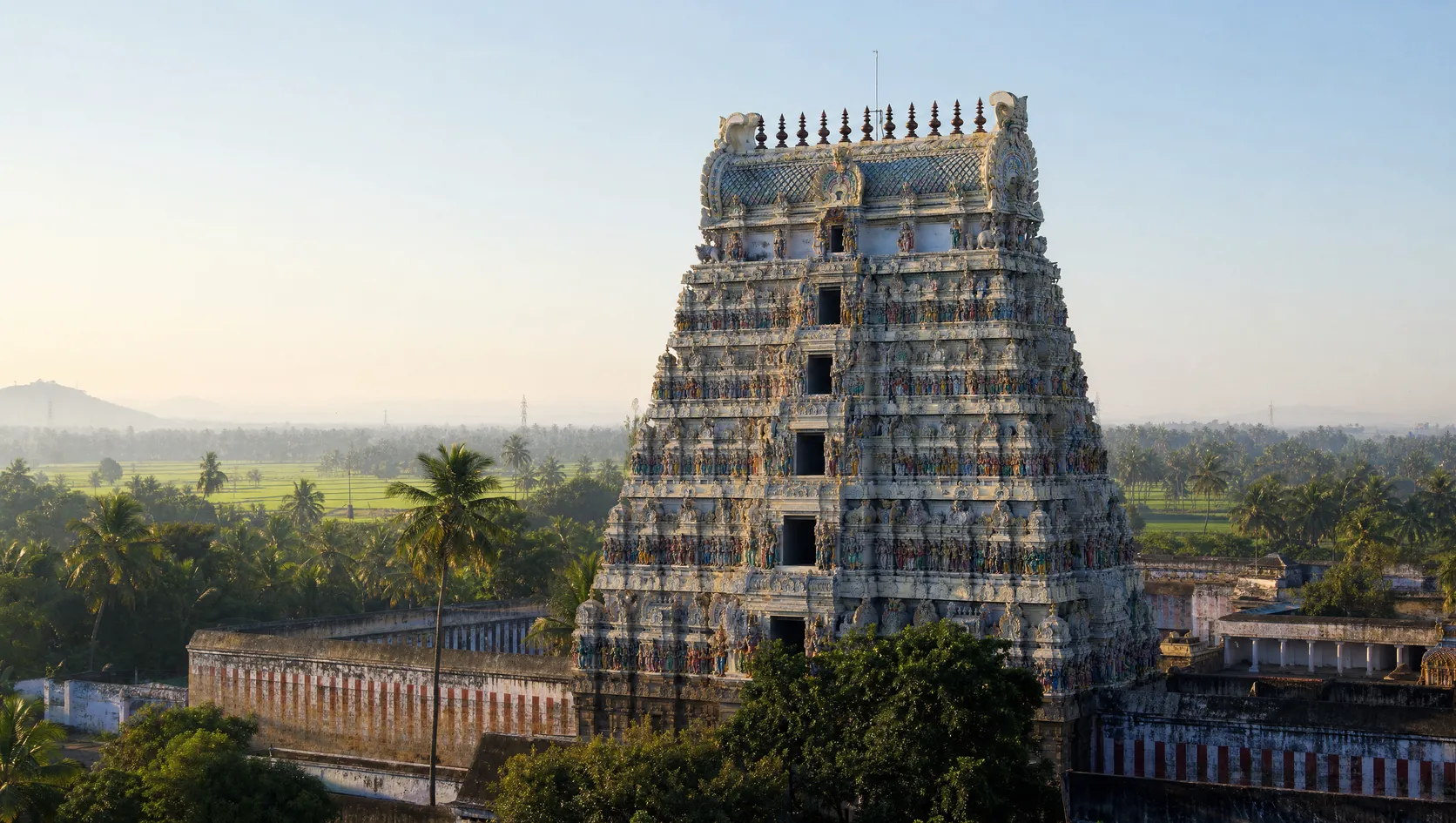
Dravidian, with a gopuram over the entrance, pillared halls and the Suddhananda Vimana rising over the sanctum of the standing Lord
Open
06:00 – 21:00
Special
The temple observes the Srivaishnava round of daily worship to Oppiliappan and Bhumi Devi, with the recitation of the Nalayira Divya Prabandham, and the naivedyam prepared always without salt. Timings run in sessions through the day with a midday break and vary with the festival calendar; they should be confirmed locally.
The Sacred Legend · पवित्र कथा
Among the hundred and eight Divya Desams, the abodes of Vishnu sung by the Alvar poet-saints, one keeps a vow found nowhere else: at Thiruvinnagar, near Kumbakonam in the Kaveri delta, the standing Lord Oppiliappan accepts every offering of food prepared without a single grain of salt. His very name says it, for Uppiliappan means the Lord of the food without salt, and the naivedyam cooked for him and the prasadam shared from his kitchen carry no salt to this day. The reason is a love story. The goddess Bhumi Devi was born on earth as the little daughter of the sage Markandeya, and the Lord, wishing to marry her, came as an old brahmin to ask for her hand. The sage said the girl was too young even to cook, that she did not yet know how to salt the food, and the old man answered that this was no barrier: he would accept from her food without salt, and gladly. So he married her, and bound himself by that promise for all time, so that at Thiruvinnagar Vishnu is worshipped as the Lord who receives the saltless offering. The tradition calls him the Venkateswara of the south, the Srinivasa of the delta, and holds that to worship Oppiliappan here is to worship the Lord of the seven hills near at hand. He stands with the goddess Bhumi Devi, sung by Nammalvar and Thirumangai Alvar, and around his single unbending vow the whole devotion of Thiruvinnagar is gathered: a God who will take the plainest food from the hand that loves him, and asks nothing added to it.
Sacred Designationपवित्र पदनाम
Sacred Origin Storyपवित्र उत्पत्ति कथा
Source: The Srivaishnava tradition and the Sthala Purana of Thiruvinnagar, on the marriage of the Lord to Bhumi Devi and the vow of the saltless offering
The tradition holds that the sage Markandeya, the deathless boy-sage of the Puranas, longed above all to have Vishnu himself as his son-in-law, and did a great penance to that end. The Lord, pleased with him, granted that the goddess Bhumi Devi, the Earth herself, would be born as Markandeya's daughter, and that he, Vishnu, would come in time to marry her. So the goddess appeared beneath a tulasi plant as a little girl, and Markandeya raised her as his own child, calling her Bhoomi, and waited for the Lord.
When the girl was still very young, an aged brahmin came to the hermitage and asked Markandeya for his daughter's hand. The sage was troubled: the child was too young, he said, she knew nothing yet of running a house, she did not even know how to cook, how to judge the salt in the food. The old brahmin, who was Vishnu come in that form, answered that none of this was any barrier to him. He would take her as she was, and he would accept from her hand food cooked without salt, and be content; let the sage give her, and never trouble over the salt again.
Markandeya understood then who the old man was, and gave his daughter to the Lord. Vishnu married Bhumi Devi at Thiruvinnagar, and kept his word for all time: here the food offered to him is cooked without a grain of salt, and the prasadam given from his kitchen carries none, and by this saltless offering he is known and named, Uppiliappan, Oppiliappan, the Lord of the food without salt. The vow made to a young bride became the standing law of his worship, so that the God of Thiruvinnagar is remembered above all as the one who asked for nothing to be added, and took the plain food of love as it was given.
Sources cited:
- Sthala Purana of Thiruvinnagar (Oppiliappan Koil)
- Srivaishnava tradition and the Nalayira Divya Prabandham
- Puranic tradition of the sage Markandeya
Other Traditions · अन्य परंपराएँ
The Srivaishnava tradition on Thiruvinnagar as the Venkateswara of the south
Scholarly Context
Thiruvinnagar is well attested among the Divya Desams, the hundred and eight abodes of Vishnu sung by the Alvars, and its antiquity rests on the hymns of Nammalvar and Thirumangai Alvar, whose activity is placed across the middle centuries of the first millennium. Their Tamil verses are the earliest firm evidence of the temple's importance, and give the standing Lord of Thiruvinnagar an attested sanctity long before the surviving stone. The temple lies in the dense sacred landscape of the Kaveri delta near Kumbakonam, a region thick with Divya Desams and other great shrines, and was endowed and expanded under the Cholas, whose delta heartland this was, and under the later dynasties that ruled the Tamil country. Scholars note the temple's distinctive saltless offering as a rare and closely kept ritual peculiarity, held unbroken as the defining mark of the shrine, and tied in tradition to the marriage legend of the Lord and Bhumi Devi. The identification of Oppiliappan with Venkateswara of Tirumala places Thiruvinnagar within the wider devotion to Srinivasa, and the shrine is treated as a southern seat of that worship. As with the other Divya Desams, the living tradition of the Prabandham recitation, kept beside the Sanskrit Veda, binds the temple to the Srivaishnava world whose hymns first made it known.
Historyइतिहास
Thiruvinnagar, the temple of Oppiliappan, is one of the 108 Divya Desams, the abodes of Vishnu sung by the Alvar poet-saints, and stands in the Kaveri delta near Thirunageswaram, a short distance from Kumbakonam. Its importance is attested from deep antiquity by the Tamil hymns of Nammalvar and Thirumangai Alvar, who sang the standing Lord of Thiruvinnagar in the Nalayira Divya Prabandham, and it is by their verses that the temple is counted among the Divya Desams.
The Lord here is Oppiliappan, worshipped also as Uppiliappan, the Lord of the food without salt, for by an unbroken vow the naivedyam offered to him and the prasadam shared from his kitchen are prepared entirely without salt. The tradition ties this to the marriage of the Lord to Bhumi Devi, the Earth-goddess born on earth as the young daughter of the sage Markandeya, whom Vishnu came to wed as an aged brahmin, promising to accept her food without salt when she was still too young to season it. The shrine keeps that promise to this day, and it is the defining mark of the temple.
The temple lies in the Chola heartland of the Kaveri delta, in a landscape dense with Divya Desams and great shrines, and was endowed and expanded under the Cholas and the dynasties that followed them, wall and hall and gopuram added over the centuries around the sanctum of the standing Lord, over which rises the Suddhananda Vimana. The Lord is worshipped with the goddess Bhumi Devi, who has her own shrine within the complex, and the temple keeps the Srivaishnava round of worship with the recitation of the Prabandham beside the Sanskrit Veda.
Oppiliappan is held to be the Venkateswara of the south, the Srinivasa of the delta, and the tradition holds that the Lord of the seven hills at Tirumala is present here near at hand, so that the devotee who cannot travel to Tirupati may worship him in the Kaveri plain. Through the centuries the temple has kept its worship and its saltless offering unbroken, and it remains a living Divya Desam, drawing pilgrims year-round and great crowds at Vaikuntha Ekadasi, at the annual Brahmotsavam, and on the Sravana days sacred to the Lord.
Historical Timelineऐतिहासिक कालक्रम
Nammalvar sings the standing Lord of Thiruvinnagar in his Thiruvaymozhi, and Thirumangai Alvar also sings the shrine, giving Thiruvinnagar its attested place among the 108 Divya Desams from deep antiquity.
The Alvars' activity is generally placed across the middle centuries of the first millennium; their hymns are the earliest firm evidence of Thiruvinnagar's sanctity as a Divya Desam.
The temple's Sthala Purana records the marriage of the Lord to Bhumi Devi, born as the young daughter of the sage Markandeya, and the Lord's vow to accept her food without salt, fixing the saltless offering as the defining rite of the shrine.
The saltless offering is among the most closely kept ritual peculiarities of any Divya Desam, tied in tradition directly to the marriage legend.
Standing in the Chola heartland of the Kaveri delta, the temple is endowed and expanded under the Cholas, whose patronage of the delta shrines shapes the region's dense sacred landscape, with halls and enclosures added around the sanctum.
The Kaveri delta around Kumbakonam is among the most temple-rich regions of the south, and its shrines are heavily endowed through the Chola centuries.
With the flourishing of Srivaishnavism the temple keeps the recitation of the Nalayira Divya Prabandham beside the Sanskrit Veda, and the acharya tradition secures its worship among the Divya Desams of the delta.
The temple is further endowed and maintained under the dynasties that ruled the Tamil country after the Cholas, the worship of Oppiliappan and Bhumi Devi and the saltless offering kept unbroken through the changes of rule.
Oppiliappan comes to be widely worshipped as the Venkateswara of the south, the Srinivasa of the delta, and Thiruvinnagar is honoured as a place where devotees who cannot make the pilgrimage to Tirumala may worship the Lord of the seven hills.
The identification with Venkateswara places Thiruvinnagar within the wider devotion to Srinivasa of Tirumala.
The temple establishes its round of great festivals, with Vaikuntha Ekadasi in Margazhi, the annual Brahmotsavam, the monthly Sravana (Thiruvonam) observances sacred to the Lord, and the Adhyayana Utsavam of the Prabandham recitation.
Sravana (Thiruvonam) is the birth-star of Vishnu and especially of Venkateswara, and is observed with particular care at a shrine held to be his southern seat.
The temple and its distinctive saltless offering are noted in colonial-era surveys and gazetteers of the Tanjore country, which record Thiruvinnagar among the Vaishnava shrines of the Kaveri delta near Kumbakonam.
The temple is administered under the Tamil Nadu Hindu Religious and Charitable Endowments framework, which maintains its worship, its festivals and its kitchen, keeping the saltless naivedyam and the daily services to Oppiliappan and Bhumi Devi.
Thiruvinnagar remains a living Divya Desam, drawing pilgrims year-round to worship Oppiliappan, the Venkateswara of the south, and to receive the saltless prasadam, with great crowds at Vaikuntha Ekadasi, the Brahmotsavam and the Sravana days.
What You'll Seeदर्शन में
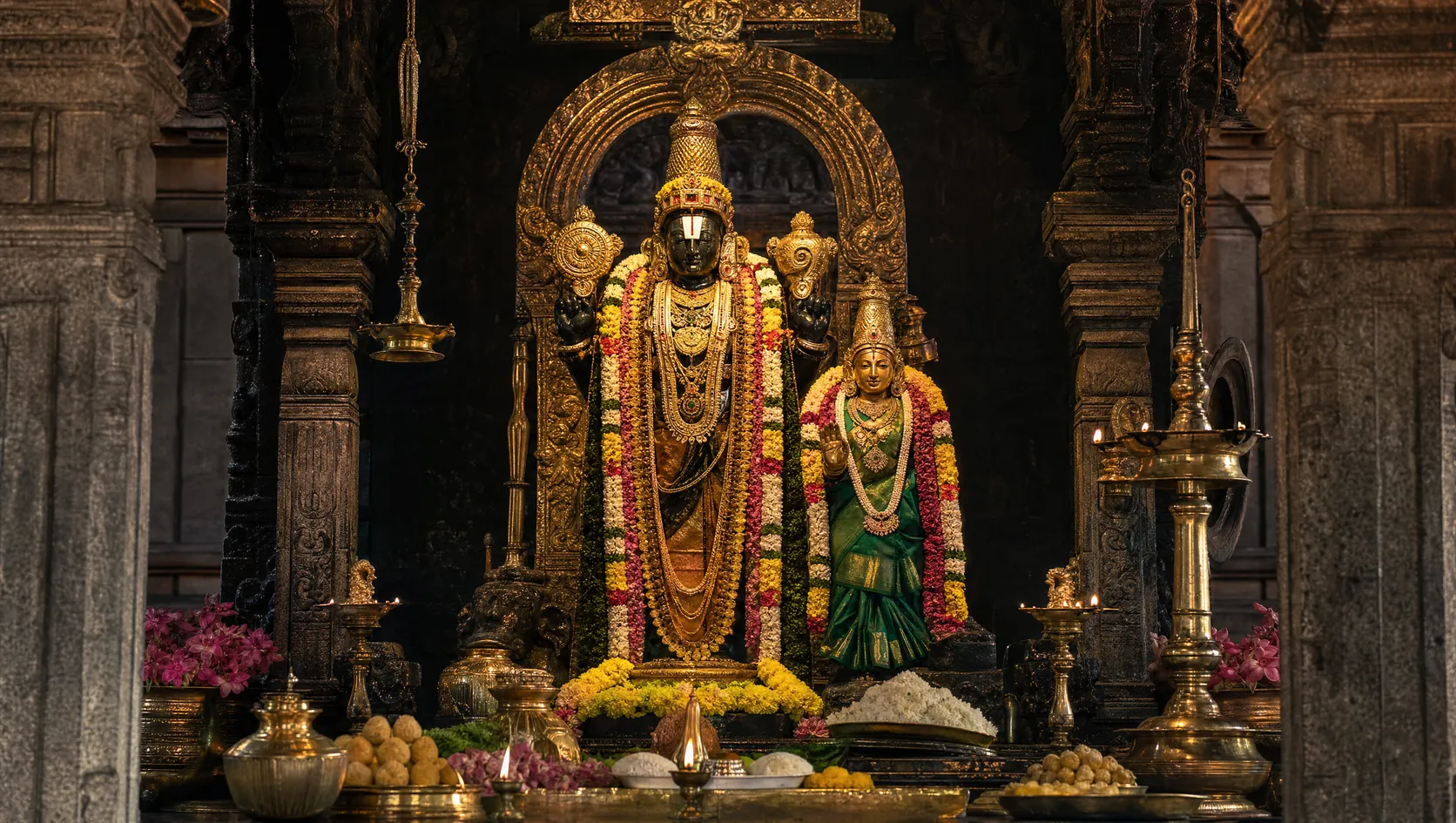
The presiding image of Thiruvinnagar is Oppiliappan, Vishnu standing in the sanctum, worshipped also as Venkatachalapathy and Srinivasa, the Venkateswara of the south. He stands upright, bearing the discus and the conch, the standing form of the Lord who receives his devotees, and over the sanctum rises the Suddhananda Vimana. Unlike the reclining Ranganatha of Srirangam or the seated forms of other shrines, the Lord here is the standing God, present and upright before those who come, in keeping with his identification with the standing Venkateswara of the seven hills.
Beside him is the goddess Bhumi Devi, Boomadevi Thayar, the Earth-goddess whom he married at Thiruvinnagar, born on earth as the young daughter of the sage Markandeya. She has her own shrine within the complex, and the marriage of the Lord and the Earth is the story the whole temple exists to remember, the saltless offering its standing sign. The presence of Bhumi Devi, the Earth herself, as the bride, gives the shrine its particular tenderness: the God who took the plain food of a young girl too small to salt it is worshipped with her at his side.
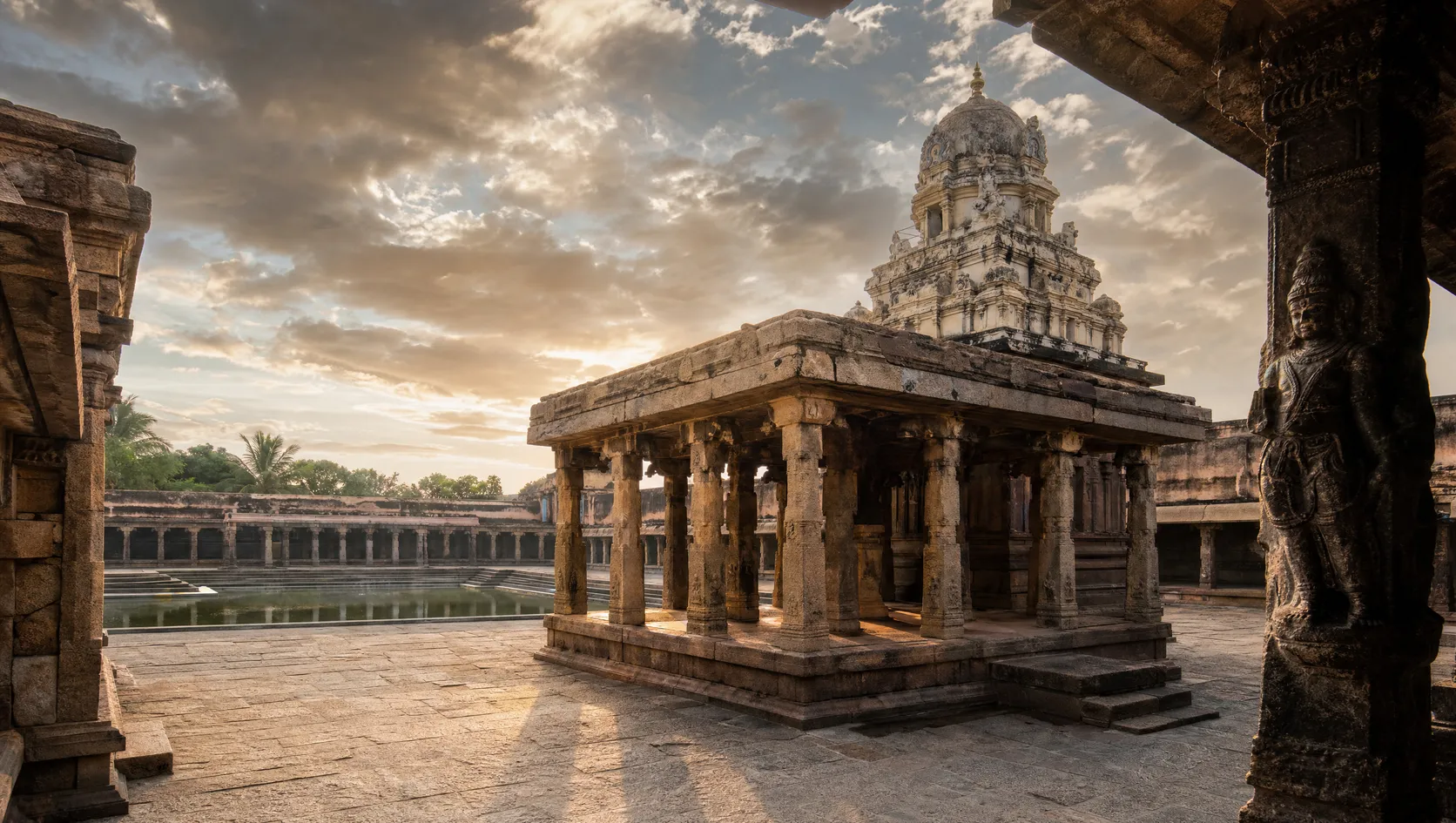
Within the temple are the shrines proper to a Divya Desam, to the Alvars and the acharyas whose hymns and teaching bound the place to the Srivaishnava tradition, and the tank called Ahoraatra Pushkarani, the tank of day and night. But the iconographic heart of Thiruvinnagar is the standing Lord and the Earth-goddess beside him, and the offering cooked without salt that carries their story into every day of worship, so that the image and the rite together tell the one thing the shrine is known for: the Lord who asked for nothing to be added.
Distinctive Practicesविशिष्ट परंपराएँ
The Saltless Naivedyam and Prasadam
बिना-नमक नैवेद्य और प्रसाद
Every day, in all the food offered to the Lord
At Thiruvinnagar, alone among the Divya Desams, all the food cooked for the Lord and offered to him as naivedyam is prepared entirely without salt, and the prasadam given to devotees from his kitchen carries no salt. From the daily offerings to the great festival feasts, the rule holds without exception, and it is by this saltless food that the Lord is named Uppiliappan, the Lord of the food without salt.
The saltless offering makes a vow edible. The tradition holds that the Lord promised his young bride Bhumi Devi, too small to know how to salt the food, that he would accept her cooking without salt, and the temple keeps that promise in its kitchen every day. To eat the saltless prasadam is to share in the tenderness of that story, the God who took the plain food of one who loved him and asked for nothing added; the rite is not an austerity but a faithfulness, the standing sign of a promise kept for all time.
Recitation of the Nalayira Divya Prabandham
नालायिर दिव्य प्रबंधम् का पाठ
Daily in worship, and centrally in the Adhyayana Utsavam
The Tamil hymns of the Alvars, the Nalayira Divya Prabandham, are recited in the temple's worship beside the Sanskrit Veda, and the verses of Nammalvar and Thirumangai Alvar that sing Thiruvinnagar are held especially dear here. In the Adhyayana Utsavam the whole Prabandham is chanted in the presence of the Lord over its days.
That the Tamil hymns are given standing beside the Sanskrit Veda is the defining claim of Srivaishnavism: the Prabandham is the Dravida Veda, the Veda in Tamil, and the Alvars are seers on a level with the ancient rishis. At Thiruvinnagar the hymns of Nammalvar and Thirumangai Alvar are the very verses by which the shrine is a Divya Desam, so that to sing them before the standing Lord is to give back to him the words that first made his abode known and loved.
Worship of Oppiliappan as the Venkateswara of the South
दक्षिण के वेंकटेश्वर के रूप में ओप्पिलिअप्पन की उपासना
Year-round, and especially on the Sravana (Thiruvonam) days
Oppiliappan is worshipped here as Venkatachalapathy, as Srinivasa, the Lord of the seven hills present in the Kaveri plain, and devotees come to him as they would to Tirumala, above all on the monthly Sravana star, the birth-star of the Lord. Many who cannot make the pilgrimage to Tirupati worship the Venkateswara of the south here.
To worship Oppiliappan as Venkateswara is to hold that the Lord of the seven hills is not far off in the north but near at hand in the delta, present to the devotee where he stands. The tradition that his grace here is the grace of Tirumala makes the shrine a southern seat of the great devotion to Srinivasa, and the Sravana star, sacred to Venkateswara, is kept with special care, so that the God of the hills and the God of Thiruvinnagar are worshipped as one Lord in two abodes.
Veneration of Bhumi Devi and the Marriage of the Lord
भूमि देवी की श्रद्धा और प्रभु का विवाह
Year-round, at the shrine of Boomadevi Thayar
The goddess Bhumi Devi, Boomadevi Thayar, the Earth-goddess whom the Lord married at Thiruvinnagar, is venerated in her own shrine within the temple, and the marriage of the Lord and the Earth is remembered in the worship and the festivals. She is honoured as the bride whose saltless cooking the Lord accepted, and as the Earth herself given to Vishnu by the sage Markandeya.
To venerate Bhumi Devi at Thiruvinnagar is to keep the marriage story at the centre of the worship, for the saltless offering has no meaning apart from her. She is the Earth given as a bride, the young girl whose plain food the Lord took gladly, and to honour her beside him is to remember that the devotion of the shrine is founded on tenderness: the God bent his own rule to receive her, and worship her at his side is worship of the love that made the vow.
Did You Know?क्या आप जानते हैं?
At Thiruvinnagar, alone among the 108 Divya Desams, all the food offered to the Lord and the prasadam shared from his kitchen are prepared entirely without salt, which is why he is called Uppiliappan, the Lord of the food without salt.
Temple tradition and Sthala Purana
The saltless offering springs from a love story: the Lord married Bhumi Devi when she was a little girl too young to know how to salt the food, and promised to accept her cooking without salt for all time.
Sthala Purana of Thiruvinnagar
Bhumi Devi, the bride of Oppiliappan, is the Earth-goddess herself, born on earth as the daughter of the deathless sage Markandeya, who did penance to have Vishnu as his son-in-law.
Puranic tradition of Markandeya
Oppiliappan is worshipped as the Venkateswara of the south, the Srinivasa of the Kaveri delta, and devotees who cannot travel to Tirumala worship the Lord of the seven hills here near Kumbakonam.
Srivaishnava tradition
The shrine is a Divya Desam by the hymns of Nammalvar and Thirumangai Alvar, who sang the standing Lord of Thiruvinnagar in the Nalayira Divya Prabandham in the first millennium.
Nalayira Divya Prabandham
Unlike the reclining Ranganatha of Srirangam, the Lord of Thiruvinnagar stands upright in the sanctum, in keeping with his worship as the standing Venkateswara of the seven hills.
Temple tradition
The temple tank is called the Ahoraatra Pushkarani, the tank of day and night, and over the sanctum rises the Suddhananda Vimana.
Temple records
The temple stands in the Kaveri delta near Kumbakonam and Thirunageswaram, one of the most temple-rich regions of the south, thick with Divya Desams and other great shrines.
Regional temple surveys
Visitor Accessप्रवेश जानकारी
The temple is open to Hindu worshippers, and the inner sanctum of Oppiliappan is entered through the halls of the temple. As at many Vaishnava temples of the south, entry to the innermost precinct is for Hindus, and worshippers should dress traditionally and leave footwear outside the temple. The temple keeps the Srivaishnava round of worship, and its naivedyam is prepared always without salt; the prasadam shared with devotees carries no salt, in keeping with the vow of the shrine. Timings run in sessions through the day with a midday closure, and vary with the festival calendar, so it is wise to confirm the current schedule locally. Expect larger crowds on Vaikuntha Ekadasi, during the annual Brahmotsavam, and on the Sravana star days sacred to the Lord. On ordinary days a visit is unhurried. Confirm current timings and any restrictions before travelling.
Spiritual Basis
The restriction of the innermost precinct to Hindu worshippers follows the practice of the Vaishnava temples of the south, which keep the ritual purity of the sanctum according to their tradition. The dress code of traditional attire and the leaving of footwear outside are the ordinary marks of respect at a living temple, the setting apart of the sacred space from the world outside. The saltless prasadam is itself a spiritual form: to receive the food of the Lord cooked without salt is to share in the promise the Lord made to his bride, and the plainness of the offering is not a lack but a faithfulness. Within these forms the God is held accessible to all his devotees, Oppiliappan the standing Lord who receives those who come to him as the Venkateswara of the south.
Contemporary Context
Thiruvinnagar is a living Divya Desam in the busy temple country of the Kaveri delta near Kumbakonam, and draws pilgrims year-round, both those making the round of the delta shrines and those who come especially to worship Oppiliappan and to receive the saltless prasadam. The temple is easily reached from Kumbakonam, a major centre of pilgrimage in its own right. The temple is administered as an institution, with the daily worship, the festivals and the kitchen maintained, the saltless naivedyam kept without exception. Crowds rise on Vaikuntha Ekadasi, during the Brahmotsavam and on the Sravana star days, when many come to worship the Venkateswara of the south; on ordinary days the shrine allows an unhurried darshan of the standing Lord and the goddess Bhumi Devi at his side.
Practical Guidance
Allow time to worship the standing Lord Oppiliappan and the goddess Bhumi Devi at her shrine, and to receive the saltless prasadam that is the temple's distinctive blessing. The shrine is easily combined with the many Divya Desams and great temples of the Kaveri delta around Kumbakonam, including the nearby Thirunageswaram temple. Dress traditionally and leave footwear outside the temple. Confirm the session timings before travelling, as the temple closes for a midday break and its schedule shifts with the festival calendar. Those who wish to worship on the Sravana star, sacred to the Lord as Venkateswara, should check the day in the month; and those who come for Vaikuntha Ekadasi or the Brahmotsavam should expect larger crowds and plan accordingly.
Festivalsत्योहार
Vaikuntha Ekadasi
वैकुण्ठ एकादशी
Dec-Jan (Margazhi)
The great winter Ekadasi sacred to Vishnu, kept at Thiruvinnagar with special worship of Oppiliappan, when devotees come in large numbers to the standing Lord, held here to be the Venkateswara of the south, on the day the tradition opens the gate of the highest heaven.
Brahmotsavam
ब्रह्मोत्सवम्
Annual (Panguni / Purattasi in the temple calendar)
The great annual festival of the temple, over which the processional Oppiliappan is taken in procession on the many vahanas around the enclosures and streets with the goddess Bhumi Devi, the fullest celebration of the Lord's public presence at Thiruvinnagar.
Sravana (Thiruvonam) observances
श्रवण (तिरुओणम्) अनुष्ठान
Monthly, on the Sravana star, with the annual Sravana in Aug-Sep
The Sravana star, Thiruvonam, is the birth-star of Vishnu and especially of Venkateswara, and is kept with particular worship at Thiruvinnagar, where Oppiliappan is the Venkateswara of the south; the monthly Sravana days and the great annual Sravana draw devotees to the standing Lord.
Adhyayana Utsavam
अध्ययन उत्सवम्
Dec-Jan (Margazhi), around Vaikuntha Ekadasi
The festival of the recitation of the Nalayira Divya Prabandham, when the Tamil hymns of the Alvars, including the verses of Nammalvar and Thirumangai Alvar that sing Thiruvinnagar, are chanted in full before the Lord, a central observance of the Srivaishnava year.
Purattasi Saturdays
पुरट्टासि शनिवार
Sep-Oct (Purattasi)
The Saturdays of the month of Purattasi are sacred to Venkateswara, and are kept with special worship of Oppiliappan as the Lord of the seven hills, drawing devotees who honour him as the Venkateswara of the south through the month.
Traditional Offeringsपारंपरिक अर्पण
Primary Offerings
Saltless naivedyam (food without salt)
बिना-नमक नैवेद्य
अलवण नैवेद्य
The offering most particular to Thiruvinnagar is the naivedyam cooked entirely without salt, for by his vow to Bhumi Devi the Lord accepts only food without salt, and this is the defining offering of the shrine. The saltless rice and dishes prepared for Oppiliappan, and the prasadam given from his kitchen, carry no salt, and to offer and receive them is to keep the promise the Lord made his bride.
Tulasi (holy basil)
तुलसी
तुलसी
Tulasi, the holy basil beloved of Vishnu, is offered to Oppiliappan as to any form of Vishnu, laid at his feet and woven into his garlands. The tradition holds that the goddess Bhumi Devi appeared beneath a tulasi plant, so the sacred basil is doubly dear at Thiruvinnagar, tied both to Vishnu's worship and to the coming of his bride.
Saltless prasadam shared with devotees
भक्तों के साथ बाँटा गया बिना-नमक प्रसाद
The prasadam given to devotees from the Lord's kitchen is, like the naivedyam, prepared without salt, so that those who receive it share directly in the vow of the shrine. To take the saltless prasadam of Oppiliappan is to receive the grace of the Lord in the very food that keeps his promise to Bhumi Devi.
Garlands of flowers
पुष्प-मालाएँ
Garlands of flowers, with tulasi, are offered to Oppiliappan and to the goddess Bhumi Devi, and garlands that have adorned the deities are returned to devotees as a blessing carrying the touch of the Lord and the Earth-goddess at his side.
Recitation of the Prabandham and the Sahasranama
प्रबंधम् और सहस्रनाम का पाठ
Beyond food and flower, the recitation of the Alvars' Tamil hymns that sing Thiruvinnagar and of the Vishnu Sahasranama, the thousand names of Vishnu, is held a high offering to Oppiliappan, the god worshipped as much in sung word as in the saltless food. At Thiruvinnagar the offering of hymn is central to the daily worship.
Unique to This Temple
The Offering Kept Without Salt for the Lord's Vow
प्रभु के व्रत के लिए बिना नमक रखी भेंट
What is wholly particular to Thiruvinnagar is that the offering itself is shaped by a promise: the food given to the Lord is kept without salt, not for any austerity, but because he vowed to his young bride to accept her cooking as it was. Every offering at the shrine, from the daily naivedyam to the festival feasts, holds to this, so that the very act of offering food here is an act of faithfulness to the Lord's word. A pilgrim brings tulasi, flowers and food as at any shrine of Vishnu, but at Thiruvinnagar the food carries the story in itself: to offer it saltless is to stand within the marriage of Oppiliappan and Bhumi Devi, and to receive the saltless prasadam is to be given the grace of the God who took the plain food of love and asked for nothing added. The offering and the blessing meet in that plainness, the tenderness of the vow made edible and shared.
Offerings at Thiruvinnagar follow the Srivaishnava tradition, with tulasi, flowers and garlands central, and the recitation of the Prabandham and the Vishnu Sahasranama held as offerings of word; but the defining mark of the shrine is that all the food offered to the Lord and shared as prasadam is prepared without salt, in keeping with his vow to Bhumi Devi. Eternal Raga presents these practices as a devotional tradition; specific seva and offering arrangements should be confirmed with the temple.
How to Reachकैसे पहुँचें
Thiruvinnagar, the temple of Oppiliappan, lies in the Kaveri delta near Thirunageswaram, about six kilometres from Kumbakonam in Thanjavur district, central Tamil Nadu, and is easily reached from the temple towns of the delta.
By air: Tiruchirappalli International Airport is the nearest airport, about 90 km away, connected to Chennai and several domestic and international destinations; Chennai is the larger gateway further off.
By rail: Kumbakonam railway station is the main railhead nearby, well connected within Tamil Nadu, and Thirunageswaram is the closest station to the temple; from either, local transport reaches Thiruvinnagar.
By road: The temple is a short distance from Kumbakonam and Thirunageswaram by road, served by local buses, autos and taxis. Kumbakonam is a major hub of the delta, connected by road to Thanjavur, Tiruchirappalli, Chennai and the many temple towns around it.
Many pilgrims combine Oppiliappan Koil with the great temples of the Kaveri delta, including the Divya Desams around Kumbakonam and the nearby Thirunageswaram temple, on a single round of the region.
Plan Your Visitयात्रा की योजना
🌤 Best Season
October to March is the most comfortable time to visit, with milder temperatures in the Kaveri delta. The Margazhi month (December-January) brings Vaikuntha Ekadasi and the Adhyayana Utsavam, a spiritually rich but busier season, and the Purattasi Saturdays in the autumn draw devotees who honour the Lord as Venkateswara. April to June is hot in the delta country, though worship continues year-round and the annual festivals fall in their seasons. The monsoon months bring rain to the delta but the temple remains fully accessible. Early morning and evening sessions are the most atmospheric, when the temple is active with worship and the heat of the plain is least. On the Sravana star days sacred to the Lord, and on the great festivals, the shrine draws larger crowds; on ordinary days the darshan of the standing Lord is unhurried.
👘 Dress Code
Traditional and modest dress is required. Men commonly wear a dhoti or trousers with a shirt; women a saree or salwar kameez. Footwear is left outside the temple. As a Vaishnava Divya Desam, Thiruvinnagar expects respectful traditional attire within the temple.
📱 Phones & Photography
Photography is generally restricted within the inner enclosures and the sanctum; follow the posted rules and the directions of temple staff, and keep phones silenced within the shrines. Cameras and phones may need to be kept away in the innermost areas.
🏨 Accommodation
Kumbakonam, a short distance away, is a major centre of pilgrimage with a full range of accommodation, from lodges and guest houses near the temples to hotels of all standards, and is the natural base for visiting Oppiliappan Koil and the other shrines of the delta. Simpler lodging is also found nearer the temple. Demand rises around Vaikuntha Ekadasi, the Brahmotsavam and the great festival days, when booking ahead is advisable. Outside the festivals the area absorbs its pilgrims easily, and the temple is comfortably visited on a day trip from Kumbakonam.
Sacred Soundsपवित्र ध्वनि
Did You Know? · क्या आप जानते हैं?
The same translation error that turned '33 Koti' into '33 crore' in Hinduism also happened in Buddhism. The Chinese translation of Buddhist texts rendered 'Sapta Koti Buddha' (7 Supreme Buddhas) as '7 Crore Buddhas.' The Tibetan translation got it right: 7 types, not 7 crore. One Sanskrit word, misread across two major world religions, generated two identical misconceptions independently.
Related Contentसंबंधित सामग्री
Related Scriptures
Community Reflections
🕉️
Be the first to share your reflection.