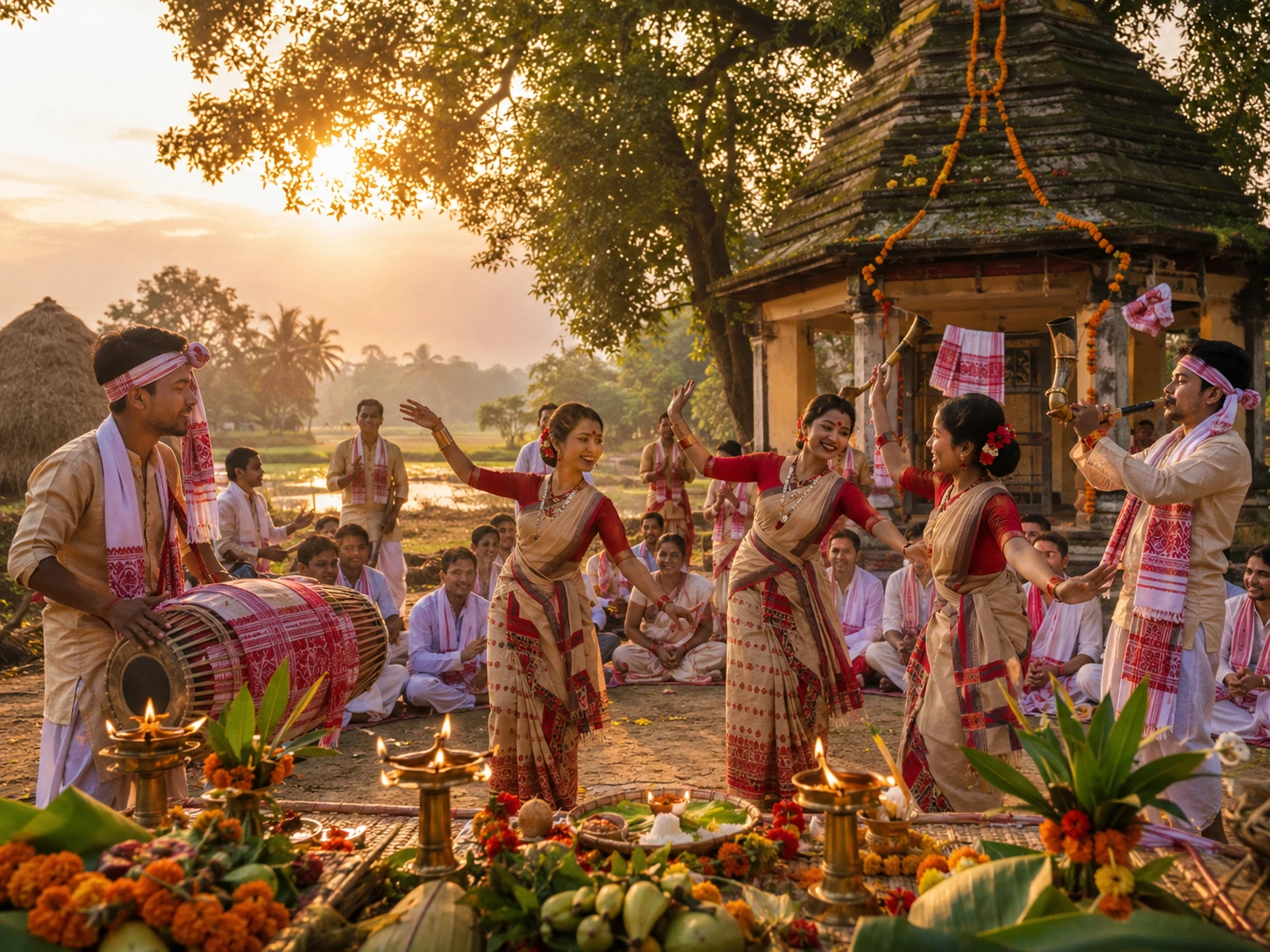
Bihu -- Assam's Three Harvests, Three Festivals, One Dance That Contains a Civilisation
बिहू -- असम की तीन फ़सलें, तीन त्योहार, एक नृत्य जो सम्पूर्ण सभ्यता समेटे
बिहू एक त्योहार नहीं। तीन-भागी वार्षिक चक्र जो ब्रह्मपुत्र घाटी -- असम की जीवनरेखा -- के चावल-कृषि कैलेण्डर को ट्रैक करता।
रोंगाली बिहू (बोहाग बिहू) मध्य अप्रैल, असमी नव वर्ष और बुवाई का आरम्भ। 'रोंगाली' अर्थात् हर्षपूर्ण: सामुदायिक नृत्य, संगीत, प्रेम गीत (हुसोरी दल घर-घर), भोज, अनियन्त्रित उत्सव। युवक-युवतियाँ बिहू नृत्य -- तीव्र कूल्हे की गति, हाथ-भंगिमाएँ, आनन्दपूर्ण ऊर्जा -- खुले मैदानों में। ढोल, पेपा (भैंस-सींग बाँसुरी), गोगोना (बाँस रीड), टोका (बाँस ताली)। रोंगाली पारम्परिक प्रणय और वर-ढूँढ़ का भी समय।
काटि बिहू (कोंगाली बिहू) अक्टूबर, धान बढ़ रहा पर कटाई नहीं। 'कोंगाली' अर्थात् ग़रीब, दुबला -- चिन्ता का मौसम जब पिछली फ़सल का भण्डार समाप्त और नई फ़सल खेत में। शान्ति से: सन्ध्या में तुलसी के तने और धान के खेतों में मिट्टी के दीपक (साकि), लक्ष्मी से फ़सल-रक्षा प्रार्थना। न नृत्य, न भोज -- शान्त सतर्कता और प्रार्थना। असम का सबसे ध्यानात्मक त्योहार।
माघ बिहू (भोगाली बिहू) जनवरी, फ़सल पूर्ण। 'भोगाली' अर्थात् भोज: माघ बिहू की पूर्व-रात्रि मेजी (बाँस-तिनके का बड़ा अलाव) और भेलाघर (बाँस-केले के पत्ते का अस्थायी भोज-गृह)। परिवार रात भर पकाते -- पीठा (चावल के पकवान), लारु (तिल-गुड़ गोले), सुंगा पीठा (बाँस नली में चावल आग पर)। सूर्योदय पर मेजी प्रज्वलित, समुदाय अग्नि के चारों ओर फ़सल हेतु कृतज्ञता और आगामी वर्ष की प्रार्थना।
तीनों बिहू का भावनात्मक चाप कृषि का चाप: रोंगाली बुवाई का आशावाद, काटि प्रतीक्षा की चिन्ता, माघ कटाई की कृतज्ञता। कोई अन्य भारतीय त्योहार-प्रणाली कृषि का पूर्ण मनोवैज्ञानिक चक्र इतनी सटीकता से नहीं पकड़ती। तीन बिहू तीन अलग त्योहार नहीं। एक सिम्फ़नी के तीन चरण -- असम के अपनी भूमि से सम्बन्ध की सिम्फ़नी।
(Bihu follows Assamese folk-Vaishnavite tradition rather than Sanskrit verse tradition)
बिहू का आध्यात्मिक प्राधिकार श्रीमन्त शंकरदेव (15वीं-16वीं सदी) की असमी नव-वैष्णव परम्परा में -- भागवत पुराण भक्ति और देशज असमी कृषि अभ्यास का मिश्रण। रोंगाली बिहू के हुसोरी गीत कृष्ण-विष्णु आवाहन करते, पर असमी मुहावरे में -- बिहू एक साथ वैष्णव और कृषि उत्सव।
— Assamese Neo-Vaishnavite (Sankardeva) tradition
तीन बिहू -- तीन ऋतु, तीन भाव
| Bihu | बिहू | Month | Season | Mood | Key Ritual | Signature Food |
|---|---|---|---|---|---|---|
| Rongali (Bohag) | रोंगाली (बोहाग) | April | Sowing / Spring | Exuberant joy | Bihu dance, Husori, Gamosa exchange | Pitha, Jolpan |
| Kati (Kongali) | काटि (कोंगाली) | October | Growing / Pre-harvest | Quiet anxiety | Lighting Saki lamps in rice fields and at Tulsi | Simple meals, prayers |
| Magh (Bhogali) | माघ (भोगाली) | January | Post-harvest / Winter | Grateful feasting | Meji bonfire, community feast in Bhelaghar | Sunga Pitha, Laru, Til Pitha |
गमोसा (लाल किनारे का श्वेत सूती वस्त्र) असम का सबसे पवित्र सांस्कृतिक प्रतीक, बिहू में सम्मान और स्नेह चिह्न। देवताओं पर, अतिथि सम्मान, उपलब्धि पुरस्कार। श्वेत (शुद्धता) और लाल (प्रेम/जीवनशक्ति) -- धागे में बुनी असम की पहचान।
बिहू नृत्य 2024 में Guinness World Records में -- गुवाहाटी में 11,000+ नर्तकों ने एक साथ प्रदर्शन -- सबसे बड़ा बिहू नृत्य जमावड़ा। असम सरकार UK, US, दक्षिण-पूर्व एशिया में सांस्कृतिक दल भेजकर अन्तर्राष्ट्रीय प्रचार। बैंगलोर (IT उद्योग से बड़ा असमी प्रवासी) में रोंगाली बिहू गुवाहाटी से स्पर्धा -- समर्पित बिहू मैदान, professional ढोल-पेपा, सामुदायिक बिहुतली। पुणे-हैदराबाद के युवा असमी engineer के लिए स्थानीय बिहू घर से वार्षिक पुनर्सम्बन्ध।
अपनी फ़सल मनाओ
बिहू सिखाता है कि जीवन की हर ऋतु सम्मान की अधिकारी है -- बुआई, प्रतीक्षा और कटाई। आज कृतज्ञता के मन्त्र के रूप में माला पर "ॐ श्री कृष्णाय नमः" का 108 बार जप करो, उस फ़सल के लिए जो तुम अभी काट रहे हो -- व्यावसायिक, व्यक्तिगत या आध्यात्मिक। एटर्नल राग के मन्त्र-ध्यान पुस्तकालय में जप के लिए और मन्त्र हैं।
Eternal Raga · शाश्वत राग
Institutional voice — scholarly articles on Sanatan Dharma
अपनी समझ गहरी करें
अपनी समझ और गहरी करें
rituals traditions
Makar Sankranti -- The Only Hindu Festival Tied to the Sun, Not the Moon
Almost every Hindu festival follows the lunar calendar. Makar Sankranti is the exception. It falls on a fixed solar date -- January 14 (or 15) -- when the sun crosses from Sagittarius (Dhanu) into Capricorn (Makara), marking the beginning of Uttarayana, the northern journey of the sun. This astronomical event triggers the most geographically diverse celebration in India: Pongal in Tamil Nadu, Lohri in Punjab, Bihu in Assam, Uttarayan in Gujarat, and Til-Gul in Maharashtra -- all on the same day, all celebrating the same sun, all in completely different ways.
rituals traditions
Pongal -- Tamil Nadu's Four-Day Harvest Festival That Worships the Sun, the Cow, and the Overflowing Pot
When the rice-milk pot overflows on Thai Pongal morning and the family shouts 'Pongal-o-Pongal!', Tamil Nadu is performing one of the oldest agricultural thanksgivings on earth. Four days of celebration -- Bhogi (discarding the old), Thai Pongal (thanking the Sun), Mattu Pongal (honouring cattle), and Kaanum Pongal (family outings) -- encode an entire civilisation's relationship with the land, the sun, and the animals that make agriculture possible. Pongal is not just a festival. It is Tamil Nadu's love letter to the harvest.
rituals traditions
Vishu -- The Kerala New Year Where the First Thing You See Decides Your Year
On the first day of the Malayalam month of Medam (April 14-15), every Keralite wakes to a carefully arranged sight: a brass lamp illuminating a display of golden Konna flowers, rice, fruits, vegetables, gold coins, a mirror, and a Krishna idol. This is Vishukkani -- the 'first sight of Vishu' -- and the tradition holds that what you see first on this morning determines the quality of your entire year. So the family ensures that the first sight is abundance, beauty, and the divine.
rituals traditions
Onam -- The Festival Where Kerala Welcomes Back Its Banished King
Every year in the month of Chingam (August-September), Kerala erupts in ten days of celebration -- flower carpets, boat races, feasts of 26 dishes, tiger dances, and the return of a king who was pushed underground by a god. Onam celebrates Mahabali -- the generous Asura king who ruled Kerala's golden age until Vamana (Vishnu's dwarf avatar) tricked him into the netherworld. But the twist: Kerala loves Bali more than Vamana. This is the only Hindu festival that sympathises with the 'villain' -- because in Kerala's telling, Bali was no villain at all.
rituals traditions
Chhath Puja -- The Only Hindu Festival Where You Worship the Setting Sun
Most Hindu worship faces east -- toward the rising sun, toward beginnings. Chhath Puja faces west -- toward the setting sun, toward endings, toward the courage to honour what is departing. Standing waist-deep in a river or pond at sunset and again at sunrise, offering Arghya (water oblation) to Surya with bare hands while chanting Vedic hymns -- this is the most physically demanding, most ecologically pure, and most egalitarian festival in the Hindu calendar. No priest. No temple. No idol. Just you, the water, and the sun.
rituals traditions
Ugadi / Gudi Padwa -- The Hindu New Year That Begins With Bitterness and Sweetness Together
On Chaitra Shukla Pratipada -- the first day of the first month of the Hindu calendar -- the new year begins not with champagne but with a spoonful of neem and jaggery mixed together. Bitter and sweet in the same bite. This is Ugadi (in Karnataka, Andhra, Telangana) and Gudi Padwa (in Maharashtra) -- the Hindu New Year that teaches you the year's first lesson before breakfast: life will give you both. Accept both with equanimity.
rituals traditions
Annadana -- Why Feeding Is the Highest Form of Charity in Hindu Tradition
The Taittiriya Upanishad declares: 'Do not turn away anyone who comes for food.' The Mahabharata ranks Annadana above all other forms of giving. The Sikh Langar feeds 100,000 people daily at the Golden Temple alone. The Akshaya Patra Foundation, inspired by ISKCON, serves mid-day meals to 2 million schoolchildren every day. In a civilisation that equates food with Brahman (Annam Brahma), feeding another person is not charity -- it is worship.
बिहू नृत्य 2024 में Guinness World Records में -- गुवाहाटी में 11,000+ नर्तकों ने एक साथ प्रदर्शन -- सबसे बड़ा बिहू नृत्य जमावड़ा। असम सरकार UK, US, दक्षिण-पूर्व एशिया में सांस्कृतिक दल भेजकर अन्तर्राष्ट्रीय प्रचार। बैंग…
More in Rituals & Traditions
Aarti -- Why Hindus Circle Light Before God
13 मिनट पढ़ें
Abhisheka -- Why Hindus Bathe Their Gods
10 मिनट पढ़ें
Akshaya Tritiya -- The Day Nothing Given Away Runs Out
12 मिनट पढ़ेंवही अनुवाद त्रुटि जिसने हिन्दू धर्म में '33 कोटि' को '33 करोड़' बनाया, बौद्ध धर्म में भी हुई। बौद्ध ग्रन्थों के चीनी अनुवाद ने 'सप्त कोटि बुद्ध' (7 श्रेष्ठ बुद्ध) का अनुवाद '7 करोड़ बुद्ध' कर दिया। तिब्बती अनुवाद ने सही …
Deities AvatarsCommunity Reflections
🕉️
Be the first to share your reflection.