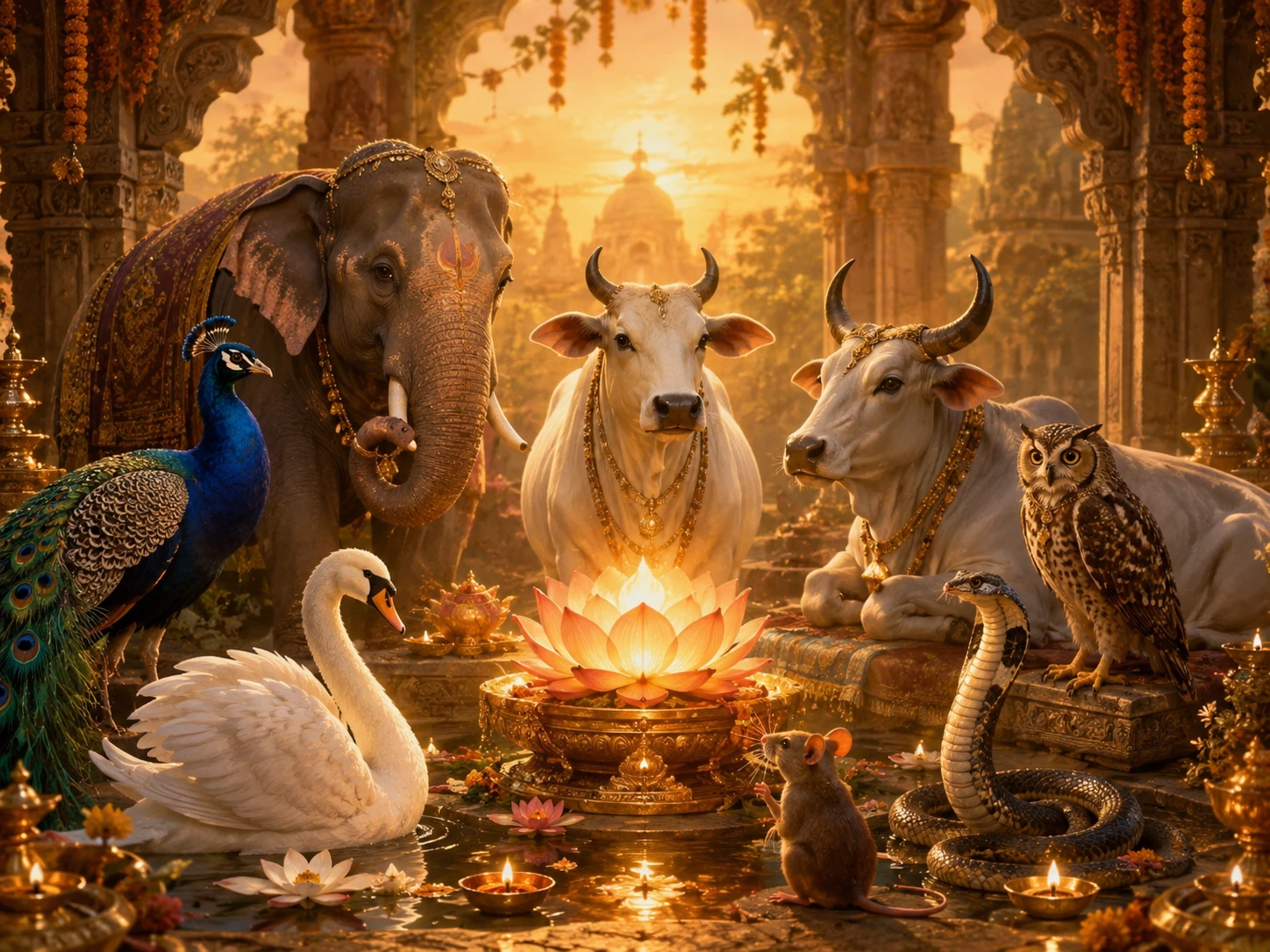
Gau -- Why the Cow Holds the Place She Does in Hindu Life
गौ -- हिन्दू जीवन में गाय का यह विशेष स्थान क्यों है
Anand district in central Gujarat, four in the morning, March of any recent year. A 52-year-old dairy farmer named Hasmukh Patel is awake in the small shed attached to his house. His best Gir cow is calving. He has done this thousands of times now, since his grandfather first put his hands under a calf when he was eleven, but he is still tense. The cow's breathing is uneven, the position of the calf is wrong, and the local veterinarian is forty minutes away. Hasmukh works the calf gently, talks to the cow in low Gujarati, and waits. By 5:15 the calf is breathing. By 5:30 it has found the udder. Hasmukh sits down on the floor, suddenly tired, and watches the two of them for a long time before going inside to make tea.
If you ask him later why he stays in the shed all night when modern dairy farms in Anand have hired help and electric monitors, he will not give you a religious answer. He will say that this cow has fed his family for nine years. That her mother fed his grandfather. That a calf that does not breathe in the first three minutes is gone, and that the only person on this earth who can be trusted with those three minutes is the family member who knows the cow. The Sanskrit word he sometimes uses, almost without noticing, is Mata. Mother. He is not making a metaphysical claim. He is naming a relationship that has been in his family for a hundred and fifty years and that pre-dates anything anyone in the policy debates of the last few decades has had to say on the subject.
This is the actual ground from which the Hindu civilisational treatment of the cow grows. Not slogan, not symbol, not theology in the abstract -- but a five-thousand-year-old continuity of agricultural life in which the cow is the single living being that links the household, the field, the kitchen, the temple, and the burial fire. To start anywhere else when explaining why she is sacred is to miss the foundation.
The earliest layer of textual evidence is the Rigveda itself. The cow appears in roughly seven hundred verses across the ten mandalas, more frequently than almost any other living being. She is called aghnya -- the not-to-be-killed -- in multiple hymns. The wealth of a household is reckoned, in early Vedic Sanskrit, in literal head of cattle: the word gau-dhana -- cow-wealth -- is a compound that survived into modern Hindi as godhan and into the legal vocabulary of the Manusmriti centuries later. A man with many cows was a wealthy man. A man with no cows was a poor man. This was not poetry. It was the basic metric of agricultural civilisation, and India was an agricultural civilisation organised around dairy and traction long before it was an empire or a nation.
The cow's productive role made her sacred in a way that needs to be understood structurally. Five things came directly from her. Milk for the household. Curd, set overnight, for the next morning. Ghee, the clarified butter without which Vedic ritual would simply not function -- it is poured into the fire, smeared on the body of the deity, used in cooking the offerings. Dung, dried into cakes for fuel and mixed with water for cleaning floors, walls, and ritual surfaces. And, in classical reckoning, urine, used in small ritual measures and in some traditional formulations. The system that uses these five together is called panchagavya -- the five products of the cow. The classical literature treats these uses with great seriousness. Modern claims about gomutra curing serious diseases are a separate matter, often unsupported by evidence, and the texts themselves do not make such claims. The original framework was practical, ritual, and modest in its medical scope.
What is striking, looking back from 2026, is how systematically the cow integrated into every domain of life. She fed the family three meals a day. She powered the plough that grew the family's grain. Her dung kept the cooking fire going. Her ghee fed the temple flame. When her time came, her hide was used, her bones were used, the field was returned what it had given. She was, in working economic terms, the household's renewable infrastructure. Sacredness, in the early Vedic conception, is not a separate magical category opposed to the practical. It is what gets attached to the practical when the practical reaches a particular density and irreplaceability.
माता रुद्राणां दुहिता वसूनां स्वसादित्यानाममृतस्य नाभिः। प्र नु वोचं चिकितुषे जनाय मा गामनागामदितिं वधिष्ट॥
mātā rudrāṇāṃ duhitā vasūnāṃ svasādityānām amṛtasya nābhiḥ pra nu vocaṃ cikituṣe janāya mā gām anāgām aditiṃ vadhiṣṭa
She is the mother of the Rudras, the daughter of the Vasus, the sister of the Adityas, the navel of immortality. I speak to people of understanding -- do not slay her, the sinless inviolate cow.
— Rigveda 8.101.15
The figure who carries the cow into the mainstream of Hindu devotional life is, of course, Krishna. The boy-god of Vrindavan is not a god of palaces or thrones. He is a god of pastures. His childhood is spent leading the herd of his foster father Nanda out at dawn and bringing it back at dusk, and the most loved iconography of him in any Indian household shows him with his arm around a cow's neck, a flute in his other hand, calves looking up at him. Almost every name by which he is known carries the word for cow. Govinda. Gopala. Gopikāntha. Gopinath. The nineteen-syllable Vaishnava chant most commonly heard at temple gates -- Govindaya namaha -- is in essence praise to the deity-as-cowherd.
The cycle of stories around Govardhan, in particular, fixes the relationship. As tradition relates it, the people of Braj had been performing an annual ritual to Indra, the deity of rains. Krishna, still a teenager, suggests instead that they offer the ritual to Govardhan, the local hill that gives their cows pasture and water. Indra, slighted, sends torrential rains to drown the village. Krishna lifts Govardhan on the little finger of his left hand and holds it up like an umbrella for seven days while the herders, the cows, the calves, and the entire village shelter beneath it. The story is read across India as a parable about the right object of worship -- the local sustaining ground rather than the distant power -- but it is also, very specifically, a story about a god who picked up a hill to keep his cows dry. Govardhan Puja, on the day after Diwali in the lunar calendar, is still observed in Braj, in much of Rajasthan, Gujarat, Uttar Pradesh, and across the Indian diaspora.
What Krishna does for the cow in the bhakti tradition is take her out of the abstract Rigvedic register and place her in the centre of a personal devotional relationship. After Krishna, the cow is no longer just the foundation of the household economy. She is the animal whom the Lord himself loved by name, the animal whose presence in the courtyard is a small everyday participation in his life. This is why so many Indian households across regions still bow to the family cow on festival days, why Tamil Pongal has its second day called Mattu Pongal devoted entirely to bathing and decorating the cattle, why a Marathi farming family in Satara still keeps a small kumkum mark on the forehead of the lead cow during festivals. None of these is mere superstition. Each is a continuation of a relationship that Krishna's life made personal.
Hindu thought formalises the cow's place using a category called pancha-mata -- the five mothers. The five are usually listed as: the birth mother, the earth (bhumi), the cow (gau), the wife of one's guru (guru-patni), and one's homeland or the sacred river that runs through it. The list varies slightly across regional traditions, but the cow appears in almost every version. The category is significant because it does not subordinate the cow to a metaphor. It places her on the same structural footing as one's own mother, signalling something about what the tradition wants to claim. The cow is not like a mother. In the working religious anthropology of Hindu thought, she is a mother, in the same enumeration.
This vocabulary has had quiet practical effects. In many traditional Indian households, a cow was sold but never sent for slaughter; she was retired to a gaushala when she could no longer give milk. The gaushala system, ranging from temple-attached shelters to large institutional ones such as the Pathmeda Gauchikitsalaya in Rajasthan, the Bhagvati Gaushala in Mathura, and dozens of smaller ones across rural India, exists because of this category. A senior Marwari businessman who funds a gaushala in his home town is not making an obscure religious gesture. He is acting on a category his tradition has been carrying for over two thousand years.
It is honest to acknowledge that the contemporary scene around cows in India is more complicated than the tradition's internal logic alone would suggest. The dairy industry, which is one of the largest in the world, has features that classical Hindu thought would not endorse without significant modification, particularly around the welfare of male calves and of cows past peak lactation. The legal landscape is uneven: states such as Gujarat, Madhya Pradesh, Rajasthan, Haryana, Uttar Pradesh, and Maharashtra have strong restrictions on cow slaughter, while Kerala, West Bengal, and most of the northeast permit cattle slaughter under various conditions. The political debate, especially since the 1880s and again with renewed intensity since the 2010s, has often run ahead of either the dairy economy or the textual tradition. A thoughtful reader can hold all of this in mind without flattening any of it. The category of cow-as-mother predates these debates, and it will outlast them.
Five Mythological Cows in Hindu Tradition
| Cow | Devanagari | Origin | Special role |
|---|---|---|---|
| Kamadhenu | कामधेनु | Emerged from the Samudra Manthan, the churning of the cosmic ocean | The wish-fulfilling cow. Mother of all cows. Lives in the realm of Indra and Brahma; gives whatever is asked of her. |
| Surabhi | सुरभि | Often identified with Kamadhenu in some texts; in others, her daughter | Mother of cattle, especially the celestial cows. Her name means 'sweet-fragrant.' |
| Nandini | नन्दिनी | Daughter of Surabhi or Kamadhenu, kept by sage Vasishtha | Source of the Vasishtha-Vishvamitra conflict. King Vishvamitra tries to seize Nandini by force; her quiet protection by Vasishtha shows the limits of brute power before sacred relationship. |
| Bahula | बहुला | A devoted cow described in Skanda and Padma Puranas | Famous for her dialogue with a tiger who threatened to eat her. She begs for time to feed her calf and return; her honesty causes the tiger to spare her, an Indian parable about the moral force of truth-keeping. |
| Kapila | कपिला | A specific reddish-brown cow extolled in the Mahabharata's Anushasana Parva | Considered most auspicious for daana, ritual gifting. Donating a Kapila cow to a deserving recipient is described in the Mahabharata as among the highest acts of merit. |
Different texts list these cows differently. Kamadhenu and Surabhi sometimes appear as the same figure; in some Puranas, the names refer to a class of celestial cows rather than individuals.
Modern India still has a remarkably resilient ecosystem of indigenous cow breeds, each with its own regional history. Five are particularly well-documented. The Gir, originating in the Gir forest region of Saurashtra, Gujarat, is the breed Hasmukh Patel keeps in Anand. She is recognisable by her dome-shaped forehead, drooping ears, and reddish coat with white patches. Gir milk has become well-known in Indian metropolitan markets in the last decade because of its A2 beta-casein protein profile, which a growing body of nutritional research suggests is more easily digested by adults sensitive to conventional A1-dominant milk. Gir cows have also been exported, in genetic and breeding form, to Brazil, where they have been crossbred and form part of one of the largest dairy populations in South America.
The Sahiwal, from the Punjab region, is one of the highest-yielding indigenous milch breeds, with documented yields competitive against many imported European breeds when raised in their native climate. The Tharparkar, native to the Thar desert region of Rajasthan, is famous for its hardiness and ability to thrive on minimal forage. The Kankrej, from the Kutch region, is a powerful draught breed historically used for ploughing and bullock-cart work, and is recognisable by its lyre-shaped horns. The Vechur, from central Kerala, is the smallest cattle breed in the world; an adult Vechur cow stands roughly 90 to 100 cm at the shoulder, weighs about 130 kg, and was nearly extinct in the 1980s before a determined revival programme led by Sosamma Iype at Kerala Agricultural University brought the population back to a few thousand head.
The revival of indigenous breeds is one of the quiet success stories of post-2000 Indian agriculture, and it is happening in places not usually associated with traditionalism. Bengaluru, Chennai, and Pune all have functioning networks of indigenous-breed dairy farms supplying urban customers willing to pay a premium for traceable A2 milk and bullock-ploughed grain. The agricultural research stations at Anand, Karnal, and Ludhiana run formal breed-conservation programmes. The cow that the Rigveda celebrated four thousand years ago is, in many of her current Indian forms, the same animal -- with the same hump, the same dewlap, the same tolerance of heat -- and a small but determined community is making sure she does not vanish.
विद्याविनयसम्पन्ने ब्राह्मणे गवि हस्तिनि। शुनि चैव श्वपाके च पण्डिताः समदर्शिनः॥
vidyā-vinaya-sampanne brāhmaṇe gavi hastini śuni caiva śva-pāke ca paṇḍitāḥ sama-darśinaḥ
The truly wise see with equal vision a brahmana endowed with knowledge and humility, a cow, an elephant, a dog, and a dog-eater.
— Bhagavad Gita 5.18
The Vechur cow of Kerala, the smallest cattle breed in the world, was nearly extinct by the early 1980s. Sosamma Iype, then a faculty member at Kerala Agricultural University, located the last remaining herds, organised a conservation programme, and brought the population back from fewer than two hundred animals to several thousand by the mid-2000s. In 2009, Vechur milk was the subject of an international research dispute when a UK firm attempted to file a patent on certain genetic markers. Indian farmers and the Kerala state government successfully challenged the application. The cow that walks at hip-height in a Kerala village courtyard was, briefly, the centre of a global biopiracy debate.
The festival calendar provides one more layer of evidence for how integrated the cow remains in Hindu life. Govardhan Puja, on the day after Diwali, is the most widely observed cow festival across north and west India. Households decorate cows with garlands, paint their horns in bright colours, and offer them the first morsel of festival food. In Tamil Nadu, the second day of the four-day Pongal harvest festival is Mattu Pongal, devoted entirely to cattle. Bulls and cows are bathed at the family well or local pond, smeared with turmeric, decorated with flowers, and fed sweetened cooked rice from a banana leaf before any human eats. In Maharashtra and Karnataka, Bali Pratipada and the closely related Bendur festival mark a similar relationship.
Kerala's Onam, though not formally a cow festival, traditionally features cow-themed lamp lighting and the family cow being fed first on the morning of Thiruvonam. Bengal's Itu Puja, less widely known, includes a special offering of milk to a small earthen image. In the upper Himalayas, the Gaddi shepherd communities of Himachal Pradesh, who keep their cows on summer pastures and bring them down for winter, observe a brief festival called Lohri specifically for the herd. None of these is a fringe practice. They survived the medieval period, the colonial period, post-Independence agrarian transformation, and the migration of huge populations to cities. They survive in 2026 in Mumbai high-rises where a third-generation family will keep a small cow figurine in the puja room and offer it the first sweet on Govardhan Puja, even though no one has touched a real cow in years. The category survives even when the animal is far away.
If a careful reader asks what the deeper teaching of all this is -- beyond economy, beyond mythology, beyond festival -- the tradition's answer is fairly direct. The cow stands, in Hindu thought, for a particular kind of being. She is unhurried, productive, peaceful, and gives more than she takes. She does not fight her circumstances. She accepts the field and the shed, eats what the land provides, gives milk twice a day for as long as her body permits, and when her body is no longer giving milk, she stops giving milk. There is no resentment in this, no grasping, no agitation. A traditional Indian image for the highest spiritual state -- the still, satisfied yogi who has become a quiet centre of giving without depleting -- often borrows directly from the iconography of the cow. The Sanskrit phrase santi-mati gau, the peaceful-minded cow, is found in several Puranic passages, and is meant to invoke a particular human ideal as much as it describes an animal.
For a young Indian in 2026 who is trying to make sense of her own restless inner life -- the constant pull to optimise, perform, accumulate, and respond -- the cow as taught by Hindu tradition is not a quaint pastoral image. She is a working argument that one of the highest possible ways of being is the way of someone who simply, steadily, and over a long lifetime, gives. Without spectacle. Without resentment. Without bargaining. The household categories of mother, of provider, of patient ground, all converge in this single domesticated animal. To honour her is, in part, to honour the version of oneself that is capable of that kind of quiet generosity.
The young woman in Hyderabad who, on a Sunday morning, drives forty minutes out of the city to bring fresh banana leaves and gud to the cows at a small gaushala on the outskirts of Cherlapally is not performing a duty she has been taught to perform. She is, however inarticulately, recognising something. The cow knows her by smell within a few visits. The relationship grows quietly. By the third year she will tell you, if you ask, that she has not been able to fully explain to her colleagues why she does this, but that those Sunday mornings are now the most settled hours of her week. This is, in working form, what the tradition has been saying for five thousand years.
Three closing observations, given the topic's contemporary intensity. First, the textual tradition is older, more layered, and considerably more sober than the recent political debate around the cow tends to suggest. The Vedic verses, the Krishna-Gopala literature, the Mahabharata's Anushasana Parva on cow donation, the Puranic genealogies of celestial cows, and the Manusmriti's regulations together amount to a sustained civilisational engagement that long predates any twentieth or twenty-first century mobilisation. Reading the tradition slowly is not the same as endorsing the politics. Both readings deserve their own clear-eyed treatment, and conflating them does justice to neither.
Second, the dairy economy of contemporary India is enormous and deserves the seriousness any large industry receives. India is the largest milk producer in the world. The National Dairy Development Board, founded in 1965 in Anand by Verghese Kurien, transformed the dairy economy of the country in the second half of the twentieth century. The cooperative model that Amul represents is one of the most studied agricultural success stories of post-Independence India. The relationship between this modern dairy infrastructure and the older household relationship between farmer and cow is not always smooth. Honest engagement requires acknowledging both the achievement and the tensions.
Third, the cow is not a Hindu monopoly. Every agricultural civilisation has had its sacred animals; the bull cult of ancient Egypt, the cattle traditions of the Maasai, the special place of the cow in Zoroastrianism and in early Vedic religion as a shared Indo-Iranian heritage, all attest to this. What is distinctive about the Hindu treatment is the unbroken continuity of the relationship across five thousand years and the sheer density of textual, ritual, devotional, and economic detail that has accumulated around it. That continuity is, finally, what the cow represents in the Hindu civilisational imagination. She is not just a sacred animal. She is the link between the deepest past of the subcontinent and its present, walking, in 2026, in the same fields and the same courtyards, doing the same quiet work she has been doing all along.
Read the Govardhan Puja prayers in Eternal Raga
The traditional Govardhan Puja sequence -- recited the day after Diwali in much of India -- includes Sanskrit verses to the cow, to the hill, and to Krishna as cowherd. Read it through once in your own language to feel the structure of the relationship before the next Govardhan Puja arrives.
Eternal Raga · शाश्वत राग
Institutional voice — scholarly articles on Sanatan Dharma
Deepen Your Understanding
अपनी समझ और गहरी करें
deities avatars
Krishna Leela -- Why God Chose to Play
He stole butter, broke pots, lied to his mother's face, danced with married women under the full moon, and lifted an entire mountain on his little finger. The Bhagavata Purana's Tenth Skandha -- the most popular 4,000 verses in all of Hindu literature -- is not a biography. It is a theological argument that the Supreme Being's highest expression is not creation, destruction, or cosmic governance. It is play. Krishna Leela is the radical idea that God's truest nature is joy.
rituals traditions
Govardhan Puja and Annakut -- The Day After Diwali
The day after Diwali, households shape a hill out of cow dung, temples pile up a mountain of food, and pilgrims walk twenty-one kilometres around a low ridge in Braj. Why: the story of the boy who held up Govardhan for seven days, and how the festival is kept today.
sacred symbols
Vanaspati -- The Sacred Trees of the Hindu Civilisational Imagination
Pipal, Banyan, Bel, Tulsi, Neem. Five names a Hindu child learns before she can read. Each one is a deity, a doctrine, and a doctor at the same time. Behind them stands the older idea of vrkshayajna -- the worship of trees as the first acts of religion -- and the network of sacred groves that quietly preserved India's biodiversity for two thousand years.
sacred artefacts
Kamadhenu -- The Wish-Fulfilling Cow
She rose from the churning of the ocean, lived in the hermitages of the sages, and was the cause of two of the epics' great quarrels. Who Kamadhenu is, why kings went to war over her daughter, and how she became the image of the cow as the giving mother.
The Vechur cow of Kerala, the smallest cattle breed in the world, was nearly extinct by the early 1980s. Sosamma Iype, then a faculty member at Kerala Agricultural University, located the last remaining herds, organised …
More in Sacred Symbols

Ashtamangala -- The Eight Auspicious Symbols of Hindu Tradition
13 min read
Bindu -- The Point from which Creation Emerges
12 min read
Dharma Chakra -- The Wheel on Your Flag That Spins Since Before the Buddha
13 min readThe same translation error that turned '33 Koti' into '33 crore' in Hinduism also happened in Buddhism. The Chinese translation of Buddhist texts rendered 'Sapta Koti Buddha' (7 Supreme Buddhas) as '7 Crore Buddhas.' The…
Deities AvatarsCommunity Reflections
🕉️
Be the first to share your reflection.