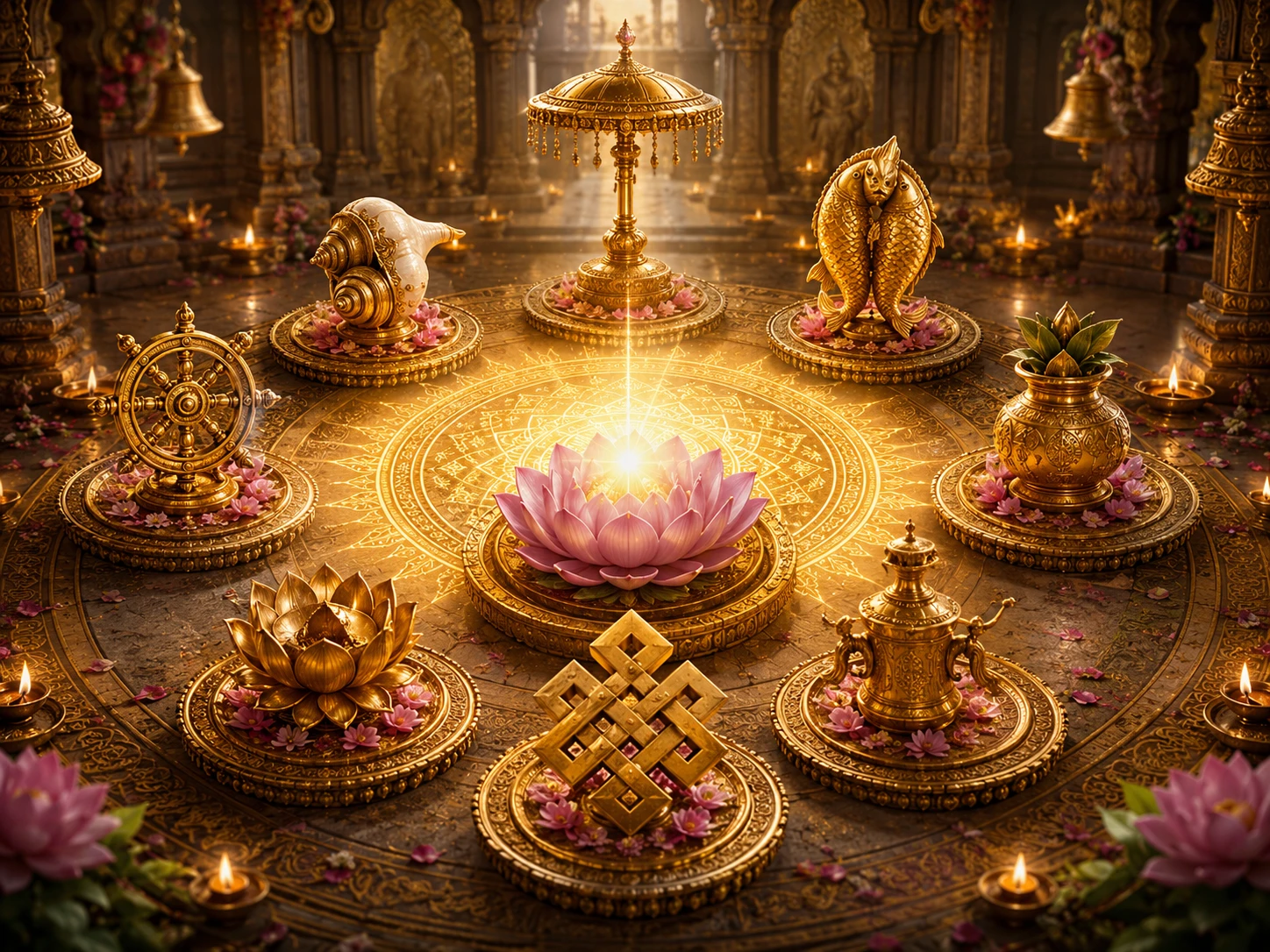
Ashtamangala -- The Eight Auspicious Symbols of Hindu Tradition
अष्टमंगल -- हिन्दू परम्परा के आठ शुभ प्रतीक
The Symbols You Have Already Seen
Look closely at the next Hindu wedding card you receive in your inbox. Beneath the names of the bride and groom, beneath the date in Devanagari and Roman script, you will find a small ornamental band. Look closer. The band is not a generic decorative motif. It is a specific set of eight symbols arranged in a row or a circle. A swastika at one end. A water-pot, the kalasha, with mango leaves and a coconut on top. A pair of fish. A spiral conch. A small lamp. A waving banner. A mirror with an ornate handle. And, often, a curled mark like a stylised flower or knot at the very centre. These eight symbols are the Ashtamangala, the eight auspicious signs of Hindu tradition, and they have been printed on Indian wedding cards, foundation stones, temple thresholds, and household entrances for at least two thousand years.
You have seen them in many places without naming them. The kalasha placed at the front of every griha pravesh ceremony when a Mumbai family takes possession of a new flat in Worli. The brass diya lit at the launch of a new IT services company in Bengaluru's Electronic City. The pair of fish painted at the bottom corner of a hand-drawn rangoli in a Kolkata Durga Puja pandal. The conch displayed on the dashboard of a Tamil Brahmin family's car driving from Chennai to Tirumala for a darshan. The small darpana mirror placed at the entrance of a Rajasthani haveli to deflect evil eye. The dhvaja flag flying above every major Hindu temple from Kashi to Rameshwaram. The shrivatsa curl carved on the chest of every Vishnu murti from the Brihadeeshwara to the smallest Vaishnava puja-room icon. None of these are accidental. Each is a member of the eight, doing its specific work in its specific place.
This article unpacks why these eight, what each one carries, and how the set itself functions as a compressed visual encyclopedia of Hindu auspiciousness. The traditional accounting begins from a longer list of one hundred and eight mangala objects -- the same one hundred and eight that appears in mantra-counts, malas, and divine names. From that long list, eight have been selected, in slightly different ways by different texts and regions, as the irreducible core. Why eight and not seven or twelve, why these eight and not others -- these are the questions the article addresses. Once you have read it, the wedding card you receive next month will not look the same.
मङ्गलं भगवान् विष्णुः मङ्गलं गरुडध्वजः। मङ्गलं पुण्डरीकाक्षो मङ्गलायतनो हरिः॥
mangalam bhagavan vishnuh mangalam garuda-dhvajah mangalam pundarikaksho mangalayatano harih
Auspicious is Lord Vishnu; auspicious is the one whose flag bears Garuda. Auspicious is the lotus-eyed one; Hari is the very abode of auspiciousness.
— Mangala Stotra (traditional verse recited at the close of Vishnu Sahasranama and at the beginning of Vaishnava ritual occasions; widely cited in Hindu liturgical practice)
What Mangala Means and Why Eight
The Sanskrit word mangala carries a richer meaning than the English auspicious can quite hold. Mangala means that which removes obstacles, that which protects, that which brings well-being, that which is itself an instance of the sacred. The word is dual in function: it both names the auspicious object and performs the auspicious work. To say mangala is to participate in mangala. The Mangala Stotra quoted above does not merely describe Vishnu as auspicious; it performs the act of invoking auspiciousness through the four-fold repetition of the word.
Classical Hindu texts list one hundred and eight objects considered mangala -- a number that recurs throughout the tradition for reasons both numerological and structural. From this longer list, eight are selected to form the ashtamangala, the standard set displayed at every major auspicious occasion. The number eight is itself meaningful. It corresponds to the eight directions overseen by the Dikpalas, to the eight kinds of Lakshmi, to the eight limbs of yoga in Patanjali's framework, to the eight forms of Shiva worshipped in Maharashtra. Eight is the Hindu number for completeness in the spatial and operational sense. To gather eight auspicious objects is to gather a complete coverage of all auspicious vectors at once.
The specific list of which eight is not perfectly fixed across all Hindu sources. Different texts and regions vary. The Vishnu Dharmottara Purana gives one list. The Brihat Samhita gives another. The Garuda Purana mentions a slightly different set. Modern Hindu wedding-card printers in Surat or Vrindavan tend to settle on a popular set that combines the most widely recognised symbols. This article uses the most commonly displayed contemporary Hindu Ashtamangala -- swastika, purna kalasha, shrivatsa, matsya yugma, shankha, deepa, dhvaja, and darpana -- while noting where regional and textual variation exists. The variation is not a problem to be resolved. It is a feature of a living tradition that has allowed local culture to choose from a shared vocabulary without enforcing a single canon. The same eight-symbol logic operates in Jain Ashtamangala and Buddhist Ashtamangala as well, with different selections from related but partly different lists. The number is universal across these Indian dharmas. The specific choices are local.
The Eight Auspicious Symbols and Their Meanings
| Symbol | Sanskrit | Form | Meaning |
|---|---|---|---|
| Swastika | स्वस्तिक | Cross with four right-angled bent arms turning clockwise | Well-being, the four directions, the cycle of dharma |
| Purna Kalasha | पूर्ण कलश | Full water-pot with mango leaves and coconut on top | Abundance, fertility, the womb of creation |
| Shrivatsa | श्रीवत्स | Curl or stylised flower-mark on Vishnu's chest | Sri (Lakshmi) seated in the heart; mark of divine grace |
| Matsya Yugma | मत्स्य युग्म | Pair of fish facing each other or vertically aligned | Conjugal harmony, fertility, sacred rivers Ganga and Yamuna |
| Shankha | शंख | Spiral conch shell, often Vishnu's panchajanya | Cosmic primordial sound, victory, dharma's call |
| Deepa | दीप | Oil lamp with cotton wick, often shaped like a leaf | Knowledge dispelling darkness, presence of agni, beginning of every ritual |
| Dhvaja | ध्वज | Banner or flag, often saffron or red, on a tall pole | Victory of dharma, deity's residence, public declaration |
| Darpana | दर्पण | Mirror, often with an ornate handle | Self-reflection, clarity of perception, the goddess's instrument |
These eight constitute the most commonly displayed Hindu Ashtamangala. Variations exist: some lists include vyajana (fan), bheri (kettledrum), or simha (lion) in place of darpana or dhvaja, depending on text and region.
The Swastika -- The Most Misunderstood of the Eight
The swastika sits first in almost every Hindu Ashtamangala enumeration, and it is also the symbol that demands the most careful contemporary handling. The word swastika comes from the Sanskrit svasti, meaning well-being or all-is-well. The su prefix means good. The asti is the present third-person singular form of the verb to be. Together they make a compressed sentence: it is good. The kk suffix transforms this into a symbol-noun: the thing that says it is good. Every time a Hindu draws a swastika at the doorway during Diwali, on a brand-new Maruti car at a Pune showroom delivery, or on the cover of a child's first arithmetic notebook, the symbol is performing this small Sanskrit sentence as a graphic event.
The shape itself is older than recorded history. Archaeologists have recovered swastika seals from the Indus Valley civilization at Mohenjo-daro and Harappa, dated to roughly 3000 to 2500 BCE. Swastika motifs appear in Greek pottery, Celtic metalwork, Native American basketry, and African textiles. The shape is a near-universal early human geometric form, recurring independently in distant cultures. In the Indian context, the four right-angled arms have specific meanings: the four directions, the four Vedas, the four ages of dharma, the four states of consciousness. The clockwise rotation of the arms corresponds to dakshinacara, the right-hand path of mainstream Hindu ritual. The four dots sometimes placed in the four spaces between arms represent the four classes of beings or the four cardinal stations of the cosmos.
The twentieth-century misappropriation of the swastika by the Nazi regime created a deep wound in the symbol's global readability. The Nazi swastika is rotated forty-five degrees and tilted, and it represents an explicit ideology of racial supremacy that bears no relation whatsoever to the Hindu meaning. The conflation of the two is, on every level, a category error. Hindus, Jains, and Buddhists across India, Nepal, and Sri Lanka continue to use the swastika as their ancient symbol of well-being. The recovery of this distinction in international public discourse is a slow process but is genuinely happening. Indian commentators including Rajiv Malhotra, scholars at Indic Studies departments, and contemporary Hindu cultural advocates have done patient work over the last two decades to clarify that the Nazi misappropriation does not retroactively contaminate a five-thousand-year-old Indic symbol. The swastika at the threshold of a Pune household before Lakshmi puja and the swastika at Auschwitz are not the same symbol, regardless of superficial resemblance. To pretend otherwise is to surrender Indian visual heritage to twentieth-century European political failure. The honest course is to acknowledge the historical wound, refuse the conflation, and continue to use the symbol with full awareness of both its ancient meaning and its modern misreading.
The Archaeological Survey of India and museums at Mohenjo-daro and Harappa hold dozens of small terracotta and steatite seals from the Indus Valley civilization, dated 3000 to 2500 BCE, that bear clearly recognisable swastika motifs. The National Museum at Janpath in New Delhi displays several of these seals in its Indus Valley gallery, and they are routinely photographed by visiting school groups. These seals predate the Nazi swastika by approximately 4500 years. They also predate the Vedas, depending on which dating one accepts for the Rig Veda. The continuity of the symbol from Indus Valley artifacts through Vedic ritual through Hindu, Jain, and Buddhist usage represents one of the longest unbroken visual lineages in human cultural history. When a Bengaluru tech professional draws a swastika at her doorway during Diwali, she is participating in a graphic tradition older than the pyramids.
Purna Kalasha and Shankha -- Water and Sound
The purna kalasha is the most ubiquitous of the eight, the one symbol that physically appears at every major Hindu ritual rather than just being depicted on cards. A copper or brass pot, filled with water sometimes mixed with rice, capped with five mango leaves arranged in a fan, topped with a coconut, and tied around the neck with red kumkum-stained thread -- this is the kalasha. Place it at the centre of any puja and the geometry of the ritual immediately settles around it. The kalasha is called purna, full, because the water inside represents the abundance of the cosmic ocean from which all manifestation arises. The mango leaves are agni, the green fire of growth. The coconut is the head of Brahma, the unbroken seed. The thread is the binding of intent. Together the assembled object stands for the entire universe in compressed form, ready to be invoked into the ritual.
A Mumbai homemaker performing satyanarayan puja in her ninth-floor apartment, a temple priest at Tirupati conducting suprabhatam at four in the morning, a foundation-stone laying ceremony at a Bengaluru tech park, an NRI couple in San Jose California setting up a Diwali puja with a make-do kalasha of stainless steel because they could not source a copper one in time -- all are performing the same compressed cosmology. The water in the pot is not municipal water. It is, ritually, the cosmic ocean. The leaves are not garden mango leaves. They are, ritually, the green flame. The substance and the symbol have collapsed into a single object. Hindu ritual is consistently this way. It refuses to maintain a sharp distinction between the physical thing and what the thing represents. The kalasha is both at once.
The shankha, the spiral conch shell, performs a parallel function in the domain of sound rather than substance. Shankha is the primordial sound of cosmic creation, the sound that, in Vedic and Vaishnava theology, accompanies the moment of manifestation. Vishnu's conch is named Panchajanya, said to have been recovered by Krishna from a sea-demon. The conch is blown at the start of every major ritual to announce the deity's presence and at the end to mark the ritual's closure. The dakshinavarti shankha, the rare clockwise-spiralling conch covered in detail in our companion article on the right-hand and clockwise convention, is considered the most auspicious form. The everyday vamavarti shankha used in temples, while not as rare, still carries the same ritual weight. When the priest at the Pashupatinath temple in Kathmandu blows the conch at the start of the morning aarti, the sound that fills the courtyard is not just an announcement. It is, in the framework of the ritual, a graphic recreation of the cosmic primordial sound at the moment of creation. Every aarti is, on this reading, a small re-enactment of cosmogenesis.
Shrivatsa, Matsya, Deepa -- Body, Pair, and Flame
The shrivatsa is the curl that sits on Vishnu's chest in every iconographic depiction. Some traditions describe it as a wisp of white hair, others as a stylised flower, others as an endless knot. Whatever the visual rendering, the meaning is consistent. Sri is Lakshmi, the consort of Vishnu and the goddess of abundance. Vatsa is dear one, beloved. Shrivatsa is therefore the mark of the goddess seated permanently in Vishnu's heart. The symbol declares that the divine masculine is never separable from the divine feminine. Where Vishnu is, Lakshmi is. Where the preserver acts, abundance flows. This is why the symbol appears in the Ashtamangala set despite being technically a personal mark of one specific deity. It encodes a structural claim about how the universe holds together: the active principle is incomplete without the abundance principle, and the chest of Vishnu carries this declaration in graphic form. A devotee at the ISKCON Mayapur temple touching the chest of the Vishnu murti is reaching for this exact teaching, even if the gesture is not articulated.
Matsya yugma, the pair of fish, encodes a different teaching: that auspiciousness comes in pairs. A single fish is just a fish. A pair facing each other or vertically aligned in mirror symmetry signals that something has been completed by joining its other. In Hindu wedding contexts, the matsya yugma stands for conjugal harmony. In riverine contexts, the two fish are sometimes read as the Ganga and Yamuna, the two great rivers that join at the sangam in Prayagraj. In tantric readings, the pair represents ida and pingala, the two channels of the subtle body that meet in the central sushumna. Whichever reading you take, the visual logic is the same: the fish symbol announces the auspicious completion that comes through pairing rather than singularity. A bride and groom signing a register at a Pune marriage hall are, ritually, the matsya yugma realised at human scale.
The deepa, the oil lamp, requires the least explanation because every Indian household already practices it. The lit lamp is fire in domesticated form, agni invited into the room and asked to stay for the duration of the puja. A diya at the threshold during Diwali, a tall brass standing lamp lit at the start of a Bharatanatyam recital at the Music Academy in Chennai, a small ghee-lamp burning before the family puja shelf in a Hyderabad apartment -- all carry the same logic. Where the deepa is, agni is present. Where agni is present, the protocol for ritual is open. The Sanskrit phrase deepojyoti param brahma, the lamp's flame is the highest Brahman, captures this teaching: the small domestic flame is not just a representation of cosmic light. It is, ritually, the cosmic light condensed into something a child can light with a matchstick. The deepa in the Ashtamangala set is the household-scale version of the agni in the great Vedic yajna. The same fire, different scale.
Ashtamangala Across the Three Indian Dharma Traditions
| Tradition | Common Symbols | Distinctive Symbols | Primary Use |
|---|---|---|---|
| Hindu | Swastika, Kalasha, Shankha, Deepa, Dhvaja | Shrivatsa, Matsya yugma, Darpana | Wedding cards, griha pravesh, temple rituals, foundation ceremonies |
| Jain (Shvetambara) | Swastika, Kalasha, Matsya yugma, Darpana, Bhadrasana | Shrivatsa, Nandyavarta, Vardhamanaka | Tirthankara worship, manuscript covers, temple equipment |
| Jain (Digambara) | Swastika, Kalasha, Bhadrasana | Chamara (fly-whisk), Vyajana (fan), Chatra (parasol), Dhvaja, Supratishtha | Tirthankara installation rituals; varies from Shvetambara list |
| Buddhist (Mahayana / Vajrayana) | Shankha, Kalasha, Dhvaja, Lotus | Dharmachakra, Endless knot (Shrivatsa), Pair of fish, Parasol | Tibetan and Newari household art, monastery rituals |
All three traditions share an underlying eight-symbol logic and a common substrate of shared symbols (swastika, kalasha, fish-pair). The selections differ at the edges, reflecting each tradition's distinct theological emphasis.
The Indian Space Research Organisation (ISRO) has, on multiple mission patches and pre-launch ceremonies, incorporated traditional auspicious symbols including the swastika, kalasha, and shrivatsa motifs alongside its scientific iconography. The Chandrayaan and Mangalyaan missions both featured ritual coconut-breaking ceremonies at the Sriharikota launch facility prior to lift-off, with full kalasha installations and traditional pujas conducted by ISRO scientists themselves. The Mangalyaan team famously held a small ritual at Tirumala before the orbital insertion in 2014. ISRO chairmen including K Sivan, S Somanath, and earlier U R Rao have publicly affirmed that conducting traditional rituals alongside cutting-edge engineering is, for them, not a contradiction but a continuity. The Ashtamangala visual grammar in this context is doing the same work it has done for two thousand years: marking a major undertaking as auspicious before it begins. The technology has changed; the symbol continues.
Living the Eight in Modern Indian Life
The Ashtamangala set is not a museum object. It is in active circulation in every Hindu household, every wedding, every business inauguration, and every digital invitation that lands on your WhatsApp. The young couple in Gurgaon designing their wedding card on Canva chooses an Ashtamangala header from a template library, often without knowing what each of the eight symbols specifically means. The card is then printed at a Sadar Bazaar press, courier-delivered across India, and forwarded as a JPEG to relatives in Toronto and Sydney. The symbols travel with the card. The grammar is older than the printing technology by two thousand years.
For someone who wants to engage the set more deliberately, the entry points are simple. Notice the eight on the next wedding card you receive. See if you can name each one before reading the explanatory caption (most cards no longer carry one). Notice the kalasha at the next puja you attend. Pay attention to whether the shankha is dakshinavarti or vamavarti. Look for the shrivatsa on the chest of the Vishnu murti at the next Pandharpur or Tirumala or ISKCON temple visit. Each of these small acts of attention turns passive participation into active reading. The set has been waiting for you to read it; it has been entirely visible all along.
There is a deeper move available too. Use the eight as a checklist for major life occasions. Before a big undertaking -- a new business launch, a house move, a child's first day at school, a long-anticipated journey -- consciously gather a representation of the eight. Draw a swastika. Place a small kalasha with water. Light a deepa. Sound a shankha if you have one, or play a recording. Display a small mirror. Place a paper printout of the matsya yugma and the shrivatsa if no physical objects are available. Hang a small flag. The act of gathering the eight is itself the ritual. You do not need a priest. You do not need elaborate Sanskrit. The presence of the eight establishes the auspicious frame, and the major undertaking that follows is held within that frame.
The deepest understanding of the Ashtamangala is that the set is not eight separate symbols but a single graphic sentence about how Hindu civilization has organised auspiciousness. Each symbol covers one face of the same crystal. The swastika covers the directional and cyclical face. The kalasha covers the abundance and womb face. The shankha covers the sound and announcement face. The deepa covers the fire and witness face. The dhvaja covers the victory and public-declaration face. The shrivatsa covers the divine-grace and pair face. The matsya yugma covers the conjugal and rivers face. The darpana covers the self-reflection and clarity face. Eight faces of one crystal. Together they form the complete outline of what Hindus mean when they say a thing is mangala. A wedding photographer in Jaipur who notices that the Ashtamangala band on the wedding card matches the symbols actually present at the mandap is reading both the card and the ritual with eyes that have absorbed the grammar. So can you. The reading is available to anyone who pays attention, in any language.
Arrange the Ashtamangala
At a griha pravesh, a wedding, a business opening or a festival puja, set out the eight auspicious objects your tradition names -- the lists differ between regions and between Hindu, Jain and Buddhist usage -- at the threshold or around the altar. The Rituals and Traditions section of Eternal Gyan covers the ceremonies they adorn.
Tags
Eternal Raga · शाश्वत राग
Institutional voice — scholarly articles on Sanatan Dharma
Deepen Your Understanding
अपनी समझ और गहरी करें
sacred symbols
Sacred Colors -- The Hindu Spectrum and What Each Hue Carries
Why is bhagva the color of renunciation, red the color of marriage, white worn at funerals in some regions and weddings in others? Hindu ritual colors are not arbitrary aesthetics. Each hue carries a precise meaning rooted in scripture, season, and deity.
sacred symbols
Fire, Water, and Ash -- The Three Substances of Hindu Ritual
Every Hindu ritual you have ever attended uses three substances: fire to transform, water to cleanse, ash to remind you of impermanence. Together they trace a complete arc -- creation, sustenance, dissolution -- in ingredients you can hold in your hand.
sacred symbols
Yantra Geometry -- The Sacred Mathematics of Form
Triangles, hexagrams, lotus petals, the central dot, the framing square -- every classical Hindu yantra is built from a small grammar of geometric elements. This is the visual language behind Sri Yantra, Shri Chakra, and every temple wall.
sacred symbols
Why the Right Hand and Clockwise -- The Logic of Dakshina
Why are gifts received with the right hand, why is pradakshina always clockwise, why is the rare right-spiral conch worth lakhs? The principle is one word: dakshina. It carries skill, south, and right -- and it shapes every Hindu ritual.
sacred symbols
Sacred Directions and Dikpalas -- The Eight Guardians of Space
Why does your grandmother insist the kitchen face southeast and the master bedroom southwest? Behind every Vastu rule stands a Dikpala -- a deity assigned to guard one of eight directions of cosmic space. Meet the eight watchmen who turn empty space into sacred geography.
sacred artefacts
The Kalasha Across Temple and Household Ritual
A brass pot filled with water, topped with five mango leaves and a coconut, tied with red thread and marked with turmeric. Every Hindu wedding sets one up. Every griha pravesh, every puja, every temple consecration. The same object appears at the top of every Hindu temple spire as the crowning kalasha. From the Rig Veda to a Bengaluru flat-warming in 2026, one pot carries the tradition.
The Archaeological Survey of India and museums at Mohenjo-daro and Harappa hold dozens of small terracotta and steatite seals from the Indus Valley civilization, dated 3000 to 2500 BCE, that bear clearly recognisable swa…
More in Sacred Symbols
Bindu -- The Point from which Creation Emerges
12 min read
Gau -- Why the Cow Holds the Place She Does in Hindu Life
14 min read
Dharma Chakra -- The Wheel on Your Flag That Spins Since Before the Buddha
13 min readThe same translation error that turned '33 Koti' into '33 crore' in Hinduism also happened in Buddhism. The Chinese translation of Buddhist texts rendered 'Sapta Koti Buddha' (7 Supreme Buddhas) as '7 Crore Buddhas.' The…
Deities AvatarsCommunity Reflections
🕉️
Be the first to share your reflection.