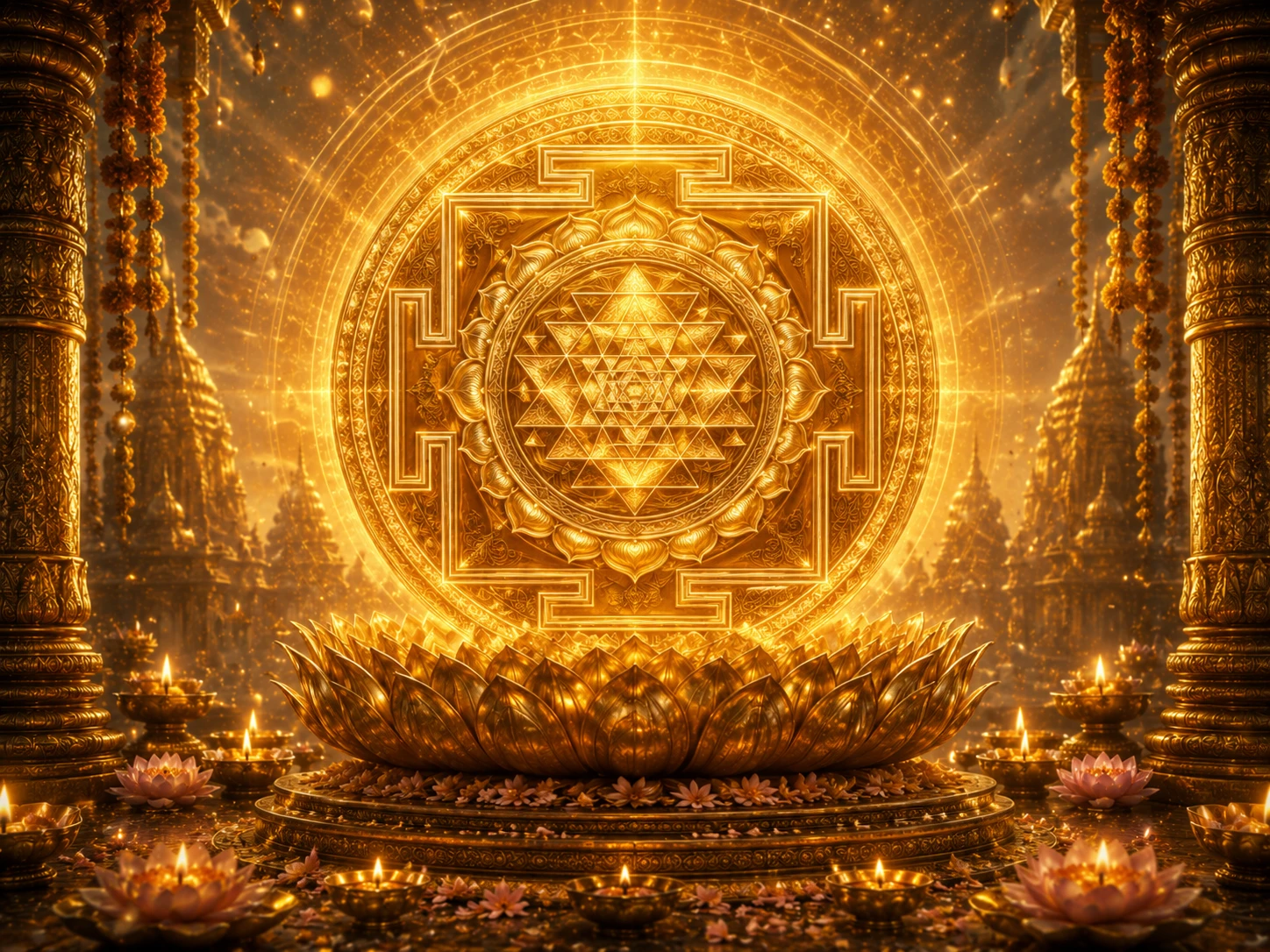
Yantra Geometry -- The Sacred Mathematics of Form
यन्त्र ज्यामिति -- आकार का पवित्र गणित
The Grammar Hidden in Every Yantra
Open any classical yantra -- the Sri Yantra above the cash counter at a Mumbai jeweller's shop, the Durga Yantra inscribed on a copper plate at a Pune household altar, the Hanuman Yantra a Bengaluru engineer downloads as his phone wallpaper before a difficult appraisal -- and at first glance you see a tangle of triangles, circles, petals, and squares. To the untrained eye it looks like decoration with rules. To someone who has learned the grammar, it reads like a sentence. Every line carries meaning. Every angle is a verb. The shapes are not arbitrary symbols. They are a working geometric language with maybe six or seven core elements, combined in different ratios to invoke different deities and energies.
The extraordinary thing is that this language has been stable for at least two thousand years. The Sri Yantra carved into the floor of a Shrividya temple at Kanchipuram and the Sri Yantra printed on a paper card sold at a Haridwar street stall use the same nine intersecting triangles and the same forty-three smaller triangles formed by their intersections. The geometry has not drifted. This is unusual. Most visual traditions evolve. Yantra geometry behaves more like Sanskrit grammar -- once Panini codified it, the rules stayed put. There is a reason. A yantra is not a representation of a deity. It is the deity, in geometric form. Drift the geometry and you drift the deity.
This article unpacks the six or seven elements that make up almost every yantra you will ever encounter -- the bindu at the centre, the upward triangle, the downward triangle, the six-pointed star formed by their union, the lotus petals, the surrounding circles, and the outer square called the bhupura. Once you know how to read these, you can walk into any Hindu temple, look at any tantric diagram, and follow the grammar.
ईश्वरः सर्वभूतानां हृद्देशेऽर्जुन तिष्ठति। भ्रामयन्सर्वभूतानि यन्त्रारूढानि मायया॥
iśvarah sarva-bhutanam hrd-deshe 'rjuna tishthati bhramayan sarva-bhutani yantra-arudhani mayaya
The Lord dwells in the heart of all beings, O Arjuna, causing all beings -- mounted as if on a machine -- to wander by His Maya.
— Bhagavad Gita 18.61
The Word Yantra and Its Root
The word yantra comes from the Sanskrit root yam, meaning to hold, restrain, control, or sustain. A yantra is, etymologically, an instrument that holds something. The Bhagavad Gita verse just quoted uses the word yantra in the sense of a contraption or machine that holds the soul in motion. The same root gives us niyantra, the controller, and saiyantra, self-restraint. So when the tantric tradition calls the geometric diagram a yantra, the choice of word is precise. The diagram is an instrument that holds the deity in place, holds the practitioner's attention, and holds a specific energy in geometric containment.
This matters because western readers often translate yantra as symbol, which is wrong. A symbol points to something else. A yantra contains what it depicts. The classical analogy used in tantric texts is that the yantra is the body of the mantra and the mantra is the speech of the deity. Worshipping the yantra and chanting the mantra together is, in this framework, identical to worshipping the deity directly. There is no representation gap. The Kularnava Tantra makes this point repeatedly in its sixth chapter, calling the yantra the deity's actual residence rather than its picture.
For a contemporary Indian, this distinction is important because it explains why a printed Sri Yantra placed on a desk is not casual decoration the way a Mona Lisa print is. The classical view is that even a printed yantra, once consecrated through proper mantras and prana pratishtha, becomes the deity's seat. This is why your grandfather refuses to throw away an old printed yantra into the trash and insists it be given to a flowing river instead. The geometry is not paper. The geometry is presence.
The Six Core Elements of Yantra Geometry
| Element | Sanskrit | Geometric Form | Symbolic Meaning | Where You See It |
|---|---|---|---|---|
| Bindu | बिन्दु | Single dot at centre | Origin point, undifferentiated consciousness, the source from which all geometry radiates | Centre of every yantra; dot above ॐ; bindi on forehead |
| Upward Triangle | ऊर्ध्व त्रिकोण | Apex pointing up | Shiva, fire, masculine principle, the ascent of consciousness toward the absolute | Shiva yantra core; central triangle of any solar/fire yantra |
| Downward Triangle | अधो त्रिकोण | Apex pointing down | Shakti, water, feminine principle, the descent of grace into manifestation | Shri Yantra (4 of 9 triangles point down); womb-shaped yoni symbols |
| Hexagram (Shatkona) | षट्कोण | Six-pointed star, two interlocking triangles | Union of Shiva and Shakti; the inseparable polarity that generates the universe | Centre of Sri Yantra; Anahata chakra symbol; Vishnu yantra |
| Lotus Petals | कमल दल | Concentric rings of stylised petals (8, 16, or 1000) | Unfolding consciousness; chakras of the subtle body; manifestation expanding outward from the centre | Outer rings of most yantras; Sahasrara chakra; padma-asana |
| Bhupura (Earth-Square) | भूपुर | Outer square with three lines on each side and four T-shaped gates | The earthly plane; cosmos contained; the four cardinal directions sealed by gates | Outermost frame of nearly every classical yantra |
Almost every classical yantra is built from these six elements arranged in different ratios. Mastering this small vocabulary lets you read any yantra you encounter.
The Two Triangles -- Shiva, Shakti, and the Logic of Polarity
Of all the geometric elements in the yantra grammar, the two triangles are the most fundamental and the most misunderstood. The upward-pointing triangle and the downward-pointing triangle are not decorative choices. They are a precise statement about how the universe is structured.
The upward triangle, with apex pointing toward the sky, represents Shiva, fire, the masculine principle, the still witness consciousness. Geometrically, it concentrates upward into a point -- a movement toward singularity, toward the absolute. This shape appears in fire altars, in the upper triangle of the hexagram, and in solar yantras across India. It is also the shape of a flame, of a mountain like Kailash, of the upward thrust of a temple shikhara. None of these correspondences are coincidence. They are the same idea repeated in different scales.
The downward triangle, with apex pointing toward the earth, represents Shakti, water, the feminine principle, the manifesting power that brings the absolute into form. It concentrates downward into a point -- a movement toward manifestation, toward embodiment. This shape appears in tantric yoni symbols, in the lower triangle of the hexagram, in Devi yantras across the goddess traditions. It is also the shape of a vessel that receives, of a womb, of a kunda or fire-pit, of the downward sweep of grace.
The genius of yantric geometry is that it never picks one triangle over the other. The Sri Yantra has nine triangles -- five pointing down and four pointing up -- because Shrividya philosophy holds that Shakti slightly predominates in this current cosmic cycle, but never to the exclusion of Shiva. The two are co-implicated, never separable. When a Bengaluru product manager sketches a SWOT matrix on a whiteboard, she draws four quadrants because business strategy thinks in clean oppositions. When a tantric draws a yantra, she draws interlocking triangles because Hindu metaphysics thinks in irreducible polarities. The difference is not stylistic. It is philosophical. Hindu cosmology has no patience for either-or framings. Reality, in this view, is always both, in tension, in geometric balance.
Drawing a perfect Sri Yantra requires solving the classical problem of fitting nine intersecting triangles such that all forty-three sub-triangles are clean and meet precisely at shared vertices. Mathematicians at IIT Bombay and the Indian Statistical Institute have published papers on the geometric construction of Sri Yantra, noting that there is no closed-form algebraic solution -- the construction requires iterative numerical methods to converge on the exact ratios. The pre-modern Indian artisans who carved Sri Yantra into temple floors solved this iteratively by eye, using calibrated cords and templates. Try drawing one freehand and you will quickly understand why temple sthapatis trained for years before they were trusted to inscribe one.
The Hexagram and the Logic of Intersection
When the upward and downward triangles overlay each other, they create a six-pointed star that Sanskrit calls the shatkona, literally six-cornered. This is the same shape that western readers recognise from Jewish iconography as the Star of David. The two traditions arrived at the geometry independently and gave it different meanings. In the Hindu reading, the shatkona is the visible diagram of Shiva-Shakti union. The two triangles do not merely sit on top of each other. They interpenetrate. Each holds a small region of the other inside itself. This is geometric vocabulary for inseparable union.
The shatkona appears at the heart of the Anahata chakra, the heart-centre in tantric yoga. It appears in the central triangle of the Sri Yantra. It appears in countless temple ceiling rosettes. It appears tattooed on the foreheads of certain Vaishnava sannyasis as a tilak. The geometric idea is consistent across all these uses: the meeting point of the masculine ascending and the feminine descending currents is the place where life happens. Anahata, in fact, means unstruck -- referring to a sound that arises without two surfaces colliding, a sound that exists at the meeting of the two triangles, a sound that is the heart's silent music.
For a Pune software architect debugging a system at midnight, the shatkona offers an unexpected metaphor. Two opposing currents, neither of which can be eliminated, find their resolution not by one defeating the other but by interpenetrating. The bug is not always solved by killing one path of code. Sometimes it is solved by recognising that two paths must coexist in geometric balance. The shatkona is not a religious symbol used metaphorically here. It is a structural insight rendered as geometry, applicable wherever opposing forces refuse to negotiate themselves out of existence.
Lotus Petals and the Rhythm of Unfolding
Around the central geometry of any major yantra you will see one or more rings of stylised lotus petals -- usually eight, sometimes sixteen, occasionally twenty-four or one hundred and eight or one thousand. The lotus is not random Indian decoration. The lotus carries a precise philosophical claim. It is the only flower that grows in mud, blooms above water, and stays untouched by either. In yantric grammar, the lotus represents consciousness as it unfolds outward from the bindu without losing its purity. Each petal is one degree of manifestation. The eight petals of the inner lotus often correspond to the eight Dikpalas, or the eight forms of a deity, or the eight powers of the goddess. The sixteen petals of the outer lotus typically correspond to the sixteen kalas of the moon, or the sixteen vowels of Sanskrit, or the sixteen aspects of consciousness in different schools.
The rhythm of petal counts -- one, two, four, six, eight, sixteen, sixty-four, one thousand -- is itself meaningful. These are doublings, the same logarithmic rhythm that recurs in chakra theory, in mantra repetition counts, in the Indian musical tala system. The geometry of the lotus tells the practitioner that consciousness expands not arithmetically but exponentially. From bindu to first petal is a small step. From inner petal-ring to outer petal-ring is a much larger step. This is mathematically the same scaling that engineers in modern Bengaluru deal with when they think in orders of magnitude. The Indian sthapati who designed the lotus rings was working with the same intuition.
Look closely at the Sahasrara chakra at the crown of the head as drawn in any tantric chart. It is a thousand-petalled lotus, depicted with concentric rings of petals at multiple counts. The thousand is not a literal census. The thousand means the petal-rhythm has reached a density where individual petals can no longer be counted -- the unfolding has saturated. The same logic applies to the outer petals of major yantras. They are not decoration around the geometric core. They are the geometric statement that consciousness, once it leaves the bindu, expands in petals all the way outward to the bhupura at the edge of the yantra.
Computer scientists at the Indian Institute of Science in Bengaluru, working on procedural generation algorithms, have noted that the petal-doubling rhythm of yantric rings carries a recursive structure that maps cleanly onto modern fractal mathematics. The Sri Yantra has nested triangles within triangles. The Sahasrara has petal-rings within petal-rings. Smaller mandalas appear inside larger ones, repeating the parent pattern at smaller scales. These are not aesthetic accidents. They are early intuitions of self-similarity, the same principle that Benoit Mandelbrot would formalise as fractal geometry only in the late twentieth century. Whether the pre-modern Indian sthapatis had the abstract concept is unprovable and not the claim being made. What is geometrically undeniable is that they were drawing fractal patterns long before the mathematics existed to describe what they had drawn.
Famous Yantras and Their Primary Geometric Signatures
| Yantra | Deity | Distinguishing Geometry | Primary Use |
|---|---|---|---|
| Sri Yantra (Shri Chakra) | Lalita Tripurasundari | 9 interlocking triangles forming 43 sub-triangles, central bindu, 8+16 lotus petals, bhupura | Highest tantric worship; supreme yantra in Shrividya |
| Ganesha Yantra | Ganesha | Central bindu in upward triangle, 8-petalled lotus, hexagram, bhupura | Removing obstacles; new beginnings; placed at thresholds |
| Kali Yantra | Mahakali | 5 inverted triangles around bindu, 8 lotus petals, bhupura | Shakta worship; transformation, dissolution of fear |
| Durga Yantra | Durga / Bhuvaneshwari | 9-pointed star pattern, 16-petalled lotus, bhupura | Protection; courage; warrior energy |
| Hanuman Yantra | Hanuman | Central inscribed mantra in upward triangle, surrounded by hexagrams | Strength, fearlessness, freedom from negative influences |
| Maha Mrityunjaya Yantra | Shiva (death-conqueror) | Central trishul or shivalinga, 8-petalled lotus, square bhupura | Health, longevity, recovery from illness |
The shared grammar (bindu, triangles, petals, bhupura) is consistent. The variations -- which way the triangles point, how many petals, what mantra inscription -- specify which deity the yantra holds.
The Bhupura -- Why Every Yantra Is Sealed in a Square
Step back from the centre of any classical yantra and you will see the geometry framed in an outer square with three concentric lines on each side and four T-shaped openings at the cardinal points. This is the bhupura, literally earth-city. The bhupura is the most overlooked element in popular yantra commentary, but in tantric ritual it is the most important. Without the bhupura, the yantra is incomplete and unsafe to invoke. The Kularnava Tantra is explicit about this. A yantra without a properly drawn bhupura is energy without containment, like running an electric current without insulation.
The symbolism is layered. The four sides represent the four cardinal directions, the four Vedas, the four ages of dharma, the four states of consciousness. The three lines on each side often represent body-mind-spirit, or the three gunas, or the three states of waking-dreaming-deep-sleep. The four T-shaped gates at the cardinal points are the doorways through which the worshipper symbolically enters the yantra during meditation -- usually approaching from the east. The square shape itself is significant. Where circles represent cosmic time and triangles represent dynamic principles, the square represents the earthly plane, the realm of stability, the geometry of buildings and rooms. The yantra is saying that the cosmic geometry it depicts must be grounded in this world to be useful. Spiritual reality without earthly grounding is unsafe to access.
This matters because the same logic governs Hindu temple architecture. The garbhagriha, the womb-house at the centre of any major temple, is square. The vimana that rises above it has a square base. The temple compound is a square or a square subdivided into smaller squares according to the Vastu mandala. A Vastu Purusha Mandala, which any architect designing a temple at Tirupati or a home in Pune Vastu-approved layout still consults, is fundamentally a yantra at architectural scale. The bhupura you see around a printed Sri Yantra and the boundary wall around your house are the same shape doing the same job. The principle is one.
When you visit Brihadeeshwara Temple at Thanjavur or Lingaraja Temple at Bhubaneswar from above, you can see the entire temple plan is laid out as a yantra. The garbhagriha sits at the bindu position. The vimana directly above contains an inverted triangle of stones in its inner chamber. The mandapas radiate outward in petal-like patterns. The compound walls form the bhupura. Drone footage of major South Indian temples published by Indian heritage channels in recent years has made this geometry visible to anyone with a phone. The temple is not a building decorated with yantric motifs. The temple is a yantra rendered at the scale of stone.
Reading Yantra Geometry in Daily Life
Once you know the grammar -- bindu, two triangles, hexagram, lotus petals, bhupura -- you can read yantric geometry almost everywhere in Indian life. The rangoli your mother draws at the threshold every morning is a small yantra; the central dot is the bindu, the radiating petals or triangles are the lotus and shatkona, the outer enclosing line is the bhupura. The mandala that a Mumbai art teacher gets her students to colour for relaxation is a simplified yantra. The pattern on the wedding mandap floor at any classical Hindu marriage is a yantra at room scale. The thali plate at a Tamil Brahmin meal is laid out in a quasi-yantric pattern with rice at the bindu and accompaniments arranged in cardinal directions.
Even contemporary Indian branding draws on this geometric vocabulary, sometimes deliberately, sometimes without the designer realising the lineage. The Air India Maharaja's turban motifs, the Padma Awards medallion, the logo of the Indira Gandhi National Centre for the Arts, the seal of the National Institute of Design at Ahmedabad -- all carry traces of yantric proportion. When Raghunath Anant Mashelkar, the chemical engineer who led CSIR for many years, gave a TED talk on Indian design thinking, he observed that the strongest contemporary Indian logos almost always honour an underlying mandalic geometry. The visual vocabulary outlasts its religious context. The grammar persists even where the worship does not.
The interesting move for a contemporary practitioner is to start drawing your own. You do not need to attempt the Sri Yantra on your first try. A Mumbai design student bored on a Sunday afternoon can pick a sheet of paper, mark a central dot, draw an upward triangle around it, draw a downward triangle interpenetrating, add an eight-petalled lotus around the hexagram, and enclose the whole thing in a square with four gates. That is, geometrically, a complete yantra. Whether or not you treat it as a sacred object, drawing it teaches you the grammar from inside out. The hand learns what the eye merely recognises.
For the more committed seeker, a printed Sri Yantra placed at eye level for ten minutes of trataka -- soft-eyed gaze meditation -- in the morning before checking the phone is a complete contemplative practice. Studies on visual gaze meditation conducted at the All India Institute of Medical Sciences in New Delhi have documented measurable changes in attention and stress markers after sustained yantra trataka. The geometry, when held in the visual field with steady attention, reorganises the practitioner's visual cortex around the yantra's structure. Whether you frame this scientifically or spiritually, the effect is real.
There is one more reading worth offering. The yantra's geometry is a map of how to think about your own life. Where is your bindu -- the still centre, the unmoving witness? Where are your two triangles -- the ascending aspirations and the descending obligations, the masculine and feminine currents within you? Where is your hexagram -- the place where these meet and produce something neither could alone? Where are your petals -- the relationships and responsibilities that radiate outward from your centre? And where is your bhupura -- the boundaries that hold all this in safe containment? A life without all five elements is, in yantric terms, geometrically incomplete. The diagram does not just hold a deity. It holds a complete map of a well-formed self.
Sri Yantra Trataka Meditation
A ten-minute trataka on the Sri Yantra: soft gaze, structured attention, and the geometry of contemplation. When the eyes tire, close them and hold the after-image. The Steady Gaze dharana on Eternal Raga teaches the same practice with a lamp flame.
Tags
Eternal Raga · शाश्वत राग
Institutional voice — scholarly articles on Sanatan Dharma
Deepen Your Understanding
अपनी समझ और गहरी करें
sacred symbols
Bindu -- The Point from which Creation Emerges
Look closely at the symbol ॐ. See the small dot above the curve? That is the Bindu, and in Hindu metaphysics it is not decoration. It is the point from which the universe began, and the point into which it will return. Meet the smallest mark in Hinduism that contains all of cosmology.
sacred symbols
Sacred Directions and Dikpalas -- The Eight Guardians of Space
Why does your grandmother insist the kitchen face southeast and the master bedroom southwest? Behind every Vastu rule stands a Dikpala -- a deity assigned to guard one of eight directions of cosmic space. Meet the eight watchmen who turn empty space into sacred geography.
tantra mantra yantra
Tantra, Mantra and Yantra -- The Three Pillars of Spiritual Practice
Tantra is the loom, Mantra is the thread, Yantra is the pattern. Together they form the complete technology of spiritual transformation that India gifted to the world -- and they are far more profound than popular culture imagines.
vedic sciences
Kaal Ganana -- The Hindu Measure of Time
From a single blink of the eye (Nimesha) to one Day of Brahma (4.32 billion years) -- explore the complete cosmic time hierarchy of Hindu cosmology, anchored in Vishnu Purana 1.3, with its remarkable parallels to modern science.
sacred symbols
Sri Chakra -- The Sacred Geometry That Takes a Lifetime to Draw Perfectly
Nine interlocking triangles. Four pointing upward (Shiva). Five pointing downward (Shakti). Their intersection creates 43 smaller triangles that map the entire journey of consciousness from the material to the divine. The Sri Yantra is the most complex sacred geometric figure in any world tradition -- and mathematicians still argue about whether it can be drawn with perfect precision.
vedic sciences
Vastu Shastra -- The Ancient Science of Architecture That India Still Builds By
Before Frank Lloyd Wright talked about buildings harmonising with nature, before Le Corbusier designed Chandigarh, and before LEED green-building certifications existed, Indian architects were writing Sanskrit manuals on how to align a house with sunlight, wind, water, and the earth's magnetic field. Vastu Shastra -- literally 'the science of dwelling' -- is not superstition wrapped in incense. At its core, it is an empirical framework for orienting buildings so that natural light, ventilation, and thermal comfort work in the occupants' favour. The problem is that centuries of misapplication have buried the science under astrology, pseudoscience, and real-estate marketing. This article separates the architecture from the astrology.
Drawing a perfect Sri Yantra requires solving the classical problem of fitting nine intersecting triangles such that all forty-three sub-triangles are clean and meet precisely at shared vertices. Mathematicians at IIT Bo…
More in Sacred Symbols
Ashtamangala -- The Eight Auspicious Symbols of Hindu Tradition
13 min read
Bindu -- The Point from which Creation Emerges
12 min read
Gau -- Why the Cow Holds the Place She Does in Hindu Life
14 min readThe same translation error that turned '33 Koti' into '33 crore' in Hinduism also happened in Buddhism. The Chinese translation of Buddhist texts rendered 'Sapta Koti Buddha' (7 Supreme Buddhas) as '7 Crore Buddhas.' The…
Deities AvatarsCommunity Reflections
🕉️
Be the first to share your reflection.