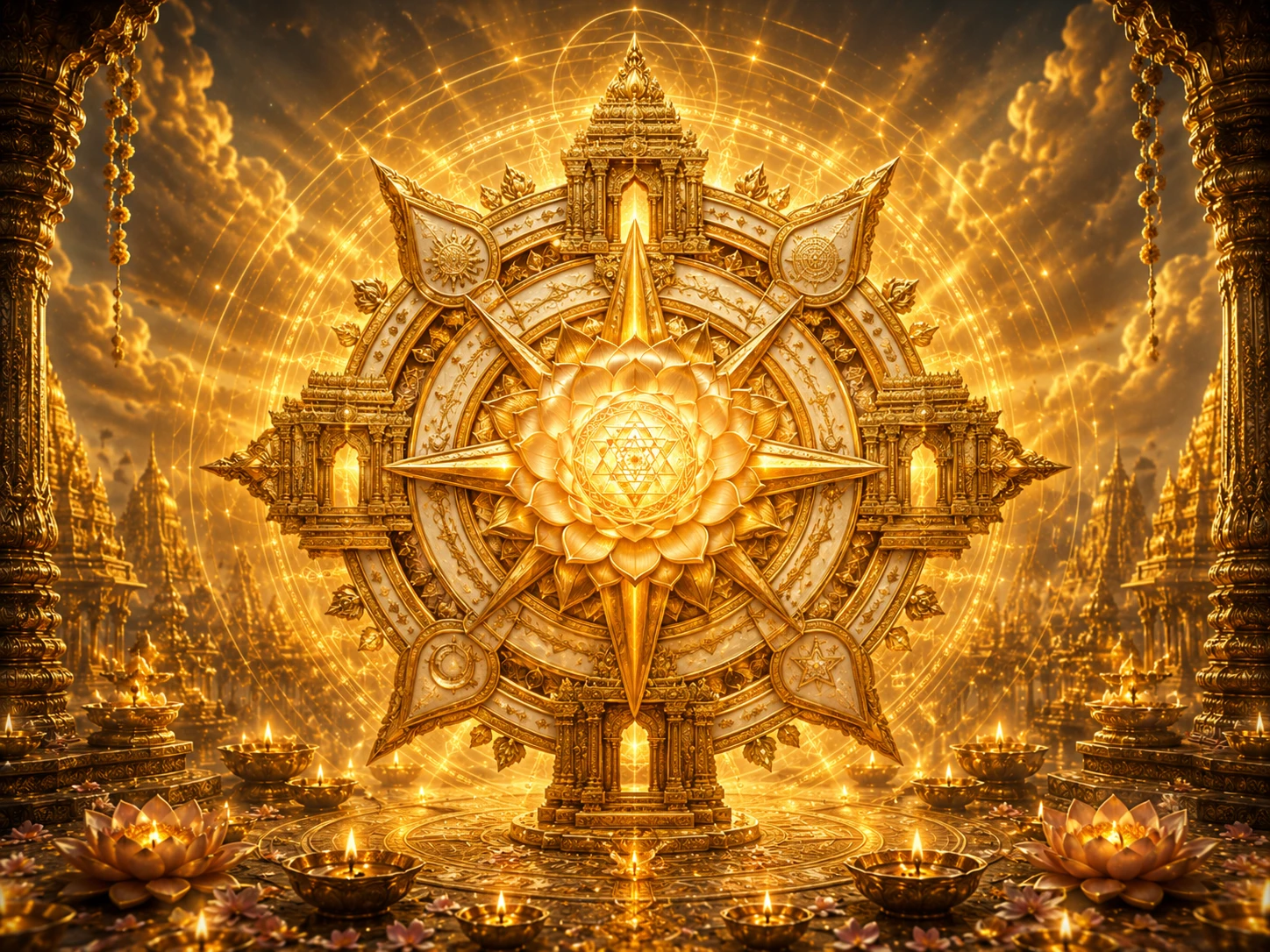
Sacred Directions and Dikpalas -- The Eight Guardians of Space
पवित्र दिशाएँ और दिक्पाल -- अष्ट दिशाओं के रक्षक
The Architecture of Sacred Space
Walk into any new flat in Bengaluru's Whitefield, Mumbai's Worli, or Pune's Baner, and a particular kind of conversation will start. The kitchen should ideally be in the southeast. The pooja room belongs in the northeast. Heavy furniture should sit in the southwest. The main door is best on the east or north side. Most young Indians who hear this from their parents or in-laws assume it is grandmother-physics, charming but unrigorous. What they are actually hearing is a five-thousand-year-old map of cosmic responsibility, where each direction in space carries the signature of a specific deity tasked with guarding it.
In Hindu cosmology, space is never empty. Every direction is awake. Every direction has a watchman. These eight watchmen are called the Ashta Dikpalas, the eight guardians of the directions, and behind every Vastu Shastra prescription, every temple orientation, every Hindu ritual that asks you to face a specific way, stands one of them. The Dikpalas are not abstractions. They are deities with names, weapons, mounts, mantras, palaces, queens, and ethical jurisdictions. To know them is to understand why a Hindu temple is built the way it is, why a wedding mandap faces the way it does, and why the Sankalp before any puja explicitly states the direction the worshipper sits in.
This article is your map of the eight directional deities. Once you know them, the world stops being neutral. Every road you walk down is a road one of them rules. Every house you live in sits at the intersection of their gazes.
इन्द्रानिलयमार्काणामग्नेश्च वरुणस्य च। चन्द्रवित्तेशयोश्चैव मात्रा निर्हृत्य शाश्वतीः॥
indraanilayamaarkaanaam agneshca varunasya ca candravittesayoshcaiva maatraa nirhrtya shaashvateeh
Drawing forth the eternal essential particles of Indra, Anila (Wind), Yama, Arka (Sun), Agni (Fire), Varuna, Chandra (Moon), and Vittesha (Lord of Wealth, Kubera) -- the Lord fashioned the king. Each of these eight directional powers is described as a permanent, indestructible portion of cosmic order.
— Manu Smriti 7.4
Why the Hindu Mind Maps Space This Way
Most modern human beings think of space the way Newton thought of it: an empty container, a passive grid of x, y, and z coordinates that holds objects but does nothing itself. Direction, for the post-Newtonian mind, is just a label. North is north because of the magnetic pole. East is east because the sun comes up there. The cardinal points are practical instruments, not living agents.
The Vedic seers held a different view. For them, space was an organism. The eight cardinal and intercardinal directions were not mere coordinates but ethical jurisdictions, and each jurisdiction had a deity whose specific qualities defined the moral and physical character of that quadrant. The east, ruled by Indra, holds beginnings, leadership, light, and the rising of consciousness. The south, ruled by Yama, holds ancestors, judgement, the realm of the departed. The west, ruled by Varuna, holds water, the unconscious, dissolution, the descent of the sun. The north, ruled by Kubera, holds wealth, prosperity, the polar steadiness around which the heavens rotate.
This is not poetic decoration. It is a functional cosmology. When the Vastu Shastra says the kitchen should be in the southeast, it is because Agni, the Fire deity, rules that direction, and the kitchen is essentially a domestic agnihotra, a daily fire ritual disguised as cooking. When it says the head of the house should sleep with the head pointing south, it is because Yama rules the south, and turning your sleeping head toward Yama is symbolically aligning yourself with the ancestor stream from which you came. The recommendation is not arbitrary. It is theology compressed into architecture.
This is why the Sankalp recited before any major puja, from a Bengali graduate student's first Saraswati Puja in her hostel room to the Kumbhabhishekam of a major temple, includes the directional formula. The worshipper is not just stating where they are physically. They are entering into a contract with the directional deity ruling that space, requesting permission and witness. Without the Dikpala's silent assent, the ritual is technically incomplete.
The Eight Dikpalas (Ashta Dikpalakas) -- A Complete Reference
| Direction | दिशा | Dikpala | Vahana (Mount) | Weapon / Symbol | Domain |
|---|---|---|---|---|---|
| East (Purva) | पूर्व | Indra (इन्द्र) | Airavata (white elephant) | Vajra (thunderbolt) | Rulership, rain, leadership, the heavens |
| Southeast (Agneya) | आग्नेय | Agni (अग्नि) | Ram (mesha) | Shakti (spear), flames | Fire, transformation, the kitchen, sacrifice |
| South (Dakshina) | दक्षिण | Yama (यम) | Mahisha (buffalo) | Danda (rod of justice), pasha (noose) | Death, dharma, ancestors, judgement |
| Southwest (Nairritya) | नैऋत्य | Nirriti (निर्ऋति) | Nara (corpse) or lion | Khadga (sword), shield | Misfortune, dissolution, the unwanted, stability of foundations |
| West (Pashchima) | पश्चिम | Varuna (वरुण) | Makara (sea creature) | Pasha (noose), water vessel | Oceans, oaths, cosmic law (rta), the unconscious |
| Northwest (Vayavya) | वायव्य | Vayu (वायु) | Mriga (deer) or antelope | Dhvaja (banner), ankusha (goad) | Wind, breath, motion, change, communication |
| North (Uttara) | उत्तर | Kubera (कुबेर) | Nara (man) or horse | Gada (mace), money pouch | Wealth, treasures, the Yakshas, polar stability |
| Northeast (Ishana) | ईशान | Ishana / Shiva (ईशान) | Vrishabha (bull, Nandi) | Trishula (trident), damaru | Knowledge, liberation, the divine, the pooja room |
Note: Manu Smriti 7.4 lists Surya and Chandra in place of Nirriti and Ishana, reflecting a slightly older formulation. The eight given here represent the standard Puranic and Tantric Ashta Dikpala system used in Vastu Shastra and temple architecture today. The same deities are also called Ashta Dikpalakas or Lokapalas, the spelling common in South Indian and Agamic texts.
East and Northeast -- Where the Light Begins
Of the eight directions, two are considered most auspicious: the east and the northeast. Both are tied to the rising sun, but they carry different specific energies.
The east is Indra's domain. Indra is the Vedic king of the gods, the slayer of Vritra (the demon of drought), the rider of Airavata, the wielder of Vajra. He is associated with rain, lightning, victory in battle, and the public, exterior, social face of dharma. When you face east during sandhya-vandana, you are turning toward Indra's throne. When the main door of a Hindu house faces east, the household is symbolically inviting Indra to bless its comings and goings. Even the architecture of a JEE coaching centre in Kota tells you something: the desks are usually arranged so that the student faces the front, the front faces the entrance, and the entrance, when possible, faces east. Indra, after all, rules over leadership and victory.
The northeast, called Ishana, belongs to Shiva in his benevolent, knowledge-bestowing form. Ishana is the most sacred direction in the entire Vastu system. The pooja room must be in the northeast. The water source (the bore-well, the underground tank) should ideally be there too. The northeast must remain light, open, and uncluttered. This is why Vastu consultants insist on no toilets, no heavy storage, no staircases in the northeast corner. The northeast is the corner where the building, like a child looking up at its grandfather, faces the divine.
For the modern Indian, the practical takeaway is simple. If you have a choice in your office layout, your study desk, your meditation cushion, your work-from-home setup, place yourself so that you face east during the day or northeast during morning practice. You are not following superstition. You are aligning with five thousand years of accumulated observation about how attention, intention, and the body's circadian rhythm respond to directional light.
Major Indian temples are oriented along the east-west axis with mathematical precision. The Sun Temple at Konark, the Brihadeshwara at Thanjavur, and Kashi Vishwanath at Varanasi all have their main entrances facing east, so that the rising sun illuminates the garbhagriha through the doorway twice a year on specific days. This was achieved without compass technology, using only shadow-stick (shanku) measurements at the equinoxes -- a Vedic surveying technique called Vastu-prakriti, documented in the Manasara and Mayamatam.
South and Southwest -- The Ancestral Quadrant
If the eastern half of the compass is the realm of beginnings, the southern half is the realm of completion, finality, and the dead. This is why these directions, while sacred, are handled with caution.
Yama rules the south. He is the first man to die, and so the first to enter the realm of the departed, and so the king of that realm. He is also the dharma-raja, the lord of moral accounting, weighing the deeds of every soul on a cosmic balance. South-facing doors are traditionally avoided in residential design, not because the south is evil, but because Yama's gaze is heavy. South-facing doors are reserved for buildings where Yama's qualities are useful: courthouses, hospitals, places where life-and-death decisions get made. The Tirupati Balaji temple, atypically, faces east, but the deity inside, Venkateshwara, is said to be looking south, witnessing all who pass on. This is not a contradiction. It is a precise theological choice.
The southwest, called Nairritya, belongs to Nirriti -- a goddess of dissolution, decay, and misfortune. This sounds frightening to a modern ear, but the Vastu logic is exquisite. Because the southwest holds the weight of decay, you put heavy, anchoring things there: the master bedroom, the heaviest cupboard, the foundation stone, the family safe. You let the unwanted accumulate where the deity of the unwanted already lives, so that the rest of the house stays light. The southwest is not where you put the dustbin. The southwest is where you put your heaviest commitments, because Nirriti's weight will keep them from drifting. Your grandmother who insists the master bedroom be in the southwest has, without ever opening Manasara, internalised this principle perfectly.
This is also why ancestral rituals and Pitru Paksha tarpan are performed facing south. You are not turning toward death. You are turning toward the lineage that produced you, asking it to bless the next generation through you. The ancestor stream flows from the south, and you must face it to be in dialogue with it.
West, Northwest, North -- Water, Wind, Wealth
The western trio of directions completes the cycle. The west is Varuna, lord of waters, oaths, and cosmic law. He is the most ancient of the Vedic deities in some readings, older than Indra himself, and his domain is the realm of binding agreements, the truth that must be kept. When a Hindu marriage takes saptapadi vows, when a soldier swears allegiance, when a doctor takes the modern oath, Varuna is the unseen witness. The west is also where the sun sets. To face west at sunset is to acknowledge that everything that begins must dissolve, that every commitment must be honoured even after the light fades.
The northwest is Vayu, lord of wind, breath, and movement. This is the direction of communication, change, and travel. In Vastu, guest rooms and toilets are often placed in the northwest, because the energies of motion and impermanence are appropriate there. A guest is a person passing through, and Vayu rules passage. Even modern airport architecture in cities that respect Vastu, like the planning of certain temple-town railway stations, places transit zones along the northwest axis.
The north is Kubera, the lord of treasures. He is a Yaksha king, brother of Ravana, regent of Mount Kailasa, owner of nine fabulous wealth-deposits called the Nava Nidhis. His direction holds the Pole Star (Dhruva), the only stable point in the rotating sky, and so the north represents both stability and prosperity. This is why the cash-box, the safe, and the financial documents in any traditional Indian shop are placed along the north wall. The shopkeeper in Old Delhi who places his Lakshmi photo facing north on Dhanteras is doing applied Dikpala theology. The Bengaluru startup founder who unconsciously prefers his investor-pitch desk to face north or sit in the north of the office is participating in the same five-thousand-year-old logic, even if she has never read a Vastu book.
The genius of the eight-direction system is that it is not symmetrical. East is for beginnings, south for completion, west for promises, north for accumulation. Each direction has a distinct ethical signature, and the well-built Hindu house, the well-oriented temple, and the well-aligned ritual move through these signatures in sequence, taking blessings from each.
Bija Mantra and Tantric Attribute of Each Dikpala
| Dikpala | Bija Mantra | Tantric Element | Modern Application |
|---|---|---|---|
| Indra (East) | Lam (लं) | Earth/leadership | Invoked before exams, interviews, presentations |
| Agni (Southeast) | Ram (रं) | Fire | Invoked before lighting any new stove, first havan in a new home |
| Yama (South) | Yam (यं) | Discipline/restraint | Invoked during pitru tarpan, end-of-life rites |
| Nirriti (Southwest) | Ksham (क्षं) | Decay/grounding | Invoked when laying foundation stone of a new building |
| Varuna (West) | Vam (वं) | Water | Invoked at oath-taking, sankalp before vows |
| Vayu (Northwest) | Yam (यं) / Pavanaya | Air | Invoked before journeys, by sailors and pilots traditionally |
| Kubera (North) | Sham (शं) | Wealth | Invoked on Dhanteras, before opening a new business or account |
| Ishana (Northeast) | Ham (हं) | Ether/akasha | Invoked before any spiritual practice, japa, study of scripture |
Bija mantras vary slightly between Tantric schools (Shrividya, Kashmir Shaiva, Vaishnava). The forms above follow the most widely transmitted Shrividya tradition. Always learn from a qualified guru before sustained practice.
When Eight Become Ten -- The Tantric Expansion
The standard Ashta Dikpala system covers eight directions on a flat plane. But human experience is three-dimensional, and the Tantric tradition expanded the framework accordingly. To the eight horizontal directions, two more were added: zenith (urdhva, directly above) and nadir (adhah, directly below). The deity assigned to the zenith is Brahma, the creator, the one whose seat is above all manifestation. The deity assigned to the nadir is Anantaa Shesha, the cosmic serpent, on whose coils the universe rests.
This ten-direction model is the framework you actually see when a temple priest performs the Dikpala Puja before a major event. He invokes each guardian by name, offers flowers in the appropriate direction, and finally gestures upward and downward to invite Brahma and Anantaa. The model embeds a deep philosophical claim: the human being is suspended at the centre of a perfectly balanced three-dimensional grid, watched from every conceivable angle, with no escape from the witness of the cosmos.
If this sounds claustrophobic, the Tantric reading is the opposite. To be witnessed from ten directions is also to be supported from ten directions. The same gaze that judges also protects. The Dikpalas are not surveillance officers. They are co-residents of the space you occupy, neighbours in the cosmic apartment building. When you bow at the four corners of the puja mandala before beginning, you are introducing yourself, asking permission to perform, and announcing your intention to ten beings whose territories you are temporarily entering.
If you have ever wondered why the ceiling of a major temple at Khajuraho or the mandapa at Belur is always richly carved with concentric mandala patterns rather than left blank, this is the answer. The ceiling is not decoration. It is the territory of Brahma the zenith deity, and Hindu shilpa shastra refuses to leave that quadrant unconsulted. Look up inside the inner sanctum of the Lakshmana Temple at Khajuraho or any classical Hoysala mandapa and you will see the eight Dikpalas carved at the cardinal and ordinal points of the ceiling rosette, with a lotus or padmanidhi at the centre marking the zenith. The architects were rendering, in stone, the same cosmology the Vedic seers gave us in mantra. A complete sacred space is sealed in all ten directions, including up and down, before a single human being walks in.
For a contemporary Indian, this framework offers a quietly radical alternative to the loneliness of modern urban life. You are never in an empty room. You are always in a room with eight visible neighbours and two invisible ones, all of whom remember you, all of whom respond to your conduct. The Dikpalas turn space itself into a community.
अग्निर्वाक् भूत्वा मुखं प्राविशद् वायुः प्राणो भूत्वा नासिके प्राविशद् आदित्यश्चक्षुर्भूत्वा अक्षिणी प्राविशद् दिशः श्रोत्रं भूत्वा कर्णौ प्राविशन्॥
agnirvaak bhutvaa mukham praavishad vaayuh praano bhutvaa naasike praavishad aadityashcakshurbhutvaa akshinee praavishad dishah shrotram bhutvaa karnau praavishan
Agni became speech and entered the mouth. Vayu became breath and entered the nostrils. Aditya (the Sun) became sight and entered the eyes. The Directions became hearing and entered the ears. (The text declares that the cosmic powers ruling the directions also live within the human body, as faculties of sense.)
— Aitareya Upanishad 1.2.4 (paraphrased structure)
When the Indian Space Research Organisation (ISRO) launches a major mission, several mission scientists, including former chairman Dr K Sivan and Dr S Somanath, have been publicly photographed visiting Tirupati Balaji and offering prayers facing the appropriate direction before launch days. While not part of official ISRO protocol, this private practice reflects the same Dikpala awareness that has shaped Indian temple architecture for millennia: significant beginnings deserve directional alignment. Whether one reads it as cultural ritual or as a deeper conviction, the gesture itself preserves a four-thousand-year-old habit of treating direction as ethically alive rather than geometrically inert.
Living the Dikpalas Today
You do not need to be a Vastu purist to bring this framework into daily life. The simplest application is direction-awareness during four key moments of a day. In the morning, face east when you wake up and offer the day to Indra and Surya before reaching for your phone. At lunch, if possible, sit so that you face east or north while eating, an old custom that aligns digestion with solar light. At sunset, allow yourself one minute of standing facing west, acknowledging Varuna and the day's promises kept or broken. Before sleep, lie down with your head pointing south or east, never north (which is reserved for the dead in traditional preparation). Even practising one of these four turnings, with attention, transforms the body's relationship with space.
For a college student in a hostel room or a working professional in a rented studio, no dramatic redesign is required. Your study desk against the eastern wall, your wallet on the northern shelf, your bed with its head to the south or east, your single small Lakshmi photo on the northern surface during Diwali, and a brief turn to each direction during morning sandhya, even thirty seconds long, are enough to restore the Dikpala framework to your daily rhythm.
The Dikpala framework also corrects a common misunderstanding about temple visits. When a devotee enters a major Hindu temple, the priest often instructs a specific direction-circuit -- start with the southeast lamp, move clockwise, finish at the northeast. This is not arbitrary etiquette. The devotee is being walked through the eight directional jurisdictions in the precise sequence the texts prescribe, taking blessings from each Dikpala before approaching the central deity. The next time a temple priest in Madurai or Khajuraho asks you to walk in a specific direction during pradakshina, you are not being managed. You are being introduced, one by one, to the eight neighbours of the cosmos. Each Dikpala is being asked to witness your visit. The deity in the garbhagriha receives a worshipper who has already been recognised by the eight guardians of space. This is why even a five-minute temple visit, properly performed, is far more elaborate than it appears.
This is also where you discover that Vastu is not a tyrant. The eight directions are not making demands on you. They are offering themselves as conscious neighbours. Most modern Vastu consultants who promise drastic transformation through expensive directional corrections have, frankly, distorted the tradition. The real Dikpala practice is quieter. It is the small daily acknowledgement that you live in space populated by witnesses, and that turning toward them, even by a few degrees, returns you to the cosmic conversation that the Vedic seers already mapped out for you.
There is a moment in the Ram Mandir Pran Pratishtha at Ayodhya in January 2024 that captures this beautifully. Before the central consecration, the officiating priests performed the Ashta-Dik-Bandhan, the binding of the eight directions, invoking each Dikpala by name and asking permission to install the deity. Hundreds of millions watched on television without recognising what they were seeing. They thought it was preliminary prayer. It was, in fact, a five-thousand-year-old protocol being executed live: the eight rulers of space being formally consulted before a new occupant moved into their shared neighbourhood. The temple at Ayodhya, like every properly consecrated Hindu temple before it, was built on the principle that no significant structure can be raised without the assent of the eight watchmen of the directions.
When your grandmother insists the kitchen face southeast and the safe sit in the north, she is not imposing a rule. She is handing you a key. Use it.
Sandhya Vandana with Directional Mantras
Begin a daily practice of facing east at sunrise and west at sunset, with a brief bow to the guardian of each direction. Eternal Raga's sandhyavandana guide sets out the fuller twice-daily practice this grows into.
Tags
Eternal Raga · शाश्वत राग
Institutional voice — scholarly articles on Sanatan Dharma
Deepen Your Understanding
अपनी समझ और गहरी करें
sacred symbols
Temple Architecture Symbolism -- Why Every Hindu Temple Is a Human Body, a Mountain, and the Universe
The dark womb-room at the centre. The tower rising above it like a spine. The gateway that frames the divine like an eye. A Hindu temple is not a building where you go to see God. It IS the body of God -- designed on a mandala grid, proportioned by sacred mathematics, and oriented to catch the first ray of the rising sun.
sacred symbols
Sri Chakra -- The Sacred Geometry That Takes a Lifetime to Draw Perfectly
Nine interlocking triangles. Four pointing upward (Shiva). Five pointing downward (Shakti). Their intersection creates 43 smaller triangles that map the entire journey of consciousness from the material to the divine. The Sri Yantra is the most complex sacred geometric figure in any world tradition -- and mathematicians still argue about whether it can be drawn with perfect precision.
sacred symbols
Yantra Geometry -- The Sacred Mathematics of Form
Triangles, hexagrams, lotus petals, the central dot, the framing square -- every classical Hindu yantra is built from a small grammar of geometric elements. This is the visual language behind Sri Yantra, Shri Chakra, and every temple wall.
sacred symbols
Why the Right Hand and Clockwise -- The Logic of Dakshina
Why are gifts received with the right hand, why is pradakshina always clockwise, why is the rare right-spiral conch worth lakhs? The principle is one word: dakshina. It carries skill, south, and right -- and it shapes every Hindu ritual.
sacred symbols
Ashtamangala -- The Eight Auspicious Symbols of Hindu Tradition
Eight symbols, drawn from a longer list of one hundred and eight auspicious objects, anchor every Hindu wedding card, every griha pravesh ceremony, every temple threshold. The swastika, the kalasha, the conch, the lamp -- and four more -- carry the entire compressed grammar of Hindu auspiciousness in a single visual set.
vedic sciences
Kaal Ganana -- The Hindu Measure of Time
From a single blink of the eye (Nimesha) to one Day of Brahma (4.32 billion years) -- explore the complete cosmic time hierarchy of Hindu cosmology, anchored in Vishnu Purana 1.3, with its remarkable parallels to modern science.
Major Indian temples are oriented along the east-west axis with mathematical precision. The Sun Temple at Konark, the Brihadeshwara at Thanjavur, and Kashi Vishwanath at Varanasi all have their main entrances facing east…
More in Sacred Symbols
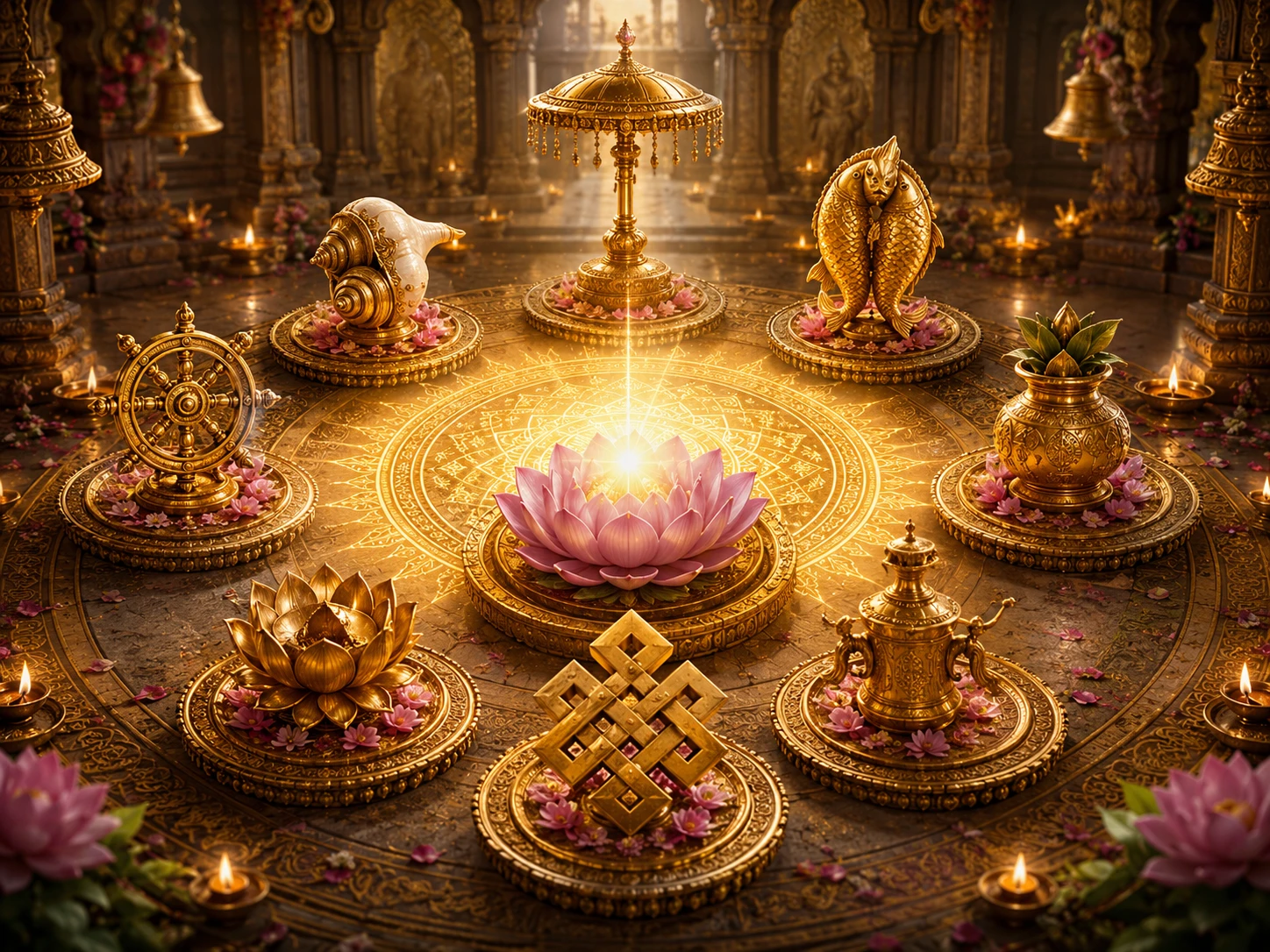
Ashtamangala -- The Eight Auspicious Symbols of Hindu Tradition
13 min read
Bindu -- The Point from which Creation Emerges
12 min read
Gau -- Why the Cow Holds the Place She Does in Hindu Life
14 min readThe same translation error that turned '33 Koti' into '33 crore' in Hinduism also happened in Buddhism. The Chinese translation of Buddhist texts rendered 'Sapta Koti Buddha' (7 Supreme Buddhas) as '7 Crore Buddhas.' The…
Deities AvatarsCommunity Reflections
🕉️
Be the first to share your reflection.