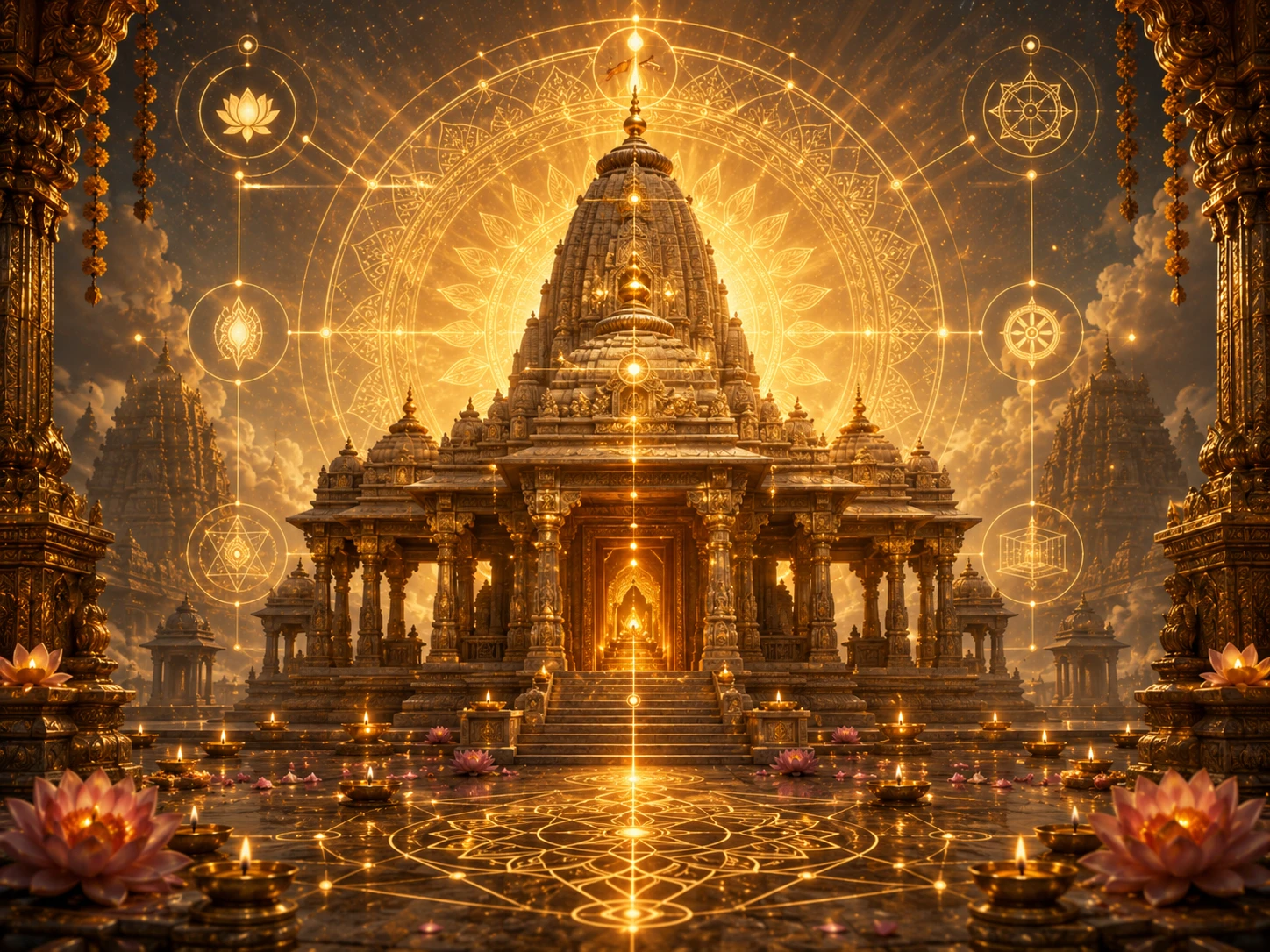
Temple Architecture Symbolism -- Why Every Hindu Temple Is a Human Body, a Mountain, and the Universe
मन्दिर वास्तु प्रतीकवाद -- क्यों हर हिन्दू मन्दिर मानव शरीर, पर्वत और ब्रह्माण्ड है
You have entered a Hindu temple hundreds of times. You have stood in the queue at Tirupati, circled the pradakshina path at Meenakshi Amman, touched the dwajasthambha at a neighbourhood temple, and felt that unmistakable shift -- the temperature dropping as you step from the blazing courtyard into the cool, dark sanctum where the deity waits, lit by a single oil lamp.
That shift is not an accident. It is architecture.
A Hindu temple is not simply a house for a deity. It is a three-dimensional mandala -- a built cosmogram that maps the structure of the universe onto stone, brick, and mortar. Every element -- the entrance gateway, the pillared hall, the circumambulatory path, the dark inner sanctum, the tower above it, the kalash at the apex -- corresponds to a specific cosmological, anatomical, and theological reality. The temple is simultaneously the body of God (with the garbhagriha as the heart), the cosmic mountain Meru (with the shikhara as its peak), and the human body (with the entrance as the feet and the sanctum as the head). To walk through a temple is to walk through all three at once.
The design system that governs all of this is the Vastu Purusha Mandala -- the sacred geometric grid prescribed by the Vastu Shastras and Shilpa Shastras, India's architectural treatises. The mandala divides space into a grid of squares (most commonly 64 or 81), each square assigned to a deity, each zone corresponding to a cosmic function. The central squares -- the Brahmasthana -- become the garbhagriha. The peripheral squares become the enclosure walls. The proportions of height, width, and depth are all derived from this grid.
The result is that a temple in Tanjore and a temple in Bhubaneswar and a temple in Khajuraho, though separated by thousands of kilometres and centuries of construction, share the same underlying logic. The styles differ -- Nagara in the north, Dravida in the south, Vesara in the Deccan -- but the grammar is one. The mandala is the source code.
गर्भगृहं तु हृदयं मण्डपं देहमुच्यते। गोपुरं पादमित्याहुर्देवालयस्य लक्षणम्॥
garbhagṛhaṃ tu hṛdayaṃ maṇḍapaṃ dehamucyate | gopuraṃ pādamityāhurdevālayasya lakṣaṇam ||
The garbhagriha is the heart, the mandapa is declared the body, the gopuram is said to be the feet -- these are the characteristics of a temple (devalaya, abode of God).
— Shilpa Shastra tradition (Manasara and Mayamata commentarial texts)
The temple is read from outside in -- and each zone you cross corresponds to a deeper layer of reality.
**Gopuram / Dvara (Gateway)**
In Dravida (South Indian) temples, the gopuram -- the towering gateway -- is the most visually dominant structure, often far taller than the central shrine. The Meenakshi Amman Temple in Madurai has gopurams reaching 52 metres, covered with thousands of painted stucco sculptures of gods, demons, animals, and mythological scenes. The gopuram is the feet of the temple-body. It is the threshold between the mundane world and sacred space. It is also a statement of power -- historically, the size of the gopuram indicated the wealth and piety of the patron king.
In Nagara (North Indian) temples, the entrance is marked by a torana (ornamental arch) or a porch rather than a towering gateway. The visual emphasis in Nagara style is on the shikhara (tower) over the sanctum, not the entrance.
**Mandapa (Pillared Hall)**
The mandapa is the body of the temple -- a pillared hall where devotees gather, where music and dance are performed, where the community assembles for festivals. Large temples have multiple mandapas: the mukha-mandapa (entrance hall), the sabha-mandapa (assembly hall), the nritya-mandapa (dance hall), and the bhoga-mandapa (offering hall). The pillars often feature intricate carvings of dancers, musicians, animals, yali (mythical creatures), and narrative scenes from the epics.
The Thousand Pillar Hall at Meenakshi Amman, the musical pillars of Hampi's Vittala Temple (where each pillar produces a different musical note when struck), and the sculpted pillars of Hoysala temples at Belur and Halebidu are among the most celebrated examples of mandapa craftsmanship.
**Antarala (Vestibule)**
The antarala is the narrow passage between the mandapa and the garbhagriha -- the transition zone between the communal space and the most sacred space. It is the throat of the temple-body. Symbolically, it represents the passage from the outer world to the inner divine -- the narrowing of consciousness as you approach the deity.
**Garbhagriha (Sanctum Sanctorum)**
Garbhagriha literally means 'womb-house'. It is a small, dark, enclosed chamber with no windows, containing only the murti (deity image) and the lamp. The darkness is deliberate. The devotee, having walked through the bright, sensory-rich mandapa, enters a space of radical simplification -- no decoration, no distraction, just the deity and the flame. The garbhagriha is the heart of the temple-body. It is the Brahmasthana of the Vastu Purusha Mandala. It is Mount Meru's peak cave. It is the sahasrara chakra of the yogic body. All metaphors converge here.
The murti inside is not understood as a statue. It is the deity -- installed through the Prana Pratishtha ceremony, which infuses divine energy into the image. The garbhagriha is, therefore, literally the womb in which the divine is born and housed.
**Shikhara / Vimana (Tower)**
Rising directly above the garbhagriha, the shikhara (North India) or vimana (South India) is the cosmic mountain -- Mount Meru, the axis of the universe. In Nagara style, the shikhara is a curvilinear tower (the iconic beehive shape of Khajuraho and Bhubaneswar). In Dravida style, the vimana is a stepped pyramid of diminishing storeys (as at Tanjore's Brihadeshwara or Kanchipuram's Kailasanatha). In Vesara style (Deccan -- Hoysala, Chalukya), the tower combines elements of both.
The shikhara is the spine reaching upward. At its apex sits the kalash -- the sacred pot, the sahasrara, the crown. The vertical axis from garbhagriha to kalash is the Brahma-nadi -- the central channel of divine energy, equivalent to the sushumna nadi in yogic anatomy. The temple, from floor to finial, is a frozen act of spiritual ascent.
For an architecture student at SPA Delhi or CEPT Ahmedabad studying vernacular Indian building traditions, the Hindu temple is the most sophisticated example of architecture-as-philosophy in world history. For a tourist at Hampi or Ellora, it is a visual spectacle. For a devotee entering the garbhagriha at dawn, it is simply the place where God lives.
Three Styles of Hindu Temple Architecture
| Style / शैली | Region / क्षेत्र | Shikhara / शिखर | Key Examples / प्रमुख उदाहरण | Distinctive Feature / विशिष्ट लक्षण |
|---|---|---|---|---|
| Nagara / नागर | North India / उत्तर भारत | Curvilinear (beehive) tower / वक्ररेखीय (मधुमक्खी-छत्ता) शिखर | Kandariya Mahadeva (Khajuraho), Lingaraj (Bhubaneswar), Somnath (Gujarat) | Shikhara dominates, no enclosure walls, amalaka disc below kalash / शिखर प्रभावी, परिसर-दीवारें नहीं, कलश नीचे आमलक |
| Dravida / द्राविड | South India / दक्षिण भारत | Stepped pyramid (vimana) + towering gopurams / सोपानी पिरामिड (विमान) + विशाल गोपुरम | Brihadeshwara (Tanjore), Meenakshi Amman (Madurai), Padmanabhaswamy (Thiruvananthapuram) | Gopurams taller than vimana, elaborate enclosure walls, temple tanks / गोपुरम विमान से ऊँचे, विस्तृत परिसर-दीवारें, मन्दिर सरोवर |
| Vesara / वेसर | Deccan / दक्कन | Hybrid -- stepped base with curvilinear top / मिश्रित -- सोपानी आधार, वक्ररेखीय शीर्ष | Chennakeshava (Belur), Hoysaleshwara (Halebidu), Durga Temple (Aihole) | Star-shaped plans, lathe-turned pillars, intricate soapstone carving / तारा-आकार योजना, खराद-कटे स्तम्भ, विस्तृत शैलखट नक्काशी |
The distinction between Nagara, Dravida, and Vesara was first codified in texts like the Manasara and Mayamata Shilpa Shastras. In practice, many temples blend elements -- the Puri Jagannath temple has Nagara shikhara with Dravida-style enclosures. The classification is a framework, not a rigid boundary.
The Brihadeshwara Temple in Tanjore, built by Rajaraja Chola I in 1010 CE, has a vimana tower that rises 66 metres -- and its 80-tonne granite capstone (the single stone at the very top) was transported up to that height without cranes, pulleys as we know them, or modern machinery. The prevailing theory is that the builders constructed a 6-kilometre earthen ramp with a gentle gradient to haul the stone up incrementally. The temple's shadow never falls on its own base at noon -- a feat of astronomical alignment. The entire structure was completed in just 7 years. For comparison, Notre-Dame de Paris took 182 years. The Chola engineers accomplished in 7 years what most medieval civilisations could not do in 20 times that span, and they did it with a design system -- the Vastu Purusha Mandala -- that had been refined over millennia.
Read a Temple Before You Visit
Make the journey from gopuram to garbhagriha knowingly. Before your next temple visit, read about its history and presiding deity, then walk inward slowly, noticing how the spaces narrow and darken toward the sanctum. Eternal Raga's temple guides cover hundreds of India's temples.
Tags
Eternal Raga · शाश्वत राग
Institutional voice — scholarly articles on Sanatan Dharma
Deepen Your Understanding
अपनी समझ और गहरी करें
sacred symbols
Mandala -- The Cosmic Blueprint That Hinduism Drew Before the Universe Existed
A circle inside a square. A dot at the centre. Four gates facing the four directions. This is a mandala -- and it is the DNA of Hindu sacred space. Every temple in India is built on one. Every yantra used in worship is one. The Rig Veda is divided into them. The mandala is not a drawing. It is the operating system of the cosmos.
sacred symbols
Kalash -- The Sacred Pot That Contains Every Hindu Ritual Inside It
A brass pot, some water, mango leaves, a coconut on top. Looks simple. But the Purna Kumbha is a complete cosmological diagram -- the pot is Earth, the water is the life-force, the leaves are creation, the coconut is divine consciousness. No Hindu ritual begins without it. From Navratri to weddings to your griha pravesh -- the kalash was there first.
sacred symbols
Dharma Chakra -- The Wheel on Your Flag That Spins Since Before the Buddha
The 24-spoke blue wheel at the centre of the Indian flag is not just a Buddhist symbol adopted by Ashoka. It is a Vedic concept of cosmic order, a weapon on Vishnu's finger, a sun-symbol older than recorded history, and a political statement about the sovereignty of dharma over kings. It is the most seen Hindu symbol in the world -- and the least understood.
sacred symbols
Rangoli -- The Sacred Floor Art That Turns Every Doorstep into a Temple
Every morning before dawn, millions of Indian women bend at their doorsteps and draw geometric patterns in rice flour. They are not decorating. They are performing a ritual older than any standing temple -- inviting Lakshmi in, keeping Moodevi out, feeding the ants, and encoding sacred geometry into the threshold between the profane street and the sacred home.
sacred symbols
Ghanta -- The Temple Bell That Resets Your Brain Before You Meet God
You ring it without thinking. Every single time you enter a temple. But that brass bell hanging at the entrance is a neurological instrument designed to produce a specific frequency that empties your mind of distraction. The ancients called it 'devata-ahvana' -- the invocation of the divine. Neuroscience calls it an attentional reset. The bell is the same technology.
sacred symbols
Trishul -- The Three-Pronged Weapon That Encodes the Entire Operating System of the Universe
Three prongs. At least seven simultaneous meanings. Forged from the sun's own fire by Vishwakarma. The Trishul is not just Shiva's weapon -- it is a philosophical diagram you can hold in your hand. Creation-preservation-destruction. Past-present-future. Ida-Pingala-Sushumna. Every triad in Hinduism converges on those three points.
The Brihadeshwara Temple in Tanjore, built by Rajaraja Chola I in 1010 CE, has a vimana tower that rises 66 metres -- and its 80-tonne granite capstone (the single stone at the very top) was transported up to that height…
More in Sacred Symbols
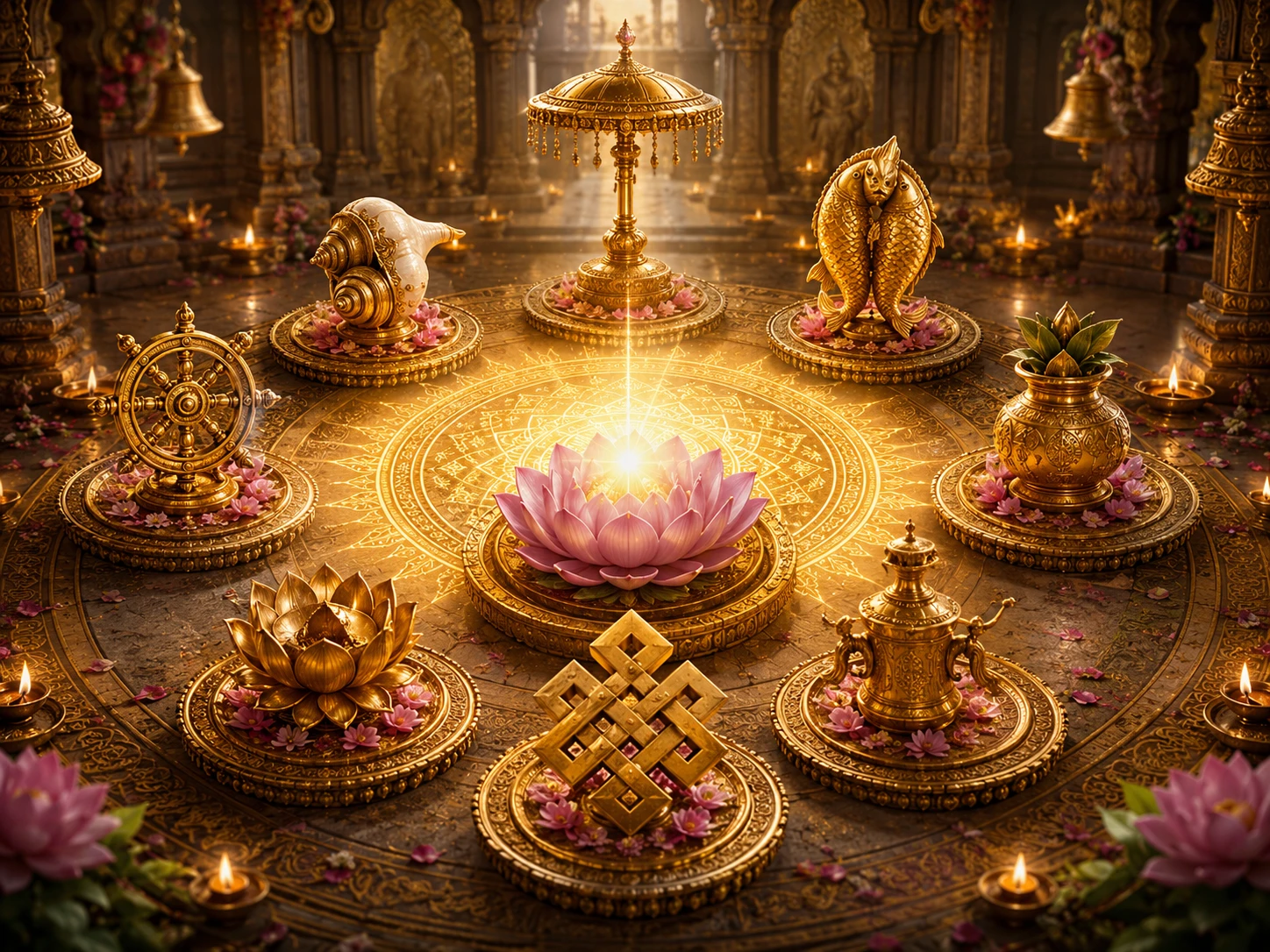
Ashtamangala -- The Eight Auspicious Symbols of Hindu Tradition
13 min read
Bindu -- The Point from which Creation Emerges
12 min read
Gau -- Why the Cow Holds the Place She Does in Hindu Life
14 min readThe same translation error that turned '33 Koti' into '33 crore' in Hinduism also happened in Buddhism. The Chinese translation of Buddhist texts rendered 'Sapta Koti Buddha' (7 Supreme Buddhas) as '7 Crore Buddhas.' The…
Deities AvatarsCommunity Reflections
🕉️
Be the first to share your reflection.