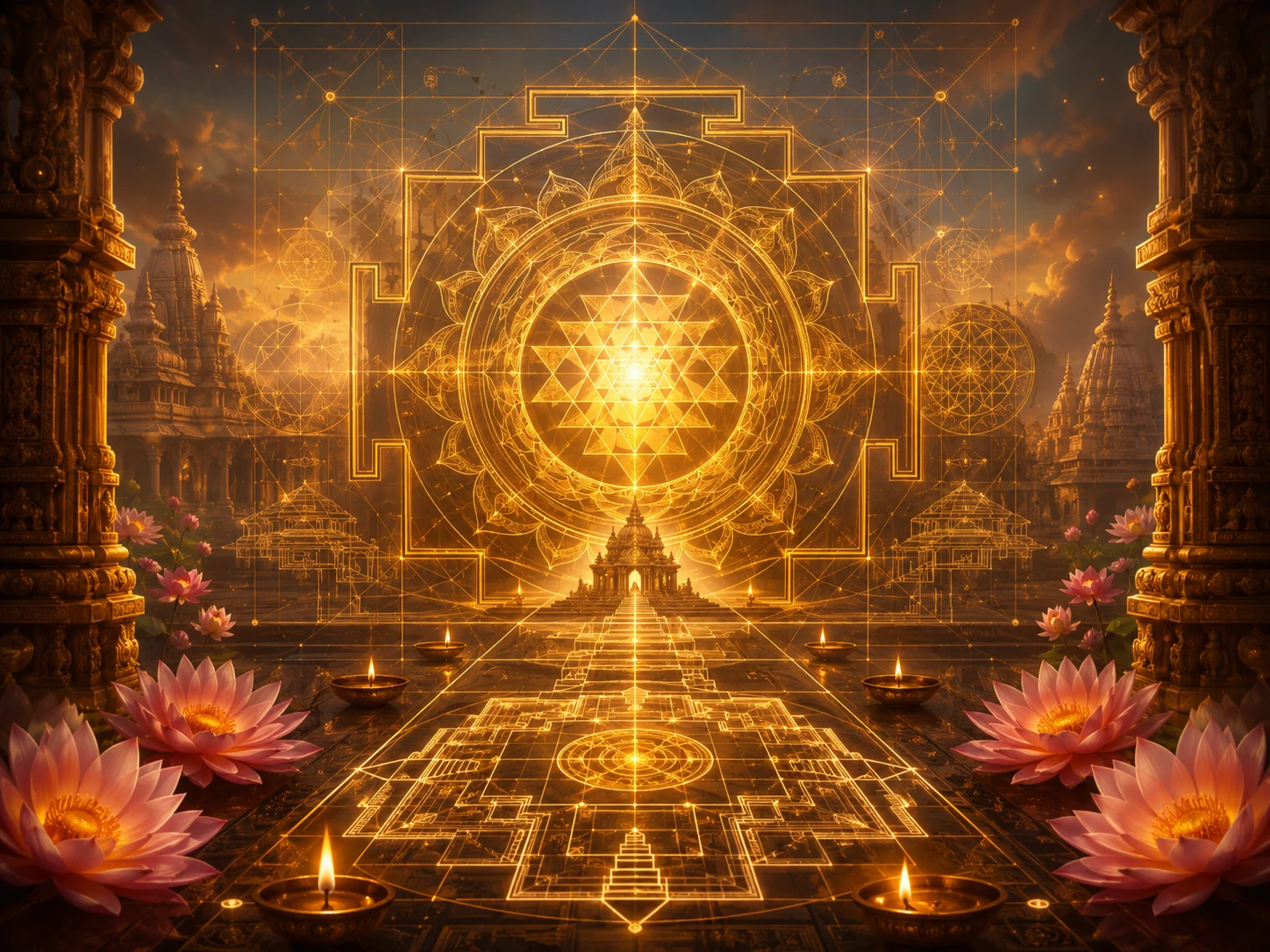
Rangoli -- The Sacred Floor Art That Turns Every Doorstep into a Temple
रंगोली -- वो पवित्र भूमि-कला जो हर देहली को मन्दिर बनाती है
It is 4:45 AM in Mylapore, Chennai. The street is still dark. A woman in a cotton sari steps outside her front door, brass pot of water in one hand, steel plate of white rice flour in the other. She sprinkles water on the threshold, cleaning yesterday's design away. Then she bends at the waist, reaches down, and with her right hand pinches a controlled stream of powder between thumb and forefinger. In ninety seconds -- without a ruler, without a stencil, without pausing -- she draws a perfectly symmetrical geometric pattern: interlocking loops around a grid of dots, every curve mirroring its opposite, every line returning to its origin without a single break.
She does this every single day. She has done it every day since she was twelve. Her mother taught her. Her mother's mother taught her mother. The pattern she drew today is different from yesterday's. Tomorrow's will be different again. There are thousands of patterns in her memory, and she can draw any of them from recall, at speed, in the dark.
This is kolam. In Maharashtra, it is rangoli. In Bengal, alpana. In Andhra Pradesh, muggu. In Rajasthan, mandana. In Bihar, aripana. In Odisha, murja or chita. In Himachal Pradesh, aippan. In Kerala, pookalam. In Uttar Pradesh, chowkpurna. Every region of India has its own name, its own materials, its own design vocabulary -- but the core practice is universal: a woman draws a sacred geometric pattern at the threshold of her home, every morning, as an act of devotion, protection, invitation, and -- though she might not use this word -- mathematics.
This is the largest daily art practice on the planet. No other tradition asks millions of practitioners to create and destroy a geometric artwork every twenty-four hours. The rangoli is ephemeral by design -- it is walked on, rained on, blown away. Tomorrow it will be made again. This cycle of creation and dissolution mirrors the Hindu understanding of the cosmos itself: Brahma creates, Vishnu sustains, Shiva dissolves, and the cycle repeats. The kolam at your doorstep is a daily micro-cosmogony.
सर्वमङ्गलमाङ्गल्ये शिवे सर्वार्थसाधिके। शरण्ये त्र्यम्बके गौरि नारायणि नमोऽस्तु ते॥
sarvamaṅgalamāṅgalye śive sarvārthasādhike | śaraṇye tryambake gauri nārāyaṇi namo'stu te ||
O auspicious one, who is the source of all auspiciousness, O Shiva (consort of Shiva), who fulfils all purposes, O refuge, O three-eyed Gauri, O Narayani -- salutations to you.
— Devi Mahatmyam (Durga Saptashati), Chapter 11, Verse 10 -- commonly chanted during rangoli-making and threshold rituals
The practice has at least three simultaneous functions, and all three are active every single morning.
**1. Sacred Threshold Protection**
The threshold (dehalī in Sanskrit) is one of the most ritually charged spaces in Hindu architecture. It is the boundary between the internal sacred space of the home and the external profane space of the street. In Tamil tradition, the kolam functions like the bindi on a woman's forehead -- a mark of auspiciousness whose presence signals purity and whose absence signals ritual pollution (such as mourning or menstruation). A house without a kolam is considered inauspicious -- the Puranic legend says Lakshmi enters homes with clean thresholds decorated with kolam, while Moodevi (the goddess of misfortune) inhabits dirty, undecorated entrances.
The unbroken line of the kolam is itself protective magic. In folk tradition, closed loops prevent evil spirits from entering -- they follow the line endlessly, unable to find an entry point. This is the same principle behind the labyrinth designs in kolam traditions from Tamil Nadu, which are so complex they have attracted the attention of mathematicians studying knot theory and graph traversal.
**2. Ecological Charity**
The traditional material for kolam is rice flour -- not chalk, not paint, not synthetic powder. Rice flour is edible. When drawn on the ground, it feeds ants, insects, birds, and small creatures before the household itself has eaten. This is pancha-mahabhuta seva -- service to the five elements and to all living beings. The tradition encodes the Hindu principle that one should feed others before oneself. The rangoli is simultaneously art, prayer, and a daily act of ecological generosity.
Some scholars note that the limestone and calcite powders used in North Indian rangoli have an additional function: they are natural insect repellents. So the rangoli simultaneously feeds some creatures (with rice flour at the threshold) while repelling others (with limestone inside the home). The boundary management is precise.
**3. Mathematical Meditation**
The act of drawing a kolam requires intense concentration, spatial memory, bilateral hand coordination, and mathematical thinking. The pulli kolam (dot-grid kolam) system is a formal mathematical structure: dots are placed in a grid, and curves must loop around every dot exactly once, forming a single unbroken path. This is equivalent to finding an Euler path or Hamilton cycle in graph theory -- a problem that professional mathematicians study.
Marcia Ascher, Emeritus Professor of Mathematics at Ithaca College, studied Tamil kolam patterns and documented their mathematical properties: symmetry groups, fractal self-similarity, Fibonacci sequences, and topological principles. The kolam tradition, she concluded, represents a sophisticated indigenous mathematical practice that predates formal Western graph theory by centuries.
For a JEE aspirant in Kota who thinks his mother's morning kolam is 'just a pretty design', here is the correction: his mother is solving Euler-path problems at 5 AM while he sleeps. She is doing it from memory, in the dark, on the ground, with rice flour. And she learned it when she was six.
Regional Names and Styles of Hindu Floor Art
| Region / क्षेत्र | Name / नाम | Material / सामग्री | Style / शैली | Key Occasion / प्रमुख अवसर |
|---|---|---|---|---|
| Tamil Nadu | Kolam / कोलम | Rice flour (kola-podi) / चावल चूर्ण | Dot-grid, unbroken loops, labyrinthine / बिन्दु-जाल, अखण्ड फन्दे | Daily ritual + Margazhi month (Dec-Jan) / दैनिक + मार्गळि मास |
| Maharashtra | Rangoli / रंगोली | Coloured powders, flower petals / रंगीन चूर्ण, पुष्प-पंखुड़ी | Figurative (Lakshmi feet, diyas, Om) / आकृतिमूलक (लक्ष्मी चरण, दीये, ॐ) | Diwali, Gudi Padwa / दीवाली, गुड़ी पड़वा |
| Bengal | Alpana / अल्पना | Rice flour paste / चावल आटे का लेप | White on red floor, flowing curves / लाल फ़र्श पर श्वेत, प्रवाही वक्र | Durga Puja, Lakshmi Puja / दुर्गा पूजा, लक्ष्मी पूजा |
| Andhra / Telangana | Muggu / मुग्गु | White stone powder, chalk / श्वेत पाषाण चूर्ण | Geometric grids, Sankranti special / ज्यामितीय जाल, संक्रान्ति विशेष | Makar Sankranti / मकर संक्रान्ति |
| Rajasthan | Mandana / मंदना | Red ochre + lime / गेरू + चूना | Wall + floor, geometric and figurative / दीवार + भूमि | Festivals, weddings / उत्सव, विवाह |
| Kerala | Pookalam / पूकलम | Flower petals exclusively / केवल पुष्प-पंखुड़ी | Circular, concentric, grows over 10 days / वृत्ताकार, 10 दिन बढ़ता | Onam / ओणम |
| Bihar | Aripana / अरिपना | Rice paste / चावल लेप | Geometric, often square-based / ज्यामितीय, प्रायः वर्ग-आधारित | Chhath Puja, weddings / छठ पूजा, विवाह |
| Odisha | Murja-Chita / मुरजा-चिता | Rice powder / चावल चूर्ण | Krishna-Jagannath motifs / कृष्ण-जगन्नाथ आकृति | Kartik month / कार्तिक मास |
The Sri Chakra rangoli -- drawing the complex yantra of interlocking triangles as a floor design -- is considered the most sacred form. In South India, women draw it during Navaratri while chanting the Lalita Sahasranama.
Tamil kolam patterns have been studied by computer scientists and mathematicians as examples of 'picture languages' -- formal grammars that generate images instead of strings of text. In 1989, gift Siromoney and others at Madras Christian College published research showing that kolam patterns could be described using array grammars and Lindenmayer systems (L-systems) -- the same mathematical framework used to model plant growth, fractal coastlines, and computer-generated graphics. The humble rice-flour kolam that your Mylapore paati draws before dawn turns out to be computationally equivalent to the formal languages that power modern CGI. Pixar's rendering algorithms and your grandmother's kolam share a mathematical ancestor.
Draw Your First Kolam
Begin with a simple three-by-three grid of dots at your doorstep and loop a single unbroken line around them; work up from there. Drawn at dawn, the kolam is a moving meditation. The Meditate section has seated practices for the rest of the day.
Tags
Eternal Raga · शाश्वत राग
Institutional voice — scholarly articles on Sanatan Dharma
Deepen Your Understanding
अपनी समझ और गहरी करें
sacred symbols
Mandala -- The Cosmic Blueprint That Hinduism Drew Before the Universe Existed
A circle inside a square. A dot at the centre. Four gates facing the four directions. This is a mandala -- and it is the DNA of Hindu sacred space. Every temple in India is built on one. Every yantra used in worship is one. The Rig Veda is divided into them. The mandala is not a drawing. It is the operating system of the cosmos.
sacred symbols
Lotus (Padma) -- The Flower That Grows in Mud and Became God's Throne
It grows from the bottom of a swamp. It rises through murky water. It blooms in sunlight without a single stain. This is not a motivational poster -- it is the central metaphor of Hindu civilisation. Every god sits on it. Every scripture references it. The Bhagavad Gita used it to explain the entire philosophy of detached action in one line.
sacred symbols
Temple Architecture Symbolism -- Why Every Hindu Temple Is a Human Body, a Mountain, and the Universe
The dark womb-room at the centre. The tower rising above it like a spine. The gateway that frames the divine like an eye. A Hindu temple is not a building where you go to see God. It IS the body of God -- designed on a mandala grid, proportioned by sacred mathematics, and oriented to catch the first ray of the rising sun.
sacred symbols
Dharma Chakra -- The Wheel on Your Flag That Spins Since Before the Buddha
The 24-spoke blue wheel at the centre of the Indian flag is not just a Buddhist symbol adopted by Ashoka. It is a Vedic concept of cosmic order, a weapon on Vishnu's finger, a sun-symbol older than recorded history, and a political statement about the sovereignty of dharma over kings. It is the most seen Hindu symbol in the world -- and the least understood.
sacred symbols
Tulasi -- The Only Plant in Hinduism That Gets Married to God
She has eight names. She gets a wedding ceremony. Vishnu refuses prasadam without her leaf. And she sits in the courtyard of 100 million Indian homes -- not as decoration but as a living deity. Tulasi is not a plant you worship. She is a goddess who chose to become a plant.
tantra mantra yantra
Tantra, Mantra and Yantra -- The Three Pillars of Spiritual Practice
Tantra is the loom, Mantra is the thread, Yantra is the pattern. Together they form the complete technology of spiritual transformation that India gifted to the world -- and they are far more profound than popular culture imagines.
Tamil kolam patterns have been studied by computer scientists and mathematicians as examples of 'picture languages' -- formal grammars that generate images instead of strings of text. In 1989, gift Siromoney and others a…
More in Sacred Symbols
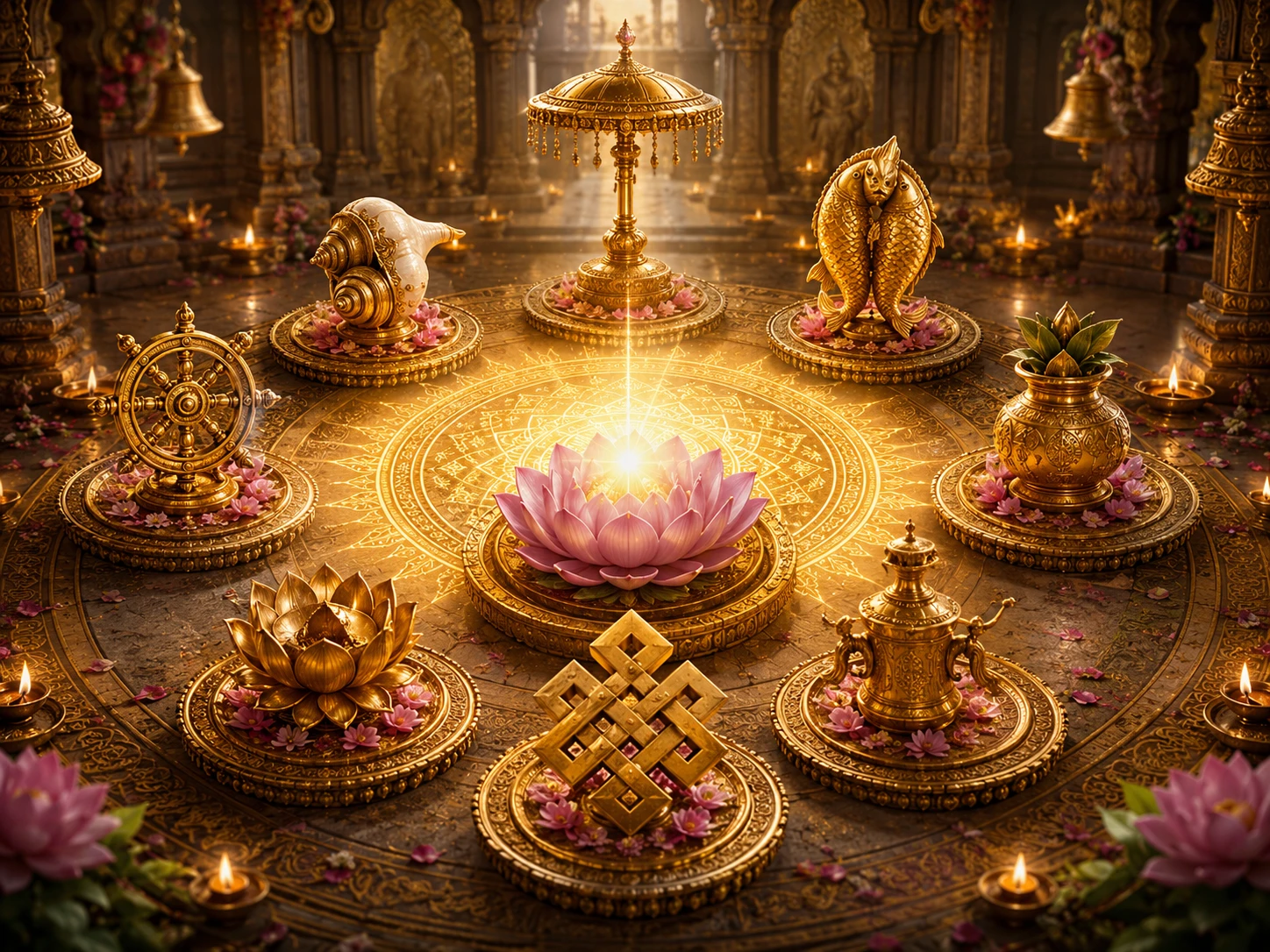
Ashtamangala -- The Eight Auspicious Symbols of Hindu Tradition
13 min read
Bindu -- The Point from which Creation Emerges
12 min read
Gau -- Why the Cow Holds the Place She Does in Hindu Life
14 min readThe same translation error that turned '33 Koti' into '33 crore' in Hinduism also happened in Buddhism. The Chinese translation of Buddhist texts rendered 'Sapta Koti Buddha' (7 Supreme Buddhas) as '7 Crore Buddhas.' The…
Deities AvatarsCommunity Reflections
🕉️
Be the first to share your reflection.