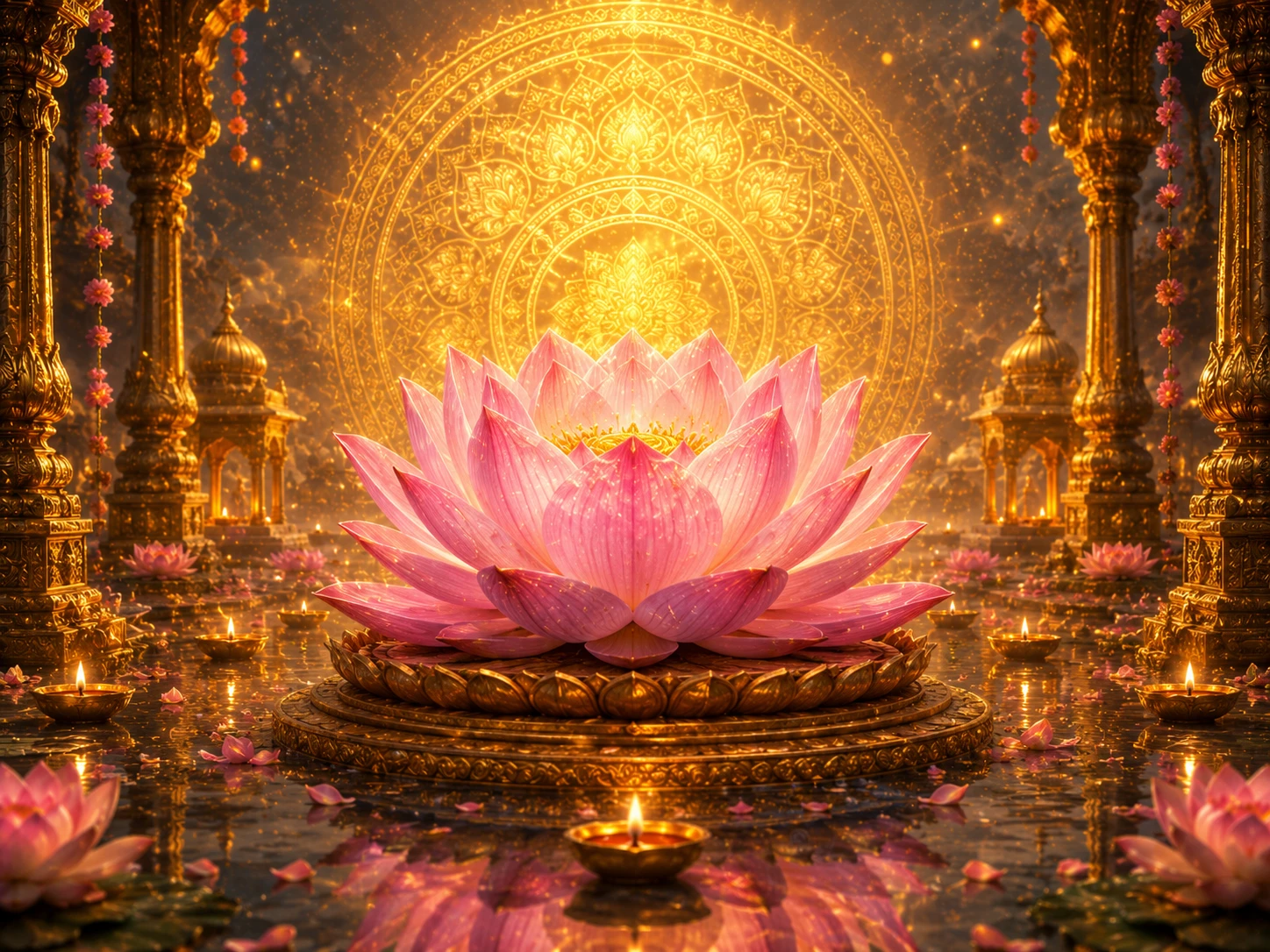
Lotus (Padma) -- The Flower That Grows in Mud and Became God's Throne
कमल (पद्म) -- वो फूल जो कीचड़ में उगा और भगवान का सिंहासन बना
Of all the symbols in Hinduism, the lotus is the only one that is simultaneously a botanical organism, a philosophical argument, a divine throne, a yogic posture, a national emblem, a political party symbol, and a compliment. When a Sanskrit poet says someone has 'lotus eyes' (padmakshi) or 'lotus feet' (charankamal), it is the highest aesthetic praise. When a yogi sits in Padmasana, the lotus position, the body becomes a living mandala. When Brahma sits on the lotus that grows from Vishnu's navel, the entire cosmogony of creation is contained in a single image.
The lotus (Nelumbo nucifera) -- called Padma, Kamala, Pankaja, Ambuja, Saroja, and at least forty other names in Sanskrit alone -- is India's national flower and arguably the most referenced natural object in all of Hindu literature. The Vedas mention it. The Upanishads philosophise about it. The Puranas narrate its cosmic origin. The Bhagavad Gita deploys it as the definitive metaphor for spiritual detachment. Buddhist, Jain, and Sikh traditions adopted it. Egyptian mythology independently revered it. No other flower has been asked to carry this much meaning.
And here is the fact that makes all the symbolism work: the lotus actually does what the metaphor claims. The plant grows in stagnant, muddy water. Its roots anchor in pond-bottom sludge. Its stem rises through murky, often foul-smelling water. And the flower emerges above the surface, immaculate -- its petals exhibit a property called the 'lotus effect' (discovered by botanists Barthlott and Neinhuis in 1997), a superhydrophobic nano-structure on the leaf surface that causes water and dirt to bead off instantly. The flower is literally self-cleaning. It cannot be stained.
This is not a poet's imagination. It is a verifiable physical property. The lotus leaf's micro-architecture features microscopic wax-coated bumps (papillae) that create an air layer between the leaf and any liquid. Water droplets sit on this air cushion and roll off, carrying dirt particles with them. This principle -- now called the 'Lotus Effect' -- has been replicated in industrial coatings, self-cleaning glass, and waterproof fabrics. German engineers patented it. Indian sages observed it three thousand years earlier and built an entire philosophy of life around it.
The next time someone dismisses Hindu symbolism as 'just mythology', point them to the lotus. The mythology turns out to be materials science.
ब्रह्मण्याधाय कर्माणि सङ्गं त्यक्त्वा करोति यः। लिप्यते न स पापेन पद्मपत्रमिवाम्भसा॥
brahmaṇyādhāya karmāṇi saṅgaṃ tyaktvā karoti yaḥ | lipyate na sa pāpena padmapatramivāmbhasā ||
One who performs all actions offering them to Brahman, abandoning attachment, is not touched by sin -- just as a lotus leaf is not wetted by water.
— Bhagavad Gita, Chapter 5, Verse 10
This single verse -- Bhagavad Gita 5.10 -- is one of the most quoted lines in all of Sanskrit literature, and it rests entirely on the lotus. Krishna tells Arjuna: live in the world, act in the world, but do not let the world's contamination touch you. Be the lotus leaf. Be in the water without being wet.
This is the foundational principle of Karma Yoga -- the yoga of action. It does not ask you to withdraw from life (that is Sannyasa). It does not ask you to stop working (that is impractical). It asks you to work without attachment to results. The lotus does not refuse the water. It grows in it. It depends on it. But it is not of it. The water slides off.
For a startup founder in HSR Layout Bangalore burning through runway, this is not abstract philosophy. It is survival strategy. Do the work. Ship the product. Pitch the investors. But do not let the outcome -- funding or failure -- define your inner state. Be the lotus leaf. For a UPSC aspirant in Mukherjee Nagar on their third attempt, the lotus teaches: prepare fully, write the exam completely, but let the result slide off like water. The effort is yours. The outcome belongs to Brahman.
Swami Vivekananda translated it with characteristic directness: 'Whosoever lives in the midst of the world, and works, and gives up all the fruit of his action unto the Lord, is never touched with the evils of the world. Just as the lotus, born under the water, rises up and blossoms above the water, even so is the man who is engaged in the activities of the world, giving up all the fruit of his activities unto the Lord.'
The lotus is not an ornament in the Gita. It is the argument.
The lotus is inseparable from Hindu iconography. Nearly every deity in the pantheon has a lotus connection, and each connection carries specific theological meaning.
**Vishnu and Padmanabha** -- Vishnu reclines on the cosmic serpent Ananta-Shesha in the Kshirasagara (Ocean of Milk). From his navel, a lotus grows. On that lotus sits Brahma, who then creates the universe. This image -- called the Padmanabha (lotus-navelled) form -- is the foundational creation narrative of Vaishnavism. The Padmanabhaswamy Temple in Thiruvananthapuram, Kerala (whose vaults held an estimated $22 billion in treasure) is dedicated to this form. The lotus here represents the potential of creation emerging from the stillness of the divine.
**Lakshmi and Padma** -- Lakshmi is called Padma, Kamala, Padmini, Padmesthita (standing on lotus), Padmavarna (lotus-coloured), Padmasambhava (lotus-born), Padmahasta (holding lotus). She emerged from the Samudra Manthan seated on a lotus, holding lotuses. Her identity is so intertwined with the flower that in many texts, 'Padma' simply means Lakshmi. The lotus in her context represents beauty, prosperity, and the generative abundance of the natural world.
**Brahma** -- The creator sits on the lotus that grows from Vishnu's navel. His seat is the Padmasana -- both the yogic posture and the literal lotus throne. Every murti of Brahma shows him seated on the lotus, often holding a lotus in one hand. The lotus here is the substrate of creation -- the platform from which the universe is designed.
**Saraswati** -- The goddess of knowledge is Shweta-padmasana (she who sits on the white lotus). The white lotus represents purity of intellect -- wisdom that emerges unblemished from the chaos of ignorance, just as the white lotus rises from mud.
**Surya** -- The Sun God holds lotuses in both hands, and is sometimes called Kamalabandhu (friend of the lotus) and Kamalanatha (lord of the lotus). The lotus opens at dawn and closes at dusk, tracking the sun. In Surya temples, the lotus motif is carved in concentric rings radiating from the central deity, mirroring the sun's rays.
The lotus also appears as the Padmapitha -- the lotus pedestal on which deities stand in temple sculpture. This is not mere artistic convention. The Padmapitha establishes the deity as existing above the material world (the mud), having transcended it (the water) and achieved full divine expression (the bloom). When you see a deity standing on a lotus in any temple, you are seeing a compressed creation-transcendence narrative.
In yogic anatomy, each of the seven chakras is depicted as a lotus with a specific number of petals: Muladhara (4 petals), Svadhisthana (6), Manipura (10), Anahata (12), Vishuddha (16), Ajna (2), and Sahasrara (1,000 -- the thousand-petalled lotus at the crown, representing full enlightenment). The entire chakra system is a vertical garden of lotuses, each blooming as the practitioner's consciousness ascends.
The Lotus and Hindu Deities -- A Quick Map
| Deity / देवता | Lotus Connection / कमल-सम्बन्ध | Specific Name / विशिष्ट नाम | Symbolism / प्रतीकार्थ |
|---|---|---|---|
| Vishnu / विष्णु | Lotus grows from navel / नाभि से कमल उगता | Padmanabha / पद्मनाभ | Creation emerging from divine stillness / दिव्य स्थिरता से सृष्टि |
| Lakshmi / लक्ष्मी | Seated on lotus, holds lotuses / कमल पर विराजी, कमल धारित | Padma, Kamala / पद्मा, कमला | Prosperity, beauty, abundance / समृद्धि, सौन्दर्य, प्रचुरता |
| Brahma / ब्रह्मा | Seated on Vishnu's navel-lotus / विष्णु के नाभि-कमल पर विराजे | Kamalasana / कमलासन | Creation, cosmic design / सृष्टि, ब्रह्माण्डीय रचना |
| Saraswati / सरस्वती | Seated on white lotus / श्वेत कमल पर विराजी | Shweta-padmasana / श्वेतपद्मासना | Pure knowledge, wisdom / शुद्ध ज्ञान, प्रज्ञा |
| Surya / सूर्य | Holds lotuses in both hands / दोनों हाथों में कमल | Kamalabandhu / कमलबन्धु | Light, life, solar energy / प्रकाश, जीवन, सौर ऊर्जा |
| Ganesha / गणेश | Sometimes depicted on lotus / कभी कमल पर चित्रित | -- | Overcoming obstacles from impure origins / अशुद्ध उत्पत्ति से बाधा-निवारण |
| Chakra System / चक्र प्रणाली | Each chakra is a lotus / प्रत्येक चक्र एक कमल | Sahasrara (1000 petals) / सहस्रार | Ascending consciousness / आरोही चेतना |
The lotus's Sanskrit names reveal its symbolic range: Pankaja (born of mud), Ambuja (born of water), Saroja (born of lake), Nalini (stemmed one). Each name emphasizes a different stage of its journey from origin to bloom.
The 'Lotus Effect' -- the self-cleaning superhydrophobic property of the lotus leaf -- was scientifically documented by German botanists Wilhelm Barthlott and Christoph Neinhuis in 1997. It has since been replicated in industrial coatings, self-cleaning paints (Lotusan by Sto AG), waterproof textiles, and anti-fouling surfaces for ships. The nano-structure that makes this possible -- microscopic wax-coated papillae creating an air cushion under water droplets -- was observed and described metaphorically in the Bhagavad Gita (5.10) roughly 2,300 years before its scientific documentation. Krishna's lotus-leaf analogy for detachment turns out to be a precise description of a real physical phenomenon, making it perhaps the oldest known reference to nano-scale surface engineering in world literature.
Sit in Padmasana and Meditate
The lotus posture is the body's tribute to the flower. Sit in padmasana, or in a simple cross-legged seat if your knees ask for it, and stay for ten minutes: grounded in the mud of daily life while awareness opens above it. The Meditate section has breath and dharana practices to take into the posture.
Tags
Eternal Raga · शाश्वत राग
Institutional voice — scholarly articles on Sanatan Dharma
Deepen Your Understanding
अपनी समझ और गहरी करें
sacred symbols
Tulasi -- The Only Plant in Hinduism That Gets Married to God
She has eight names. She gets a wedding ceremony. Vishnu refuses prasadam without her leaf. And she sits in the courtyard of 100 million Indian homes -- not as decoration but as a living deity. Tulasi is not a plant you worship. She is a goddess who chose to become a plant.
sacred artefacts
Samudra Manthan Treasures -- The 14 Things That Came Out When Gods and Demons Churned the Ocean Together
Poison came first. Immortality came last. In between: a goddess, a gem, a cow, a horse, a tree, a physician, a bow, a moon, and an elephant. The Samudra Manthan is not just a myth -- it is a startup pitch deck for the universe. Two rival teams. One impossible project. Fourteen deliverables. And a hostile takeover at the end.
sacred symbols
Rangoli -- The Sacred Floor Art That Turns Every Doorstep into a Temple
Every morning before dawn, millions of Indian women bend at their doorsteps and draw geometric patterns in rice flour. They are not decorating. They are performing a ritual older than any standing temple -- inviting Lakshmi in, keeping Moodevi out, feeding the ants, and encoding sacred geometry into the threshold between the profane street and the sacred home.
sacred symbols
Mandala -- The Cosmic Blueprint That Hinduism Drew Before the Universe Existed
A circle inside a square. A dot at the centre. Four gates facing the four directions. This is a mandala -- and it is the DNA of Hindu sacred space. Every temple in India is built on one. Every yantra used in worship is one. The Rig Veda is divided into them. The mandala is not a drawing. It is the operating system of the cosmos.
sacred symbols
Temple Architecture Symbolism -- Why Every Hindu Temple Is a Human Body, a Mountain, and the Universe
The dark womb-room at the centre. The tower rising above it like a spine. The gateway that frames the divine like an eye. A Hindu temple is not a building where you go to see God. It IS the body of God -- designed on a mandala grid, proportioned by sacred mathematics, and oriented to catch the first ray of the rising sun.
sacred symbols
Dharma Chakra -- The Wheel on Your Flag That Spins Since Before the Buddha
The 24-spoke blue wheel at the centre of the Indian flag is not just a Buddhist symbol adopted by Ashoka. It is a Vedic concept of cosmic order, a weapon on Vishnu's finger, a sun-symbol older than recorded history, and a political statement about the sovereignty of dharma over kings. It is the most seen Hindu symbol in the world -- and the least understood.
The 'Lotus Effect' -- the self-cleaning superhydrophobic property of the lotus leaf -- was scientifically documented by German botanists Wilhelm Barthlott and Christoph Neinhuis in 1997. It has since been replicated in i…
More in Sacred Symbols
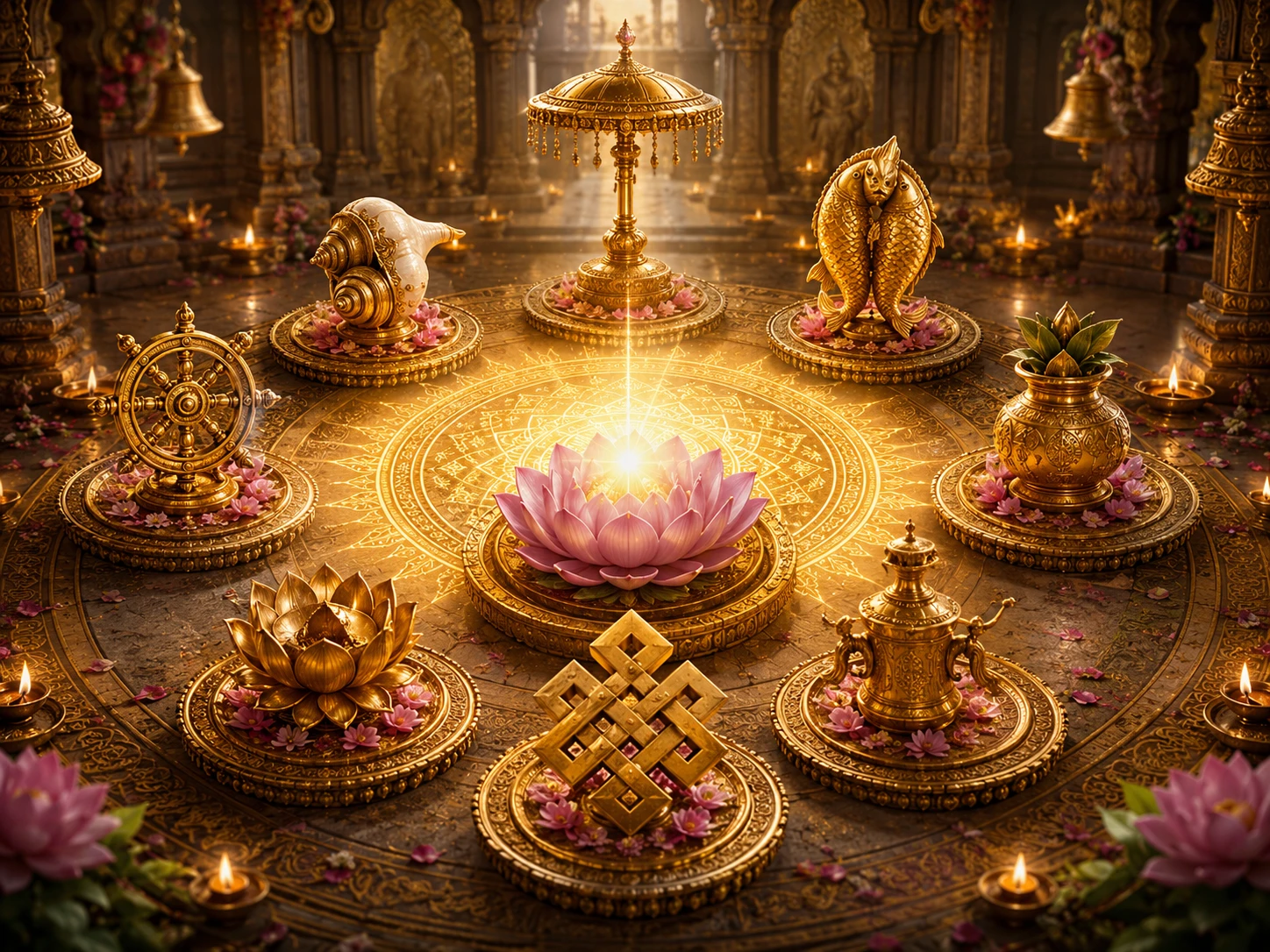
Ashtamangala -- The Eight Auspicious Symbols of Hindu Tradition
13 min read
Bindu -- The Point from which Creation Emerges
12 min read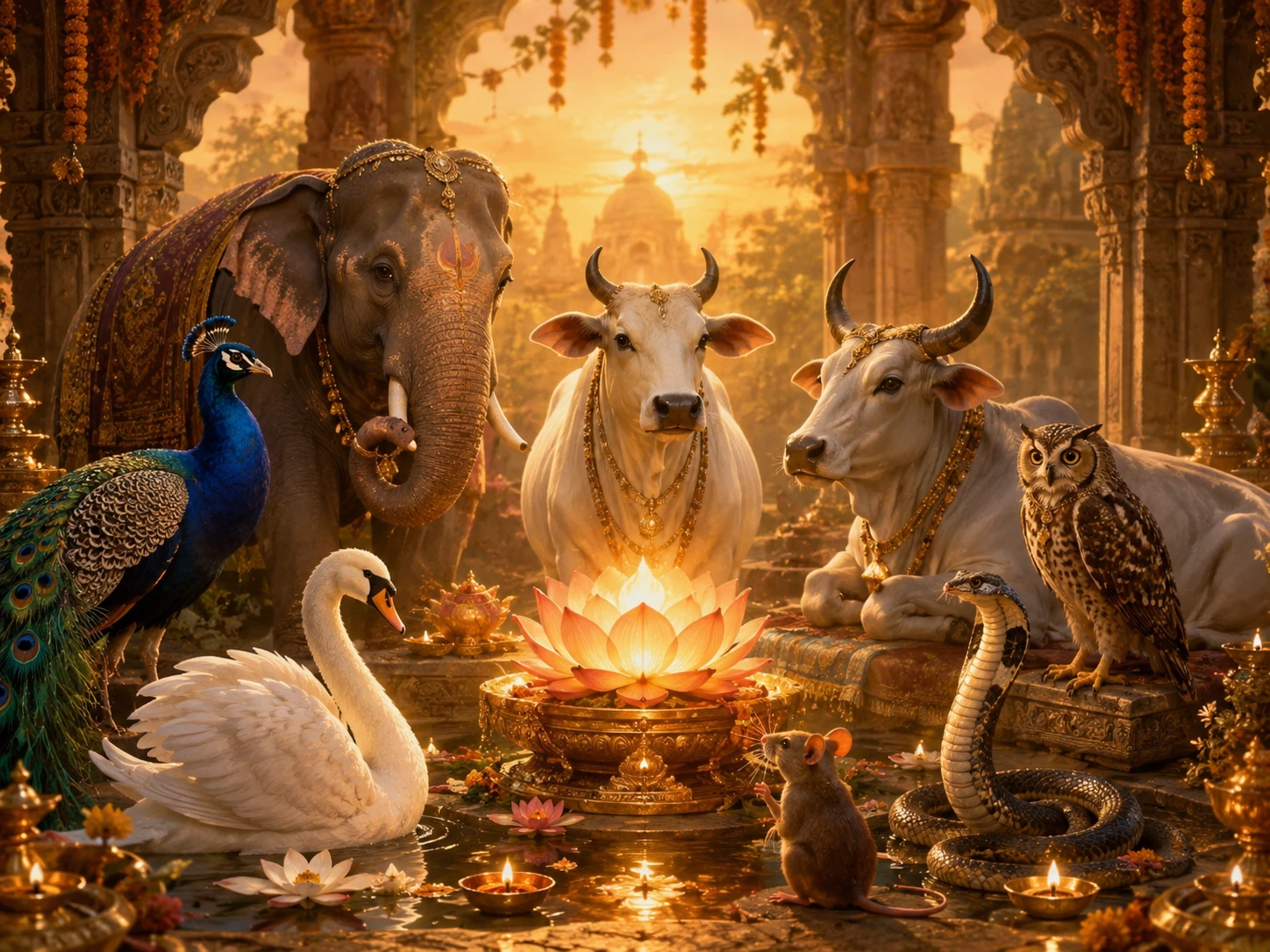
Gau -- Why the Cow Holds the Place She Does in Hindu Life
14 min readThe same translation error that turned '33 Koti' into '33 crore' in Hinduism also happened in Buddhism. The Chinese translation of Buddhist texts rendered 'Sapta Koti Buddha' (7 Supreme Buddhas) as '7 Crore Buddhas.' The…
Deities AvatarsCommunity Reflections
🕉️
Be the first to share your reflection.