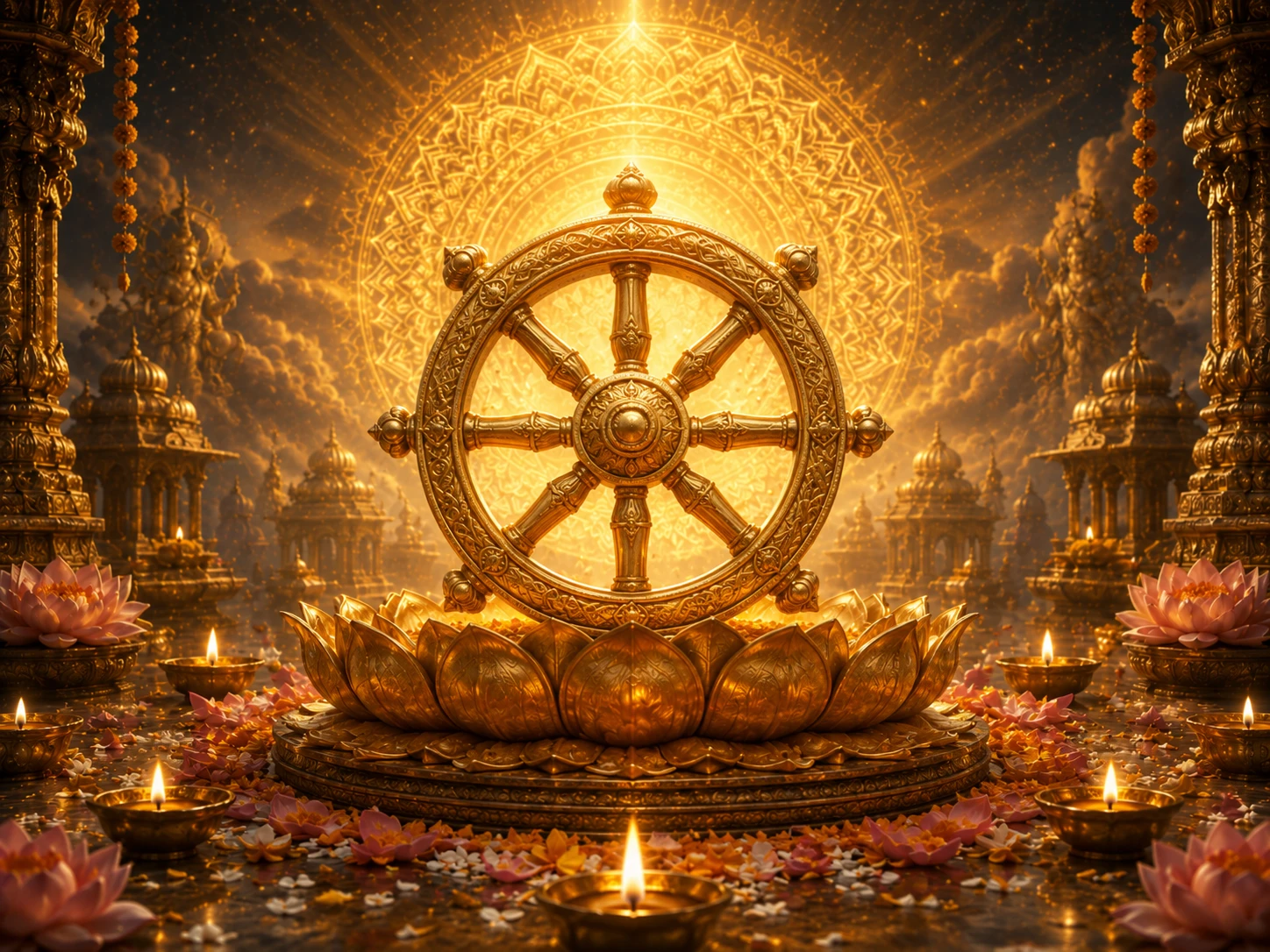
Dharma Chakra -- The Wheel on Your Flag That Spins Since Before the Buddha
धर्मचक्र -- तुम्हारे झण्डे पर वो पहिया जो बुद्ध से भी पहले से घूम रहा
Every Indian sees it every day. On the flag fluttering above government buildings. On currency notes. On the national emblem above every courtroom and passport office. On the jersey of the Indian cricket team. The 24-spoke wheel at the centre of the Indian tricolour -- the Ashoka Chakra -- is the most reproduced symbol in Indian public life.
And yet, if you stopped a hundred people on MG Road Bangalore and asked them what the 24 spokes represent, you would get a hundred blank stares. Most would say 'something Buddhist'. Some would say 'Ashoka put it there'. A few might guess 'it means progress'. Almost nobody would connect it to the Rig Veda, to Vishnu's Sudarshana Chakra, to the concept of the Chakravartin (the ideal sovereign whose wheel rolls unimpeded across the earth), or to the profound Hindu-Buddhist-Jain understanding that the cosmos operates as a wheel -- cyclical, self-sustaining, governed by an impersonal moral law called Dharma.
The Dharma Chakra is not one symbol. It is a family of wheel-symbols that have accumulated meaning across three thousand years of Indian religious and political thought. In its earliest Vedic layer, the wheel is the sun -- Surya's chariot wheel rolling across the sky, the visible mechanism of cosmic order. In its Puranic layer, the wheel is Vishnu's Sudarshana Chakra -- a spinning disc weapon with 108 serrated edges, fashioned from the sun's radiance by Vishvakarma, capable of annihilating any force that disrupts dharmic order. In its Buddhist layer, the wheel is the Dharmachakra -- turned by the Buddha at Sarnath in his first sermon, representing the Eightfold Path and the continuous motion of spiritual teaching. In its political layer, the wheel is the Ashoka Chakra -- adopted by Emperor Ashoka on his pillars and edicts, representing the sovereign's duty to rule by dharma rather than by force.
When India's Constituent Assembly chose this wheel for the national flag in 1947, Sarvepalli Radhakrishnan explained it as representing 'the wheel of the law of dharma', 'Truth or Satya', 'Virtue', and 'the dynamism of peaceful change'. That is a lot of weight for a geometric shape. But the wheel has been carrying that weight since before India was a nation.
चक्रं यस्य दक्षिणे विराजति सदा सुदर्शनं नाम तत्। दैत्यारीणामनेकधा विदलनं देवस्य विष्णोः प्रियम्॥
cakraṃ yasya dakṣiṇe virājati sadā sudarśanaṃ nāma tat | daityārīṇāmanekdhā vidalanaṃ devasya viṣṇoḥ priyam ||
That disc which ever shines resplendent on His right -- named Sudarshana -- is the destroyer of countless demon-enemies, and is beloved of Lord Vishnu.
— Vishnu Sahasranama Bhashya tradition / Sudarshana Ashtakam context
The layers of meaning in the Dharma Chakra unfold chronologically, each building on the last.
**Layer 1: The Solar Wheel (Vedic Period)**
In the Rig Veda, the wheel (chakra) is primarily a solar symbol. The Sun God Surya rides a chariot with wheels across the sky, and the wheel's revolution is the visible evidence of cosmic order (rita). The Vedic seer Dirghatamas (Rig Veda 1.164.11) asks: 'Upon the five-spoked wheel revolving, all beings rest. Its axle never heats, its hub never breaks.' This is the earliest known Indian use of the wheel as a metaphor for cosmic law -- the axle that holds the universe together never fails.
Mitra, a form of Surya, is called 'the eye of the world' (cakshu), and the sun-wheel thus also becomes a symbol of perception, knowledge, and truth. The Vedic wheel is not an arbitrary shape -- it is the most direct observation available to early humans of a natural cycle: the sun rises, crosses the sky, sets, and returns. The wheel encodes the fact that reality operates in cycles, not lines.
**Layer 2: Vishnu's Sudarshana Chakra (Puranic Period)**
The Sudarshana Chakra is Vishnu's primary weapon -- a spinning disc with 108 serrated edges, said to have been fashioned by the divine architect Vishvakarma from the blazing radiance of the sun. The Puranas narrate that Vishvakarma shaved the excess brilliance of Surya so that his daughter Sanjna could bear his presence; from that excess solar energy came three divine objects: the Pushpaka Vimana (aerial vehicle), Shiva's Trishula, and Vishnu's Sudarshana.
The name Sudarshana means 'auspicious vision' (su = good, darshana = sight), suggesting that the weapon is not merely destructive but revelatory -- it grants true perception. In the Mahabharata, Krishna uses the Sudarshana to behead Shishupala at the Rajasuya Yajna. In the Bhagavata Purana, the Chakra rescues Gajendra (the elephant king) from a crocodile's grasp. In the Ramayana traditions, the Sudarshana is used to dismember the body of Sati, creating the 51 Shakti Pithas.
The Sudarshana is not just a weapon. It is the Kala Chakra -- the wheel of time itself. The 108 edges represent the completeness of cosmic cycles. It spins perpetually on Vishnu's right index finger, symbolising that dharma is always in motion, always actively protecting, never static.
**Layer 3: The Buddha's Dharmachakra (5th Century BCE)**
When the Buddha delivered his first sermon at Sarnath (the Deer Park near Varanasi), the event was called Dharmachakra Pravartana -- 'the turning of the wheel of dharma'. The eight spokes of the Buddhist Dharma Wheel represent the Noble Eightfold Path. The wheel was used as a symbol of the Buddha himself before anthropomorphic images of him became common -- early Buddhist art at Sanchi and Bharhut depicts devotees worshipping the Dharma Wheel, not a human figure.
The Buddhist Dharma Wheel did not invent the wheel symbol. It inherited it from Vedic and Hindu tradition and gave it a specifically Buddhist interpretation. The continuity is visible: the wheel at Sarnath is a transformation of the Vedic solar wheel into a wheel of ethical teaching.
**Layer 4: Ashoka's Chakra and the Indian Flag (3rd Century BCE to 1947 CE)**
Emperor Ashoka (304-232 BCE), after his conversion to Buddhism following the carnage at Kalinga, erected pillars across his empire bearing the Dharma Wheel. The Lion Capital at Sarnath -- four lions atop an abacus featuring a 24-spoke wheel, a bull, a horse, an elephant, and a lion -- became the emblem of independent India in 1950. The 24-spoke wheel from the abacus became the Ashoka Chakra at the centre of the Indian flag.
The 24 spokes are interpreted variously. In one Buddhist reading, they represent the 12 links of dependent origination (Pratityasamutpada) in forward and reverse -- hence 24 total. In a Hindu reading, they represent 24 virtues or qualities of an ideal citizen. In a secular reading, they represent the 24 hours of the day -- the continuous, tireless progress of the nation.
The political significance is enormous. By placing the Dharma Chakra on the flag, the founders of the Indian republic declared that the nation would be governed by dharma -- not by any particular king, religion, or ideology, but by an impersonal moral law that transcends all of them. The wheel says: justice moves. Truth moves. Progress moves. And it does not stop for anyone.
The Dharma Chakra Across Traditions
| Tradition / परम्परा | Name / नाम | Spokes / तीलियाँ | Represents / प्रतिनिधित्व | Key Association / प्रमुख सम्बन्ध |
|---|---|---|---|---|
| Vedic / वैदिक | Surya Chakra / सूर्य चक्र | Varies (5, 12) / भिन्न | Cosmic order (Rita), solar cycle / ब्रह्माण्डीय व्यवस्था (ऋत), सौर चक्र | Surya's chariot / सूर्य का रथ |
| Vaishnava / वैष्णव | Sudarshana Chakra / सुदर्शन चक्र | 108 edges, 6 spokes / 108 किनारे, 6 तीलियाँ | Divine weapon, wheel of time / दिव्य अस्त्र, काल-चक्र | Vishnu / विष्णु |
| Buddhist / बौद्ध | Dharmachakra / धर्मचक्र | 8 | Noble Eightfold Path / अष्टांगिक मार्ग | Buddha's first sermon at Sarnath / बुद्ध का सारनाथ प्रथम उपदेश |
| Jain / जैन | Dharmachakra / धर्मचक्र | 24 | 24 Tirthankaras / 24 तीर्थंकर | Tirthankara symbol / तीर्थंकर प्रतीक |
| Ashokan / अशोकीय | Ashoka Chakra / अशोक चक्र | 24 | Dharma as sovereign law / धर्म सम्प्रभु नियम | Lion Capital, Sarnath / सिंह शीर्ष, सारनाथ |
| Indian Republic / भारतीय गणराज्य | Ashoka Chakra / अशोक चक्र | 24 | Progress, justice, dharma / प्रगति, न्याय, धर्म | Indian national flag (since 1947) / भारतीय राष्ट्रीय ध्वज |
| Political / राजनीतिक | Chakravartin concept / चक्रवर्ती अवधारणा | Varies | Ideal sovereign whose wheel of dharma rolls unimpeded / आदर्श सम्राट जिसका धर्मचक्र निर्बाध लुढ़के | Arthashastra, Puranic kings / अर्थशास्त्र, पुराणिक राजा |
The Chakravartin concept -- a universal sovereign whose chariot wheel rolls across the earth without opposition -- appears in Hindu, Buddhist, and Jain traditions alike. The word literally means 'one whose wheels are in motion'. It is the Indian political philosophy's highest aspiration: a ruler so dharmic that resistance to his rule is unnecessary.
The Sudarshana Chakra -- Vishnu's spinning disc weapon -- is described in the Puranas as having 108 serrated edges. The number 108 is considered sacred across Hinduism, Buddhism, and Jainism: there are 108 Upanishads, 108 beads on a mala, 108 names of major deities, 108 sacred sites in Shaivism, and the ratio of the Sun's distance to its diameter is approximately 108. The Sudarshana's 108 edges encode cosmic completeness into a weapon -- it destroys not with brute force but with the mathematical precision of the universe itself. Modern DRDO missile systems like Sudarshan (a laser-guided bomb) are named after this very weapon, making the Dharma Chakra's martial dimension a living tradition in Indian defence technology.
Chant the Vishnu Sahasranama
The Vishnu Sahasranama closes its thousand names by calling Vishnu Chakri, the bearer of the discus. Recite it and let the wheel of dharma turn through the names. The Sahasranama is on Eternal Raga with the meaning of each name.
Tags
Eternal Raga · शाश्वत राग
Institutional voice — scholarly articles on Sanatan Dharma
Deepen Your Understanding
अपनी समझ और गहरी करें
sacred symbols
Mandala -- The Cosmic Blueprint That Hinduism Drew Before the Universe Existed
A circle inside a square. A dot at the centre. Four gates facing the four directions. This is a mandala -- and it is the DNA of Hindu sacred space. Every temple in India is built on one. Every yantra used in worship is one. The Rig Veda is divided into them. The mandala is not a drawing. It is the operating system of the cosmos.
sacred symbols
Temple Architecture Symbolism -- Why Every Hindu Temple Is a Human Body, a Mountain, and the Universe
The dark womb-room at the centre. The tower rising above it like a spine. The gateway that frames the divine like an eye. A Hindu temple is not a building where you go to see God. It IS the body of God -- designed on a mandala grid, proportioned by sacred mathematics, and oriented to catch the first ray of the rising sun.
sacred symbols
Trishul -- The Three-Pronged Weapon That Encodes the Entire Operating System of the Universe
Three prongs. At least seven simultaneous meanings. Forged from the sun's own fire by Vishwakarma. The Trishul is not just Shiva's weapon -- it is a philosophical diagram you can hold in your hand. Creation-preservation-destruction. Past-present-future. Ida-Pingala-Sushumna. Every triad in Hinduism converges on those three points.
divine arsenal
Sudarshana Chakra -- The Disc of Divine Will
Vishnu's spinning disc is not merely a weapon -- it is cosmic justice made manifest. With 108 serrated edges, it never misses, never falters, and returns to the hand that released it. From Shishupala's hundredth sin to the Sudarshana Homa still performed in South Indian temples, this is the story of divine precision.
sacred symbols
Vahanas -- Why Every Hindu God Has an Animal and What It Actually Means
Shiva rides a bull. Vishnu flies on an eagle. Ganesha sits on a mouse. Saraswati glides on a swan. These are not random animal companions. Each vahana is a philosophical equation -- the deity masters the very force the animal represents. The mouse is uncontrolled desire. Ganesha sits on it. The lesson writes itself.
sacred artefacts
Samudra Manthan Treasures -- The 14 Things That Came Out When Gods and Demons Churned the Ocean Together
Poison came first. Immortality came last. In between: a goddess, a gem, a cow, a horse, a tree, a physician, a bow, a moon, and an elephant. The Samudra Manthan is not just a myth -- it is a startup pitch deck for the universe. Two rival teams. One impossible project. Fourteen deliverables. And a hostile takeover at the end.
The Sudarshana Chakra -- Vishnu's spinning disc weapon -- is described in the Puranas as having 108 serrated edges. The number 108 is considered sacred across Hinduism, Buddhism, and Jainism: there are 108 Upanishads, 10…
More in Sacred Symbols
Ashtamangala -- The Eight Auspicious Symbols of Hindu Tradition
13 min read
Bindu -- The Point from which Creation Emerges
12 min read
Gau -- Why the Cow Holds the Place She Does in Hindu Life
14 min readThe same translation error that turned '33 Koti' into '33 crore' in Hinduism also happened in Buddhism. The Chinese translation of Buddhist texts rendered 'Sapta Koti Buddha' (7 Supreme Buddhas) as '7 Crore Buddhas.' The…
Deities AvatarsCommunity Reflections
🕉️
Be the first to share your reflection.