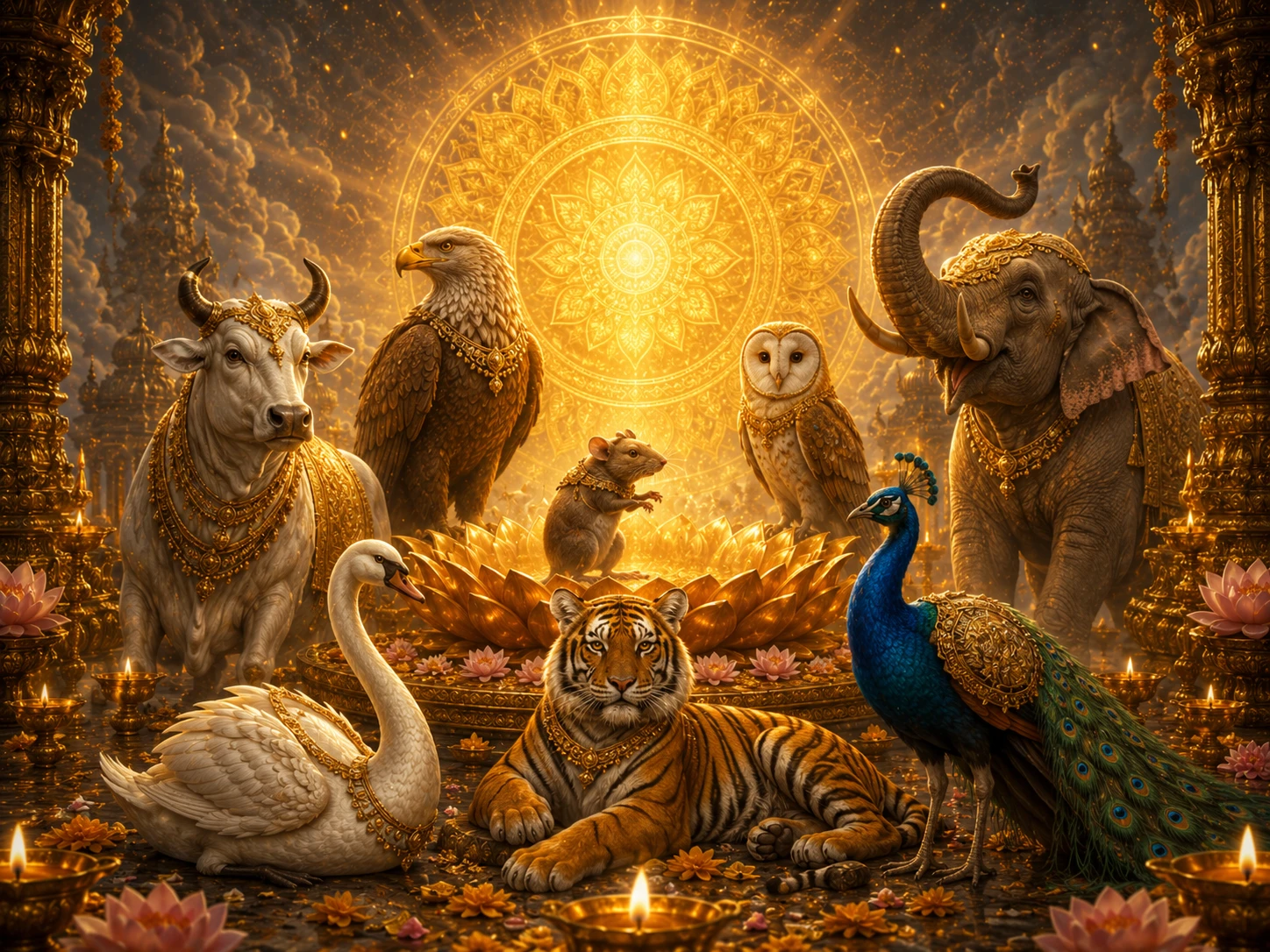
Vahanas -- Why Every Hindu God Has an Animal and What It Actually Means
वाहन -- क्यों हर हिन्दू देवता के पास एक पशु है और इसका वास्तविक अर्थ क्या
One of the first things that strikes a non-Hindu observer about Hindu iconography is that the gods travel on animals. Shiva sits cross-legged on Nandi, the bull. Vishnu soars through the cosmos on Garuda, the eagle-king. Ganesha, the elephant-headed god of beginnings, inexplicably rides a mouse. Saraswati glides across a lake on a swan. Durga charges into battle on a lion. Kartikeya, the commander of the divine army, rides a peacock. Yama, the god of death, arrives on a buffalo. Shani (Saturn) moves slowly on a crow or vulture.
To the uninitiated, this looks like charming mythology -- gods and their animal friends. To the tradition, it is anything but charming. It is precise. Each vahana (Sanskrit: that which carries, from the root 'vah' -- to bear, to carry) is selected to represent a specific cosmic force, psychological tendency, or natural phenomenon that the deity governs. The relationship between deity and vahana is not companionship. It is mastery. The deity sits on top of the vahana -- meaning the deity has conquered, tamed, or transcended the force the animal embodies.
This is one of the most elegant symbolic systems in world religion. The mouse that Ganesha rides is not a cute pet. It represents the restless, nibbling, hole-boring nature of desire (kama) and the wandering mind (chanchala manas). Ganesha -- the remover of obstacles, the lord of beginnings, the god invoked before every exam, every business launch, every wedding -- sits on desire itself. He has tamed it. He rides it. It carries him, but he directs it.
For a JEE aspirant who prays to Ganesha before opening his textbook, the message is not 'God will remove your obstacles magically'. It is: 'Master your desires the way Ganesha masters the mouse, and obstacles will dissolve on their own.'
Every vahana in the Hindu pantheon carries a similarly precise philosophical payload.
नमस्ते गरुडारूढ कोलासुरभयंकर। सर्वपापहरे विष्णो सर्वलोकहिताय ते॥
namaste garuḍārūḍha kolāsurabhayaṃkara | sarvapāpahare viṣṇo sarvalokaahitāya te ||
Salutations to You who ride Garuda, O terrifier of the demon Kola, O Vishnu who removes all sins -- You exist for the welfare of all worlds.
— Vishnu Stuti tradition (Garuda-Gamana invocation)
Here is a field guide to the major vahanas and what they encode.
**Nandi (Bull) -- Vahana of Shiva**
Nandi is not merely Shiva's mount; he is Shiva's foremost devotee, his gatekeeper, and the living embodiment of dharma. The bull represents virility, strength, and unshakeable steadfastness. In every Shiva temple, Nandi faces the garbhagriha -- he is the eternal witness, perpetually gazing at his lord. Nandi also represents the jivatma (individual soul) in a posture of surrender before Paramatma (supreme soul). In yogic tradition, Nandi is associated with the concept of controlled power -- the bull's immense strength disciplined by Shiva's presence. Nandi is not wild; he is powerful and perfectly still. The massive Nandi statues at Lepakshi (Andhra Pradesh), Chamundi Hills (Mysore), and Tanjore are among the largest monolithic bull sculptures in the world.
**Garuda (Eagle-King) -- Vahana of Vishnu**
Garuda is the king of birds, sworn enemy of nagas (serpents), and the divine vehicle who carries Vishnu across the three worlds. He represents speed, power, and the ability to soar above earthly concerns. Garuda is courage in its purest form. In the Garuda Purana, he is the being who ferries the soul after death. In Southeast Asian cultures -- Indonesia's national airline Garuda Indonesia, Thailand's royal emblem -- Garuda remains a living political and cultural symbol. Garuda is also a metaphor for the Vedas: just as Garuda carries Vishnu, the Vedas carry the knowledge of the divine.
**Mushika (Mouse) -- Vahana of Ganesha**
The mouse is restless, nibbling, always seeking, always gnawing through barriers. It represents kama (desire), the wandering mind, and the persistent ego that eats through obstacles from below rather than addressing them directly. Ganesha's mastery of the mouse signifies that true intelligence controls desire rather than being driven by it. The mouse also represents the ability to penetrate any barrier -- it can enter any hole, any space. This aligns with Ganesha's role as the opener of ways.
**Hamsa (Swan) -- Vahana of Brahma and Saraswati**
The hamsa has a unique mythological property: it can separate milk from water when the two are mixed. This is the metaphor for viveka -- the power of discrimination between the real and the unreal, truth and illusion. Brahma, the creator, rides on discrimination. Saraswati, the goddess of knowledge, glides on it. Without viveka, knowledge is undifferentiated data. With it, knowledge becomes wisdom.
**Simha (Lion) -- Vahana of Durga and Narasimha**
The lion represents raw, untameable power -- primal force, sovereignty, courage beyond fear. Durga rides the lion into battle against Mahishasura. The message: the feminine divine does not shy from wielding absolute power when dharma demands it. For women across India who light the lamp before Durga during Navratri, the lion is not just an icon. It is permission.
**Mayura (Peacock) -- Vahana of Kartikeya (Murugan/Skanda)**
The peacock eats snakes -- it consumes venom and transforms it into the iridescent beauty of its feathers. Kartikeya, the god of war and commander of the divine army, rides on the ability to transmute poison into beauty. This is the warrior's ultimate skill: taking adversity and turning it into strength.
**Airavata (White Elephant) -- Vahana of Indra**
The four-tusked, cloud-white elephant of the king of gods represents rainfall, fertility, royal authority, and the connection between heaven and earth. Airavata emerged from the Samudra Manthan and is the most majestic of all elephants. Indra rides earthly abundance itself.
**Makara (Sea Creature) -- Vahana of Varuna and Ganga**
The makara -- a hybrid creature with crocodile jaws, elephant trunk, and fish tail -- represents the chaotic power of water. Varuna (lord of the oceans) and Ganga (the river goddess) ride on this chaos, directing it rather than being swept by it.
**Mahisha (Buffalo) -- Vahana of Yama**
The buffalo is slow, patient, ponderous, and unstoppable -- exactly like death itself. Yama does not rush. He does not need to. He arrives.
Hindu Deity Vahanas -- Complete Reference
| Deity / देवता | Vahana / वाहन | Animal / पशु | Symbolism / प्रतीकार्थ |
|---|---|---|---|
| Shiva / शिव | Nandi / नन्दी | Bull / वृषभ | Dharma, steadfast devotion, controlled power / धर्म, दृढ़ भक्ति, नियन्त्रित शक्ति |
| Vishnu / विष्णु | Garuda / गरुड़ | Eagle-King / गरुत्मान | Speed, transcendence, Vedic knowledge / गति, उत्थान, वैदिक ज्ञान |
| Ganesha / गणेश | Mushika / मूषिक | Mouse / मूषक | Desire, wandering mind, penetrating obstacles / इच्छा, भटकता मन, बाधा-भेदन |
| Brahma / ब्रह्मा | Hamsa / हंस | Swan / हंस | Viveka (discrimination), separating real from unreal / विवेक, सत्य-असत्य भेद |
| Saraswati / सरस्वती | Hamsa / हंस | Swan / हंस | Pure knowledge, aesthetic grace / शुद्ध ज्ञान, सौन्दर्यपरक लावण्य |
| Durga / दुर्गा | Simha / सिंह | Lion / सिंह | Raw power, fearlessness, sovereignty / कच्ची शक्ति, निर्भयता, सम्प्रभुता |
| Kartikeya / कार्तिकेय | Mayura / मयूर | Peacock / मयूर | Transmutation of poison into beauty / विष का सुन्दरता में रूपान्तर |
| Indra / इन्द्र | Airavata / ऐरावत | White Elephant / श्वेत गज | Rainfall, royal authority, heaven-earth link / वृष्टि, राजसत्ता, स्वर्ग-भू सम्बन्ध |
| Lakshmi / लक्ष्मी | Uluka / उलूक | Owl / उल्लू | Patience, seeing in darkness, wealth wisdom / धैर्य, अन्धकार में दर्शन, धन-विवेक |
| Yama / यम | Mahisha / महिष | Buffalo / भैंसा | Inevitability, patience, unstoppable force / अनिवार्यता, धैर्य, अप्रतिरोध्य बल |
| Shani / शनि | Kaka/Gridhra / काक/गृध्र | Crow or Vulture / काक या गिद्ध | Karma, patience, scavenging justice / कर्म, धैर्य, अवशिष्ट न्याय |
| Varuna / वरुण | Makara / मकर | Sea creature / जलचर | Oceanic chaos, controlled water / सागरी अराजकता, नियन्त्रित जल |
| Agni / अग्नि | Mesha / मेष | Ram / मेढ़ा | Sacrificial fire, forward charging energy / यज्ञाग्नि, अग्रगामी ऊर्जा |
| Vayu / वायु | Mriga / मृग | Deer or Antelope / हिरण | Swiftness, the breath of life / तीव्रता, प्राण-वायु |
Lakshmi's owl (Uluka) is particularly instructive: wealth (Lakshmi) rides on the ability to see in darkness -- to perceive value where others see nothing. This is the original investment philosophy.
Indonesia -- the world's most populous Muslim-majority country -- has Garuda (Vishnu's vahana) as its national emblem and its flag carrier airline is named Garuda Indonesia. The Thai royal emblem features Garuda. The Cambodian royal coat of arms includes both Garuda and Naga. These are not Hindu countries, but they preserve Hindu vahana iconography as national identity symbols -- a testament to how deeply Hindu civilisational symbols penetrated Southeast Asian culture during the 1st millennium CE through the maritime Chola, Pallava, and Srivijaya empires. The mouse that carries Ganesha and the eagle that carries Vishnu continue to carry entire nations.
Invoke Ganesha Before Every Beginning
Ganesha, who rides the mouse of desire, is invoked before every new start. Begin your day with the Vakratunda Mahakaya shloka, the most widely recited Ganesha vandana; it is on Eternal Raga with its meaning.
Eternal Raga · शाश्वत राग
Institutional voice — scholarly articles on Sanatan Dharma
Deepen Your Understanding
अपनी समझ और गहरी करें
sacred symbols
Trishul -- The Three-Pronged Weapon That Encodes the Entire Operating System of the Universe
Three prongs. At least seven simultaneous meanings. Forged from the sun's own fire by Vishwakarma. The Trishul is not just Shiva's weapon -- it is a philosophical diagram you can hold in your hand. Creation-preservation-destruction. Past-present-future. Ida-Pingala-Sushumna. Every triad in Hinduism converges on those three points.
sacred symbols
Dharma Chakra -- The Wheel on Your Flag That Spins Since Before the Buddha
The 24-spoke blue wheel at the centre of the Indian flag is not just a Buddhist symbol adopted by Ashoka. It is a Vedic concept of cosmic order, a weapon on Vishnu's finger, a sun-symbol older than recorded history, and a political statement about the sovereignty of dharma over kings. It is the most seen Hindu symbol in the world -- and the least understood.
sacred artefacts
Samudra Manthan Treasures -- The 14 Things That Came Out When Gods and Demons Churned the Ocean Together
Poison came first. Immortality came last. In between: a goddess, a gem, a cow, a horse, a tree, a physician, a bow, a moon, and an elephant. The Samudra Manthan is not just a myth -- it is a startup pitch deck for the universe. Two rival teams. One impossible project. Fourteen deliverables. And a hostile takeover at the end.
sacred symbols
Lotus (Padma) -- The Flower That Grows in Mud and Became God's Throne
It grows from the bottom of a swamp. It rises through murky water. It blooms in sunlight without a single stain. This is not a motivational poster -- it is the central metaphor of Hindu civilisation. Every god sits on it. Every scripture references it. The Bhagavad Gita used it to explain the entire philosophy of detached action in one line.
sacred symbols
Temple Architecture Symbolism -- Why Every Hindu Temple Is a Human Body, a Mountain, and the Universe
The dark womb-room at the centre. The tower rising above it like a spine. The gateway that frames the divine like an eye. A Hindu temple is not a building where you go to see God. It IS the body of God -- designed on a mandala grid, proportioned by sacred mathematics, and oriented to catch the first ray of the rising sun.
divine arsenal
The Divine Shields and Armour -- Karna's Kavach-Kundal, Agastya's Gift, and the Spiritual Meaning of Protection
Karna was born wearing armour that made him invincible -- and gave it away to the one man who wanted him dead. Rama received divine armour from a sage moments before facing Ravana. In Hindu tradition, the greatest protection is not what you wear on your body but what you carry in your soul.
Indonesia -- the world's most populous Muslim-majority country -- has Garuda (Vishnu's vahana) as its national emblem and its flag carrier airline is named Garuda Indonesia. The Thai royal emblem features Garuda. The Cam…
More in Sacred Symbols
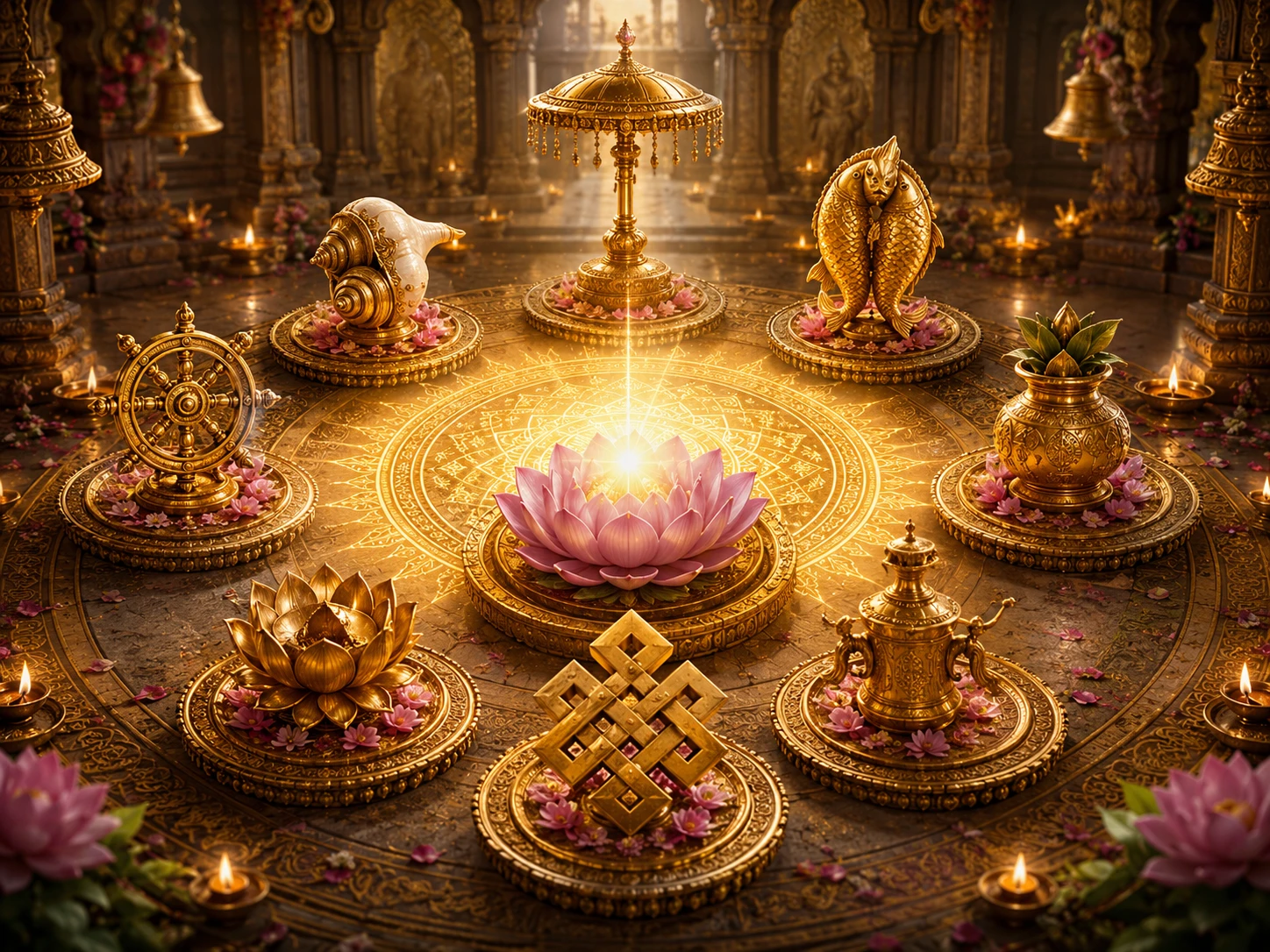
Ashtamangala -- The Eight Auspicious Symbols of Hindu Tradition
13 min read
Bindu -- The Point from which Creation Emerges
12 min read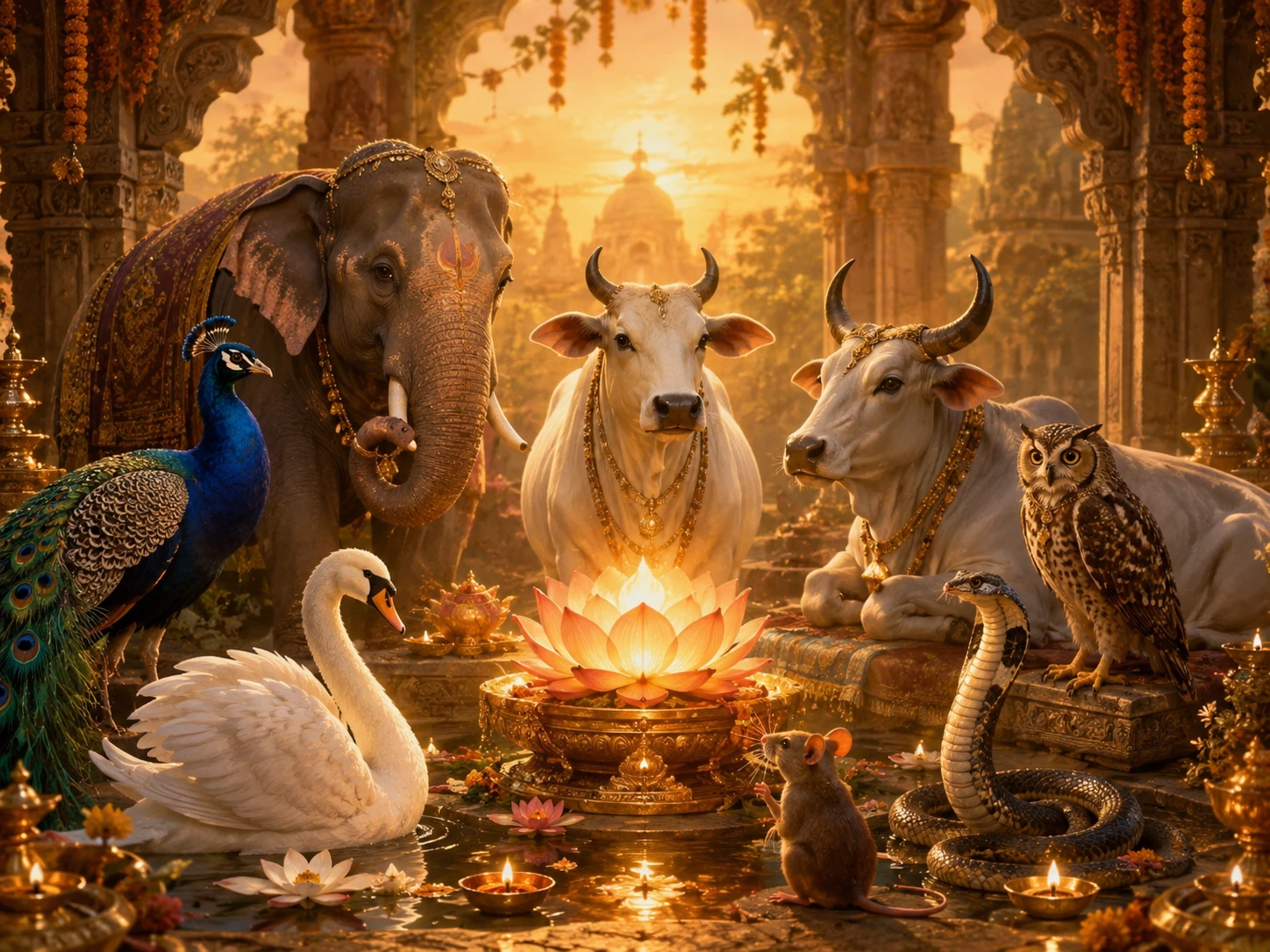
Gau -- Why the Cow Holds the Place She Does in Hindu Life
14 min readThe same translation error that turned '33 Koti' into '33 crore' in Hinduism also happened in Buddhism. The Chinese translation of Buddhist texts rendered 'Sapta Koti Buddha' (7 Supreme Buddhas) as '7 Crore Buddhas.' The…
Deities AvatarsCommunity Reflections
🕉️
Be the first to share your reflection.