Samudra Manthan Treasures -- The 14 Things That Came Out When Gods and Demons Churned the Ocean Together
समुद्र मन्थन के रत्न -- जब देवों और असुरों ने मिलकर सागर मथा तो 14 चीज़ें निकलीं
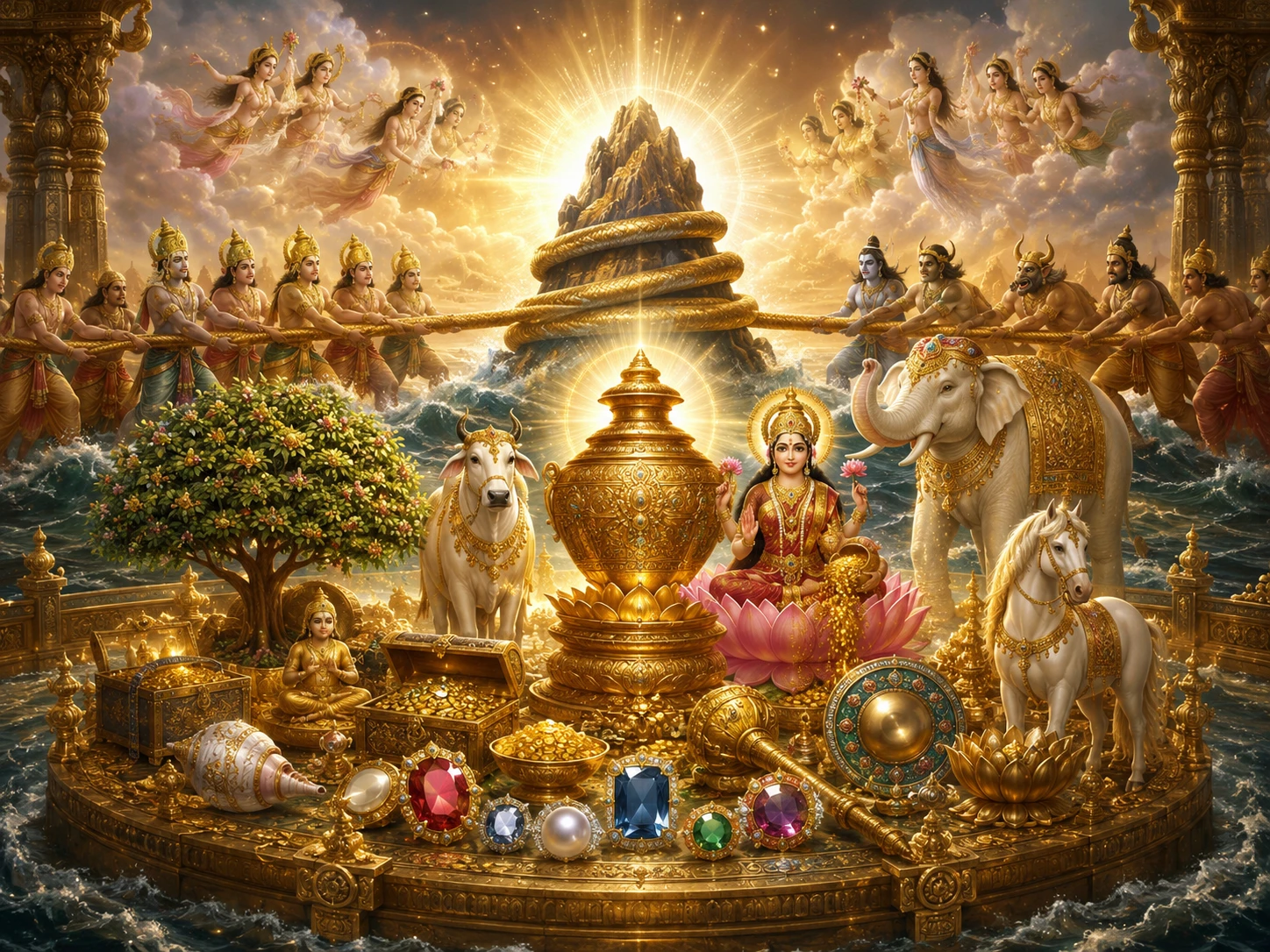
The Samudra Manthan -- the Churning of the Ocean of Milk -- is the single most consequential event in Hindu cosmological narrative. It involves every major category of being (gods, demons, serpents, mountains, the cosmic tortoise), produces the origin stories for at least a dozen individually significant objects and beings, directly causes the creation of the Kumbh Mela (the largest human gathering on earth), introduces two of Vishnu's most important avatars (Kurma and Mohini), and serves as the foundational narrative for Hindu medicine (through Dhanvantari), Hindu economics (through Lakshmi), and Hindu theology of sacrifice (through Shiva's consumption of Halahala).
The story appears in the Bhagavata Purana (Book 8, Chapters 6-11), Vishnu Purana, Padma Purana, Mahabharata, and Skanda Purana with variations. The core narrative is this:
Indra, king of the Devas, riding his elephant Airavata, encountered the irascible sage Durvasa, who offered him a divine garland. Indra, in an act of careless arrogance, placed it on Airavata's trunk. The elephant, irritated by the garland's fragrance, threw it to the ground. Durvasa, enraged by this disrespect to a divine gift, cursed all the Devas to lose their power and fortune. The Devas, weakened and driven from heaven by the Asuras, approached Vishnu for help.
Vishnu's solution was characteristically strategic: churn the Kshirasagara -- the Ocean of Milk -- to extract Amrita (the nectar of immortality). But the task was too enormous for the Devas alone. They needed the Asuras' labour. Vishnu brokered a temporary alliance: Devas and Asuras would churn together, and share the treasures. Privately, Vishnu intended to ensure only the Devas received the Amrita.
The setup itself required cosmic engineering. Mount Mandara became the churning rod. Vasuki, the serpent king, became the churning rope. When Mandara began sinking into the ocean floor, Vishnu incarnated as the Kurma (tortoise) Avatar and dived beneath the mountain, supporting it on his shell -- the ultimate load-bearing structure. The Devas held Vasuki's tail; the Asuras held his head. As they pulled back and forth, the ocean churned.
For a startup founder in Koramangala, Bangalore, the structure is familiar: two parties with opposing interests forced to collaborate on a project neither can execute alone, with one party planning from the start to capture the final product. The Samudra Manthan is the original joint venture with a predetermined exit strategy.
मन्दरं पर्वतं दैत्या देवाश्चामृतकाम्यया। ममन्थुरब्धिं तं क्षीरं तस्मादुद्भूतमद्भुतम्॥
mandaraṃ parvataṃ daityā devāścāmṛtakāmyayā | mamanthurbdhiṃ taṃ kṣīraṃ tasmādubhbhūtamadbhutam ||
Using Mount Mandara, the Daityas and Devas, desiring Amrita, churned that ocean of milk -- and from it emerged wondrous things.
— Vishnu Purana, Amsha 1, Adhyaya 9 (paraphrased from the Manthan narrative)
The treasures emerged in sequence, and the sequence itself carries meaning -- the first thing out of the ocean was not a blessing but a catastrophe.
**1. Halahala (हालाहल) -- The Cosmic Poison**
Before any treasure, the ocean produced Halahala -- a poison so deadly its fumes began killing all living beings. The Devas and Asuras fled in terror. Only Shiva stepped forward. At Vishnu's request (and Parvati's anxious watch), Shiva drank the poison. Parvati pressed his throat to prevent it from entering his body, turning his throat blue -- earning him the name Neelakantha (the blue-throated one). The lesson: before you get to the reward, you must survive the worst that the process produces. Every startup, every career, every spiritual journey begins with poison you must digest.
**2. Kamadhenu / Surabhi -- The Wish-Fulfilling Cow**
Given to the sages for producing milk and ghee for yajnas. She represents abundance that serves the community, not the individual.
**3. Uchhaishravas -- The Seven-Headed Divine Horse**
Snow-white, king of horses, claimed by the Asura king Bali. Speed, beauty, and royal transport. A bet between Kadru and Vinata over Uchhaishravas' tail colour directly leads to the birth story of Garuda.
**4. Airavata -- The Four-Tusked White Elephant**
Claimed by Indra, becomes his vahana. Represents rainfall, royal authority, and the connection between heaven and earth. The elephant that started all the trouble (by dropping Durvasa's garland) is cosmically replaced by the greatest elephant ever born.
**5. Kaustubha Mani -- The Supreme Gem**
Placed on Vishnu's chest, representing the jiva-atma resting on the Paramatma. Covered in detail in our Divine Gems article.
**6. Kalpavriksha / Parijata -- The Wish-Fulfilling Tree**
Taken to Indraloka. Later, Krishna fights Indra to bring the Parijata to earth for Satyabhama -- one of the most humanly entertaining episodes in the Bhagavata.
**7. Sharanga -- The Divine Bow**
Claimed by Vishnu, becomes part of his standard iconography alongside the Sudarshana Chakra, Panchajanya Conch, and Kaumodaki Mace.
**8. Chandra -- The Moon**
Yes, the moon. The Samudra Manthan produced the moon, which Shiva placed in his matted locks. This is why Shiva is called Chandrashekhara (moon-crested). The moon's cool light counterbalances the Halahala's fire in Shiva's throat -- an internal thermoregulation system of mythological elegance.
**9. Lakshmi -- The Goddess of Wealth and Fortune**
Seated on a lotus, radiant with beauty, holding lotuses, choosing Vishnu as her eternal consort. This moment -- Lakshmi emerging from the ocean and garlanding Vishnu -- is celebrated during Diwali as the foundational event of prosperity entering the cosmos. Every Diwali puja of Lakshmi is a re-enactment of this scene.
**10. Apsaras -- The Celestial Nymphs**
Rambha, Menaka, Urvashi, Tilottama and others. They chose the Gandharvas as companions. Their stories weave through the Mahabharata (Menaka and Vishwamitra, Urvashi and Arjuna) as agents of divine disruption.
**11. Varuni / Sura -- The Goddess of Wine**
Accepted by the Asuras. This is the etymological origin of the word 'Asura' -- those who accepted Sura (wine) became A-suras. The Devas, who refused, remained Suras. Naming through beverage choice.
**12. Dhanvantari -- The Divine Physician**
Emerging with the Amrita kalash in his hands, Dhanvantari is the father of Ayurveda. Dhanteras (two days before Diwali) celebrates his emergence. Every Ayurvedic practitioner traces their lineage to this moment.
**13. Amrita -- The Nectar of Immortality**
The final and supreme treasure. The Asuras snatched it; Vishnu transformed into Mohini, the enchantress, and distributed it exclusively to the Devas. Rahu, an Asura disguised as a Deva, drank a sip before being decapitated by Vishnu's Sudarshana -- his head became Rahu and his body Ketu, the shadow planets of Vedic astrology. The four drops that fell to earth during Garuda's flight with the pot became the four sites of the Kumbh Mela.
**14. Panchajanya -- The Conch (in some lists)**
Vishnu's conch, whose sound is the cosmic Om. Some Puranas include this; others replace it with Vishnu's mace Kaumodaki or the divine umbrella given to Varuna.
The 14 Treasures of Samudra Manthan -- Who Got What
| # | Treasure / रत्न | Sanskrit / संस्कृत | Claimed By / किसने प्राप्त किया | Significance / महत्त्व |
|---|---|---|---|---|
| 1 | Halahala (Poison) / हालाहल | हालाहल | Shiva (consumed it) / शिव (पान किया) | Sacrifice before reward; Neelakantha / पुरस्कार से पहले बलिदान; नीलकण्ठ |
| 2 | Kamadhenu (Cow) / कामधेनु | कामधेनु | Sages / ऋषि | Abundance for yajna and community / यज्ञ और समुदाय के लिए प्रचुरता |
| 3 | Uchhaishravas (Horse) / उच्चैःश्रवा | उच्चैःश्रवस् | Bali (Asura king) / बलि | Speed, royalty; triggers Garuda's origin / गति, राजत्व; गरुड़ की उत्पत्ति |
| 4 | Airavata (Elephant) / ऐरावत | ऐरावत | Indra / इन्द्र | Rain, heaven-earth link, royal authority / वृष्टि, स्वर्ग-भू सम्बन्ध |
| 5 | Kaustubha (Gem) / कौस्तुभ | कौस्तुभ | Vishnu / विष्णु | Jiva-atma on Paramatma; supreme consciousness / जीवात्मा परमात्मा पर |
| 6 | Kalpavriksha (Tree) / कल्पवृक्ष | कल्पवृक्ष | Devas (Indraloka) / देव (इन्द्रलोक) | Wish-fulfilment; Krishna-Satyabhama episode / इच्छापूर्ति |
| 7 | Sharanga (Bow) / शारंग | शारङ्ग | Vishnu / विष्णु | Divine weapon; Vishnu iconography / दिव्य अस्त्र |
| 8 | Chandra (Moon) / चन्द्र | चन्द्र | Shiva (in hair) / शिव (जटाओं में) | Cool light; Chandrashekhara; counterbalance to poison / शीतल प्रकाश |
| 9 | Lakshmi (Goddess) / लक्ष्मी | लक्ष्मी | Vishnu (as consort) / विष्णु (पत्नी रूप) | Wealth, fortune, prosperity; Diwali origin / धन, सौभाग्य; दीवाली |
| 10 | Apsaras (Nymphs) / अप्सराएँ | अप्सरा | Gandharvas / गन्धर्व | Beauty, art, divine disruption / सौन्दर्य, कला |
| 11 | Varuni (Wine goddess) / वारुणी | वारुणी | Asuras / असुर | Origin of Sura/Asura naming / सुर/असुर नामकरण |
| 12 | Dhanvantari (Physician) / धन्वन्तरि | धन्वन्तरि | Cosmic (Vishnu avatar) / ब्रह्माण्डीय | Father of Ayurveda; Dhanteras / आयुर्वेद के पिता; धनतेरस |
| 13 | Amrita (Nectar) / अमृत | अमृत | Devas (via Mohini) / देव (मोहिनी द्वारा) | Immortality; Rahu-Ketu origin; Kumbh Mela / अमरता; राहु-केतु; कुम्भ मेला |
| 14 | Panchajanya (Conch) / पाञ्चजन्य | पाञ्चजन्य | Vishnu / विष्णु | Cosmic Om; victory declaration / ब्रह्माण्डीय ॐ; विजय-घोषणा |
The list varies across Puranas. Some include Tulasi, Alakshmi (goddess of misfortune), divine earrings, Vishnu's mace Kaumodaki, or a divine umbrella for Varuna. The core 9-10 items are consistent across all versions.
The Angkor Wat temple complex in Cambodia -- the largest religious monument ever built -- features a 49-metre bas-relief of the Samudra Manthan on its eastern gallery. Carved in the 12th century, it shows 88 Asuras and 92 Devas pulling Vasuki around Mount Mandara, with Vishnu at the centre directing the operation. This Hindu narrative, carved into a Buddhist-era temple in Southeast Asia, is the longest continuous stone carving in the world. The Samudra Manthan is not just Indian mythology -- it is the foundational narrative of mainland Southeast Asian civilisation, encoded in the largest stone monument on the planet.
Celebrate Dhanteras with the Dhanvantari Mantra
Dhanvantari's emergence from the ocean with the pot of amrita is celebrated every Dhanteras. Recite the Dhanvantari Suktam that day for health and healing; it is on Eternal Raga with its meaning.
Tags
Eternal Raga · शाश्वत राग
Institutional voice — scholarly articles on Sanatan Dharma
Deepen Your Understanding
अपनी समझ और गहरी करें
sacred artefacts
Divine Gems -- Syamantaka, Kaustubha, and Chintamani
Hindu mythology's most precious stones are not mere ornaments -- they are plot devices, moral tests, and cosmic forces. The Syamantaka Mani turned Krishna into a detective. The Kaustubha emerged from the Ocean of Milk to sit forever on Vishnu's chest. The Chintamani fulfils every wish -- and teaches why that might be the worst thing that could happen to you.
sacred symbols
Kalash -- The Sacred Pot That Contains Every Hindu Ritual Inside It
A brass pot, some water, mango leaves, a coconut on top. Looks simple. But the Purna Kumbha is a complete cosmological diagram -- the pot is Earth, the water is the life-force, the leaves are creation, the coconut is divine consciousness. No Hindu ritual begins without it. From Navratri to weddings to your griha pravesh -- the kalash was there first.
sacred symbols
Lotus (Padma) -- The Flower That Grows in Mud and Became God's Throne
It grows from the bottom of a swamp. It rises through murky water. It blooms in sunlight without a single stain. This is not a motivational poster -- it is the central metaphor of Hindu civilisation. Every god sits on it. Every scripture references it. The Bhagavad Gita used it to explain the entire philosophy of detached action in one line.
sacred symbols
Vahanas -- Why Every Hindu God Has an Animal and What It Actually Means
Shiva rides a bull. Vishnu flies on an eagle. Ganesha sits on a mouse. Saraswati glides on a swan. These are not random animal companions. Each vahana is a philosophical equation -- the deity masters the very force the animal represents. The mouse is uncontrolled desire. Ganesha sits on it. The lesson writes itself.
sacred artefacts
Panchamrita -- The Five-Nectar Offering That Is Simultaneously Puja and Pharmacy
Milk, yogurt, ghee, honey, sugar. Five ingredients. Mixed in a specific order, offered to the deity, poured over the murti, and then distributed as prasadam. Every Hindu has tasted Panchamrita. Almost none know that each ingredient represents a cosmic element and that the mixture is also a clinically documented Ayurvedic formulation for immunity and digestion.
sacred symbols
Tulasi -- The Only Plant in Hinduism That Gets Married to God
She has eight names. She gets a wedding ceremony. Vishnu refuses prasadam without her leaf. And she sits in the courtyard of 100 million Indian homes -- not as decoration but as a living deity. Tulasi is not a plant you worship. She is a goddess who chose to become a plant.
scriptural exegesis
Mohini and Shiva -- Why the Bhagavatam Tells This Story
Social media loves verse 8.12.32 -- Shiva loses control chasing Mohini. It never shows verse 8.12.36 -- where Shiva recovers instantly and is not at all surprised. It never shows 8.12.37 -- where Vishnu is very pleased to see Shiva unagitated and unashamed. And it never shows 8.12.38 -- where Vishnu Himself declares that Shiva is 'established in his position' despite everything. This is not a story about Shiva's weakness. It is the Bhagavatam's most powerful teaching on Maya, surrender, and why even the greatest ascetic needs divine grace.
The Angkor Wat temple complex in Cambodia -- the largest religious monument ever built -- features a 49-metre bas-relief of the Samudra Manthan on its eastern gallery. Carved in the 12th century, it shows 88 Asuras and 9…
More in Sacred Artefacts
Ashtadhatu -- The Sacred Eight-Metal Alloy of Indian Temples
12 min read
Banalinga -- The Stone God Made Himself in a River Over Millions of Years
13 min read
Celestial Trees -- Kalpavriksha and Parijata
12 min readThe same translation error that turned '33 Koti' into '33 crore' in Hinduism also happened in Buddhism. The Chinese translation of Buddhist texts rendered 'Sapta Koti Buddha' (7 Supreme Buddhas) as '7 Crore Buddhas.' The…
Deities AvatarsCommunity Reflections
🕉️
Be the first to share your reflection.