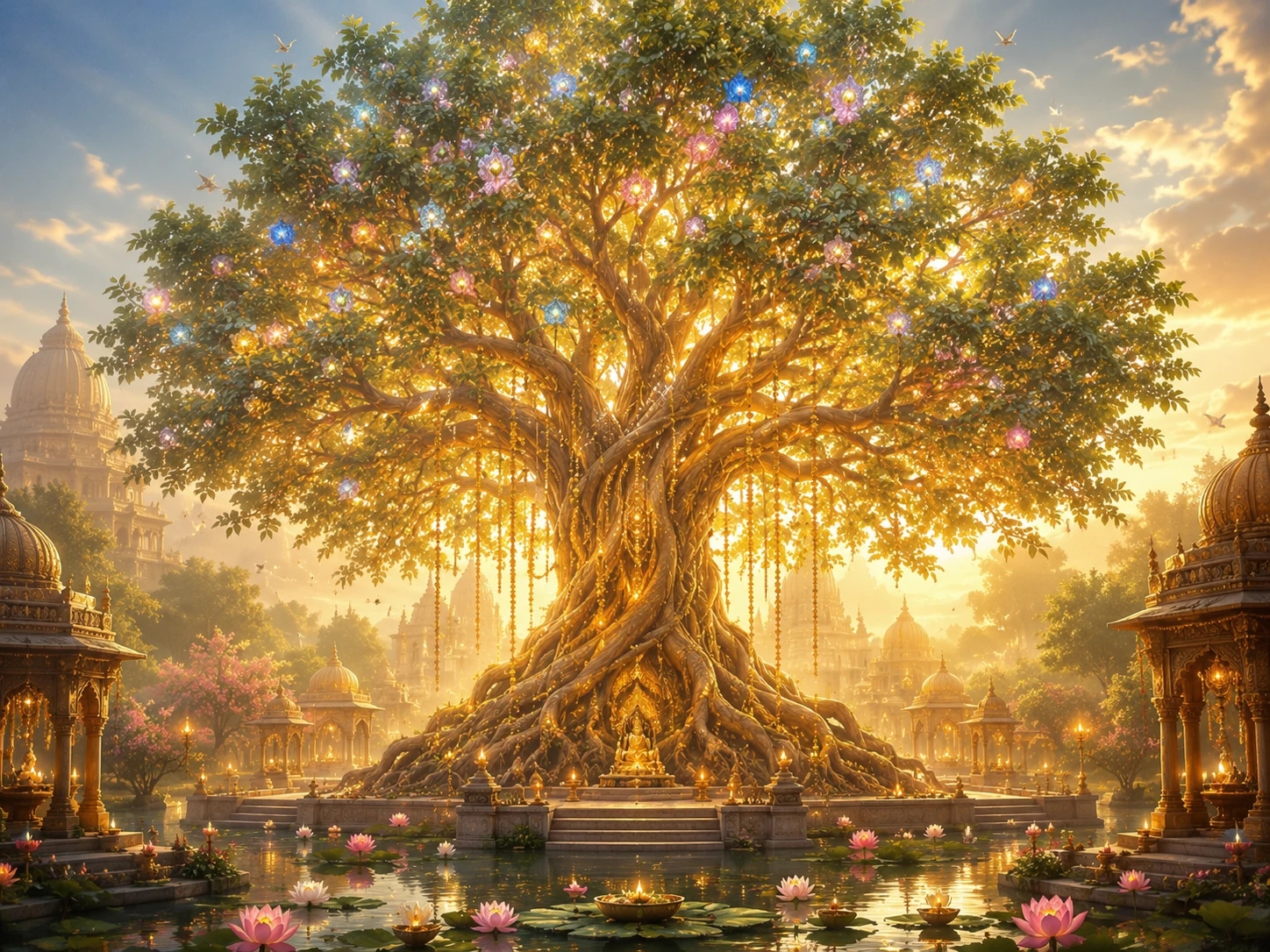
Celestial Trees -- Kalpavriksha and Parijata
दिव्य वृक्ष -- कल्पवृक्ष और पारिजात
India worships trees. This is not a quaint folkway or a tourism brochure cliche -- it is a deep, continuous, ecologically profound tradition that has preserved forests, watersheds, and biodiversity for millennia. The Peepal (Ficus religiosa) is sacred to Vishnu and Buddha alike, and cutting one down remains socially taboo across most of India. The Banyan (Vat Vriksha) is the national tree, venerated by women during Vat Savitri. Neem, Ashoka, Tulsi, Bilva -- each has a deity, a festival, and a community that protects it.
At the mythological apex of this tree-reverence stand two celestial specimens: the Kalpavriksha, a wish-fulfilling tree that grows in Indra's heaven, and the Parijata, a night-blooming jasmine whose fragrance is so intoxicating that it caused a war between Krishna and the king of the gods. These are not minor mythological props. They are central to some of the tradition's most revealing stories about desire, ecology, and the politics of divine entitlement.
कल्पद्रुमः सर्वसम्पत्प्रदायी स्वर्गे स्थितो देवगणैरुपास्यः। यं सेवते यो मनुजः स नित्यं सर्वार्थसिद्धिं लभतेऽचिरेण॥
kalpadrumah sarvasampatpradaayii svarge sthito devaganairupaasyah | yam sevate yo manujah sa nityam sarvaarthasiddhim labhate'chirena ||
The Kalpavriksha, granter of all prosperity, stands in heaven worshipped by the gods. The mortal who serves it constantly attains the fulfilment of all goals without delay.
— Brahmanda Purana
The Kalpavriksha -- also called Kalpataru or Kalpadruma -- is one of the chaturdasha ratnas that emerged during the Samudra Manthan, alongside the Kaustubha gem, the goddess Lakshmi, and the divine cow Kamadhenu. It was claimed by Indra and planted in his celestial garden, Nandanavana. The tree grants whatever is wished for beneath its branches -- material wealth, spiritual knowledge, physical beauty, even immortality.
But there is a crucial condition in the tradition that is often overlooked: the tree grants wishes without discrimination. It gives the wisher exactly what they ask for, including wishes born of ignorance, greed, or fear. If you sit beneath the Kalpavriksha and think 'a tiger will come and eat me,' a tiger will materialise. The tree is, in this sense, a perfect mirror of the mind -- it has no moral filter. It amplifies whatever is already inside the wisher.
This is precisely why it is in heaven and not on earth. The sages understood that a wish-fulfilling entity without a purified mind to wield it is a catastrophe. Indra's paradise is populated by beings who have earned their place through merit (punya). The Kalpavriksha is safe in their hands. In human hands -- where desire, fear, and envy coexist in every waking moment -- it would be an instrument of chaos.
If the Kalpavriksha is philosophy, the Parijata is comedy -- divine comedy of the highest order, involving a domestic quarrel, an offended wife, a cosmic theft, and a full-scale battle between Krishna and Indra.
The story begins simply enough. When Krishna visits Indra's heaven, Narada presents him with a Parijata flower. Krishna gives it to Rukmini, his first queen. Satyabhama, his second queen -- known for her fiery temperament and her conviction that she deserves at least equal treatment -- is furious. Why did Rukmini get the flower? Is she more loved? Is she more important?
Krishna, displaying the survival instincts of every married person in history, does not argue theology. He goes back to heaven and uproots the entire Parijata tree to plant in Satyabhama's garden. Indra, understandably, objects. A battle ensues. Krishna defeats Indra, loads the tree onto Garuda, and flies home.
The punchline is exquisite. The tree is planted in Satyabhama's compound, but because it is a celestial species, its flowers bloom at night and are carried by the wind to fall in Rukmini's garden next door. Satyabhama gets the tree; Rukmini gets the flowers. Krishna satisfies both wives while teaching a lesson about the difference between possession and enjoyment.
The Parijata is not just a mythological tree -- it is a real species. Nyctanthes arbor-tristis (the Night Jasmine or Harsingar) is native to South Asia and blooms exclusively at night, dropping its fragrant white-and-orange flowers before dawn. It is the state flower of West Bengal. In Ayurveda, its leaves are used to treat fever, arthritis, and sciatica. The Kintoor village in Barabanki district, Uttar Pradesh claims to have a Parijata tree believed to be the original one brought by Krishna -- the tree is over 40 feet tall and is a local pilgrimage site.
Celestial Trees and Sacred Trees of Hindu Tradition
| Tree | Associated Deity | Special Property | Earthly Parallel |
|---|---|---|---|
| Kalpavriksha | Indra (keeper) | Grants any wish beneath its branches | Peepal -- sacred wishing tree across rural India (tying threads, circumambulation) |
| Parijata | Krishna (brought from heaven) | Night-blooming, intoxicating fragrance, falls at dawn | Nyctanthes arbor-tristis (Harsingar) -- real tree, state flower of West Bengal |
| Santana Tree | Heavenly garden | Grants children to the childless | Ashoka tree -- associated with fertility rites and Vat Savitri puja |
| Mandara Tree | Heavenly garden | Provides divine coral-red flowers | Erythrina (Parijata in some regions) -- used in Ayurvedic medicine |
| Harichandana | Heavenly garden | Celestial sandalwood, cooling divine fragrance | Sandalwood (Chandan) -- Mysuru/Marayoor forests, used in temple rituals across India |
Each celestial tree has an earthly counterpart that is worshipped and protected. Hindu ecology encodes conservation in mythology.
The ecological dimension of celestial tree mythology deserves serious attention. India's sacred grove tradition -- known as Devara Kadus in Karnataka, Sarpakavu in Kerala, Orans in Rajasthan, and Sacred Groves in Meghalaya -- has preserved patches of climax forest that would otherwise have been cleared centuries ago. Researchers at the Indian Institute of Science, Bangalore have documented that sacred groves in the Western Ghats harbour significantly higher biodiversity than adjacent non-sacred forest plots.
This is mythology doing environmental work. When a village in Coorg refuses to cut trees in a Devara Kadu because 'the deity lives there,' they are practising conservation -- however they might frame it. When a family in Varanasi maintains a Tulsi plant on their balcony and waters it every morning as an act of devotion, they are engaging in urban greening. When the Bishnoi community in Rajasthan protects khejri trees at the cost of their lives -- as they did in the Khejarli massacre of 1730, where 363 Bishnois died protecting trees -- they are enacting a mythological mandate with real ecological consequences.
The Kalpavriksha and the Parijata are the celestial archetypes of this earthly practice. They encode a message that India's environmental movement is only now recovering: trees are not resources to be extracted. They are persons to be respected.
In 2019, Uttarakhand High Court granted legal 'personhood' to the Ganga and Yamuna rivers, and subsequent rulings have explored similar protections for forests. India's National Forest Policy traces its philosophical roots to the concept of 'Aranyani' -- the goddess of the forest mentioned in the Rigveda (10.146). The modern environmental law concept of 'rights of nature' is, in India, not imported Western jurisprudence -- it is a recovery of indigenous Hindu ecological philosophy. The Kalpavriksha's lesson is now being written into law: nature has rights because nature has personhood.
Meditate Under a Tree -- Nature Meditation
The Kalpavriksha grants wishes to those who sit beneath it with a pure mind. Sit under any tree for fifteen minutes and simply listen -- the leaves, the birds, the traffic beyond. The 'Hearing What Is Already Here' dharana on Eternal Raga is this practice.
Tags
Eternal Raga · शाश्वत राग
Institutional voice — scholarly articles on Sanatan Dharma
Deepen Your Understanding
अपनी समझ और गहरी करें
sacred artefacts
Divine Gems -- Syamantaka, Kaustubha, and Chintamani
Hindu mythology's most precious stones are not mere ornaments -- they are plot devices, moral tests, and cosmic forces. The Syamantaka Mani turned Krishna into a detective. The Kaustubha emerged from the Ocean of Milk to sit forever on Vishnu's chest. The Chintamani fulfils every wish -- and teaches why that might be the worst thing that could happen to you.
divine arsenal
The Cosmic Forge -- Vishwakarma, Divine Engineer
Every divine weapon. Every celestial city. Every flying chariot. They all have the same maker. Vishwakarma -- the architect of the gods -- built Lanka for Kubera, Dwarka for Krishna, Indraprastha for the Pandavas, and forged every weapon in the divine arsenal. He is the patron deity of Indian engineers, craftsmen, and factory workers, worshipped annually on Vishwakarma Puja with the tools of modern industry laid at his feet.
sacred artefacts
Divine Musical Instruments -- Veena, Damaru, Murali
Saraswati's Veena created knowledge. Shiva's Damaru created language. Krishna's Murali created longing. Three instruments, three cosmic functions -- and the foundation of one of the world's oldest musical traditions. From the 14 Maheshwara Sutras that birthed Sanskrit grammar to the raga system that maps human emotion, Hindu mythology placed music at the centre of creation itself.
divine arsenal
The Sacred Conch Shells -- Panchajanya, Devadatta and the War Horns of Kurukshetra
The Bhagavad Gita opens not with words but with sound -- the thunderous blowing of five sacred conch shells that signalled the beginning of the greatest war in mythology. Each conch had a name, a story, and a power. Know them all.
divine arsenal
The Celestial Chariots -- Pushpaka Vimana, Arjuna's Ratha, and the Flying Machines of Hindu Mythology
Ravana's Pushpaka Vimana could fly across oceans and read its owner's mind. Arjuna's chariot bore Hanuman on its flag and was driven by God himself. These were not fairy tale carriages -- they may be literary encodings of technologies that ancient India actually possessed.
vedic sciences
Kaal Ganana -- The Hindu Measure of Time
From a single blink of the eye (Nimesha) to one Day of Brahma (4.32 billion years) -- explore the complete cosmic time hierarchy of Hindu cosmology, anchored in Vishnu Purana 1.3, with its remarkable parallels to modern science.
The Parijata is not just a mythological tree -- it is a real species. Nyctanthes arbor-tristis (the Night Jasmine or Harsingar) is native to South Asia and blooms exclusively at night, dropping its fragrant white-and-ora…
More in Sacred Artefacts
Ashtadhatu -- The Sacred Eight-Metal Alloy of Indian Temples
12 min read
Banalinga -- The Stone God Made Himself in a River Over Millions of Years
13 min read
The Sacred Conch (Shankha) -- The Sound That Opens Temples and Closes Battles
13 min readThe same translation error that turned '33 Koti' into '33 crore' in Hinduism also happened in Buddhism. The Chinese translation of Buddhist texts rendered 'Sapta Koti Buddha' (7 Supreme Buddhas) as '7 Crore Buddhas.' The…
Deities AvatarsCommunity Reflections
🕉️
Be the first to share your reflection.