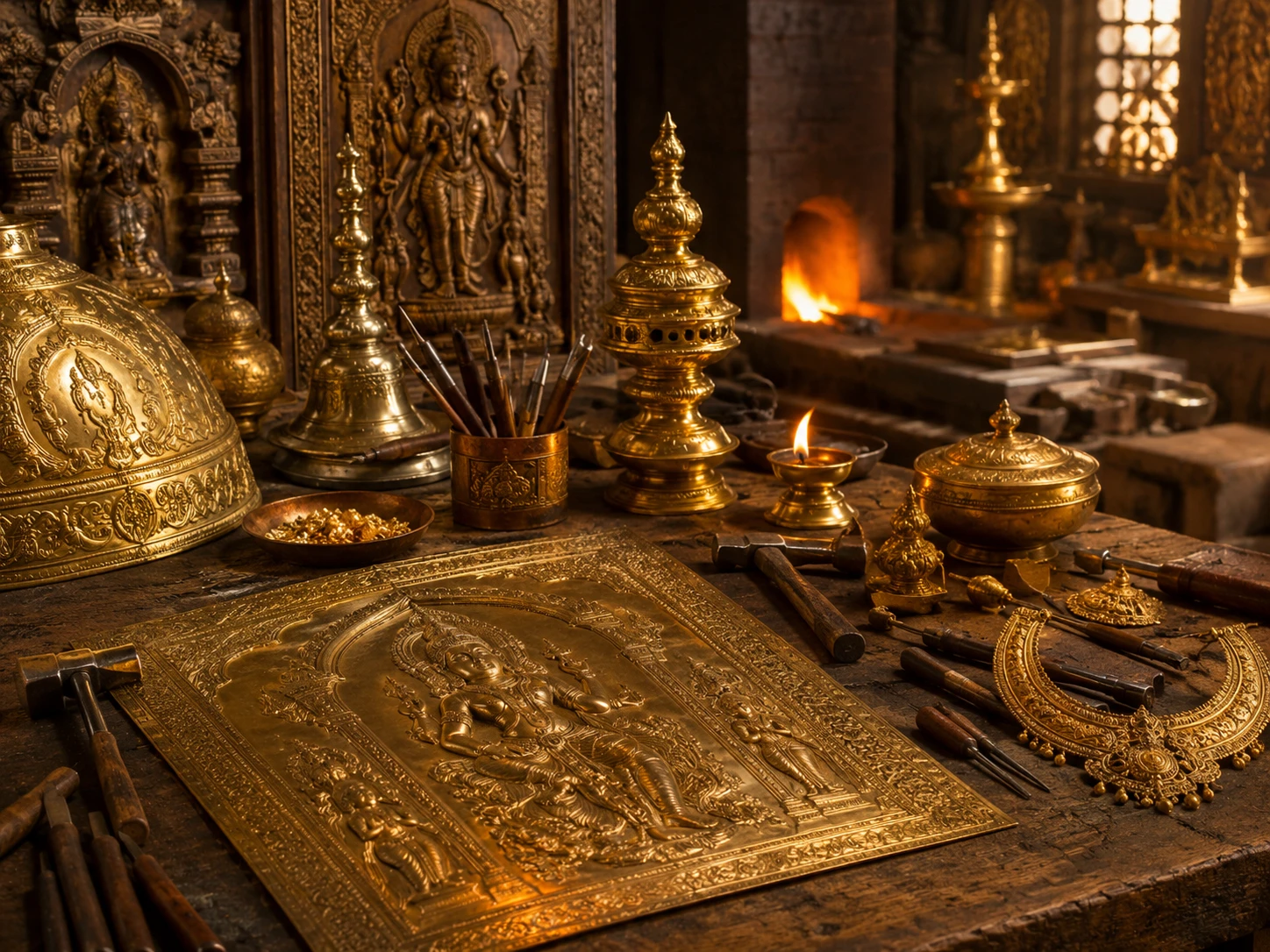
Ashtadhatu -- The Sacred Eight-Metal Alloy of Indian Temples
अष्टधातु -- भारतीय मन्दिरों का पवित्र अष्ट-धातु मिश्र
On 22 January 2024, two days before the consecration of the Ram Temple at Ayodhya, a 2,400-kilogram bell arrived by train at the temple complex. It was six feet tall, five feet wide, audible within a two-kilometre radius, and made of ashtadhatu -- eight metals melted into a single alloy. It came from the Mittal family's workshop in Jalesar town, Etah district of Uttar Pradesh. About thirty workers, both Hindu and Muslim, had spent over a month casting it. Vikas Mittal, who first received the order from the Nirmohi Akhara, did not live to see the bell installed -- he had passed away in 2022, and his brothers Aditya and Prashant carried the work to completion in his memory.
This is what ashtadhatu looks like in the present tense. Not a museum object. A working alloy, cast by craft families who have been doing this for generations, used in a brand-new temple bell that will ring through Ayodhya for the next several centuries. The Mittals are not unique. The Karkala family of Karnataka, the Mahapatra families of Odisha, the Vishwakarma craftsmen of Tamil Nadu, the Shakya and Tamrakar artisans of Patan in Kathmandu Valley -- across South Asia, this is a continuing tradition that has never gone away.
The word ashtadhatu means simply eight (ashta) metals (dhatu). The composition, ratios, and casting method are described in the Shilpa Shastras -- a body of Sanskrit technical literature on the visual and material arts compiled between roughly the 5th and 14th centuries CE. The Manasara, the Shilparatna, the Mayamata, and several Vastu and Vishvakarma texts all give detailed instructions. The metallurgy that follows from those instructions is harder to do well than it sounds. Eight metals with very different melting points, densities, and chemical affinities have to combine cleanly without phase separation. That is why the craft is concentrated in specific families and specific places. It cannot be improvised.
हिरण्यं च मे अयश्च मे श्यामं च मे लोहं च मे सीसं च मे त्रपुश्च मे यजञेन कल्पन्ताम्॥
hiraṇyaṃ ca me ayaś ca me śyāmaṃ ca me lohaṃ ca me sīsaṃ ca me trapuś ca me yajñena kalpantām ||
Gold for me, iron for me, dark iron (steel) for me, copper for me, lead for me, tin for me -- by the yajna may these be granted unto me.
— Krishna Yajurveda Taittiriya Samhita 4.7.5 (Chamaka Prashna)
The Chamaka Prashna of the Krishna Yajurveda is a well-known liturgy still chanted at every Shiva temple during Rudrabhisheka. It is a long string of ca me clauses -- gold for me, iron for me, dark iron for me, copper for me, lead for me, tin for me, and dozens of other things including grains, animals, weapons, and virtues. The verse above lists six metals by name, all six of which would later become part of the eight-metal canon. The Vedic awareness of distinct metals -- not as a single category but as named substances each with its own properties -- is the deep root from which both Rasaratnasamuccaya's metallurgy and the Shilpa Shastras' iconography eventually grew.
Which eight metals make up ashtadhatu varies slightly by source. The most common list, given by Manasara and repeated in many later texts, is: gold (suvarna), silver (rajata), copper (tamra), iron (lauha), lead (sisa), zinc (yashada), tin (vanga), and mercury (parada). Some texts substitute antimony (anjana) for mercury. A few regional traditions include bell-metal (kamsya, copper-tin alloy) as one of the eight, replacing pure tin. The full Shilpa Shastra canon describes several variants -- panchaloha (five metals), saptaloha (seven), ashtadhatu (eight), and navadhatu (nine, with the addition of a particular type of brass). Each is prescribed for different deities and different ritual purposes.
What distinguishes ashtadhatu specifically is its near-symbolic completeness. Eight is also the number of cardinal directions including the four cardinal and four intercardinal points. It is the number of Ashtadikpalas (the eight directional guardians), of Ashtalakshmi (the eight forms of prosperity), of Ashtanga Yoga (the eight limbs of yoga). When a craftsman makes an ashtadhatu image, the metallurgy and the symbolism are deliberately aligned. Mixing all eight metals invokes all eight directions and the totality of the ordered cosmos.
The Eight Metals -- Sanskrit, Modern, and Function
| Sanskrit | संस्कृत | Modern equivalent | Role in the alloy |
|---|---|---|---|
| Suvarna | सुवर्ण | Gold (Au) | Imparts brightness, prevents tarnish, traditionally considered most sattvic |
| Rajata | रजत | Silver (Ag) | Slight antimicrobial action; reflective polish; ritual purity |
| Tamra | ताम्र | Copper (Cu) | Base metal of the alloy; provides workability and warmth of colour |
| Lauha | लौह | Iron (Fe) | Hardness and structural strength; trace amounts only |
| Yashada | यशद | Zinc (Zn) | Lowers melting point; helps homogenisation of the melt |
| Vanga | वंग | Tin (Sn) | Hardens copper; gives bell-metal its acoustic resonance |
| Sisa | सीस | Lead (Pb) | Improves casting flow; allows fine detail in lost-wax process |
| Parada | पारद | Mercury (Hg) | Trace; symbolic completeness; sometimes substituted with antimony |
The traditional ratio is roughly equal proportions (12.5% each), but real metallurgical analyses of historical ashtadhatu objects show wide variation. Most surviving idols are about 80 to 90 percent copper, with smaller proportions of the other seven metals. Trace gold and silver content is consistently present even when not visible. The mix functions as a copper-base alloy with seven additions, much like medieval European bronze.
The casting method prescribed by the Shilpa Shastras is madhuchista vidhana -- literally, the wax-melting technique, known internationally as cire perdue or lost-wax casting. It is one of humanity's most ancient metalworking processes, found independently in Mesopotamia, Egypt, and India over four millennia. The Indian version is described in detail in the Manasara, the Shilparatna, and the Vishvakarma Shastra. The steps go like this. The artisan first models the deity in wax, with all its iconographic details -- the curl of hair, the position of fingers, the fold of cloth, the inset gem-like eyes. The wax model is coated with successive layers of fine clay and then thicker clay. The mould is fired -- the wax melts and flows out through carefully placed channels, leaving a hollow cavity that exactly preserves the wax model.
Then comes the metallurgy. The eight metals are heated in specific order in a single crucible -- traditionally clay-lined and built up over a wood fire. Mercury, with the lowest melting point, is added last and in trace quantity to avoid evaporation losses. The molten alloy is poured into the mould through the same channels by which the wax escaped. The mould is allowed to cool slowly. Then the clay is broken away. What remains is the cast image, which still requires extensive cold-finishing -- chasing, filing, polishing, and sometimes fire-gilding (mercury amalgam gold-plating, a Newar specialty).
What makes the process extraordinary is that the wax model is destroyed in the firing and the clay mould is destroyed in the demoulding. Each ashtadhatu image is a single original. There is no reproduction. This is why two ashtadhatu Krishnas from the same workshop in Mathura, six months apart, are not identical and are not meant to be. The deity is meant to be present in this image, this one, made for this temple, by these artisans, on this date.
The Gopinath Temple at Gopeshwar in Chamoli district of Uttarakhand has a 5-metre-tall ashtadhatu trident standing in its courtyard. The trident has multiple Sanskrit inscriptions in Devanagari, with the earliest dated by some scholars to the 6th century CE (attributed to the Naga king Ganapati Naga) and the most prominent dated to the 12th century, attributed to Ashokachalla, the Khasa king of Nepal. James Prinsep first deciphered some of these inscriptions in 1836 and sent a copy to the Asiatic Society in Kolkata. The trident has stood out in open Himalayan weather -- snow, monsoon, frost -- for at least eight centuries. Like the Mehrauli iron pillar, it has not significantly weathered. Real metallurgical study of its alloy composition has been limited because the temple authorities do not permit invasive testing.
The most living tradition of ashtadhatu casting today is in the Kathmandu Valley, particularly in the city of Patan (Lalitpur). The Newar people who inhabit the valley have specialised in lost-wax bronze and ashtadhatu casting since at least the 10th century. Three caste groups -- the Shakyas, the Tamrakars (literally copper-shapers), and the Vajracharyas -- have been the principal artisan families. Their work was historically exported in vast quantities to Tibet, where many of the finest Tibetan Buddhist bronzes are in fact Nepali in origin, and to north India for Hindu temple use. During the Malla period (1201 to 1779 CE), Patan was effectively the workshop of Buddhist and Hindu sculpture for the entire Himalayan region.
The Newar tradition is unusual in two respects. First, it preserved the technique of fire-gilding -- a process where mercury and gold are amalgamated, applied to the cast surface, and then heated to drive off the mercury, leaving a thin layer of gold bonded to the metal underneath. The mercury vapour is toxic, the technique is dangerous, and most other gilding traditions worldwide abandoned it in favour of safer electroplating in the 19th century. Newar artisans still do it. Walk into a workshop in Patan today and you will see masks, breathing equipment, and ventilation hoods over the gilding stations. The product is a gilt that lasts centuries -- the Indian government's National Mission for Manuscripts and the National Museum in Delhi have both confirmed Newar fire-gilding holds up better than 19th-century European electroplating on comparable objects.
Second, Newar casting tradition has retained close iconographic discipline. The proportions of a Buddha image, the mudras of a Bodhisattva, the specific arrangement of weapons in a Mahakala, are governed by the Shilpa Shastras and the Tantric iconographic manuals (sadhanamala). A finished Newar bronze can be dated by specialists to within a few decades just from stylistic features. This is craft-as-knowledge, transmitted orally and through apprenticeship across thirty or forty generations.
Notable Ashtadhatu and Related Objects in India
| Object | वस्तु | Location | Date / Period |
|---|---|---|---|
| Gopeshwar trident | गोपेश्वर त्रिशूल | Gopinath Temple, Chamoli, Uttarakhand | c. 6th century CE; major inscriptions 12th century |
| Sun-god image (Deulbadi) | सूर्य प्रतिमा (देउलबाड़ी) | Bangladesh; archaeological find | c. 9th-10th century CE |
| Kurkihar bronzes | कुर्किहार कांस्य | Bihar; Patna Museum | c. 9th-12th century CE (Pala period) |
| Tirumala Venkateshwara processional idols | तिरुमला वेंकटेश्वर उत्सव मूर्तियाँ | Tirupati, Andhra Pradesh | Various (panchaloha, multiple periods) |
| Chola bronzes (Nataraja, etc.) | चोल कांस्य (नटराज आदि) | Tamil Nadu; multiple temples and museums | c. 9th-13th century CE |
| Newar Buddhist bronzes | नेवार बौद्ध कांस्य | Patan, Nepal; exported across the Himalayas | c. 10th century onward |
| Ayodhya Ram Temple bell | अयोध्या राम मन्दिर घण्टा | Ayodhya, Uttar Pradesh | 2024 (Mittal workshop, Etah, UP) |
Tirupati's principal Moolavar idol is svayambhu (self-manifest stone), not metal. The Utsava Murti and processional images are panchaloha or related alloys. The Sun-god image from Deulbadi (now Bangladesh) is one of the earliest archaeologically attested ashtadhatu objects; its alloy composition was published by archaeologist Sutapa Sinha in the early 2000s and contains all eight metals in detectable quantities including trace gold and silver.
The metallurgy is more interesting than the symbolism, in the sense that the science is harder than the iconography. Eight metals with melting points ranging from -39 degrees Celsius (mercury) to 1538 degrees Celsius (iron) cannot simply be thrown into a single pot. The ratios have to be carefully tuned so that the alloy stays homogeneous when it solidifies. The order of addition matters. The fluxes (substances that scavenge oxide impurities and lower the effective melting point) matter. The crucible material matters. The fuel matters -- traditional wood-fired clay-lined crucibles produce a slightly reducing atmosphere that protects the molten metal from oxidation in ways that modern gas-fired furnaces do not.
Researchers at the Bhabha Atomic Research Centre and at IIT Madras have studied the microstructure of historical ashtadhatu objects using scanning electron microscopy. The results show that despite the wide variation in metal proportions, well-cast ashtadhatu objects show a remarkably uniform copper-tin matrix with the other metals distributed as fine secondary particles -- not as separated phases or layered laminations. This is a metallurgical achievement. Producing it requires consistent temperature control across the whole melt, careful sequencing of additions, and a fluxing system that ties up the impurities without contaminating the result. Modern materials scientists who try to reproduce ashtadhatu in laboratory conditions report that the variability between batches is high. The traditional craftsmen produced more consistent results because they knew what to look for. They could read the colour of the molten metal, the smell of the smoke, and the sound the alloy made when poured. None of this is in the Sanskrit texts. It lives only in the apprenticeship.
The Geographical Indication tag for Ashtadhatu Idols of Banaras was registered in 2014, recognising a specific Varanasi-area craft tradition. Bidri ware, a related Bidar (Karnataka) craft based on a zinc-copper alloy with silver inlay, received its GI tag in 2005. The Patan ashtadhatu craft of the Newars is protected by Nepali law and certified through the Department of Archaeology in Kathmandu. The recognition is partly economic protection, partly a hedge against counterfeiting from machine-cast Chinese imports, and partly a quiet acknowledgement that this knowledge needs to be kept somewhere safe before too many master craftsmen die without successors.
The Tirumala Tirupati Devasthanam (TTD) maintains its own dedicated metalcraft workshop within the temple complex. When a processional Utsava Murti needs replacement or repair, the work is done in-house by hereditary stapathis (sculptor-priests) who follow the Shilpa Shastra precisely. The casting is done with traditional wood-fired furnaces, the alloys are mixed by recipes that have been verbally transmitted within these families for centuries, and the finished images are consecrated in a ritual that itself takes several days. TTD's stapathi tradition is one of the few that continues to operate inside an active temple complex rather than as a separate craft business.
Read on Ancient Indian Metallurgy
From the Iron Pillar to wootz steel to ashtadhatu -- the lineage of Indian metalwork from the Vedic period to today.
Tags
Eternal Raga · शाश्वत राग
Institutional voice — scholarly articles on Sanatan Dharma
Deepen Your Understanding
अपनी समझ और गहरी करें
vedic sciences
Ancient Indian Metallurgy -- The Iron Pillar That Refuses to Rust
A 7-metre iron pillar has stood in open Delhi air for 1,600 years without rusting. Wootz steel from Tamil Nadu became the legendary Damascus blade. From Vedic kṛṣṇāyas to Vagbhata's bell-metal recipe -- the textual and material evidence of how Bharat worked metal.
sacred artefacts
Divine Musical Instruments -- Veena, Damaru, Murali
Saraswati's Veena created knowledge. Shiva's Damaru created language. Krishna's Murali created longing. Three instruments, three cosmic functions -- and the foundation of one of the world's oldest musical traditions. From the 14 Maheshwara Sutras that birthed Sanskrit grammar to the raga system that maps human emotion, Hindu mythology placed music at the centre of creation itself.
sacred artefacts
Temple Bells -- Sound as Purification
You never enter a Hindu temple in silence. Your first act at the threshold is to reach up and strike the bell. There is a verse for why. There is an alloy-ratio for the metal. There is an agamic rule for when to ring it, and who may. The temple bell is not decoration. It is the audible signal that ordinary space has just become sacred.
sacred artefacts
Navaratna -- Nine Gems That Map the Cosmos to Your Finger
Nine planets. Nine gems. Nine frequencies of cosmic light captured in crystalline matter and worn on the human body. The Navaratna system is not superstition -- it is the oldest surviving framework of planetary gemology, codified in the Garuda Purana, the Brihat Samhita, and still followed by jewellers from Jaipur to Jakarta.
sacred artefacts
Divine Gems -- Syamantaka, Kaustubha, and Chintamani
Hindu mythology's most precious stones are not mere ornaments -- they are plot devices, moral tests, and cosmic forces. The Syamantaka Mani turned Krishna into a detective. The Kaustubha emerged from the Ocean of Milk to sit forever on Vishnu's chest. The Chintamani fulfils every wish -- and teaches why that might be the worst thing that could happen to you.
vedic sciences
Shulba Sutras -- Geometry of Sacred Altars
Centuries before Pythagoras was born, a Vedic priest named Baudhayana wrote a rule about rectangles, diagonals, and areas that would later bear a Greek mathematician's name. The Shulba Sutras are where Indian mathematics began -- not in a classroom, but at a fire altar, with a rope and a stake, solving geometry because the gods demanded precision.
The Gopinath Temple at Gopeshwar in Chamoli district of Uttarakhand has a 5-metre-tall ashtadhatu trident standing in its courtyard. The trident has multiple Sanskrit inscriptions in Devanagari, with the earliest dated b…
More in Sacred Artefacts
Banalinga -- The Stone God Made Himself in a River Over Millions of Years
13 min read
Celestial Trees -- Kalpavriksha and Parijata
12 min read
The Sacred Conch (Shankha) -- The Sound That Opens Temples and Closes Battles
13 min readThe same translation error that turned '33 Koti' into '33 crore' in Hinduism also happened in Buddhism. The Chinese translation of Buddhist texts rendered 'Sapta Koti Buddha' (7 Supreme Buddhas) as '7 Crore Buddhas.' The…
Deities AvatarsCommunity Reflections
🕉️
Be the first to share your reflection.